
Ethereum (ETH) is once again attracting significant attention across the cryptocurrency market as institutional demand strengthens, spot Ethereum ETFs record consecutive inflows, and the network moves closer to its next major protocol upgrade.

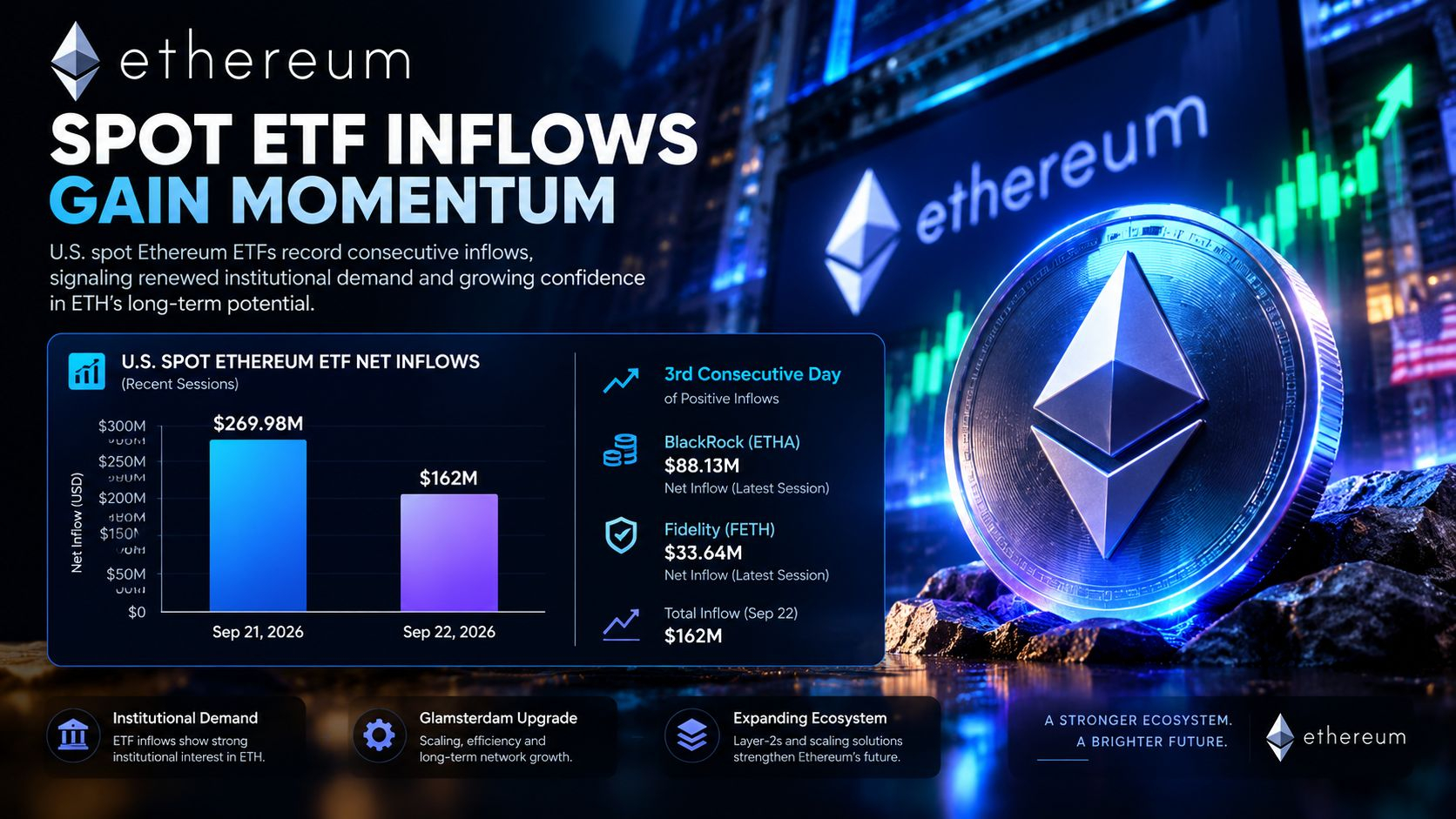
The latest developments put Ethereum at an important point in its 2026 roadmap. On September 22, U.S. spot Ethereum ETFs recorded approximately $162 million in net inflows, marking the third consecutive day of positive inflows. BlackRock’s ETHA led the latest session with approximately $88.13 million in net inflows, followed by Fidelity’s FETH with about $33.64 million.
This renewed ETF demand is particularly notable because institutional flows have become an increasingly important factor in the digital-asset market. Earlier in the week, Ethereum spot ETFs also recorded a much larger single-day inflow of approximately $269.98 million, according to data reported from SoSoValue.
ETH Price Recovers as Market Momentum Improves
Ethereum has also experienced a significant recovery during September.
Recent market data placed ETH around the $2,700–$2,800 range, while reports showed ETH reaching levels not seen since earlier in the year. On September 21, ETH closed around $2,776 after reaching an intraday high near $2,805.
Reuters reported that Ether had broken above a key technical resistance area around $2,661.52, following a strong rally in late August. The report also highlighted that ETH had moved above its 10-day moving average and a longer-term trendline.
However, technical levels should not be interpreted as guarantees of future price movements. Ethereum remains sensitive to broader market conditions, liquidity, investor sentiment and changes in cryptocurrency flows.
Institutional Accumulation Adds Another Important Dimension
ETF activity is not the only sign of institutional interest in Ethereum.
Ethereum treasury company BitMine recently increased its ETH holdings to approximately 5.98 million ETH, according to The Block. The company’s holdings represented more than 4.9% of Ethereum’s circulating supply at the time of the report. BitMine also purchased another 27,562 ETH during the previous week.
Large-scale accumulation does not automatically determine the future price of ETH, but it demonstrates that Ethereum is increasingly being treated by some institutions as a strategic digital asset rather than simply a trading instrument.
Glamsterdam: Ethereum’s Next Major Upgrade
One of the most important long-term developments for Ethereum is the upcoming Glamsterdam upgrade.
According to Ethereum’s official roadmap, Glamsterdam is currently being tested on devnets and is targeted for Q4 2026, although a final mainnet date has not yet been confirmed. The next major milestone is a Sepolia fork scheduled for October 6, 2026.
The upgrade is designed to improve Ethereum’s ability to scale while maintaining decentralization and network sustainability.
One of the headline changes is Enshrined Proposer-Builder Separation (ePBS). This is intended to bring the separation between block proposers and block builders directly into the Ethereum protocol, reducing reliance on external relay infrastructure and helping the network handle larger amounts of data more efficiently.
Another major component is Block-Level Access Lists, which are designed to make transaction dependencies easier to identify and support greater parallel processing. This could help Ethereum process more activity efficiently as the network continues to scale.
Potential Improvements to Transaction Costs
Glamsterdam also includes proposals aimed at improving Ethereum’s transaction economics.
One proposal, EIP-2780, would reduce the intrinsic gas cost associated with basic ETH transfers between existing accounts. Ethereum’s official documentation estimates that a standard transfer could become substantially cheaper under the proposal, although the exact effect will depend on the final implementation and network conditions.
For Ethereum users, lower costs could make simple transactions more efficient. For developers, improvements in scalability and data handling could support a broader range of applications and higher network activity.
Ethereum’s Scaling Strategy Continues to Evolve
Glamsterdam is not an isolated development. It is part of Ethereum’s broader roadmap following major upgrades including The Merge, Shapella, Dencun, Pectra and Fusaka.
Ethereum’s official roadmap currently lists Glamsterdam for Q4 2026 and Hegotá for 2027. The broader objective is to improve scalability, security and sustainability while allowing Ethereum and its Layer-2 ecosystem to handle significantly more activity.
The Ethereum Foundation has also identified longer-term research areas including faster finality, privacy, state growth, zkEVM development and post-quantum security. These developments show that Ethereum’s evolution is continuing well beyond the next upgrade.
What the Latest Data Means for ETH
The current Ethereum story is therefore being driven by several factors at the same time:
1. ETF demand is returning.
Spot Ethereum ETFs have recorded consecutive days of net inflows, with September 22 producing approximately $162 million in net inflows.
2. Institutional exposure is expanding.
Large treasury-focused entities such as BitMine continue accumulating ETH, highlighting growing institutional involvement in the Ethereum ecosystem.
3. Ethereum’s protocol is still evolving.
Glamsterdam is being tested ahead of a planned Q4 2026 mainnet release, with scaling, efficiency and protocol-level improvements among its major objectives.
4. ETH market momentum has improved.
ETH has recovered into the $2,700–$2,800 area during the latest market move, although volatility remains significant.
The Road Ahead
Ethereum enters the final part of September with a combination of stronger institutional activity, renewed ETF demand and major technological developments on the horizon.
The upcoming Glamsterdam upgrade could become an important milestone in Ethereum’s long-term scaling strategy, while continued ETF flows and institutional accumulation are providing additional market data to watch.
At the same time, investors should recognize that positive ETF flows, institutional purchases and network upgrades do not guarantee a specific future price. Cryptocurrency markets remain highly volatile, and Ethereum’s price can be affected by macroeconomic conditions, liquidity, regulation, market sentiment and changes in capital flows.
For now, the key Ethereum developments to monitor are spot ETF flows, institutional ETH accumulation, the October 6 Sepolia milestone, and the progress of Glamsterdam toward its planned Q4 2026 mainnet launch.
ETH remains one of the most closely watched assets in the digital-asset market, with both its financial demand and underlying network development entering an important period.