


With Bitcoin ETF funds flowing back, what else needs to be confirmed for the next leg higher?
As of 12:05 Beijing time on September 23, 2026, one of the most worth-watching developments for Bitcoin is the return of U.S. spot ETF capital.
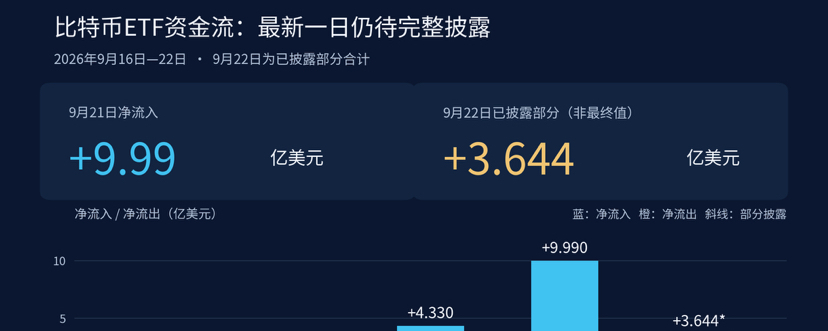
According to the public table released by Farside, on September 21 (a U.S. trading day), net inflows were $999 million. On September 17, 18, and 21—three consecutive trading days—net inflows totaled about $1.592 billion. Meanwhile, on September 15 and 16 there were still net outflows. This shift indicates that demand for funds through the ETF channel is improving.
Overseas institutions are also re-evaluating this round of market action. In its public analysis on September 22, K33 believes that with external capital returning and leverage not yet showing signs of overheating, the current rebound has a relatively positive underlying structure. However, it also emphasizes that sustained inflows are more important than single-day, large inflows.
In its September 21 report, Bitfinex acknowledged an improvement in spot buying demand, while also reminding investors to watch for selling pressure after investors recoup their costs. On the same day, QCP noted that as the options quarter near September 25 expiry approaches, volatility risk still needs to be kept in mind. Together, these views point to a key question: can new buy orders continue to absorb sell orders?
My view is that, for now, we can place greater emphasis on the demand recovery, but the evidence is still not sufficient to declare that a one-way uptrend has already begun. ETF inflows only cover one funding channel and cannot prove that all buyers are making longer-term bullish allocations. We should also consider new capital together with price changes, to avoid cherry-picking only the data that supports our own position.
Next, we should focus on three things: first, whether net inflows can continue over the next few U.S. trading days; second, whether there is sustained spot-buying support when prices pull back; and third, when contract open interest increases, whether the funding rate rises noticeably. If net outflows return to being consecutive later on, spot buying should weaken accordingly, and the currently optimistic assessment would need to be scaled down.
Also pay attention to the completeness of the latest data: as of the search time mentioned above, as of September 22, a total of $364.4 million in net fund inflows had already been disclosed, but IBIT still has not filed its figures. This number cannot be treated as the final total, nor can it be directly used to compare the relative strength with the full set of data from September 21. Missing values are not zero, and subsequent data may be revised.
This article is an interpretation of publicly available information and does not constitute investment advice.