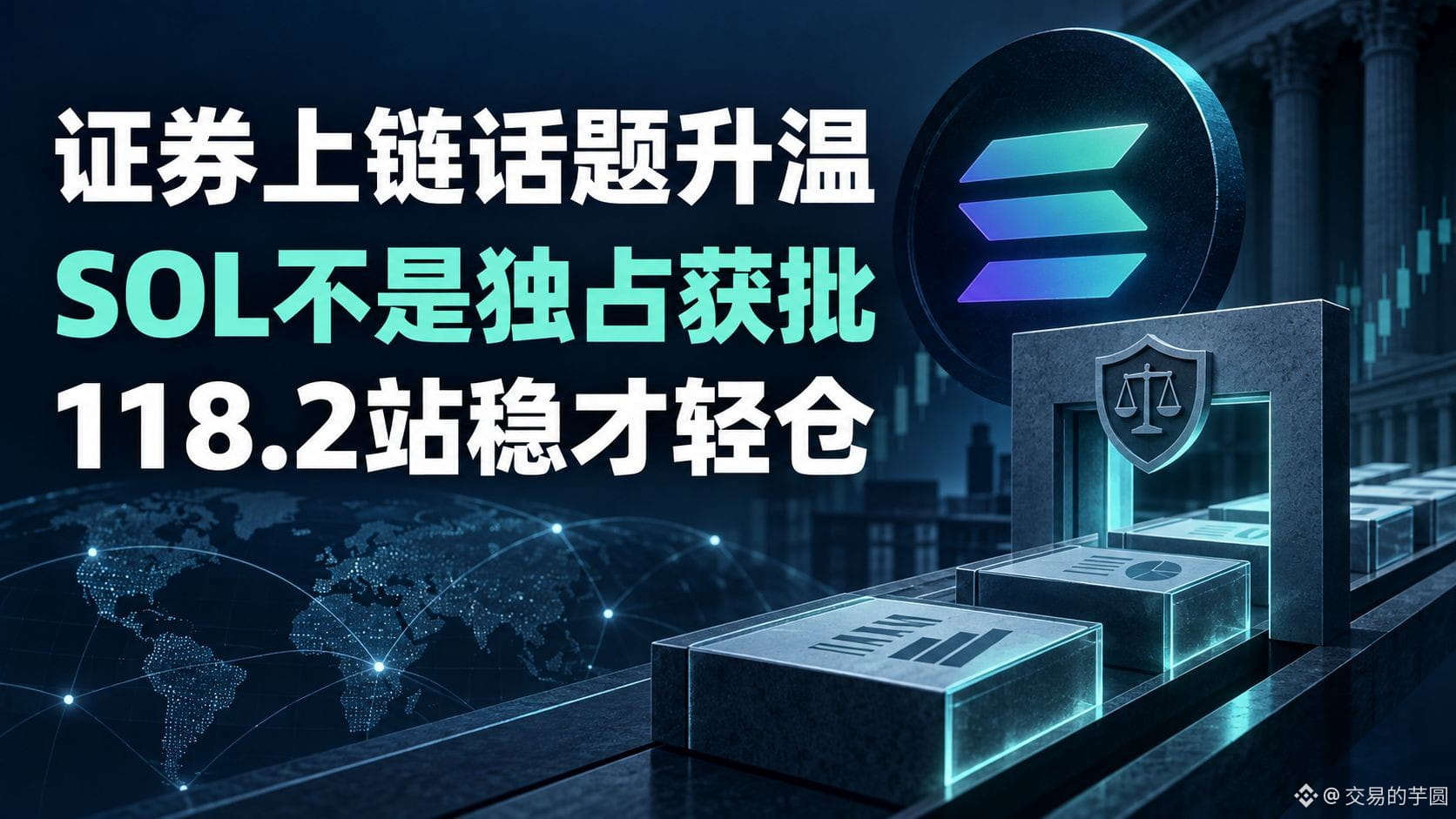
Tokenized stocks topic heats up|Solana has existing business but isn’t the only chain granted approval|SOL near 117—I’ll wait first
My view is that you shouldn’t treat regulatory progress directly as a buy signal for SOL. The relevant hot topic is #TokenizedStockPlatformsCouldLaunchNextQuarter on Binance Square. On September 17, the U.S. SEC announced a temporary, conditional exemption for trading venues for tokenized U.S.-listed stocks that meet eligibility requirements: within the scope of licensed participants, venues may execute trades via automated market-maker pools, subject to conditions such as the underlying asset, trading volume, holder rights, trading halt synchronization, and public auditability. This is a pilot of the securities trading mechanism—not an approval of a particular blockchain as the only channel, and not a guarantee that “all platforms are confirmed to launch next quarter.” Separating the already-issued exemptions from market speculation about launch timing is where the value lies.
The link between Solana and this news is that there are real assets and trading activity already, rather than inventing official partnerships out of thin air. In its September ecosystem recap, the Solana Foundation stated that, as of August, the on-chain real-world asset value on its chain exceeds $4 billion; the xStocks asset management scale has surpassed $500 million; and Raydium’s tokenized stock cumulative trading volume has exceeded $4 billion. Binance Research’s report on stock tokenization also emphasizes that on-chain liquidity, price discovery during traditional market closures, and underlying holder rights should not be conflated. These on-chain metrics can be used to assess whether a product has real users, but they can’t be equated with capital flowing into SOL tokens; growth in tokenized stock trading also doesn’t automatically translate into validator revenue, token burn, or SOL price growth in proportion. Going forward, you need to look at which compliant venues actually choose which chain, whether the assets are redeemable, the depth of spreads, and security incidents—not only the words “on-chain.”
As for price action, there is currently no synchronized strength. At the time of observation, KuCoin’s SOLUSDT perpetual is around $116.9, with a 24-hour range of roughly 115.49–120.01; on OKX, the UTC 15:30 contract in the same direction closed at 117.54, and at 16:00 it fell back to close at 116.78. In other words, while discussion of the big narrative is heating up, SOL in the short term is still bouncing around near 117; you can’t write the chart as one-way upside driven solely by regulatory news. Above, 117.5–118.2 is the zone to reclaim first, then 119.3–120; below, 116.5 and 115.5 are the observation levels. If 15-minute candles keep closing continuously below 115.5, the short-term view that the lower end of the range will hold will be invalid. Different exchanges, contracts, and spot markets can diverge—actual trading depends on your own order book.
If I were trading this myself, I wouldn’t participate. I’d only consider small-capital spot long positions after the conditions are met, and I wouldn’t touch high leverage. Only if two consecutive full 15-minute candles close above 118.2, and then a pullback to 117.6 holds without breaking, would I place a test trade using 1% of total funds. First target: 119.2–119.5 (reduce half first); second target: 119.9–120.2 (close the remaining position in batches). If after entering, the 15-minute close falls back below 116.5, I’d cut the loss and exit fully. If it hasn’t even entered and breaks below 115.5 first, I’d cancel the plan—I won’t try to guess the bottom. Being able to independently judge whether the narrative matches the price matters more than interpreting every policy as a positive catalyst.
Source: SEC official exemption announcement on September 17, Solana Foundation ecosystem recap, Binance Research, Binance Square real-time trends, KuCoin and OKX public market data.#TokenizedStockPlatformsCouldLaunchNextQuarter #SOL
The above is only my personal market observation and does not constitute investment advice.
My view is that you shouldn’t treat regulatory progress directly as a buy signal for SOL. The relevant hot topic is #TokenizedStockPlatformsCouldLaunchNextQuarter on Binance Square. On September 17, the U.S. SEC announced a temporary, conditional exemption for trading venues for tokenized U.S.-listed stocks that meet eligibility requirements: within the scope of licensed participants, venues may execute trades via automated market-maker pools, subject to conditions such as the underlying asset, trading volume, holder rights, trading halt synchronization, and public auditability. This is a pilot of the securities trading mechanism—not an approval of a particular blockchain as the only channel, and not a guarantee that “all platforms are confirmed to launch next quarter.” Separating the already-issued exemptions from market speculation about launch timing is where the value lies.
The link between Solana and this news is that there are real assets and trading activity already, rather than inventing official partnerships out of thin air. In its September ecosystem recap, the Solana Foundation stated that, as of August, the on-chain real-world asset value on its chain exceeds $4 billion; the xStocks asset management scale has surpassed $500 million; and Raydium’s tokenized stock cumulative trading volume has exceeded $4 billion. Binance Research’s report on stock tokenization also emphasizes that on-chain liquidity, price discovery during traditional market closures, and underlying holder rights should not be conflated. These on-chain metrics can be used to assess whether a product has real users, but they can’t be equated with capital flowing into SOL tokens; growth in tokenized stock trading also doesn’t automatically translate into validator revenue, token burn, or SOL price growth in proportion. Going forward, you need to look at which compliant venues actually choose which chain, whether the assets are redeemable, the depth of spreads, and security incidents—not only the words “on-chain.”
As for price action, there is currently no synchronized strength. At the time of observation, KuCoin’s SOLUSDT perpetual is around $116.9, with a 24-hour range of roughly 115.49–120.01; on OKX, the UTC 15:30 contract in the same direction closed at 117.54, and at 16:00 it fell back to close at 116.78. In other words, while discussion of the big narrative is heating up, SOL in the short term is still bouncing around near 117; you can’t write the chart as one-way upside driven solely by regulatory news. Above, 117.5–118.2 is the zone to reclaim first, then 119.3–120; below, 116.5 and 115.5 are the observation levels. If 15-minute candles keep closing continuously below 115.5, the short-term view that the lower end of the range will hold will be invalid. Different exchanges, contracts, and spot markets can diverge—actual trading depends on your own order book.
If I were trading this myself, I wouldn’t participate. I’d only consider small-capital spot long positions after the conditions are met, and I wouldn’t touch high leverage. Only if two consecutive full 15-minute candles close above 118.2, and then a pullback to 117.6 holds without breaking, would I place a test trade using 1% of total funds. First target: 119.2–119.5 (reduce half first); second target: 119.9–120.2 (close the remaining position in batches). If after entering, the 15-minute close falls back below 116.5, I’d cut the loss and exit fully. If it hasn’t even entered and breaks below 115.5 first, I’d cancel the plan—I won’t try to guess the bottom. Being able to independently judge whether the narrative matches the price matters more than interpreting every policy as a positive catalyst.
Source: SEC official exemption announcement on September 17, Solana Foundation ecosystem recap, Binance Research, Binance Square real-time trends, KuCoin and OKX public market data.#TokenizedStockPlatformsCouldLaunchNextQuarter #SOL
The above is only my personal market observation and does not constitute investment advice.