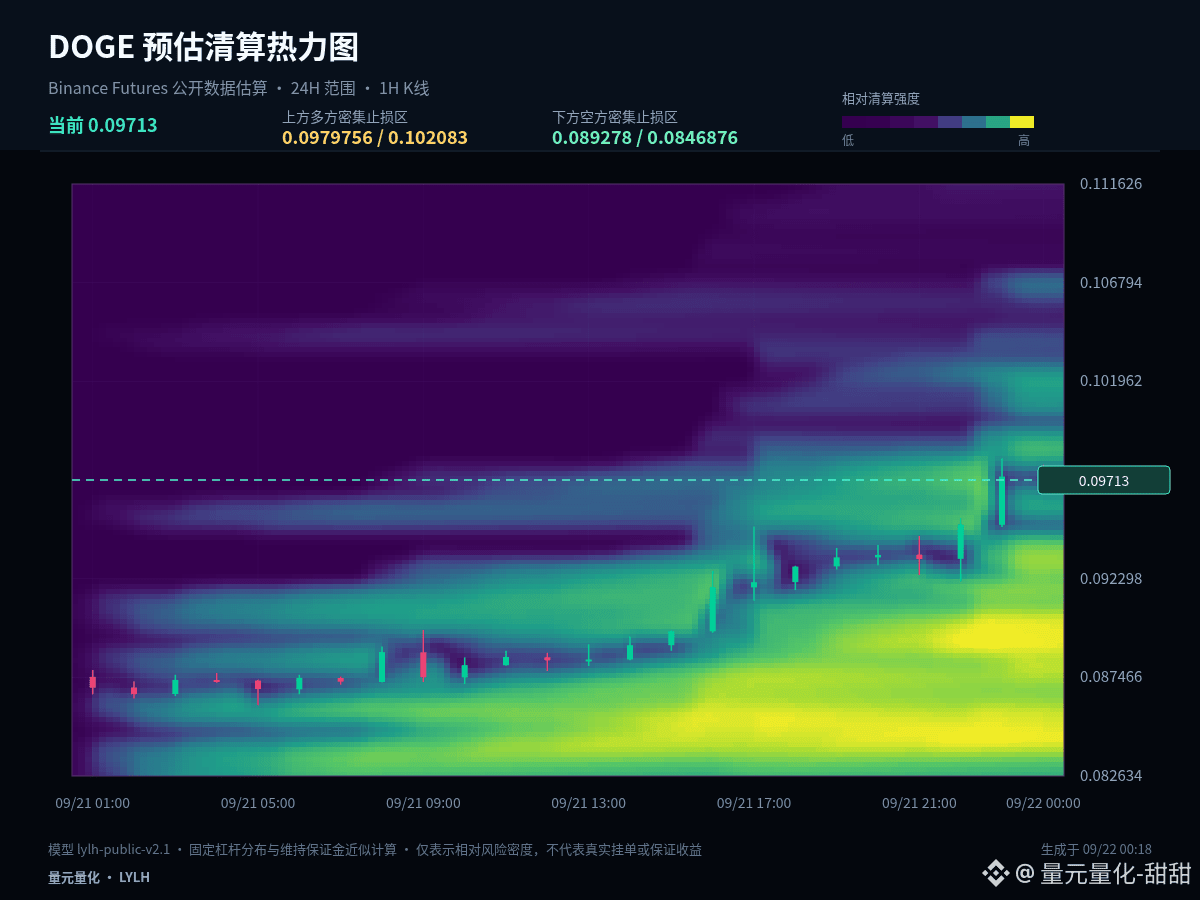
$DOGE #DOGE In a strong market, pullbacks often reveal real buying support better than a rapid surge. The current 1-hour change is -0.16%, and the 24-hour change is +12.2%. The key is to judge whether this is a normal cooldown or a sign of structural weakness.
The current price is near the upper end of the past 24 hours’ range, with 1-hour -0.16% and 24-hour +12.2%. At elevated levels, the most important thing is to confirm acceptance after a breakout: if price can stay above the upper range, it shows the market is recognizing a higher zone; if it only briefly pierces through and quickly falls back, beware of a false breakout.
A pullback has already appeared on the 1-hour chart, so first watch whether 0.08615 can form stable support. If price can quickly reclaim 0.092165, it suggests the pullback is still manageable; if the rebound is weak and the lows keep moving down, then the strong-trend logic can no longer be used.
In execution, set clear conditions: after breaking above 0.09818, confirmation is needed rather than chasing an instant spike; after dipping below 0.08615, watch whether it can quickly recover instead of blindly buying the dip; in the middle range, when there is not enough risk-reward, waiting is also part of the strategy.
Position sizing should distinguish between spot and futures. Existing spot holdings can be managed in stages around key levels, without frequently changing direction based on a single 1-hour candle; if you are flat, waiting for confirmation before scaling in is more composed. Futures place greater emphasis on entry location and invalidation conditions; when volatility expands, actively reduce position size to avoid turning a short-term judgment into a passive hold.
The focus in futures is not predicting every candle, but ensuring that entry, reduction, and exit all have a basis. Do less when there is no confirmation, rebuild the plan when key levels fail, and control single-trade risk first before discussing further upside.
#CanaryFilesSecondAmendmentForStakedSEIETF
The current price is near the upper end of the past 24 hours’ range, with 1-hour -0.16% and 24-hour +12.2%. At elevated levels, the most important thing is to confirm acceptance after a breakout: if price can stay above the upper range, it shows the market is recognizing a higher zone; if it only briefly pierces through and quickly falls back, beware of a false breakout.
A pullback has already appeared on the 1-hour chart, so first watch whether 0.08615 can form stable support. If price can quickly reclaim 0.092165, it suggests the pullback is still manageable; if the rebound is weak and the lows keep moving down, then the strong-trend logic can no longer be used.
In execution, set clear conditions: after breaking above 0.09818, confirmation is needed rather than chasing an instant spike; after dipping below 0.08615, watch whether it can quickly recover instead of blindly buying the dip; in the middle range, when there is not enough risk-reward, waiting is also part of the strategy.
Position sizing should distinguish between spot and futures. Existing spot holdings can be managed in stages around key levels, without frequently changing direction based on a single 1-hour candle; if you are flat, waiting for confirmation before scaling in is more composed. Futures place greater emphasis on entry location and invalidation conditions; when volatility expands, actively reduce position size to avoid turning a short-term judgment into a passive hold.
The focus in futures is not predicting every candle, but ensuring that entry, reduction, and exit all have a basis. Do less when there is no confirmation, rebuild the plan when key levels fail, and control single-trade risk first before discussing further upside.
#CanaryFilesSecondAmendmentForStakedSEIETF