
A friend who built an agent marketplace in another space once said: every marketplace dies for the same reason—no one knows which agents are good until after they’ve lost money for choosing wrong.
Newton Protocol is building exactly that kind of marketplace—where developers publish agent models, users choose to use them, and operators run them to earn fees.
Not from the number of agent models in the registry. Not from how quickly an agent processes automation intents. Not from strategy diversity—recurring buys, yield aggregation, copy trading.
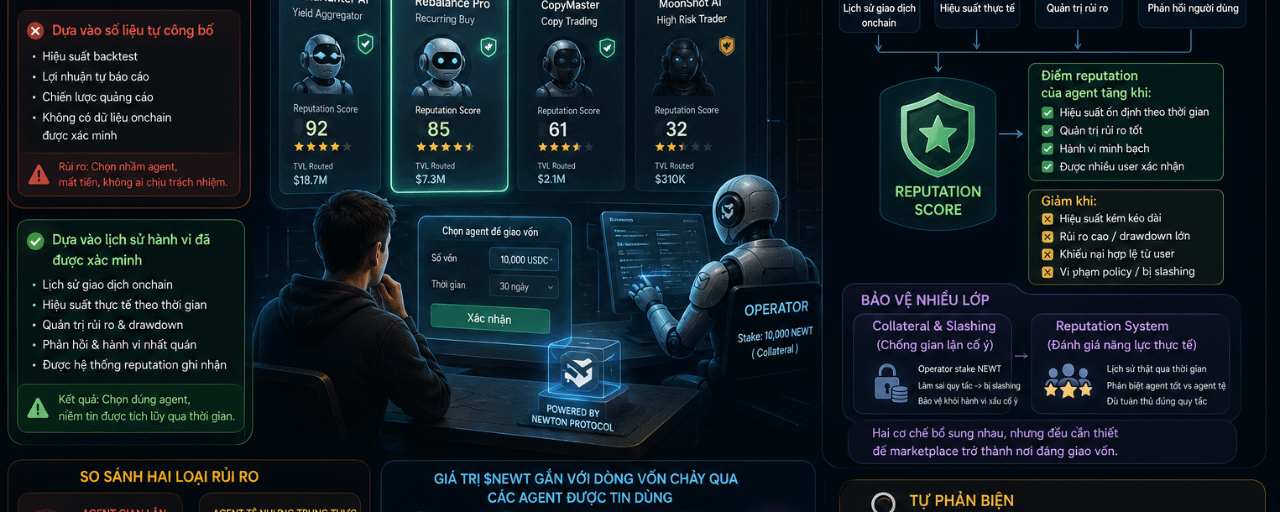
A simpler question—when a user selects an agent to allocate capital, what do they rely on to know that agent is trustworthy: a self-reported performance number, or behavioral history verified across many real transactions?
That is the @NewtonProtocol that needs to be answered better than both the marketplace itself and its compliance part, because marketplace agents carry risks that are completely different—not blocked transactions due to something being wrong, but allocating capital to an agent that doesn’t have enough data to be evaluated.
Opening a registry for everyone to post agents is easy—that’s just a permissions issue.
Building a reputation system reliable enough to tell good agents from bad ones before users lose money is hard, because reputation needs to accumulate over time and across real transactions—it can’t be quickly faked by advertising backtest performance.
The operator mechanism—staking NEWT as collateral and getting slashed when an agent misbehaves—is a protection layer, but it protects against intentional fraud, not automatically against a bad agent with “proper” operations. These are two different kinds of risk, and slashing alone isn’t enough to handle the second kind.
If Newton Protocol can build a transparent reputation layer, based on real history instead of self-reported metrics, that’s what would make an agent marketplace trustworthy for large-scale capital allocation. The value of $NEWT k at that point would be tied to how much capital flows through agents with verified histories—not just to the total number of agents in the registry.
Self-reflection: I don’t yet have specific information about the reputation mechanism for the Newton Model Registry beyond the collateral and slashing that have been published, so this is a question that needs to be raised—not a conclusion that the current marketplace lacks this mechanism.
But distinguishing between an “fraudulent agent” and a “bad but honest agent” is a problem that any agent marketplace has to solve, and I’ll keep watching how Newton Protocol addresses it as the registry grows.