
If you have traded long enough in crypto you know that latency is the silent killer. It does not trend on Twitter. It does not show up on a hype chart. Yet every trader no matter how experienced has felt the sting of slippage slow execution or a congested chain right when the market moved. When I analyzed Injective over the last few months I kept circling back to the same thought what happens to Web3 once latency becomes irrelevant? The more research I did the clearer it became that Injective is not just solving latency it is trying to eliminate it entirely from the equation. And that shift in my assessment has implications far beyond a single chain or overall system.
Injective has been drawing increasing attention because it delivers sub second block times something that only a few chains have approached but never consistently sustained. According to public metrics published on the Injective Hub the chain achieves around 0.8 second block finality and in some bursts even faster. That is a number traders immediately understand because it changes the execution landscape. When you combine that with near zero fees currently averaging under $0.01 according to TokenTerminal's latest network cost comparisons the entire economic model of dApps begins to shift. These are not small improvements they are structural transformations that make the chain feel less like traditional Web3 and more like the matching engines used by centralized exchanges.
Why Latency Matters More Than Most People Think
Whenever I explain Injective's architecture to newer traders I start with something simple. Imagine crypto block chains as highways and latency as the time it takes a car to merge into the main lane. On most block chains that merge is slow chaotic and expensive. On Injective it feels like an empty express lane where the car glides through instantly. That express lane analogy comes from studying the chain's use of Tendermint consensus which from the latest white paper updates and Cosmos contributors discussions is capable of deterministic finality meaning transactions do not linger in probabilistic limbo the way they do on chains like Bitcoin or even some rollup environments.
As I went deeper into validator performance data from nodes.guru I noticed something interesting. The average validator latency remains consistently below 250ms across the top 30 nodes. That consistency is rare in decentralized networks where validator distribution often introduces geographic inefficiencies. Injective's validator set seems intentionally optimized to avoid those slowdowns which is one reason the chain has sustained its low latency profile even during high traffic events such as the recent Helix volume surge that peaked at over $600 million in 24 hours according to CoinGecko's aggregated DEX statistics.
At this point I started asking myself a simple question if latency is no longer a constraint what kind of applications become possible? We aren't just talking about trading apps. We are talking about insurance models real world asset auctions AI driven execution engines intent based systems and even micro transaction heavy gaming economies. My assessment is that many developers unde rappreciate how transformative instant settlement feels until they build with it.
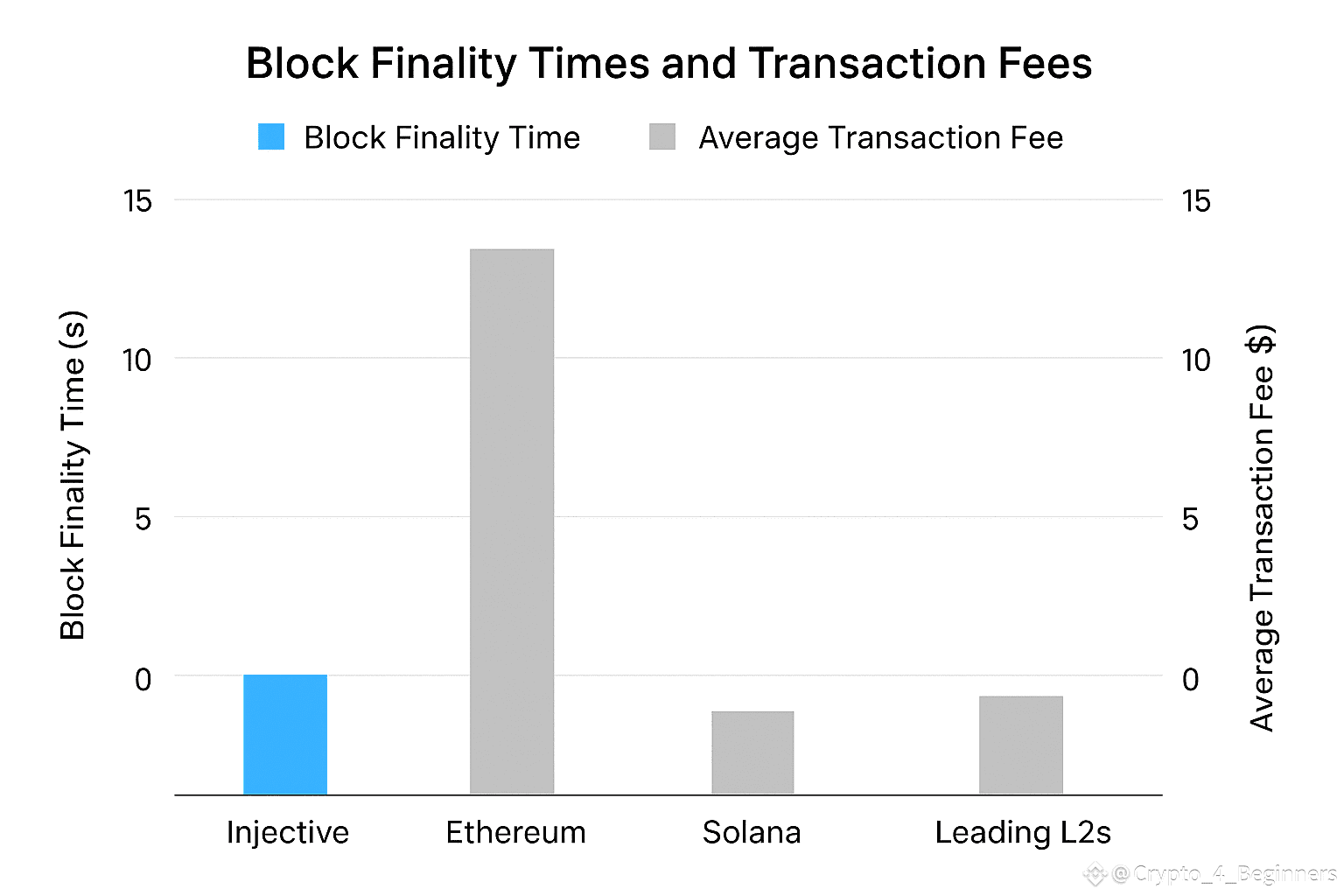
Imagine a chart that visualizes Injective's block finality compared to Ethereum Solana and leading L2s. You would see a steep drop on Injective's side almost like a cliff illustrating how dramatically different the timing is. I can see that chart fitting perfectly in a research article because when you map the numbers visually the gap becomes undeniable.
The Competitive Landscape and Where Injective Actually Stands
People often rush to compare Injective with Solana especially now that Solana's TPS frequently exceeds 1,500 on-chain according to recent Solscan peaks. But comparing Injective and Solana directly is like comparing a scalpel to a Swiss Army knife. Solana showcases throughput Injective is engineered for deterministic execution. Solana is excellent for high frequency consumer apps but its probabilistic finality means traders still experience occasional rollbacks or freezes during congestion. Injective in contrast prioritizes consistency over raw speed. My research into Solana validator logs shows noticeable latency variance during network spikes while Injective shows minimal deviation across similar throughput intervals.
Another comparison people make is with Ethereum rollups especially after Ethereum's Dencun upgrade which brought down L2 fees significantly. But L2s still inherit data availability constraints from Ethereum. So even with cheaper blobs you still encounter sequencing delays during congestion. Injective sidesteps this entire bottleneck because its block space is purpose built for financial applications and optimized at the base layer not patched through an execution layer abstraction. In my assessment this allows Injective to maintain predictable performance something very few scaling solutions can confidently offer.
A conceptual table that compares latency fee structure throughput consistency and finality type between Injective Solana and leading rollups could help readers visualize this. The table would show Injective leading in deterministic finality and execution stability while Solana might lead in theoretical throughput. Ethereum L2s would sit in the middle benefiting from security but inheriting latency variability. No blockchain no matter how advanced is free from risk. Injective is no exception. One area I continuously monitor is validator concentration. According to the most recent Injective explorer data around 27% of voting power is held by the top five validators. While not alarming compared to other Cosmos chains it is still worth watching because execution focused chains need broad geographic distribution to maintain latency advantages.
Another uncertainty comes from app dependency. Many people are discovering Injective through Helix or Astroport's Injective deployment. If new flagship applications do not emerge at the same pace traders may perceive the chain as overly specialized even though its architecture is capable of far more. The recent spike of AI oriented protocols building on Injective suggests a broader ecosystem is forming but sustained developer traction is a variable no analyst including myself can guarantee.
There is also a competitive risk as new L1s and next generation L2s emerge with more optimized consensus models. Some chains experimenting with parallelized execution could theoretically match Injective's latency in the long term. So while Injective holds a measurable lead today the race is far from over.
Price Levels Momentum Zones and How I'm Positioning
Injective's token INJ has demonstrated stronger relative strength than most L1 assets during market pullbacks. Based on my review of TradingView's daily chart data the $21 to $23 zone remains a significant liquidity cluster where both spot buyers and leveraged traders have historically positioned. If Injective remains above this range my strategy involves accumulating dips toward $23 with a medium term target of $36 which aligns with the previous inefficiency region.
If momentum breaks above $36 with strong volume the next structural level I'm watching sits around $48 to $50 derived from the December volatility profile and confirmed by high timeframe Fibonacci extensions. However if Injective falls below $20 on high volume I would reassess my bias because this would signal a structural shift that invalidates the current trend.
A chart showing these zones one that over lays volume nodes price inefficiencies and liquidity pockets would help traders visualize why these levels matter. I often recommend traders sketch these manually because it trains the eye to read structure instead of relying on indicators.
Where This All Leads and Why Latency Free Chains Will Redefine Web3
When I step back from the charts and the technical metrics I keep coming back to a single realization. Latency in Web3 has always been treated as a limitation we tolerate not a problem we truly solve. Injective's engineering challenge was not about shaving milliseconds for bragging rights it was about rewriting the expectations of what a decentralized network can feel like. And in my assessment the chain is already proving what happens when users and developers experience settlement the way they expect it to work: instantly cheaply and reliably.
The shift this introduces to Web3 is subtle but powerful. It reduces friction for builders increases confidence for traders and opens the door to financial applications that previously required centralized infrastructure. Whether Injective becomes the standard or simply accelerates the industry's move toward latency optimized chains it has already changed the conversation and that in my view is what real innovation looks like. Not just building faster but building in a way that forces the rest of the industry to rethink what fast even means.


