
There s a strange feeling you get when you stop looking at crypto charts as numbers and start watching them as behavior Not patterns in a technical sense but patterns in how people panic hesitate return disappear and come back again pretending nothing happened. In places like Binance Square everything is loud, but very little of it is grounded. The real story is almost always quieter than the feed
Inside this environment one particular highspeed blockchain ecosystem keeps showing up in conversationsnot because it is new anymore, but because it behaves differently under pressure. It doesn’t move like something that is still trying to prove itself. It moves like something that has already accepted it will be tested constantly, and built itself around that expectation.
What stands out first is not technology. It’s tempo.
Most systems in this space feel like they are asking users to slow down, double-check, and stay cautious. This one does the opposite. It removes delay from action. And when you remove delay, you don’t just change performance—you change human behavior. People stop treating actions as decisions and start treating them as reflexes.
At first, that feels like freedom. You try things without thinking too much. You trade, interact, experiment, move assets around just to see what happens. Early users behave almost like explorers who are not afraid of getting lost because everything is reversible in their mind. That phase always looks energetic from the outside.
But energy is not the same as stability.
After a while, something quieter begins to happen. The same speed that made experimentation easy also makes repetition dangerous. When actions are cheap and fast, mistakes don’t feel heavy in the moment—but they accumulate in ways people don’t notice immediately. It’s not a dramatic failure. It’s a gradual one. A thousand small decisions that were never really considered.
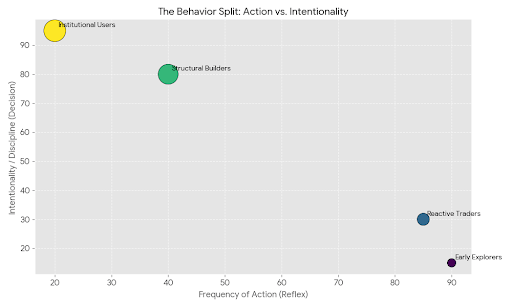
That is usually where the user base splits.
Some people leave because the environment feels too noisy, too unpredictable, or too fast to emotionally process. Others stay—but they change. They become more structured, more intentional, less reactive. They learn that in a system that never slows down, discipline has to come from the user, not the environment.
Over time, that difference becomes the real identity of the ecosystem: not speed itself, but what speed forces people to become.
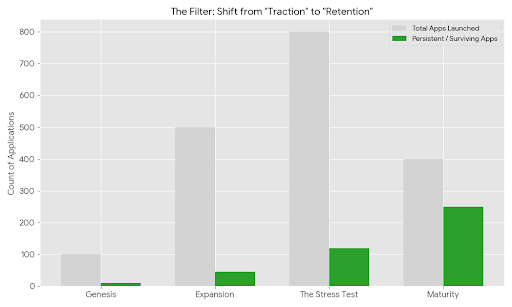
There is also a second layer that only becomes visible if you stop focusing on price movement. The ecosystem is constantly producing things—applications, tokens, experiments, tools. Too many, honestly. Most of them don’t last. They appear, attract attention briefly, and then fade without ceremony.
At first glance, this looks like chaos. But underneath it, a filtering process is always happening.
Users stop paying attention to what is new and start paying attention to what persists. Builders stop designing for attention and start designing for retention. Slowly, without anyone announcing it, the standard changes from “can this get traction” to “can this survive contact with real usage.”
That shift matters more than it looks like on a chart.
Because once a system becomes easy to enter and easy to build on, the real scarcity is no longer access—it is trust. And trust is not something that gets declared. It gets observed. People watch how things behave when conditions get difficult. They remember what breaks, but more importantly, they remember what recovers.
There have been moments where the network didn’t behave perfectly. Periods where things slowed down, stalled, or felt uncertain. In most environments, that kind of history would permanently damage uconfidence. But here, something more complicated happened. Instead of disappearing, users adjusted their expectations. They stopped demanding perfection and started looking for consistency over time.
That is a different kind of trust. Not emotional trust. Behavioral trust.
You can see it most clearly in how people build on top of the system now. Early builders were experimenting—they were trying to see what was even possible. Later builders assume the system will hold under load, and they design with that assumption in mind. That change is subtle, but it marks a transition from experimentation to dependency.
And dependency is the point where something stops being a “project” and starts becoming infrastructure.
But infrastructure is never just about performance. It is about predictability under stress. And stress in this environment is constant. Attention cycles are short. Narratives rotate quickly. New tokens appear faster than people can evaluate them properly. In that kind of environment, noise is not an exception—it is the baseline.
So users develop a second skill that has nothing to do with technology: filtering reality.
They stop reacting to everything. They learn to ignore most signals. They begin to rely on repetition, not excitement. They trust what keeps showing up, not what appears loudly for a moment. This is where experience actually matters—not in understanding the system, but in ignoring the parts of it that are designed to be distracting.
Meanwhile, builders quietly adapt too. When a system processes transactions quickly and at scale, it doesn’t leave much room for careful correction after the fact. That forces a different mindset. You don’t build assuming users will behave perfectly. You build assuming they won’t. Edge cases stop being rare. They become normal. And systems either adapt to that reality or fail under it.
What emerges over time is not a perfect ecosystem, but a resilient one. And resilience is often misunderstood. It is not the absence of problems. It is the ability to keep functioning while problems are happening.
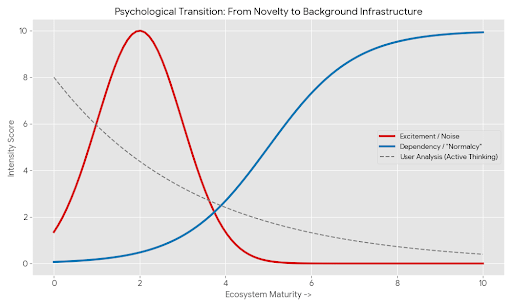
The most important transition, though, is psychological. At some point, users stop thinking about the system constantly. They stop analyzing every move. They stop asking whether it will work. They just use it. That sounds simple, but it is actually rare in this space.
Because most crypto ecosystems never reach that stage. They stay trapped in attention loops always being discussed, always being questioned, never being quietly relied upon.
The direction this ecosystem is moving in is not loud. It is not dramatic. It doesn’t need to be.
It is shifting from something people interact with to something they assume will be there. From novelty to background. From curiosity to dependency.
And if it continues on that path without losing discipline to speed itself, it won’t be remembered for excitement.
It will be remembered for becoming normal in a space that rarely stays stable long enough for anything to feel normal at all.
