


In 1971, Bruce Bent and Henry Brown launched the Reserve Primary Fund, creating the world's first money market mutual fund. This innovation allowed ordinary investors to access institutional-grade short-term debt instruments that were previously reserved for large corporations and wealthy individuals. The fund promised safety, liquidity, and yield above traditional savings accounts, fundamentally reshaping how Americans managed their cash reserves. Within a decade, money market funds grew from zero to nearly $200 billion in assets, demonstrating the massive demand for accessible yield products.
Fifty-five years later, we're witnessing a similar revolution in decentralized finance. Just as money market funds democratized access to institutional yield instruments, DeFi vaults and automated strategies are now democratizing access to sophisticated financial engineering through blockchain technology. The emergence of non-custodial, programmable yield generation represents the next evolutionary step in the centuries-long pursuit of efficient capital allocation.
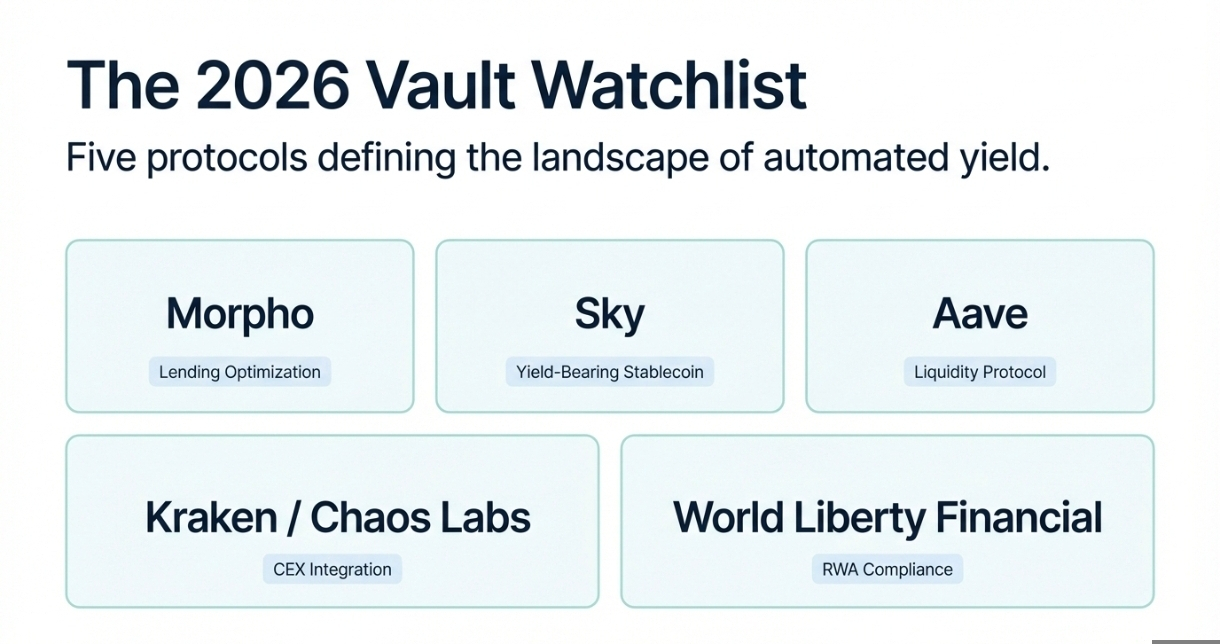
The transition is already underway. Traditional finance giants like Bitwise are partnering with DeFi protocols like Morpho to launch on-chain vaults targeting 6% APY. Kraken has integrated AI-powered yield strategies from Chaos Labs, bringing institutional-grade risk management to retail users. And the rebranded Sky Protocol (formerly MakerDAO) projects $611 million in revenue for 2026 from its yield-bearing stablecoin ecosystem. We're moving from the era of manual yield farming to automated wealth management that operates like financial autopilot.
II. What Are DeFi Vaults?
DeFi vaults are non-custodial smart contracts that automatically execute complex yield-generating strategies on behalf of users. Think of them as robotic fund managers that never sleep, constantly optimizing your capital across multiple decentralized finance protocols without requiring manual intervention. Unlike traditional funds where you surrender custody of your assets to a third party, vaults allow you to maintain control while delegonly the execution of investment strategies.
These vaults represent a fundamental shift from the early days of DeFi, where users had to manually move assets between protocols, monitor rates, and compound returns. The first-generation yield farming required technical expertise and constant attention, creating barriers for most investors. Vaults abstract away this complexity, allowing users to simply deposit assets and let the smart contract handle the rest.
The core value proposition of DeFi vaults revolves around three principles: automation, optimization, and accessibility. They automate the tedious process of yield hunting across multiple protocols. They optimize returns through sophisticated algorithms that rebalance allocations based on real-time market conditions. And they make advanced strategies accessible to users who lack the technical knowledge or time to manage deployments manually.
According to Bitwise's 2026 predictions, the on-chain vault market is poised to double its assets under management this year, with major financial publications expected to label them "ETFs 2.0." This growth is driven by increasing institutional participation and the maturation of vault infrastructure that can deliver reliable yields without the counterparty risk of centralized platforms.
III. How DeFi Vaults Work
At their core, DeFi vaults are sophisticated smart contract systems that implement automated portfolio management logic on-chain. The technical architecture typically consists of several key components:
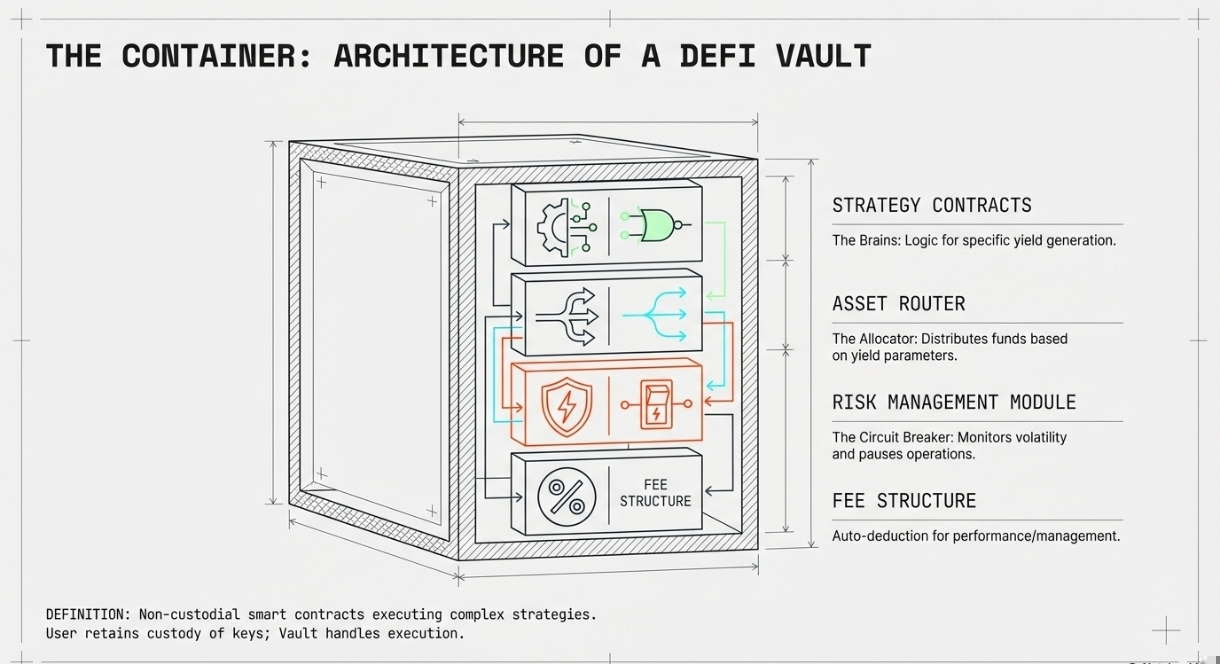
Strategy Contracts: These are the brains of the operation, containing the specific logic for yield generation. A vault might have multiple strategy contracts for different market conditions or asset types. For example, a stablecoin vault might have strategies for lending on Aave, providing liquidity on Curve, and executing delta-neutral strategies on perpetual exchanges.
Asset Router: This component handles the allocation of deposited funds across different strategies based on predefined parameters. It continuously monitors yield opportunities and rebalances allocations to maximize returns while managing risk exposure. Advanced vaults use machine learning algorithms to predict optimal allocations based on historical data and market signals.
Risk Management Module: Perhaps the most critical component, this module monitors for smart contract risks, market volatility, and protocol-specific dangers. It implements circuit breakers that can pause operations during extreme market conditions and automatically withdraw funds from protocols showing signs of stress.
Fee Structure: Vaults typically charge performance fees (a percentage of profits) and/or management fees (a percentage of assets under management). These fees are automatically deducted and distributed to vault creators and sometimes to token holders as well.
The operational flow begins when a user deposits assets into the vault contract. The vault mints shares representing the user's proportional ownership, similar to how ETFs work. The deposited assets are then deployed according to the active strategy, generating yield that compounds back into the vault. Users can withdraw at any time by burning their shares and receiving their proportional share of the vault's assets.
State Transitions and Execution:
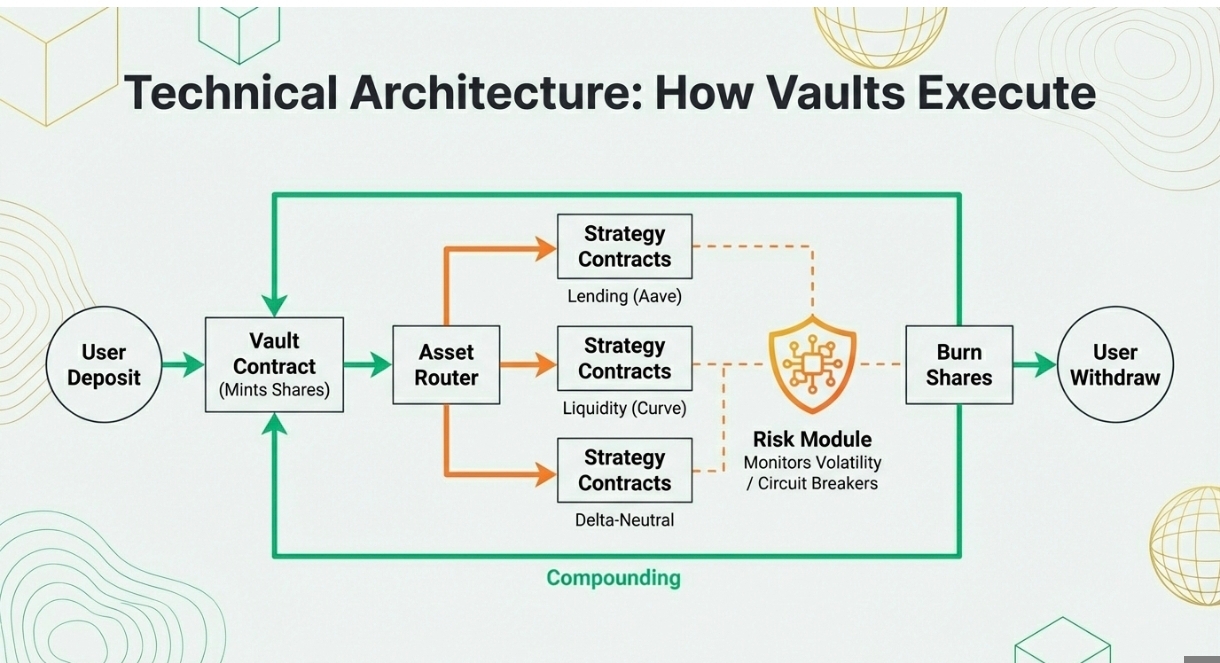
Deposit: User transfers assets → Vault mints shares
Allocation: Router deploys assets to strategies → Yield generation begins
Monitoring: Risk module scans for threats → Rebalancing occurs as needed
Compounding: Yield reinvested automatically → Share value increases
Withdrawal: User burns shares → Receives assets + accumulated yield
Imagine you have a savings account that doesn't just sit there earning minimal interest, but instead has a tiny robot financial advisor living inside it. This robot's only job is to constantly look for the best ways to make your money grow safely.
When you deposit money into a DeFi vault, you're essentially hiring this robot. The robot takes your money and spreads it across multiple safe opportunities: it might lend some to borrowers (earning interest), provide some to traders who need liquidity (earning fees), and use some for other smart strategies. The robot works 24/7, moving your money to better opportunities as they appear and automatically reinvesting all the earnings.
The best part? You never give up control of your money. The robot can only do what it's programmed to do, and you can take your money back anytime. It's like having a professional fund manager working for you, but without the high fees and with complete transparency about where your money is at all times.
IV. Top 5 DeFi Vaults to Look Forward in 2026
1. Morpho Blue with Bitwise Institutional Curation
Morpho has emerged as the seventh-largest DeFi protocol with $9.97 billion in total value locked, but its recent partnership with Bitwise represents a watershed moment for institutional adoption.
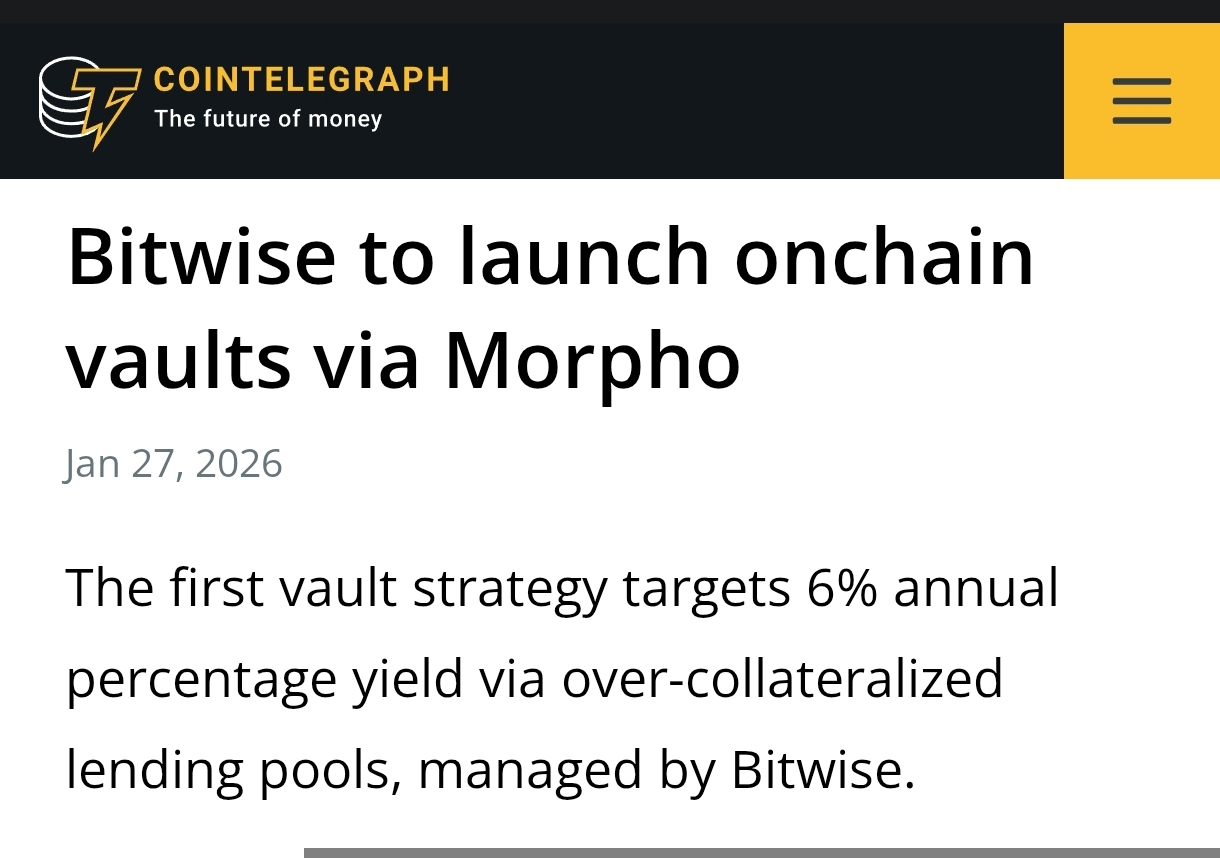
The collaboration brings traditional asset management expertise to on-chain yield generation. Bitwise acts as a "curator" on Morpho, designing vault strategies that target 6% APY through overcollateralized lending pools. This structure allows Bitwise to define risk parameters and allocation strategies without taking custody of user assets, addressing a major institutional concern.
What makes Morpho particularly compelling is its minimalist architecture. Unlike more complex protocols, Morpho Blue uses a simpler, more efficient design that reduces smart contract risk while maintaining competitive yields. The Bitwise vaults represent the first wave of what the firm calls "ETFs 2.0" – on-chain investment funds that combine the transparency of DeFi with professional strategy curation.
2. Sky Protocol (formerly MakerDAO) USDS Vaults
The rebranded MakerDAO ecosystem now operates as Sky Protocol, and it's positioning itself as a yield powerhouse rather than just a stablecoin issuer.

Sky projects $611.5 million in gross protocol revenue for 2026, with USDS supply expected to nearly double to $20.6 billion. Unlike traditional stablecoins that maintain a static 1:1 peg, USDS is designed as a yield-bearing asset, automatically generating returns for holders through diversified on-chain and real-world asset strategies.
The protocol plans to launch up to 10 new "Sky Agents" in 2026, beginning with structured credit solutions backed by stablecoin liquidity. This expansion represents a significant evolution from simple stablecoin issuance to a comprehensive yield generation ecosystem that competes directly with traditional money market funds.
3. Aave V3 and GHO Ecosystem
Aave remains the third-largest DeFi protocol with $45 billion in TVL, but its recent innovations position it for continued dominance in the vault space.
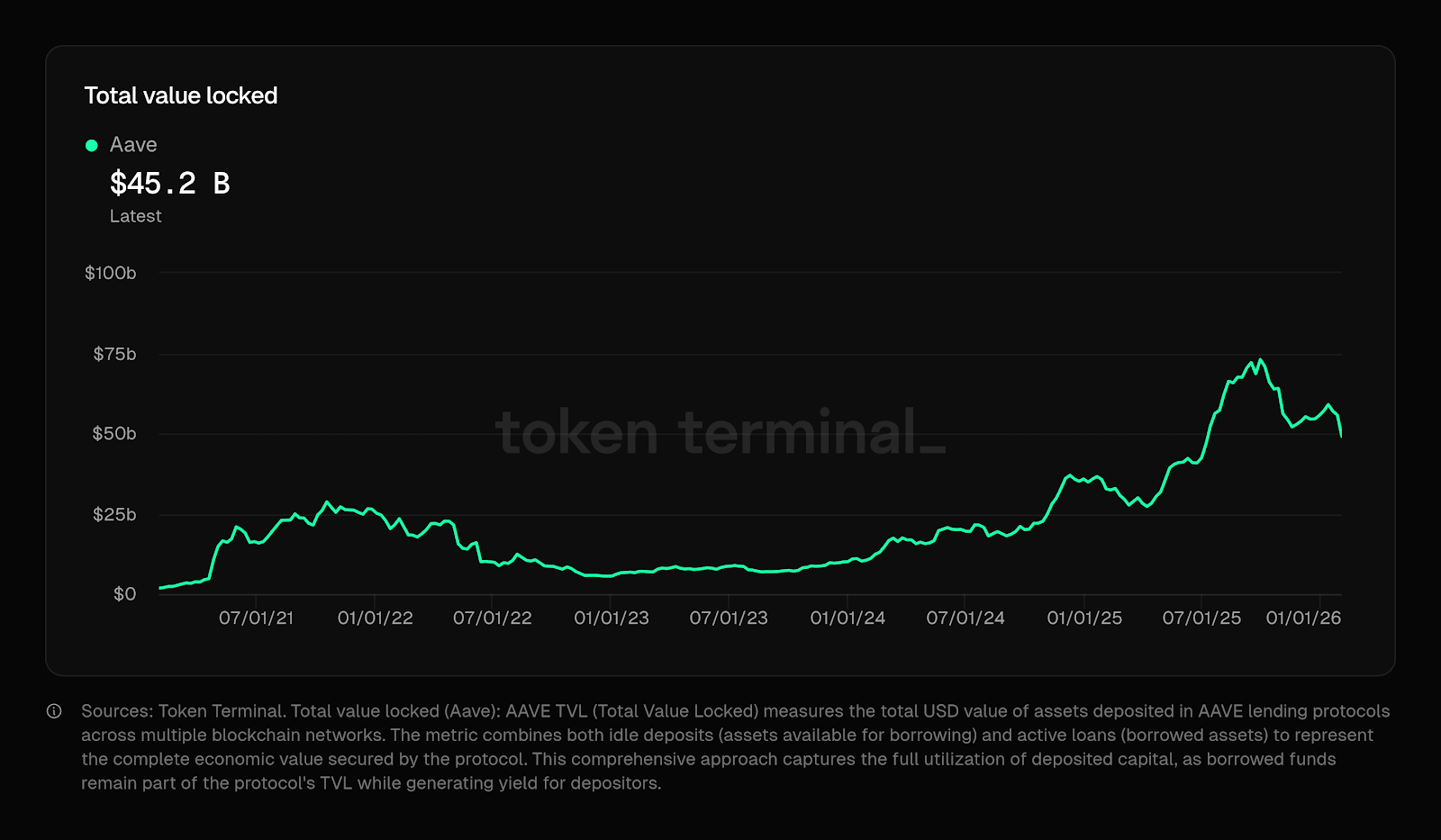
The protocol's V3 introduction brought cross-chain liquidity capabilities and improved risk management features. More importantly, Aave's native stablecoin GHO has created new yield opportunities within the ecosystem. GHO is inherently yield-bearing through its minting mechanism, where interest payments from borrowers flow to GHO minters.
Aave's vault strategy focuses on creating synergistic relationships between borrowing, lending, and stablecoin minting. The protocol's massive liquidity depth allows it to offer competitive rates with minimal slippage, making it a cornerstone for more complex automated strategies built on top of its infrastructure.
4. Chaos Vaults on Kraken DeFi Earn
Chaos Labs has brought institutional-grade risk management to mainstream users through its integration with Kraken's DeFi Earn platform.
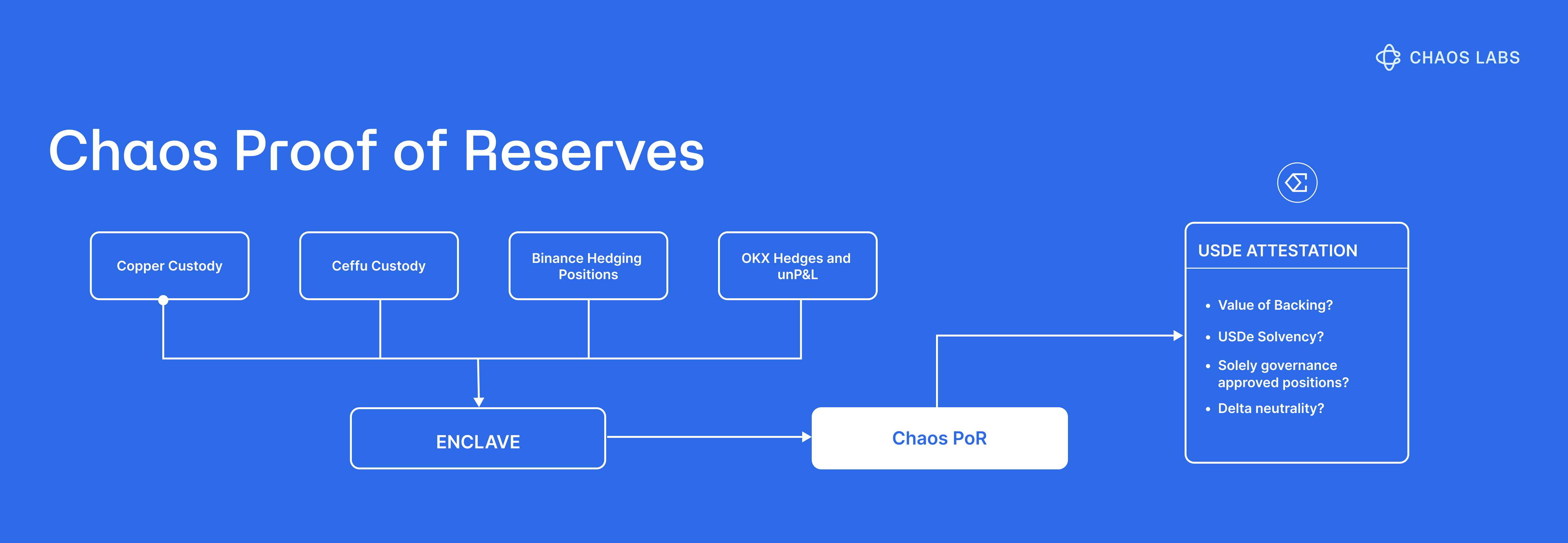
What sets Chaos Vaults apart is their AI-powered risk management system that continuously monitors exposure and dynamically allocates across venues as market conditions change. The platform benefits from Chaos Labs' experience securing over $5 trillion in transaction volume across major protocols like Aave and Ethena.
The Kraken integration is particularly significant because it removes technical barriers for non-DeFi native users. Customers can access sophisticated yield strategies with a single click, without worrying about gas fees, wallet setup, or smart contract interactions. This represents the consumerization of DeFi yield – all the sophistication without the complexity.
5. World Liberty Financial Institutional Framework
World Liberty Financial has built a unique position at the intersection of traditional finance and DeFi, with a focus on regulatory compliance and institutional-grade infrastructure.
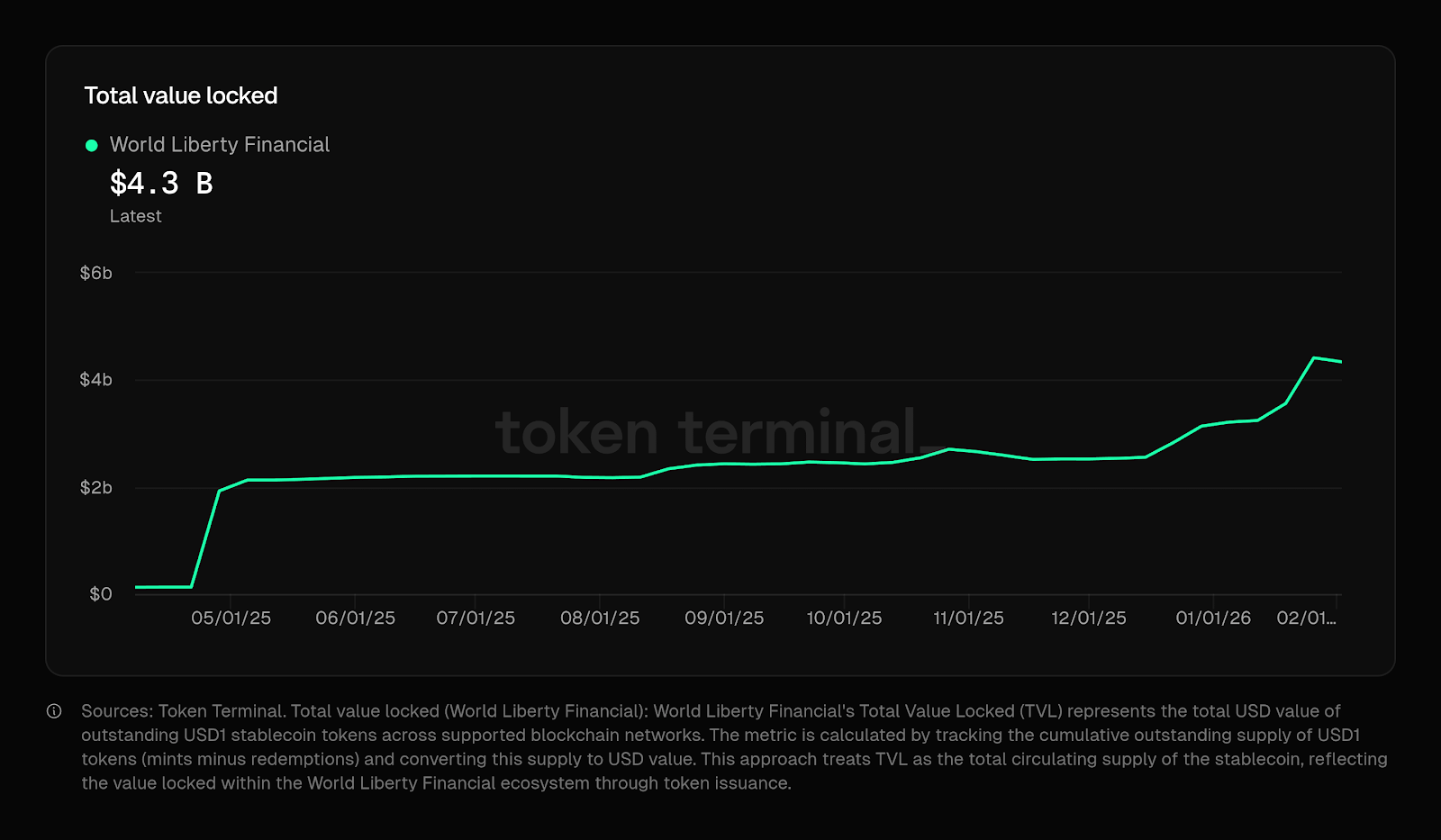
The protocol issues both a governance token (WLFI) and a stablecoin (USD1) that's backed 1:1 by U.S. dollars and government money-market funds held via BitGo. This structure provides the regulatory clarity that institutions require while still offering DeFi-native yield opportunities.
WLFI's approach demonstrates how DeFi is maturing to meet institutional requirements rather than expecting institutions to adapt to DeFi. By building bridges to traditional finance through compliant structures and verified reserves, protocols like WLFI are paving the way for broader adoption beyond crypto-native users.
V. What Are Automated Yield Strategies?
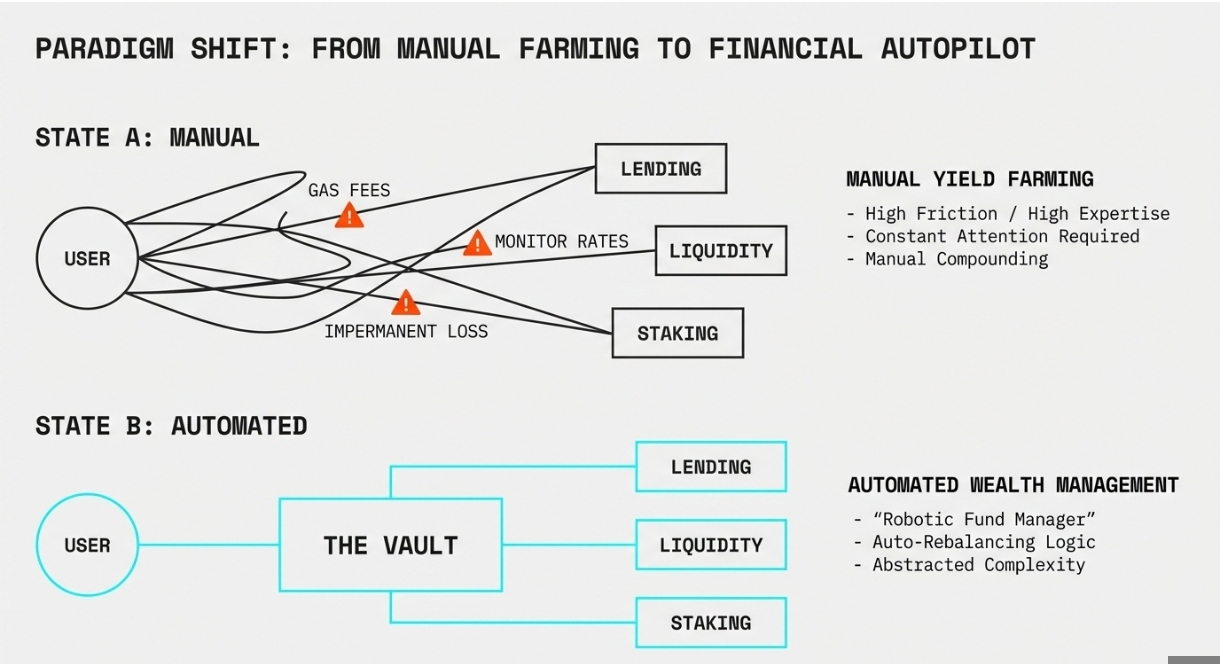
Automated yield strategies are sophisticated algorithms that dynamically allocate capital across multiple DeFi protocols to maximize returns while managing risk. Unlike static yield farming where users manually deposit into a single protocol, automated strategies continuously monitor market conditions and rebalance allocations to capture the best risk-adjusted opportunities across the entire DeFi landscape.
These strategies represent the evolution from first-generation yield farming, which required users to manually compound rewards, monitor impermanent loss, and constantly chase the highest APY. Automation eliminates the need for active management while typically delivering better results through mathematical optimization and 24/7 market monitoring.
The key innovation of automated strategies is their ability to respond to real-time market conditions. They can detect when a protocol's rates are dropping and reallocate to better opportunities, when volatility is increasing and reduce risk exposure, or when arbitrage opportunities appear and execute complex multi-step transactions within single blocks.
In 2026, we're seeing these strategies evolve from simple automated farming to intent-based architectures where users specify desired outcomes (e.g., "earn 10% APY with less than 5% drawdown risk") and sophisticated solvers compete to fulfill these requests optimally. This represents a fundamental shift from protocol-centric to user-centric DeFi.
VI. How Automated Yield Strategies Work
Technical Architecture: Intent-Based Systems and Solvers
The most advanced automated yield strategies in 2026 operate on intent-based architectures rather than traditional transaction-based models. Here's how they work at a technical level:
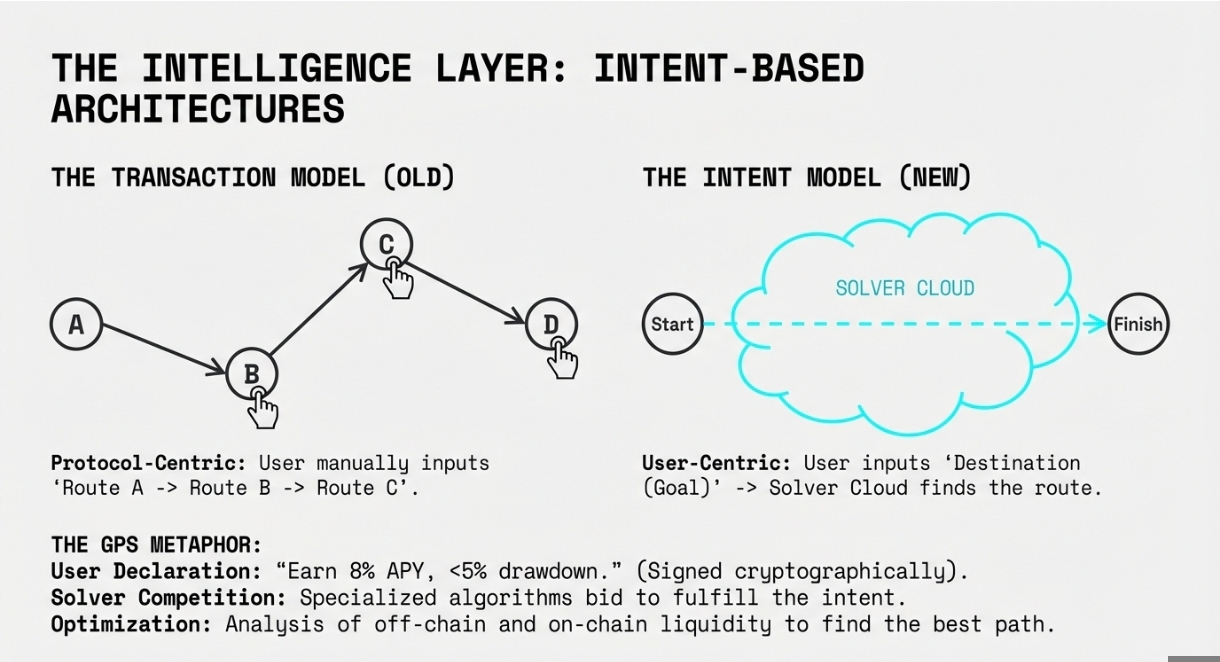
User Intention Declaration: Instead of specifying exact transactions, users declare their desired outcome through a standardized intent schema. For yield strategies, this might include parameters like target APY, risk tolerance, acceptable protocols, and asset preferences. The intent is signed cryptographically but doesn't specify how to achieve the outcome.
Solver Competition: Specialized actors called "solvers" compete to fulfill user intents optimally. Solvers run sophisticated algorithms that analyze current market conditions across multiple protocols and chains to find the best execution path. They submit their proposed solutions along with the expected outcome and fee.
Execution and Verification: Once a user accepts a solver's proposal, the execution occurs through a secure settlement layer. The solver's performance is verified against their承诺, and they only get paid if they deliver the promised results. This creates strong incentives for solvers to optimize execution continually.
Cross-Chain Orchestration: Advanced strategies operate across multiple blockchains simultaneously. They use cross-chain messaging protocols and liquidity bridges to move assets where they can earn the best yields, often executing complex arbitrage and carry trades that wouldn't be possible on a single chain.
AI-Powered Optimization: The most sophisticated systems use machine learning to predict yield opportunities before they appear. They analyze historical data, market sentiment, protocol developments, and macroeconomic conditions to anticipate rate changes and position assets accordingly.
Imagine you're trying to get across a busy city during rush hour. In the old days (manual yield farming), you had to study maps, check traffic reports, and make every turn yourself. With automated strategies, you simply tell your GPS "get me to the airport as quickly as possible" and it handles the rest.
The GPS (the solver) looks at all possible routes, current traffic conditions, construction updates, and even predicts where traffic will be heavy by the time you get there. It might route you through side streets you didn't know existed, switch routes mid-trip when conditions change, and even tell you when to take a different mode of transportation.
In DeFi terms, you say "I want to earn 8% yield on my USDC with low risk." The automated system looks across every lending platform, liquidity pool, and strategy available. It might put some in a safe lending protocol, some in a balanced liquidity pool, and use a small portion for opportunistic strategies. If rates change, it automatically moves your money to better options, always working to achieve your goal without you lifting a finger.
VII. Top 5 Automated Yield Strategies to Look Forward in 2026
1. Intent-Based Solvers (Echelon/Nado)
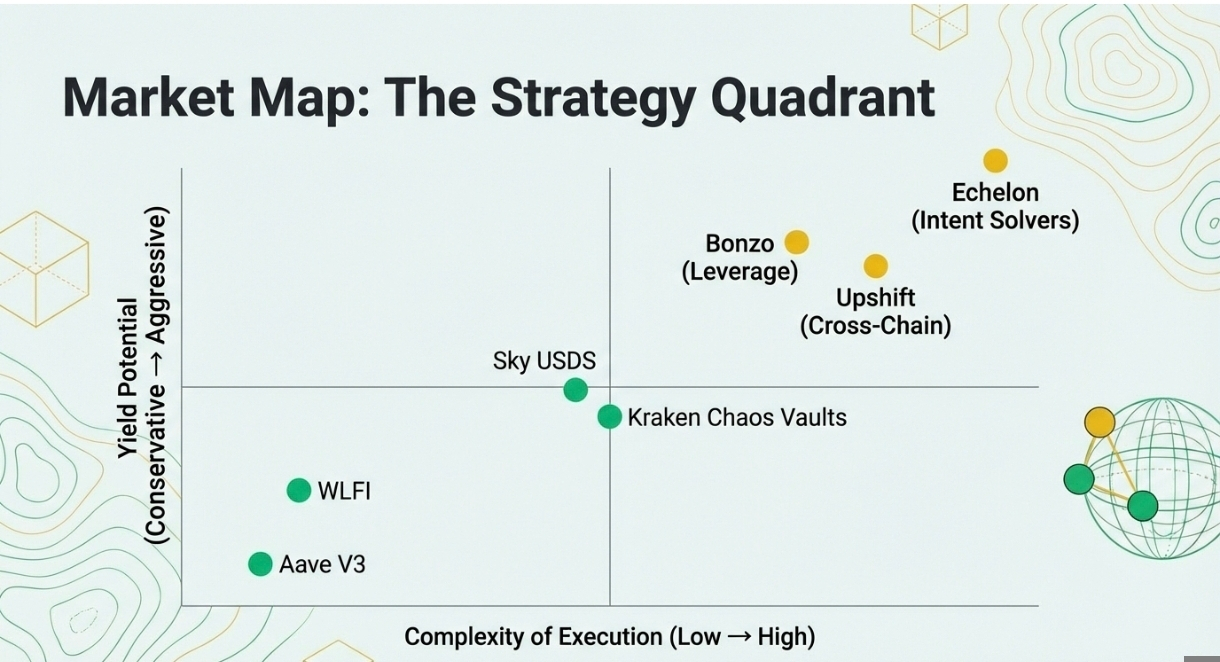
The emergence of intent-based architectures represents the most significant evolution in DeFi usability since the invention of the AMM. Platforms like Echelon and Nado are building infrastructure that allows users to specify what they want to achieve rather than how to achieve it.
These systems work through a competitive solver market where specialized algorithms bid to fulfill user intents optimally. For yield strategies, this means users can specify desired return profiles, risk parameters, and constraints, then let solvers compete to find the best execution across all available DeFi protocols.
The beauty of this approach is that it leverages market competition to drive innovation and efficiency. Solvers continuously develop better algorithms and access to more liquidity sources, while users benefit from increasingly sophisticated execution without needing to understand the underlying complexity.
2. AI-Managed Portfolio Risk (Chaos Labs)
Chaos Labs has pioneered the application of artificial intelligence to DeFi risk management and yield optimization. Their systems use machine learning to predict market movements, detect emerging risks, and optimize portfolio allocations in real-time.
What sets AI-managed strategies apart is their ability to process vast amounts of data that would be impossible for humans to analyze. They monitor social sentiment, protocol developments, macroeconomic indicators, and on-chain analytics to anticipate rate changes and volatility before they happen.
These systems can also perform sophisticated stress testing, simulating how strategies would perform under various market conditions and adjusting allocations to minimize drawdowns during periods of stress. This represents a quantum leap beyond simple APY chasing toward truly risk-aware yield generation.
3. Cross-Chain Carry Trades (Upshift/Sentora)
As DeFi expands across multiple blockchains, cross-chain arbitrage and carry trades have emerged as sophisticated yield opportunities. Platforms like Upshift and Sentora specialize in identifying and executing these strategies automatically.
Cross-chain strategies work by exploiting rate differences between identical assets on different blockchains. For example, if USDC lending rates are 5% on Ethereum but 8% on Solana, the system might bridge assets to Solana to capture the higher yield while hedging the bridging risk.
These strategies require sophisticated risk management due to the additional complexities of cross-chain operations, including bridge risks, varying transaction costs, and settlement delays. The most advanced systems use probabilistic modeling and real-time monitoring to ensure that the additional yield justifies the additional risks.
4. Leveraged Staking (Bonzo Finance)
Leveraged staking strategies have gained significant traction, particularly in ecosystems with liquid staking tokens. Bonzo Finance's recent launch on Hedera demonstrates how automated systems can safely manage leverage to amplify returns.
These strategies work by staking assets, borrowing against them, and restaking the borrowed assets in a carefully controlled loop. The automation continuously monitors collateral ratios, borrowing costs, and staking rewards to ensure the strategy remains profitable and safe.
The key innovation in automated leveraged staking is the risk management systems that can quickly deleverage positions during market downturns to prevent liquidation. This allows users to capture the upside of leverage while minimizing the typical risks associated with manual leverage management.
5. RWA-Backed Structured Credit (Sky Agents/Rain)
The integration of real-world assets (RWA) with DeFi yield strategies represents perhaps the most significant bridge between traditional finance and decentralized protocols. Sky Protocol's planned "Sky Agents" and Rain's $250 million funding round highlight this trend.
RWA strategies work by tokenizing real-world debt instruments like corporate loans, invoices, or treasury bills and making them available as yield-bearing assets in DeFi. Automation comes in the form of risk assessment, collateral management, and liquidation systems that operate similarly to traditional credit funds but with blockchain transparency.
These strategies offer the potential for stable, uncorrelated yields sourced from the traditional economy while maintaining the accessibility and composability of DeFi. As regulatory frameworks mature, R-backed strategies are expected to become increasingly important components of diversified yield portfolios.
The evolution from manual yield farming to automated vaults and intent-based strategies represents a fundamental maturation of DeFi. We're moving from an era where technical expertise was required to earn yield to one where sophisticated wealth management is accessible to anyone with an internet connection.
Mind you, higher the returns, higher the risk, so, if you want to play the automated vault or any High APY Vault, please beware of the risks beneath the surface.
Don't chase the higher returns blindly, closely observe the protocol, the backers, and the strategies behind the yield.