


In brief
An audit will provide a detailed analysis of the security of the project's smart contracts. This is an important norm to follow to protect the funds invested through them. Since all transactions on the blockchain are irreversible, it is impossible to get funds back if they are stolen. Normally, validators will check the code of smart contracts, creating reports so that the project can continue to improve. A final report on the project's safety will then be released. This report details the remaining bugs and the work that has been done to resolve performance or safety issues.
Introduce
Smart contract security audits are a very common activity in the Decentralized Finance (DeFi) ecosystem. If you have invested in a blockchain project, smart contract code audit results are something you need to consider.
Although most people understand the importance of audits for cybersecurity, not many people dive deep into the lines of code. Let's explore the methods, tools, and results commonly found in smart contract auditing so you can make more informed decisions.

What is smart contract auditing?
Smart contract security audit is the process of checking and commenting on the project's smart contract code. Typically, these contracts are written in the Solidity programming language and made available via GitHub. Security audits are especially important for DeFi projects, as they handle blockchain transactions worth millions of dollars or with a large user base. Audits typically follow a four-step process:
1. The smart contract is provided to the validation team for initial analysis.
2. The inspection team presents their findings to the project so that it can find solutions.
3. The project team makes changes based on the problems found.
4. The site team plans to issue the final report, reviewing any changes or remaining errors.
For many cryptocurrency users, determining whether a project has audited smart contracts is essential before they decide to invest in a new DeFi project. Accreditation has become a standard for projects that want to prove that they are taking their work seriously. Several smart contract auditing service providers are considered leaders in the industry. Their audits are considered more trustworthy in the eyes of investors than others.
Why do we need smart contract audits?
With large amounts of value being transacted or locked, smart contracts have become attractive targets for malicious attacks from hackers. Small errors in code can lead to major thefts of money. For example, the DAO hack on the Ethereum blockchain took about $60 million worth of ETH and even led to a hard fork of the Ethereum network.
Since blockchain transactions are immutable, ensuring that the project's code is secure is essential. With its highly secure nature for users, blockchain technology also makes it difficult to retrieve funds and resolve problems after the fact, so it's better to prevent security vulnerabilities. confidentiality at all costs.
How does smart contract auditing take place?
The smart contract auditing process has been put into a standard by auditing companies. While each accreditor's approach may vary slightly, the process typically goes like this:
1. Determine the scope of inspection. Smart contracts and technical specifications are determined by the project (their intended purpose) and the overall architecture. The specification helps the testing team understand the project's goals when writing and using code.
2. Provide an initial quote based on the work required.
3. Run a test. Their exact nature will vary depending on the validation team, their analysis tools and methods. Usually, both manual and automated testing are performed.
4. Create a first draft of the report with the errors found and provide it to the project team for feedback and further corrections.
5. Publish a final report, reviewing any actions taken by the project team to resolve the issues raised.
Smart contract auditing methods
Gas efficiency
Smart contract audits don't just focus on blockchain security. The validation team also looks at efficiency and optimization. Some contracts execute a complex series of transactions to accomplish their intended function. With gas fees on networks like Ethereum being relatively costly, efficient contracts can save a lot on transaction costs.
Performance optimization is also an indicator to evaluate a developer's skills. Ineffective steps provide multiple points for failure and should be avoided. When gas costs are high, smart contracts may not be fulfilled, even more so than when low gas limits are used.
Potential loopholes in the contract
Most of the work in audits involves examining contracts for security vulnerabilities. While some issues are easy to see, many exploits involve withdrawal techniques and strategies. For example, market manipulation can be used with weak smart contracts through flash loan attacks. To find these issues, the auditor begins the process of breaking tests and simulating malicious attacks on the smart contract. Common vulnerabilities include:
1. Reentrancy problems: When a smart contract makes an external call to another external contract before any action is taken. The external contract can then recursively call the original smart contract and interact with it in ways that it would not otherwise be able to, because the original contract's balance has not been updated.
2. Integer overflow: When a smart contract performs an arithmetic operation, but the output exceeds the storage capacity (usually 18 decimal places). This can lead to incorrect amount calculations.
3. Front-running opportunity: Ill-structured code can provide advance information about buy or sell transactions in the market. This may allow others to use the information and trade for their benefit.
Platform security flaws
Most audits include looking at the network hosting the contracts and even the APIs used to interact with the DApp. A project could be vulnerable to DDoS attacks or compromises from the website UI, meaning users would risk connecting their wallets to malicious blockchain applications.
What is an inspection report?
The inspection report is generated at the end of the inspection process. For transparency, projects are expected to share the information in their reports with their communities. Most reports categorize problems by severity, such as critical, major, minor, etc. The report will also list the status of the issue, as projects will have time to resolve them before releasing the final report.
Along with the summary, a standard report will contain recommendations, redundant code examples, and a full analysis of where coding errors exist. The project has time to fix the report's findings before its final version is released.
Where can I view project smart contract audit results?
Several smart contract auditing services have become famous for their services. Among them, two companies are particularly popular and their reports provide quite a bit of information.
CertiK
CertiK is an industry leader when it comes to smart contract auditing. They have audited the smart contracts of hundreds of projects. PancakeSwap, BSC's largest automated market maker (AMM) platform, is an example. Below are the test results of PancakeSwap on Certik.
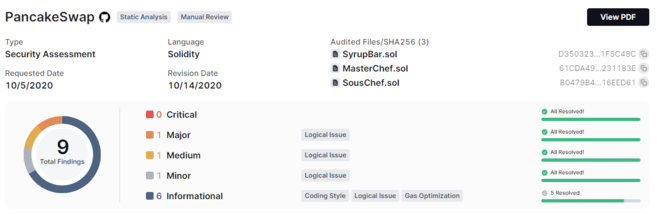
Additionally, the majority of projects supported by Binance Labs have their contracts audited using CertiK. CertiK has created a ranking of audited projects and allows you to compare the safety scores of each project. Note that, in addition to Ethereum, CertiK also audits projects on BSC and Polygon.

ConsenSys Diligence
Run by Ethereum co-founder Joseph Lubin, ConsenSys is one of the cryptocurrency industry's biggest names in blockchain development. According to ConsenSys Diligence, the company provides Ethereum smart contract auditing services. They also provide a service that automatically checks Ethereum Virtual Machine (EVM) contracts for common errors.
How much does it cost to audit smart contracts?
The exact cost of auditing depends on the number of smart contracts to be audited. Typically, an inspection will cost thousands of dollars. A particular large project can easily cost more than $10,000 per inspection. The inspection company and its reputation will also affect how much you pay.

summary
Fortunately for investors and users, smart contract auditing has become a mandatory standard for many projects. However, when every project undergoes audits, its results are no longer an easy indicator of value. This is why it is so important to read the accreditation review yourself. Even if you don't have technical knowledge, by reading reviews and the severity of potential problems, the reports will still be very helpful to you.
After this article, if you come across an inspection report, you can at least understand its content more easily. As always, make sure any investment decision looks at the big picture and considers all the information.