


Today we continue to talk in order of market capitalization. Today we are talking about Holochain (HOT), which is different from the common blockchain types. It is a bit similar to BTT. It is a peer-to-peer open source APP protocol. The current market value is 175 million US dollars, ranking around 140+. Let’s take a look at it today.
Introduction
Holochain is an open source framework for creating secure, reliable, and fast peer-to-peer applications. Instead of relying on servers, Holochain applications connect user devices directly to each other in a secure network. This gives users the best of both worlds - the autonomy and availability of locally installed software, and the power and redundancy of cloud software. In turn, application developers no longer need to maintain and pay for cloud hosting.

HoloChain is a project based on the "DHT (Distributed Hash Table)" technology. In fact, it is not a blockchain technology in essence. Just like the current DAG, it is just a "distributed" solution. The core purpose is not decentralized (Decentralized) but distributed (Distributed). In the blockchain, each node strives to have the same latest copy of the distributed ledger. Blockchain also has the obstacles of extremely high storage costs and low scalability. Holochain attempts to break these obstacles in order to make it cheaper for application developers and run their products quickly. The difference between Holochain and blockchain is that it attempts to be a lightweight architecture that can run the network even on mobile phones and other low-capacity devices.
Before we understand HoloChain, let’s first introduce DHT technology.
DHT, a distributed hash table, is a distributed storage solution. This distributed network does not require centralized nodes. Each endpoint only needs to be responsible for a small part of the data to achieve the addressing and storage of the entire DHT network. It can be imagined that the existing P2P software only needs a seed file (Torrent) to establish a connection with other computers and obtain files.
Currently, applications that use DHT technology include: BitTorrent, Git, Storm Botnet, Freenet, Yacy, IPFS and HoloChain. The first five applications are traditional Internet technology applications, and the last two involve the currently popular blockchain industry. Among them, IPFS (InterPlanetary File System) uses DHT addressing and storage technology to store the target storage information to distributed storage media providers through DHT technology. There are already video publishing websites built on IPFS.

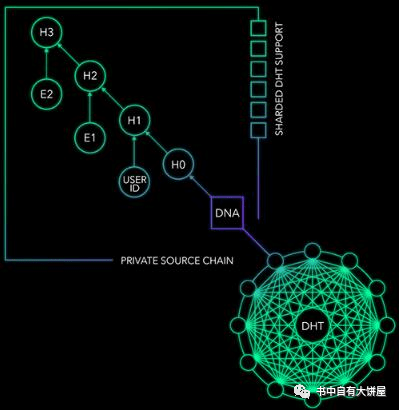
Figure 1: Nodes in holochain only store content related to themselves
DHT is a distributed ledger storage and addressing technology for the entire network. Like the distributed network in the blockchain, it does not require a central node. To avoid node failure, a node only stores a small portion of the content related to itself and copies redundant information from nearby nodes.
Single distributed ledger
In order to ensure information consistency in the blockchain, each node in the system is a separate ledger that records the same information. Although the distributed ledger technology of blockchain meets the consistency requirement, it causes huge information redundancy.
Holochain believes that consensus can be differentiated and that it is not necessary to reach consensus on all events. Therefore, it innovatively solves the consensus problem from another angle.
Holochain divides a ledger into several parts, gives them to each participating node, and uses DHT technology and cryptography to ensure the consistency between the ledgers. In simple terms, we can understand the role of DHT as a picture on a puzzle, and we can use the picture to determine whether the puzzle is complete.
Nodes no longer need to synchronize records in multiple ledgers. They only need to record content related to themselves to reach a consensus across the entire network. This is the innovation of Holochain.
Differentiated consensus mechanism
Holochain Features
1. As the first project to use the DHT network, the distributed nodes on the HoloChain network use DHT technology (distributed hash table) to achieve consensus and ensure the integrity of the main ledger.
2. On the HoloChain network, each user is a chain, storing copies of their own transactions or state exchanges, and these copies are also part of the main network, so there is no need to synchronize and update the ledger like the blockchain, which also reduces storage costs. In the future, Dapp will be able to operate on Holo at a lower cost and faster speed.
3.Holochain differs from blockchain in that it attempts to be a lightweight architecture that allows even mobile phones and other low-capacity devices to run the network.
4. In the DHT system, all previous information can be found from any information source and verified to be valid through Holo's rules. DHT supports distributed storage and data integrity verification.
To summarize, each node in the HoloChain network runs its own chain, just like how GitHub developers copy source code themselves, and can check in and out from the central repository. Holochain uses DHT so that data can be stored in distributed nodes. Like the blockchain technology we know so far, HoloChain allows secure storage without the need for a central server, and the system supports distributed storage and data integrity verification.
It is designed to enable developers and users to quickly and easily launch applications from a centralized server repository and execute them on localized distributed nodes without waiting for confirmation on the blockchain, resulting in less waiting time.
HoloChain provides a new idea: the overall network does not require all ledgers to be completely consistent, but everyone's ledger or data is part of the entire network data and can be called by other people in need at any time.
team
Arthur Block: CEO, serial entrepreneur of various applications and consultant for building rewards systems.
Eric Harris-Braun: BS in Computer Science from Yale University, Executive Engineer/Co-Founder, co-founded MetaCurrency with Art, consultant and leader of multiple applications.
The team on the website is very large. Therefore, many people are probably part-time, contractors or consultants. After reading their personal profiles or social networking sites, you can find that they have a strong belief in HoloChain's positioning. Many team members of HoloChain are independent leaders and consultants in their respective fields. Usually, other projects will try to amplify the number of large companies on their resumes or launch a "star" consultant to attract more attention, but HoloChain did not do this pragmatically and looked for suitable candidates in various fields.
Token Economy
The total amount is currently 177,619,433,541 HOT, which has basically been circulated. The current price is $0.001, and the peak was $0.003 (21 years). The current HOT is an erc20 token. Since the platform is still under development, HOT is designed to be used as a temporary currency until Holo is launched in the beta version and HoloFuel is released. When Holo is officially launched, HOT holders will be able to exchange tokens for HoloFuel at a 1: 1 exchange rate (1 HOT equals 1 HoloFuel). During the initial coin offering (ICO) held in April 2018, the project's team raised more than $20 million using HOT. Since its launch, the value of HOT has been relatively stable until the beginning of 2021, when the token officially entered a bull market in February. The price of HOT rose from $0.0007569 on February 1 to $0.02848 on April 5, an increase of more than 3650%.
Finally, let's summarize this project. This project is not a traditional blockchain technology (distributed ledger), but DHT distributed addressing technology, that is, its ledger is decentralized, each node only has a small part, and does not require the consensus of the entire network. The advantage is definitely fast speed, but it will definitely leave hidden dangers in security. DHT itself is not a very new technology, and it is the first time to be installed on the blockchain, but it has been developed for 5 years, and the main network has not yet been launched. It can be seen that many problems have been encountered in the process, and it is not so easy to do. So its advantage is that there is a new narrative, but in fact it has risen many times. The disadvantage is that this technology is not easy to land on the blockchain. If you can't get out of the next bull market, it may be more dangerous.