


Original title: "Layer 2 Economics"
Original author: Michael Nadeau, The DeFi Report
Original compilation: The Way of DeFi
In this article we will review layer 2 scaling solutions in the Ethereum ecosystem.
Topics covered:
Why do we need L2?
Layer 2 extends the capabilities of your solution
Economics and business models
Impact on Ethereum, the base layer of the technology stack
Why do we need L2?
Anyone who has used Ethereum during 2021 knows that the chain can get very crowded. This is a classic problem - too much demand and not enough supply. Therefore, gas fees (transaction fees) become quite expensive. At the height of the bull run, sending a transaction using the Ethereum blockchain cost nearly $200. This is not scalable. But it tells us something.
The first is that the Ethereum block space is extremely valuable. Some say the Ethereum blockchain space is the “New York City” of today’s ecosystem. This is a very good question.
The second revelation is that Ethereum’s product roadmap is still in the very early stages. It can't support today's 1 billion users. To support more users, applications, and use cases, Ethereum must scale on Layer 2.
It’s worth noting that demand for block space may always exceed supply. Why? Because this has been true of all important computing resources throughout history. CPU, GPU, memory, storage, and wired and wireless bandwidth can all provide useful evidence.
As Chris Dixon points out, computing movements tend to have mutually reinforcing feedback loops between applications and infrastructure. For example, smartphones have improved significantly over the past decade. At the same time, most of the value we get from our phones comes from the apps on them. As apps improve, more users flock to smartphones, which gives manufacturers more money to invest in the infrastructure underlying the phones—powering both the phones (infrastructure) and the things people use (apps) reinforcing feedback loop.
We can observe this happening on Ethereum today.
As Ethereum applications improve, more users flock to Ethereum. As more and more users flock to blockchain, we run into scalability issues. This drives the need to reinvest in infrastructure to support more users, better applications and improved user experience.
Ethereum is preparing for its “broadband” moment. Layer 2 can be thought of as the broadband for blockchain applications. As the infrastructure improves, so will the applications. This should drive user demand, which will lead to better applications and further investment in more scalable infrastructure.
Layer 2 functionality
We can think of layer 2 blockchains as “resellers of the block space.” Essentially, what they do is buy block space on Ethereum, make it more efficient (compress data), and then resell it to users and applications looking for lower transaction fees and higher throughput .
Quick thought model: We can think of this similar to how we use zip (compressed) files when sharing information. Sometimes we want to send a very large file or many files at once. However, our computers usually don't have the storage space required to send these files, so we create a "zip file". This compresses the data and allows it to be shared more seamlessly.
Another way to think about it is how credit card transactions relate to our bank accounts. Credit cards are an expanded solution for bank transfers. Similar to L2 on the blockchain, credit cards such as Visa can batch transactions and then settle with banks on the base layer. This reduces overhead and increases throughput/scalability.
Likewise, Ethereum’s layer 2 scaling solution is to batch transactions off the L1 main chain, compress the data, and then anchor it back to Ethereum to ensure transaction security and proof. This increases throughput and reduces costs—without sacrificing the functionality and security of Ethereum smart contracts.
As a result, applications originally deployed on the Ethereum base layer are moving up the technology stack to be deployed on layer 2 solutions like Optimism and Arbitrum. If you're curious, you can check out the various applications on Ethereum and the additional chains they're deployed to here.
Currently, a total of $24 billion in value is locked in the Ethereum ecosystem. Of that amount, $4.38 billion is locked in applications that leverage Layer 2 scaling solutions. Optimism currently has 79 projects and Arbitrum has 128 projects.
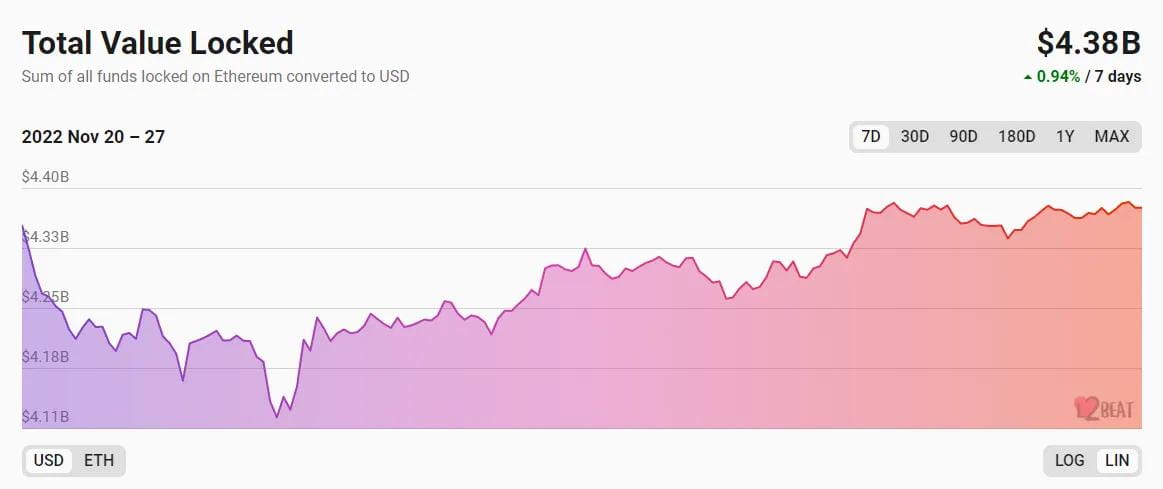
Source: L2 Beat & DeFillama
Economics and business models
Optimism and Arbitrum are the leading layer 2 solutions for Ethereum today. In fact, they ranked 6th and 7th in terms of transaction fees among all cryptocurrency projects over the past 6 months. Both collected $6.4 million in fees. This is significantly more than alternative layer 1 blockchains such as Avalanche, Polkadot, Cosmos, Cardano, Near, and others. Solana ($8.4 million) and Binance Smart Chain ($132 million) are the only two alternative L1s with more active economic activity over the past 6 months.
Here are Optimism’s daily costs (green) and daily active users (purple) over the past 180 days:
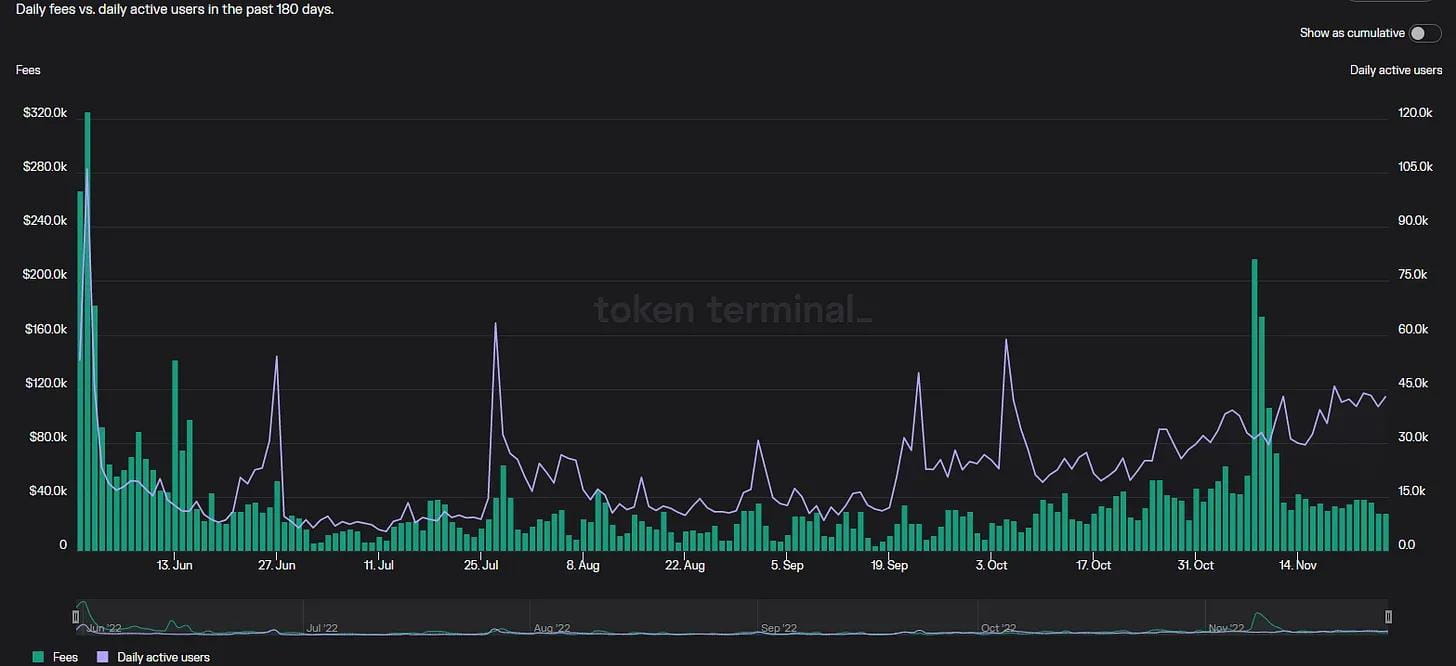
Source: Token Terminal
Here is the percentage of total ETH gas fees represented by layer 2 transactions (representing total transactions):

Image source: @funnyking on Dune Analytics
Optimism charges users (who are interacting with applications that use Optimism) a fee to take advantage of their scaling solution, while still using the power and security of Ethereum at the base layer. Like any business, Optimism works by creating value for others and taking a portion of the value created as revenue. In this case, Optimism’s technology improves efficiency by compressing transactions at the execution layer of the technology stack and saves users transaction fees. In fact, the team claims they have saved users over $1 billion so far.
Optimism charges users slightly more than what they end up paying for block space on Ethereum. This price difference is their profit. Additionally, Optimism’s “Sequencer” is responsible for sorting, batching, and submitting transactions to L1. Since the "sequencer" completes the role of determining the order of transactions, it can also earn revenue by extracting MEV. Today, these fees are used to fund ecosystem development.
Optimism costs are incurred when batch transactions are recorded to Ethereum’s base layer. These costs are passed on to their users - users are happy to pay cheaper gas fees compared to Ethereum.
Tokenomics
Optimism launched its token in June 2021 (Arbitrum has not yet).
(As a quick side note, we always like to see projects release their tokens after achieving product/market fit.)
Having said that, there are no fees for OP tokens for Optimism users. Instead, they pay in ETH. Here are the current fees per transaction:
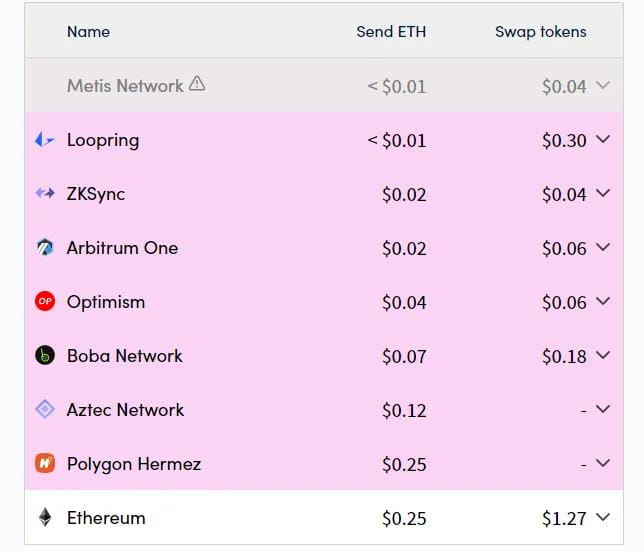
Source: L2fees.info
Because fees are paid in ETH, there is no mechanism to destroy OP tokens. Instead, the activity happening on Optimism actually promotes the burning of base layer ETH. Additionally, since Optimism’s sequencer (where transactions are sent, verified, and sorted) is currently centralized, there are no distributed validators or standard protocol inflation rates like we see in layer 1 blockchains That way. In other words, Optimism has outsourced its validators (security) to Ethereum’s base layer.
This means that the OP token is only a “governance” token today. Therefore, the value embedded in the token comes from the ability of token holders to vote on key future decisions, including whether to return a portion of transaction fees to token holders. This is a token model similar to DeFi applications like Uniswap.
Optimism’s circulating token supply currently accounts for only 5% of the total supply at launch (4,294,967,296) and will grow at a rate of 2% per year. Here is the unlocking schedule:
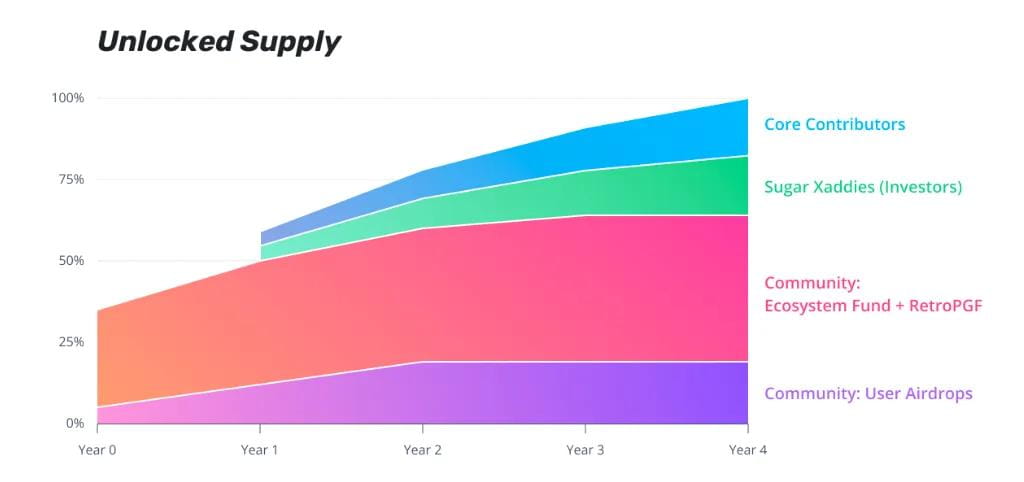
Source: Optimism Community Documentation
Conclusion: With only 5% of the token supply in circulation today and no clear or set inflation rate, it is difficult to predict the appropriate value of OP tokens. The float market cap is currently $214 million, giving a fully diluted market cap of $4.7 billion.
We believe there is clear value here due to product/market fit, usage, volume/revenue and early ecosystem development - especially collaboration with DeFi applications like Uniswap. However, today’s valuation of $4.7 billion seems quite high given the uncertainty surrounding the token’s accumulated value.
Nonetheless, Optimism Labs, the development company behind the protocol, raised $150 million in Series B funding last March at a $1.5 billion valuation. Here’s how we think about it in relation to the value of the protocol (and tokens): Investors in Optimism Equity receive a prorated allocation of tokens when they sign their subscription documents. Why? This is where value is expected to be generated.
Optimism Labs and its investors received 36% of the tokens. So if we value Optimism Labs at $1.5 billion and divide that by 36%, we get a valuation of the protocol (the fully diluted value of the token) of $4.1 billion. How often does the retail industry have easy access to Series B investment opportunities like this at similar valuations to those invested by Silicon Valley insiders? Here are some questions worth thinking about.
Impact on Ethereum
We believe scaling solutions are positive-sum for Ethereum. Layer 2 s will enable Ethereum to usher in its “broadband” moment. We think this will ultimately open up a lot of use cases that may not have been thought of yet. Did anyone think YouTube was possible when we were on AOL? Maybe not. This is enabled by the throughput created by increased bandwidth.
As more applications are deployed on L2, this should lead to more users. This creates more demand for block space and creates more transactions, which causes more ETH to be burned, bringing scarcity and value back into the ETH asset.
According to Ultrasound.money, Optimism is currently the 12th largest contributor to ETH burned in the past 30 days (652 ETH). Arbitrum is just two spots behind.
The key takeaway here is that L2s leverage Ethereum for security and functionality. They pay Ethereum for these services. If these solutions had their own set of validators to secure the network, they might not need to anchor data back to Ethereum — and thus would be seen as competitors rather than admirers.
in conclusion
While mainstream media focuses on Sam Bankman Fried’s (SBF) apology tour, the signal of crypto winter so far is the growth of Ethereum scaling solutions. L2 is quietly becoming the “execution” layer of the technology stack, while Ethereum serves as the “settlement” layer. The application layer of the Ethereum technology stack will eventually be built on Layer 2 (and possibly L3). We believe this is Ethereum’s “broadband moment” and expect to see a proliferation of new use cases and applications in the next cycle – all enabled by new scaling layers.
In the long term, we believe L2s will be the primary driver of value accumulation back into the underlying settlement layer asset of the ETH technology stack. At the same time, we expect leading L2 to gain significant value growth in the next cycle.