

#mpc
mpc
15,046 views
141 Discussing
Hot
Latest

·
--
𝗘𝘃𝗲𝗿 𝘄𝗼𝗻𝗱𝗲𝗿𝗲𝗱 𝗵𝗼𝘄 𝗺𝗮𝗷𝗼𝗿 𝗪𝗲𝗯𝟯 𝗼𝗿𝗴𝗮𝗻𝗶𝘇𝗮𝘁𝗶𝗼𝗻𝘀 𝗮𝗻𝗱 𝗶𝗻𝘀𝘁𝗶𝘁𝘂𝘁𝗶𝗼𝗻𝗮𝗹 𝘁𝗿𝗲𝗮𝘀𝘂𝗿𝗶𝗲𝘀 𝘀𝗲𝗰𝘂𝗿𝗲 𝗺𝗶𝗹𝗹𝗶𝗼𝗻𝘀 𝗼𝗳 𝗱𝗼𝗹𝗹𝗮𝗿𝘀 𝘄𝗶𝘁𝗵𝗼𝘂𝘁 𝗿𝗲𝗹𝘆𝗶𝗻𝗴 𝗼𝗻 𝗮 𝘀𝗶𝗻𝗴𝗹𝗲 𝗽𝗲𝗿𝘀𝗼𝗻'𝘀 𝗽𝗿𝗶𝘃𝗮𝘁𝗲 𝗸𝗲𝘆? 𝗘𝗻𝘁𝗲𝗿 𝗠𝘂𝗹𝘁𝗶-𝗦𝗶𝗴 & 𝗠𝗣𝗖 🔐🛡️
𝘋𝘳𝘢𝘸𝘪𝘯𝘨 𝘧𝘳𝘰𝘮 𝘧𝘰𝘶𝘯𝘥𝘢𝘵𝘪𝘰𝘯𝘢𝘭 𝘭𝘦𝘴𝘴𝘰𝘯𝘴 𝘰𝘯 #BinanceAcademy, 𝘩𝘦𝘳𝘦 𝘪𝘴 𝘺𝘰𝘶𝘳 𝘲𝘶𝘪𝘤𝘬 𝘖𝘗𝘚𝘌𝘊 𝘣𝘳𝘦𝘢𝘬𝘥𝘰𝘸𝘯:
1️⃣ 𝗧𝗵𝗲 𝗦𝗶𝗻𝗴𝗹𝗲 𝗣𝗼𝗶𝗻𝘁 𝗼𝗳 𝗙𝗮𝗶𝗹𝘂𝗿𝗲:
• Traditional wallets (EOAs) rely on one private key, if that key is compromised, all funds can be permanently lost.
2️⃣ 𝗠𝘂𝗹𝘁𝗶-𝗦𝗶𝗴𝗻𝗮𝘁𝘂𝗿𝗲 (𝗠𝘂𝗹𝘁𝗶-𝗦𝗶𝗴) 𝗦𝗺𝗮𝗿𝘁 𝗖𝗼𝗻𝘁𝗿𝗮𝗰𝘁𝘀:
• Require multiple independent signatures (e.g., 3 out of 5 stakeholders) to approve a transaction, distributing trust across a team or multiple devices.
3️⃣ 𝗠𝘂𝗹𝘁𝗶-𝗣𝗮𝗿𝘁𝘆 𝗖𝗼𝗺𝗽𝘂𝘁𝗮𝘁𝗶𝗼𝗻 (𝗠𝗣𝗖):
• Splits a single private key into mathematical "shards" distributed across different servers or devices, the shards compute the signature collaboratively without the full key ever being assembled in one place.
📖 Learn more on Binance Academy: https://www.binance.com/en/academy/glossary/multisignature
Expand your technical literacy, upgrade your operational security 🛡️
Crypto involves risk, this is not financial advice, Always DYOR 💡
#MultiSig #MPC #CryptoEducation
Follow me for more 💛
𝗘𝘃𝗲𝗿 𝘄𝗼𝗻𝗱𝗲𝗿𝗲𝗱 𝗵𝗼𝘄 𝗺𝗮𝗷𝗼𝗿 𝗪𝗲𝗯𝟯 𝗼𝗿𝗴𝗮𝗻𝗶𝘇𝗮𝘁𝗶𝗼𝗻𝘀 𝗮𝗻𝗱 𝗶𝗻𝘀𝘁𝗶𝘁𝘂𝘁𝗶𝗼𝗻𝗮𝗹 𝘁𝗿𝗲𝗮𝘀𝘂𝗿𝗶𝗲𝘀 𝘀𝗲𝗰𝘂𝗿𝗲 𝗺𝗶𝗹𝗹𝗶𝗼𝗻𝘀 𝗼𝗳 𝗱𝗼𝗹𝗹𝗮𝗿𝘀 𝘄𝗶𝘁𝗵𝗼𝘂𝘁 𝗿𝗲𝗹𝘆𝗶𝗻𝗴 𝗼𝗻 𝗮 𝘀𝗶𝗻𝗴𝗹𝗲 𝗽𝗲𝗿𝘀𝗼𝗻'𝘀 𝗽𝗿𝗶𝘃𝗮𝘁𝗲 𝗸𝗲𝘆? 𝗘𝗻𝘁𝗲𝗿 𝗠𝘂𝗹𝘁𝗶-𝗦𝗶𝗴 & 𝗠𝗣𝗖 🔐🛡️
𝘋𝘳𝘢𝘸𝘪𝘯𝘨 𝘧𝘳𝘰𝘮 𝘧𝘰𝘶𝘯𝘥𝘢𝘵𝘪𝘰𝘯𝘢𝘭 𝘭𝘦𝘴𝘴𝘰𝘯𝘴 𝘰𝘯 #BinanceAcademy, 𝘩𝘦𝘳𝘦 𝘪𝘴 𝘺𝘰𝘶𝘳 𝘲𝘶𝘪𝘤𝘬 𝘖𝘗𝘚𝘌𝘊 𝘣𝘳𝘦𝘢𝘬𝘥𝘰𝘸𝘯:
1️⃣ 𝗧𝗵𝗲 𝗦𝗶𝗻𝗴𝗹𝗲 𝗣𝗼𝗶𝗻𝘁 𝗼𝗳 𝗙𝗮𝗶𝗹𝘂𝗿𝗲:
• Traditional wallets (EOAs) rely on one private key, if that key is compromised, all funds can be permanently lost.
2️⃣ 𝗠𝘂𝗹𝘁𝗶-𝗦𝗶𝗴𝗻𝗮𝘁𝘂𝗿𝗲 (𝗠𝘂𝗹𝘁𝗶-𝗦𝗶𝗴) 𝗦𝗺𝗮𝗿𝘁 𝗖𝗼𝗻𝘁𝗿𝗮𝗰𝘁𝘀:
• Require multiple independent signatures (e.g., 3 out of 5 stakeholders) to approve a transaction, distributing trust across a team or multiple devices.
3️⃣ 𝗠𝘂𝗹𝘁𝗶-𝗣𝗮𝗿𝘁𝘆 𝗖𝗼𝗺𝗽𝘂𝘁𝗮𝘁𝗶𝗼𝗻 (𝗠𝗣𝗖):
• Splits a single private key into mathematical "shards" distributed across different servers or devices, the shards compute the signature collaboratively without the full key ever being assembled in one place.
📖 Learn more on Binance Academy: https://www.binance.com/en/academy/glossary/multisignature
Expand your technical literacy, upgrade your operational security 🛡️
Crypto involves risk, this is not financial advice, Always DYOR 💡
#MultiSig #MPC #CryptoEducation
Follow me for more 💛
𝘋𝘳𝘢𝘸𝘪𝘯𝘨 𝘧𝘳𝘰𝘮 𝘧𝘰𝘶𝘯𝘥𝘢𝘵𝘪𝘰𝘯𝘢𝘭 𝘭𝘦𝘴𝘴𝘰𝘯𝘴 𝘰𝘯 #BinanceAcademy, 𝘩𝘦𝘳𝘦 𝘪𝘴 𝘺𝘰𝘶𝘳 𝘲𝘶𝘪𝘤𝘬 𝘖𝘗𝘚𝘌𝘊 𝘣𝘳𝘦𝘢𝘬𝘥𝘰𝘸𝘯:
1️⃣ 𝗧𝗵𝗲 𝗦𝗶𝗻𝗴𝗹𝗲 𝗣𝗼𝗶𝗻𝘁 𝗼𝗳 𝗙𝗮𝗶𝗹𝘂𝗿𝗲:
• Traditional wallets (EOAs) rely on one private key, if that key is compromised, all funds can be permanently lost.
2️⃣ 𝗠𝘂𝗹𝘁𝗶-𝗦𝗶𝗴𝗻𝗮𝘁𝘂𝗿𝗲 (𝗠𝘂𝗹𝘁𝗶-𝗦𝗶𝗴) 𝗦𝗺𝗮𝗿𝘁 𝗖𝗼𝗻𝘁𝗿𝗮𝗰𝘁𝘀:
• Require multiple independent signatures (e.g., 3 out of 5 stakeholders) to approve a transaction, distributing trust across a team or multiple devices.
3️⃣ 𝗠𝘂𝗹𝘁𝗶-𝗣𝗮𝗿𝘁𝘆 𝗖𝗼𝗺𝗽𝘂𝘁𝗮𝘁𝗶𝗼𝗻 (𝗠𝗣𝗖):
• Splits a single private key into mathematical "shards" distributed across different servers or devices, the shards compute the signature collaboratively without the full key ever being assembled in one place.
📖 Learn more on Binance Academy: https://www.binance.com/en/academy/glossary/multisignature
Expand your technical literacy, upgrade your operational security 🛡️
Crypto involves risk, this is not financial advice, Always DYOR 💡
#MultiSig #MPC #CryptoEducation
Follow me for more 💛

Noobie Trader:
Binance Wallet is MCP wallet
1
4
84
·
--
$MPC.US caught traders' eyes today by showing up among the strongest 24-hour gainers. When a smaller token spikes like this, check volume, liquidity, and the project's recent updates before making any move.
What is your first check before buying a fast mover?
Not financial advice. Crypto is volatile, so always do your own research and only invest what you can afford to lose.
#MPC #Binance #altcoins #DYOR #CryptoTrending
{stock_us}(MPC.US)
$MPC.US caught traders' eyes today by showing up among the strongest 24-hour gainers. When a smaller token spikes like this, check volume, liquidity, and the project's recent updates before making any move.
What is your first check before buying a fast mover?
Not financial advice. Crypto is volatile, so always do your own research and only invest what you can afford to lose.
#MPC #Binance #altcoins #DYOR #CryptoTrending
What is your first check before buying a fast mover?
Not financial advice. Crypto is volatile, so always do your own research and only invest what you can afford to lose.
#MPC #Binance #altcoins #DYOR #CryptoTrending
MPCUS+2.61%
53

·
--
Bullish
$GENIUS
🔄Cross-Chain Velocity and the MPC Execution Paradigm🤧
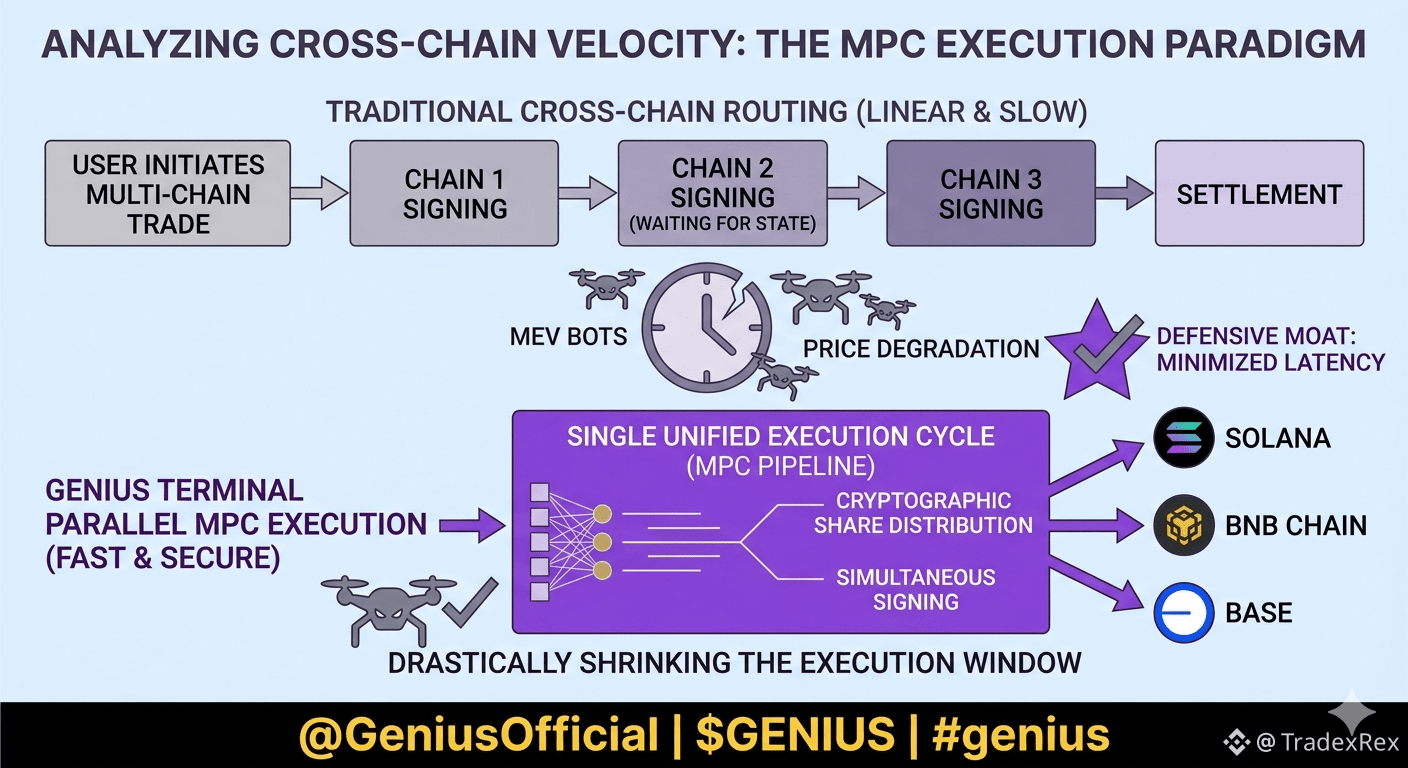
When evaluating decentralized trading infrastructure, most participants focus entirely on frontend speed, completely ignoring backend latency. But in high-volatility environments, the true bottleneck isn't how fast a UI renders—it's the time it takes to securely sign and route cross-chain payloads across separate distributed ledgers. Traditional multi-chain routing requires linear, state-dependent transaction signing, adding vital seconds of exposure to price degradation and front-running bots.
To achieve true capital optimization, the system architecture has to eliminate these structural bottlenecks entirely. This is where @GeniusOfficial introduces a fundamental shift through parallel Multi-Party Computation (#MPC ) execution pipelines.
Instead of processing complex multi-route trades sequentially, the terminal breaks down the transaction payload into distributed, cryptographic shares. By running these cryptographic pieces simultaneously across isolated execution nodes, the terminal can authorize and settle a split order across disparate chains (like #solana , #bnb Chain, and Base) in a single unified execution cycle.
For anyone tracking the long-term structural value of $GENIUS , this isn't just a minor optimization—it’s a defensive moat. By minimizing cross-chain signing latency, the platform drastically shrinks the execution window where MEV bots can exploit slippage. True institutional-grade decentralized trading isn't just about aggregating deep liquidity; it’s about moving that liquidity faster than the predatory bots scanning the mempool. #genius
{future}(GENIUSUSDT)
$GENIUS
🔄Cross-Chain Velocity and the MPC Execution Paradigm🤧
When evaluating decentralized trading infrastructure, most participants focus entirely on frontend speed, completely ignoring backend latency. But in high-volatility environments, the true bottleneck isn't how fast a UI renders—it's the time it takes to securely sign and route cross-chain payloads across separate distributed ledgers. Traditional multi-chain routing requires linear, state-dependent transaction signing, adding vital seconds of exposure to price degradation and front-running bots.
To achieve true capital optimization, the system architecture has to eliminate these structural bottlenecks entirely. This is where @GeniusOfficial introduces a fundamental shift through parallel Multi-Party Computation (#MPC ) execution pipelines.
Instead of processing complex multi-route trades sequentially, the terminal breaks down the transaction payload into distributed, cryptographic shares. By running these cryptographic pieces simultaneously across isolated execution nodes, the terminal can authorize and settle a split order across disparate chains (like #solana , #bnb Chain, and Base) in a single unified execution cycle.
For anyone tracking the long-term structural value of $GENIUS , this isn't just a minor optimization—it’s a defensive moat. By minimizing cross-chain signing latency, the platform drastically shrinks the execution window where MEV bots can exploit slippage. True institutional-grade decentralized trading isn't just about aggregating deep liquidity; it’s about moving that liquidity faster than the predatory bots scanning the mempool. #genius
🔄Cross-Chain Velocity and the MPC Execution Paradigm🤧
When evaluating decentralized trading infrastructure, most participants focus entirely on frontend speed, completely ignoring backend latency. But in high-volatility environments, the true bottleneck isn't how fast a UI renders—it's the time it takes to securely sign and route cross-chain payloads across separate distributed ledgers. Traditional multi-chain routing requires linear, state-dependent transaction signing, adding vital seconds of exposure to price degradation and front-running bots.
To achieve true capital optimization, the system architecture has to eliminate these structural bottlenecks entirely. This is where @GeniusOfficial introduces a fundamental shift through parallel Multi-Party Computation (#MPC ) execution pipelines.
Instead of processing complex multi-route trades sequentially, the terminal breaks down the transaction payload into distributed, cryptographic shares. By running these cryptographic pieces simultaneously across isolated execution nodes, the terminal can authorize and settle a split order across disparate chains (like #solana , #bnb Chain, and Base) in a single unified execution cycle.
For anyone tracking the long-term structural value of $GENIUS , this isn't just a minor optimization—it’s a defensive moat. By minimizing cross-chain signing latency, the platform drastically shrinks the execution window where MEV bots can exploit slippage. True institutional-grade decentralized trading isn't just about aggregating deep liquidity; it’s about moving that liquidity faster than the predatory bots scanning the mempool. #genius
129
Sui ecosystem privacy layer gets an upgrade: Seal MPC officially goes live on the mainnet.
Seal is positioned as a programmable access layer for data, AI, and digital assets. The highlight of this update is the flexibility in deployment—developers can choose to use standalone key servers, an MPC committee, or a hybrid of both, creating stronger trust assumptions.
The first mainnet MPC committee employs a 5-of-8 threshold scheme, composed of 8 node operators: Mysten Labs, Unconfirmed Labs, H2O Nodes, Ruby Nodes, Natsai, Triton One, Nodeinfra, and OverclockSol, significantly enhancing signature security and resistance to collusion.
My take: In the current climate where AI agents and on-chain data authorization scenarios are heating up, whoever cracks the "fine-grained access control + trustlessness" puzzle holds the key to the next narrative. Seal's approach of making MPC a plug-and-play module rather than a single fixed solution is much more friendly for real business applications.
It’s worth keeping an eye on whether the Sui ecosystem will see more AI and RWA projects integrating Seal for key management and data authorization.
#Sui #Seal #MPC $SUI
Sui ecosystem privacy layer gets an upgrade: Seal MPC officially goes live on the mainnet.
Seal is positioned as a programmable access layer for data, AI, and digital assets. The highlight of this update is the flexibility in deployment—developers can choose to use standalone key servers, an MPC committee, or a hybrid of both, creating stronger trust assumptions.
The first mainnet MPC committee employs a 5-of-8 threshold scheme, composed of 8 node operators: Mysten Labs, Unconfirmed Labs, H2O Nodes, Ruby Nodes, Natsai, Triton One, Nodeinfra, and OverclockSol, significantly enhancing signature security and resistance to collusion.
My take: In the current climate where AI agents and on-chain data authorization scenarios are heating up, whoever cracks the "fine-grained access control + trustlessness" puzzle holds the key to the next narrative. Seal's approach of making MPC a plug-and-play module rather than a single fixed solution is much more friendly for real business applications.
It’s worth keeping an eye on whether the Sui ecosystem will see more AI and RWA projects integrating Seal for key management and data authorization.
#Sui #Seal #MPC $SUI
Seal is positioned as a programmable access layer for data, AI, and digital assets. The highlight of this update is the flexibility in deployment—developers can choose to use standalone key servers, an MPC committee, or a hybrid of both, creating stronger trust assumptions.
The first mainnet MPC committee employs a 5-of-8 threshold scheme, composed of 8 node operators: Mysten Labs, Unconfirmed Labs, H2O Nodes, Ruby Nodes, Natsai, Triton One, Nodeinfra, and OverclockSol, significantly enhancing signature security and resistance to collusion.
My take: In the current climate where AI agents and on-chain data authorization scenarios are heating up, whoever cracks the "fine-grained access control + trustlessness" puzzle holds the key to the next narrative. Seal's approach of making MPC a plug-and-play module rather than a single fixed solution is much more friendly for real business applications.
It’s worth keeping an eye on whether the Sui ecosystem will see more AI and RWA projects integrating Seal for key management and data authorization.
#Sui #Seal #MPC $SUI
223

·
--
The Sui mainnet is rolling out a crucial infrastructure upgrade — Seal MPC is officially live.
As a programmable access layer geared towards data, AI, and digital assets, Seal is offering developers three choices: independent key servers, MPC committees, or a hybrid deployment of both. Behind this flexibility lies a stronger trust assumption — you can define your own security boundaries based on the application scenario.
The first mainnet MPC committee adopts a 5-of-8 threshold scheme, and the lineup of node operators is quite noteworthy: Mysten Labs, Unconfirmed Labs, H2O Nodes, Ruby Nodes, Natsai, Triton One, Nodeinfra, and OverclockSol. With decentralization at play, any three parties cannot collude to unlock the keys.
Why is this worth watching?
With the rise of on-chain AI, privacy computing, and custodianship of confidential assets, single-point key management is no longer sufficient. The MPC committee model spreads trust across multiple independent operators, while hybrid deployment allows projects to find a balance between decentralization and performance.
For the $SUI ecosystem, this marks a step from 'programmable assets' to 'programmable access control'. As the access layer thickens, the boundaries for applications on top can naturally expand.
Next, it will be interesting to observe how many new projects will be built on Seal and whether the committee nodes will further expand.
#Sui #Seal #MPC
The Sui mainnet is rolling out a crucial infrastructure upgrade — Seal MPC is officially live.
As a programmable access layer geared towards data, AI, and digital assets, Seal is offering developers three choices: independent key servers, MPC committees, or a hybrid deployment of both. Behind this flexibility lies a stronger trust assumption — you can define your own security boundaries based on the application scenario.
The first mainnet MPC committee adopts a 5-of-8 threshold scheme, and the lineup of node operators is quite noteworthy: Mysten Labs, Unconfirmed Labs, H2O Nodes, Ruby Nodes, Natsai, Triton One, Nodeinfra, and OverclockSol. With decentralization at play, any three parties cannot collude to unlock the keys.
Why is this worth watching?
With the rise of on-chain AI, privacy computing, and custodianship of confidential assets, single-point key management is no longer sufficient. The MPC committee model spreads trust across multiple independent operators, while hybrid deployment allows projects to find a balance between decentralization and performance.
For the $SUI ecosystem, this marks a step from 'programmable assets' to 'programmable access control'. As the access layer thickens, the boundaries for applications on top can naturally expand.
Next, it will be interesting to observe how many new projects will be built on Seal and whether the committee nodes will further expand.
#Sui #Seal #MPC
As a programmable access layer geared towards data, AI, and digital assets, Seal is offering developers three choices: independent key servers, MPC committees, or a hybrid deployment of both. Behind this flexibility lies a stronger trust assumption — you can define your own security boundaries based on the application scenario.
The first mainnet MPC committee adopts a 5-of-8 threshold scheme, and the lineup of node operators is quite noteworthy: Mysten Labs, Unconfirmed Labs, H2O Nodes, Ruby Nodes, Natsai, Triton One, Nodeinfra, and OverclockSol. With decentralization at play, any three parties cannot collude to unlock the keys.
Why is this worth watching?
With the rise of on-chain AI, privacy computing, and custodianship of confidential assets, single-point key management is no longer sufficient. The MPC committee model spreads trust across multiple independent operators, while hybrid deployment allows projects to find a balance between decentralization and performance.
For the $SUI ecosystem, this marks a step from 'programmable assets' to 'programmable access control'. As the access layer thickens, the boundaries for applications on top can naturally expand.
Next, it will be interesting to observe how many new projects will be built on Seal and whether the committee nodes will further expand.
#Sui #Seal #MPC
226

·
--
Threshold Escrow Is Moving from On-Chain Assets to Online Payment Infrastructure2026-08-23
Last week’s lesson was that key security can’t be judged by a one-time generation or a one-time update. Today’s signal is different at another layer: threshold signatures are being embedded into more complex, continuously online payment protocols, and the protocol’s security boundaries must be redesigned as well.
According to an IACR ePrint report, a new paper starts from Lightning’s real-world constraints: the channel endpoint depends on a single online key, and existing on-chain Bitcoin threshold signature experience cannot directly solve Lightning’s message-flow problem. The paper proposes nested threshold multisignatures and uses an Iceberg construction as an example, so that the Lightning side runs as a threshold group, while the counterparty still sees it as a standard MuSig2 participant.
Threshold Escrow Is Moving from On-Chain Assets to Online Payment Infrastructure
2026-08-23
Last week’s lesson was that key security can’t be judged by a one-time generation or a one-time update. Today’s signal is different at another layer: threshold signatures are being embedded into more complex, continuously online payment protocols, and the protocol’s security boundaries must be redesigned as well.
According to an IACR ePrint report, a new paper starts from Lightning’s real-world constraints: the channel endpoint depends on a single online key, and existing on-chain Bitcoin threshold signature experience cannot directly solve Lightning’s message-flow problem. The paper proposes nested threshold multisignatures and uses an Iceberg construction as an example, so that the Lightning side runs as a threshold group, while the counterparty still sees it as a standard MuSig2 participant.
Last week’s lesson was that key security can’t be judged by a one-time generation or a one-time update. Today’s signal is different at another layer: threshold signatures are being embedded into more complex, continuously online payment protocols, and the protocol’s security boundaries must be redesigned as well.
According to an IACR ePrint report, a new paper starts from Lightning’s real-world constraints: the channel endpoint depends on a single online key, and existing on-chain Bitcoin threshold signature experience cannot directly solve Lightning’s message-flow problem. The paper proposes nested threshold multisignatures and uses an Iceberg construction as an example, so that the Lightning side runs as a threshold group, while the counterparty still sees it as a standard MuSig2 participant.
145

A lot of folks see cryptographic algorithms as mere 'knowledge points', but in Web3, they're actually part of a skillset:
Symmetric Encryption (AES)
👉 responsible for 'speed'
Asymmetric Encryption (RSA / ECC)
👉 responsible for 'identity'
Hash
👉 responsible for 'immutability'
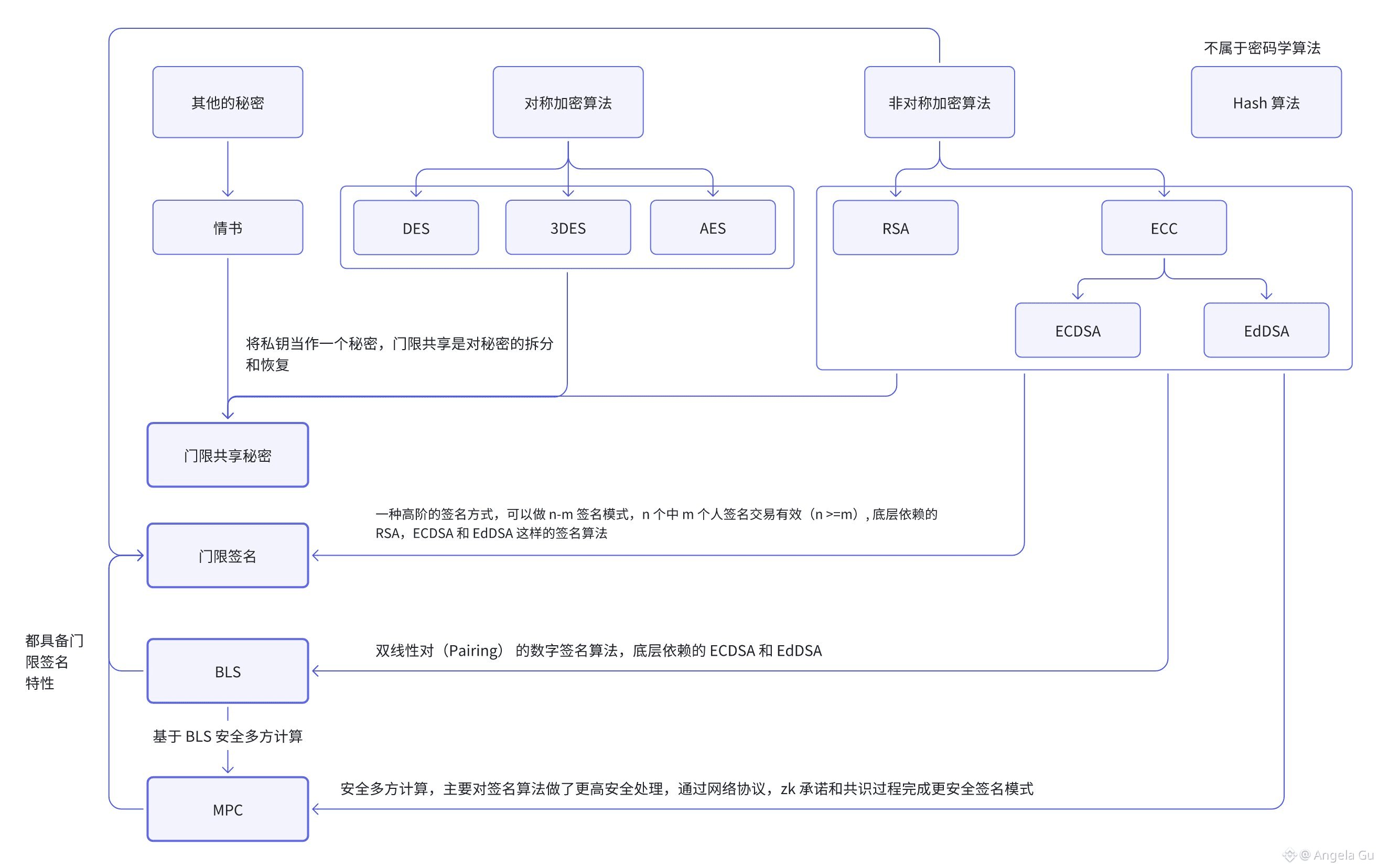
But the real backbone supporting blockchain security is this evolutionary chain:
Private Key → Threshold Secret Sharing → Threshold Signature → BLS → MPC
This is a path from 'individual control' to 'collective consensus security'.
Threshold Secret Sharing breaks a private key into n parts, where any k parts can restore it.
👉 Solves: The private key is no longer controlled by just one person.
Threshold Signature (Threshold Signature) allows k individuals among n to collectively sign, appearing on-chain as 'one signature'.
👉 Security shifts from 'single point' to 'organizational level'.
BLS Signature: Based on bilinear pairing, inherently supports signature aggregation and threshold characteristics, serving as core infrastructure for PoS, public chain consensus, DA, and Rollup validator systems.
MPC (Multi-Party Computation): Not a new signing algorithm, but rather: completing signature calculations without reconstructing the complete private key. Combining network protocols, ZK, and consensus mechanisms transforms 'signing rights' into a 'collaborative process'.
In conclusion:
ECDSA / EdDSA solve 'I can sign'
Threshold Signatures solve 'we sign together'
BLS solves 'many sign efficiently'
MPC solves 'everyone signs but no one actually holds the complete private key'
This is why exchanges, custodians, L2s, validators, and Rollup Sequencers are moving from the 'private key' era to a security architecture of Threshold + BLS + MPC.
Cryptography isn't just algorithms; it's also the design of organizational security structures. #密码学 #安全 #MPC
A lot of folks see cryptographic algorithms as mere 'knowledge points', but in Web3, they're actually part of a skillset:
Symmetric Encryption (AES)
👉 responsible for 'speed'
Asymmetric Encryption (RSA / ECC)
👉 responsible for 'identity'
Hash
👉 responsible for 'immutability'
But the real backbone supporting blockchain security is this evolutionary chain:
Private Key → Threshold Secret Sharing → Threshold Signature → BLS → MPC
This is a path from 'individual control' to 'collective consensus security'.
Threshold Secret Sharing breaks a private key into n parts, where any k parts can restore it.
👉 Solves: The private key is no longer controlled by just one person.
Threshold Signature (Threshold Signature) allows k individuals among n to collectively sign, appearing on-chain as 'one signature'.
👉 Security shifts from 'single point' to 'organizational level'.
BLS Signature: Based on bilinear pairing, inherently supports signature aggregation and threshold characteristics, serving as core infrastructure for PoS, public chain consensus, DA, and Rollup validator systems.
MPC (Multi-Party Computation): Not a new signing algorithm, but rather: completing signature calculations without reconstructing the complete private key. Combining network protocols, ZK, and consensus mechanisms transforms 'signing rights' into a 'collaborative process'.
In conclusion:
ECDSA / EdDSA solve 'I can sign'
Threshold Signatures solve 'we sign together'
BLS solves 'many sign efficiently'
MPC solves 'everyone signs but no one actually holds the complete private key'
This is why exchanges, custodians, L2s, validators, and Rollup Sequencers are moving from the 'private key' era to a security architecture of Threshold + BLS + MPC.
Cryptography isn't just algorithms; it's also the design of organizational security structures. #密码学 #安全 #MPC
Symmetric Encryption (AES)
👉 responsible for 'speed'
Asymmetric Encryption (RSA / ECC)
👉 responsible for 'identity'
Hash
👉 responsible for 'immutability'
But the real backbone supporting blockchain security is this evolutionary chain:
Private Key → Threshold Secret Sharing → Threshold Signature → BLS → MPC
This is a path from 'individual control' to 'collective consensus security'.
Threshold Secret Sharing breaks a private key into n parts, where any k parts can restore it.
👉 Solves: The private key is no longer controlled by just one person.
Threshold Signature (Threshold Signature) allows k individuals among n to collectively sign, appearing on-chain as 'one signature'.
👉 Security shifts from 'single point' to 'organizational level'.
BLS Signature: Based on bilinear pairing, inherently supports signature aggregation and threshold characteristics, serving as core infrastructure for PoS, public chain consensus, DA, and Rollup validator systems.
MPC (Multi-Party Computation): Not a new signing algorithm, but rather: completing signature calculations without reconstructing the complete private key. Combining network protocols, ZK, and consensus mechanisms transforms 'signing rights' into a 'collaborative process'.
In conclusion:
ECDSA / EdDSA solve 'I can sign'
Threshold Signatures solve 'we sign together'
BLS solves 'many sign efficiently'
MPC solves 'everyone signs but no one actually holds the complete private key'
This is why exchanges, custodians, L2s, validators, and Rollup Sequencers are moving from the 'private key' era to a security architecture of Threshold + BLS + MPC.
Cryptography isn't just algorithms; it's also the design of organizational security structures. #密码学 #安全 #MPC
174

🔐 Multi-Party Computation (MPC) Wallets: An Evolution in Crypto Security
Multi-party computation (MPC) wallets are seeing growing interest as a potential alternative to traditional seed phrases for storing cryptocurrencies. This technology aims to enhance security by splitting the private key into multiple parts and distributing them, reducing single points of failure and hacking risks.
━━━━━━━━━━━━━━
📊 Impact: 📈 High
🏷️ OTHER
#MPC #CryptoSecurity #WalletTech #Blockchain
📰 Source: bitcoinfoundation.org
🔐 Multi-Party Computation (MPC) Wallets: An Evolution in Crypto Security
Multi-party computation (MPC) wallets are seeing growing interest as a potential alternative to traditional seed phrases for storing cryptocurrencies. This technology aims to enhance security by splitting the private key into multiple parts and distributing them, reducing single points of failure and hacking risks.
━━━━━━━━━━━━━━
📊 Impact: 📈 High
🏷️ OTHER
#MPC #CryptoSecurity #WalletTech #Blockchain
📰 Source: bitcoinfoundation.org
Multi-party computation (MPC) wallets are seeing growing interest as a potential alternative to traditional seed phrases for storing cryptocurrencies. This technology aims to enhance security by splitting the private key into multiple parts and distributing them, reducing single points of failure and hacking risks.
━━━━━━━━━━━━━━
📊 Impact: 📈 High
🏷️ OTHER
#MPC #CryptoSecurity #WalletTech #Blockchain
📰 Source: bitcoinfoundation.org
38

·
--
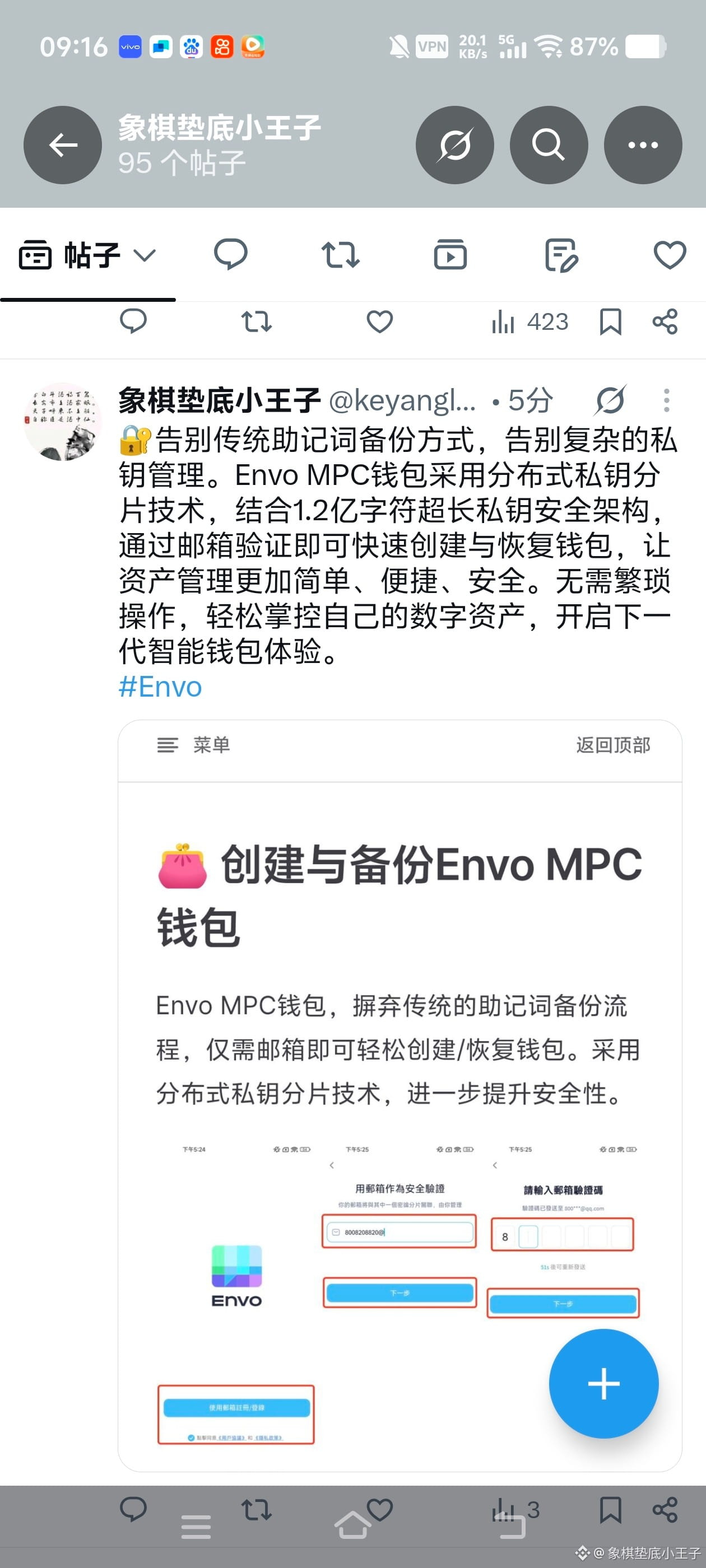
Your assets need a more powerful guardian.🛡️
The Envo MPC wallet breaks through the limitations of traditional wallets with MPC technology + a 120-million-character ultra-long private-key system, offering a safer and smarter asset protection solution. Simple backup, secure storage—so every on-chain operation feels more安心.
#Envo #MPC
Your assets need a more powerful guardian.🛡️
The Envo MPC wallet breaks through the limitations of traditional wallets with MPC technology + a 120-million-character ultra-long private-key system, offering a safer and smarter asset protection solution. Simple backup, secure storage—so every on-chain operation feels more安心.
#Envo #MPC
The Envo MPC wallet breaks through the limitations of traditional wallets with MPC technology + a 120-million-character ultra-long private-key system, offering a safer and smarter asset protection solution. Simple backup, secure storage—so every on-chain operation feels more安心.
#Envo #MPC
1
81

·
--
After RFI and Safeheron launch their quantum digital asset pilot this week, participating institutions will test wallet generation and on-chain transfers on the NEAR testnet. Its signature layer uses the ML-DSA-65 specified in the NIST FIPS 204 standard and is integrated with a multiparty computation (MPC) process.
The technical focus of this test is not to prove that quantum computing can already break existing wallets. Instead, it verifies whether a wallet can switch its cryptographic algorithm without rebuilding the entire custodial infrastructure.
Conventional wallets typically bind the address, private key format, transaction encoding, and signature verification rules to the same elliptic-curve cryptography stack. After migrating to ML-DSA, the public key and signature sizes will increase significantly. Hardware security modules (HSMs), MPC nodes, transaction parsers, and on-chain verification logic all need to be updated in parallel. Simply replacing the signing function in the client is not enough to complete the migration.
MPC also does not automatically provide quantum security. What it addresses is the problem that the private key does not appear as a single complete point. If the parties still jointly execute a traditional signature algorithm, the underlying mathematical assumptions do not change.
This pilot incorporates post-quantum signatures directly into the distributed key generation and signing workflow. It tests the full key lifecycle, including key generation, share storage, joint signing, and on-chain verification.
Post-quantum wallets need to have “cryptographic agility”: accounts can upgrade the signature scheme, old assets can be migrated, new and old algorithms can coexist during the transition period, and recovery and auditing processes remain effective.
The real engineering challenge is not generating a new key, but securely updating the keys across the entire authorization chain.
#钱包技术 #后量子密码 #MPC
After RFI and Safeheron launch their quantum digital asset pilot this week, participating institutions will test wallet generation and on-chain transfers on the NEAR testnet. Its signature layer uses the ML-DSA-65 specified in the NIST FIPS 204 standard and is integrated with a multiparty computation (MPC) process.
The technical focus of this test is not to prove that quantum computing can already break existing wallets. Instead, it verifies whether a wallet can switch its cryptographic algorithm without rebuilding the entire custodial infrastructure.
Conventional wallets typically bind the address, private key format, transaction encoding, and signature verification rules to the same elliptic-curve cryptography stack. After migrating to ML-DSA, the public key and signature sizes will increase significantly. Hardware security modules (HSMs), MPC nodes, transaction parsers, and on-chain verification logic all need to be updated in parallel. Simply replacing the signing function in the client is not enough to complete the migration.
MPC also does not automatically provide quantum security. What it addresses is the problem that the private key does not appear as a single complete point. If the parties still jointly execute a traditional signature algorithm, the underlying mathematical assumptions do not change.
This pilot incorporates post-quantum signatures directly into the distributed key generation and signing workflow. It tests the full key lifecycle, including key generation, share storage, joint signing, and on-chain verification.
Post-quantum wallets need to have “cryptographic agility”: accounts can upgrade the signature scheme, old assets can be migrated, new and old algorithms can coexist during the transition period, and recovery and auditing processes remain effective.
The real engineering challenge is not generating a new key, but securely updating the keys across the entire authorization chain.
#钱包技术 #后量子密码 #MPC
The technical focus of this test is not to prove that quantum computing can already break existing wallets. Instead, it verifies whether a wallet can switch its cryptographic algorithm without rebuilding the entire custodial infrastructure.
Conventional wallets typically bind the address, private key format, transaction encoding, and signature verification rules to the same elliptic-curve cryptography stack. After migrating to ML-DSA, the public key and signature sizes will increase significantly. Hardware security modules (HSMs), MPC nodes, transaction parsers, and on-chain verification logic all need to be updated in parallel. Simply replacing the signing function in the client is not enough to complete the migration.
MPC also does not automatically provide quantum security. What it addresses is the problem that the private key does not appear as a single complete point. If the parties still jointly execute a traditional signature algorithm, the underlying mathematical assumptions do not change.
This pilot incorporates post-quantum signatures directly into the distributed key generation and signing workflow. It tests the full key lifecycle, including key generation, share storage, joint signing, and on-chain verification.
Post-quantum wallets need to have “cryptographic agility”: accounts can upgrade the signature scheme, old assets can be migrated, new and old algorithms can coexist during the transition period, and recovery and auditing processes remain effective.
The real engineering challenge is not generating a new key, but securely updating the keys across the entire authorization chain.
#钱包技术 #后量子密码 #MPC
205
·
--
Blockchain did not bypass the basic boundaries of MPC, and regulation did not bypass record control2026-09-04
Two signals today: one from cryptography research, and one from U.S. securities regulation. Blockchain can provide persistence and finality, but it does not automatically change the classical fault-tolerance threshold for asynchronous MPC. Meanwhile, the SEC has proposed updating the rules for registered transfer agents, bringing electronic records, blockchain records, and risk management under the same modernized framework. [1][2]
According to IACR ePrint 2026/1860, researchers separately analyze asynchronous verifiable secret sharing and asynchronous multi-party computation in blockchain hybrid models. The paper points out that in the absence of a trusted setup, or when relying only on the Minicrypt assumption, asynchronous MPC is still subject to the classical fault-tolerance boundary constraints. Under a public-key assumption with a trusted setup, the authors construct a scheme that tolerates Byzantine adversaries and make the on-chain communication complexity independent of the circuit size. [1]
Blockchain did not bypass the basic boundaries of MPC, and regulation did not bypass record control
2026-09-04
Two signals today: one from cryptography research, and one from U.S. securities regulation. Blockchain can provide persistence and finality, but it does not automatically change the classical fault-tolerance threshold for asynchronous MPC. Meanwhile, the SEC has proposed updating the rules for registered transfer agents, bringing electronic records, blockchain records, and risk management under the same modernized framework. [1][2]
According to IACR ePrint 2026/1860, researchers separately analyze asynchronous verifiable secret sharing and asynchronous multi-party computation in blockchain hybrid models. The paper points out that in the absence of a trusted setup, or when relying only on the Minicrypt assumption, asynchronous MPC is still subject to the classical fault-tolerance boundary constraints. Under a public-key assumption with a trusted setup, the authors construct a scheme that tolerates Byzantine adversaries and make the on-chain communication complexity independent of the circuit size. [1]
Two signals today: one from cryptography research, and one from U.S. securities regulation. Blockchain can provide persistence and finality, but it does not automatically change the classical fault-tolerance threshold for asynchronous MPC. Meanwhile, the SEC has proposed updating the rules for registered transfer agents, bringing electronic records, blockchain records, and risk management under the same modernized framework. [1][2]
According to IACR ePrint 2026/1860, researchers separately analyze asynchronous verifiable secret sharing and asynchronous multi-party computation in blockchain hybrid models. The paper points out that in the absence of a trusted setup, or when relying only on the Minicrypt assumption, asynchronous MPC is still subject to the classical fault-tolerance boundary constraints. Under a public-key assumption with a trusted setup, the authors construct a scheme that tolerates Byzantine adversaries and make the on-chain communication complexity independent of the circuit size. [1]
114


·
--
Verified
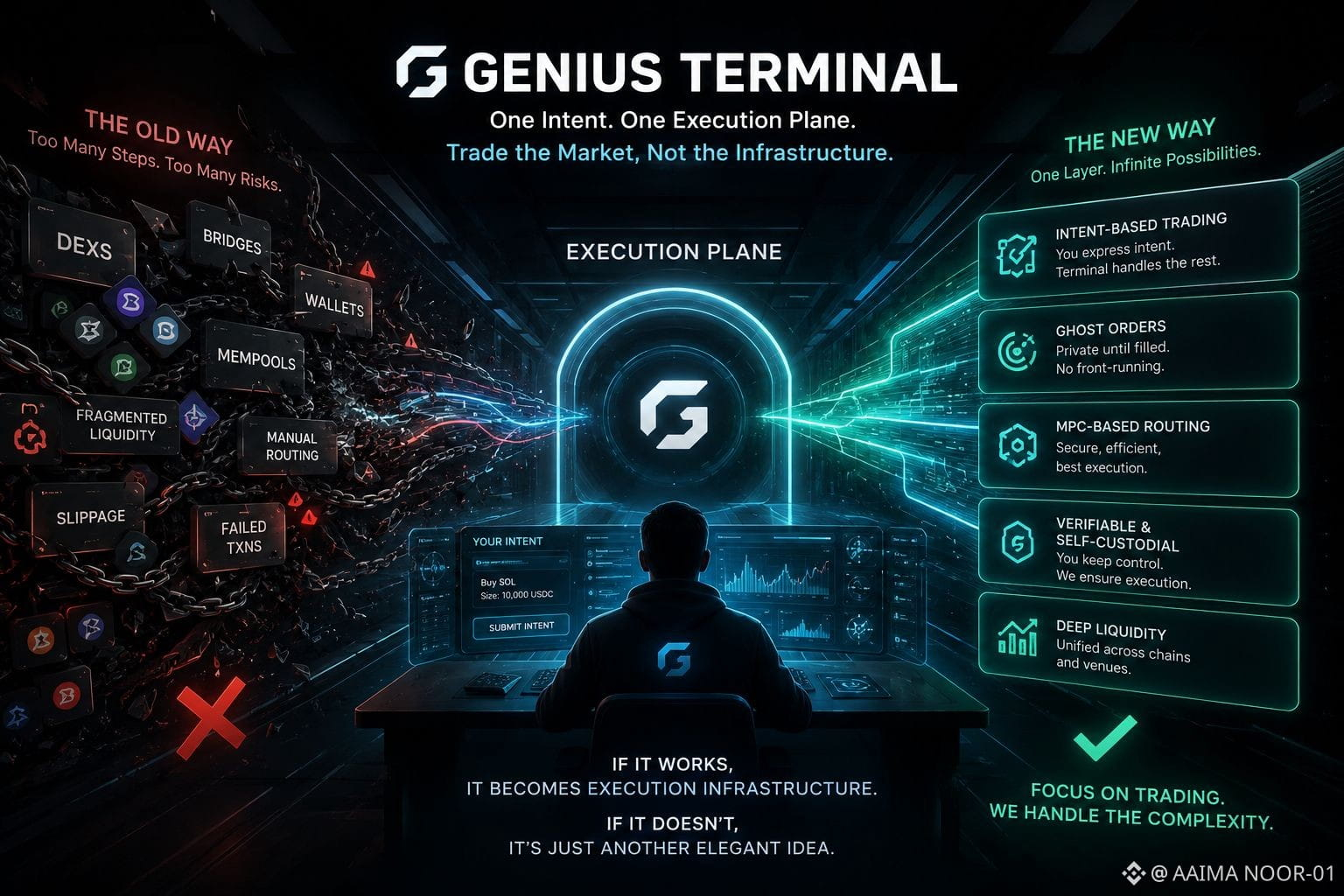
#genius $GENIUS Genius Terminal looks like a serious attempt to compress the mess of on-chain trading into a single execution layer.
Instead of forcing users to deal with DEXs, bridges, wallets, and mempools separately, it shifts everything into an “execution plane” where you interact through intent, not infrastructure. Ghost Orders and MPC-based routing are the core ideas here—not just UX upgrades, but a change in how exposure itself is handled.
What I find interesting isn’t the feature list, but the direction: hiding operational complexity while still trying to keep things verifiable and self-custodial.
That said, I’m cautious. Private execution always creates a tension—less transparency in a system that was built on openness. The real question is whether it can stay fair and liquid when things get volatile and high-volume.
If it works, it’s not just another trading interface—it becomes execution infrastructure.
If it doesn’t, it’s just another elegant idea that couldn’t survive real market stress.
#DeFi #Blockchain #MPC
@GeniusOfficial
$GENIUS
#genius
{future}(GENIUSUSDT)
#genius $GENIUS Genius Terminal looks like a serious attempt to compress the mess of on-chain trading into a single execution layer.
Instead of forcing users to deal with DEXs, bridges, wallets, and mempools separately, it shifts everything into an “execution plane” where you interact through intent, not infrastructure. Ghost Orders and MPC-based routing are the core ideas here—not just UX upgrades, but a change in how exposure itself is handled.
What I find interesting isn’t the feature list, but the direction: hiding operational complexity while still trying to keep things verifiable and self-custodial.
That said, I’m cautious. Private execution always creates a tension—less transparency in a system that was built on openness. The real question is whether it can stay fair and liquid when things get volatile and high-volume.
If it works, it’s not just another trading interface—it becomes execution infrastructure.
If it doesn’t, it’s just another elegant idea that couldn’t survive real market stress.
#DeFi #Blockchain #MPC
@GeniusOfficial
$GENIUS
#genius
Instead of forcing users to deal with DEXs, bridges, wallets, and mempools separately, it shifts everything into an “execution plane” where you interact through intent, not infrastructure. Ghost Orders and MPC-based routing are the core ideas here—not just UX upgrades, but a change in how exposure itself is handled.
What I find interesting isn’t the feature list, but the direction: hiding operational complexity while still trying to keep things verifiable and self-custodial.
That said, I’m cautious. Private execution always creates a tension—less transparency in a system that was built on openness. The real question is whether it can stay fair and liquid when things get volatile and high-volume.
If it works, it’s not just another trading interface—it becomes execution infrastructure.
If it doesn’t, it’s just another elegant idea that couldn’t survive real market stress.
#DeFi #Blockchain #MPC
@GeniusOfficial
$GENIUS
#genius
38
20
736

INSTITUTIONAL GRADE SECURITY FLIPS THE SCRIPT AS BIOMETRIC MPC WALLETS GO LIVE FOR $ETH ! 🔒
Smart money infrastructure just took a major leap forward during TOKEN2049 week. ChainIT released its production-ready organizational MPC wallets, eliminating password vulnerabilities by tying biometric liveness directly to transaction-specific signing authorities. 🦈
Instead of static passphrases that can be phished, isolated dual enclave tech inside AWS Nitro verifies member identity and explicit permissions before any signature executes on $ETH -compatible chains. 📊 This bridges institutional treasury governance with agentic Web3 commerce without ever exposing full private keys. 💡
With passwordless liveness checks setting a new security standard for corporate treasuries, are you holding funds on legacy setups or moving toward biometric MPC control? 🤔
⚠️ Not financial advice. Always manage your risk. 🛡️
🏷️ #ETH #Web3 #Security #TOKEN2049 #MPC
🔥 💎
INSTITUTIONAL GRADE SECURITY FLIPS THE SCRIPT AS BIOMETRIC MPC WALLETS GO LIVE FOR $ETH ! 🔒
Smart money infrastructure just took a major leap forward during TOKEN2049 week. ChainIT released its production-ready organizational MPC wallets, eliminating password vulnerabilities by tying biometric liveness directly to transaction-specific signing authorities. 🦈
Instead of static passphrases that can be phished, isolated dual enclave tech inside AWS Nitro verifies member identity and explicit permissions before any signature executes on $ETH -compatible chains. 📊 This bridges institutional treasury governance with agentic Web3 commerce without ever exposing full private keys. 💡
With passwordless liveness checks setting a new security standard for corporate treasuries, are you holding funds on legacy setups or moving toward biometric MPC control? 🤔
⚠️ Not financial advice. Always manage your risk. 🛡️
🏷️ #ETH #Web3 #Security #TOKEN2049 #MPC
🔥 💎
Smart money infrastructure just took a major leap forward during TOKEN2049 week. ChainIT released its production-ready organizational MPC wallets, eliminating password vulnerabilities by tying biometric liveness directly to transaction-specific signing authorities. 🦈
Instead of static passphrases that can be phished, isolated dual enclave tech inside AWS Nitro verifies member identity and explicit permissions before any signature executes on $ETH -compatible chains. 📊 This bridges institutional treasury governance with agentic Web3 commerce without ever exposing full private keys. 💡
With passwordless liveness checks setting a new security standard for corporate treasuries, are you holding funds on legacy setups or moving toward biometric MPC control? 🤔
⚠️ Not financial advice. Always manage your risk. 🛡️
🏷️ #ETH #Web3 #Security #TOKEN2049 #MPC
🔥 💎
28

·
--
🚨 INSTITUTIONAL INFRASTRUCTURE SHIFT: $CHAINIT UNVEILS MPC WALLETS FOR AGENTIC COMMERCE 🛡️
Smart money capital demands institutional-grade security before committing serious liquidity to agentic Web3 frameworks. 🦈 $CHAINIT is addressing key execution risks by launching dual-enclave MPC wallets that integrate biometric identity verification directly into transaction-level authority checks.
By eliminating static passphrases and enforcing single-use, time-bound approvals, this architecture plugs major structural vulnerabilities in enterprise treasury management across $ETH compatible chains. 🔒 This focus on provable authority establishes a vital foundation as automated AI agents begin executing high-value transactions. 📊
💬 Will biometrically governed MPC wallets become the standard protocol for institutional Web3 treasuries this year? 👇
⚠️ Not financial advice. Always manage your risk. 🛡️
🏷️ #CHAINIT #Web3 #CryptoSecurity #MPC #Infrastructure
🔒 💎
🚨 INSTITUTIONAL INFRASTRUCTURE SHIFT: $CHAINIT UNVEILS MPC WALLETS FOR AGENTIC COMMERCE 🛡️
Smart money capital demands institutional-grade security before committing serious liquidity to agentic Web3 frameworks. 🦈 $CHAINIT is addressing key execution risks by launching dual-enclave MPC wallets that integrate biometric identity verification directly into transaction-level authority checks.
By eliminating static passphrases and enforcing single-use, time-bound approvals, this architecture plugs major structural vulnerabilities in enterprise treasury management across $ETH compatible chains. 🔒 This focus on provable authority establishes a vital foundation as automated AI agents begin executing high-value transactions. 📊
💬 Will biometrically governed MPC wallets become the standard protocol for institutional Web3 treasuries this year? 👇
⚠️ Not financial advice. Always manage your risk. 🛡️
🏷️ #CHAINIT #Web3 #CryptoSecurity #MPC #Infrastructure
🔒 💎
Smart money capital demands institutional-grade security before committing serious liquidity to agentic Web3 frameworks. 🦈 $CHAINIT is addressing key execution risks by launching dual-enclave MPC wallets that integrate biometric identity verification directly into transaction-level authority checks.
By eliminating static passphrases and enforcing single-use, time-bound approvals, this architecture plugs major structural vulnerabilities in enterprise treasury management across $ETH compatible chains. 🔒 This focus on provable authority establishes a vital foundation as automated AI agents begin executing high-value transactions. 📊
💬 Will biometrically governed MPC wallets become the standard protocol for institutional Web3 treasuries this year? 👇
⚠️ Not financial advice. Always manage your risk. 🛡️
🏷️ #CHAINIT #Web3 #CryptoSecurity #MPC #Infrastructure
🔒 💎
30

·
--
MPC Does Not Replace PolicyMulti-party computation can remove one complete private key as a single point of failure. Several participants hold separate shares and cooperate to produce one valid signature only when the threshold is met.
That is valuable, but the threshold is not the complete security model.
The operational question is what causes those shares to participate. If an internal service can create a signing request without passing the expected checks, or if the signers accept a vague instruction that is not bound to the exact transaction, the system can produce a cryptographically valid signature for an unauthorized action.
A serious MPC design should bind approval to the chain, destination, value, calldata, fees, nonce policy and expiry. Signers should verify the approval bundle before participating. Shares should be separated across real failure domains, not placed under one cloud account, one administrator or one vendor-controlled path.
Policy changes need stronger controls than routine transactions. Emergency recovery should be slower, separately governed and tested. Monitoring should compare approved intent with the transaction that was actually broadcast.
MPC protects key control. It does not automatically prove that the request is legitimate or economically safe.
TokenToolHub explains threshold signing, policy bypass, share refresh, monitoring and recovery design:
https://tokentoolhub.com/multi-party-computation-mpc-web3/
#CryptoSecurity #MPC #blockchain #Web3 #wallets
MPC Does Not Replace Policy
Multi-party computation can remove one complete private key as a single point of failure. Several participants hold separate shares and cooperate to produce one valid signature only when the threshold is met.
That is valuable, but the threshold is not the complete security model.
The operational question is what causes those shares to participate. If an internal service can create a signing request without passing the expected checks, or if the signers accept a vague instruction that is not bound to the exact transaction, the system can produce a cryptographically valid signature for an unauthorized action.
A serious MPC design should bind approval to the chain, destination, value, calldata, fees, nonce policy and expiry. Signers should verify the approval bundle before participating. Shares should be separated across real failure domains, not placed under one cloud account, one administrator or one vendor-controlled path.
Policy changes need stronger controls than routine transactions. Emergency recovery should be slower, separately governed and tested. Monitoring should compare approved intent with the transaction that was actually broadcast.
MPC protects key control. It does not automatically prove that the request is legitimate or economically safe.
TokenToolHub explains threshold signing, policy bypass, share refresh, monitoring and recovery design:
https://tokentoolhub.com/multi-party-computation-mpc-web3/
#CryptoSecurity #MPC #blockchain #Web3 #wallets
That is valuable, but the threshold is not the complete security model.
The operational question is what causes those shares to participate. If an internal service can create a signing request without passing the expected checks, or if the signers accept a vague instruction that is not bound to the exact transaction, the system can produce a cryptographically valid signature for an unauthorized action.
A serious MPC design should bind approval to the chain, destination, value, calldata, fees, nonce policy and expiry. Signers should verify the approval bundle before participating. Shares should be separated across real failure domains, not placed under one cloud account, one administrator or one vendor-controlled path.
Policy changes need stronger controls than routine transactions. Emergency recovery should be slower, separately governed and tested. Monitoring should compare approved intent with the transaction that was actually broadcast.
MPC protects key control. It does not automatically prove that the request is legitimate or economically safe.
TokenToolHub explains threshold signing, policy bypass, share refresh, monitoring and recovery design:
https://tokentoolhub.com/multi-party-computation-mpc-web3/
#CryptoSecurity #MPC #blockchain #Web3 #wallets
106
·
--
Multisig or MPC?Multisig and MPC both distribute control, but they expose and enforce policy differently.
With a smart-contract multisig, several owners approve a transaction and the account enforces a threshold on-chain. The owner set, threshold and transaction activity can be inspectable, and the account can add modules, guards, spending rules or timelocks. That transparency is useful, but every extension and admin path becomes part of the security review.
With MPC or threshold signing, participants jointly produce one valid signature without reconstructing the full private key in one place. The resulting transaction can look like a normal externally owned account transaction, which can improve compatibility. The approval policy, recovery flow and operator evidence may sit off-chain, so reliable logs, coordinator security and independent controls matter.
Neither label settles the decision. Compare chain and application compatibility, how approvals are verified, whether policies are publicly auditable, recovery and rotation procedures, infrastructure dependencies, incident response and the evidence retained after each action. Hybrid designs can also combine smart-account policy with threshold signing for owners.
TokenToolHub’s overview explains the tradeoffs without treating either model as automatically safer:
https://tokentoolhub.com/multisig-wallets-safe-gnosis-mpc/
#MultisigSafety #MPC #SelfCustody #CryptoSecurity #blockchain
Multisig or MPC?
Multisig and MPC both distribute control, but they expose and enforce policy differently.
With a smart-contract multisig, several owners approve a transaction and the account enforces a threshold on-chain. The owner set, threshold and transaction activity can be inspectable, and the account can add modules, guards, spending rules or timelocks. That transparency is useful, but every extension and admin path becomes part of the security review.
With MPC or threshold signing, participants jointly produce one valid signature without reconstructing the full private key in one place. The resulting transaction can look like a normal externally owned account transaction, which can improve compatibility. The approval policy, recovery flow and operator evidence may sit off-chain, so reliable logs, coordinator security and independent controls matter.
Neither label settles the decision. Compare chain and application compatibility, how approvals are verified, whether policies are publicly auditable, recovery and rotation procedures, infrastructure dependencies, incident response and the evidence retained after each action. Hybrid designs can also combine smart-account policy with threshold signing for owners.
TokenToolHub’s overview explains the tradeoffs without treating either model as automatically safer:
https://tokentoolhub.com/multisig-wallets-safe-gnosis-mpc/
#MultisigSafety #MPC #SelfCustody #CryptoSecurity #blockchain
With a smart-contract multisig, several owners approve a transaction and the account enforces a threshold on-chain. The owner set, threshold and transaction activity can be inspectable, and the account can add modules, guards, spending rules or timelocks. That transparency is useful, but every extension and admin path becomes part of the security review.
With MPC or threshold signing, participants jointly produce one valid signature without reconstructing the full private key in one place. The resulting transaction can look like a normal externally owned account transaction, which can improve compatibility. The approval policy, recovery flow and operator evidence may sit off-chain, so reliable logs, coordinator security and independent controls matter.
Neither label settles the decision. Compare chain and application compatibility, how approvals are verified, whether policies are publicly auditable, recovery and rotation procedures, infrastructure dependencies, incident response and the evidence retained after each action. Hybrid designs can also combine smart-account policy with threshold signing for owners.
TokenToolHub’s overview explains the tradeoffs without treating either model as automatically safer:
https://tokentoolhub.com/multisig-wallets-safe-gnosis-mpc/
#MultisigSafety #MPC #SelfCustody #CryptoSecurity #blockchain
77

·
--
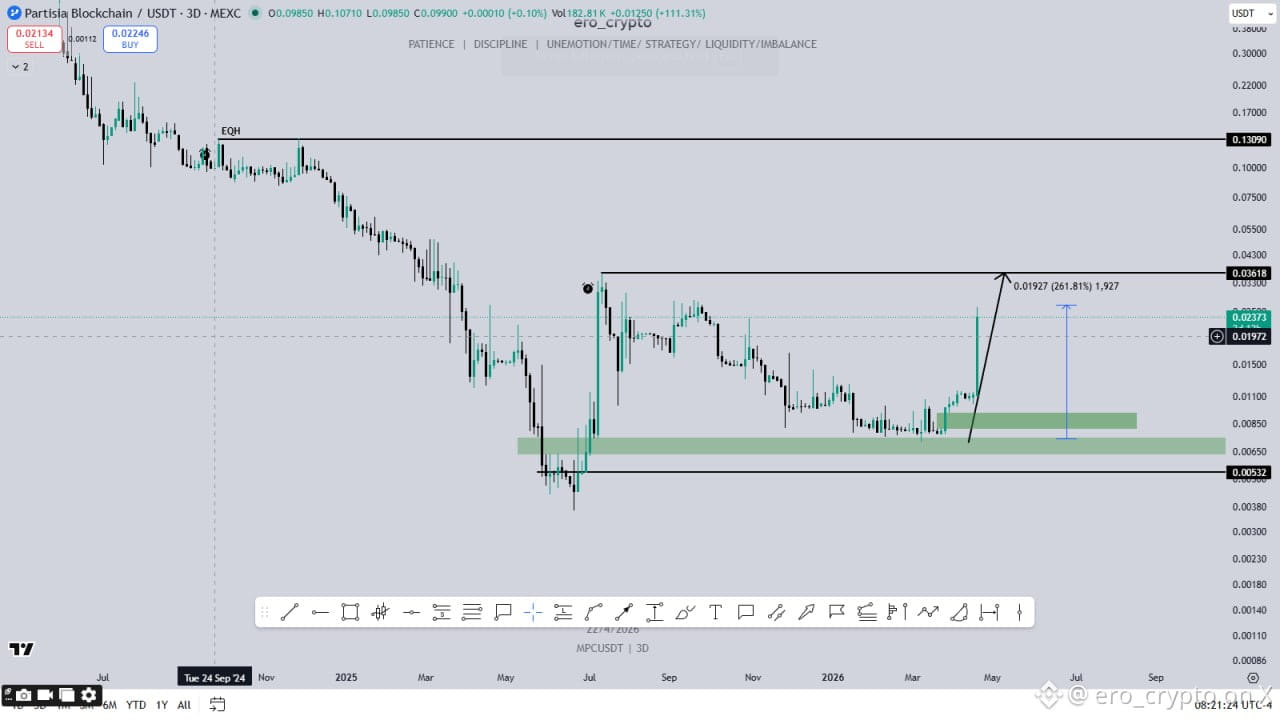
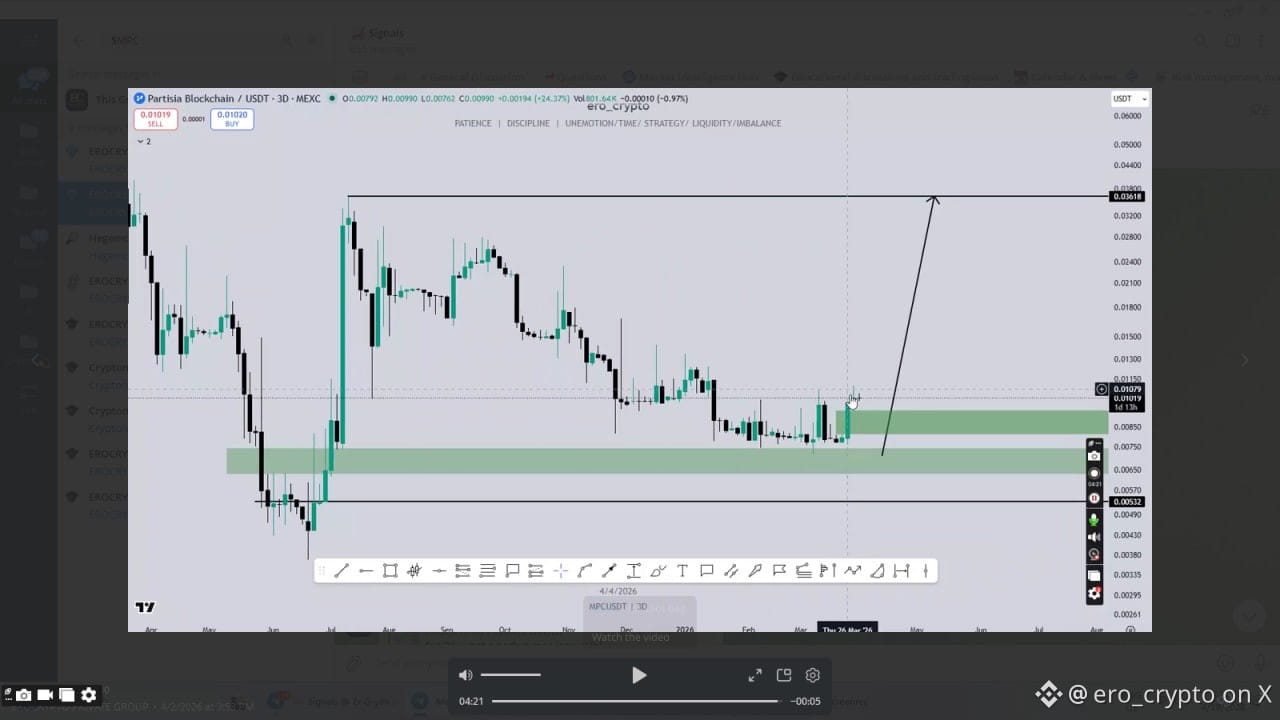
$MPC/ #MPC / @partisiampc - spot bag 260% up after my tweet
1st pic. from my premium video posted on April 2
My premium members always a few steps ahead of 99%
Hit follow here, on X and join my TG channel for Calls, TA and insights like this .
$MPC/ #MPC / @partisiampc - spot bag 260% up after my tweet
1st pic. from my premium video posted on April 2
My premium members always a few steps ahead of 99%
Hit follow here, on X and join my TG channel for Calls, TA and insights like this .
1st pic. from my premium video posted on April 2
My premium members always a few steps ahead of 99%
Hit follow here, on X and join my TG channel for Calls, TA and insights like this .
69

1
402
·
--
The attack surface of a hardware wallet isn’t just inside the device2026-08-17 · Observations on self-custody and key security
No key leakage does not mean there is no risk. According to SafePal’s disclosure on August 16, its order-tracking plugin has an authorization flaw that, under certain conditions, could allow an unauthorized party to access other customers’ order information. Affected data includes name, email, shipping address, phone number, and purchase details, impacting approximately 39,798 customers.
SafePal states that the event does not involve a mnemonic phrase, private key, wallet password, bank card information, or government-issued identification documents, and there is no evidence showing that the wallet or funds were compromised as a result. However, order data turns the fact that “someone owns a hardware wallet” into a profile that can be used for targeted phishing: attackers know how to contact them, where the hardware might be shipped, and how to disguise themselves using after-sales support, replacement services, or firmware reminders.
The attack surface of a hardware wallet isn’t just inside the device
2026-08-17 · Observations on self-custody and key security
No key leakage does not mean there is no risk. According to SafePal’s disclosure on August 16, its order-tracking plugin has an authorization flaw that, under certain conditions, could allow an unauthorized party to access other customers’ order information. Affected data includes name, email, shipping address, phone number, and purchase details, impacting approximately 39,798 customers.
SafePal states that the event does not involve a mnemonic phrase, private key, wallet password, bank card information, or government-issued identification documents, and there is no evidence showing that the wallet or funds were compromised as a result. However, order data turns the fact that “someone owns a hardware wallet” into a profile that can be used for targeted phishing: attackers know how to contact them, where the hardware might be shipped, and how to disguise themselves using after-sales support, replacement services, or firmware reminders.
No key leakage does not mean there is no risk. According to SafePal’s disclosure on August 16, its order-tracking plugin has an authorization flaw that, under certain conditions, could allow an unauthorized party to access other customers’ order information. Affected data includes name, email, shipping address, phone number, and purchase details, impacting approximately 39,798 customers.
SafePal states that the event does not involve a mnemonic phrase, private key, wallet password, bank card information, or government-issued identification documents, and there is no evidence showing that the wallet or funds were compromised as a result. However, order data turns the fact that “someone owns a hardware wallet” into a profile that can be used for targeted phishing: attackers know how to contact them, where the hardware might be shipped, and how to disguise themselves using after-sales support, replacement services, or firmware reminders.
84
·
--
Robinhood August Data: Crypto Trading Rebounds, Event Contracts Still Amplifying2026-09-22
This isn’t a sudden development today; it’s the August operating data that Robinhood released on September 10. The announcement shows that in August, crypto notional trading volume was $17.5 billion, up 61% quarter over quarter, but down 38% year over year. Of that, crypto notional trading volume on the Robinhood App was $7.4 billion, up 72% quarter over quarter, but down 46% year over year.
Another set of data makes it easier to understand how users perceive the product structure: in August, event-contract trading volume was 4.7 billion shares, up about 15x year over year, but down 23% quarter over quarter. This means that “trading activity” can’t be judged by a single total figure alone—different asset classes and statistical methodologies can produce completely different readings.
Robinhood August Data: Crypto Trading Rebounds, Event Contracts Still Amplifying
2026-09-22
This isn’t a sudden development today; it’s the August operating data that Robinhood released on September 10. The announcement shows that in August, crypto notional trading volume was $17.5 billion, up 61% quarter over quarter, but down 38% year over year. Of that, crypto notional trading volume on the Robinhood App was $7.4 billion, up 72% quarter over quarter, but down 46% year over year.
Another set of data makes it easier to understand how users perceive the product structure: in August, event-contract trading volume was 4.7 billion shares, up about 15x year over year, but down 23% quarter over quarter. This means that “trading activity” can’t be judged by a single total figure alone—different asset classes and statistical methodologies can produce completely different readings.
This isn’t a sudden development today; it’s the August operating data that Robinhood released on September 10. The announcement shows that in August, crypto notional trading volume was $17.5 billion, up 61% quarter over quarter, but down 38% year over year. Of that, crypto notional trading volume on the Robinhood App was $7.4 billion, up 72% quarter over quarter, but down 46% year over year.
Another set of data makes it easier to understand how users perceive the product structure: in August, event-contract trading volume was 4.7 billion shares, up about 15x year over year, but down 23% quarter over quarter. This means that “trading activity” can’t be judged by a single total figure alone—different asset classes and statistical methodologies can produce completely different readings.
81
Log in to explore more content
Join global crypto users on Binance Square
⚡️ Get latest and useful information about crypto.
💬 Trusted by the world’s largest crypto exchange.
👍 Discover real insights from verified creators.
Email / Phone number
Trending Topics
1
#BinancePick
3M views
151,670 Discussing
2
#EarningsSeason
5.2M views
25,788 Discussing
3
#AnthropicTTMRevenueGrewAbout1200%
18,994 views
332 Discussing
4
#AnthropicS1ExpectedToday
20,461 views
296 Discussing
5
#SouthKoreaReportedlyWeighsFourthCryptoTaxDelay
25,433 views
416 Discussing
6
#FranklinTempletonFilesForTwoDividendToBitcoinETFs
33,156 views
511 Discussing
7
#StrategyMSTRSurpassesNasdaqInMarketCap
25,513 views
371 Discussing
8
#CanadaProposesStablecoinRedemptionWithin3BusinessDays
1,177 views
34 Discussing
9
#ElectrumWalletBugLetRogueServersStealFunds
27,339 views
448 Discussing
10
#ArgentineCourtDismissesLIBRACaseAgainstMilei
41,564 views
553 Discussing