
#acrossprotocol
acrossprotocol
36,548 views
141 Discussing
Hot
Latest

·
--
"Mixing up people and places" appears again in the information feed: some discussions claim that Uniswap’s revenue data has been applied to $ACX. But Across Protocol is fundamentally a cross-chain interoperability and bridging protocol; the two businesses have no direct linkage. This kind of misaligned narrative won’t be reflected in the token price. Before you chase the updates, verify the source.
Back to the charts: ACX is currently around $0.04145. Its 24-hour trading volume is only about $112,000, and the market cap is approximately $29.84 million. Thin liquidity means that once sentiment shifts, volatility can be amplified easily—position management matters more than the story.
Rather than hopping on unrelated hype, it’s better to track Across’s own bridge transaction volume, growth in deposits, and progress in fee distribution. If the cross-chain sector warms up again, real usage—not narratives—will be the anchor supporting valuation.
#AcrossProtocol #跨链 #ACX
"Mixing up people and places" appears again in the information feed: some discussions claim that Uniswap’s revenue data has been applied to $ACX. But Across Protocol is fundamentally a cross-chain interoperability and bridging protocol; the two businesses have no direct linkage. This kind of misaligned narrative won’t be reflected in the token price. Before you chase the updates, verify the source.
Back to the charts: ACX is currently around $0.04145. Its 24-hour trading volume is only about $112,000, and the market cap is approximately $29.84 million. Thin liquidity means that once sentiment shifts, volatility can be amplified easily—position management matters more than the story.
Rather than hopping on unrelated hype, it’s better to track Across’s own bridge transaction volume, growth in deposits, and progress in fee distribution. If the cross-chain sector warms up again, real usage—not narratives—will be the anchor supporting valuation.
#AcrossProtocol #跨链 #ACX
Back to the charts: ACX is currently around $0.04145. Its 24-hour trading volume is only about $112,000, and the market cap is approximately $29.84 million. Thin liquidity means that once sentiment shifts, volatility can be amplified easily—position management matters more than the story.
Rather than hopping on unrelated hype, it’s better to track Across’s own bridge transaction volume, growth in deposits, and progress in fee distribution. If the cross-chain sector warms up again, real usage—not narratives—will be the anchor supporting valuation.
#AcrossProtocol #跨链 #ACX

I’ve seen discussions linking Uniswap’s revenue data to $ACX, and here we need to stay calm and make a clear distinction: they’re not the same business logic. Uniswap’s revenue data by itself does not directly translate into a positive outlook for Across Protocol, nor can it be simply inferred that the token price will rise.
The key things to focus on for Across Protocol should still be tied to cross-chain bridging volume, user growth, relayer and liquidity provider incentives, as well as the protocol’s own fee allocation and the token unlock schedule.
Currently, the ACX quote is about $0.04145. The 24-hour trading volume is around $112k, and the circulating market cap is about $29.84M. When trading volume is thin, external news is more likely to amplify short-term volatility—so when judging, you should distinguish between “industry news” and the project’s underlying fundamentals.
Don’t mistake data from other protocols as a catalyst for ACX.#AcrossProtocol #跨链 #ACX
I’ve seen discussions linking Uniswap’s revenue data to $ACX, and here we need to stay calm and make a clear distinction: they’re not the same business logic. Uniswap’s revenue data by itself does not directly translate into a positive outlook for Across Protocol, nor can it be simply inferred that the token price will rise.
The key things to focus on for Across Protocol should still be tied to cross-chain bridging volume, user growth, relayer and liquidity provider incentives, as well as the protocol’s own fee allocation and the token unlock schedule.
Currently, the ACX quote is about $0.04145. The 24-hour trading volume is around $112k, and the circulating market cap is about $29.84M. When trading volume is thin, external news is more likely to amplify short-term volatility—so when judging, you should distinguish between “industry news” and the project’s underlying fundamentals.
Don’t mistake data from other protocols as a catalyst for ACX.#AcrossProtocol #跨链 #ACX
The key things to focus on for Across Protocol should still be tied to cross-chain bridging volume, user growth, relayer and liquidity provider incentives, as well as the protocol’s own fee allocation and the token unlock schedule.
Currently, the ACX quote is about $0.04145. The 24-hour trading volume is around $112k, and the circulating market cap is about $29.84M. When trading volume is thin, external news is more likely to amplify short-term volatility—so when judging, you should distinguish between “industry news” and the project’s underlying fundamentals.
Don’t mistake data from other protocols as a catalyst for ACX.#AcrossProtocol #跨链 #ACX

See an interpretation that connects Uniswap revenue data with $ACX—need to cool down first: the original text discusses Uniswap revenue, not Across Protocol’s business data, and the two should not be mixed up, nor does this constitute a direct price catalyst.
Currently, the ACX quote is about $0.04145, with a 24-hour trading volume of about 112,000 USDT, and a market cap of about $29.84 million. Liquidity is relatively thin, and when sentiment amplifies, price fluctuations may be more severe. Focus on cross-chain bridge transaction volume, protocol fees, staking incentives, and the roadmap—these are more meaningful than trying to latch onto unrelated revenue data.
#AcrossProtocol #跨链 #DeFi
See an interpretation that connects Uniswap revenue data with $ACX—need to cool down first: the original text discusses Uniswap revenue, not Across Protocol’s business data, and the two should not be mixed up, nor does this constitute a direct price catalyst.
Currently, the ACX quote is about $0.04145, with a 24-hour trading volume of about 112,000 USDT, and a market cap of about $29.84 million. Liquidity is relatively thin, and when sentiment amplifies, price fluctuations may be more severe. Focus on cross-chain bridge transaction volume, protocol fees, staking incentives, and the roadmap—these are more meaningful than trying to latch onto unrelated revenue data.
#AcrossProtocol #跨链 #DeFi
Currently, the ACX quote is about $0.04145, with a 24-hour trading volume of about 112,000 USDT, and a market cap of about $29.84 million. Liquidity is relatively thin, and when sentiment amplifies, price fluctuations may be more severe. Focus on cross-chain bridge transaction volume, protocol fees, staking incentives, and the roadmap—these are more meaningful than trying to latch onto unrelated revenue data.
#AcrossProtocol #跨链 #DeFi

·
--
There’s a lot of market noise, but don’t force unrelated narratives onto $ACX.
Recently, there has been discussion linking Across Protocol to certain content, but the actual information is Uniswap’s revenue data—which has no direct connection to Across, and therefore doesn’t constitute a price catalyst. Your judgment should still come back to the project itself.
Across is an intents-based cross-chain bridge. It relies on a relayer network and optimistic oracles to enable fast cross-chain transfers. ACX is its ecosystem token.
Data snapshot: current price is about 0.04145 USDT, market cap is about $29.84 million, and 24-hour trading volume is only about $112,000.
A few takeaways:
1· Trading volume is muted and the market cap is relatively small. Low liquidity can amplify volatility, making it easy to get hurt by chasing or panic selling;
2· In the bridge track, the core metrics are real cross-chain volume and relayer income—not sentiment spillover from news in the DEX sector;
3· If you want to track ACX, focus on official bridged transaction volume, the number of active chains, and the token unlock schedule.
Narratives don’t move out of thin air—on-chain data is the real basis.
#AcrossProtocol #跨链 #Web3
There’s a lot of market noise, but don’t force unrelated narratives onto $ACX.
Recently, there has been discussion linking Across Protocol to certain content, but the actual information is Uniswap’s revenue data—which has no direct connection to Across, and therefore doesn’t constitute a price catalyst. Your judgment should still come back to the project itself.
Across is an intents-based cross-chain bridge. It relies on a relayer network and optimistic oracles to enable fast cross-chain transfers. ACX is its ecosystem token.
Data snapshot: current price is about 0.04145 USDT, market cap is about $29.84 million, and 24-hour trading volume is only about $112,000.
A few takeaways:
1· Trading volume is muted and the market cap is relatively small. Low liquidity can amplify volatility, making it easy to get hurt by chasing or panic selling;
2· In the bridge track, the core metrics are real cross-chain volume and relayer income—not sentiment spillover from news in the DEX sector;
3· If you want to track ACX, focus on official bridged transaction volume, the number of active chains, and the token unlock schedule.
Narratives don’t move out of thin air—on-chain data is the real basis.
#AcrossProtocol #跨链 #Web3
Recently, there has been discussion linking Across Protocol to certain content, but the actual information is Uniswap’s revenue data—which has no direct connection to Across, and therefore doesn’t constitute a price catalyst. Your judgment should still come back to the project itself.
Across is an intents-based cross-chain bridge. It relies on a relayer network and optimistic oracles to enable fast cross-chain transfers. ACX is its ecosystem token.
Data snapshot: current price is about 0.04145 USDT, market cap is about $29.84 million, and 24-hour trading volume is only about $112,000.
A few takeaways:
1· Trading volume is muted and the market cap is relatively small. Low liquidity can amplify volatility, making it easy to get hurt by chasing or panic selling;
2· In the bridge track, the core metrics are real cross-chain volume and relayer income—not sentiment spillover from news in the DEX sector;
3· If you want to track ACX, focus on official bridged transaction volume, the number of active chains, and the token unlock schedule.
Narratives don’t move out of thin air—on-chain data is the real basis.
#AcrossProtocol #跨链 #Web3
2
·
--
📊 Across Protocol Recent Market Commentary
Based on the latest data, $ACX is currently trading at around $0.04125, with a 24-hour trading volume of $122,600 and a market cap of approximately $29.7 million.
It should be specifically noted that: the background of this discussion mainly focuses on Uniswap’s revenue data, and does not directly involve Across Protocol’s project progress or changes in fundamentals. Therefore, it will not have a direct impact on the price of $ACX.
In the cross-chain bridge sector, things have been relatively calm lately. As a leading protocol specializing in fast bridging, Across’s token performance is driven more by its own ecosystem developments and overall market risk appetite. Investors are advised to watch key indicators such as subsequent changes in bridging volume and adjustments to incentive policies, and not to be distracted by unrelated information when making judgments.
#AcrossProtocol #Cross-chain sector
📊 Across Protocol Recent Market Commentary
Based on the latest data, $ACX is currently trading at around $0.04125, with a 24-hour trading volume of $122,600 and a market cap of approximately $29.7 million.
It should be specifically noted that: the background of this discussion mainly focuses on Uniswap’s revenue data, and does not directly involve Across Protocol’s project progress or changes in fundamentals. Therefore, it will not have a direct impact on the price of $ACX.
In the cross-chain bridge sector, things have been relatively calm lately. As a leading protocol specializing in fast bridging, Across’s token performance is driven more by its own ecosystem developments and overall market risk appetite. Investors are advised to watch key indicators such as subsequent changes in bridging volume and adjustments to incentive policies, and not to be distracted by unrelated information when making judgments.
#AcrossProtocol #Cross-chain sector
Based on the latest data, $ACX is currently trading at around $0.04125, with a 24-hour trading volume of $122,600 and a market cap of approximately $29.7 million.
It should be specifically noted that: the background of this discussion mainly focuses on Uniswap’s revenue data, and does not directly involve Across Protocol’s project progress or changes in fundamentals. Therefore, it will not have a direct impact on the price of $ACX.
In the cross-chain bridge sector, things have been relatively calm lately. As a leading protocol specializing in fast bridging, Across’s token performance is driven more by its own ecosystem developments and overall market risk appetite. Investors are advised to watch key indicators such as subsequent changes in bridging volume and adjustments to incentive policies, and not to be distracted by unrelated information when making judgments.
#AcrossProtocol #Cross-chain sector
2
$ACX current price is $0.04125, with approximately $1.226 million in 24-hour trading volume and a market cap of $29.7 million.
Recently, what the market has been discussing is Uniswap revenue data, which does not have a direct connection to Across Protocol itself—so this information will not directly affect the $ACX coin price.
For the bridge sector, what truly determines the long-term trend is its own cross-chain transaction volume, TVL growth, and ecosystem integration progress. In the short term, you don’t need to overinterpret external noise.
#AcrossProtocol #跨链桥 #Crypto
$ACX current price is $0.04125, with approximately $1.226 million in 24-hour trading volume and a market cap of $29.7 million.
Recently, what the market has been discussing is Uniswap revenue data, which does not have a direct connection to Across Protocol itself—so this information will not directly affect the $ACX coin price.
For the bridge sector, what truly determines the long-term trend is its own cross-chain transaction volume, TVL growth, and ecosystem integration progress. In the short term, you don’t need to overinterpret external noise.
#AcrossProtocol #跨链桥 #Crypto
Recently, what the market has been discussing is Uniswap revenue data, which does not have a direct connection to Across Protocol itself—so this information will not directly affect the $ACX coin price.
For the bridge sector, what truly determines the long-term trend is its own cross-chain transaction volume, TVL growth, and ecosystem integration progress. In the short term, you don’t need to overinterpret external noise.
#AcrossProtocol #跨链桥 #Crypto
3

·
--
Across Protocol Recent discussions have not mentioned any direct catalytic factors related to $ACX, and the current market sentiment is having no clear impact on the coin price.
The core of this discussion is actually Uniswap’s revenue data, and it has no direct connection to Across Protocol itself. So when you look at the news flow, be sure to distinguish clearly which project the information actually belongs to, to avoid getting thrown off by irrelevant signals.
At the moment, $ACX is quoted at about $0.04092. The 24-hour trading volume is approximately $378,000, and the market cap is around $29.46 million. The overall scale is still relatively small, and liquidity is also limited. In this situation, when there is no clear positive or negative catalyst, the coin price often follows broader market movements, and the probability of an independent breakout is relatively low.
For those holding or paying attention to $ACX, it’s recommended to focus on tracking Across’s own bridging metrics, progress on ecosystem partnerships, and the overall enthusiasm for the cross-chain sector, rather than letting news about other projects confuse your judgment. In the short term, watch more and act less—wait until a catalyst that truly belongs to it appears before making decisions.
#ACX #AcrossProtocol
Across Protocol Recent discussions have not mentioned any direct catalytic factors related to $ACX, and the current market sentiment is having no clear impact on the coin price.
The core of this discussion is actually Uniswap’s revenue data, and it has no direct connection to Across Protocol itself. So when you look at the news flow, be sure to distinguish clearly which project the information actually belongs to, to avoid getting thrown off by irrelevant signals.
At the moment, $ACX is quoted at about $0.04092. The 24-hour trading volume is approximately $378,000, and the market cap is around $29.46 million. The overall scale is still relatively small, and liquidity is also limited. In this situation, when there is no clear positive or negative catalyst, the coin price often follows broader market movements, and the probability of an independent breakout is relatively low.
For those holding or paying attention to $ACX, it’s recommended to focus on tracking Across’s own bridging metrics, progress on ecosystem partnerships, and the overall enthusiasm for the cross-chain sector, rather than letting news about other projects confuse your judgment. In the short term, watch more and act less—wait until a catalyst that truly belongs to it appears before making decisions.
#ACX #AcrossProtocol
The core of this discussion is actually Uniswap’s revenue data, and it has no direct connection to Across Protocol itself. So when you look at the news flow, be sure to distinguish clearly which project the information actually belongs to, to avoid getting thrown off by irrelevant signals.
At the moment, $ACX is quoted at about $0.04092. The 24-hour trading volume is approximately $378,000, and the market cap is around $29.46 million. The overall scale is still relatively small, and liquidity is also limited. In this situation, when there is no clear positive or negative catalyst, the coin price often follows broader market movements, and the probability of an independent breakout is relatively low.
For those holding or paying attention to $ACX, it’s recommended to focus on tracking Across’s own bridging metrics, progress on ecosystem partnerships, and the overall enthusiasm for the cross-chain sector, rather than letting news about other projects confuse your judgment. In the short term, watch more and act less—wait until a catalyst that truly belongs to it appears before making decisions.
#ACX #AcrossProtocol
2
·
--
$ACX current price is about $0.04092, with roughly $378,000 in 24-hour trading volume and a market cap of about $29.46 million.
What has been discussed more recently in the market is Uniswap’s revenue data. This topic has no direct connection to Across Protocol, so it will not create any direct short-term impact on the $ACX price.
For holders, rather than being pulled along by unrelated market noise, it’s better to shift attention back to the protocol itself—bridge volume, user growth, and the fee structure. These are the key variables that determine the long-term direction.
#AcrossProtocol
$ACX current price is about $0.04092, with roughly $378,000 in 24-hour trading volume and a market cap of about $29.46 million.
What has been discussed more recently in the market is Uniswap’s revenue data. This topic has no direct connection to Across Protocol, so it will not create any direct short-term impact on the $ACX price.
For holders, rather than being pulled along by unrelated market noise, it’s better to shift attention back to the protocol itself—bridge volume, user growth, and the fee structure. These are the key variables that determine the long-term direction.
#AcrossProtocol
What has been discussed more recently in the market is Uniswap’s revenue data. This topic has no direct connection to Across Protocol, so it will not create any direct short-term impact on the $ACX price.
For holders, rather than being pulled along by unrelated market noise, it’s better to shift attention back to the protocol itself—bridge volume, user growth, and the fee structure. These are the key variables that determine the long-term direction.
#AcrossProtocol
$ACX currently has a market cap of $28.49 million, a 24-hour trading volume of about $1.06 million, and a current price of $0.0396. As a project in the cross-chain bridge protocol sector, Across Protocol focuses on low-cost, efficient cross-chain asset transfers. At present, market attention is relatively low, and there are no publicly discussed community hot topics for now.
Cross-chain bridges are a very core piece of infrastructure in the cross-chain ecosystem. Against the backdrop of the continued development of the current multi-chain ecosystem, leading cross-chain bridges have already captured most of the market share, making it difficult for emerging projects to break through. Whether Across Protocol can stand out with its own technical features still requires ongoing observation of the project's progress and ecosystem data.
#跨链桥 #AcrossProtocol
$ACX currently has a market cap of $28.49 million, a 24-hour trading volume of about $1.06 million, and a current price of $0.0396. As a project in the cross-chain bridge protocol sector, Across Protocol focuses on low-cost, efficient cross-chain asset transfers. At present, market attention is relatively low, and there are no publicly discussed community hot topics for now.
Cross-chain bridges are a very core piece of infrastructure in the cross-chain ecosystem. Against the backdrop of the continued development of the current multi-chain ecosystem, leading cross-chain bridges have already captured most of the market share, making it difficult for emerging projects to break through. Whether Across Protocol can stand out with its own technical features still requires ongoing observation of the project's progress and ecosystem data.
#跨链桥 #AcrossProtocol
Cross-chain bridges are a very core piece of infrastructure in the cross-chain ecosystem. Against the backdrop of the continued development of the current multi-chain ecosystem, leading cross-chain bridges have already captured most of the market share, making it difficult for emerging projects to break through. Whether Across Protocol can stand out with its own technical features still requires ongoing observation of the project's progress and ecosystem data.
#跨链桥 #AcrossProtocol
2

·
--
🔥 BREAKING NEWS 🔥
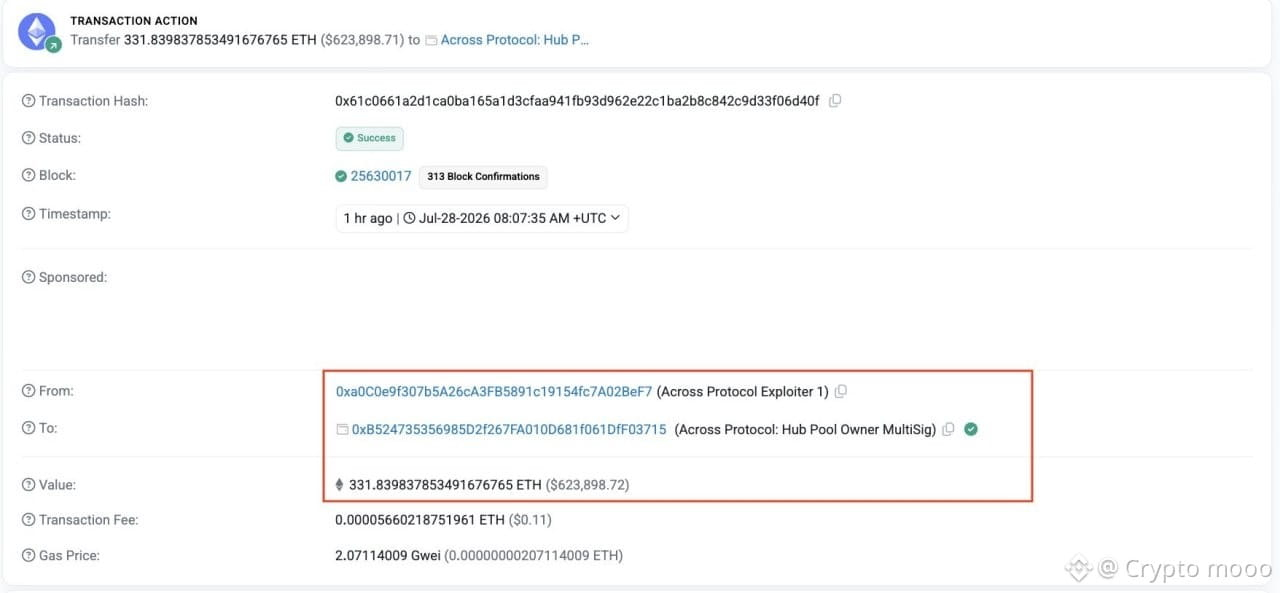
The perpetrator behind the $3.6 million security incident targeting Across Protocol on Solana has returned 331.8 $ETH, valued at approximately $624,000, according to blockchain security firm PeckShield.
#CryptoNews #AcrossProtocol #Ethereum
$TON $SUI
Source: Compiled
🔥 BREAKING NEWS 🔥
The perpetrator behind the $3.6 million security incident targeting Across Protocol on Solana has returned 331.8 $ETH , valued at approximately $624,000, according to blockchain security firm PeckShield.
#CryptoNews #AcrossProtocol #Ethereum
$TON $SUI
Source: Compiled
The perpetrator behind the $3.6 million security incident targeting Across Protocol on Solana has returned 331.8 $ETH , valued at approximately $624,000, according to blockchain security firm PeckShield.
#CryptoNews #AcrossProtocol #Ethereum
$TON $SUI
Source: Compiled
27

·
--
🔥 BREAKING NEWS 🔥
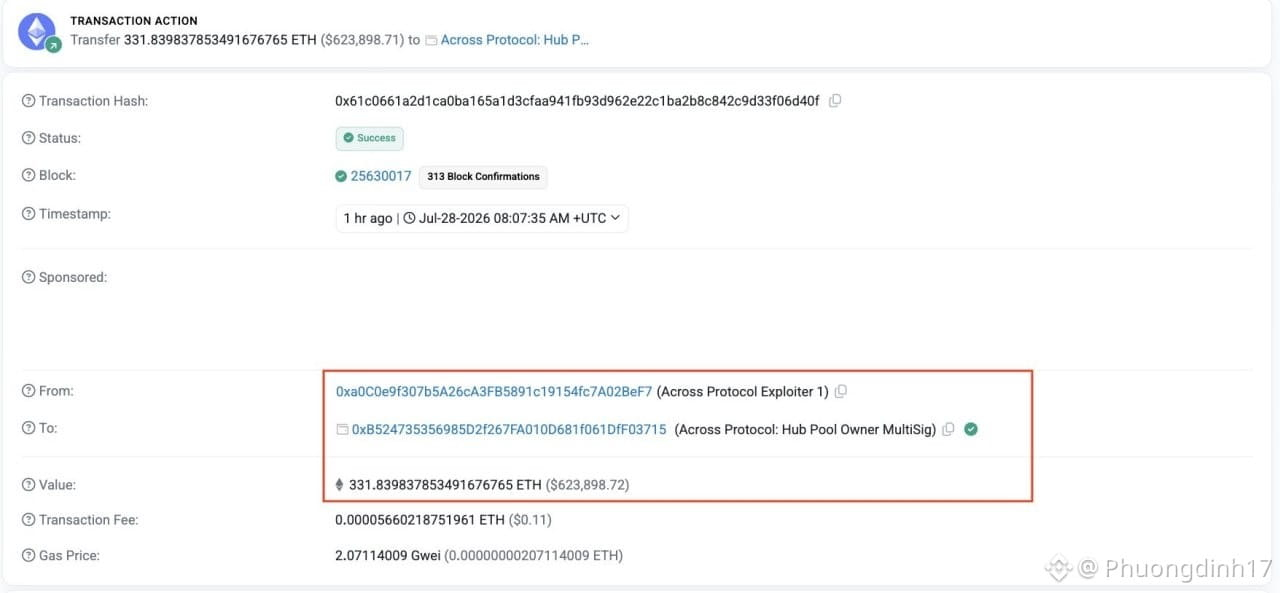
The perpetrator behind the $3.6 million security incident targeting Across Protocol on Solana has returned 331.8 $ETH, valued at approximately $624,000, according to blockchain security firm PeckShield.
#CryptoNews #AcrossProtocol #Ethereum
$TON $SUI
Source: Compiled
🔥 BREAKING NEWS 🔥
The perpetrator behind the $3.6 million security incident targeting Across Protocol on Solana has returned 331.8 $ETH , valued at approximately $624,000, according to blockchain security firm PeckShield.
#CryptoNews #AcrossProtocol #Ethereum
$TON $SUI
Source: Compiled
The perpetrator behind the $3.6 million security incident targeting Across Protocol on Solana has returned 331.8 $ETH , valued at approximately $624,000, according to blockchain security firm PeckShield.
#CryptoNews #AcrossProtocol #Ethereum
$TON $SUI
Source: Compiled
23
·
--
Across Protocol ($ACX) is facing a predicament of multiple negative factors stacking up, with significant downward pressure on prices in the short term. Specifically:
1. Being placed on Binance’s monitoring tag, it faces the risk of delisting in August 2026, dealing a blow to both liquidity and market confidence;
2. Suffered a $4.5 million exploit attack on July 17, raising doubts about the protocol’s security and reducing funding confidence;
3. Smart money accounts are at severe unrealized losses, and the potential exit by large holders may further intensify sell pressure.
At present, ACX is quoted at $0.04058, with only $1.31 million in 24-hour trading volume and a market cap of $29.06 million; liquidity has clearly contracted. With multiple negative factors resonating together, investors should remain alert to the risk of further downside in the short term and not blindly buy the dip.
#AcrossProtocol #ACX
Across Protocol ($ACX) is facing a predicament of multiple negative factors stacking up, with significant downward pressure on prices in the short term. Specifically:
1. Being placed on Binance’s monitoring tag, it faces the risk of delisting in August 2026, dealing a blow to both liquidity and market confidence;
2. Suffered a $4.5 million exploit attack on July 17, raising doubts about the protocol’s security and reducing funding confidence;
3. Smart money accounts are at severe unrealized losses, and the potential exit by large holders may further intensify sell pressure.
At present, ACX is quoted at $0.04058, with only $1.31 million in 24-hour trading volume and a market cap of $29.06 million; liquidity has clearly contracted. With multiple negative factors resonating together, investors should remain alert to the risk of further downside in the short term and not blindly buy the dip.
#AcrossProtocol #ACX
1. Being placed on Binance’s monitoring tag, it faces the risk of delisting in August 2026, dealing a blow to both liquidity and market confidence;
2. Suffered a $4.5 million exploit attack on July 17, raising doubts about the protocol’s security and reducing funding confidence;
3. Smart money accounts are at severe unrealized losses, and the potential exit by large holders may further intensify sell pressure.
At present, ACX is quoted at $0.04058, with only $1.31 million in 24-hour trading volume and a market cap of $29.06 million; liquidity has clearly contracted. With multiple negative factors resonating together, investors should remain alert to the risk of further downside in the short term and not blindly buy the dip.
#AcrossProtocol #ACX
38
Across Protocol($ACX)has recently, one could say, been plagued by “just when it rains, it pours.” First, it was placed on Binance’s monitoring list, with an expected risk of delisting in August 2026; then on July 17, it suffered a $4.5 million vulnerability attack; and on top of that, the smart money accounts are sitting on a large unrealized loss. With multiple negative factors stacking up, downward pressure on the token price is all but inevitable. Currently, ACX is quoted at $0.04058, with a 24-hour trading volume of $1.31 million, and a market cap of about $29.06 million. Overall liquidity has already tightened noticeably.
From the perspective of the on-chain cross-chain bridge sector, ACX’s technical narrative isn’t weak in itself, and its intent-driven bridging approach offers differentiated advantages in user experience. However, in the short to mid term, with three layers of pressure—delisting expectations, security incidents, and large holders exiting—there is unlikely to be any meaningful rebound in the near term. The real factors that could turn things around are either the team delivering substantive security remediation and compensation measures, or a broader recovery in market sentiment and liquidity. Until one of these happens, the risk-reward of “blindly bottom-fishing” isn’t attractive. It’s recommended to stay on the sidelines and wait for right-side signals before making a decision.
#AcrossProtocol#跨链桥#风险预警
Across Protocol($ACX)has recently, one could say, been plagued by “just when it rains, it pours.” First, it was placed on Binance’s monitoring list, with an expected risk of delisting in August 2026; then on July 17, it suffered a $4.5 million vulnerability attack; and on top of that, the smart money accounts are sitting on a large unrealized loss. With multiple negative factors stacking up, downward pressure on the token price is all but inevitable. Currently, ACX is quoted at $0.04058, with a 24-hour trading volume of $1.31 million, and a market cap of about $29.06 million. Overall liquidity has already tightened noticeably.
From the perspective of the on-chain cross-chain bridge sector, ACX’s technical narrative isn’t weak in itself, and its intent-driven bridging approach offers differentiated advantages in user experience. However, in the short to mid term, with three layers of pressure—delisting expectations, security incidents, and large holders exiting—there is unlikely to be any meaningful rebound in the near term. The real factors that could turn things around are either the team delivering substantive security remediation and compensation measures, or a broader recovery in market sentiment and liquidity. Until one of these happens, the risk-reward of “blindly bottom-fishing” isn’t attractive. It’s recommended to stay on the sidelines and wait for right-side signals before making a decision.
#AcrossProtocol#跨链桥#风险预警
From the perspective of the on-chain cross-chain bridge sector, ACX’s technical narrative isn’t weak in itself, and its intent-driven bridging approach offers differentiated advantages in user experience. However, in the short to mid term, with three layers of pressure—delisting expectations, security incidents, and large holders exiting—there is unlikely to be any meaningful rebound in the near term. The real factors that could turn things around are either the team delivering substantive security remediation and compensation measures, or a broader recovery in market sentiment and liquidity. Until one of these happens, the risk-reward of “blindly bottom-fishing” isn’t attractive. It’s recommended to stay on the sidelines and wait for right-side signals before making a decision.
#AcrossProtocol#跨链桥#风险预警
15

Across Protocol has released a post-incident report after attackers forged 1,627 Solana deposit events, representing $41.7 million in attempted deposits.
According to the protocol, mitigation efforts limited the Risk Labs-operated relayer's losses to less than $4 million.
#AcrossProtocol #Solana #SOL #Crypto #Blockchain #Security #DeFi
Across Protocol has released a post-incident report after attackers forged 1,627 Solana deposit events, representing $41.7 million in attempted deposits.
According to the protocol, mitigation efforts limited the Risk Labs-operated relayer's losses to less than $4 million.
#AcrossProtocol #Solana #SOL #Crypto #Blockchain #Security #DeFi
According to the protocol, mitigation efforts limited the Risk Labs-operated relayer's losses to less than $4 million.
#AcrossProtocol #Solana #SOL #Crypto #Blockchain #Security #DeFi

99
·
--
Across Protocol ($ACX) has recently faced consecutive headwinds, with clear downward pressure on the price.
First, on August 17, it was delisted by Binance, causing a sharp drop in liquidity and visibility; then it suffered a vulnerability attack worth more than $4.5 million, dealing a blow to trust; it has now been added to Binance’s monitoring list, and market sentiment has weakened further.
Currently, $ACX is quoted at $0.03783, with about $13.2 million in 24-hour trading and a market cap of only about $27.1 million left. With multiple negative factors piling up, investors should remain vigilant for further volatility driven by sentiment in the short term—do not blindly buy the dip.
What do you think will be the next direction for $ACX? Let’s discuss in the comments below 👇
#ACX #AcrossProtocol
Across Protocol ($ACX) has recently faced consecutive headwinds, with clear downward pressure on the price.
First, on August 17, it was delisted by Binance, causing a sharp drop in liquidity and visibility; then it suffered a vulnerability attack worth more than $4.5 million, dealing a blow to trust; it has now been added to Binance’s monitoring list, and market sentiment has weakened further.
Currently, $ACX is quoted at $0.03783, with about $13.2 million in 24-hour trading and a market cap of only about $27.1 million left. With multiple negative factors piling up, investors should remain vigilant for further volatility driven by sentiment in the short term—do not blindly buy the dip.
What do you think will be the next direction for $ACX? Let’s discuss in the comments below 👇
#ACX #AcrossProtocol
First, on August 17, it was delisted by Binance, causing a sharp drop in liquidity and visibility; then it suffered a vulnerability attack worth more than $4.5 million, dealing a blow to trust; it has now been added to Binance’s monitoring list, and market sentiment has weakened further.
Currently, $ACX is quoted at $0.03783, with about $13.2 million in 24-hour trading and a market cap of only about $27.1 million left. With multiple negative factors piling up, investors should remain vigilant for further volatility driven by sentiment in the short term—do not blindly buy the dip.
What do you think will be the next direction for $ACX? Let’s discuss in the comments below 👇
#ACX #AcrossProtocol
1

·
--
🦈 $ACROSS ATTACKER JUST RETURNED 331.8 ETH – MORE TO FOLLOW? 🚨
📌 A partial repayment of $62.4k to the Across Protocol Hub Pool multi‑sig after a $3.6M Solana heist. This isn’t a full recovery – it’s a signal. 📉
🔍 The chessboard is shifting. Hackers usually don’t return funds unless they’re squeezing pressure or negotiating a deal. Returned ETH to the protocol’s treasury could mean the team is gaining leverage – or that the attacker is trying to soften the blow before a bigger move. 💡
📊 For $ACROSS , this reduces immediate panic bleed. But price action will depend on whether more funds trickle back or if the court of public opinion turns cold. Are you reading this as a capitulation move by the hacker or a calculated smart‑money signal? 👇
⚠️ Not financial advice. Always manage your risk. 🛡️
🏷️ #AcrossProtocol #ACROSS #CryptoNews #HackRecovery #ETH
🔍 💎
🦈 $ACROSS ATTACKER JUST RETURNED 331.8 ETH – MORE TO FOLLOW? 🚨
📌 A partial repayment of $62.4k to the Across Protocol Hub Pool multi‑sig after a $3.6M Solana heist. This isn’t a full recovery – it’s a signal. 📉
🔍 The chessboard is shifting. Hackers usually don’t return funds unless they’re squeezing pressure or negotiating a deal. Returned ETH to the protocol’s treasury could mean the team is gaining leverage – or that the attacker is trying to soften the blow before a bigger move. 💡
📊 For $ACROSS , this reduces immediate panic bleed. But price action will depend on whether more funds trickle back or if the court of public opinion turns cold. Are you reading this as a capitulation move by the hacker or a calculated smart‑money signal? 👇
⚠️ Not financial advice. Always manage your risk. 🛡️
🏷️ #AcrossProtocol #ACROSS #CryptoNews #HackRecovery #ETH
🔍 💎
📌 A partial repayment of $62.4k to the Across Protocol Hub Pool multi‑sig after a $3.6M Solana heist. This isn’t a full recovery – it’s a signal. 📉
🔍 The chessboard is shifting. Hackers usually don’t return funds unless they’re squeezing pressure or negotiating a deal. Returned ETH to the protocol’s treasury could mean the team is gaining leverage – or that the attacker is trying to soften the blow before a bigger move. 💡
📊 For $ACROSS , this reduces immediate panic bleed. But price action will depend on whether more funds trickle back or if the court of public opinion turns cold. Are you reading this as a capitulation move by the hacker or a calculated smart‑money signal? 👇
⚠️ Not financial advice. Always manage your risk. 🛡️
🏷️ #AcrossProtocol #ACROSS #CryptoNews #HackRecovery #ETH
🔍 💎
16

·
--
Across Protocol attackers have returned 331.8 ETH (about $623,900) to a multisig address controlled by the Across Protocol Hub Pool owner.
On the surface, this looks like stop-loss progress; what’s really worth discussing is the return recipient:
The funds are flowing back to a multisig address, not directly to the user side. That means the real risk lies in how the funds will be allocated afterward, how the accounting will be done, and who will confirm the loss amount.
The attacker’s willingness to return about $623,900 usually suggests the incident is more like a negotiable security matter rather than a completely out-of-control token theft and exit. However, the news does not specify the vulnerability type, the total loss, or whether the full amount was returned, so the market can’t simply treat this as risk fully resolved.
More subtly, PeckShield disclosed the details before the project itself. This may force Across to complete the missing details with a more transparent incident report. If the project only emphasizes that the funds were returned while avoiding the attack path, that’s the red flag traders should watch for.
For ACX traders, the short-term issue isn’t really those 331.8 ETH—it’s instead: whether there are additional returns afterward, whether the relevant cross-chain routes are paused, and whether liquidity providers have started to withdraw.
Do you think that after a cross-chain protocol is hacked, returned funds can restore trust?
#AcrossProtocol #ACX #跨链安全 #PeckShield #Attack
Across Protocol attackers have returned 331.8 ETH (about $623,900) to a multisig address controlled by the Across Protocol Hub Pool owner.
On the surface, this looks like stop-loss progress; what’s really worth discussing is the return recipient:
The funds are flowing back to a multisig address, not directly to the user side. That means the real risk lies in how the funds will be allocated afterward, how the accounting will be done, and who will confirm the loss amount.
The attacker’s willingness to return about $623,900 usually suggests the incident is more like a negotiable security matter rather than a completely out-of-control token theft and exit. However, the news does not specify the vulnerability type, the total loss, or whether the full amount was returned, so the market can’t simply treat this as risk fully resolved.
More subtly, PeckShield disclosed the details before the project itself. This may force Across to complete the missing details with a more transparent incident report. If the project only emphasizes that the funds were returned while avoiding the attack path, that’s the red flag traders should watch for.
For ACX traders, the short-term issue isn’t really those 331.8 ETH—it’s instead: whether there are additional returns afterward, whether the relevant cross-chain routes are paused, and whether liquidity providers have started to withdraw.
Do you think that after a cross-chain protocol is hacked, returned funds can restore trust?
#AcrossProtocol #ACX #跨链安全 #PeckShield #Attack
On the surface, this looks like stop-loss progress; what’s really worth discussing is the return recipient:
The funds are flowing back to a multisig address, not directly to the user side. That means the real risk lies in how the funds will be allocated afterward, how the accounting will be done, and who will confirm the loss amount.
The attacker’s willingness to return about $623,900 usually suggests the incident is more like a negotiable security matter rather than a completely out-of-control token theft and exit. However, the news does not specify the vulnerability type, the total loss, or whether the full amount was returned, so the market can’t simply treat this as risk fully resolved.
More subtly, PeckShield disclosed the details before the project itself. This may force Across to complete the missing details with a more transparent incident report. If the project only emphasizes that the funds were returned while avoiding the attack path, that’s the red flag traders should watch for.
For ACX traders, the short-term issue isn’t really those 331.8 ETH—it’s instead: whether there are additional returns afterward, whether the relevant cross-chain routes are paused, and whether liquidity providers have started to withdraw.
Do you think that after a cross-chain protocol is hacked, returned funds can restore trust?
#AcrossProtocol #ACX #跨链安全 #PeckShield #Attack
147

🚨 Across protocol confirms an attack on the Solana bridge.. Users’ funds are safe!
Across protocol confirmed that its Solana bridge was targeted by a security attack, which led to deposits being temporarily suspended. The protocol reassured users that their funds were not affected and are completely safe, while investigations into the incident continue.
━━━━━━━━━━━━━━
📊 Impact: 📈 High
🏷️ DEFI
#AcrossProtocol #Solana #BridgeAttack #DeFiSecurity #CryptoNews
🔗 Source: https://cryptobriefing.com/across-protocol-solana-bridge-attack/
🚨 Across protocol confirms an attack on the Solana bridge.. Users’ funds are safe!
Across protocol confirmed that its Solana bridge was targeted by a security attack, which led to deposits being temporarily suspended. The protocol reassured users that their funds were not affected and are completely safe, while investigations into the incident continue.
━━━━━━━━━━━━━━
📊 Impact: 📈 High
🏷️ DEFI
#AcrossProtocol #Solana #BridgeAttack #DeFiSecurity #CryptoNews
🔗 Source: https://cryptobriefing.com/across-protocol-solana-bridge-attack/
Across protocol confirmed that its Solana bridge was targeted by a security attack, which led to deposits being temporarily suspended. The protocol reassured users that their funds were not affected and are completely safe, while investigations into the incident continue.
━━━━━━━━━━━━━━
📊 Impact: 📈 High
🏷️ DEFI
#AcrossProtocol #Solana #BridgeAttack #DeFiSecurity #CryptoNews
🔗 Source: https://cryptobriefing.com/across-protocol-solana-bridge-attack/
21
Across Protocol ($ACX) recently faced multiple bearish blows:
Binance will delist it on August 17, tightening liquidity channels; it was then hit by a vulnerability attack of about $4.5 million, damaging trust; it has now been added to Binance’s monitoring list, putting market confidence under pressure.
At present, it is quoting $ACX at $0.03783, with a 24-hour trading volume of $13.2 million and a market cap of about $27.1 million. With the combined effects of the delisting, a trust crisis, and monitoring pressure, the short-term trend is not looking optimistic—investors should watch for further downside risk.
#ACX #AcrossProtocol
Across Protocol ($ACX) recently faced multiple bearish blows:
Binance will delist it on August 17, tightening liquidity channels; it was then hit by a vulnerability attack of about $4.5 million, damaging trust; it has now been added to Binance’s monitoring list, putting market confidence under pressure.
At present, it is quoting $ACX at $0.03783, with a 24-hour trading volume of $13.2 million and a market cap of about $27.1 million. With the combined effects of the delisting, a trust crisis, and monitoring pressure, the short-term trend is not looking optimistic—investors should watch for further downside risk.
#ACX #AcrossProtocol
Binance will delist it on August 17, tightening liquidity channels; it was then hit by a vulnerability attack of about $4.5 million, damaging trust; it has now been added to Binance’s monitoring list, putting market confidence under pressure.
At present, it is quoting $ACX at $0.03783, with a 24-hour trading volume of $13.2 million and a market cap of about $27.1 million. With the combined effects of the delisting, a trust crisis, and monitoring pressure, the short-term trend is not looking optimistic—investors should watch for further downside risk.
#ACX #AcrossProtocol
5
Across Protocol ($ACX) has recently faced multiple negative catalysts, making its situation increasingly difficult. On one hand, Binance has placed it on its watchlist, and it is expected to face a delisting risk in August 2026, with liquidity and market confidence continuing to be under pressure. On the other hand, the $4.5 million vulnerability attack that occurred on July 17 further exposed the protocol’s weaknesses on the security front, dealing a clear blow to community trust. Even more worrying is that some “smart money” accounts have begun showing large unrealized losses, and there are obvious signs of capital outflows. Based on current data, the quote at $ACX is only $0.04058, with a 24-hour trading volume of $1.31 million and a market cap of about $29.06 million. Liquidity is low, so any small rumor or development is easily magnified. Against the backdrop of multiple negative factors converging, the risk of short-term price downside cannot be ignored.
Of course, the cross-chain bridge sector still has long-term narrative value. The key is whether the team can make substantive fixes to the security vulnerabilities, and how it will respond to ecosystem contraction brought on by exchange delistings. For holders, perhaps what matters more right now is risk management rather than blindly trying to buy the dip.
One-sentence summary: Negative news is piling up—stay cautious. #AcrossProtocol#cross-chain bridge#crypto market
Across Protocol ($ACX) has recently faced multiple negative catalysts, making its situation increasingly difficult. On one hand, Binance has placed it on its watchlist, and it is expected to face a delisting risk in August 2026, with liquidity and market confidence continuing to be under pressure. On the other hand, the $4.5 million vulnerability attack that occurred on July 17 further exposed the protocol’s weaknesses on the security front, dealing a clear blow to community trust. Even more worrying is that some “smart money” accounts have begun showing large unrealized losses, and there are obvious signs of capital outflows. Based on current data, the quote at $ACX is only $0.04058, with a 24-hour trading volume of $1.31 million and a market cap of about $29.06 million. Liquidity is low, so any small rumor or development is easily magnified. Against the backdrop of multiple negative factors converging, the risk of short-term price downside cannot be ignored.
Of course, the cross-chain bridge sector still has long-term narrative value. The key is whether the team can make substantive fixes to the security vulnerabilities, and how it will respond to ecosystem contraction brought on by exchange delistings. For holders, perhaps what matters more right now is risk management rather than blindly trying to buy the dip.
One-sentence summary: Negative news is piling up—stay cautious. #AcrossProtocol#cross-chain bridge#crypto market
Of course, the cross-chain bridge sector still has long-term narrative value. The key is whether the team can make substantive fixes to the security vulnerabilities, and how it will respond to ecosystem contraction brought on by exchange delistings. For holders, perhaps what matters more right now is risk management rather than blindly trying to buy the dip.
One-sentence summary: Negative news is piling up—stay cautious. #AcrossProtocol#cross-chain bridge#crypto market
34
Log in to explore more content
Join global crypto users on Binance Square
⚡️ Get latest and useful information about crypto.
💬 Trusted by the world’s largest crypto exchange.
👍 Discover real insights from verified creators.
Email / Phone number
Trending Topics
1
#AppleDebutsFoldablePhone
21,058 views
424 Discussing
2
#IranSaysReadyToEscalateWarWithUS
871 views
41 Discussing
3
#EUExtendsCentralContactPointToCASPs
4,732 views
140 Discussing
4
#US10YTreasuryYieldHitsHighestSinceNov2023
22,038 views
358 Discussing
5
#USTreasuryToBuyBackUpTo$6BLongDatedDebt
15,624 views
160 Discussing
6
#BitcoinSurpasses$79K
65,170 views
276 Discussing
7
#BrentCrudeTops$100
121,924 views
399 Discussing
8
#USADPWeeklyEmploymentRises12000
105,493 views
1,270 Discussing
9
#BankOfAmericaGroupPilotsUSBDCStablecoin
77,540 views
1,019 Discussing
10
#RippleLobbiesToAdvanceCLARITYActVote
113,026 views
1,293 Discussing