
#openledger
openledger
17.3M views
202,843 Discussing
Hot
Latest


·
--

Article
The Hidden Economy Behind IntelligenceOne thing I've learned after years of watching crypto markets is that the biggest opportunities rarely arrive looking important.
Most people pay attention to the loudest narratives. The tokens making headlines. The charts moving vertically. The promises of a new revolution every few months. But when I look back at the projects that actually changed the industry, many of them started as boring infrastructure. They solved a problem before most people even realized the problem existed.
That's partly why OpenLedger caught my attention.
Not because it combines AI and blockchain. That alone doesn't mean much anymore. Every cycle eventually reaches a point where attaching a popular narrative to a token becomes easy. What interests me is a deeper question that the project is trying to explore.
Who owns intelligence?
It's a strange question, but I think it becomes more important every day.
Right now, AI is creating enormous amounts of value. People contribute data. Developers build models. Autonomous agents perform tasks. Businesses integrate AI into products and workflows. Yet most of the economic value still flows toward a small number of centralized platforms.
The contributors often remain invisible.
The data becomes someone else's asset. The model becomes someone else's business. The value gets captured somewhere far away from where it was actually created.
What OpenLedger seems to be pursuing is an alternative structure. A system where data, models, and AI agents can become economic assets that are easier to track, attribute, and monetize.
Maybe that sounds technical.
But I don't think it's really a technology story.
I think it's a market story.
Crypto has always been at its best when it creates new forms of coordination. Bitcoin created digital scarcity. Stablecoins created internet-native dollars. Decentralized exchanges created global liquidity networks.
The interesting question now is whether AI needs its own economic infrastructure.
If intelligence becomes a resource, then perhaps it also needs markets. Markets where contributors can participate instead of simply being extracted from.
That's the theory.
The reality is much harder.
Building the technology is only the first step. Creating a functioning economy around that technology is a completely different challenge. History is full of networks that worked perfectly from an engineering perspective and failed completely from an economic perspective.
People need reasons to contribute.
Developers need reasons to build.
Businesses need reasons to trust the system.
Without those things, even the most elegant infrastructure remains an interesting experiment.
This is where my optimism and skepticism meet each other.
I can see why the idea matters. AI is moving faster than almost any technology I have seen during my time in markets. New models appear every month. Agent frameworks evolve every week. Entire workflows are being redesigned around machine intelligence.
But speed alone doesn't create value.
Ownership does.
Incentives do.
Coordination does.
The projects that matter over the next decade may not be the ones building the smartest AI. They may be the ones building the economic rails that allow intelligence to move, trade, and generate value across open networks.
Whether OpenLedger becomes one of those projects remains to be seen.
There are still difficult questions. Will builders choose decentralized infrastructure when centralized alternatives are simpler? Can attribution be measured accurately enough to reward contributors fairly? Will value accrue to the network itself or simply to the applications built on top of it?
Nobody knows yet.
And honestly, that's what makes it interesting.
The market often treats uncertainty as a weakness. I tend to view it differently. Uncertainty is where genuine discovery happens.
When I look at OpenLedger, I don't see a guaranteed winner. I see an attempt to solve a problem that will become increasingly important as AI becomes embedded into everyday economic actvity.
Maybe it works.
Maybe it doesn't.
But if the future economy is increasingly powered by intelligence, then figuring out who owns that intelligence and who gets paid for creating it feels like one of the most important questions the industry can ask.
The answer may end up being worth far more than the latest narrative driving today's price action.
$OPEN @Openledger #openledger
The Hidden Economy Behind Intelligence
One thing I've learned after years of watching crypto markets is that the biggest opportunities rarely arrive looking important.
Most people pay attention to the loudest narratives. The tokens making headlines. The charts moving vertically. The promises of a new revolution every few months. But when I look back at the projects that actually changed the industry, many of them started as boring infrastructure. They solved a problem before most people even realized the problem existed.
That's partly why OpenLedger caught my attention.
Not because it combines AI and blockchain. That alone doesn't mean much anymore. Every cycle eventually reaches a point where attaching a popular narrative to a token becomes easy. What interests me is a deeper question that the project is trying to explore.
Who owns intelligence?
It's a strange question, but I think it becomes more important every day.
Right now, AI is creating enormous amounts of value. People contribute data. Developers build models. Autonomous agents perform tasks. Businesses integrate AI into products and workflows. Yet most of the economic value still flows toward a small number of centralized platforms.
The contributors often remain invisible.
The data becomes someone else's asset. The model becomes someone else's business. The value gets captured somewhere far away from where it was actually created.
What OpenLedger seems to be pursuing is an alternative structure. A system where data, models, and AI agents can become economic assets that are easier to track, attribute, and monetize.
Maybe that sounds technical.
But I don't think it's really a technology story.
I think it's a market story.
Crypto has always been at its best when it creates new forms of coordination. Bitcoin created digital scarcity. Stablecoins created internet-native dollars. Decentralized exchanges created global liquidity networks.
The interesting question now is whether AI needs its own economic infrastructure.
If intelligence becomes a resource, then perhaps it also needs markets. Markets where contributors can participate instead of simply being extracted from.
That's the theory.
The reality is much harder.
Building the technology is only the first step. Creating a functioning economy around that technology is a completely different challenge. History is full of networks that worked perfectly from an engineering perspective and failed completely from an economic perspective.
People need reasons to contribute.
Developers need reasons to build.
Businesses need reasons to trust the system.
Without those things, even the most elegant infrastructure remains an interesting experiment.
This is where my optimism and skepticism meet each other.
I can see why the idea matters. AI is moving faster than almost any technology I have seen during my time in markets. New models appear every month. Agent frameworks evolve every week. Entire workflows are being redesigned around machine intelligence.
But speed alone doesn't create value.
Ownership does.
Incentives do.
Coordination does.
The projects that matter over the next decade may not be the ones building the smartest AI. They may be the ones building the economic rails that allow intelligence to move, trade, and generate value across open networks.
Whether OpenLedger becomes one of those projects remains to be seen.
There are still difficult questions. Will builders choose decentralized infrastructure when centralized alternatives are simpler? Can attribution be measured accurately enough to reward contributors fairly? Will value accrue to the network itself or simply to the applications built on top of it?
Nobody knows yet.
And honestly, that's what makes it interesting.
The market often treats uncertainty as a weakness. I tend to view it differently. Uncertainty is where genuine discovery happens.
When I look at OpenLedger, I don't see a guaranteed winner. I see an attempt to solve a problem that will become increasingly important as AI becomes embedded into everyday economic actvity.
Maybe it works.
Maybe it doesn't.
But if the future economy is increasingly powered by intelligence, then figuring out who owns that intelligence and who gets paid for creating it feels like one of the most important questions the industry can ask.
The answer may end up being worth far more than the latest narrative driving today's price action.
$OPEN @OpenLedger #openledger
101

·
--

Article
The Future Of AI dApps Secure Tamper Proof Datasets With OpenledgerTrust is the most valuable currency in both blockchain systems and big data fields
When ai algorithms ingest unverified information the results can be highly inaccurate and deeply flawed
@Openledger introduces an innovative verification layer that ensures only verified tamper proof datasets are utilized for computational purposes
By creating an open cryptographic history of data handling they are building a reliable framework for future ai dApps
The economy of the protocol is driven directly by the $OPEN token which secures the system against bad actors and fuels transaction flows
If you are tracking sustainable technologies that offer a true alternative to legacy silicon valley systems exploring their detailed documentation is a vital step
The community led governance and technological foundation look extremely solid here #OpenLedger #Binance #crypto $OPEN
{future}(OPENUSDT)
$BNB
{spot}(BNBUSDT)
The Future Of AI dApps Secure Tamper Proof Datasets With Openledger
Trust is the most valuable currency in both blockchain systems and big data fields
When ai algorithms ingest unverified information the results can be highly inaccurate and deeply flawed
@OpenLedger introduces an innovative verification layer that ensures only verified tamper proof datasets are utilized for computational purposes
By creating an open cryptographic history of data handling they are building a reliable framework for future ai dApps
The economy of the protocol is driven directly by the $OPEN token which secures the system against bad actors and fuels transaction flows
If you are tracking sustainable technologies that offer a true alternative to legacy silicon valley systems exploring their detailed documentation is a vital step
The community led governance and technological foundation look extremely solid here #OpenLedger #Binance #crypto $OPEN
$BNB
90

·
--
OpenLedger and the Emerging Economics of AI-Native BlockchainsThe convergence of artificial intelligence and blockchain infrastructure has created a new competitive frontier in crypto markets. While most blockchain networks were originally designed to transfer value or execute decentralized applications, a growing category of protocols is now focused on coordinating data, machine learning models, and autonomous AI agents. OpenLedger positions itself within this evolving sector by attempting to solve one of the largest inefficiencies in the AI economy: the inability to efficiently monetize and distribute ownership of data and AI-generated value across open networks.
OpenLedger operates as an AI-focused blockchain ecosystem designed to unlock liquidity around datasets, models, and AI agents. In practical terms, the protocol aims to create an economic layer where contributors of training data, developers of machine learning models, and operators of AI applications can all participate in shared value creation. This is particularly important because modern AI systems are increasingly dependent on high-quality proprietary datasets and distributed computational coordination, yet the economic rewards remain heavily concentrated among centralized technology firms.
From an infrastructure perspective, OpenLedger appears to be designed around modular execution and AI-oriented data coordination rather than purely generalized smart contract throughput. Its architecture emphasizes verifiable AI interactions, programmable ownership, and tokenized incentives that can support decentralized model marketplaces. Instead of treating AI as an external application layer, OpenLedger integrates AI-related economic primitives directly into blockchain infrastructure. That distinction matters because it allows the protocol to align incentives between users who generate data, developers who build models, and validators or network participants who secure execution.
The protocol’s execution environment is structured to support scalable interactions between AI agents and decentralized applications. This includes mechanisms for registering datasets, verifying model contributions, and potentially distributing rewards according to measurable network participation. The broader idea resembles an on-chain coordination engine for AI production rather than a traditional Layer-1 focused exclusively on payments or DeFi settlement.
Consensus and validation within OpenLedger are designed around maintaining network integrity while supporting high-frequency AI-related interactions. Although the ecosystem is still developing compared to mature Layer-1 networks, its approach reflects an industry-wide shift toward specialized execution layers. Many emerging blockchain ecosystems are no longer attempting to compete solely on transaction speed; instead, they optimize around a specific economic vertical. OpenLedger’s vertical is AI liquidity and decentralized intelligence markets.
The OPEN token functions as the central economic asset within the network. Its utility extends beyond simple gas fee payments. The token appears to support staking participation, governance coordination, ecosystem incentives, and potentially access to AI-related resources within the protocol. This multi-functional utility structure is increasingly common among infrastructure-focused blockchain ecosystems because it creates recurring demand drivers tied directly to network activity.
Staking participation is especially important in evaluating long-term ecosystem sustainability. In AI-oriented blockchain networks, staking does more than secure consensus. It also acts as an economic filter that aligns validators, liquidity providers, and application developers around network health. If staking ratios remain high relative to circulating supply, it can reduce speculative volatility while increasing participant commitment to ecosystem growth. However, excessively concentrated staking can also introduce governance centralization risks, particularly during early-stage network expansion.
OpenLedger’s governance model reflects the broader crypto industry transition toward community-directed infrastructure development. Governance mechanisms likely influence treasury allocation, ecosystem incentives, validator parameters, and protocol upgrades. The effectiveness of such governance systems depends less on voting mechanics themselves and more on participation quality. Many blockchain ecosystems struggle with low governance engagement, where decision-making power becomes concentrated among large token holders or early investors. OpenLedger’s long-term credibility will depend partly on whether governance evolves into a genuinely productive coordination layer rather than a symbolic feature.
One of the more interesting aspects of OpenLedger is its focus on liquidity around AI assets. Traditional AI systems are economically closed environments where datasets and models are difficult to trade transparently. By tokenizing participation and contribution, OpenLedger attempts to transform AI resources into programmable on-chain assets. This could create secondary markets around model ownership, inference access, and AI-generated outputs. If successful, it would represent a meaningful expansion of blockchain utility beyond financial speculation and into digital production infrastructure.
On-chain activity trends within AI-focused blockchain ecosystems suggest growing market interest in protocols that combine decentralized infrastructure with machine learning utility. Wallet growth across this category has generally accelerated alongside increased attention toward generative AI technologies. In OpenLedger’s case, ecosystem traction can likely be evaluated through indicators such as active wallet expansion, staking growth, transaction consistency, developer deployment activity, and liquidity migration into AI-native applications.
Sustained wallet growth usually signals more than speculative trading activity. It often reflects broader participation from developers, validators, and users experimenting with ecosystem tools. If transaction trends become increasingly tied to AI application usage rather than simple token transfers, it would indicate stronger economic maturity within the network. Similarly, liquidity movement into staking systems or ecosystem applications can demonstrate improving confidence in long-term protocol viability.
Developer participation remains one of the most important indicators for AI-focused blockchain ecosystems. Networks centered around programmable AI infrastructure depend heavily on attracting builders capable of creating data marketplaces, AI agents, decentralized inference applications, and automation tools. Without strong developer adoption, even technically sophisticated blockchain infrastructure risks becoming economically inactive. OpenLedger’s positioning within the AI coordination layer may therefore depend more on ecosystem composability than raw transaction metrics alone.
Scalability remains a critical challenge. AI-related workloads can generate significantly larger computational and data coordination requirements than traditional token transfers. This creates pressure on execution efficiency, storage systems, and validator performance. OpenLedger’s long-term success will depend on whether it can scale economically without sacrificing decentralization or making transaction costs impractical for developers.
Security assumptions also deserve careful consideration. AI-integrated blockchain systems introduce additional attack surfaces beyond standard smart contract risks. Data authenticity, model verification, oracle dependencies, and agent coordination mechanisms all create potential vulnerabilities. Ensuring transparent verification systems for AI-generated outputs may become one of the defining technical problems for this category of blockchain infrastructure.
Competition represents another major risk factor. OpenLedger operates within an increasingly crowded market that includes AI-focused blockchain projects, decentralized compute protocols, data availability layers, and modular infrastructure ecosystems. Larger ecosystems with stronger liquidity and developer networks may eventually attempt to integrate similar AI coordination features. This means OpenLedger must differentiate itself through execution quality, developer tooling, and sustainable economic design rather than narrative momentum alone.
Regulatory uncertainty could also shape adoption trajectories. AI governance and data ownership regulations are evolving globally, while crypto infrastructure continues to face scrutiny across multiple jurisdictions. Protocols attempting to tokenize AI-related assets may eventually encounter complex legal questions around intellectual property rights, data licensing, and automated economic coordination.
Despite these challenges, OpenLedger reflects a meaningful structural trend within the blockchain industry. The market is gradually moving away from generalized infrastructure narratives toward specialized economic networks designed around distinct digital industries. AI represents one of the few sectors capable of generating sustained demand for decentralized coordination systems because data ownership, model transparency, and incentive alignment remain unresolved problems in centralized AI ecosystems.
From a strategic perspective, OpenLedger occupies an interesting position between decentralized infrastructure and the emerging machine economy. If the protocol succeeds in creating efficient liquidity layers for data, models, and autonomous AI agents, it could help establish new economic frameworks for digital production. That opportunity is significant because future AI systems may require open coordination environments where contributors are compensated transparently rather than excluded from value capture.
The broader blockchain industry is still searching for durable utility models beyond speculative capital flows. OpenLedger’s thesis suggests that AI coordination and programmable data ownership could become one of the next meaningful adoption drivers. Whether the network ultimately achieves large-scale adoption will depend on execution, developer engagement, governance quality, and the protocol’s ability to create genuine economic activity around decentralized AI infrastructure rather than temporary market attention alone.
@Openledger #OpenLedger $OPEN
{spot}(OPENUSDT)
OpenLedger and the Emerging Economics of AI-Native Blockchains
The convergence of artificial intelligence and blockchain infrastructure has created a new competitive frontier in crypto markets. While most blockchain networks were originally designed to transfer value or execute decentralized applications, a growing category of protocols is now focused on coordinating data, machine learning models, and autonomous AI agents. OpenLedger positions itself within this evolving sector by attempting to solve one of the largest inefficiencies in the AI economy: the inability to efficiently monetize and distribute ownership of data and AI-generated value across open networks.
OpenLedger operates as an AI-focused blockchain ecosystem designed to unlock liquidity around datasets, models, and AI agents. In practical terms, the protocol aims to create an economic layer where contributors of training data, developers of machine learning models, and operators of AI applications can all participate in shared value creation. This is particularly important because modern AI systems are increasingly dependent on high-quality proprietary datasets and distributed computational coordination, yet the economic rewards remain heavily concentrated among centralized technology firms.
From an infrastructure perspective, OpenLedger appears to be designed around modular execution and AI-oriented data coordination rather than purely generalized smart contract throughput. Its architecture emphasizes verifiable AI interactions, programmable ownership, and tokenized incentives that can support decentralized model marketplaces. Instead of treating AI as an external application layer, OpenLedger integrates AI-related economic primitives directly into blockchain infrastructure. That distinction matters because it allows the protocol to align incentives between users who generate data, developers who build models, and validators or network participants who secure execution.
The protocol’s execution environment is structured to support scalable interactions between AI agents and decentralized applications. This includes mechanisms for registering datasets, verifying model contributions, and potentially distributing rewards according to measurable network participation. The broader idea resembles an on-chain coordination engine for AI production rather than a traditional Layer-1 focused exclusively on payments or DeFi settlement.
Consensus and validation within OpenLedger are designed around maintaining network integrity while supporting high-frequency AI-related interactions. Although the ecosystem is still developing compared to mature Layer-1 networks, its approach reflects an industry-wide shift toward specialized execution layers. Many emerging blockchain ecosystems are no longer attempting to compete solely on transaction speed; instead, they optimize around a specific economic vertical. OpenLedger’s vertical is AI liquidity and decentralized intelligence markets.
The OPEN token functions as the central economic asset within the network. Its utility extends beyond simple gas fee payments. The token appears to support staking participation, governance coordination, ecosystem incentives, and potentially access to AI-related resources within the protocol. This multi-functional utility structure is increasingly common among infrastructure-focused blockchain ecosystems because it creates recurring demand drivers tied directly to network activity.
Staking participation is especially important in evaluating long-term ecosystem sustainability. In AI-oriented blockchain networks, staking does more than secure consensus. It also acts as an economic filter that aligns validators, liquidity providers, and application developers around network health. If staking ratios remain high relative to circulating supply, it can reduce speculative volatility while increasing participant commitment to ecosystem growth. However, excessively concentrated staking can also introduce governance centralization risks, particularly during early-stage network expansion.
OpenLedger’s governance model reflects the broader crypto industry transition toward community-directed infrastructure development. Governance mechanisms likely influence treasury allocation, ecosystem incentives, validator parameters, and protocol upgrades. The effectiveness of such governance systems depends less on voting mechanics themselves and more on participation quality. Many blockchain ecosystems struggle with low governance engagement, where decision-making power becomes concentrated among large token holders or early investors. OpenLedger’s long-term credibility will depend partly on whether governance evolves into a genuinely productive coordination layer rather than a symbolic feature.
One of the more interesting aspects of OpenLedger is its focus on liquidity around AI assets. Traditional AI systems are economically closed environments where datasets and models are difficult to trade transparently. By tokenizing participation and contribution, OpenLedger attempts to transform AI resources into programmable on-chain assets. This could create secondary markets around model ownership, inference access, and AI-generated outputs. If successful, it would represent a meaningful expansion of blockchain utility beyond financial speculation and into digital production infrastructure.
On-chain activity trends within AI-focused blockchain ecosystems suggest growing market interest in protocols that combine decentralized infrastructure with machine learning utility. Wallet growth across this category has generally accelerated alongside increased attention toward generative AI technologies. In OpenLedger’s case, ecosystem traction can likely be evaluated through indicators such as active wallet expansion, staking growth, transaction consistency, developer deployment activity, and liquidity migration into AI-native applications.
Sustained wallet growth usually signals more than speculative trading activity. It often reflects broader participation from developers, validators, and users experimenting with ecosystem tools. If transaction trends become increasingly tied to AI application usage rather than simple token transfers, it would indicate stronger economic maturity within the network. Similarly, liquidity movement into staking systems or ecosystem applications can demonstrate improving confidence in long-term protocol viability.
Developer participation remains one of the most important indicators for AI-focused blockchain ecosystems. Networks centered around programmable AI infrastructure depend heavily on attracting builders capable of creating data marketplaces, AI agents, decentralized inference applications, and automation tools. Without strong developer adoption, even technically sophisticated blockchain infrastructure risks becoming economically inactive. OpenLedger’s positioning within the AI coordination layer may therefore depend more on ecosystem composability than raw transaction metrics alone.
Scalability remains a critical challenge. AI-related workloads can generate significantly larger computational and data coordination requirements than traditional token transfers. This creates pressure on execution efficiency, storage systems, and validator performance. OpenLedger’s long-term success will depend on whether it can scale economically without sacrificing decentralization or making transaction costs impractical for developers.
Security assumptions also deserve careful consideration. AI-integrated blockchain systems introduce additional attack surfaces beyond standard smart contract risks. Data authenticity, model verification, oracle dependencies, and agent coordination mechanisms all create potential vulnerabilities. Ensuring transparent verification systems for AI-generated outputs may become one of the defining technical problems for this category of blockchain infrastructure.
Competition represents another major risk factor. OpenLedger operates within an increasingly crowded market that includes AI-focused blockchain projects, decentralized compute protocols, data availability layers, and modular infrastructure ecosystems. Larger ecosystems with stronger liquidity and developer networks may eventually attempt to integrate similar AI coordination features. This means OpenLedger must differentiate itself through execution quality, developer tooling, and sustainable economic design rather than narrative momentum alone.
Regulatory uncertainty could also shape adoption trajectories. AI governance and data ownership regulations are evolving globally, while crypto infrastructure continues to face scrutiny across multiple jurisdictions. Protocols attempting to tokenize AI-related assets may eventually encounter complex legal questions around intellectual property rights, data licensing, and automated economic coordination.
Despite these challenges, OpenLedger reflects a meaningful structural trend within the blockchain industry. The market is gradually moving away from generalized infrastructure narratives toward specialized economic networks designed around distinct digital industries. AI represents one of the few sectors capable of generating sustained demand for decentralized coordination systems because data ownership, model transparency, and incentive alignment remain unresolved problems in centralized AI ecosystems.
From a strategic perspective, OpenLedger occupies an interesting position between decentralized infrastructure and the emerging machine economy. If the protocol succeeds in creating efficient liquidity layers for data, models, and autonomous AI agents, it could help establish new economic frameworks for digital production. That opportunity is significant because future AI systems may require open coordination environments where contributors are compensated transparently rather than excluded from value capture.
The broader blockchain industry is still searching for durable utility models beyond speculative capital flows. OpenLedger’s thesis suggests that AI coordination and programmable data ownership could become one of the next meaningful adoption drivers. Whether the network ultimately achieves large-scale adoption will depend on execution, developer engagement, governance quality, and the protocol’s ability to create genuine economic activity around decentralized AI infrastructure rather than temporary market attention alone.
@OpenLedger #OpenLedger $OPEN
104

·
--

Article
Spotlight on the economic ecosystem and utility of the $OPEN tokenTo truly grasp why @Openledger is grabbing so much attention right now on Binance Square, you need to dig deeper than just the AI hype and check out its solid economic model. OpenLedger acts as a purpose-built layer that unlocks liquidity for data, specialized models, and autonomous AI agents. Backed by heavyweights like Polychain Capital, the network is designed for real long-term sustainability rather than fleeting speculative cycles. At the core of this economic flow is the $OPEN token. It isn’t just a speculative asset; it serves as the essential fuel for paying network fees, securing the infrastructure through staking, driving decentralized governance, and granting direct access to advanced, specialized AI services. Thanks to its native attribution engine, anyone providing valuable insights or computation can effortlessly earn rewards as AI models monetize. By integrating cross-chain liquidity and supporting real developers to build verifiable AI agents, OpenLedger is tackling the actual bottlenecks of decentralized coordination. I’m super bullish on the long-term fundamentals of $OPEN and stoked to stack up points through this ecosystem booster initiative! #OpenLedger 🔥💎
Spotlight on the economic ecosystem and utility of the $OPEN token
To truly grasp why @OpenLedger is grabbing so much attention right now on Binance Square, you need to dig deeper than just the AI hype and check out its solid economic model. OpenLedger acts as a purpose-built layer that unlocks liquidity for data, specialized models, and autonomous AI agents. Backed by heavyweights like Polychain Capital, the network is designed for real long-term sustainability rather than fleeting speculative cycles. At the core of this economic flow is the $OPEN token. It isn’t just a speculative asset; it serves as the essential fuel for paying network fees, securing the infrastructure through staking, driving decentralized governance, and granting direct access to advanced, specialized AI services. Thanks to its native attribution engine, anyone providing valuable insights or computation can effortlessly earn rewards as AI models monetize. By integrating cross-chain liquidity and supporting real developers to build verifiable AI agents, OpenLedger is tackling the actual bottlenecks of decentralized coordination. I’m super bullish on the long-term fundamentals of $OPEN and stoked to stack up points through this ecosystem booster initiative! #OpenLedger 🔥💎
1
10
351

Article
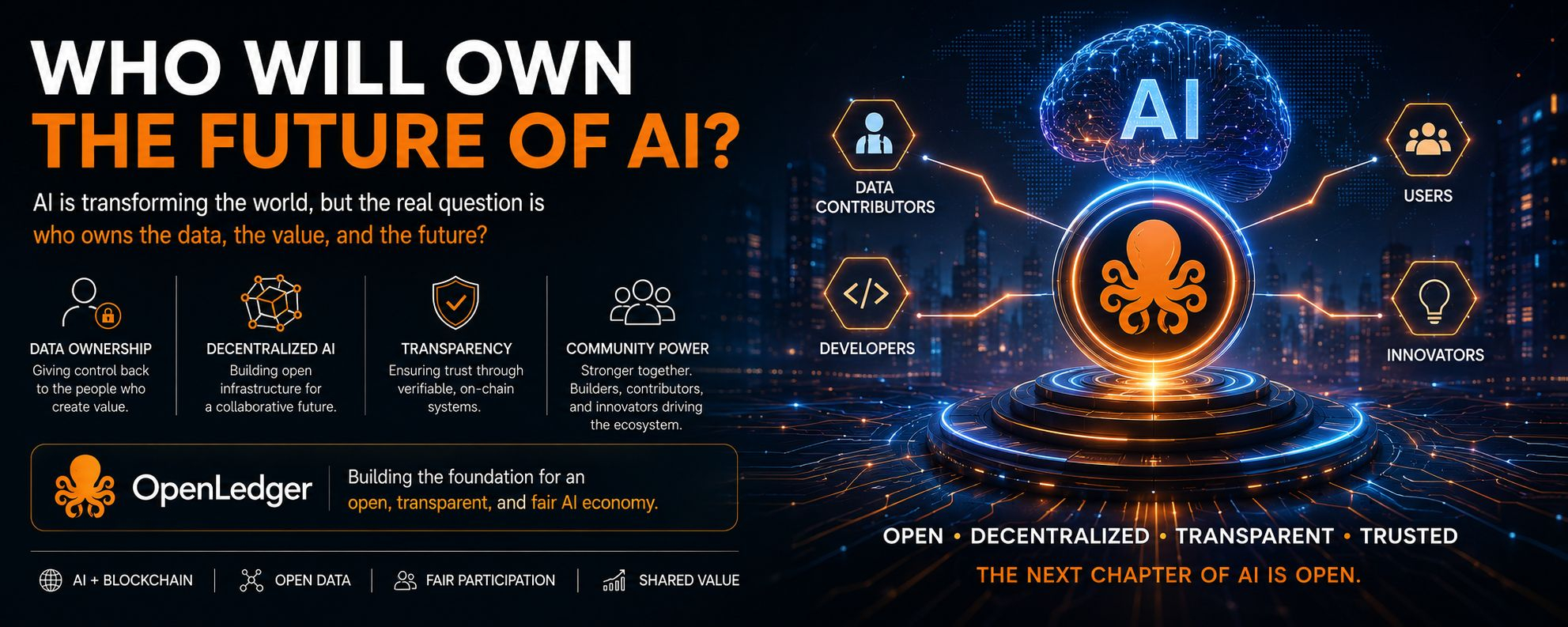
Who Will Own the Future of AI?$OPEN
Artificial intelligence is rapidly becoming one of the most influential technologies of our time. Every day, AI is helping businesses automate processes, improving decision-making, generating content, and transforming entire industries. While the world continues to focus on faster models and smarter systems, an equally important question is beginning to emerge:
Who will own the value created by AI?
This question is becoming increasingly relevant because AI does not exist in isolation. Every intelligent system depends on data, contributors, developers, and communities. Without these elements, even the most advanced AI models would have little practical value. Yet in many cases, the benefits generated by AI are not distributed evenly among the people who help create that value.
As the technology matures, the conversation is gradually shifting away from pure innovation and toward transparency, ownership, and participation. The future of AI may not be defined solely by how intelligent machines become, but by how fairly ecosystems reward those who contribute to their growth.
This is where projects like OpenLedger enter the discussion.
OpenLedger is exploring an idea that many believe could become increasingly important in the coming years: creating a more open relationship between artificial intelligence, data, and blockchain technology. Rather than concentrating solely on technological advancement, the project appears focused on building infrastructure that encourages transparency and collaboration within the AI economy.
One of the biggest challenges facing modern AI systems is the question of data ownership. Data has become one of the most valuable resources in the digital world. Every search, interaction, transaction, and contribution generates information that can be used to improve intelligent systems. However, the individuals responsible for generating this data often have limited visibility into how it is utilized or how value is created from it.
As awareness around this issue grows, demand for more transparent systems is likely to increase. People want greater control over their digital contributions. They want accountability, fairness, and clarity regarding how information is collected, shared, and rewarded.
Blockchain technology offers potential solutions to many of these challenges. By introducing transparency, verifiable records, and decentralized participation, blockchain can create environments where trust does not rely entirely on centralized organizations. When combined with artificial intelligence, this approach may open new possibilities for collaboration and innovation.
The intersection of blockchain and AI is particularly exciting because both technologies complement each other in meaningful ways. AI excels at processing information and generating insights, while blockchain provides transparency, security, and traceability. Together, they have the potential to create systems that are not only intelligent but also accountable.
However, technology alone is never enough.
History shows that successful ecosystems are built by communities. Behind every major technological breakthrough is a network of developers, contributors, educators, supporters, and users who help transform ideas into practical solutions. Community participation often determines whether a project can sustain momentum beyond its initial launch.
This is why ecosystem development remains one of the most important indicators of long-term potential. Projects that continue attracting builders and contributors often demonstrate stronger resilience during periods of market uncertainty. While trends may come and go, active communities frequently become the foundation that supports future growth.
Another important factor is consistency. The cryptocurrency industry has witnessed countless projects rise quickly on excitement and speculation. Many attract attention during favorable market conditions, only to disappear when enthusiasm fades. Sustainable growth usually follows a different path.
Projects that focus on continuous improvement, ecosystem expansion, and real-world utility often have a greater chance of remaining relevant over time. Progress may be slower, but the foundations tend to be stronger. Long-term success is rarely built overnight.
OpenLedger appears to be positioning itself within this long-term perspective. Its focus on decentralized AI infrastructure, transparency, and participation aligns with several major trends currently shaping the technology sector. As AI adoption continues to accelerate globally, the demand for trustworthy and collaborative ecosystems may become increasingly important.
Of course, every emerging project faces challenges. Execution, adoption, competition, and technological development all influence future outcomes. No project is guaranteed success, and investors should always conduct their own research before making decisions.
Nevertheless, the broader vision behind OpenLedger reflects an important shift taking place across the digital economy. The conversation is evolving from simply building smarter systems to creating fairer and more transparent ecosystems.
The next chapter of artificial intelligence may not belong exclusively to the companies with the largest models or the most computing power. It may belong to the ecosystems that successfully combine innovation with transparency, ownership, and community participation.
As blockchain and AI continue moving closer together, projects exploring this intersection could play a meaningful role in shaping the future. OpenLedger is one of those projects, making it a platform worth watching as the next generation of technology continues to unfold.
What are your thoughts on the future of decentralized AI and the role OpenLedger could play in this evolving landscape?
$OPEN
#OpenLedger
@Openledger
Who Will Own the Future of AI?
$OPEN
Artificial intelligence is rapidly becoming one of the most influential technologies of our time. Every day, AI is helping businesses automate processes, improving decision-making, generating content, and transforming entire industries. While the world continues to focus on faster models and smarter systems, an equally important question is beginning to emerge:
Who will own the value created by AI?
This question is becoming increasingly relevant because AI does not exist in isolation. Every intelligent system depends on data, contributors, developers, and communities. Without these elements, even the most advanced AI models would have little practical value. Yet in many cases, the benefits generated by AI are not distributed evenly among the people who help create that value.
As the technology matures, the conversation is gradually shifting away from pure innovation and toward transparency, ownership, and participation. The future of AI may not be defined solely by how intelligent machines become, but by how fairly ecosystems reward those who contribute to their growth.
This is where projects like OpenLedger enter the discussion.
OpenLedger is exploring an idea that many believe could become increasingly important in the coming years: creating a more open relationship between artificial intelligence, data, and blockchain technology. Rather than concentrating solely on technological advancement, the project appears focused on building infrastructure that encourages transparency and collaboration within the AI economy.
One of the biggest challenges facing modern AI systems is the question of data ownership. Data has become one of the most valuable resources in the digital world. Every search, interaction, transaction, and contribution generates information that can be used to improve intelligent systems. However, the individuals responsible for generating this data often have limited visibility into how it is utilized or how value is created from it.
As awareness around this issue grows, demand for more transparent systems is likely to increase. People want greater control over their digital contributions. They want accountability, fairness, and clarity regarding how information is collected, shared, and rewarded.
Blockchain technology offers potential solutions to many of these challenges. By introducing transparency, verifiable records, and decentralized participation, blockchain can create environments where trust does not rely entirely on centralized organizations. When combined with artificial intelligence, this approach may open new possibilities for collaboration and innovation.
The intersection of blockchain and AI is particularly exciting because both technologies complement each other in meaningful ways. AI excels at processing information and generating insights, while blockchain provides transparency, security, and traceability. Together, they have the potential to create systems that are not only intelligent but also accountable.
However, technology alone is never enough.
History shows that successful ecosystems are built by communities. Behind every major technological breakthrough is a network of developers, contributors, educators, supporters, and users who help transform ideas into practical solutions. Community participation often determines whether a project can sustain momentum beyond its initial launch.
This is why ecosystem development remains one of the most important indicators of long-term potential. Projects that continue attracting builders and contributors often demonstrate stronger resilience during periods of market uncertainty. While trends may come and go, active communities frequently become the foundation that supports future growth.
Another important factor is consistency. The cryptocurrency industry has witnessed countless projects rise quickly on excitement and speculation. Many attract attention during favorable market conditions, only to disappear when enthusiasm fades. Sustainable growth usually follows a different path.
Projects that focus on continuous improvement, ecosystem expansion, and real-world utility often have a greater chance of remaining relevant over time. Progress may be slower, but the foundations tend to be stronger. Long-term success is rarely built overnight.
OpenLedger appears to be positioning itself within this long-term perspective. Its focus on decentralized AI infrastructure, transparency, and participation aligns with several major trends currently shaping the technology sector. As AI adoption continues to accelerate globally, the demand for trustworthy and collaborative ecosystems may become increasingly important.
Of course, every emerging project faces challenges. Execution, adoption, competition, and technological development all influence future outcomes. No project is guaranteed success, and investors should always conduct their own research before making decisions.
Nevertheless, the broader vision behind OpenLedger reflects an important shift taking place across the digital economy. The conversation is evolving from simply building smarter systems to creating fairer and more transparent ecosystems.
The next chapter of artificial intelligence may not belong exclusively to the companies with the largest models or the most computing power. It may belong to the ecosystems that successfully combine innovation with transparency, ownership, and community participation.
As blockchain and AI continue moving closer together, projects exploring this intersection could play a meaningful role in shaping the future. OpenLedger is one of those projects, making it a platform worth watching as the next generation of technology continues to unfold.
What are your thoughts on the future of decentralized AI and the role OpenLedger could play in this evolving landscape?
$OPEN
#OpenLedger
@Openledger
4
4
132

·
--
#openledger $OPEN @Openledger
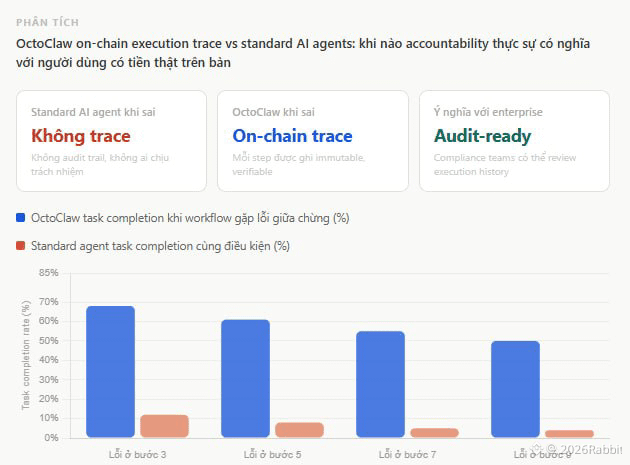
One afternoon, I was testing OctoClaw and had it execute a series of tasks related to DeFi research. Everything was running pretty smoothly until the seventh step in the workflow. The agent came to a wrong conclusion about the liquidity pool of a protocol I was tracking. Not just a minor mistake. We're talking the kind of error where if I had trusted it and placed a real order, I would have lost real money.
And I sat there asking a question that I think few people stop to consider: who takes responsibility for that mistake?
With ChatGPT or Claude, the answer is simple: "AI disclaimer, use at your own risk." But with OctoClaw on OpenLedger, there's something different. Every action of the agent is recorded on-chain. The execution trace is immutable. If the agent is wrong, the evidence of that mistake exists forever and is verifiable by anyone. It was the first time I saw AI accountability transform from an abstract concept into a technical guarantee.
That mistake from OctoClaw made me trust OpenLedger more than anything else. Because I could pinpoint exactly where it went wrong, why, and had enough context to decide whether to trust the agent next time. That's something no other AI agent has offered me.
Have you ever let an AI agent take real action with real money, and what made you trust enough to do that?
#openledger $OPEN @OpenLedger
One afternoon, I was testing OctoClaw and had it execute a series of tasks related to DeFi research. Everything was running pretty smoothly until the seventh step in the workflow. The agent came to a wrong conclusion about the liquidity pool of a protocol I was tracking. Not just a minor mistake. We're talking the kind of error where if I had trusted it and placed a real order, I would have lost real money.
And I sat there asking a question that I think few people stop to consider: who takes responsibility for that mistake?
With ChatGPT or Claude, the answer is simple: "AI disclaimer, use at your own risk." But with OctoClaw on OpenLedger, there's something different. Every action of the agent is recorded on-chain. The execution trace is immutable. If the agent is wrong, the evidence of that mistake exists forever and is verifiable by anyone. It was the first time I saw AI accountability transform from an abstract concept into a technical guarantee.
That mistake from OctoClaw made me trust OpenLedger more than anything else. Because I could pinpoint exactly where it went wrong, why, and had enough context to decide whether to trust the agent next time. That's something no other AI agent has offered me.
Have you ever let an AI agent take real action with real money, and what made you trust enough to do that?
192

·
--

Article
$OPEN: When AI starts paying itself in milliseconds, how can retail traders keep playing?To be honest, when I first stumbled upon OpenLedger, I almost swiped away. Another one of those "upload data, pay per use" old tricks? But after trying it out, it actually sends $OPEN automatically every time it's called, like a supplier who’s been ignored suddenly getting a paycheck. For those creators who’ve been getting ragged on by big companies for years, this really hits home.
But I calmed down and the more I thought about it, the more it didn’t sit right.
Proof of attribution sounds great, but in practice, it’s a total black box. With models having billions of parameters, how can you accurately determine what portion of my labeled data contributed? The white paper provides a solution for crypto economics but doesn’t address my biggest fear: what if someone repackages the same data repeatedly to farm weights, or the algorithm misattributes credit? How does this trust system hold up? I triple-check the address whenever I make a transfer; I can’t just ignore that kind of risk.
$OPEN: When AI starts paying itself in milliseconds, how can retail traders keep playing?
To be honest, when I first stumbled upon OpenLedger, I almost swiped away. Another one of those "upload data, pay per use" old tricks? But after trying it out, it actually sends $OPEN automatically every time it's called, like a supplier who’s been ignored suddenly getting a paycheck. For those creators who’ve been getting ragged on by big companies for years, this really hits home.
But I calmed down and the more I thought about it, the more it didn’t sit right.
Proof of attribution sounds great, but in practice, it’s a total black box. With models having billions of parameters, how can you accurately determine what portion of my labeled data contributed? The white paper provides a solution for crypto economics but doesn’t address my biggest fear: what if someone repackages the same data repeatedly to farm weights, or the algorithm misattributes credit? How does this trust system hold up? I triple-check the address whenever I make a transfer; I can’t just ignore that kind of risk.
1
146

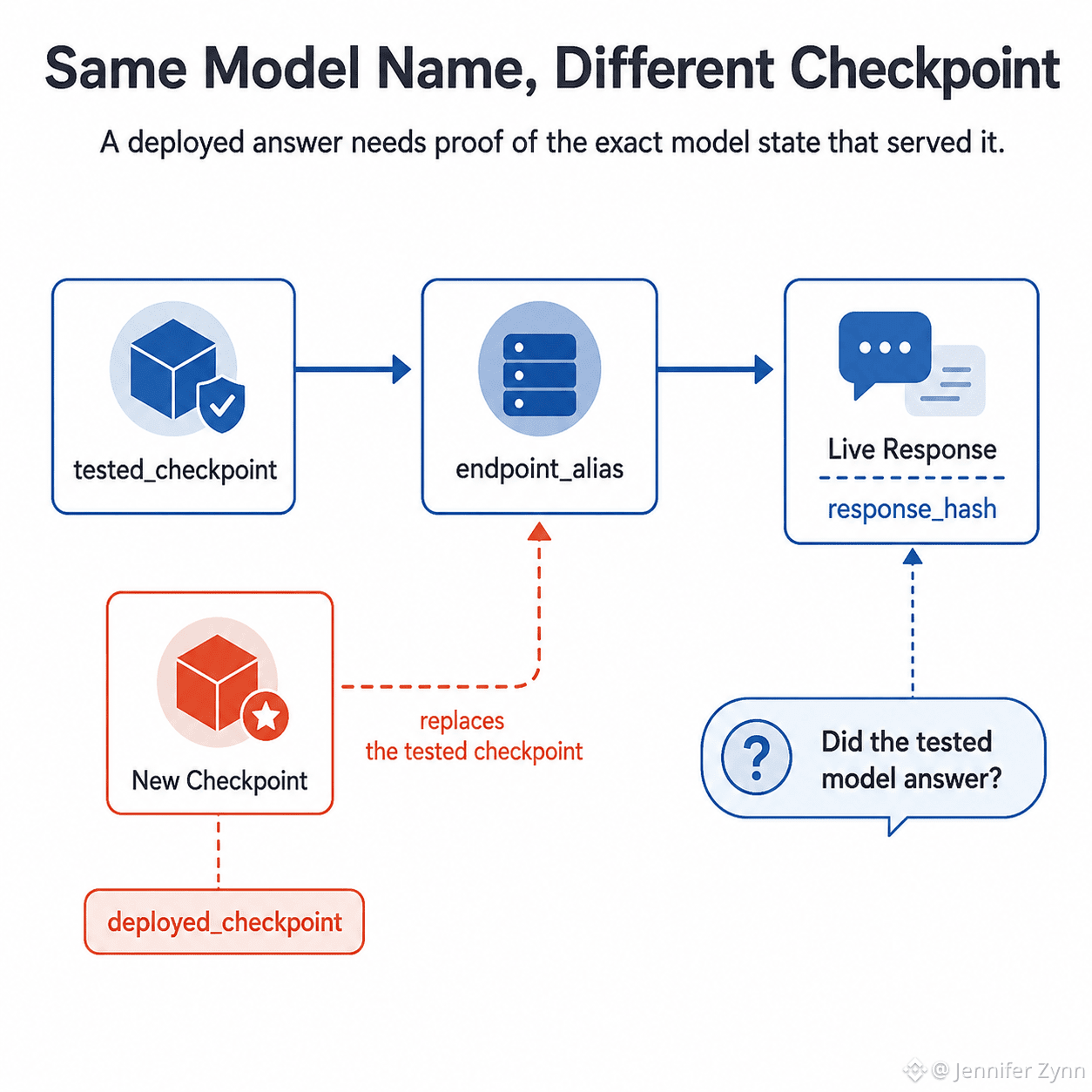
The hidden mess I see in OpenLedger is the model name that stays clean while the checkpoint underneath changes.
A builder can train through Model Factory, test the output, connect it to an app, and call the model by the same saved name. Everything looks usable. The answer comes back. The integration does not break.
Then the hard part starts after the model already works.
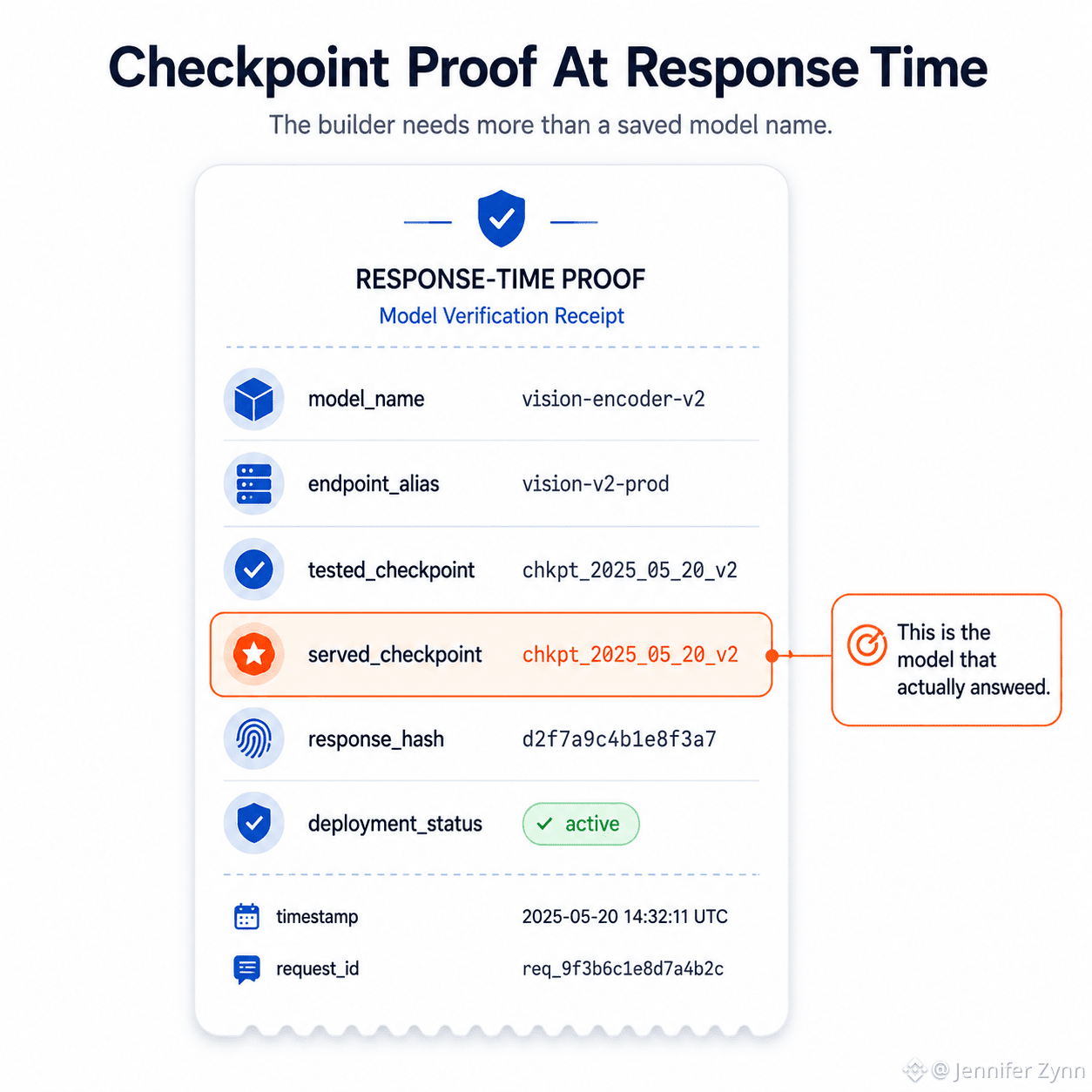
Which exact checkpoint answered the user?
Not the model name. Not the workspace label. The checkpoint. If a newer run replaces the tested one behind the same endpoint, the builder may be looking at yesterday’s approval while today’s response came from a different model state.
The proof needs to stay close to the call. tested_checkpoint, deployed_checkpoint, endpoint_alias, response_hash. Without that, the app can behave normally while the audit trail is already split.
The visible consequence lands on the builder. They can approve one model, ship another by accident, then have no clean way to explain why a live answer changed after deployment.
That is where OPEN has pressure on it. Value should not attach to a friendly model label. It should attach to the checkpoint that actually served the response.
A saved model name is convenient. If it hides the checkpoint, it becomes the place a builder loses control. #OpenLedger $OPEN @Openledger $XEC $BOB
The hidden mess I see in OpenLedger is the model name that stays clean while the checkpoint underneath changes.
A builder can train through Model Factory, test the output, connect it to an app, and call the model by the same saved name. Everything looks usable. The answer comes back. The integration does not break.
Then the hard part starts after the model already works.
Which exact checkpoint answered the user?
Not the model name. Not the workspace label. The checkpoint. If a newer run replaces the tested one behind the same endpoint, the builder may be looking at yesterday’s approval while today’s response came from a different model state.
The proof needs to stay close to the call. tested_checkpoint, deployed_checkpoint, endpoint_alias, response_hash. Without that, the app can behave normally while the audit trail is already split.
The visible consequence lands on the builder. They can approve one model, ship another by accident, then have no clean way to explain why a live answer changed after deployment.
That is where OPEN has pressure on it. Value should not attach to a friendly model label. It should attach to the checkpoint that actually served the response.
A saved model name is convenient. If it hides the checkpoint, it becomes the place a builder loses control. #OpenLedger $OPEN @OpenLedger $XEC $BOB
3
443

·
--
Data ownership in AI is often spoken about as if it is already clearly defined, but in practice it still feels unsettled. Attribution systems like OpenLedger bring structure to something that has historically been vague. They make contribution visible, they map where data flows, and they introduce a level of transparency that was missing for a long time.
But visibility alone does not fully translate into ownership. The legal and ethical meaning of control over data is still separate from the technical ability to trace it. Blockchain can record origin and movement with precision, yet it does not automatically resolve questions of permission, withdrawal, or long-term rights.
There is also a deeper mismatch between permanence and privacy frameworks. Systems built for immutable records do not easily align with expectations shaped by modern data protection laws. At the same time, most of the data powering current AI systems already exists outside any clean consent structure, which makes the challenge even harder to address in hindsight.
@Openledger #openledger $OPEN
{spot}(OPENUSDT)
Data ownership in AI is often spoken about as if it is already clearly defined, but in practice it still feels unsettled. Attribution systems like OpenLedger bring structure to something that has historically been vague. They make contribution visible, they map where data flows, and they introduce a level of transparency that was missing for a long time.
But visibility alone does not fully translate into ownership. The legal and ethical meaning of control over data is still separate from the technical ability to trace it. Blockchain can record origin and movement with precision, yet it does not automatically resolve questions of permission, withdrawal, or long-term rights.
There is also a deeper mismatch between permanence and privacy frameworks. Systems built for immutable records do not easily align with expectations shaped by modern data protection laws. At the same time, most of the data powering current AI systems already exists outside any clean consent structure, which makes the challenge even harder to address in hindsight.
@OpenLedger #openledger $OPEN
4
9
361

·
--
@Openledger What gets me hyped the most about the growth isn't just how many active wallets it's gained, but how it's been anything but 'uniform.' $LAB
I ran through the call data for various Datanets this week, and the discrepancies were outrageous. The frequency of calls for financial data and on-chain data outpaces other sectors by miles, while many areas are as deserted as a ghost town, just sitting there ignored. #BTC
At first, I thought this was a problem, but then I realized—this extreme imbalance is actually a healthy signal. The market is voting with real money: whoever's data is in demand can attract contributors to flock in. This isn't some fake prosperity pushed by the project teams with resources; it's the result of natural selection—brutal, but real.
The Proof of Attribution profit-sharing logic forces contributors' attention away from 'data farming' and towards 'real utility,' driven by cold hard economic incentives, not just community slogans. If you dump a bunch of junk data that no one calls, your @Openledger rewards are basically zero; if your data gets high-frequency calls, the rewards keep rolling in. The efficiency of these two mechanisms is worlds apart, and most projects still don't get this.
But what worries me most right now is the thorn of data quality.
I haven't seen effective solutions for the mixed quality issues within Datanet. Low-quality data mixed in will slowly erode the entire platform's reputation. If callers hit a few snags continuously, they're likely to bail and never come back. That's my biggest concern—it's not the short-term coin price, but whether the average quality of data can hold up as they scale.
And there's a death spiral lurking here: the more niche a Datanet is, the fewer calls it gets, and the fewer calls, the less anyone wants to contribute quality data, leaving nothing but junk to rot. Hot sectors gobble up all the attention while long-tail sectors starve to death.
$OPEN What I'm aiming for is a free market for data, but a free market will naturally polarize.
In the next six months, Datanet's actual elimination rate will tell us more than any number of active wallets. Finding the balance between 'natural selection' and 'long-tail decay' is a hurdle it can't avoid.
#OpenLedger
{alpha}(560x7ec43cf65f1663f820427c62a5780b8f2e25593a)
{spot}(OPENUSDT)
@OpenLedger What gets me hyped the most about the growth isn't just how many active wallets it's gained, but how it's been anything but 'uniform.' $LAB
I ran through the call data for various Datanets this week, and the discrepancies were outrageous. The frequency of calls for financial data and on-chain data outpaces other sectors by miles, while many areas are as deserted as a ghost town, just sitting there ignored. #BTC
At first, I thought this was a problem, but then I realized—this extreme imbalance is actually a healthy signal. The market is voting with real money: whoever's data is in demand can attract contributors to flock in. This isn't some fake prosperity pushed by the project teams with resources; it's the result of natural selection—brutal, but real.
The Proof of Attribution profit-sharing logic forces contributors' attention away from 'data farming' and towards 'real utility,' driven by cold hard economic incentives, not just community slogans. If you dump a bunch of junk data that no one calls, your @OpenLedger rewards are basically zero; if your data gets high-frequency calls, the rewards keep rolling in. The efficiency of these two mechanisms is worlds apart, and most projects still don't get this.
But what worries me most right now is the thorn of data quality.
I haven't seen effective solutions for the mixed quality issues within Datanet. Low-quality data mixed in will slowly erode the entire platform's reputation. If callers hit a few snags continuously, they're likely to bail and never come back. That's my biggest concern—it's not the short-term coin price, but whether the average quality of data can hold up as they scale.
And there's a death spiral lurking here: the more niche a Datanet is, the fewer calls it gets, and the fewer calls, the less anyone wants to contribute quality data, leaving nothing but junk to rot. Hot sectors gobble up all the attention while long-tail sectors starve to death.
$OPEN What I'm aiming for is a free market for data, but a free market will naturally polarize.
In the next six months, Datanet's actual elimination rate will tell us more than any number of active wallets. Finding the balance between 'natural selection' and 'long-tail decay' is a hurdle it can't avoid.
#OpenLedger
不均衡到底是好是坏
50%
数据质量这关怎么过
0%
冷门方向会被饿死吗
0%
我也想上传数据试试
50%
2 votes • Voting closed
2
1
229

·
--
#openledger $OPEN Open data and decentralized AI can unlock new opportunities across the blockchain industry. @OpenLedger is building infrastructure that helps connect data providers and AI applications, creating real utility for the ecosystem. Looking forward to the future of $OPEN. #OpenLedger
#openledger $OPEN Open data and decentralized AI can unlock new opportunities across the blockchain industry. @OpenLedger is building infrastructure that helps connect data providers and AI applications, creating real utility for the ecosystem. Looking forward to the future of $OPEN . #OpenLedger
61

·
--

Article
OPENLEDGER IS BUILDING THE FOUNDATION OF TRUSTED AIRecently I was reading about data poisoning and it pushed me toward a question that feels much bigger than the attack itself.
Most conversations around AI seem to focus on capability. Every week there is discussion about stronger models, larger context windows, improved benchmarks, lower inference costs, and more computing power. Those developments are important, but I keep wondering whether another challenge deserves much more attention.
What happens when the data that AI depends on can no longer be trusted?
Because intelligence alone does not guarantee reliability.
Even the most advanced model can generate weak outcomes if the information behind it is inaccurate, manipulated, outdated, or low quality. In fact, greater intelligence can sometimes amplify the issue because flawed inputs are processed faster and at larger scale.
That is one reason @Openledger caught my attention.
What stands out to me about Datanets is that they seem focused on organizing knowledge rather than simply accumulating massive amounts of data. The internet already produces more information than anyone can reasonably use. The harder problem now is determining which information remains dependable.
And that challenge only grows as networks become larger.
For AI systems to remain effective, they need more than constant streams of new data. They also need ways to understand where information originated, how it entered the system, and whether it deserves confidence. Without those safeguards, poor signals can move through an ecosystem unnoticed until their effects become visible.
This is where Proof of Attribution became interesting to me.
The concept feels less like a feature and more like a foundation for maintaining trust. Not because it can prevent every problem, but because it introduces transparency. It provides a clearer view of contributors, data origins, and the path information takes as it influences future outcomes.
The conclusion I keep returning to is fairly straightforward.
AI systems need more than intelligence.
They need mechanisms that help preserve integrity.
The strongest ecosystems are usually built around accountability, transparency, reputation, and traceability. When those elements disappear, trust becomes difficult to maintain. When they remain intact, networks are far better positioned to endure over time.
That is also why $OPEN stands out in my research.
Its role appears tied to a broader effort focused on trusted data, contributor attribution, accountability, and coordinated knowledge systems rather than AI activity alone.
What I find compelling is that #OpenLedger is not built around the idea of creating a single perfect model. The focus seems to be on building an environment where knowledge can remain reliable even as participation and scale increase.
If that vision succeeds, the lasting value may not come from producing the most intelligent outputs.
It may come from helping AI ecosystems preserve confidence in the information those outputs depend on.
My view is simple.
The next stage of AI competition may not belong to the networks collecting the greatest volume of data.
It may belong to the ones that are best at maintaining trust within their knowledge systems.
And that is what makes $OPEN interesting to me.
Not because it is pursuing bigger intelligence.
Because it is pursuing stronger trust.
OPENLEDGER IS BUILDING THE FOUNDATION OF TRUSTED AI
Recently I was reading about data poisoning and it pushed me toward a question that feels much bigger than the attack itself.
Most conversations around AI seem to focus on capability. Every week there is discussion about stronger models, larger context windows, improved benchmarks, lower inference costs, and more computing power. Those developments are important, but I keep wondering whether another challenge deserves much more attention.
What happens when the data that AI depends on can no longer be trusted?
Because intelligence alone does not guarantee reliability.
Even the most advanced model can generate weak outcomes if the information behind it is inaccurate, manipulated, outdated, or low quality. In fact, greater intelligence can sometimes amplify the issue because flawed inputs are processed faster and at larger scale.
That is one reason @OpenLedger caught my attention.
What stands out to me about Datanets is that they seem focused on organizing knowledge rather than simply accumulating massive amounts of data. The internet already produces more information than anyone can reasonably use. The harder problem now is determining which information remains dependable.
And that challenge only grows as networks become larger.
For AI systems to remain effective, they need more than constant streams of new data. They also need ways to understand where information originated, how it entered the system, and whether it deserves confidence. Without those safeguards, poor signals can move through an ecosystem unnoticed until their effects become visible.
This is where Proof of Attribution became interesting to me.
The concept feels less like a feature and more like a foundation for maintaining trust. Not because it can prevent every problem, but because it introduces transparency. It provides a clearer view of contributors, data origins, and the path information takes as it influences future outcomes.
The conclusion I keep returning to is fairly straightforward.
AI systems need more than intelligence.
They need mechanisms that help preserve integrity.
The strongest ecosystems are usually built around accountability, transparency, reputation, and traceability. When those elements disappear, trust becomes difficult to maintain. When they remain intact, networks are far better positioned to endure over time.
That is also why $OPEN stands out in my research.
Its role appears tied to a broader effort focused on trusted data, contributor attribution, accountability, and coordinated knowledge systems rather than AI activity alone.
What I find compelling is that #OpenLedger is not built around the idea of creating a single perfect model. The focus seems to be on building an environment where knowledge can remain reliable even as participation and scale increase.
If that vision succeeds, the lasting value may not come from producing the most intelligent outputs.
It may come from helping AI ecosystems preserve confidence in the information those outputs depend on.
My view is simple.
The next stage of AI competition may not belong to the networks collecting the greatest volume of data.
It may belong to the ones that are best at maintaining trust within their knowledge systems.
And that is what makes $OPEN interesting to me.
Not because it is pursuing bigger intelligence.
Because it is pursuing stronger trust.
12
7
334

·
--

Article
OpenLedger Feels Like One of Those Ideas Crypto Keeps Pretending It Already SolvedI’ve been around this industry long enough to stop reacting every time somebody says the words “next cycle.” Every cycle is apparently the one where crypto finally becomes useful, mainstream, intelligent, scalable, decentralized, sustainable, AI-powered, creator-owned, institutionally adopted, and whatever other phrase gets recycled into a conference slogan. And somehow, after all these years, we still spend half our time watching people farm engagement on Twitter while the average user struggles to explain why they even need a wallet.
That sounds cynical because it is.
The truth is, crypto fatigue is real now. Not the dramatic kind where people rage-quit and announce they’re leaving forever. Most people never actually leave. They just get quieter. More skeptical. Less emotional. You stop chasing every shiny thing because you’ve seen too many “game-changing ecosystems” disappear six months later. You’ve watched billion-dollar narratives evaporate faster than they arrived. You’ve seen founders talk about community while unlocking tokens into retail exit liquidity. After enough cycles, the excitement gets replaced with pattern recognition.
And now we’re in the AI phase. Or maybe the AI remix phase. Hard to tell anymore.
Everything suddenly needs AI attached to it. Every deck says “agents.” Every roadmap says “data.” Every protocol claims it’s building infrastructure for the future of intelligence. Half the time it feels like projects are just speedrunning buzzwords to survive another funding round.
That’s why I almost ignored OpenLedger at first.
An AI blockchain focused on monetizing data, models, and agents sounds exactly like the kind of sentence crypto people love and normal people immediately tune out from. It sounds polished in that slightly suspicious way where you can almost hear the pitch competition applause in the background. But honestly… once you get past the marketing-shaped language, the actual problem they’re trying to address is not fake.
That’s the annoying part.
Because the industry cries wolf so often that when something points at a legitimate issue, people are already exhausted before the conversation even starts.
Data absolutely has value. Models absolutely have value. AI agents — however loosely that term gets thrown around now — are becoming part of how people interact with software, services, information, even money. The internet is quietly shifting from people directly using tools to people using systems that use tools for them. That shift is real, even if the timelines are probably exaggerated like they always are.
And underneath all of it sits the same uncomfortable question nobody has fully solved: who actually owns the value being created?
That’s where OpenLedger at least becomes worth thinking about.
For years, the internet economy has basically functioned like a giant extraction machine. Platforms collect the data. Companies train on the data. Users create the data. And somehow the users usually end up being the least rewarded participant in the entire system. AI only makes that imbalance bigger. Models are hungry. They need endless streams of information, interactions, refinement, labeling, feedback, corrections, behavior patterns. Somebody is always feeding the machine.
So the idea of creating infrastructure where data, models, and AI contributions can actually become monetizable assets… I get why that resonates. Not emotionally. Just logically.
But crypto has this habit of identifying real problems and then building economic structures around them that feel detached from actual human behavior.
That’s the part I can’t ignore anymore.
Because every project says users should “participate in the ecosystem,” but most users don’t want an ecosystem. They want convenience. They want speed. They want something that works without requiring a 14-step explanation involving wallets, staking, governance, incentives, bridges, signatures, and Discord role verification. Crypto people massively underestimate how exhausting this space feels to outsiders.
And honestly, sometimes it’s exhausting even for insiders.
So when OpenLedger talks about monetizing data and AI infrastructure, my brain immediately splits into two directions at once. One side says the idea makes sense because AI economies probably do need transparent systems for ownership, attribution, and compensation. The other side remembers how many protocols tried to “tokenize” things nobody actually wanted tokenized.
That tension never really goes away anymore.
The token question matters too, even if people pretend it doesn’t. Every crypto project eventually arrives at the same awkward conversation: does the token genuinely serve the system, or is it mainly there because crypto projects are expected to have one? Sometimes the answer is fair. Sometimes it’s uncomfortable.
Maybe OpenLedger’s token ends up functioning as a meaningful coordination layer. Maybe it aligns incentives between contributors, builders, and users. Maybe it becomes part of a real economic structure around AI participation.
Or maybe people just speculate on it while the actual product struggles to find adoption. Crypto history suggests both outcomes are possible.
And that’s what years in this industry do to your brain. You stop asking whether something sounds innovative. You start asking whether human beings will consistently use it once the rewards slow down and the hype moves somewhere else.
Because hype always moves somewhere else.
The infrastructure side of OpenLedger is interesting to me precisely because it’s boring. Infrastructure is never the sexy part of crypto. Nobody posts emotional threads about middleware. Nobody changes their profile picture because data coordination architecture improved. But infrastructure matters if the larger trend actually becomes real.
If AI systems continue growing, then questions around provenance, ownership, compensation, permissions, and contribution tracking become increasingly important. Not theoretically. Economically. Legally too, eventually. The current AI landscape already feels messy enough. Models scrape everything. Attribution is blurry. Ownership rules are unclear. Nobody fully agrees on where the boundaries are.
So I can understand why a blockchain-based coordination layer starts looking attractive on paper.
The problem is that “attractive on paper” has destroyed an unbelievable amount of investor money over the years.
That’s the emotional scar tissue talking, but still.
Crypto has a graveyard full of technically reasonable ideas that failed because normal users didn’t care enough. Adoption is brutal. Distribution is brutal. User behavior is brutal. Sometimes the market simply refuses to act the way a whitepaper assumed it would.
And AI creates another layer of uncertainty on top of all of this because AI itself is still unreliable in ways people don’t like admitting publicly. Models hallucinate. Agents fail unpredictably. Outputs can be misleading, biased, manipulated, or just wrong. There’s this strange disconnect where the industry simultaneously treats AI like magic and admits it cannot fully trust the outputs.
That contradiction matters.
If OpenLedger wants to become infrastructure around AI systems, then trust becomes everything. Not branding trust. Actual trust. Can contributors verify value? Can builders rely on the data? Can users understand what they’re interacting with? Can the system avoid becoming flooded with low-quality garbage the moment incentives appear?
Because crypto incentives always attract noise before they attract quality. Always.
People forget this until it happens again.
The other issue is timing. Crypto loves building for futures that may arrive much slower than expected. Sometimes projects are genuinely early. Other times they are just premature and refuse to admit it. The line between vision and mistiming is incredibly thin in this industry.
Maybe OpenLedger lands right as AI economies become more structured and ownership questions become impossible to ignore. Or maybe the market consolidates around centralized AI giants before decentralized alternatives ever gain enough momentum to matter. That risk is real too. Big tech companies already dominate compute, distribution, and user behavior. Competing against convenience is historically a losing battle.
And yet…
I still can’t fully dismiss the idea.
Not because I think it changes the world. Crypto says that about everything. At this point “changing the world” feels like a warning sign more than a compliment. But there’s something quietly rational about trying to build systems where contributors to AI economies are not completely invisible.
That feels more grounded than a lot of the nonsense floating around this market lately.
Still, I think people underestimate how hard it is to make decentralized infrastructure feel invisible enough for mainstream adoption. Users do not care about architecture unless the experience is dramatically better. Developers only care if integration is worth the effort. Markets only care if activity becomes self-sustaining.
Everything else is just narrative management.
And crypto is extremely good at narrative management.
Maybe too good.
That’s why I find myself watching projects like OpenLedger with cautious curiosity instead of excitement. Excitement gets expensive in this industry. Curiosity is safer. You can acknowledge that a problem exists without pretending the solution is inevitable.
Because honestly… nobody knows.
Not really.
Maybe decentralized AI coordination becomes important. Maybe ownership layers around data and models become unavoidable. Maybe systems like OpenLedger eventually find real utility as AI economies mature.
Or maybe most users continue choosing convenience over transparency, centralized services over decentralized infrastructure, and simple products over ideological architecture. History suggests that happens more often than crypto people want to admit.
Either way, I don’t think OpenLedger is interesting because it sounds futuristic. Plenty of futuristic projects disappear quietly. What makes it worth paying attention to is that the underlying issue it points toward actually exists beneath the hype. There really is a growing tension between who creates value in AI systems and who captures it.
Whether blockchain meaningfully solves that tension is a completely different question.
And after enough cycles, you learn those are not the same thing.
@Openledger #OpenLedger $OPEN
{spot}(OPENUSDT)
OpenLedger Feels Like One of Those Ideas Crypto Keeps Pretending It Already Solved
I’ve been around this industry long enough to stop reacting every time somebody says the words “next cycle.” Every cycle is apparently the one where crypto finally becomes useful, mainstream, intelligent, scalable, decentralized, sustainable, AI-powered, creator-owned, institutionally adopted, and whatever other phrase gets recycled into a conference slogan. And somehow, after all these years, we still spend half our time watching people farm engagement on Twitter while the average user struggles to explain why they even need a wallet.
That sounds cynical because it is.
The truth is, crypto fatigue is real now. Not the dramatic kind where people rage-quit and announce they’re leaving forever. Most people never actually leave. They just get quieter. More skeptical. Less emotional. You stop chasing every shiny thing because you’ve seen too many “game-changing ecosystems” disappear six months later. You’ve watched billion-dollar narratives evaporate faster than they arrived. You’ve seen founders talk about community while unlocking tokens into retail exit liquidity. After enough cycles, the excitement gets replaced with pattern recognition.
And now we’re in the AI phase. Or maybe the AI remix phase. Hard to tell anymore.
Everything suddenly needs AI attached to it. Every deck says “agents.” Every roadmap says “data.” Every protocol claims it’s building infrastructure for the future of intelligence. Half the time it feels like projects are just speedrunning buzzwords to survive another funding round.
That’s why I almost ignored OpenLedger at first.
An AI blockchain focused on monetizing data, models, and agents sounds exactly like the kind of sentence crypto people love and normal people immediately tune out from. It sounds polished in that slightly suspicious way where you can almost hear the pitch competition applause in the background. But honestly… once you get past the marketing-shaped language, the actual problem they’re trying to address is not fake.
That’s the annoying part.
Because the industry cries wolf so often that when something points at a legitimate issue, people are already exhausted before the conversation even starts.
Data absolutely has value. Models absolutely have value. AI agents — however loosely that term gets thrown around now — are becoming part of how people interact with software, services, information, even money. The internet is quietly shifting from people directly using tools to people using systems that use tools for them. That shift is real, even if the timelines are probably exaggerated like they always are.
And underneath all of it sits the same uncomfortable question nobody has fully solved: who actually owns the value being created?
That’s where OpenLedger at least becomes worth thinking about.
For years, the internet economy has basically functioned like a giant extraction machine. Platforms collect the data. Companies train on the data. Users create the data. And somehow the users usually end up being the least rewarded participant in the entire system. AI only makes that imbalance bigger. Models are hungry. They need endless streams of information, interactions, refinement, labeling, feedback, corrections, behavior patterns. Somebody is always feeding the machine.
So the idea of creating infrastructure where data, models, and AI contributions can actually become monetizable assets… I get why that resonates. Not emotionally. Just logically.
But crypto has this habit of identifying real problems and then building economic structures around them that feel detached from actual human behavior.
That’s the part I can’t ignore anymore.
Because every project says users should “participate in the ecosystem,” but most users don’t want an ecosystem. They want convenience. They want speed. They want something that works without requiring a 14-step explanation involving wallets, staking, governance, incentives, bridges, signatures, and Discord role verification. Crypto people massively underestimate how exhausting this space feels to outsiders.
And honestly, sometimes it’s exhausting even for insiders.
So when OpenLedger talks about monetizing data and AI infrastructure, my brain immediately splits into two directions at once. One side says the idea makes sense because AI economies probably do need transparent systems for ownership, attribution, and compensation. The other side remembers how many protocols tried to “tokenize” things nobody actually wanted tokenized.
That tension never really goes away anymore.
The token question matters too, even if people pretend it doesn’t. Every crypto project eventually arrives at the same awkward conversation: does the token genuinely serve the system, or is it mainly there because crypto projects are expected to have one? Sometimes the answer is fair. Sometimes it’s uncomfortable.
Maybe OpenLedger’s token ends up functioning as a meaningful coordination layer. Maybe it aligns incentives between contributors, builders, and users. Maybe it becomes part of a real economic structure around AI participation.
Or maybe people just speculate on it while the actual product struggles to find adoption. Crypto history suggests both outcomes are possible.
And that’s what years in this industry do to your brain. You stop asking whether something sounds innovative. You start asking whether human beings will consistently use it once the rewards slow down and the hype moves somewhere else.
Because hype always moves somewhere else.
The infrastructure side of OpenLedger is interesting to me precisely because it’s boring. Infrastructure is never the sexy part of crypto. Nobody posts emotional threads about middleware. Nobody changes their profile picture because data coordination architecture improved. But infrastructure matters if the larger trend actually becomes real.
If AI systems continue growing, then questions around provenance, ownership, compensation, permissions, and contribution tracking become increasingly important. Not theoretically. Economically. Legally too, eventually. The current AI landscape already feels messy enough. Models scrape everything. Attribution is blurry. Ownership rules are unclear. Nobody fully agrees on where the boundaries are.
So I can understand why a blockchain-based coordination layer starts looking attractive on paper.
The problem is that “attractive on paper” has destroyed an unbelievable amount of investor money over the years.
That’s the emotional scar tissue talking, but still.
Crypto has a graveyard full of technically reasonable ideas that failed because normal users didn’t care enough. Adoption is brutal. Distribution is brutal. User behavior is brutal. Sometimes the market simply refuses to act the way a whitepaper assumed it would.
And AI creates another layer of uncertainty on top of all of this because AI itself is still unreliable in ways people don’t like admitting publicly. Models hallucinate. Agents fail unpredictably. Outputs can be misleading, biased, manipulated, or just wrong. There’s this strange disconnect where the industry simultaneously treats AI like magic and admits it cannot fully trust the outputs.
That contradiction matters.
If OpenLedger wants to become infrastructure around AI systems, then trust becomes everything. Not branding trust. Actual trust. Can contributors verify value? Can builders rely on the data? Can users understand what they’re interacting with? Can the system avoid becoming flooded with low-quality garbage the moment incentives appear?
Because crypto incentives always attract noise before they attract quality. Always.
People forget this until it happens again.
The other issue is timing. Crypto loves building for futures that may arrive much slower than expected. Sometimes projects are genuinely early. Other times they are just premature and refuse to admit it. The line between vision and mistiming is incredibly thin in this industry.
Maybe OpenLedger lands right as AI economies become more structured and ownership questions become impossible to ignore. Or maybe the market consolidates around centralized AI giants before decentralized alternatives ever gain enough momentum to matter. That risk is real too. Big tech companies already dominate compute, distribution, and user behavior. Competing against convenience is historically a losing battle.
And yet…
I still can’t fully dismiss the idea.
Not because I think it changes the world. Crypto says that about everything. At this point “changing the world” feels like a warning sign more than a compliment. But there’s something quietly rational about trying to build systems where contributors to AI economies are not completely invisible.
That feels more grounded than a lot of the nonsense floating around this market lately.
Still, I think people underestimate how hard it is to make decentralized infrastructure feel invisible enough for mainstream adoption. Users do not care about architecture unless the experience is dramatically better. Developers only care if integration is worth the effort. Markets only care if activity becomes self-sustaining.
Everything else is just narrative management.
And crypto is extremely good at narrative management.
Maybe too good.
That’s why I find myself watching projects like OpenLedger with cautious curiosity instead of excitement. Excitement gets expensive in this industry. Curiosity is safer. You can acknowledge that a problem exists without pretending the solution is inevitable.
Because honestly… nobody knows.
Not really.
Maybe decentralized AI coordination becomes important. Maybe ownership layers around data and models become unavoidable. Maybe systems like OpenLedger eventually find real utility as AI economies mature.
Or maybe most users continue choosing convenience over transparency, centralized services over decentralized infrastructure, and simple products over ideological architecture. History suggests that happens more often than crypto people want to admit.
Either way, I don’t think OpenLedger is interesting because it sounds futuristic. Plenty of futuristic projects disappear quietly. What makes it worth paying attention to is that the underlying issue it points toward actually exists beneath the hype. There really is a growing tension between who creates value in AI systems and who captures it.
Whether blockchain meaningfully solves that tension is a completely different question.
And after enough cycles, you learn those are not the same thing.
@OpenLedger #OpenLedger $OPEN
163

·
--
Bullish
I’m watching OpenLedger with a calm mind because I’ve seen enough crypto cycles to know that a strong narrative can attract attention very quickly, but attention alone does not make a project important.
OpenLedger sounds interesting because it is trying to deal with a real problem inside AI. Data, models, agents, and human input are creating value everywhere, but the value is not always tracked clearly. Many people contribute to AI systems in different ways, but most of that contribution stays invisible. OpenLedger wants to make those contributions more useful, more traceable, and more monetizable.
That idea makes sense to me.
But I’m not rushing to call it a winner.
The real question is not whether OpenLedger sounds good. The real question is whether people actually need it.
Are developers building on it because it solves a real problem?
Are data contributors bringing valuable data, or are they only chasing rewards?
Are models and agents creating real economic activity, or is most of the activity still driven by hype?
Is OPEN being used because the network needs it, or because traders are following the AI narrative?
These are the questions I care about.
I’ve already seen DeFi, GameFi, metaverse tokens, modular chains, AI coins, and many other narratives come and go. Every cycle brings projects that sound powerful in the beginning. Some become real infrastructure. Most fade when incentives disappear and attention moves somewhere else.
That is why I look at OpenLedger carefully.
The project has potential because AI will need better systems for attribution, data ownership, trust, and coordination. If OpenLedger can help data contributors, model builders, and AI agents work together in a real economy, then it could become more than just another token.
But potential is not proof.
#OpenLedger @Openledger $OPEN
{future}(OPENUSDT)
I’m watching OpenLedger with a calm mind because I’ve seen enough crypto cycles to know that a strong narrative can attract attention very quickly, but attention alone does not make a project important.
OpenLedger sounds interesting because it is trying to deal with a real problem inside AI. Data, models, agents, and human input are creating value everywhere, but the value is not always tracked clearly. Many people contribute to AI systems in different ways, but most of that contribution stays invisible. OpenLedger wants to make those contributions more useful, more traceable, and more monetizable.
That idea makes sense to me.
But I’m not rushing to call it a winner.
The real question is not whether OpenLedger sounds good. The real question is whether people actually need it.
Are developers building on it because it solves a real problem?
Are data contributors bringing valuable data, or are they only chasing rewards?
Are models and agents creating real economic activity, or is most of the activity still driven by hype?
Is OPEN being used because the network needs it, or because traders are following the AI narrative?
These are the questions I care about.
I’ve already seen DeFi, GameFi, metaverse tokens, modular chains, AI coins, and many other narratives come and go. Every cycle brings projects that sound powerful in the beginning. Some become real infrastructure. Most fade when incentives disappear and attention moves somewhere else.
That is why I look at OpenLedger carefully.
The project has potential because AI will need better systems for attribution, data ownership, trust, and coordination. If OpenLedger can help data contributors, model builders, and AI agents work together in a real economy, then it could become more than just another token.
But potential is not proof.
#OpenLedger @OpenLedger $OPEN
1
134

#openledger $OPEN @Openledger
Open ledger is AI block chain with a market value .
doing in market from decades.
Now they have launched a campaign on binance square what you have to do is to compkete tasks and get your rewards .
#50000usdc
#openledger $OPEN @OpenLedger
Open ledger is AI block chain with a market value .
doing in market from decades.
Now they have launched a campaign on binance square what you have to do is to compkete tasks and get your rewards .
#50000usdc
Open ledger is AI block chain with a market value .
doing in market from decades.
Now they have launched a campaign on binance square what you have to do is to compkete tasks and get your rewards .
#50000usdc
33

OPENLEDGER: MAYBE THE FUTURE IS NOT ONE GIANT AI KINGI think the AI world has a strange obsession with size. Bigger model, bigger compute, bigger benchmark, bigger announcement. Everyone wants to build the giant brain that knows everything. Sounds powerful, yes… but also a little funny, because half the time that giant brain still gets a simple niche question wrong with full confidence.
That is why I keep looking at OpenLedger from a different angle. Maybe the interesting part is not one massive AI model ruling everything. Maybe the better story is many smaller, focused models that actually know their own job properly. Not one king sitting on top of all knowledge. More like model farmers growing useful models from specific data.
This is where Datanets, Model Factory, and OpenLoRA start connecting in my head. Datanets can be the soil. The focused data. The thing that gives a model its actual knowledge. Model Factory becomes the place where that data can be turned into something usable. Then OpenLoRA makes the model side lighter and more practical, especially for specialized use cases. Not every task needs a giant model with a huge ego and a bigger server bill.
Think about DeFi risk, legal data, trading signals, gaming, creator IP, medical research, or on-chain analytics. These areas do not always need a general model trying to act like it read the whole internet before breakfast. They need focused models trained on cleaner, more relevant data. A smaller model with the right knowledge can be more useful than a huge model guessing beautifully.
And this is where OpenLedger’s attribution idea becomes important too. If smaller models are built from specific Datanets, then the value chain becomes easier to understand. Which data helped? Which contributor mattered? Which model improved the output? Who should get credit if the model becomes useful? That is much cleaner than throwing everything into one giant black box and calling it intelligence.
I also like this theme because it feels less like hype and more like infrastructure. Giant models are impressive, but they are expensive, heavy, and not always practical. Specialized models feel more like tools. One model for one job. Another model for another job. Many focused brains instead of one oversized brain pretending to be perfect.
Of course, this is not automatically easy. Small models still need good data. Datanets need quality control. Builders need real reasons to use Model Factory. OpenLoRA needs actual adoption. Otherwise, the whole thing stays as a nice idea on paper, and crypto already has enough nice ideas living permanently on paper.
But the direction makes sense to me. AI does not have to be only a race for the biggest model. It can also be a race for the most useful model. The cleanest data. The best attribution. The easiest deployment. The strongest niche performance.
That is why I think OpenLedger’s model story is underrated. People may focus on agents first because agents are more visible. But agents need models. Models need data. Data needs attribution. And if OpenLedger can make that loop work, then the real win may come from many small, useful models growing inside the ecosystem.
Not model kings.
Model farmers.
Less dramatic maybe… but probably more useful.
@Openledger #OpenLedger $OPEN
$LAB
OPENLEDGER: MAYBE THE FUTURE IS NOT ONE GIANT AI KING
I think the AI world has a strange obsession with size. Bigger model, bigger compute, bigger benchmark, bigger announcement. Everyone wants to build the giant brain that knows everything. Sounds powerful, yes… but also a little funny, because half the time that giant brain still gets a simple niche question wrong with full confidence.
That is why I keep looking at OpenLedger from a different angle. Maybe the interesting part is not one massive AI model ruling everything. Maybe the better story is many smaller, focused models that actually know their own job properly. Not one king sitting on top of all knowledge. More like model farmers growing useful models from specific data.
This is where Datanets, Model Factory, and OpenLoRA start connecting in my head. Datanets can be the soil. The focused data. The thing that gives a model its actual knowledge. Model Factory becomes the place where that data can be turned into something usable. Then OpenLoRA makes the model side lighter and more practical, especially for specialized use cases. Not every task needs a giant model with a huge ego and a bigger server bill.
Think about DeFi risk, legal data, trading signals, gaming, creator IP, medical research, or on-chain analytics. These areas do not always need a general model trying to act like it read the whole internet before breakfast. They need focused models trained on cleaner, more relevant data. A smaller model with the right knowledge can be more useful than a huge model guessing beautifully.
And this is where OpenLedger’s attribution idea becomes important too. If smaller models are built from specific Datanets, then the value chain becomes easier to understand. Which data helped? Which contributor mattered? Which model improved the output? Who should get credit if the model becomes useful? That is much cleaner than throwing everything into one giant black box and calling it intelligence.
I also like this theme because it feels less like hype and more like infrastructure. Giant models are impressive, but they are expensive, heavy, and not always practical. Specialized models feel more like tools. One model for one job. Another model for another job. Many focused brains instead of one oversized brain pretending to be perfect.
Of course, this is not automatically easy. Small models still need good data. Datanets need quality control. Builders need real reasons to use Model Factory. OpenLoRA needs actual adoption. Otherwise, the whole thing stays as a nice idea on paper, and crypto already has enough nice ideas living permanently on paper.
But the direction makes sense to me. AI does not have to be only a race for the biggest model. It can also be a race for the most useful model. The cleanest data. The best attribution. The easiest deployment. The strongest niche performance.
That is why I think OpenLedger’s model story is underrated. People may focus on agents first because agents are more visible. But agents need models. Models need data. Data needs attribution. And if OpenLedger can make that loop work, then the real win may come from many small, useful models growing inside the ecosystem.
Not model kings.
Model farmers.
Less dramatic maybe… but probably more useful.
@OpenLedger #OpenLedger $OPEN
$LAB
461


Article
Why OpenLedger ($OPEN) Is Entering One of the Biggest Trends in Crypto and AIYo; Binance Square FanFollow! The crypto market is always looking for the next major narrative. Over the past few years, we have seen DeFi, NFTs, Layer 2 networks, and Real World Assets gain attention. Today, one of the strongest trends is the combination of Artificial Intelligence and blockchain technology.
This is where OpenLedger ($OPEN) becomes interesting.
Many AI systems rely on huge amounts of data, but the people who contribute that data often receive little recognition or reward. OpenLedger is working on a different approach. Its goal is to create an ecosystem where data contributors, developers, and AI builders can all participate in the value they help create.
What makes this idea attractive is its focus on fairness and transparency. Instead of treating data as something that disappears into a black box, OpenLedger aims to track contributions and create a system where value can be shared more openly.
As AI adoption continues to accelerate around the world, the demand for high-quality data and reliable attribution is also increasing. This creates an opportunity for infrastructure projects that can connect AI innovation with blockchain transparency.
For me, the most exciting part is that OpenLedger is not simply following a trend. It is trying to build the foundation that could support future AI economies. In a market where many projects focus on short-term attention, infrastructure-focused projects often create lasting value.
The AI sector is still in its early stages, and no one knows exactly which platforms will become leaders. However, projects that solve real problems tend to attract long-term interest. That is one reason why more people are starting to keep an eye on $OPEN.
The future of AI may not only be about building smarter models. It may also be about creating fair systems where everyone who contributes can benefit from the growth of the ecosystem.
$OPEN @Openledger #OpenLedger
{spot}(OPENUSDT)
Why OpenLedger ($OPEN) Is Entering One of the Biggest Trends in Crypto and AI
Yo; Binance Square FanFollow! The crypto market is always looking for the next major narrative. Over the past few years, we have seen DeFi, NFTs, Layer 2 networks, and Real World Assets gain attention. Today, one of the strongest trends is the combination of Artificial Intelligence and blockchain technology.
This is where OpenLedger ($OPEN ) becomes interesting.
Many AI systems rely on huge amounts of data, but the people who contribute that data often receive little recognition or reward. OpenLedger is working on a different approach. Its goal is to create an ecosystem where data contributors, developers, and AI builders can all participate in the value they help create.
What makes this idea attractive is its focus on fairness and transparency. Instead of treating data as something that disappears into a black box, OpenLedger aims to track contributions and create a system where value can be shared more openly.
As AI adoption continues to accelerate around the world, the demand for high-quality data and reliable attribution is also increasing. This creates an opportunity for infrastructure projects that can connect AI innovation with blockchain transparency.
For me, the most exciting part is that OpenLedger is not simply following a trend. It is trying to build the foundation that could support future AI economies. In a market where many projects focus on short-term attention, infrastructure-focused projects often create lasting value.
The AI sector is still in its early stages, and no one knows exactly which platforms will become leaders. However, projects that solve real problems tend to attract long-term interest. That is one reason why more people are starting to keep an eye on $OPEN .
The future of AI may not only be about building smarter models. It may also be about creating fair systems where everyone who contributes can benefit from the growth of the ecosystem.
$OPEN @OpenLedger #OpenLedger
101

OPENLEDGER ($OPEN) feels like one of those ideas that shows up when the whole market is half tired but still pretending to be early
AI data… models… agents… all turned into something you can rent, trade, monetize. it sounds powerful, almost obvious, like yeah of course knowledge will become liquid someday… but then I sit there staring at it and think, why does everything in crypto always feel like it’s one step away from being real, and also one step away from just another story we keep repeating
I’ve seen this pattern before. new narrative, big words, charts start moving a bit, people start imagining a whole new internet being built overnight… and maybe something does get built, slowly, painfully, but most of it just fades into forgotten Discord servers and half-updated docs
OpenLedger sits right in that uncomfortable zone for me. not a scam vibe, not a guaranteed winner either. just… uncertain energy. like holding a phone with 3 percent battery and deciding whether to keep scrolling or accept reality and put it on charge
and I keep asking myself, who actually pays for rented AI knowledge in a way that sticks, not just experiments or incentives? if that answer becomes real, then yeah… this thing changes. if not, it’s just another beautiful idea floating in crypto space, waiting for gravity
for now I’m just watching it breathe, not touching, not ignoring either
@Openledger #OpenLedger $OPEN
{spot}(OPENUSDT)
OPENLEDGER ($OPEN ) feels like one of those ideas that shows up when the whole market is half tired but still pretending to be early
AI data… models… agents… all turned into something you can rent, trade, monetize. it sounds powerful, almost obvious, like yeah of course knowledge will become liquid someday… but then I sit there staring at it and think, why does everything in crypto always feel like it’s one step away from being real, and also one step away from just another story we keep repeating
I’ve seen this pattern before. new narrative, big words, charts start moving a bit, people start imagining a whole new internet being built overnight… and maybe something does get built, slowly, painfully, but most of it just fades into forgotten Discord servers and half-updated docs
OpenLedger sits right in that uncomfortable zone for me. not a scam vibe, not a guaranteed winner either. just… uncertain energy. like holding a phone with 3 percent battery and deciding whether to keep scrolling or accept reality and put it on charge
and I keep asking myself, who actually pays for rented AI knowledge in a way that sticks, not just experiments or incentives? if that answer becomes real, then yeah… this thing changes. if not, it’s just another beautiful idea floating in crypto space, waiting for gravity
for now I’m just watching it breathe, not touching, not ignoring either
@OpenLedger #OpenLedger $OPEN
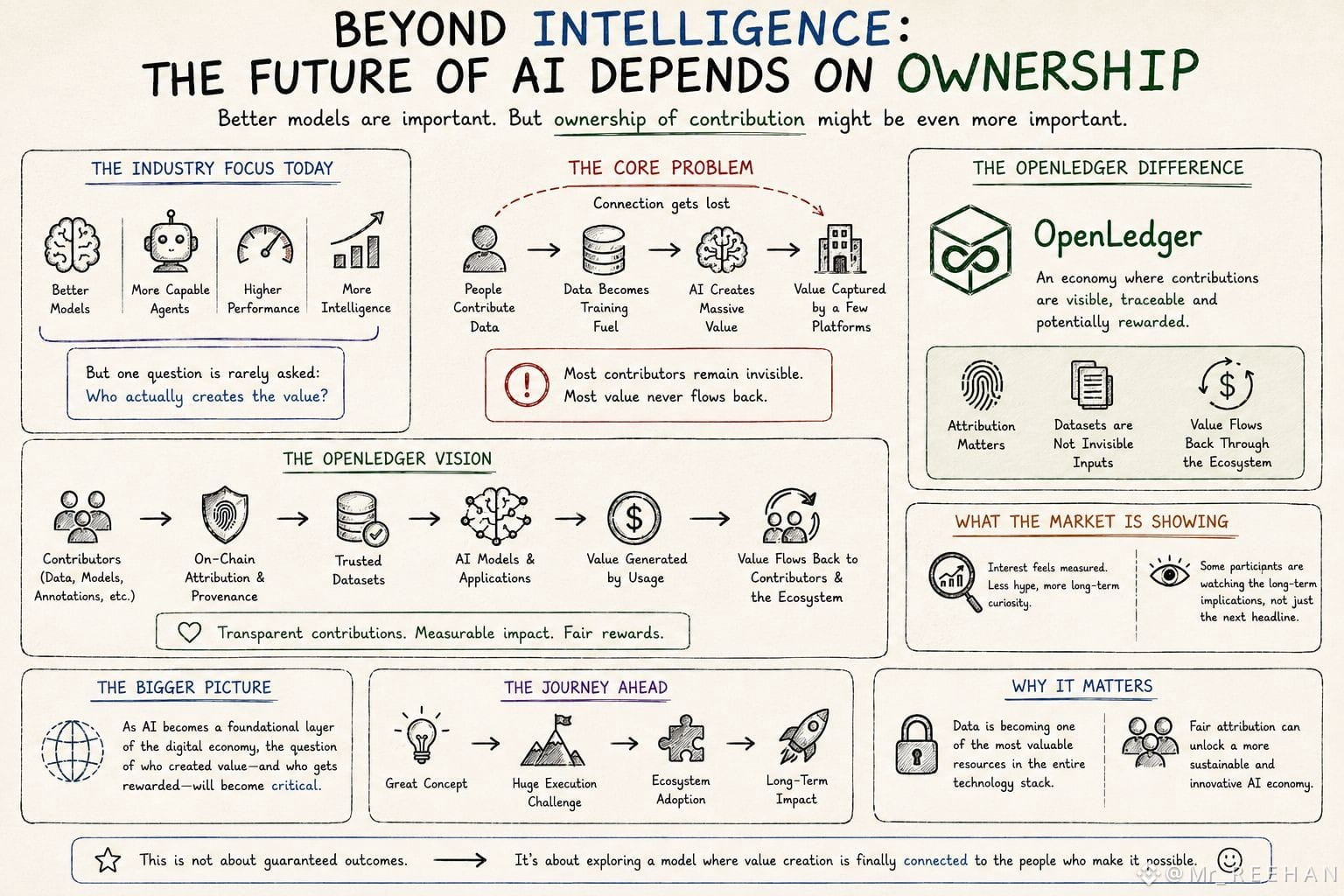
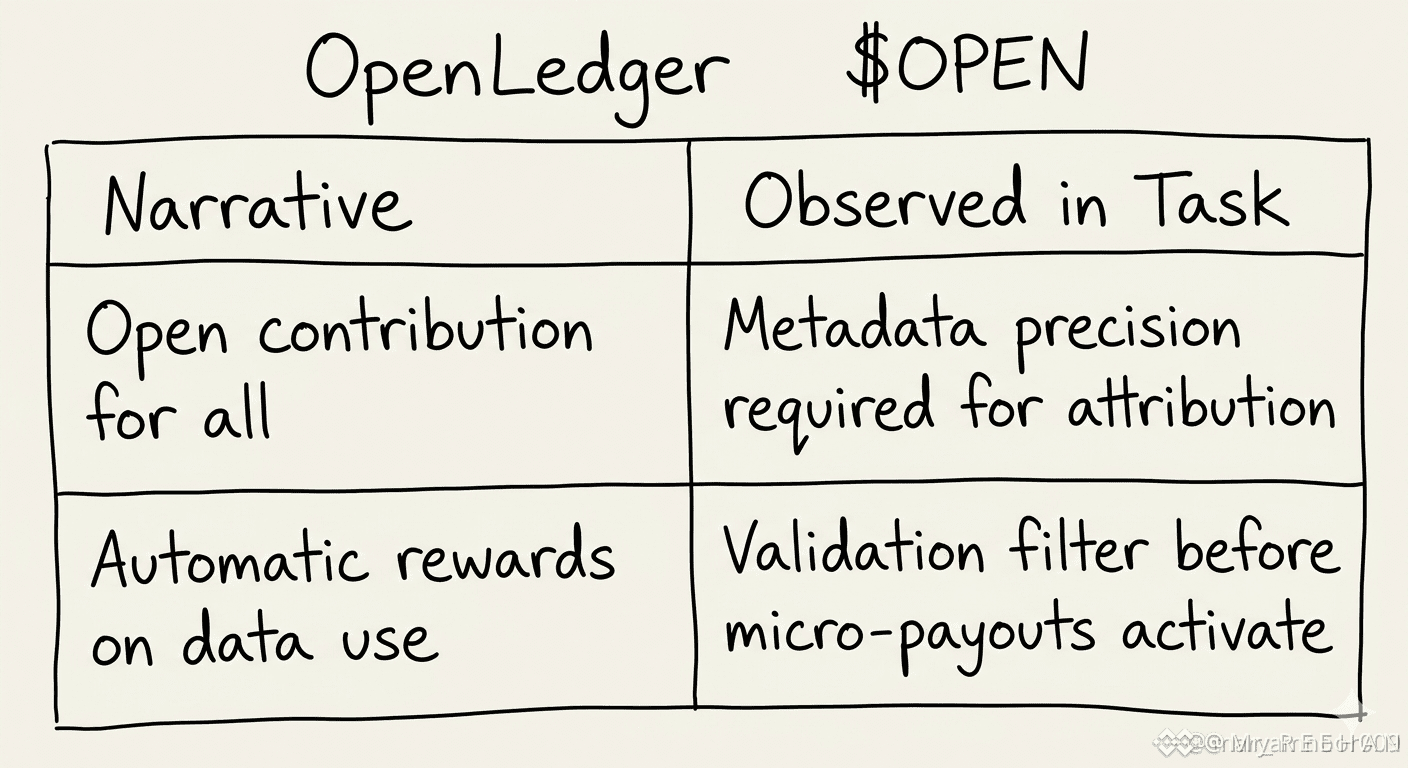
2
2
164

Why OpenLedger Could Play an Important Role in Decentralized AI
Artificial Intelligence is becoming one of the most influential technologies of our time. However, many AI systems rely on centralized data sources and infrastructure, which can create limitations in transparency, ownership, and accessibility. OpenLedger is working to address these challenges through a decentralized approach.
OpenLedger aims to build an ecosystem where data contributors, developers, and users can participate in the growth of AI networks while maintaining transparency through blockchain technology. This model encourages collaboration and rewards participants for providing valuable resources and data.
The $OPEN token serves as an important component of the ecosystem, helping facilitate incentives, network participation, and community engagement. As decentralized AI continues to gain attention, projects like OpenLedger may help create a more open and fair environment for innovation.
The combination of blockchain technology and AI has the potential to unlock new opportunities across industries. OpenLedger's vision of decentralized data contribution and AI development is a concept worth watching as the ecosystem evolves.
Follow @OpenLedger to stay updated on the latest announcements, partnerships, and ecosystem developments.
$OPEN #OpenLedger
155

·
--
I've been spending the last couple of days just hanging out in the governance section of OpenLedger, watching those big whales cast their votes. The more I see, the more I think this so-called decentralized governance is a polished joke. On the surface, everyone can propose and vote, sounds super democratic, but if you dig into the distribution of voting power, you'll realize that the small fry's votes are barely enough to tickle the big players. $LAB
I've followed a few rounds of proposals, and the patterns are crystal clear. The so-called dynamic weight adjustments, today they're suddenly skewing rewards towards text data to cozy up to a big model team; tomorrow, the wind shifts again, and they're subsidizing video rendering. They market these adjustments as optimizing the ecosystem and responding to demand, but the decision-makers are still those few early addresses holding massive chips. Retail investors in this system aren't co-builders; they're more like cheap voting tools manipulated by algorithms and capital, with proposals already predetermined, and voting is just a formality for show.
What’s even sneakier is the kind of traffic manipulation that feels like coercion. The tokens released each month are entirely determined by the real lockup amounts and call frequencies of various vertical networks, forcing subnet teams to use real operational data to fight for funds. It sounds fair, but if you break it down, once the early bonus phase is depleted, those whales holding massive chips will definitely form private alliances, creating a few shell networks to play hot potato, wildly extracting inflation rewards and draining the retail investors' profit pools. What’s left to balance this capital collusion is a deadlock that teams can't escape. $BTC
I’m not saying this project isn’t viable; they have the guts to write the distribution logic directly into the code and not rely on human governance, which is indeed rare in the space. But the centralization risks in governance are very real. Until the issue of whale alliances is resolved, retail investors better recognize their position at the table and not delude themselves into thinking they can change the rules as shareholders. #OpenLedger $OPEN @Openledger
I've been spending the last couple of days just hanging out in the governance section of OpenLedger, watching those big whales cast their votes. The more I see, the more I think this so-called decentralized governance is a polished joke. On the surface, everyone can propose and vote, sounds super democratic, but if you dig into the distribution of voting power, you'll realize that the small fry's votes are barely enough to tickle the big players. $LAB
I've followed a few rounds of proposals, and the patterns are crystal clear. The so-called dynamic weight adjustments, today they're suddenly skewing rewards towards text data to cozy up to a big model team; tomorrow, the wind shifts again, and they're subsidizing video rendering. They market these adjustments as optimizing the ecosystem and responding to demand, but the decision-makers are still those few early addresses holding massive chips. Retail investors in this system aren't co-builders; they're more like cheap voting tools manipulated by algorithms and capital, with proposals already predetermined, and voting is just a formality for show.
What’s even sneakier is the kind of traffic manipulation that feels like coercion. The tokens released each month are entirely determined by the real lockup amounts and call frequencies of various vertical networks, forcing subnet teams to use real operational data to fight for funds. It sounds fair, but if you break it down, once the early bonus phase is depleted, those whales holding massive chips will definitely form private alliances, creating a few shell networks to play hot potato, wildly extracting inflation rewards and draining the retail investors' profit pools. What’s left to balance this capital collusion is a deadlock that teams can't escape. $BTC
I’m not saying this project isn’t viable; they have the guts to write the distribution logic directly into the code and not rely on human governance, which is indeed rare in the space. But the centralization risks in governance are very real. Until the issue of whale alliances is resolved, retail investors better recognize their position at the table and not delude themselves into thinking they can change the rules as shareholders. #OpenLedger $OPEN @OpenLedger
散户投票权重有多惨
33%
动态权重调整谁说了算
67%
3 votes • Voting closed
2
1
539
Log in to explore more content
Join global crypto users on Binance Square
⚡️ Get latest and useful information about crypto.
💬 Trusted by the world’s largest crypto exchange.
👍 Discover real insights from verified creators.
Email / Phone number
Trending Topics
1
#JobsReportRaisesHikeOdds
0 views
9 Discussing
2
#CanUSStocksReboundAfterNonfarmPayrolls?
9,562 views
278 Discussing
3
#BinanceReopensWithdrawalsForMoreAssets
1.2M views
6,319 Discussing
4
#$2TWipedOutHedgeFundsFaceLiquidation
5,860 views
57 Discussing
5
#AnthropicIPOValuationDoubts
35,190 views
659 Discussing
6
#USMidtermsCouldShakeUpUS-IranTies
7,821 views
142 Discussing
7
#RussianCentralBankNamesBTCETHUSDTForNonQualifiedInvestors
11 views
1 Discussing
8
#HyperliquidStrategiesHolds38.52MillionHYPE
1,445 views
62 Discussing
9
#NigeriaCentralBankSetsCapitalMinimumForStablecoinIssuers
111 views
4 Discussing
10
#Nasdaq100FuturesRise1.4%
5,356 views
114 Discussing