

#125
125
1,505 views
16 Discussing
Hot
Latest

·
--
The question from $PENDLE has never been about how much it has dropped, but about whether the market really held onto it after pushing it up. +27.66% over 30 days is out in the open, but looking over the longer run, the real key point is the $101M volume spike on September 19. After that, the price fell from $2.61 down to $2.36, while trading volume shrank in tandem to around $61M. This isn’t panic selling—it looks more like a wave of capital pushed the price higher, but there isn’t fresh “follow-through” buying willing to keep building positions above $2.5.
Even more worth noting: its market-cap rank (#125 ) is still 68.54% away from ATH, and over the past year it has had its footing cut in half. That suggests there are still a large number of trapped holders in the market, and each rebound may simply be giving some people a chance to exit at breakeven—not starting a brand-new uptrend.
If you only look at the 24h -0.69%—that small bearish candle—you’d think the price is fairly stable. But when you put the 7-day -7.46% and the 30-day +27.66% side by side, the slope change is pretty steep. What needs to be confirmed isn’t whether it can bounce back to $2.6, but whether after this pullback the trading volume can expand again. There aren’t many signs of “smart money” activity; instead, it feels more like brief equilibrium within the $2.3–$2.5 range, waiting for a narrative catalyst—maybe protocol upgrades related to restaking, or a broad improvement in sentiment toward yields.
The most easily overlooked risk is this: the rally may not have truly exited the long-term range below $2.0. If the next few days see volume continue shrinking below $50M, and the price breaks back under $2.31 (the Sept 24 low), then technically that 27% move is likely just short-covering—not a trend reversal. Bulls need to prove that $2.3 can become a new support, rather than repeating the false breakout from late August.
So, my view is that $PENDLE is currently in a “post-rally needs confirmation” phase, and it’s still not enough to claim a trend turn. What variable could most likely overturn this view? I think it would be if volume suddenly returns to above $90M for three consecutive days, and the price also regains $2.6. That would suggest there’s a Hong Kong stock component coming from long-term capital—meaning the prior volume contraction was just a mid-game break. What do you think: do these low-volume pullbacks look more like a shakeout, or is the momentum simply running out?
The question from $PENDLE has never been about how much it has dropped, but about whether the market really held onto it after pushing it up. +27.66% over 30 days is out in the open, but looking over the longer run, the real key point is the $101M volume spike on September 19. After that, the price fell from $2.61 down to $2.36, while trading volume shrank in tandem to around $61M. This isn’t panic selling—it looks more like a wave of capital pushed the price higher, but there isn’t fresh “follow-through” buying willing to keep building positions above $2.5.
Even more worth noting: its market-cap rank (#125 ) is still 68.54% away from ATH, and over the past year it has had its footing cut in half. That suggests there are still a large number of trapped holders in the market, and each rebound may simply be giving some people a chance to exit at breakeven—not starting a brand-new uptrend.
If you only look at the 24h -0.69%—that small bearish candle—you’d think the price is fairly stable. But when you put the 7-day -7.46% and the 30-day +27.66% side by side, the slope change is pretty steep. What needs to be confirmed isn’t whether it can bounce back to $2.6, but whether after this pullback the trading volume can expand again. There aren’t many signs of “smart money” activity; instead, it feels more like brief equilibrium within the $2.3–$2.5 range, waiting for a narrative catalyst—maybe protocol upgrades related to restaking, or a broad improvement in sentiment toward yields.
The most easily overlooked risk is this: the rally may not have truly exited the long-term range below $2.0. If the next few days see volume continue shrinking below $50M, and the price breaks back under $2.31 (the Sept 24 low), then technically that 27% move is likely just short-covering—not a trend reversal. Bulls need to prove that $2.3 can become a new support, rather than repeating the false breakout from late August.
So, my view is that $PENDLE is currently in a “post-rally needs confirmation” phase, and it’s still not enough to claim a trend turn. What variable could most likely overturn this view? I think it would be if volume suddenly returns to above $90M for three consecutive days, and the price also regains $2.6. That would suggest there’s a Hong Kong stock component coming from long-term capital—meaning the prior volume contraction was just a mid-game break. What do you think: do these low-volume pullbacks look more like a shakeout, or is the momentum simply running out?
Even more worth noting: its market-cap rank (#125 ) is still 68.54% away from ATH, and over the past year it has had its footing cut in half. That suggests there are still a large number of trapped holders in the market, and each rebound may simply be giving some people a chance to exit at breakeven—not starting a brand-new uptrend.
If you only look at the 24h -0.69%—that small bearish candle—you’d think the price is fairly stable. But when you put the 7-day -7.46% and the 30-day +27.66% side by side, the slope change is pretty steep. What needs to be confirmed isn’t whether it can bounce back to $2.6, but whether after this pullback the trading volume can expand again. There aren’t many signs of “smart money” activity; instead, it feels more like brief equilibrium within the $2.3–$2.5 range, waiting for a narrative catalyst—maybe protocol upgrades related to restaking, or a broad improvement in sentiment toward yields.
The most easily overlooked risk is this: the rally may not have truly exited the long-term range below $2.0. If the next few days see volume continue shrinking below $50M, and the price breaks back under $2.31 (the Sept 24 low), then technically that 27% move is likely just short-covering—not a trend reversal. Bulls need to prove that $2.3 can become a new support, rather than repeating the false breakout from late August.
So, my view is that $PENDLE is currently in a “post-rally needs confirmation” phase, and it’s still not enough to claim a trend turn. What variable could most likely overturn this view? I think it would be if volume suddenly returns to above $90M for three consecutive days, and the price also regains $2.6. That would suggest there’s a Hong Kong stock component coming from long-term capital—meaning the prior volume contraction was just a mid-game break. What do you think: do these low-volume pullbacks look more like a shakeout, or is the momentum simply running out?
88

·
--
BTW, a 2.0% surge! Can you chase this kind of sudden rally?20:03 (7 minutes ago) BTW a 2.0% surge appeared at an important time point (5-minute window 19:58→20:03). As of 20:11:02, the current price is 1.2157, with a 24h change of -5.3%. In the same batch of unusual moves were XVS and SOON.
📅 Data as of 20:11:02 (event trigger time is noted on each item; prices are real-time snapshots at the time of writing)
📌 One-sentence highlight: During important periods (K-line close / US stock open and close), the unusual moves often involve institutions, making the signals higher quality
Market Overview: BTC 83,795.40(-0.59%) · ETH 2,694.00(-1.28%); Across the whole market, 208 stocks rose / 283 fell in the past 24h; Top gainer in the past 24h: ARK+57.21%, worst performer: Lobster -24.48%.
BTW, a 2.0% surge! Can you chase this kind of sudden rally?
20:03 (7 minutes ago) BTW a 2.0% surge appeared at an important time point (5-minute window 19:58→20:03). As of 20:11:02, the current price is 1.2157, with a 24h change of -5.3%. In the same batch of unusual moves were XVS and SOON.
📅 Data as of 20:11:02 (event trigger time is noted on each item; prices are real-time snapshots at the time of writing)
📌 One-sentence highlight: During important periods (K-line close / US stock open and close), the unusual moves often involve institutions, making the signals higher quality
Market Overview: BTC 83,795.40(-0.59%) · ETH 2,694.00(-1.28%); Across the whole market, 208 stocks rose / 283 fell in the past 24h; Top gainer in the past 24h: ARK+57.21%, worst performer: Lobster -24.48%.
📅 Data as of 20:11:02 (event trigger time is noted on each item; prices are real-time snapshots at the time of writing)
📌 One-sentence highlight: During important periods (K-line close / US stock open and close), the unusual moves often involve institutions, making the signals higher quality
Market Overview: BTC 83,795.40(-0.59%) · ETH 2,694.00(-1.28%); Across the whole market, 208 stocks rose / 283 fell in the past 24h; Top gainer in the past 24h: ARK+57.21%, worst performer: Lobster -24.48%.
5

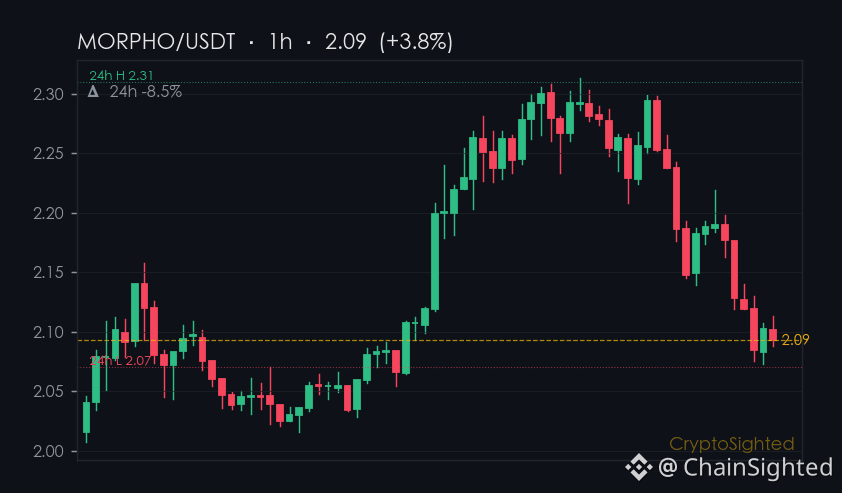
MORPHO’s 8.5% drop in 24 hours stands out - not because it’s the biggest move, but because it’s bucking its own 7-day trend.
While most tokens are falling hard, MORPHO is still 8.3% above its 7-day low. That divergence is worth noting.
Could MORPHO’s 7-day resilience signal a potential floor ahead of its 24-hour volatility?
—
Not financial advice. DYOR.
📌 Hotspot Watch · #125 · #CryptoTrends #CryptoSighted $MORPHO
MORPHO’s 8.5% drop in 24 hours stands out - not because it’s the biggest move, but because it’s bucking its own 7-day trend.
While most tokens are falling hard, MORPHO is still 8.3% above its 7-day low. That divergence is worth noting.
Could MORPHO’s 7-day resilience signal a potential floor ahead of its 24-hour volatility?
—
Not financial advice. DYOR.
📌 Hotspot Watch · #125 · #CryptoTrends #CryptoSighted $MORPHO
While most tokens are falling hard, MORPHO is still 8.3% above its 7-day low. That divergence is worth noting.
Could MORPHO’s 7-day resilience signal a potential floor ahead of its 24-hour volatility?
—
Not financial advice. DYOR.
📌 Hotspot Watch · #125 · #CryptoTrends #CryptoSighted $MORPHO
29

·
--
$SEI Today I’ll make a quick, basic fundamentals note—no pump-and-dump calls.
Sei’s current pricing feels more like the market is reassessing the strength of the narrative, rather than just looking at candlestick colors.
Current price: $0.0516
Market cap: $347.3M
Rank: #125
FDV: $0.0000
7D / 30D: -4.9% / -25.0%
What I care about most is the supply structure:
Circulating ratio is about 67.3%. Any future unlocks/supply pressure must be factored into the valuation.
Daily trend: Bearish 📉
RSI: 42.5
Support: $0.0500
Resistance: $0.0600
My read: $SEI If it regains the resistance level, the market will start giving it narrative premium; if it breaks below support, it means capital still isn’t willing to buy this story. NFA.
Do you think $SEI is undervalued, or just another dead-cat bounce trap?
$SEI Today I’ll make a quick, basic fundamentals note—no pump-and-dump calls.
Sei’s current pricing feels more like the market is reassessing the strength of the narrative, rather than just looking at candlestick colors.
Current price: $0.0516
Market cap: $347.3M
Rank: #125
FDV: $0.0000
7D / 30D: -4.9% / -25.0%
What I care about most is the supply structure:
Circulating ratio is about 67.3%. Any future unlocks/supply pressure must be factored into the valuation.
Daily trend: Bearish 📉
RSI: 42.5
Support: $0.0500
Resistance: $0.0600
My read: $SEI If it regains the resistance level, the market will start giving it narrative premium; if it breaks below support, it means capital still isn’t willing to buy this story. NFA.
Do you think $SEI is undervalued, or just another dead-cat bounce trap?
Sei’s current pricing feels more like the market is reassessing the strength of the narrative, rather than just looking at candlestick colors.
Current price: $0.0516
Market cap: $347.3M
Rank: #125
FDV: $0.0000
7D / 30D: -4.9% / -25.0%
What I care about most is the supply structure:
Circulating ratio is about 67.3%. Any future unlocks/supply pressure must be factored into the valuation.
Daily trend: Bearish 📉
RSI: 42.5
Support: $0.0500
Resistance: $0.0600
My read: $SEI If it regains the resistance level, the market will start giving it narrative premium; if it breaks below support, it means capital still isn’t willing to buy this story. NFA.
Do you think $SEI is undervalued, or just another dead-cat bounce trap?
120

·
--
Contract Quant Brief #125|The continuation isn’t broken, but I’ll only re-enter after a clean pullback
First, let’s make the order book clear: in the filters, this is a continuation. The overall funding rate is still manageable, and the trend-better candidates are still worth watching. However, the shortlist has already started to diverge—some are consolidating right along the moving average, while others are still rallying from the highs, yet their open positions don’t match up. In this kind of situation, I’d rather wait for confirmation than chase the tip.
【ARC】I’ll focus on this first
Current price is about 0.0635, up about +21% today. In the last hour it’s nearly flat. It’s almost sticking to the 20-day moving average (slightly below). Over the past 6 hours there’s still about +11% of trend “heat” remaining. Open positions in the last hour are about +5.6%, and the funding rate is about 0.047%. It hasn’t reached the point where I’d shut the long thesis down directly.
Observation zone: 0.0607–0.0640 consolidation range
Trigger: pullback that doesn’t break, then re-establish and hold above 0.0643; volume/open positions don’t collapse
Invalidation: breakdown below 0.0588, or repeated hard sells near the moving average without reclaiming
Trade-off: I don’t want to hard chase here. Only if the pullback is clean and the structure stays intact would I be more willing to follow through.
【TST】Cautious, won’t take the first step
Current price about 0.0170, up about +26% today, but it’s already about 11% above the 20-day moving average. What’s more obvious is that open positions over the last hour have dropped by about 15%—the price is still moving, but positions are shrinking. I’ll treat it as something that needs further confirmation, not something to just get on immediately.
Observation zone: 0.0164–0.0173
Trigger: after a pullback, it reclaims and holds above 0.0171, and open positions stop falling and rebound
Invalidation: breaks below 0.0160
Trade-off: If I miss it, I miss it. I’d rather wait for it to cool off some of the overheat, then see whether there’s a second attempt.
Alternative to watch: COOKIE is up about +41% today, far from the moving average and with a surge in open positions—just note it for now; I won’t chase.
Risk warning: altcoins can be highly volatile; funding rates and open positions may flip quickly. Follow strict stop-losses and control leverage and position sizing. The above is for quantitative screening observations and does not constitute investment advice.
In one sentence: In the continuation play, I prioritize waiting for ARC to confirm its pullback; for TST, I first want to see whether open positions can keep up—those accelerating at the highs, I’ll skip for now.
Contract Quant Brief #125|The continuation isn’t broken, but I’ll only re-enter after a clean pullback
First, let’s make the order book clear: in the filters, this is a continuation. The overall funding rate is still manageable, and the trend-better candidates are still worth watching. However, the shortlist has already started to diverge—some are consolidating right along the moving average, while others are still rallying from the highs, yet their open positions don’t match up. In this kind of situation, I’d rather wait for confirmation than chase the tip.
【ARC】I’ll focus on this first
Current price is about 0.0635, up about +21% today. In the last hour it’s nearly flat. It’s almost sticking to the 20-day moving average (slightly below). Over the past 6 hours there’s still about +11% of trend “heat” remaining. Open positions in the last hour are about +5.6%, and the funding rate is about 0.047%. It hasn’t reached the point where I’d shut the long thesis down directly.
Observation zone: 0.0607–0.0640 consolidation range
Trigger: pullback that doesn’t break, then re-establish and hold above 0.0643; volume/open positions don’t collapse
Invalidation: breakdown below 0.0588, or repeated hard sells near the moving average without reclaiming
Trade-off: I don’t want to hard chase here. Only if the pullback is clean and the structure stays intact would I be more willing to follow through.
【TST】Cautious, won’t take the first step
Current price about 0.0170, up about +26% today, but it’s already about 11% above the 20-day moving average. What’s more obvious is that open positions over the last hour have dropped by about 15%—the price is still moving, but positions are shrinking. I’ll treat it as something that needs further confirmation, not something to just get on immediately.
Observation zone: 0.0164–0.0173
Trigger: after a pullback, it reclaims and holds above 0.0171, and open positions stop falling and rebound
Invalidation: breaks below 0.0160
Trade-off: If I miss it, I miss it. I’d rather wait for it to cool off some of the overheat, then see whether there’s a second attempt.
Alternative to watch: COOKIE is up about +41% today, far from the moving average and with a surge in open positions—just note it for now; I won’t chase.
Risk warning: altcoins can be highly volatile; funding rates and open positions may flip quickly. Follow strict stop-losses and control leverage and position sizing. The above is for quantitative screening observations and does not constitute investment advice.
In one sentence: In the continuation play, I prioritize waiting for ARC to confirm its pullback; for TST, I first want to see whether open positions can keep up—those accelerating at the highs, I’ll skip for now.
First, let’s make the order book clear: in the filters, this is a continuation. The overall funding rate is still manageable, and the trend-better candidates are still worth watching. However, the shortlist has already started to diverge—some are consolidating right along the moving average, while others are still rallying from the highs, yet their open positions don’t match up. In this kind of situation, I’d rather wait for confirmation than chase the tip.
【ARC】I’ll focus on this first
Current price is about 0.0635, up about +21% today. In the last hour it’s nearly flat. It’s almost sticking to the 20-day moving average (slightly below). Over the past 6 hours there’s still about +11% of trend “heat” remaining. Open positions in the last hour are about +5.6%, and the funding rate is about 0.047%. It hasn’t reached the point where I’d shut the long thesis down directly.
Observation zone: 0.0607–0.0640 consolidation range
Trigger: pullback that doesn’t break, then re-establish and hold above 0.0643; volume/open positions don’t collapse
Invalidation: breakdown below 0.0588, or repeated hard sells near the moving average without reclaiming
Trade-off: I don’t want to hard chase here. Only if the pullback is clean and the structure stays intact would I be more willing to follow through.
【TST】Cautious, won’t take the first step
Current price about 0.0170, up about +26% today, but it’s already about 11% above the 20-day moving average. What’s more obvious is that open positions over the last hour have dropped by about 15%—the price is still moving, but positions are shrinking. I’ll treat it as something that needs further confirmation, not something to just get on immediately.
Observation zone: 0.0164–0.0173
Trigger: after a pullback, it reclaims and holds above 0.0171, and open positions stop falling and rebound
Invalidation: breaks below 0.0160
Trade-off: If I miss it, I miss it. I’d rather wait for it to cool off some of the overheat, then see whether there’s a second attempt.
Alternative to watch: COOKIE is up about +41% today, far from the moving average and with a surge in open positions—just note it for now; I won’t chase.
Risk warning: altcoins can be highly volatile; funding rates and open positions may flip quickly. Follow strict stop-losses and control leverage and position sizing. The above is for quantitative screening observations and does not constitute investment advice.
In one sentence: In the continuation play, I prioritize waiting for ARC to confirm its pullback; for TST, I first want to see whether open positions can keep up—those accelerating at the highs, I’ll skip for now.
523


·
--
We're excited to share the latest trending tokens on CoinGecko, giving us insight into the current market landscape. Our community is always looking for the next big opportunity, and we're here to provide the latest updates. We've got our eyes on Kled AI (KLED), Cap (CAP), and Arcium (ARX), which are making waves in the crypto space.
We're seeing significant movement in the market cap rankings, with Velvet (VELVET) at #125 and Pudgy Penguins (PENGU) at #118. Aave (AAVE) is also trending, currently sitting at #51. Meanwhile, Bitcoin (BTC) remains at the top spot, with a market cap rank of #1. We're noticing some notable changes, with these tokens experiencing fluctuations in their market cap rankings 🚀.
We're committed to keeping our community informed about the latest developments in the crypto world 💡. As we continue to monitor the market, we're eager to see how these trending tokens will perform in the coming days. With the crypto market constantly evolving, we're staying ahead of the curve to bring our community the most up-to-date information 📊💻
$AGLD, $PUNDIX, $VELVET
We're excited to share the latest trending tokens on CoinGecko, giving us insight into the current market landscape. Our community is always looking for the next big opportunity, and we're here to provide the latest updates. We've got our eyes on Kled AI (KLED), Cap (CAP), and Arcium (ARX), which are making waves in the crypto space.
We're seeing significant movement in the market cap rankings, with Velvet (VELVET) at #125 and Pudgy Penguins (PENGU) at #118. Aave (AAVE) is also trending, currently sitting at #51. Meanwhile, Bitcoin (BTC) remains at the top spot, with a market cap rank of #1. We're noticing some notable changes, with these tokens experiencing fluctuations in their market cap rankings 🚀.
We're committed to keeping our community informed about the latest developments in the crypto world 💡. As we continue to monitor the market, we're eager to see how these trending tokens will perform in the coming days. With the crypto market constantly evolving, we're staying ahead of the curve to bring our community the most up-to-date information 📊💻
$AGLD , $PUNDIX , $VELVET
We're seeing significant movement in the market cap rankings, with Velvet (VELVET) at #125 and Pudgy Penguins (PENGU) at #118. Aave (AAVE) is also trending, currently sitting at #51. Meanwhile, Bitcoin (BTC) remains at the top spot, with a market cap rank of #1. We're noticing some notable changes, with these tokens experiencing fluctuations in their market cap rankings 🚀.
We're committed to keeping our community informed about the latest developments in the crypto world 💡. As we continue to monitor the market, we're eager to see how these trending tokens will perform in the coming days. With the crypto market constantly evolving, we're staying ahead of the curve to bring our community the most up-to-date information 📊💻
$AGLD , $PUNDIX , $VELVET
2
70

Honestly, $OP this wave has something. Today +6.89% and it’s above $0.104—can’t sit still on the chain anymore. Superchain has expanded to 34 chains, with $21.7B locked up, taking 58.5% of the L2 share.
But what about the price? The market cap is only $184 million, ranked around #125; it’s down 95% from its peak. Everyone complains about the annual inflation rate of 23% and won’t buy. Old-school weeders know the L2 narrative only really pops off at the end—on-chain first the coin price runs, then the narrative follows.
The $BTC ETF had net inflows of $266 million on No. 7—risk-on is on. Strong data but weak price—that’s exactly cheap chips.
Which L2 are you still watching?
#行情分析 #链上数据 #altcoin
Honestly, $OP this wave has something. Today +6.89% and it’s above $0.104—can’t sit still on the chain anymore. Superchain has expanded to 34 chains, with $21.7B locked up, taking 58.5% of the L2 share.
But what about the price? The market cap is only $184 million, ranked around #125; it’s down 95% from its peak. Everyone complains about the annual inflation rate of 23% and won’t buy. Old-school weeders know the L2 narrative only really pops off at the end—on-chain first the coin price runs, then the narrative follows.
The $BTC ETF had net inflows of $266 million on No. 7—risk-on is on. Strong data but weak price—that’s exactly cheap chips.
Which L2 are you still watching?
#行情分析 #链上数据 #altcoin
But what about the price? The market cap is only $184 million, ranked around #125; it’s down 95% from its peak. Everyone complains about the annual inflation rate of 23% and won’t buy. Old-school weeders know the L2 narrative only really pops off at the end—on-chain first the coin price runs, then the narrative follows.
The $BTC ETF had net inflows of $266 million on No. 7—risk-on is on. Strong data but weak price—that’s exactly cheap chips.
Which L2 are you still watching?
#行情分析 #链上数据 #altcoin
82
Log in to explore more content
Join global crypto users on Binance Square
⚡️ Get latest and useful information about crypto.
💬 Trusted by the world’s largest crypto exchange.
👍 Discover real insights from verified creators.
Email / Phone number
Trending Topics
1
#ZcashETFPostsFirstWeeklyOutflow$93.6M
39,025 views
129 Discussing
2
#GreekPoliceBustCryptoScamRingArrest17
92,141 views
761 Discussing
3
#BitcoinRejectedAt$87K
130,032 views
186 Discussing
4
#FedOctoberRateHikeOddsFallTo17%
117,342 views
1,031 Discussing
5
#NvidiaHitsRecordHighUp2.4%
83,314 views
747 Discussing
6
#CanaryFilesAmendedS1ForPEPEETF
22,474 views
525 Discussing
7
#USRussiaUkraineTalksReportedlyIncludeLukoilOilDeal
33,713 views
505 Discussing
8
#BitcoinParesGainsAfterRallyTo$86.5K
49,252 views
168 Discussing
9
#CerebrasSinksNearly20%OnReportNvidiaToPowerOpenAI
121,939 views
1,140 Discussing
10
#SECProposesCryptoCustodyRules
166,128 views
1,418 Discussing