

By Ben Giove
Compilation: The Way of DeFi
2022 has been a bleak year for Crypto, with stablecoins, hedge funds, lenders, and exchanges all imploding in horrific fashion. Much of the space has collapsed, but there are still some pockets of growth amid the carnage. A prime example of this long-term growth is the Layer-2 ecosystem.
Ethereum’s superior scaling solution has quietly experienced a breakout year in 2022, achieving numerous milestones at both the infrastructure and application layers, and seeing extraordinary growth in key KPIs.
With that in mind, let’s take a look back at 22 years of L2 and see if 2023 will be another breakout year.
Metrics Snapshot
TVL
L2 TVL denominated in ETH; Source: L2Beat
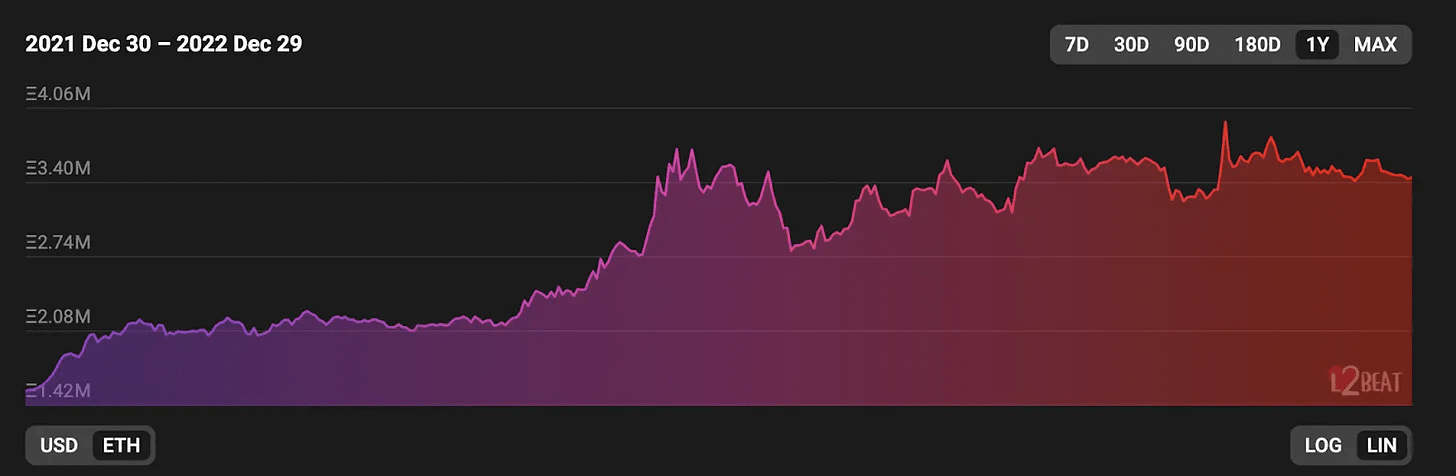
The USD value of assets bridged to L2 fell 28.6% from $5.7 billion to $4.1 billion. However, this may be due to falling cryptocurrency prices rather than user capital withdrawals, as TVL denominated in ETH rose 120.6% from $1.6 million to $3.4 million. This suggests that L2 has seen significant liquidity inflows in 2022, net of price.
Trading Volume
 Arbitrum’s monthly trading volume; Source: Dune Analytics
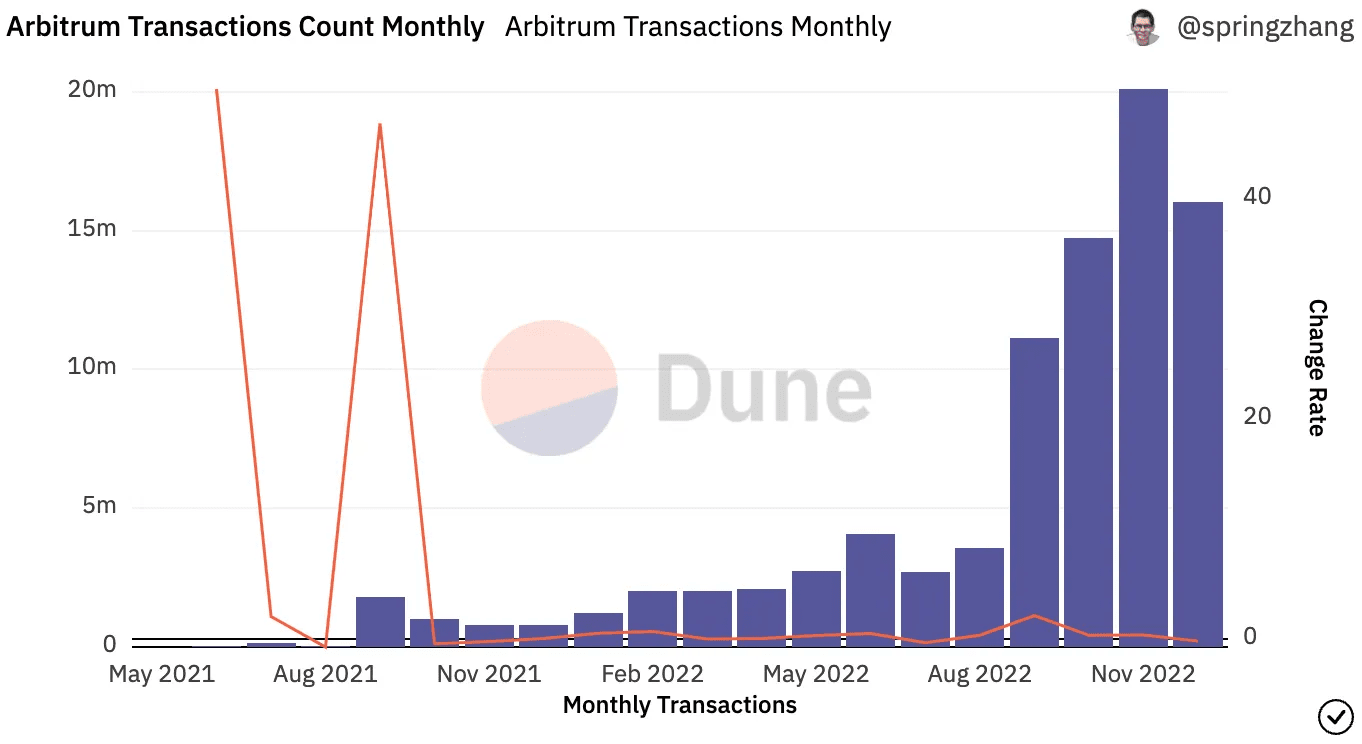
Arbitrum has seen significant growth in transaction volume throughout 2022, driven by increased traction from native dapps like GMX and the Nitro upgrade that significantly reduced transaction fees. The network’s transaction volume grew 590% from 5 million in Q1 to 34.9 million in Q4.
Optimism monthly trading volume; Source: Dune Analytics
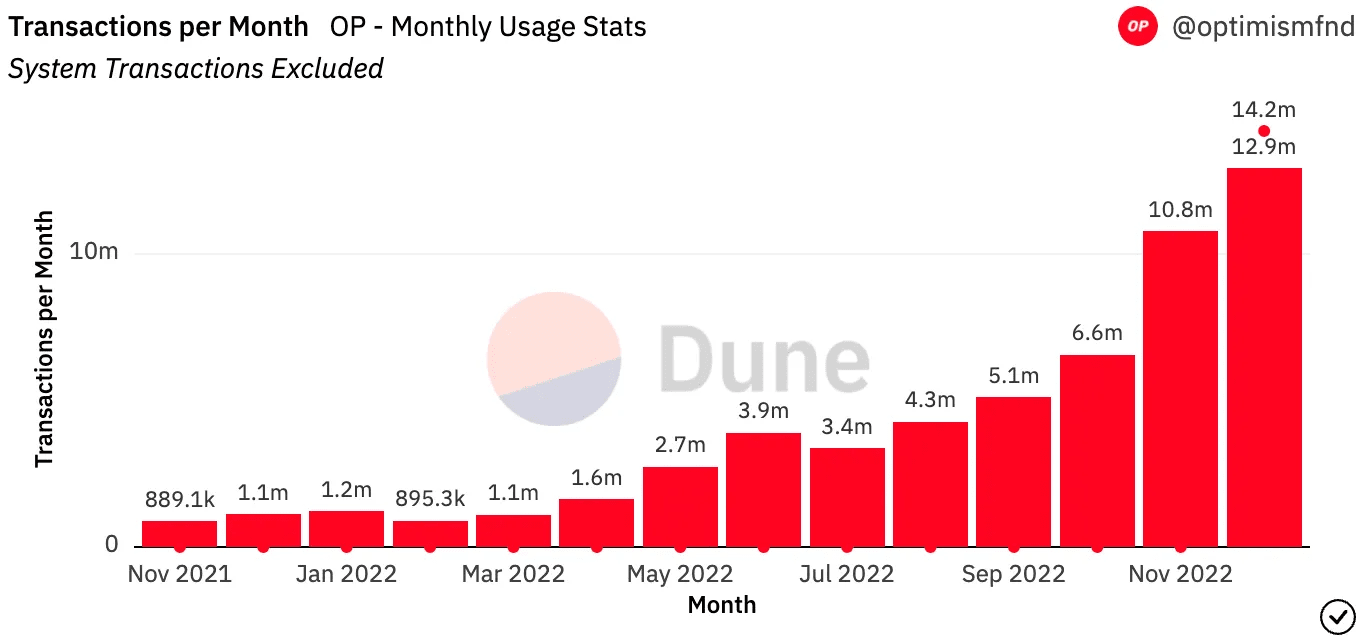
Optimism also experienced a significant increase in transaction volume, likely due to increased activity following the launch of OP and the subsequent incentive program. Optimism processed 3.2 million transactions in Q1 and 30.3 million in Q4, representing an increase of 846.7% between the two periods.
user
Arbitrum monthly active users; Source: Dune Analytics
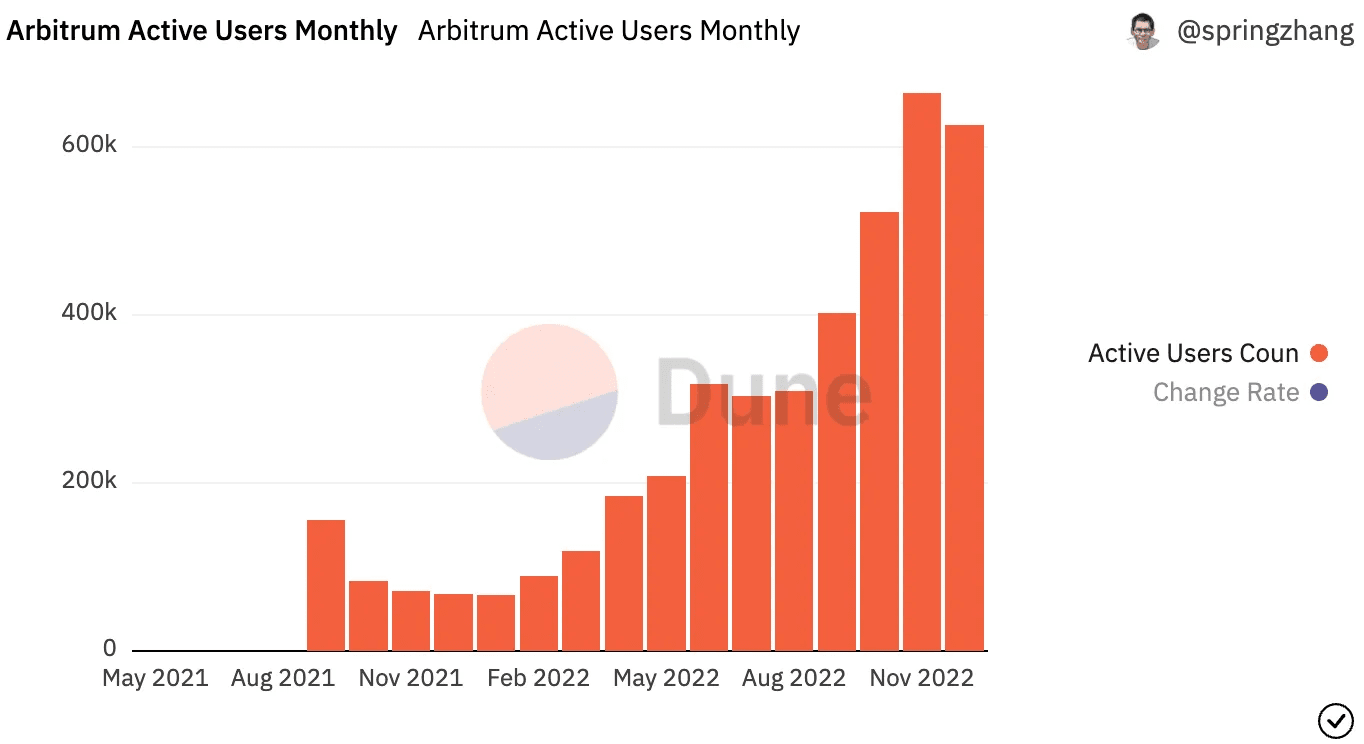
As mentioned earlier, Arbitrum experienced strong growth in active users during 2022, driven by the use of applications such as GMX and the Nitro scalability upgrade. L2's monthly average active users surged from 91,800 in the first quarter to 6,050,000 in the fourth quarter, an increase of 559.1%.
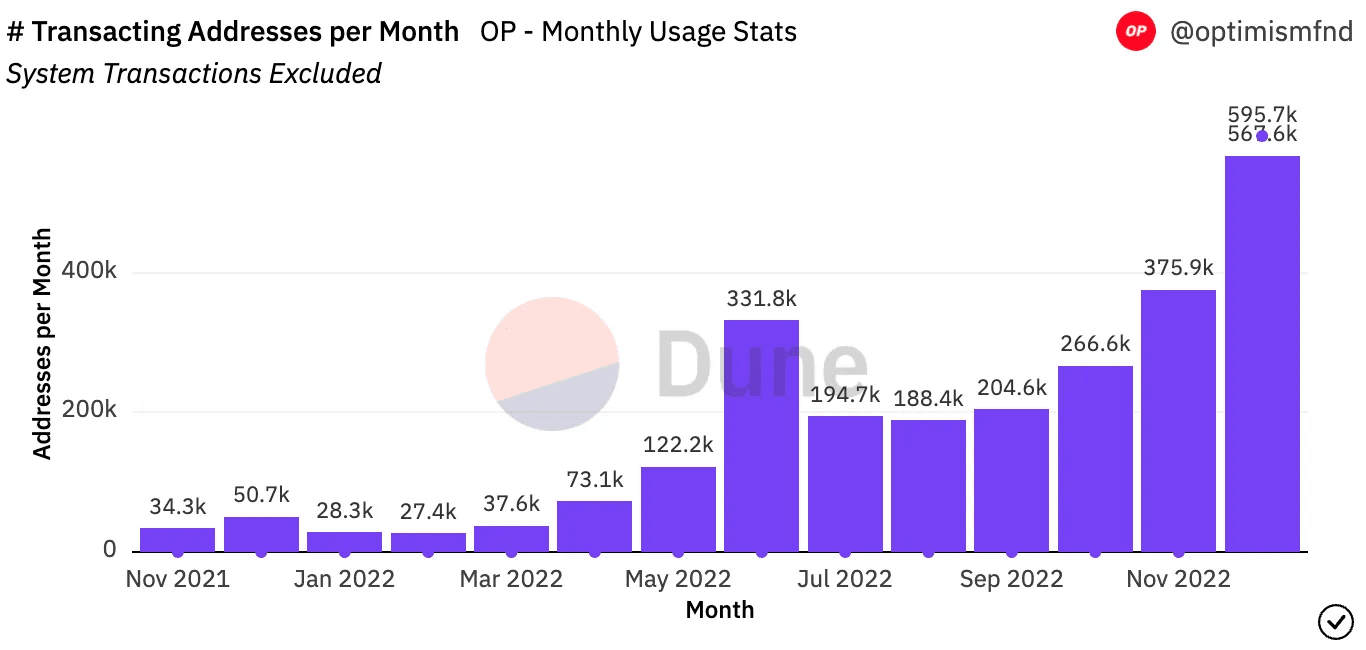
Optimism monthly active users; Source: Dune Analytics
Optimism has also experienced a significant increase in users during 2022. Riding the wave of the aforementioned token issuance and incentive programs, Optimism's monthly active addresses soared from an average of 33.1K in Q1 to 403.4K in Q4, an increase of 1118.7%.
Highlight moments
The rise of GMX
GMX emerged as the breakout L2 application of 2022. When on-chain activity dried up and prices fell, the usage of this Arbitrum-based decentralized perpetual exchange soared, making good use of the increased throughput of L2 by facilitating $81.4 billion in trading volume and generating $33 million in revenue. GMX has become the core foundation of Arbitrum, accounting for 39.5% of the network's TVL, and many projects such as Dopex, Vesta Finance, Rage Trade, Umami Finance, etc. are built on GMX and integrate the platform's liquidity token GLP.
This growth, along with the inclusion of a strong group of tokens for revenue sharing, has resulted in the GMX token becoming one of the best performing assets in all of crypto, gaining 87.4% and 487.2% against the USD and ETH in 2022, respectively.
L2 Token Airdrop
Several well-known L2s launched tokens in 2022.
The most notable of these was Optimism, which airdropped 5% of its OP supply to early users and stakeholders. The launch of this token catalyzed an increase in user activity and liquidity on the network, with its TVL rising 86.9% since its launch date on May 31.
Another L2 to launch a token is zk-rollup provider StarkWare. StarkWare, which announced a funding round in May at a massive $8 billion valuation, launched their STRK token in mid-November, though it’s not yet available for trading.
OP, and of course STRK, have yet to unlock their full value accrual capabilities in terms of their use in decentralized Optimism and the StarkWare sequencer, respectively. Nonetheless, their launch is an exciting first step in L2 token design and will continue to serve as important strategic tools for each network.
zkSync is now live
The zkEVM is considered the holy grail of scaling solutions because it combines the network effects and developer tooling of the EVM with the massive throughput of zk-rollups.
However, no one seems to be hyping zkSync, but they launched zkEVM, zkSync 2.0, mainnet in October. It is worth noting that the network is still "baby alpha", the first of a three-phase rollout, and is not currently open to contract deployment or end users, but the network reaching production still represents a huge achievement in terms of scaling.
Lows
dYdX’s Exodus
A major low point for the L2 ecosystem in 2022 was the impending acquisition of dYdX by Cosmos.
In June, the perpetual exchange announced that it would migrate from StarkEx and opted to launch its V4 as its application-specific blockchain built using the Cosmos SDK.
This is a substantial blow to the current L2 landscape, as dYdX is the largest decentralized perpetual exchange, facilitating $461.2 billion in trading volume over the past 12 months. This move by dYdX has also led to speculation that many other well-known dapps will also migrate from Ethereum, eschewing the L2 ecosystem and choosing to build their own sovereign chains.
For now, this mass exodus has not occurred. However, dYdX’s decision is a stark reminder that L2 will continue to face stiff competition.
Centralized carriers still exist
It might be a bit harsh to call this a "trough" - but many L2s still continue to operate under major trust assumptions. For example, neither Arbitrum nor Optimism have yet fully implemented trustless fraud prevention measures and decentralized sequencers. Furthermore, each network can still be upgraded by the core team (albeit with a timelock delay).
This is understandable, as the upgrade is new technology and these centralized entities act as guardrails to prevent loss of user funds. However, these trust assumptions remain a source of risk heading into 2023.
Outlook
2023 will hold many exciting developments for existing and new L2s.
Let’s talk about a few of these aspects:
Decision
First, Arbitrum has a number of catalysts that could spur growth in 2023.
In addition to the seemingly endless stream of innovative DeFi applications launching on L2, the network is poised to benefit from the resumption of Arbitrum Odyssey, an event designed to incentivize the use of prominent dapps on the network by rewarding users with NFTs. Odyssey was postponed in its second week due to a spike in gas fees, but the event should resume in the near future.
It’s also possible that Odyssey will be a precursor to the launch of the Arbitrum token. This token will likely be airdropped to early users and Odyssey participants, as well as used by dapps for incentive programs. Arbitrum is keeping mum on the details of its token, but if (and when) it does launch, it will likely result in a major spike in user activity and liquidity flowing into the network.
Optimism
Optimism is also expected to see another year of strong growth in 2023.
With the ongoing rollout of OP incentives and the upcoming second airdrop, Optimism is poised to achieve major scalability improvements with the launch of Bedrock. Currently live on testnet, Bedrock is an upcoming network upgrade that is expected to reduce the cost of submitting calldata to L1 and enable support for "alternative proof systems" such as zk-proofs. Bedrock (along with the upcoming implementation of EIP-4844, which will greatly reduce gas costs for all L2s) should result in a significant increase in Optimism's scalability.
Optimism is also expected to see greater adoption of the OP Stack, a development framework that enables the creation of custom L2s. The OP Stack is expected to see greater adoption with the launch of Aevo, a decentralized options exchange from Ribbon Finance that will be built on an L2 that leverages the stack.
「Everything」L2s
These two optimistic rollups aren’t the only L2s poised to make a big splash in 2023.
There are a number of L2s that will achieve milestones, such as mainnet launches of Polygon and Scroll’s zkEVMs.
As mentioned before, zkSync will continue to roll out in phases to support the deployment of smart contracts and eventually support usage by eager degens like me.
Additionally, other networks like Fuel, a highly scalable ORU that leverages Swell as its programming language, will also see further traction as developers become more familiar with their tools.
As we can see, L2 is a rare growth point in the ecosystem in 2022.
There have been many highs and some lows, but Ethereum is scaling and 2023 will be another explosive year for L2.