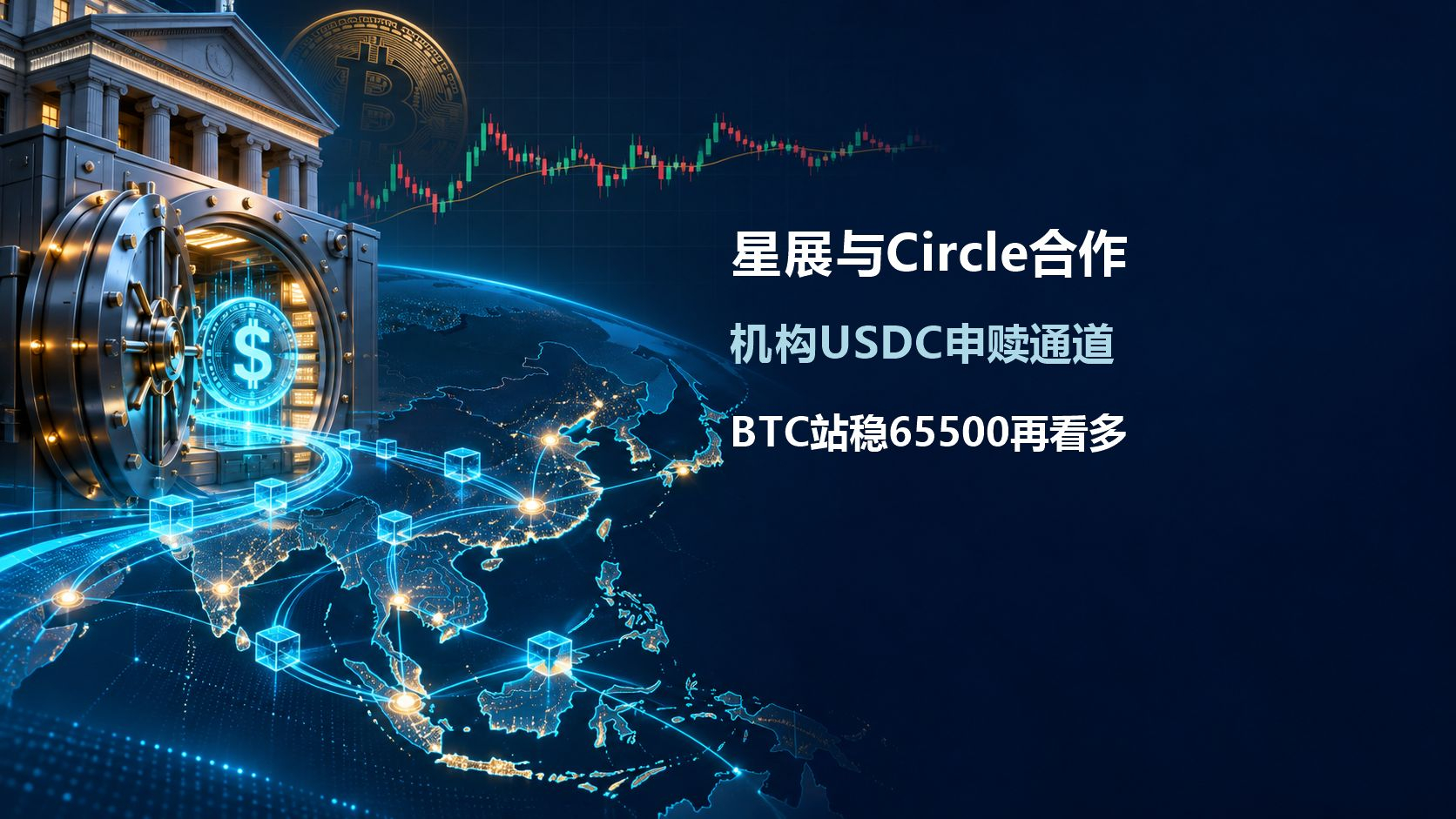
DBS and Circle connect USDC subscriptions and redemptions | Smoother institutional access to dollars | BTC still depends on ETF flows
I view this news as a positive development for crypto market infrastructure, but remain cautious about BTC in the short term. Binance Square is discussing DBS Bank’s partnership with Circle to expand institutional use of USDC in Asia. In an announcement on its website on November 18, DBS confirmed that eligible institutional clients can subscribe to and redeem USDC directly through DBS, with round-the-clock settlement arrangements for USD and USDC. The aim is to give institutions more flexibility in moving funds between bank accounts and on-chain, not to announce that any institution has already bought Bitcoin. Circle issues USDC, while DBS provides the banking channel; the announcement did not disclose the number of participating institutions or the scale of any additional issuance.
Mechanically, this could ease the friction institutions face when accessing or redeeming digital dollars outside traditional banking hours. If more compliant capital eventually enters trading, settlement, and asset tokenization through this channel, market depth could improve, and BTC, as a major risk asset, could benefit indirectly. But “a broader stablecoin channel” does not mean “inflows into BTC.” Institutions could also use USDC solely for payments or treasury management, or redeem USDC back into dollars. To judge whether this genuinely supports prices, look at net USDC issuance, exchange inflows, and spot demand for BTC—not convert a partnership announcement directly into buying pressure.
I would read this news alongside ETF flows that have already occurred. Farside’s current table shows that US spot BTC ETFs saw combined net outflows of about $239.9 million on November 17, including about $209.5 million in net outflows from IBIT; on November 16, they saw combined net inflows of about $7.9 million. These are fund flows organized by trading day, not trades generated on the day of the banking partnership, and they may be revised later. At least based on these figures, the notable net outflows from US funds cannot be ignored just because Asian institutions have gained access to a USDC channel.
At the time of checking, BTC/USDT on Binance was around $64,668, down about 0.21% over the past 24 hours, with a range of $63,336 to $65,447. BTC remains within its range after the news was announced, and no new uptrend has been confirmed; I would not attribute this sideways movement to the DBS partnership. First, watch whether price can reclaim and hold $65,500, then $66,000. $64,300 is a short-term support level to watch, while $63,336 is the 24-hour low. If price breaks above $65,500 but fails to hold, or if ETF outflows continue and spot weakness persists, I would abandon my short-term bullish plan.
If I were trading this myself, I would not chase the price; I would only consider a small spot long. I would enter with about 3% of my total capital only if BTC holds above $65,500 for a consecutive hour, retests and holds $65,300–$65,500, and ETF outflows do not widen further. I would take half off at the first target of $66,000, reduce further at the second target of $67,000, and close the remainder if price falls back below $65,500. The initial stop-loss would be below $64,900, and I would exit the entire position if it is hit. If price first falls below $64,300, I would cancel the entry plan; if it then breaks below $63,336, I would remain in cash and wait for new information. I would keep the expected loss on any single trade to about 0.1% of total capital, avoid high leverage, and not describe a plan that has not been triggered as a profitable trade.
#DBSAndCirclePartnerToExpandAsianInstitutionsUSDCAccess #BTC #USDC
The above is solely my personal market observation and does not constitute investment advice.