
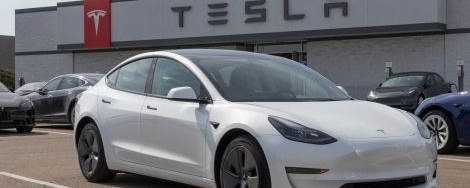

Tesla’s stock price this year really does look pretty ugly. It’s down about 18% so far this year, while the S&P 500 is up 11% over the same period—so all told, they’re off by nearly 30 points. In the past, Musk would have already tweeted “Tesla to the moon,” but now he’s choosing a different way to save the day—holding a new product launch event.
The calendar is already set: September 24, Sparks, Nevada—semi-truck plant inauguration. October 1, Waco, Texas—the unveiling of the second-generation Roadster sports car. From the first time both cars were shown to now, it’s been almost nine years—finally, they’re going to be brought out to meet the public.
But whether the market believes it is another matter.
Analysts’ views are pretty consistent: the new car can’t save the stock price.
CFRA’s Garrett Nelson said outright that he doesn’t think either the semi-truck or the Roadster can significantly boost investors’ enthusiasm. Zacks’ Andrew Rocco was even more direct: what investors really want to see is Robotaxi service expanding to more cities, not another concept car. Morningstar’s Seth Goldstein called the Roadster a “halo model”—good-looking, but it won’t bring in real, measurable revenue. He put it plainly: market sentiment depends on three things—Robotaxi expansion, tangible progress on Optimus humanoid robots, and an improvement in free cash flow.
Free cash flow is indeed a major problem. According to FactSet, Wall Street expects Tesla’s free cash flow to be negative $9.7 billion this year. The reason isn’t complicated: the AI projects are burning cash too aggressively. On one side, there are huge investments; on the other, deliveries have been downgraded—Goldman cut its third-quarter delivery expectation from 490,000 to 435,000, which is also below the market consensus of 456,000. That figure is the real rock weighing on the stock.
Competition in Robotaxi is starting to make people anxious, too.
On X, Ross Gerber of Gerber Kawasaki posted a photo showing that in a parking lot in Santa Monica, hundreds of new Waymo vehicles are lined up for deployment. Waymo currently operates in 15 U.S. cities, with more than 500,000 paid trips each week, and its year-end goal is one million trips. On Tesla’s side, Robotaxi is running in only six cities in Texas and Florida, and San Francisco is still only a “supervised” route. What’s more troubling is that the federal regulator NHTSA requires Tesla to answer 21 questions by September 30, explaining how the Cybercab—without a steering wheel or pedals—can comply with safety regulations. And as of now, Tesla still hasn’t applied for any exemption. Meanwhile, Zoox, part of Amazon, already received an exemption in July this year.
Earlier this month, the Cybercab event already served as a warning shot to the market.
After the event on September 3, Tesla’s stock price didn’t rise—it fell, giving back all the gains from before the release. Some investors and analysts were disappointed with the car. On the weekend of September 12, Tesla confirmed the Roadster’s release date. On the next trading day, the stock closed down 1.77%, at $358.97. The market voted with its feet, and the message was clear.
Morgan Stanley is actually fairly optimistic about the semi-trailer truck, expecting it to generate $17 billion in software revenue by 2040. But that’s more than a decade away—its help to the stock price in the near term is roughly zero.
The problem right now isn’t whether Tesla has a story—it’s that the gap between the story and reality is just too long.
The Roadster is a halo, the semi is a concept, Optimus is still in the lab, Robotaxi has been left behind by Waymo, free cash flow is negative, and deliveries are being lowered. Each item on its own might be tolerable, but stacked together, investors can’t easily convince themselves to keep holding.
There are three key milestones worth watching next: On September 24, the semi-truck factory opening—see whether there are any concrete plans for mass production. On September 30, the NHTSA response deadline—see how the Cybercab compliance issue will be resolved. On October 1, the Roadster release—see whether Musk can come up with something unexpected. Before these three milestones, the stock price will very likely continue to trade sideways and weaker.
A new vehicle launch can spark a burst of optimism, but it can’t change cash flow or the competitive landscape. What Tesla lacks right now isn’t a new car—it’s the tipping point that will actually get Robotaxi running.
Risk warning: The above content is an objective analysis based on publicly available market information and does not constitute any investment advice. Tesla’s stock price is influenced by multiple factors, and there are uncertainties regarding product launches and regulatory progress—please make independent judgments. Investing involves risk; enter the market cautiously.#币安广场