
#dtcc
dtcc
180,127 views
516 Discussing
Hot
Latest

·
--
Bearish
30D trade $XRP 17.5K USDT
🚨BREAKING NEWS: NadineChakar, head of digital assets at DTCC, resigns!
And there is now a lot of speculation that she could join @xrpl ! Chakar helped lead the tokenization push at #DTCC , while Ripple Prime took part in its working group.
Could Ripple be her next destination? $XRP .$BTC .$ETH .#Ripple .#xrp .#BTC .#ETH
🚨BREAKING NEWS: NadineChakar, head of digital assets at DTCC, resigns!
And there is now a lot of speculation that she could join @Ripple ! Chakar helped lead the tokenization push at #DTCC , while Ripple Prime took part in its working group.
Could Ripple be her next destination? $XRP .$BTC .$ETH .#Ripple .#xrp .#BTC .#ETH
And there is now a lot of speculation that she could join @Ripple ! Chakar helped lead the tokenization push at #DTCC , while Ripple Prime took part in its working group.
Could Ripple be her next destination? $XRP .$BTC .$ETH .#Ripple .#xrp .#BTC .#ETH

174

Article
See translation
THE FIRST JOB OF A DTC DIGITAL TWIN: Collateral Mobility Before Secondary TradingTHE FIRST JOB OF A DTC DIGITAL TWIN: Collateral Mobility Before Secondary Trading
Independent Research | @AlphaCyl
I. The Asset Does Not Need to Leave DTC
The most important development in #DTCC tokenization programme may have little to do with secondary trading.
On October 28, 2026, The Depository Trust Company (DTC), a subsidiary of the Depository Trust & Clearing Corporation (DTCC), launched its Tokenization Service. The service allows eligible participants to convert securities already held at DTC into tokenized representations that can move between registered digital wallets.
DTCC holds more than $114 trillion in securities. Its stated objectives for tokenization include greater liquidity, collateral mobility and capital efficiency. The July 15 production event had already tested collateral pledges, securities lending, Treasury repo, equity delivery versus payment (DVP) and central counterparty (CCP) margin workflows.
The launch initially supports 34 securities, representing approximately $30 trillion in assets under custody. Twenty DTC Participants have signed agreements to access the service.
The interesting part is the structure.
The underlying securities remain within DTC. The token represents the corresponding security entitlement, while DTC maintains the official record of token movements and holdings through its LedgerScan infrastructure.
This paper argues that collateral mobility may become the first economically significant use case for DTC’s digital twins. The immediate opportunity is to make securities already held within the depository easier to deploy across financing, margin and collateral arrangements, without requiring their full withdrawal from DTC.
That is a narrower proposition than the usual argument that tokenization will produce continuous securities trading. It is also a more practical starting point for institutional adoption.
dtcc.com/press-releases…
dtcc.com/press-releases…
II. What DTC Actually Tokenizes
The first distinction is between the underlying security and the entitlement represented by its token.
In the traditional U.S. securities holding structure, DTC operates as the central securities depository. Securities are generally registered in the name of Cede & Co., DTC’s nominee, while DTC Participants maintain securities entitlements through their accounts.
The tokenization service introduces another way to represent and transfer those entitlements.
The process works in four stages:
1. A DTC Participant registers a digital wallet on a supported blockchain and submits a Tokenization Instruction for an eligible security held in its DTC account.
2. DTC applies its existing risk controls. Once the instruction is accepted, the relevant securities are debited from the Participant’s account and credited to DTC’s Digital Omnibus Account.
3. DTC’s ComposerX Factory system mints a token representing the corresponding security entitlement and delivers it to the registered wallet.
4. LedgerScan monitors blockchain movements and records the location of the tokens. Its record constitutes DTC’s official books and records for tokenized entitlements.
The Digital Omnibus Account is particularly important.
It holds the underlying traditional securities represented by the tokens. Those securities cannot be transferred out of the omnibus account until the corresponding tokens have been burned.
This is the control against double spending.
A Participant cannot transfer the token to another wallet and separately instruct DTC to transfer the same underlying security through its traditional books. The token movement or an authorized conversion back into book entry form must account for the entitlement.
The legal registration of the underlying securities also remains in Cede & Co.’s name.
Consequently, the digital twin gives the entitlement a blockchain based transfer mechanism while retaining the existing depository relationship.
There is another important distinction concerning the holder.
Only DTC Participants can register wallets under the #SecGov framework. A Participant may manage client sub wallets, but the DTC Participant associated with the registered wallet remains the entitlement holder of record in DTC’s system.
This means the service provides a new way for institutional participants to manage and distribute their securities entitlements. It does not automatically turn every individual wallet holder into a directly registered shareholder.
The SEC’s December 11, 2025 no action letter describes this arrangement in detail.
sec.gov/files/tm/no-ac…
dtcclearning.com/helpfiles/dda/…
III. Mechanism One: Turning a Security Into Mobile Collateral
Collateral mobility concerns how quickly an institution can make an asset available to satisfy an obligation.
A bank may hold Treasury securities, equities or other eligible instruments while simultaneously facing margin requirements, financing needs and obligations to multiple counterparties.
The problem is often location and availability.
An institution may have sufficient assets on its balance sheet but still face delays in making those assets available to the counterparty that needs them. The securities may sit with a custodian, within a particular settlement infrastructure or inside a collateral arrangement that requires several operational steps before they can be redeployed.
A tokenized entitlement introduces a different movement mechanism.
Consider a hypothetical dealer holding $100 million in eligible U.S. Treasury securities at DTC.
The dealer needs to satisfy a margin obligation with an external counterparty.
Under the traditional arrangement, the movement of securities may involve instructions between custodians, collateral agents and settlement infrastructure, together with eligibility checks, reconciliation and confirmation.
Under a tokenized arrangement:
- The dealer converts the eligible Treasury position into tokenized entitlements.
-The tokens are delivered to a registered wallet.
-The dealer transfers the relevant tokens to the counterparty’s registered wallet.
-The receiving institution can verify the movement through the blockchain and DTC’s associated records.
-The collateral arrangement governs the obligation, valuation, haircut and conditions for release.
The underlying securities remain within DTC’s Digital Omnibus Account throughout the tokenized holding period.
The operational advantage comes from moving the entitlement through a shared digital infrastructure rather than repeatedly processing movements through disconnected systems.
This can reduce the time spent waiting for confirmation, reconciling positions and coordinating transfers between institutions.
The distinction matters because collateral mobility can create economic value even when the underlying security never enters a public trading market.
A Treasury that can be mobilized more efficiently may support financing, margin and liquidity requirements across multiple institutional relationships.
The asset becomes more useful through its ability to move.
IV. Mechanism Two: The Difference Between DTC Tokenization and Collateral AppChain
There are two related DTCC initiatives that need to be separated.
The first is the DTC Tokenization Service.
It provides the mechanism for converting eligible securities held at DTC into tokenized entitlements, registering wallets, minting and burning tokens, and recording their movements.
The second is the DTCC Collateral AppChain.
It is a shared infrastructure platform designed to coordinate collateral management across providers, receivers, managers, triparty agents and custodians.
The distinction is important.
Tokenization gives the security entitlement a digital representation that can move between approved wallets.
Collateral infrastructure determines how that asset can be deployed against an obligation.
That second layer requires additional information and processes:
- Asset eligibility.
- Market valuation.
- Collateral haircuts.
- Margin requirements.
- Counterparty agreements.
- Allocation and substitution rules.
- Settlement and release conditions.
DTCC announced its collaboration with @chainlink on May 12 to integrate the #Chainlink Runtime Environment (CRE) and data standard into Collateral AppChain.
The integration is intended to support data and orchestration for asset pricing, valuations, eligibility, margining, collateral optimization and settlement.
This is significant because a token transfer alone cannot determine whether an asset satisfies a particular collateral requirement.
A receiving institution may accept one Treasury security at a particular haircut while rejecting an equity with the same market value. The collateral system must understand the agreement and the risk attached to each instrument.
The AppChain is designed to coordinate those decisions and movements through shared infrastructure.
DTCC has described its objective as supporting 24/7, near real-time collateral management across markets and blockchains.
Its May announcement targeted Q4 2026 for the AppChain’s production launch.
The two products therefore address different parts of the same operational problem: one makes eligible DTC securities mobile in digital form, while the other coordinates how collateral is identified, valued and deployed.
dtcc.com/press-releases…
dtcc.com/products-and-s…
V. Three Cases From Production
Case One: #JPMorgan and CME Group, July 15
One of the clearest demonstrations of collateral mobility came during DTCC’s July production event.
At 9:00 a.m. ET, J.P. Morgan successfully converted its position in the Invesco QQQ Trust (QQQ) into a tokenized asset.
At 10:45 a.m., J.P. Morgan successfully posted tokenized assets to satisfy central counterparty margin requirements with CME Group.
The significance is the destination of the asset.
The tokenized securities were being used in an established institutional margin workflow rather than simply being transferred between digital wallets for demonstration purposes.
This connects DTC held securities with the collateral requirements of a major derivatives clearing infrastructure.
DTCC’s production record identifies the transaction as one of the day’s major demonstrations of tokenized collateral mobility.
An important qualification: DTCC identifies the CCP margin workflow as operating through its separate Collateral AppChain product. The demonstration therefore validates the interaction between DTC-tokenized assets and collateral infrastructure, rather than proving that DTC itself has started assigning collateral value to tokens in its own risk-management system.
dtcc.com/products-and-s…
Case Two: The First Onchain U.S. Treasury Repo, July 2026
Temple Digital Group announced on July 27 that it had executed a live onchain U.S. Treasury repo transaction using the DTCC Tokenization Service.
The transaction involved a tokenized representation of a U.S. Treasury security financed against Circle’s USDCx on the Canton Network.
Temple’s institutional RFQ platform coordinated the transaction.
DRW and HIFI participated as principals, while Marex acted as prime broker and settlement agent.
#Hifi also confirmed its involvement in two onchain Treasury repo transactions during the July production initiative, executed through Temple Digital Group and Tradeweb.
The cash leg involved converting USD from a fiat account into USDC and then USDCx on #CantonNetwork . The Treasury and cash legs settled against each other in the digital environment.
The important feature was the separation of the underlying security from its digital movement.
The Treasury remained within DTC’s existing book entry framework while its tokenized representation participated in the financing transaction.
This is a particularly useful example because repo is fundamentally a financing arrangement.
One party provides securities and receives cash, with an agreement to reverse the transaction at a later date.
Tokenized securities can make the delivery and return of collateral more efficient, while tokenized cash can provide the corresponding payment leg.
The transaction also demonstrates why securities tokenization and digital money need to develop together.
A tokenized Treasury can move onchain, but the financing transaction still requires a reliable cash settlement instrument.
templedigitalgroup.com/news/temple-di…
templedigitalgroup.com/news/introduci…
Case Three: The Great Collateral Experiment, 2025
DTCC’s collateral mobility thesis predates the current Tokenization Service.
In 2025, DTCC organized the Great Collateral Experiment to test how distributed ledger technology could improve collateral management across institutions.
The experiment demonstrated the movement of tokenized assets through smart contracts incorporating collateral eligibility rules, haircut calculations and minimum transfer requirements.
DTCC’s retrospective published on April 29, 2026, reported that processes that traditionally took hours or a full business day were compressed into seconds during the demonstration.
The experiment also showed how participants could obtain immediate visibility into collateral movements rather than waiting for settlement confirmation.
This matters because collateral management involves more than transferring securities.
A margin call must be communicated, the collateral must satisfy agreed eligibility requirements, the receiving institution must obtain control, and the relevant records must be updated.
The experiment tested how these activities could be coordinated through shared infrastructure.
It also established an important foundation for the subsequent Collateral AppChain initiative.
The 2025 experiment and the July 2026 DTC production event are separate milestones. The former tested broader tokenized collateral infrastructure; the latter demonstrated production transactions involving securities tokenized through DTC.
dtcc.com/insights/2026/…
VI. The Economic Case: What Faster Collateral Actually Saves
The business case for collateral mobility comes down to the cost of holding assets in the wrong place or waiting for them to become available.
Institutions maintain liquidity buffers to meet unexpected funding requirements and margin calls.
Some assets remain idle because moving them between counterparties or jurisdictions takes time. Others require financing while the institution waits for collateral to settle.
Tokenized collateral can reduce these inefficiencies by allowing institutions to deploy assets closer to the moment they are needed.
DTCC and Finadium examined this opportunity in their May 2026 paper, Collateral Infrastructure for Tokenized Capital Markets.
One of the central use cases is intraday repo.
Intraday repo allows institutions to obtain secured funding for shorter periods rather than relying on overnight financing or carrying larger liquidity buffers throughout the day.
The paper compares daylight overdraft costs, using a 50-basis point Federal Reserve rate floor plus intermediary spreads, with intraday repo pricing of approximately 30–40 basis points.
Under that scenario, intraday repo could reduce funding costs by up to half.
The paper also cites @jpmorgan research suggesting that intraday repo could reduce operational costs by 56% compared with traditional funding sources across settlement risk, suboptimal capital management and data transmission errors.
DTCC provides another illustrative calculation.
In one model, applying Collateral AppChain to 15% of wholesale funding exposures, with a starting Liquidity Coverage Ratio of 130%, could reduce required High Quality Liquid Assets by 17%.
These figures are modeled scenarios, not savings already realized by DTCC participants.
The distinction matters. The economic benefit depends on how much funding activity moves onto the infrastructure, the assets accepted, the costs of implementation and the extent to which institutions can redeploy released capital.
The same paper estimates that an institution adopting the infrastructure could free approximately $150 million in capital and generate $9 million in incremental bank-wide revenue during its first year under one set of assumptions.
By year three, a scenario assuming 25% of business activity had moved to the platform estimated $1.9 billion in freed up capital and $225 million in incremental revenue.
These projections illustrate the potential scale of the opportunity. They should be treated as scenario analysis rather than observed financial results.
dtcc.com/-/media/collat…
VII. The Structural Limitation: A Token Is Not Automatically Eligible Collateral
There is an important restriction within the SEC’s authorization that changes how DTC’s tokenization service should be understood.
Under the December 11, 2025 no action letter, DTC does not assign tokenized entitlements collateral value or settlement value when calculating a Participant’s Net Debit Cap or Collateral Monitor.
These are part of DTC’s existing risk management framework.
The restriction means that a tokenized security cannot simply be counted as collateral within DTC’s own risk calculations because it exists on a blockchain.
This creates an important distinction between two types of collateral use.
External collateral use
A counterparty, clearing institution or financing provider may accept a DTC tokenized entitlement under its own eligibility rules, agreements and risk controls.
The July production transactions demonstrated this broader possibility.
DTC’s internal risk management
DTC does not assign these tokens collateral or settlement value for its own Net Debit Cap and Collateral Monitor calculations under the authorized framework.
The two arrangements operate under different rules.
There are also operational restrictions.
Only approved wallets can receive tokens. DTC screens registered wallets for OFAC compliance, and Participants remain responsible for the AML/KYC requirements associated with their customers.
DTC also retains administrative capabilities, including the ability to reverse certain token movements and recover tokens in cases involving loss, theft or erroneous entries.
The SEC authorization itself is limited.
The December 2025 letter provides a no action position for the specified service and regulatory provisions. It does not constitute blanket SEC approval of every possible tokenized securities activity.
The authorization runs for three years from the service’s launch.
These restrictions show that institutional adoption is being built around controlled access, recognized ownership records and existing financial market safeguards.
SEC No-Action Letter, December 11, 2025.
DTCC Tokenization Service FAQ.
sec.gov/files/tm/no-ac…
dtcc.com/-/media/Files/…
VIII. The Other Risk: Faster Settlement Can Change the Economics of Netting
There is another question worth examining before treating faster collateral movement as an automatic improvement.
Traditional financial institutions often benefit from netting.
A dealer may have multiple repo transactions with different counterparties. Rather than settling every gross obligation independently, the institution can offset incoming and outgoing cash and securities movements, reducing the amount that actually needs to settle.
Faster settlement can reduce the time assets spend in transit, but it can also reduce opportunities to net transactions.
The @IMFNews examined this tension in Chapter 3 of its October 2026 Global Financial Stability Report, Scaling Tokenization: New Efficiencies, New Vulnerabilities.
Its analysis highlights that shorter settlement cycles can increase gross bilateral settlement requirements when transactions that previously offset against one another must settle individually.
Programmable batching may help preserve some netting benefits by grouping transactions before settlement.
This introduces a trade off between immediate settlement and settlement efficiency.
The IMF also reports that tokenized repo activity averages approximately $303 billion in daily volume, while the traditional U.S. repo market handles roughly $13 trillion daily.
Despite the substantial tokenized activity, much of it remains concentrated among affiliated entities and private platforms.
The lesson for DTC is that moving securities faster does not automatically create a more efficient financing market.
The infrastructure must preserve the economic benefits of existing market arrangements while reducing unnecessary operational friction.
Tokenized collateral must also maintain reliable valuation, enforceable security interests, settlement finality and clear procedures for default and collateral release.
IMF, Global Financial Stability Report, October 2026, Chapter 3.
IMF, What Is Needed for Tokenization to Deliver, October 8, 2026.
imf.org/en/Publication…
imf.org/en/blogs/artic…
IX. Where the Research Points
The central thesis is that collateral mobility may provide the strongest initial economic justification for DTC’s digital twins.
The July production event demonstrated that DTC held securities could enter collateral pledges, CCP margin workflows, securities lending and Treasury repo transactions.
The October 28 launch has now established the service as a live institutional offering, with 20 Participants signed up and 34 securities available for tokenization at launch.
However, the real measure of adoption will be how frequently these securities are deployed across financing and collateral arrangements, and whether the resulting operational improvements translate into measurable balance-sheet benefits.
Three developments deserve particular attention:
1. The scale of collateral deployment.
How much DTC tokenized securities value moves into actual collateral arrangements? The number of tokenized assets alone will tell us little about their economic utilization.
2. The integration between DTC and Collateral AppChain.
Whether institutions can coordinate eligibility, valuation, margining and collateral movements across multiple counterparties and networks will determine how much value the combined infrastructure can deliver.
3. The expansion of collateral acceptance.
The next important development is the number of clearing institutions, financing providers and collateral managers willing to accept DTC tokenized entitlements under their existing risk frameworks.
There is also a fourth question: whether the same security entitlement can move between traditional and digital financing arrangements without creating additional settlement, reconciliation or liquidity costs.
The future value of DTC’s digital twins will depend heavily on the answers.
Tokenization gives the security another way to move. Collateral mobility gives that movement an economic purpose.
The first major institutional benefit may come from making existing securities work harder across financial markets, rather than creating an entirely new secondary trading market around them
THE FIRST JOB OF A DTC DIGITAL TWIN: Collateral Mobility Before Secondary Trading
THE FIRST JOB OF A DTC DIGITAL TWIN: Collateral Mobility Before Secondary Trading
Independent Research | @AlphaCyl
I. The Asset Does Not Need to Leave DTC
The most important development in #DTCC tokenization programme may have little to do with secondary trading.
On October 28, 2026, The Depository Trust Company (DTC), a subsidiary of the Depository Trust & Clearing Corporation (DTCC), launched its Tokenization Service. The service allows eligible participants to convert securities already held at DTC into tokenized representations that can move between registered digital wallets.
DTCC holds more than $114 trillion in securities. Its stated objectives for tokenization include greater liquidity, collateral mobility and capital efficiency. The July 15 production event had already tested collateral pledges, securities lending, Treasury repo, equity delivery versus payment (DVP) and central counterparty (CCP) margin workflows.
The launch initially supports 34 securities, representing approximately $30 trillion in assets under custody. Twenty DTC Participants have signed agreements to access the service.
The interesting part is the structure.
The underlying securities remain within DTC. The token represents the corresponding security entitlement, while DTC maintains the official record of token movements and holdings through its LedgerScan infrastructure.
This paper argues that collateral mobility may become the first economically significant use case for DTC’s digital twins. The immediate opportunity is to make securities already held within the depository easier to deploy across financing, margin and collateral arrangements, without requiring their full withdrawal from DTC.
That is a narrower proposition than the usual argument that tokenization will produce continuous securities trading. It is also a more practical starting point for institutional adoption.
dtcc.com/press-releases…
dtcc.com/press-releases…
II. What DTC Actually Tokenizes
The first distinction is between the underlying security and the entitlement represented by its token.
In the traditional U.S. securities holding structure, DTC operates as the central securities depository. Securities are generally registered in the name of Cede & Co., DTC’s nominee, while DTC Participants maintain securities entitlements through their accounts.
The tokenization service introduces another way to represent and transfer those entitlements.
The process works in four stages:
1. A DTC Participant registers a digital wallet on a supported blockchain and submits a Tokenization Instruction for an eligible security held in its DTC account.
2. DTC applies its existing risk controls. Once the instruction is accepted, the relevant securities are debited from the Participant’s account and credited to DTC’s Digital Omnibus Account.
3. DTC’s ComposerX Factory system mints a token representing the corresponding security entitlement and delivers it to the registered wallet.
4. LedgerScan monitors blockchain movements and records the location of the tokens. Its record constitutes DTC’s official books and records for tokenized entitlements.
The Digital Omnibus Account is particularly important.
It holds the underlying traditional securities represented by the tokens. Those securities cannot be transferred out of the omnibus account until the corresponding tokens have been burned.
This is the control against double spending.
A Participant cannot transfer the token to another wallet and separately instruct DTC to transfer the same underlying security through its traditional books. The token movement or an authorized conversion back into book entry form must account for the entitlement.
The legal registration of the underlying securities also remains in Cede & Co.’s name.
Consequently, the digital twin gives the entitlement a blockchain based transfer mechanism while retaining the existing depository relationship.
There is another important distinction concerning the holder.
Only DTC Participants can register wallets under the #SecGov framework. A Participant may manage client sub wallets, but the DTC Participant associated with the registered wallet remains the entitlement holder of record in DTC’s system.
This means the service provides a new way for institutional participants to manage and distribute their securities entitlements. It does not automatically turn every individual wallet holder into a directly registered shareholder.
The SEC’s December 11, 2025 no action letter describes this arrangement in detail.
sec.gov/files/tm/no-ac…
dtcclearning.com/helpfiles/dda/…
III. Mechanism One: Turning a Security Into Mobile Collateral
Collateral mobility concerns how quickly an institution can make an asset available to satisfy an obligation.
A bank may hold Treasury securities, equities or other eligible instruments while simultaneously facing margin requirements, financing needs and obligations to multiple counterparties.
The problem is often location and availability.
An institution may have sufficient assets on its balance sheet but still face delays in making those assets available to the counterparty that needs them. The securities may sit with a custodian, within a particular settlement infrastructure or inside a collateral arrangement that requires several operational steps before they can be redeployed.
A tokenized entitlement introduces a different movement mechanism.
Consider a hypothetical dealer holding $100 million in eligible U.S. Treasury securities at DTC.
The dealer needs to satisfy a margin obligation with an external counterparty.
Under the traditional arrangement, the movement of securities may involve instructions between custodians, collateral agents and settlement infrastructure, together with eligibility checks, reconciliation and confirmation.
Under a tokenized arrangement:
- The dealer converts the eligible Treasury position into tokenized entitlements.
-The tokens are delivered to a registered wallet.
-The dealer transfers the relevant tokens to the counterparty’s registered wallet.
-The receiving institution can verify the movement through the blockchain and DTC’s associated records.
-The collateral arrangement governs the obligation, valuation, haircut and conditions for release.
The underlying securities remain within DTC’s Digital Omnibus Account throughout the tokenized holding period.
The operational advantage comes from moving the entitlement through a shared digital infrastructure rather than repeatedly processing movements through disconnected systems.
This can reduce the time spent waiting for confirmation, reconciling positions and coordinating transfers between institutions.
The distinction matters because collateral mobility can create economic value even when the underlying security never enters a public trading market.
A Treasury that can be mobilized more efficiently may support financing, margin and liquidity requirements across multiple institutional relationships.
The asset becomes more useful through its ability to move.
IV. Mechanism Two: The Difference Between DTC Tokenization and Collateral AppChain
There are two related DTCC initiatives that need to be separated.
The first is the DTC Tokenization Service.
It provides the mechanism for converting eligible securities held at DTC into tokenized entitlements, registering wallets, minting and burning tokens, and recording their movements.
The second is the DTCC Collateral AppChain.
It is a shared infrastructure platform designed to coordinate collateral management across providers, receivers, managers, triparty agents and custodians.
The distinction is important.
Tokenization gives the security entitlement a digital representation that can move between approved wallets.
Collateral infrastructure determines how that asset can be deployed against an obligation.
That second layer requires additional information and processes:
- Asset eligibility.
- Market valuation.
- Collateral haircuts.
- Margin requirements.
- Counterparty agreements.
- Allocation and substitution rules.
- Settlement and release conditions.
DTCC announced its collaboration with @chainlink on May 12 to integrate the #Chainlink Runtime Environment (CRE) and data standard into Collateral AppChain.
The integration is intended to support data and orchestration for asset pricing, valuations, eligibility, margining, collateral optimization and settlement.
This is significant because a token transfer alone cannot determine whether an asset satisfies a particular collateral requirement.
A receiving institution may accept one Treasury security at a particular haircut while rejecting an equity with the same market value. The collateral system must understand the agreement and the risk attached to each instrument.
The AppChain is designed to coordinate those decisions and movements through shared infrastructure.
DTCC has described its objective as supporting 24/7, near real-time collateral management across markets and blockchains.
Its May announcement targeted Q4 2026 for the AppChain’s production launch.
The two products therefore address different parts of the same operational problem: one makes eligible DTC securities mobile in digital form, while the other coordinates how collateral is identified, valued and deployed.
dtcc.com/press-releases…
dtcc.com/products-and-s…
V. Three Cases From Production
Case One: #JPMorgan and CME Group, July 15
One of the clearest demonstrations of collateral mobility came during DTCC’s July production event.
At 9:00 a.m. ET, J.P. Morgan successfully converted its position in the Invesco QQQ Trust (QQQ) into a tokenized asset.
At 10:45 a.m., J.P. Morgan successfully posted tokenized assets to satisfy central counterparty margin requirements with CME Group.
The significance is the destination of the asset.
The tokenized securities were being used in an established institutional margin workflow rather than simply being transferred between digital wallets for demonstration purposes.
This connects DTC held securities with the collateral requirements of a major derivatives clearing infrastructure.
DTCC’s production record identifies the transaction as one of the day’s major demonstrations of tokenized collateral mobility.
An important qualification: DTCC identifies the CCP margin workflow as operating through its separate Collateral AppChain product. The demonstration therefore validates the interaction between DTC-tokenized assets and collateral infrastructure, rather than proving that DTC itself has started assigning collateral value to tokens in its own risk-management system.
dtcc.com/products-and-s…
Case Two: The First Onchain U.S. Treasury Repo, July 2026
Temple Digital Group announced on July 27 that it had executed a live onchain U.S. Treasury repo transaction using the DTCC Tokenization Service.
The transaction involved a tokenized representation of a U.S. Treasury security financed against Circle’s USDCx on the Canton Network.
Temple’s institutional RFQ platform coordinated the transaction.
DRW and HIFI participated as principals, while Marex acted as prime broker and settlement agent.
#Hifi also confirmed its involvement in two onchain Treasury repo transactions during the July production initiative, executed through Temple Digital Group and Tradeweb.
The cash leg involved converting USD from a fiat account into USDC and then USDCx on #CantonNetwork . The Treasury and cash legs settled against each other in the digital environment.
The important feature was the separation of the underlying security from its digital movement.
The Treasury remained within DTC’s existing book entry framework while its tokenized representation participated in the financing transaction.
This is a particularly useful example because repo is fundamentally a financing arrangement.
One party provides securities and receives cash, with an agreement to reverse the transaction at a later date.
Tokenized securities can make the delivery and return of collateral more efficient, while tokenized cash can provide the corresponding payment leg.
The transaction also demonstrates why securities tokenization and digital money need to develop together.
A tokenized Treasury can move onchain, but the financing transaction still requires a reliable cash settlement instrument.
templedigitalgroup.com/news/temple-di…
templedigitalgroup.com/news/introduci…
Case Three: The Great Collateral Experiment, 2025
DTCC’s collateral mobility thesis predates the current Tokenization Service.
In 2025, DTCC organized the Great Collateral Experiment to test how distributed ledger technology could improve collateral management across institutions.
The experiment demonstrated the movement of tokenized assets through smart contracts incorporating collateral eligibility rules, haircut calculations and minimum transfer requirements.
DTCC’s retrospective published on April 29, 2026, reported that processes that traditionally took hours or a full business day were compressed into seconds during the demonstration.
The experiment also showed how participants could obtain immediate visibility into collateral movements rather than waiting for settlement confirmation.
This matters because collateral management involves more than transferring securities.
A margin call must be communicated, the collateral must satisfy agreed eligibility requirements, the receiving institution must obtain control, and the relevant records must be updated.
The experiment tested how these activities could be coordinated through shared infrastructure.
It also established an important foundation for the subsequent Collateral AppChain initiative.
The 2025 experiment and the July 2026 DTC production event are separate milestones. The former tested broader tokenized collateral infrastructure; the latter demonstrated production transactions involving securities tokenized through DTC.
dtcc.com/insights/2026/…
VI. The Economic Case: What Faster Collateral Actually Saves
The business case for collateral mobility comes down to the cost of holding assets in the wrong place or waiting for them to become available.
Institutions maintain liquidity buffers to meet unexpected funding requirements and margin calls.
Some assets remain idle because moving them between counterparties or jurisdictions takes time. Others require financing while the institution waits for collateral to settle.
Tokenized collateral can reduce these inefficiencies by allowing institutions to deploy assets closer to the moment they are needed.
DTCC and Finadium examined this opportunity in their May 2026 paper, Collateral Infrastructure for Tokenized Capital Markets.
One of the central use cases is intraday repo.
Intraday repo allows institutions to obtain secured funding for shorter periods rather than relying on overnight financing or carrying larger liquidity buffers throughout the day.
The paper compares daylight overdraft costs, using a 50-basis point Federal Reserve rate floor plus intermediary spreads, with intraday repo pricing of approximately 30–40 basis points.
Under that scenario, intraday repo could reduce funding costs by up to half.
The paper also cites @jpmorgan research suggesting that intraday repo could reduce operational costs by 56% compared with traditional funding sources across settlement risk, suboptimal capital management and data transmission errors.
DTCC provides another illustrative calculation.
In one model, applying Collateral AppChain to 15% of wholesale funding exposures, with a starting Liquidity Coverage Ratio of 130%, could reduce required High Quality Liquid Assets by 17%.
These figures are modeled scenarios, not savings already realized by DTCC participants.
The distinction matters. The economic benefit depends on how much funding activity moves onto the infrastructure, the assets accepted, the costs of implementation and the extent to which institutions can redeploy released capital.
The same paper estimates that an institution adopting the infrastructure could free approximately $150 million in capital and generate $9 million in incremental bank-wide revenue during its first year under one set of assumptions.
By year three, a scenario assuming 25% of business activity had moved to the platform estimated $1.9 billion in freed up capital and $225 million in incremental revenue.
These projections illustrate the potential scale of the opportunity. They should be treated as scenario analysis rather than observed financial results.
dtcc.com/-/media/collat…
VII. The Structural Limitation: A Token Is Not Automatically Eligible Collateral
There is an important restriction within the SEC’s authorization that changes how DTC’s tokenization service should be understood.
Under the December 11, 2025 no action letter, DTC does not assign tokenized entitlements collateral value or settlement value when calculating a Participant’s Net Debit Cap or Collateral Monitor.
These are part of DTC’s existing risk management framework.
The restriction means that a tokenized security cannot simply be counted as collateral within DTC’s own risk calculations because it exists on a blockchain.
This creates an important distinction between two types of collateral use.
External collateral use
A counterparty, clearing institution or financing provider may accept a DTC tokenized entitlement under its own eligibility rules, agreements and risk controls.
The July production transactions demonstrated this broader possibility.
DTC’s internal risk management
DTC does not assign these tokens collateral or settlement value for its own Net Debit Cap and Collateral Monitor calculations under the authorized framework.
The two arrangements operate under different rules.
There are also operational restrictions.
Only approved wallets can receive tokens. DTC screens registered wallets for OFAC compliance, and Participants remain responsible for the AML/KYC requirements associated with their customers.
DTC also retains administrative capabilities, including the ability to reverse certain token movements and recover tokens in cases involving loss, theft or erroneous entries.
The SEC authorization itself is limited.
The December 2025 letter provides a no action position for the specified service and regulatory provisions. It does not constitute blanket SEC approval of every possible tokenized securities activity.
The authorization runs for three years from the service’s launch.
These restrictions show that institutional adoption is being built around controlled access, recognized ownership records and existing financial market safeguards.
SEC No-Action Letter, December 11, 2025.
DTCC Tokenization Service FAQ.
sec.gov/files/tm/no-ac…
dtcc.com/-/media/Files/…
VIII. The Other Risk: Faster Settlement Can Change the Economics of Netting
There is another question worth examining before treating faster collateral movement as an automatic improvement.
Traditional financial institutions often benefit from netting.
A dealer may have multiple repo transactions with different counterparties. Rather than settling every gross obligation independently, the institution can offset incoming and outgoing cash and securities movements, reducing the amount that actually needs to settle.
Faster settlement can reduce the time assets spend in transit, but it can also reduce opportunities to net transactions.
The @IMFNews examined this tension in Chapter 3 of its October 2026 Global Financial Stability Report, Scaling Tokenization: New Efficiencies, New Vulnerabilities.
Its analysis highlights that shorter settlement cycles can increase gross bilateral settlement requirements when transactions that previously offset against one another must settle individually.
Programmable batching may help preserve some netting benefits by grouping transactions before settlement.
This introduces a trade off between immediate settlement and settlement efficiency.
The IMF also reports that tokenized repo activity averages approximately $303 billion in daily volume, while the traditional U.S. repo market handles roughly $13 trillion daily.
Despite the substantial tokenized activity, much of it remains concentrated among affiliated entities and private platforms.
The lesson for DTC is that moving securities faster does not automatically create a more efficient financing market.
The infrastructure must preserve the economic benefits of existing market arrangements while reducing unnecessary operational friction.
Tokenized collateral must also maintain reliable valuation, enforceable security interests, settlement finality and clear procedures for default and collateral release.
IMF, Global Financial Stability Report, October 2026, Chapter 3.
IMF, What Is Needed for Tokenization to Deliver, October 8, 2026.
imf.org/en/Publication…
imf.org/en/blogs/artic…
IX. Where the Research Points
The central thesis is that collateral mobility may provide the strongest initial economic justification for DTC’s digital twins.
The July production event demonstrated that DTC held securities could enter collateral pledges, CCP margin workflows, securities lending and Treasury repo transactions.
The October 28 launch has now established the service as a live institutional offering, with 20 Participants signed up and 34 securities available for tokenization at launch.
However, the real measure of adoption will be how frequently these securities are deployed across financing and collateral arrangements, and whether the resulting operational improvements translate into measurable balance-sheet benefits.
Three developments deserve particular attention:
1. The scale of collateral deployment.
How much DTC tokenized securities value moves into actual collateral arrangements? The number of tokenized assets alone will tell us little about their economic utilization.
2. The integration between DTC and Collateral AppChain.
Whether institutions can coordinate eligibility, valuation, margining and collateral movements across multiple counterparties and networks will determine how much value the combined infrastructure can deliver.
3. The expansion of collateral acceptance.
The next important development is the number of clearing institutions, financing providers and collateral managers willing to accept DTC tokenized entitlements under their existing risk frameworks.
There is also a fourth question: whether the same security entitlement can move between traditional and digital financing arrangements without creating additional settlement, reconciliation or liquidity costs.
The future value of DTC’s digital twins will depend heavily on the answers.
Tokenization gives the security another way to move. Collateral mobility gives that movement an economic purpose.
The first major institutional benefit may come from making existing securities work harder across financial markets, rather than creating an entirely new secondary trading market around them
Independent Research | @AlphaCyl
I. The Asset Does Not Need to Leave DTC
The most important development in #DTCC tokenization programme may have little to do with secondary trading.
On October 28, 2026, The Depository Trust Company (DTC), a subsidiary of the Depository Trust & Clearing Corporation (DTCC), launched its Tokenization Service. The service allows eligible participants to convert securities already held at DTC into tokenized representations that can move between registered digital wallets.
DTCC holds more than $114 trillion in securities. Its stated objectives for tokenization include greater liquidity, collateral mobility and capital efficiency. The July 15 production event had already tested collateral pledges, securities lending, Treasury repo, equity delivery versus payment (DVP) and central counterparty (CCP) margin workflows.
The launch initially supports 34 securities, representing approximately $30 trillion in assets under custody. Twenty DTC Participants have signed agreements to access the service.
The interesting part is the structure.
The underlying securities remain within DTC. The token represents the corresponding security entitlement, while DTC maintains the official record of token movements and holdings through its LedgerScan infrastructure.
This paper argues that collateral mobility may become the first economically significant use case for DTC’s digital twins. The immediate opportunity is to make securities already held within the depository easier to deploy across financing, margin and collateral arrangements, without requiring their full withdrawal from DTC.
That is a narrower proposition than the usual argument that tokenization will produce continuous securities trading. It is also a more practical starting point for institutional adoption.
dtcc.com/press-releases…
dtcc.com/press-releases…
II. What DTC Actually Tokenizes
The first distinction is between the underlying security and the entitlement represented by its token.
In the traditional U.S. securities holding structure, DTC operates as the central securities depository. Securities are generally registered in the name of Cede & Co., DTC’s nominee, while DTC Participants maintain securities entitlements through their accounts.
The tokenization service introduces another way to represent and transfer those entitlements.
The process works in four stages:
1. A DTC Participant registers a digital wallet on a supported blockchain and submits a Tokenization Instruction for an eligible security held in its DTC account.
2. DTC applies its existing risk controls. Once the instruction is accepted, the relevant securities are debited from the Participant’s account and credited to DTC’s Digital Omnibus Account.
3. DTC’s ComposerX Factory system mints a token representing the corresponding security entitlement and delivers it to the registered wallet.
4. LedgerScan monitors blockchain movements and records the location of the tokens. Its record constitutes DTC’s official books and records for tokenized entitlements.
The Digital Omnibus Account is particularly important.
It holds the underlying traditional securities represented by the tokens. Those securities cannot be transferred out of the omnibus account until the corresponding tokens have been burned.
This is the control against double spending.
A Participant cannot transfer the token to another wallet and separately instruct DTC to transfer the same underlying security through its traditional books. The token movement or an authorized conversion back into book entry form must account for the entitlement.
The legal registration of the underlying securities also remains in Cede & Co.’s name.
Consequently, the digital twin gives the entitlement a blockchain based transfer mechanism while retaining the existing depository relationship.
There is another important distinction concerning the holder.
Only DTC Participants can register wallets under the #SecGov framework. A Participant may manage client sub wallets, but the DTC Participant associated with the registered wallet remains the entitlement holder of record in DTC’s system.
This means the service provides a new way for institutional participants to manage and distribute their securities entitlements. It does not automatically turn every individual wallet holder into a directly registered shareholder.
The SEC’s December 11, 2025 no action letter describes this arrangement in detail.
sec.gov/files/tm/no-ac…
dtcclearning.com/helpfiles/dda/…
III. Mechanism One: Turning a Security Into Mobile Collateral
Collateral mobility concerns how quickly an institution can make an asset available to satisfy an obligation.
A bank may hold Treasury securities, equities or other eligible instruments while simultaneously facing margin requirements, financing needs and obligations to multiple counterparties.
The problem is often location and availability.
An institution may have sufficient assets on its balance sheet but still face delays in making those assets available to the counterparty that needs them. The securities may sit with a custodian, within a particular settlement infrastructure or inside a collateral arrangement that requires several operational steps before they can be redeployed.
A tokenized entitlement introduces a different movement mechanism.
Consider a hypothetical dealer holding $100 million in eligible U.S. Treasury securities at DTC.
The dealer needs to satisfy a margin obligation with an external counterparty.
Under the traditional arrangement, the movement of securities may involve instructions between custodians, collateral agents and settlement infrastructure, together with eligibility checks, reconciliation and confirmation.
Under a tokenized arrangement:
- The dealer converts the eligible Treasury position into tokenized entitlements.
-The tokens are delivered to a registered wallet.
-The dealer transfers the relevant tokens to the counterparty’s registered wallet.
-The receiving institution can verify the movement through the blockchain and DTC’s associated records.
-The collateral arrangement governs the obligation, valuation, haircut and conditions for release.
The underlying securities remain within DTC’s Digital Omnibus Account throughout the tokenized holding period.
The operational advantage comes from moving the entitlement through a shared digital infrastructure rather than repeatedly processing movements through disconnected systems.
This can reduce the time spent waiting for confirmation, reconciling positions and coordinating transfers between institutions.
The distinction matters because collateral mobility can create economic value even when the underlying security never enters a public trading market.
A Treasury that can be mobilized more efficiently may support financing, margin and liquidity requirements across multiple institutional relationships.
The asset becomes more useful through its ability to move.
IV. Mechanism Two: The Difference Between DTC Tokenization and Collateral AppChain
There are two related DTCC initiatives that need to be separated.
The first is the DTC Tokenization Service.
It provides the mechanism for converting eligible securities held at DTC into tokenized entitlements, registering wallets, minting and burning tokens, and recording their movements.
The second is the DTCC Collateral AppChain.
It is a shared infrastructure platform designed to coordinate collateral management across providers, receivers, managers, triparty agents and custodians.
The distinction is important.
Tokenization gives the security entitlement a digital representation that can move between approved wallets.
Collateral infrastructure determines how that asset can be deployed against an obligation.
That second layer requires additional information and processes:
- Asset eligibility.
- Market valuation.
- Collateral haircuts.
- Margin requirements.
- Counterparty agreements.
- Allocation and substitution rules.
- Settlement and release conditions.
DTCC announced its collaboration with @chainlink on May 12 to integrate the #Chainlink Runtime Environment (CRE) and data standard into Collateral AppChain.
The integration is intended to support data and orchestration for asset pricing, valuations, eligibility, margining, collateral optimization and settlement.
This is significant because a token transfer alone cannot determine whether an asset satisfies a particular collateral requirement.
A receiving institution may accept one Treasury security at a particular haircut while rejecting an equity with the same market value. The collateral system must understand the agreement and the risk attached to each instrument.
The AppChain is designed to coordinate those decisions and movements through shared infrastructure.
DTCC has described its objective as supporting 24/7, near real-time collateral management across markets and blockchains.
Its May announcement targeted Q4 2026 for the AppChain’s production launch.
The two products therefore address different parts of the same operational problem: one makes eligible DTC securities mobile in digital form, while the other coordinates how collateral is identified, valued and deployed.
dtcc.com/press-releases…
dtcc.com/products-and-s…
V. Three Cases From Production
Case One: #JPMorgan and CME Group, July 15
One of the clearest demonstrations of collateral mobility came during DTCC’s July production event.
At 9:00 a.m. ET, J.P. Morgan successfully converted its position in the Invesco QQQ Trust (QQQ) into a tokenized asset.
At 10:45 a.m., J.P. Morgan successfully posted tokenized assets to satisfy central counterparty margin requirements with CME Group.
The significance is the destination of the asset.
The tokenized securities were being used in an established institutional margin workflow rather than simply being transferred between digital wallets for demonstration purposes.
This connects DTC held securities with the collateral requirements of a major derivatives clearing infrastructure.
DTCC’s production record identifies the transaction as one of the day’s major demonstrations of tokenized collateral mobility.
An important qualification: DTCC identifies the CCP margin workflow as operating through its separate Collateral AppChain product. The demonstration therefore validates the interaction between DTC-tokenized assets and collateral infrastructure, rather than proving that DTC itself has started assigning collateral value to tokens in its own risk-management system.
dtcc.com/products-and-s…
Case Two: The First Onchain U.S. Treasury Repo, July 2026
Temple Digital Group announced on July 27 that it had executed a live onchain U.S. Treasury repo transaction using the DTCC Tokenization Service.
The transaction involved a tokenized representation of a U.S. Treasury security financed against Circle’s USDCx on the Canton Network.
Temple’s institutional RFQ platform coordinated the transaction.
DRW and HIFI participated as principals, while Marex acted as prime broker and settlement agent.
#Hifi also confirmed its involvement in two onchain Treasury repo transactions during the July production initiative, executed through Temple Digital Group and Tradeweb.
The cash leg involved converting USD from a fiat account into USDC and then USDCx on #CantonNetwork . The Treasury and cash legs settled against each other in the digital environment.
The important feature was the separation of the underlying security from its digital movement.
The Treasury remained within DTC’s existing book entry framework while its tokenized representation participated in the financing transaction.
This is a particularly useful example because repo is fundamentally a financing arrangement.
One party provides securities and receives cash, with an agreement to reverse the transaction at a later date.
Tokenized securities can make the delivery and return of collateral more efficient, while tokenized cash can provide the corresponding payment leg.
The transaction also demonstrates why securities tokenization and digital money need to develop together.
A tokenized Treasury can move onchain, but the financing transaction still requires a reliable cash settlement instrument.
templedigitalgroup.com/news/temple-di…
templedigitalgroup.com/news/introduci…
Case Three: The Great Collateral Experiment, 2025
DTCC’s collateral mobility thesis predates the current Tokenization Service.
In 2025, DTCC organized the Great Collateral Experiment to test how distributed ledger technology could improve collateral management across institutions.
The experiment demonstrated the movement of tokenized assets through smart contracts incorporating collateral eligibility rules, haircut calculations and minimum transfer requirements.
DTCC’s retrospective published on April 29, 2026, reported that processes that traditionally took hours or a full business day were compressed into seconds during the demonstration.
The experiment also showed how participants could obtain immediate visibility into collateral movements rather than waiting for settlement confirmation.
This matters because collateral management involves more than transferring securities.
A margin call must be communicated, the collateral must satisfy agreed eligibility requirements, the receiving institution must obtain control, and the relevant records must be updated.
The experiment tested how these activities could be coordinated through shared infrastructure.
It also established an important foundation for the subsequent Collateral AppChain initiative.
The 2025 experiment and the July 2026 DTC production event are separate milestones. The former tested broader tokenized collateral infrastructure; the latter demonstrated production transactions involving securities tokenized through DTC.
dtcc.com/insights/2026/…
VI. The Economic Case: What Faster Collateral Actually Saves
The business case for collateral mobility comes down to the cost of holding assets in the wrong place or waiting for them to become available.
Institutions maintain liquidity buffers to meet unexpected funding requirements and margin calls.
Some assets remain idle because moving them between counterparties or jurisdictions takes time. Others require financing while the institution waits for collateral to settle.
Tokenized collateral can reduce these inefficiencies by allowing institutions to deploy assets closer to the moment they are needed.
DTCC and Finadium examined this opportunity in their May 2026 paper, Collateral Infrastructure for Tokenized Capital Markets.
One of the central use cases is intraday repo.
Intraday repo allows institutions to obtain secured funding for shorter periods rather than relying on overnight financing or carrying larger liquidity buffers throughout the day.
The paper compares daylight overdraft costs, using a 50-basis point Federal Reserve rate floor plus intermediary spreads, with intraday repo pricing of approximately 30–40 basis points.
Under that scenario, intraday repo could reduce funding costs by up to half.
The paper also cites @jpmorgan research suggesting that intraday repo could reduce operational costs by 56% compared with traditional funding sources across settlement risk, suboptimal capital management and data transmission errors.
DTCC provides another illustrative calculation.
In one model, applying Collateral AppChain to 15% of wholesale funding exposures, with a starting Liquidity Coverage Ratio of 130%, could reduce required High Quality Liquid Assets by 17%.
These figures are modeled scenarios, not savings already realized by DTCC participants.
The distinction matters. The economic benefit depends on how much funding activity moves onto the infrastructure, the assets accepted, the costs of implementation and the extent to which institutions can redeploy released capital.
The same paper estimates that an institution adopting the infrastructure could free approximately $150 million in capital and generate $9 million in incremental bank-wide revenue during its first year under one set of assumptions.
By year three, a scenario assuming 25% of business activity had moved to the platform estimated $1.9 billion in freed up capital and $225 million in incremental revenue.
These projections illustrate the potential scale of the opportunity. They should be treated as scenario analysis rather than observed financial results.
dtcc.com/-/media/collat…
VII. The Structural Limitation: A Token Is Not Automatically Eligible Collateral
There is an important restriction within the SEC’s authorization that changes how DTC’s tokenization service should be understood.
Under the December 11, 2025 no action letter, DTC does not assign tokenized entitlements collateral value or settlement value when calculating a Participant’s Net Debit Cap or Collateral Monitor.
These are part of DTC’s existing risk management framework.
The restriction means that a tokenized security cannot simply be counted as collateral within DTC’s own risk calculations because it exists on a blockchain.
This creates an important distinction between two types of collateral use.
External collateral use
A counterparty, clearing institution or financing provider may accept a DTC tokenized entitlement under its own eligibility rules, agreements and risk controls.
The July production transactions demonstrated this broader possibility.
DTC’s internal risk management
DTC does not assign these tokens collateral or settlement value for its own Net Debit Cap and Collateral Monitor calculations under the authorized framework.
The two arrangements operate under different rules.
There are also operational restrictions.
Only approved wallets can receive tokens. DTC screens registered wallets for OFAC compliance, and Participants remain responsible for the AML/KYC requirements associated with their customers.
DTC also retains administrative capabilities, including the ability to reverse certain token movements and recover tokens in cases involving loss, theft or erroneous entries.
The SEC authorization itself is limited.
The December 2025 letter provides a no action position for the specified service and regulatory provisions. It does not constitute blanket SEC approval of every possible tokenized securities activity.
The authorization runs for three years from the service’s launch.
These restrictions show that institutional adoption is being built around controlled access, recognized ownership records and existing financial market safeguards.
SEC No-Action Letter, December 11, 2025.
DTCC Tokenization Service FAQ.
sec.gov/files/tm/no-ac…
dtcc.com/-/media/Files/…
VIII. The Other Risk: Faster Settlement Can Change the Economics of Netting
There is another question worth examining before treating faster collateral movement as an automatic improvement.
Traditional financial institutions often benefit from netting.
A dealer may have multiple repo transactions with different counterparties. Rather than settling every gross obligation independently, the institution can offset incoming and outgoing cash and securities movements, reducing the amount that actually needs to settle.
Faster settlement can reduce the time assets spend in transit, but it can also reduce opportunities to net transactions.
The @IMFNews examined this tension in Chapter 3 of its October 2026 Global Financial Stability Report, Scaling Tokenization: New Efficiencies, New Vulnerabilities.
Its analysis highlights that shorter settlement cycles can increase gross bilateral settlement requirements when transactions that previously offset against one another must settle individually.
Programmable batching may help preserve some netting benefits by grouping transactions before settlement.
This introduces a trade off between immediate settlement and settlement efficiency.
The IMF also reports that tokenized repo activity averages approximately $303 billion in daily volume, while the traditional U.S. repo market handles roughly $13 trillion daily.
Despite the substantial tokenized activity, much of it remains concentrated among affiliated entities and private platforms.
The lesson for DTC is that moving securities faster does not automatically create a more efficient financing market.
The infrastructure must preserve the economic benefits of existing market arrangements while reducing unnecessary operational friction.
Tokenized collateral must also maintain reliable valuation, enforceable security interests, settlement finality and clear procedures for default and collateral release.
IMF, Global Financial Stability Report, October 2026, Chapter 3.
IMF, What Is Needed for Tokenization to Deliver, October 8, 2026.
imf.org/en/Publication…
imf.org/en/blogs/artic…
IX. Where the Research Points
The central thesis is that collateral mobility may provide the strongest initial economic justification for DTC’s digital twins.
The July production event demonstrated that DTC held securities could enter collateral pledges, CCP margin workflows, securities lending and Treasury repo transactions.
The October 28 launch has now established the service as a live institutional offering, with 20 Participants signed up and 34 securities available for tokenization at launch.
However, the real measure of adoption will be how frequently these securities are deployed across financing and collateral arrangements, and whether the resulting operational improvements translate into measurable balance-sheet benefits.
Three developments deserve particular attention:
1. The scale of collateral deployment.
How much DTC tokenized securities value moves into actual collateral arrangements? The number of tokenized assets alone will tell us little about their economic utilization.
2. The integration between DTC and Collateral AppChain.
Whether institutions can coordinate eligibility, valuation, margining and collateral movements across multiple counterparties and networks will determine how much value the combined infrastructure can deliver.
3. The expansion of collateral acceptance.
The next important development is the number of clearing institutions, financing providers and collateral managers willing to accept DTC tokenized entitlements under their existing risk frameworks.
There is also a fourth question: whether the same security entitlement can move between traditional and digital financing arrangements without creating additional settlement, reconciliation or liquidity costs.
The future value of DTC’s digital twins will depend heavily on the answers.
Tokenization gives the security another way to move. Collateral mobility gives that movement an economic purpose.
The first major institutional benefit may come from making existing securities work harder across financial markets, rather than creating an entirely new secondary trading market around them
2
911

·
--
See translation
💥💥💥💥💥💥🚨Solana Nears Wall Street As #DTCC Unveils Tokenization Plans Solana is moving closer to traditional financial markets following a major announcement from the Depository Trust & Clearing Corporation (DTCC). As institutional interest in Solana continues to expand, the Wall Street infrastructure giant has revealed plans to connect its tokenization service to the blockchain, potentially bringing regulated securities onto the network in 2027. ⚠️ Personal market analysis only. NFA — manage risk and #DYOR. $SOL
{spot}(SOLUSDT)
💥💥💥💥💥💥🚨Solana Nears Wall Street As #DTCC Unveils Tokenization Plans Solana is moving closer to traditional financial markets following a major announcement from the Depository Trust & Clearing Corporation (DTCC). As institutional interest in Solana continues to expand, the Wall Street infrastructure giant has revealed plans to connect its tokenization service to the blockchain, potentially bringing regulated securities onto the network in 2027. ⚠️ Personal market analysis only. NFA — manage risk and #DYOR. $SOL
31
·
--
See translation
💥💥💥💥💥💥🚨Solana Nears Wall Street As #DTCC Unveils Tokenization Plans Solana is moving closer to traditional financial markets following a major announcement from the Depository Trust & Clearing Corporation (DTCC). As institutional interest in Solana continues to expand, the Wall Street infrastructure giant has revealed plans to connect its tokenization service to the blockchain, potentially bringing regulated securities onto the network in 2027. ⚠️ Personal market analysis only. NFA — manage risk and #DYOR. $SOL
{spot}(SOLUSDT)
💥💥💥💥💥💥🚨Solana Nears Wall Street As #DTCC Unveils Tokenization Plans Solana is moving closer to traditional financial markets following a major announcement from the Depository Trust & Clearing Corporation (DTCC). As institutional interest in Solana continues to expand, the Wall Street infrastructure giant has revealed plans to connect its tokenization service to the blockchain, potentially bringing regulated securities onto the network in 2027. ⚠️ Personal market analysis only. NFA — manage risk and #DYOR. $SOL
12

·
--
See translation
📰 Solana Becomes the Fifth Network on DTCC’s Tokenization Roadmap, Due in Late 2027
The Solana link, due in the second half of 2027, would be the fifth network DTCC has named for the service. Only firms with DTC accounts could hold the tokens. The post Solana Becomes the Fifth Network on DTCC’s Tokenization Roadmap, Due in Late 2027 appeared first on Unchained.
Source : Unchained Crypto News
Time : 2026-11-12 23:57:00
Credit : unchained
#solana #dtcc #yahoo #tokenization
$XLM
Share your opinion in the comment section below
📰 Solana Becomes the Fifth Network on DTCC’s Tokenization Roadmap, Due in Late 2027
The Solana link, due in the second half of 2027, would be the fifth network DTCC has named for the service. Only firms with DTC accounts could hold the tokens. The post Solana Becomes the Fifth Network on DTCC’s Tokenization Roadmap, Due in Late 2027 appeared first on Unchained.
Source : Unchained Crypto News
Time : 2026-11-12 23:57:00
Credit : unchained
#solana #dtcc #yahoo #tokenization
$XLM
Share your opinion in the comment section below
The Solana link, due in the second half of 2027, would be the fifth network DTCC has named for the service. Only firms with DTC accounts could hold the tokens. The post Solana Becomes the Fifth Network on DTCC’s Tokenization Roadmap, Due in Late 2027 appeared first on Unchained.
Source : Unchained Crypto News
Time : 2026-11-12 23:57:00
Credit : unchained
#solana #dtcc #yahoo #tokenization
$XLM
Share your opinion in the comment section below
6

·
--
See translation
📰 Solana Becomes the Fifth Network on DTCC’s Tokenization Roadmap, Due in Late 2027
The Solana link, due in the second half of 2027, would be the fifth network DTCC has named for the service. Only firms with DTC accounts could hold the tokens. The post Solana Becomes the Fifth Network on DTCC’s Tokenization Roadmap, Due in Late 2027 appeared first on Unchained.
Source : Unchained Crypto News
Time : 2026-11-12 23:57:00
Credit : unchained
#solana #dtcc #yahoo #tokenization
$XLM
Share your opinion in the comment section below
📰 Solana Becomes the Fifth Network on DTCC’s Tokenization Roadmap, Due in Late 2027
The Solana link, due in the second half of 2027, would be the fifth network DTCC has named for the service. Only firms with DTC accounts could hold the tokens. The post Solana Becomes the Fifth Network on DTCC’s Tokenization Roadmap, Due in Late 2027 appeared first on Unchained.
Source : Unchained Crypto News
Time : 2026-11-12 23:57:00
Credit : unchained
#solana #dtcc #yahoo #tokenization
$XLM
Share your opinion in the comment section below
The Solana link, due in the second half of 2027, would be the fifth network DTCC has named for the service. Only firms with DTC accounts could hold the tokens. The post Solana Becomes the Fifth Network on DTCC’s Tokenization Roadmap, Due in Late 2027 appeared first on Unchained.
Source : Unchained Crypto News
Time : 2026-11-12 23:57:00
Credit : unchained
#solana #dtcc #yahoo #tokenization
$XLM
Share your opinion in the comment section below
1
9

·
--
DTCC plans to integrate Solana in the second half of 2027. The significance of this news may be underestimated by short-term sentiment.
A quick bit of background: DTCC (the Depository Trust & Clearing Corporation) is a core clearing infrastructure provider for traditional global financial markets, processing securities transactions worth hundreds of trillions of dollars each year. It is essentially Wall Street’s “settlement backbone.” The fact that an institution like this has publicly included Solana in its integration timeline is, in itself, a major endorsement of the throughput capacity and compliance pathway of public blockchains.
A few points worth considering calmly:
1. The timeline is set for the second half of 2027, making this a medium- to long-term narrative. In the short term, it is mainly a sentiment catalyst, and actual business realization is still a long way off;
2. When choosing a blockchain, traditional institutions prioritize high throughput, low fees, and network stability—areas Solana has been consistently working to improve in recent years;
3. A plan does not guarantee a launch. Technical, regulatory, and execution uncertainties remain, so it would be unwise to bet heavily on the positive news and chase prices higher.
As for the market, SOL is currently trading around $81. These kinds of long-term catalysts are better suited to underpinning dollar-cost averaging and long-term holdings than to justifying short-term FOMO buying. If details of a pilot or a partnership announcement emerge later, the narrative will likely be hyped repeatedly; if progress is slower than expected, the price will still revert to ecosystem fundamentals.
One more reminder: this topic is attracting meme coins such as BarbieCrashBandicootRFK888Inu, which are simply trying to ride the hype. Liquidity and contract addresses vary widely in quality, and most are just short-term speculation. Ordinary users should exercise caution and avoid blindly buying in at the top.
$SOL
#Solana #DTCC #InstitutionalAdoption
DTCC plans to integrate Solana in the second half of 2027. The significance of this news may be underestimated by short-term sentiment.
A quick bit of background: DTCC (the Depository Trust & Clearing Corporation) is a core clearing infrastructure provider for traditional global financial markets, processing securities transactions worth hundreds of trillions of dollars each year. It is essentially Wall Street’s “settlement backbone.” The fact that an institution like this has publicly included Solana in its integration timeline is, in itself, a major endorsement of the throughput capacity and compliance pathway of public blockchains.
A few points worth considering calmly:
1. The timeline is set for the second half of 2027, making this a medium- to long-term narrative. In the short term, it is mainly a sentiment catalyst, and actual business realization is still a long way off;
2. When choosing a blockchain, traditional institutions prioritize high throughput, low fees, and network stability—areas Solana has been consistently working to improve in recent years;
3. A plan does not guarantee a launch. Technical, regulatory, and execution uncertainties remain, so it would be unwise to bet heavily on the positive news and chase prices higher.
As for the market, SOL is currently trading around $81. These kinds of long-term catalysts are better suited to underpinning dollar-cost averaging and long-term holdings than to justifying short-term FOMO buying. If details of a pilot or a partnership announcement emerge later, the narrative will likely be hyped repeatedly; if progress is slower than expected, the price will still revert to ecosystem fundamentals.
One more reminder: this topic is attracting meme coins such as BarbieCrashBandicootRFK888Inu, which are simply trying to ride the hype. Liquidity and contract addresses vary widely in quality, and most are just short-term speculation. Ordinary users should exercise caution and avoid blindly buying in at the top.
$SOL
#Solana #DTCC #InstitutionalAdoption
A quick bit of background: DTCC (the Depository Trust & Clearing Corporation) is a core clearing infrastructure provider for traditional global financial markets, processing securities transactions worth hundreds of trillions of dollars each year. It is essentially Wall Street’s “settlement backbone.” The fact that an institution like this has publicly included Solana in its integration timeline is, in itself, a major endorsement of the throughput capacity and compliance pathway of public blockchains.
A few points worth considering calmly:
1. The timeline is set for the second half of 2027, making this a medium- to long-term narrative. In the short term, it is mainly a sentiment catalyst, and actual business realization is still a long way off;
2. When choosing a blockchain, traditional institutions prioritize high throughput, low fees, and network stability—areas Solana has been consistently working to improve in recent years;
3. A plan does not guarantee a launch. Technical, regulatory, and execution uncertainties remain, so it would be unwise to bet heavily on the positive news and chase prices higher.
As for the market, SOL is currently trading around $81. These kinds of long-term catalysts are better suited to underpinning dollar-cost averaging and long-term holdings than to justifying short-term FOMO buying. If details of a pilot or a partnership announcement emerge later, the narrative will likely be hyped repeatedly; if progress is slower than expected, the price will still revert to ecosystem fundamentals.
One more reminder: this topic is attracting meme coins such as BarbieCrashBandicootRFK888Inu, which are simply trying to ride the hype. Liquidity and contract addresses vary widely in quality, and most are just short-term speculation. Ordinary users should exercise caution and avoid blindly buying in at the top.
$SOL
#Solana #DTCC #InstitutionalAdoption
4

DTCC plans to connect to Solana in the second half of 2027. The significance of this news may be underestimated by the market.
First, who is DTCC? It’s a core clearing infrastructure provider for the U.S. securities market, processing securities transactions worth tens of quadrillions of dollars every year. It’s one of the “heaviest” players in the traditional financial system. The fact that an institution of this scale is actively choosing a public blockchain, rather than building a permissioned chain behind closed doors, is in itself a meaningful endorsement of the public-chain approach.
Why Solana? The logic isn’t complicated: clearing and settlement are extremely sensitive to throughput and per-transaction costs. Solana’s high TPS, low fees, and single global state address the pain points of institutional-grade operations. Of course, with implementation not expected until the second half of 2027, there are still more than two years of development, audits, and compliance work ahead, and plenty could change. It wouldn’t be rational to treat this as a short-term price catalyst.
As for price, SOL is currently hovering around $81. It didn’t surge dramatically after the news broke, suggesting the market is pricing in this “long-term positive” relatively cautiously. What’s really worth tracking are the milestones ahead: the scope of the pilot, the types of settlement assets, and whether other traditional financial infrastructure providers follow suit.
Institutional adoption is never an overnight story; it’s built one concrete contract at a time. This time, the name written on the contract is Solana.
$SOL
#Solana #DTCC #InstitutionalAdoption
DTCC plans to connect to Solana in the second half of 2027. The significance of this news may be underestimated by the market.
First, who is DTCC? It’s a core clearing infrastructure provider for the U.S. securities market, processing securities transactions worth tens of quadrillions of dollars every year. It’s one of the “heaviest” players in the traditional financial system. The fact that an institution of this scale is actively choosing a public blockchain, rather than building a permissioned chain behind closed doors, is in itself a meaningful endorsement of the public-chain approach.
Why Solana? The logic isn’t complicated: clearing and settlement are extremely sensitive to throughput and per-transaction costs. Solana’s high TPS, low fees, and single global state address the pain points of institutional-grade operations. Of course, with implementation not expected until the second half of 2027, there are still more than two years of development, audits, and compliance work ahead, and plenty could change. It wouldn’t be rational to treat this as a short-term price catalyst.
As for price, SOL is currently hovering around $81. It didn’t surge dramatically after the news broke, suggesting the market is pricing in this “long-term positive” relatively cautiously. What’s really worth tracking are the milestones ahead: the scope of the pilot, the types of settlement assets, and whether other traditional financial infrastructure providers follow suit.
Institutional adoption is never an overnight story; it’s built one concrete contract at a time. This time, the name written on the contract is Solana.
$SOL
#Solana #DTCC #InstitutionalAdoption
First, who is DTCC? It’s a core clearing infrastructure provider for the U.S. securities market, processing securities transactions worth tens of quadrillions of dollars every year. It’s one of the “heaviest” players in the traditional financial system. The fact that an institution of this scale is actively choosing a public blockchain, rather than building a permissioned chain behind closed doors, is in itself a meaningful endorsement of the public-chain approach.
Why Solana? The logic isn’t complicated: clearing and settlement are extremely sensitive to throughput and per-transaction costs. Solana’s high TPS, low fees, and single global state address the pain points of institutional-grade operations. Of course, with implementation not expected until the second half of 2027, there are still more than two years of development, audits, and compliance work ahead, and plenty could change. It wouldn’t be rational to treat this as a short-term price catalyst.
As for price, SOL is currently hovering around $81. It didn’t surge dramatically after the news broke, suggesting the market is pricing in this “long-term positive” relatively cautiously. What’s really worth tracking are the milestones ahead: the scope of the pilot, the types of settlement assets, and whether other traditional financial infrastructure providers follow suit.
Institutional adoption is never an overnight story; it’s built one concrete contract at a time. This time, the name written on the contract is Solana.
$SOL
#Solana #DTCC #InstitutionalAdoption
8

·
--
The “settlement heart” of traditional finance is starting to embrace public blockchains.
DTCC (The Depository Trust & Clearing Corporation) plans to integrate with Solana in the second half of 2027. This institution processes securities transactions worth tens of quadrillions of dollars every year, making it one of the true foundational pipelines of global financial markets. Its willingness to connect its business to a public blockchain is itself a powerful endorsement of Solana’s high throughput, low fees, and network stability.
A few points worth considering:
1. The integration may not happen until 2027, but crypto markets have always priced in narratives early; expectations often build well before the event itself.
2. DTCC had plenty of public blockchains to choose from. Its decision to go with Solana shows that, when institutions evaluate their options, they still prioritize hard metrics like performance and cost over marketing hype.
3. SOL is currently around $81. The long-term case for institutional adoption is being realized piece by piece, and short-term price swings may not change that broader trend.
When traditional finance giants start voting with their feet, the competition among public blockchains is no longer just an industry-insider story.
$SOL
#Solana #DTCC #Institutional adoption
The “settlement heart” of traditional finance is starting to embrace public blockchains.
DTCC (The Depository Trust & Clearing Corporation) plans to integrate with Solana in the second half of 2027. This institution processes securities transactions worth tens of quadrillions of dollars every year, making it one of the true foundational pipelines of global financial markets. Its willingness to connect its business to a public blockchain is itself a powerful endorsement of Solana’s high throughput, low fees, and network stability.
A few points worth considering:
1. The integration may not happen until 2027, but crypto markets have always priced in narratives early; expectations often build well before the event itself.
2. DTCC had plenty of public blockchains to choose from. Its decision to go with Solana shows that, when institutions evaluate their options, they still prioritize hard metrics like performance and cost over marketing hype.
3. SOL is currently around $81. The long-term case for institutional adoption is being realized piece by piece, and short-term price swings may not change that broader trend.
When traditional finance giants start voting with their feet, the competition among public blockchains is no longer just an industry-insider story.
$SOL
#Solana #DTCC #Institutional adoption
DTCC (The Depository Trust & Clearing Corporation) plans to integrate with Solana in the second half of 2027. This institution processes securities transactions worth tens of quadrillions of dollars every year, making it one of the true foundational pipelines of global financial markets. Its willingness to connect its business to a public blockchain is itself a powerful endorsement of Solana’s high throughput, low fees, and network stability.
A few points worth considering:
1. The integration may not happen until 2027, but crypto markets have always priced in narratives early; expectations often build well before the event itself.
2. DTCC had plenty of public blockchains to choose from. Its decision to go with Solana shows that, when institutions evaluate their options, they still prioritize hard metrics like performance and cost over marketing hype.
3. SOL is currently around $81. The long-term case for institutional adoption is being realized piece by piece, and short-term price swings may not change that broader trend.
When traditional finance giants start voting with their feet, the competition among public blockchains is no longer just an industry-insider story.
$SOL
#Solana #DTCC #Institutional adoption
7
Traditional finance giants have quietly handed out an “entry ticket.”
The DTCC, a key institution at the heart of the U.S. securities settlement system, announced plans to integrate with Solana in the second half of 2027. The DTCC processes securities transactions worth hundreds of trillions of dollars every year, making it a true Wall Street “plumber” behind the scenes. Its willingness to connect its business to a public blockchain is, in itself, a strong endorsement of Solana’s high-throughput, low-fee architecture.
For $SOL , this looks more like a “long-term institutional ID” than a short-term catalyst: from the meme craze and DeFi ecosystem to traditional clearing infrastructure, Solana’s narrative is shifting from retail toward institutional adoption. SOL is currently trading around $81, still with considerable room to recover its previous highs. Markets typically price in this kind of long-term positive news in stages.
Still, it’s important to stay level-headed: the second half of 2027 is a long way off, and there’s no certainty the plan will be delivered on schedule. The emotional boost from the news must be weighed against actual results, so the integration’s progress and on-chain data will need to be monitored continuously.
The narrative comes first; validation comes later. Do you think this is the beginning of Solana’s move toward becoming a mainstream settlement layer, or just another classic case of “buying the rumor”?
#Solana #DTCC #Institutional Adoption
Traditional finance giants have quietly handed out an “entry ticket.”
The DTCC, a key institution at the heart of the U.S. securities settlement system, announced plans to integrate with Solana in the second half of 2027. The DTCC processes securities transactions worth hundreds of trillions of dollars every year, making it a true Wall Street “plumber” behind the scenes. Its willingness to connect its business to a public blockchain is, in itself, a strong endorsement of Solana’s high-throughput, low-fee architecture.
For $SOL , this looks more like a “long-term institutional ID” than a short-term catalyst: from the meme craze and DeFi ecosystem to traditional clearing infrastructure, Solana’s narrative is shifting from retail toward institutional adoption. SOL is currently trading around $81, still with considerable room to recover its previous highs. Markets typically price in this kind of long-term positive news in stages.
Still, it’s important to stay level-headed: the second half of 2027 is a long way off, and there’s no certainty the plan will be delivered on schedule. The emotional boost from the news must be weighed against actual results, so the integration’s progress and on-chain data will need to be monitored continuously.
The narrative comes first; validation comes later. Do you think this is the beginning of Solana’s move toward becoming a mainstream settlement layer, or just another classic case of “buying the rumor”?
#Solana #DTCC #Institutional Adoption
The DTCC, a key institution at the heart of the U.S. securities settlement system, announced plans to integrate with Solana in the second half of 2027. The DTCC processes securities transactions worth hundreds of trillions of dollars every year, making it a true Wall Street “plumber” behind the scenes. Its willingness to connect its business to a public blockchain is, in itself, a strong endorsement of Solana’s high-throughput, low-fee architecture.
For $SOL , this looks more like a “long-term institutional ID” than a short-term catalyst: from the meme craze and DeFi ecosystem to traditional clearing infrastructure, Solana’s narrative is shifting from retail toward institutional adoption. SOL is currently trading around $81, still with considerable room to recover its previous highs. Markets typically price in this kind of long-term positive news in stages.
Still, it’s important to stay level-headed: the second half of 2027 is a long way off, and there’s no certainty the plan will be delivered on schedule. The emotional boost from the news must be weighed against actual results, so the integration’s progress and on-chain data will need to be monitored continuously.
The narrative comes first; validation comes later. Do you think this is the beginning of Solana’s move toward becoming a mainstream settlement layer, or just another classic case of “buying the rumor”?
#Solana #DTCC #Institutional Adoption
5

·
--
The custodial settlement giant DTCC plans to connect to Solana in the second half of 2027. The key point of this news is not short-term stimulation, but that traditional financial infrastructure is seriously evaluating high-performance public blockchains. If the partnership is implemented, Solana is expected to participate in scenarios such as institutional-grade asset settlement and on-chain post-processing, which would be an important endorsement for network credibility and the long-term ecosystem.
However, there is still a relatively long execution period before the second half of 2027, and the partnership details, compliance framework, and actual business volume all remain to be verified; it cannot simply be equated with an immediate surge in revenue. The current $SOL price is around $81, and the market is mostly pricing in expectations of institutional adoption in advance.
What is more worth tracking next are pilot announcements, the types of settled assets, and the actual number of institutions connected, rather than blindly chasing higher prices based on a timeline alone.
#Solana #DTCC #Crypto Market
The custodial settlement giant DTCC plans to connect to Solana in the second half of 2027. The key point of this news is not short-term stimulation, but that traditional financial infrastructure is seriously evaluating high-performance public blockchains. If the partnership is implemented, Solana is expected to participate in scenarios such as institutional-grade asset settlement and on-chain post-processing, which would be an important endorsement for network credibility and the long-term ecosystem.
However, there is still a relatively long execution period before the second half of 2027, and the partnership details, compliance framework, and actual business volume all remain to be verified; it cannot simply be equated with an immediate surge in revenue. The current $SOL price is around $81, and the market is mostly pricing in expectations of institutional adoption in advance.
What is more worth tracking next are pilot announcements, the types of settled assets, and the actual number of institutions connected, rather than blindly chasing higher prices based on a timeline alone.
#Solana #DTCC #Crypto Market
However, there is still a relatively long execution period before the second half of 2027, and the partnership details, compliance framework, and actual business volume all remain to be verified; it cannot simply be equated with an immediate surge in revenue. The current $SOL price is around $81, and the market is mostly pricing in expectations of institutional adoption in advance.
What is more worth tracking next are pilot announcements, the types of settled assets, and the actual number of institutions connected, rather than blindly chasing higher prices based on a timeline alone.
#Solana #DTCC #Crypto Market
6

·
--
Traditional financial infrastructure has its eyes on $SOL.
The DTCC plans to bring tokenized stocks to the Solana network by 2027.
It’s a big move for the industry, though there’s one catch.
Some analysts warn that current wallet rules could limit its real-world adoption.
We’ll see how the technology evolves over the next two years.
What do you think of this step toward tokenization?
#Solana #DTCC
Traditional financial infrastructure has its eyes on $SOL .
The DTCC plans to bring tokenized stocks to the Solana network by 2027.
It’s a big move for the industry, though there’s one catch.
Some analysts warn that current wallet rules could limit its real-world adoption.
We’ll see how the technology evolves over the next two years.
What do you think of this step toward tokenization?
#Solana #DTCC
The DTCC plans to bring tokenized stocks to the Solana network by 2027.
It’s a big move for the industry, though there’s one catch.
Some analysts warn that current wallet rules could limit its real-world adoption.
We’ll see how the technology evolves over the next two years.
What do you think of this step toward tokenization?
#Solana #DTCC
37

🚀 DTCC will bring securities tokenization to Solana in 2027
The Depository Trust & Clearing Corporation (DTCC) announced that it will bring its stock, ETF, and Treasury bond tokenization service to the Solana blockchain in the second half of 2027. The initiative, already live on Stellar and other networks, will cover 34 eligible securities representing around $30 trillion in potential assets. Tokenizing these instruments will preserve existing ownership rights and regulations, while offering market participants greater flexibility and more options.
$SOL
#Tokenizacion #Solana #DTCC
🚀 DTCC will bring securities tokenization to Solana in 2027
The Depository Trust & Clearing Corporation (DTCC) announced that it will bring its stock, ETF, and Treasury bond tokenization service to the Solana blockchain in the second half of 2027. The initiative, already live on Stellar and other networks, will cover 34 eligible securities representing around $30 trillion in potential assets. Tokenizing these instruments will preserve existing ownership rights and regulations, while offering market participants greater flexibility and more options.
$SOL
#Tokenizacion #Solana #DTCC
The Depository Trust & Clearing Corporation (DTCC) announced that it will bring its stock, ETF, and Treasury bond tokenization service to the Solana blockchain in the second half of 2027. The initiative, already live on Stellar and other networks, will cover 34 eligible securities representing around $30 trillion in potential assets. Tokenizing these instruments will preserve existing ownership rights and regulations, while offering market participants greater flexibility and more options.
$SOL
#Tokenizacion #Solana #DTCC
102

·
--
See translation
🚨BREAKING🚨
* 🏦 DTCC (a major U.S. financial market infrastructure provider) plans to bring its tokenization services to Solana in H2 2027.
* 📈 The integration will enable tokenization of eligible stocks, ETFs, and U.S. Treasury securities on Solana.
* 💰 The service launched with 34 eligible securities representing approximately $30 trillion in potential tokenized assets.
* 🔐 Tokenized securities will retain existing ownership rights, investor protections, and regulatory safeguards.
* 🌐 DTCC is expanding its blockchain strategy, with Stellar (XLM), Solana, and Circle's Arc among its planned integrations.
* 🚀 Solana already hosts around $600 million in tokenized stock assets, strengthening its position in the real-world asset (RWA) sector.
#DTCC #U.S.
$XLM $SOL
🚨BREAKING🚨
* 🏦 DTCC (a major U.S. financial market infrastructure provider) plans to bring its tokenization services to Solana in H2 2027.
* 📈 The integration will enable tokenization of eligible stocks, ETFs, and U.S. Treasury securities on Solana.
* 💰 The service launched with 34 eligible securities representing approximately $30 trillion in potential tokenized assets.
* 🔐 Tokenized securities will retain existing ownership rights, investor protections, and regulatory safeguards.
* 🌐 DTCC is expanding its blockchain strategy, with Stellar (XLM), Solana, and Circle's Arc among its planned integrations.
* 🚀 Solana already hosts around $600 million in tokenized stock assets, strengthening its position in the real-world asset (RWA) sector.
#DTCC #U.S.
$XLM $SOL
* 🏦 DTCC (a major U.S. financial market infrastructure provider) plans to bring its tokenization services to Solana in H2 2027.
* 📈 The integration will enable tokenization of eligible stocks, ETFs, and U.S. Treasury securities on Solana.
* 💰 The service launched with 34 eligible securities representing approximately $30 trillion in potential tokenized assets.
* 🔐 Tokenized securities will retain existing ownership rights, investor protections, and regulatory safeguards.
* 🌐 DTCC is expanding its blockchain strategy, with Stellar (XLM), Solana, and Circle's Arc among its planned integrations.
* 🚀 Solana already hosts around $600 million in tokenized stock assets, strengthening its position in the real-world asset (RWA) sector.
#DTCC #U.S.
$XLM $SOL

1
366

·
--
Wall Street has its eye on Solana.
But your wallet could be left out.
The DTCC, a key player in settling trades on Wall Street, plans to expand its tokenization initiative to Solana. The detail that changes everything is that eligibility rules limit which wallets can participate.
For those following $SOL , this is a step toward the institutional market. For now, access has a gatekeeper.
#Solana #DTCC
Wall Street has its eye on Solana.
But your wallet could be left out.
The DTCC, a key player in settling trades on Wall Street, plans to expand its tokenization initiative to Solana. The detail that changes everything is that eligibility rules limit which wallets can participate.
For those following $SOL , this is a step toward the institutional market. For now, access has a gatekeeper.
#Solana #DTCC
But your wallet could be left out.
The DTCC, a key player in settling trades on Wall Street, plans to expand its tokenization initiative to Solana. The detail that changes everything is that eligibility rules limit which wallets can participate.
For those following $SOL , this is a step toward the institutional market. For now, access has a gatekeeper.
#Solana #DTCC
133


·
--
Verified
See translation
🏛️ DTCC will bring tokenized securities to Solana in late 2027
The Depository Trust & Clearing Corporation plans to make tokenized versions of eligible securities held by its DTC subsidiary available on Solana in the second half of 2027. Its tokenization service went live on Oct. 28 on Canton Network and DTCC's private Besu network, letting users convert securities into tokens and back. An SEC no-action letter allows DTC to tokenize Russell 1000 stocks, major index ETFs and U.S. Treasurys, and 20 firms including Bank of America, Citi, JPMorgan, Morgan Stanley and UBS have signed up.
⭐ The backbone of U.S. securities settlement, which held $114 trillion in custody in 2025, picking a public blockchain is a major vote of confidence for Solana and the tokenization trend.
#DTCC #Solana #SOL #Tokenization #RWA
🏛️ DTCC will bring tokenized securities to Solana in late 2027
The Depository Trust & Clearing Corporation plans to make tokenized versions of eligible securities held by its DTC subsidiary available on Solana in the second half of 2027. Its tokenization service went live on Oct. 28 on Canton Network and DTCC's private Besu network, letting users convert securities into tokens and back. An SEC no-action letter allows DTC to tokenize Russell 1000 stocks, major index ETFs and U.S. Treasurys, and 20 firms including Bank of America, Citi, JPMorgan, Morgan Stanley and UBS have signed up.
⭐ The backbone of U.S. securities settlement, which held $114 trillion in custody in 2025, picking a public blockchain is a major vote of confidence for Solana and the tokenization trend.
#DTCC #Solana #SOL #Tokenization #RWA
The Depository Trust & Clearing Corporation plans to make tokenized versions of eligible securities held by its DTC subsidiary available on Solana in the second half of 2027. Its tokenization service went live on Oct. 28 on Canton Network and DTCC's private Besu network, letting users convert securities into tokens and back. An SEC no-action letter allows DTC to tokenize Russell 1000 stocks, major index ETFs and U.S. Treasurys, and 20 firms including Bank of America, Citi, JPMorgan, Morgan Stanley and UBS have signed up.
⭐ The backbone of U.S. securities settlement, which held $114 trillion in custody in 2025, picking a public blockchain is a major vote of confidence for Solana and the tokenization trend.
#DTCC #Solana #SOL #Tokenization #RWA
1.2k

·
--
See translation
Wall Street's settlement plumbing just picked $SOL as its next chain, and the token still slid 3.44% in the last 24 hours.
DTCC, whose DTC unit custodied $114 trillion in securities in 2025, announced today (Nov 12) it will connect its Tokenization Service to Solana 🏦
What's coming: tokenized versions of eligible DTC-held assets, meaning Russell 1000 stocks, major index ETFs and US Treasuries. DTCC says they keep the same ownership rights and investor protections as the traditional versions.
The catch for a holder: the integration is planned for the second half of 2027. Nothing lands on Solana before then.
It isn't exclusive either. The service went live October 28 on Canton and DTCC's private Besu network, and Stellar and Circle's Arc are also expected in 2027, per Decrypt (13:25 UTC) citing a DTCC fact sheet.
The users are big ones: the 20 firms DTCC named at launch include Bank of America, Citi, JPMorgan, Morgan Stanley and UBS.
So the headline is long-dated, and the tape is about now. Bitcoin is down 2.73% today, Fear & Greed sits at 28, and $SOL trades at $81.02, down 12.80% over 7 days, near the $80.46 low of its 24h range with funding at +0.002%.
#SOL #DTCC #Tokenization #RWA
Wall Street's settlement plumbing just picked $SOL as its next chain, and the token still slid 3.44% in the last 24 hours.
DTCC, whose DTC unit custodied $114 trillion in securities in 2025, announced today (Nov 12) it will connect its Tokenization Service to Solana 🏦
What's coming: tokenized versions of eligible DTC-held assets, meaning Russell 1000 stocks, major index ETFs and US Treasuries. DTCC says they keep the same ownership rights and investor protections as the traditional versions.
The catch for a holder: the integration is planned for the second half of 2027. Nothing lands on Solana before then.
It isn't exclusive either. The service went live October 28 on Canton and DTCC's private Besu network, and Stellar and Circle's Arc are also expected in 2027, per Decrypt (13:25 UTC) citing a DTCC fact sheet.
The users are big ones: the 20 firms DTCC named at launch include Bank of America, Citi, JPMorgan, Morgan Stanley and UBS.
So the headline is long-dated, and the tape is about now. Bitcoin is down 2.73% today, Fear & Greed sits at 28, and $SOL trades at $81.02, down 12.80% over 7 days, near the $80.46 low of its 24h range with funding at +0.002%.
#SOL #DTCC #Tokenization #RWA
DTCC, whose DTC unit custodied $114 trillion in securities in 2025, announced today (Nov 12) it will connect its Tokenization Service to Solana 🏦
What's coming: tokenized versions of eligible DTC-held assets, meaning Russell 1000 stocks, major index ETFs and US Treasuries. DTCC says they keep the same ownership rights and investor protections as the traditional versions.
The catch for a holder: the integration is planned for the second half of 2027. Nothing lands on Solana before then.
It isn't exclusive either. The service went live October 28 on Canton and DTCC's private Besu network, and Stellar and Circle's Arc are also expected in 2027, per Decrypt (13:25 UTC) citing a DTCC fact sheet.
The users are big ones: the 20 firms DTCC named at launch include Bank of America, Citi, JPMorgan, Morgan Stanley and UBS.
So the headline is long-dated, and the tape is about now. Bitcoin is down 2.73% today, Fear & Greed sits at 28, and $SOL trades at $81.02, down 12.80% over 7 days, near the $80.46 low of its 24h range with funding at +0.002%.
#SOL #DTCC #Tokenization #RWA
118

·
--
Wall Street’s settlement center wants to bring U.S. stocks onto Solana, but SOL fell nearly 4% that day—the biggest piece of good news for Solana this year, and the price barely even noticed.
On November 12, DTCC announced that it would connect its tokenization services to Solana in the second half of 2027, allowing compliant stocks, ETFs, and U.S. Treasuries to be tokenized on-chain. DTCC’s depository subsidiary holds more than $114 trillion in securities. The service went live on Canton and DTCC’s own private blockchain on October 28, with an initial 34 securities representing about $30 trillion in assets eligible for tokenization.
The key difference is this: the roughly $600 million worth of stock tokens on Solana today are mostly synthetic products with no shareholder rights; DTCC’s tokens preserve actual ownership and investor protections. Morgan Stanley already began using the service to transfer stocks and U.S. Treasuries on November 3.
But SOL closed at $81.49 that day, down 3.84% on the day and 35% year to date, still far below its 50-day and 200-day moving averages near $98. That same day, BTC fell below $72,000, while the 10-year Treasury yield surged to 5.07%.
My take: what the market is pricing in now isn’t “whose blockchain,” but interest rates. DTCC’s choice of Solana is a long-term vote of confidence in the blockchain, but the payoff won’t come until the second half of 2027—too far away to help in the near term.
In the short term, SOL’s fate depends on whether support at $77.60 holds and where rate expectations head after Friday’s PPI report. The real test lies ahead: signing 20 major banks doesn’t mean they’ll actually use it. Morgan Stanley has made the first move, but will a second or third follow? And how much real trading volume will there be once assets are on-chain? That’s what will distinguish “Wall Street is really here” from “just another memorandum of understanding.”
Do you think ordinary investors will really care about the difference between DTCC’s “tokens with real equity ownership” and the synthetic stock tokens already on-chain? Or will they only care about which one goes up more?
$SOL $BTC #Solana #RWA #代币化 #DTCC
The above is for informational purposes only and does not constitute investment advice.
Wall Street’s settlement center wants to bring U.S. stocks onto Solana, but SOL fell nearly 4% that day—the biggest piece of good news for Solana this year, and the price barely even noticed.
On November 12, DTCC announced that it would connect its tokenization services to Solana in the second half of 2027, allowing compliant stocks, ETFs, and U.S. Treasuries to be tokenized on-chain. DTCC’s depository subsidiary holds more than $114 trillion in securities. The service went live on Canton and DTCC’s own private blockchain on October 28, with an initial 34 securities representing about $30 trillion in assets eligible for tokenization.
The key difference is this: the roughly $600 million worth of stock tokens on Solana today are mostly synthetic products with no shareholder rights; DTCC’s tokens preserve actual ownership and investor protections. Morgan Stanley already began using the service to transfer stocks and U.S. Treasuries on November 3.
But SOL closed at $81.49 that day, down 3.84% on the day and 35% year to date, still far below its 50-day and 200-day moving averages near $98. That same day, BTC fell below $72,000, while the 10-year Treasury yield surged to 5.07%.
My take: what the market is pricing in now isn’t “whose blockchain,” but interest rates. DTCC’s choice of Solana is a long-term vote of confidence in the blockchain, but the payoff won’t come until the second half of 2027—too far away to help in the near term.
In the short term, SOL’s fate depends on whether support at $77.60 holds and where rate expectations head after Friday’s PPI report. The real test lies ahead: signing 20 major banks doesn’t mean they’ll actually use it. Morgan Stanley has made the first move, but will a second or third follow? And how much real trading volume will there be once assets are on-chain? That’s what will distinguish “Wall Street is really here” from “just another memorandum of understanding.”
Do you think ordinary investors will really care about the difference between DTCC’s “tokens with real equity ownership” and the synthetic stock tokens already on-chain? Or will they only care about which one goes up more?
$SOL $BTC #Solana #RWA #代币化 #DTCC
The above is for informational purposes only and does not constitute investment advice.
On November 12, DTCC announced that it would connect its tokenization services to Solana in the second half of 2027, allowing compliant stocks, ETFs, and U.S. Treasuries to be tokenized on-chain. DTCC’s depository subsidiary holds more than $114 trillion in securities. The service went live on Canton and DTCC’s own private blockchain on October 28, with an initial 34 securities representing about $30 trillion in assets eligible for tokenization.
The key difference is this: the roughly $600 million worth of stock tokens on Solana today are mostly synthetic products with no shareholder rights; DTCC’s tokens preserve actual ownership and investor protections. Morgan Stanley already began using the service to transfer stocks and U.S. Treasuries on November 3.
But SOL closed at $81.49 that day, down 3.84% on the day and 35% year to date, still far below its 50-day and 200-day moving averages near $98. That same day, BTC fell below $72,000, while the 10-year Treasury yield surged to 5.07%.
My take: what the market is pricing in now isn’t “whose blockchain,” but interest rates. DTCC’s choice of Solana is a long-term vote of confidence in the blockchain, but the payoff won’t come until the second half of 2027—too far away to help in the near term.
In the short term, SOL’s fate depends on whether support at $77.60 holds and where rate expectations head after Friday’s PPI report. The real test lies ahead: signing 20 major banks doesn’t mean they’ll actually use it. Morgan Stanley has made the first move, but will a second or third follow? And how much real trading volume will there be once assets are on-chain? That’s what will distinguish “Wall Street is really here” from “just another memorandum of understanding.”
Do you think ordinary investors will really care about the difference between DTCC’s “tokens with real equity ownership” and the synthetic stock tokens already on-chain? Or will they only care about which one goes up more?
$SOL $BTC #Solana #RWA #代币化 #DTCC
The above is for informational purposes only and does not constitute investment advice.
429

·
--
DTCC’s New Solana Era in 2027: Tokenizing Stocks and Bonds
In the second quarter of 2027, the Solana network will usher in a revolution in tokenized stocks and bonds. The DTS service is now live, and more assets will be converted into digital tokens, opening a new chapter in finance.#DTCC #Solana #Fintech
DTCC’s New Solana Era in 2027: Tokenizing Stocks and Bonds
In the second quarter of 2027, the Solana network will usher in a revolution in tokenized stocks and bonds. The DTS service is now live, and more assets will be converted into digital tokens, opening a new chapter in finance.#DTCC #Solana #Fintech
In the second quarter of 2027, the Solana network will usher in a revolution in tokenized stocks and bonds. The DTS service is now live, and more assets will be converted into digital tokens, opening a new chapter in finance.#DTCC #Solana #Fintech
135

·
--
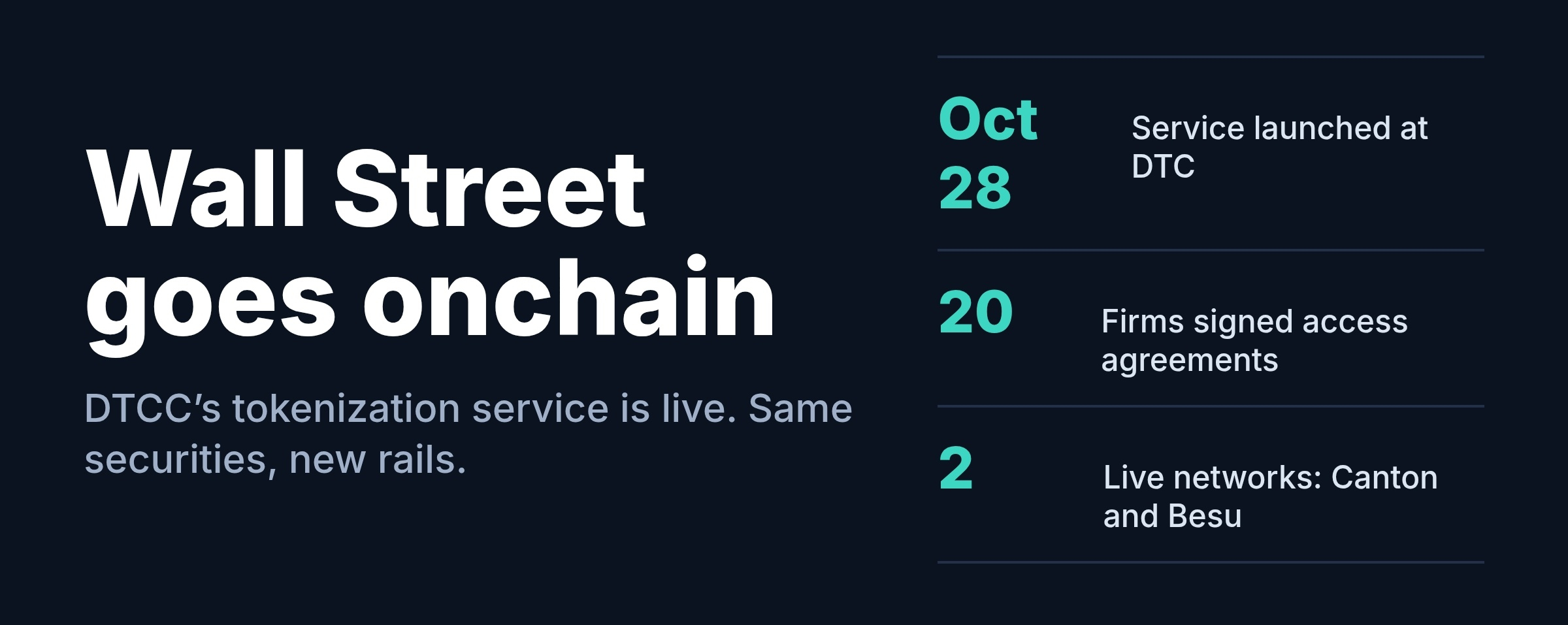
Article
See translation
🏦 Wall Street Goes Onchain: What DTCC's Tokenization Service Really MeansTokenized stocks are no longer just a crypto idea. DTC, part of DTCC, launched its Tokenization Service on October 28 after limited production transactions in July, and twenty participants had already signed access agreements. (crypto)
What is it?
Eligible institutions can convert securities held at DTC into tokens that move between registered wallets. DTCC says the tokens keep the same ownership rights, investor protections and economic entitlements as the original securities. It is not a new coin. It is the same asset in a new form. (crypto)
Where does it run?
The first networks are Canton and DTCC's private Besu infrastructure, with more planned. So a live service does not mean every blockchain is included. (crypto)
The real story: collateral
Faster transfers are useful, but the bigger question is whether a token can be used as collateral. That still depends on whether the receiver accepts the asset, how it is valued, what haircut applies and the terms agreed between the parties. Blockchain speed helps, but legal and market agreements decide how useful the token really is. (crypto)
What to watch next
✅ How much value is actually tokenized, not just how many firms signed up
✅ Real examples of tokens accepted as collateral
✅ New network integrations
✅ Cash and payment options for settlement
Bottom line: Traditional finance is building its own onchain rails, and this is the infrastructure layer behind tokenized real-world assets (RWA). It is early and permissioned, but it is a major step. Retail users should not expect to move these tokens between random wallets.
What do you think, will tokenization change collateral markets? Share your view below 👇
#DTCC #Tokenization #RWA #Crypto #BinanceSquare
🏦 Wall Street Goes Onchain: What DTCC's Tokenization Service Really Means
Tokenized stocks are no longer just a crypto idea. DTC, part of DTCC, launched its Tokenization Service on October 28 after limited production transactions in July, and twenty participants had already signed access agreements. (crypto)
What is it?
Eligible institutions can convert securities held at DTC into tokens that move between registered wallets. DTCC says the tokens keep the same ownership rights, investor protections and economic entitlements as the original securities. It is not a new coin. It is the same asset in a new form. (crypto)
Where does it run?
The first networks are Canton and DTCC's private Besu infrastructure, with more planned. So a live service does not mean every blockchain is included. (crypto)
The real story: collateral
Faster transfers are useful, but the bigger question is whether a token can be used as collateral. That still depends on whether the receiver accepts the asset, how it is valued, what haircut applies and the terms agreed between the parties. Blockchain speed helps, but legal and market agreements decide how useful the token really is. (crypto)
What to watch next
✅ How much value is actually tokenized, not just how many firms signed up
✅ Real examples of tokens accepted as collateral
✅ New network integrations
✅ Cash and payment options for settlement
Bottom line: Traditional finance is building its own onchain rails, and this is the infrastructure layer behind tokenized real-world assets (RWA). It is early and permissioned, but it is a major step. Retail users should not expect to move these tokens between random wallets.
What do you think, will tokenization change collateral markets? Share your view below 👇
#DTCC #Tokenization #RWA #Crypto #BinanceSquare
What is it?
Eligible institutions can convert securities held at DTC into tokens that move between registered wallets. DTCC says the tokens keep the same ownership rights, investor protections and economic entitlements as the original securities. It is not a new coin. It is the same asset in a new form. (crypto)
Where does it run?
The first networks are Canton and DTCC's private Besu infrastructure, with more planned. So a live service does not mean every blockchain is included. (crypto)
The real story: collateral
Faster transfers are useful, but the bigger question is whether a token can be used as collateral. That still depends on whether the receiver accepts the asset, how it is valued, what haircut applies and the terms agreed between the parties. Blockchain speed helps, but legal and market agreements decide how useful the token really is. (crypto)
What to watch next
✅ How much value is actually tokenized, not just how many firms signed up
✅ Real examples of tokens accepted as collateral
✅ New network integrations
✅ Cash and payment options for settlement
Bottom line: Traditional finance is building its own onchain rails, and this is the infrastructure layer behind tokenized real-world assets (RWA). It is early and permissioned, but it is a major step. Retail users should not expect to move these tokens between random wallets.
What do you think, will tokenization change collateral markets? Share your view below 👇
#DTCC #Tokenization #RWA #Crypto #BinanceSquare
1
57
Log in to explore more content
Join global crypto users on Binance Square
⚡️ Get latest and useful information about crypto.
💬 Trusted by the world’s largest crypto exchange.
👍 Discover real insights from verified creators.
Email / Phone number
Trending Topics
1
#NvidiaLoses$2.7TrillionInMonthAndAHalf
0 views
2 Discussing
2
#CanBTCReboundAfterFallingBelow60K?
448,740 views
1,997 Discussing
3
#GlobalStocksFaceLongestLosingStreakSince2023
152,117 views
1,395 Discussing
4
#BlackRockIBITPostsRecord$541MSingleDayOutflow
5,295 views
44 Discussing
5
#AnthropicPlungesTowardIPOPriceonDay2
73,269 views
799 Discussing
6
#TwentyOneCapitalAdds172.25BTC
23,984 views
321 Discussing
7
#HKBillWouldExcludeTokenizedDepositsFromVirtualAssets
2,671 views
37 Discussing
8
#BNBDropsBelow540USDTWith8.46%DailyDecline
42,673 views
391 Discussing
9
#HKBillProposesHK$100KFineForUnauthorizedCryptoTitles
1,500 views
20 Discussing
10
#BitMineFaces$10.1BUnrealizedETHLoss
2,750 views
25 Discussing