
Notbear
23 Posts

Notbear
5 Following
3 Followers
4 Liked
Posts
bStocks without an exchange interface
After bStock is issued into a compatible Web3 wallet, it is not the asset itself that changes, but the way you interact with it.
On an exchange, users work with bStock through a ready-made interface. In your own wallet, the model becomes different: a tokenized asset can be stored and transferred directly on a supported blockchain network.
This adds another important layer—self-custody. Control over access to the token shifts from the exchange account to your own wallet.
At the same time, it’s important to separate two things: the ability to store BEP-20 tokens and the actual support of a specific bStock. For each asset, you need to separately check whether withdrawals are available and whether it’s compatible with the required wallet.
For me, this is what makes bStocks interesting: tokenization changes not only the form of the asset, but also the environment in which you can interact with it#bStocks #RWA #Tokenization @BinanceCIS
After bStock is issued into a compatible Web3 wallet, it is not the asset itself that changes, but the way you interact with it.
On an exchange, users work with bStock through a ready-made interface. In your own wallet, the model becomes different: a tokenized asset can be stored and transferred directly on a supported blockchain network.
This adds another important layer—self-custody. Control over access to the token shifts from the exchange account to your own wallet.
At the same time, it’s important to separate two things: the ability to store BEP-20 tokens and the actual support of a specific bStock. For each asset, you need to separately check whether withdrawals are available and whether it’s compatible with the required wallet.
For me, this is what makes bStocks interesting: tokenization changes not only the form of the asset, but also the environment in which you can interact with it#bStocks #RWA #Tokenization @BinanceCIS
Alpha Zone TermMax V2
Here you can create a new market permissionlessly, without waiting, while the protocol team adds the required pair.
I like this model for one simple reason: it removes the barrier between the appearance of a new asset and the credit infrastructure built for it.
This is especially important for RWA, exotic collateral, and niche assets.
Alpha Zone allows you to create markets not only for what has already become popular.
A new market can emerge even before the asset becomes mainstream.
Then the market itself shows whether this credit setup is needed by users and liquidity.
For me, this is one of the strongest ideas in V2: part of the development of credit infrastructure shifts from the platform to its ecosystem.
TermMax becomes more than just a bundle of ready-made markets—it becomes infrastructure where a credit market can be created for a specific asset and demand.
This is especially valuable for RWA and assets that are only beginning to form their own liquidity.
@TermMax #TermMax
Here you can create a new market permissionlessly, without waiting, while the protocol team adds the required pair.
I like this model for one simple reason: it removes the barrier between the appearance of a new asset and the credit infrastructure built for it.
This is especially important for RWA, exotic collateral, and niche assets.
Alpha Zone allows you to create markets not only for what has already become popular.
A new market can emerge even before the asset becomes mainstream.
Then the market itself shows whether this credit setup is needed by users and liquidity.
For me, this is one of the strongest ideas in V2: part of the development of credit infrastructure shifts from the platform to its ecosystem.
TermMax becomes more than just a bundle of ready-made markets—it becomes infrastructure where a credit market can be created for a specific asset and demand.
This is especially valuable for RWA and assets that are only beginning to form their own liquidity.
@TermMax #TermMax
I came across mechanics at TermMax that made me look at the concept of liquidity differently.
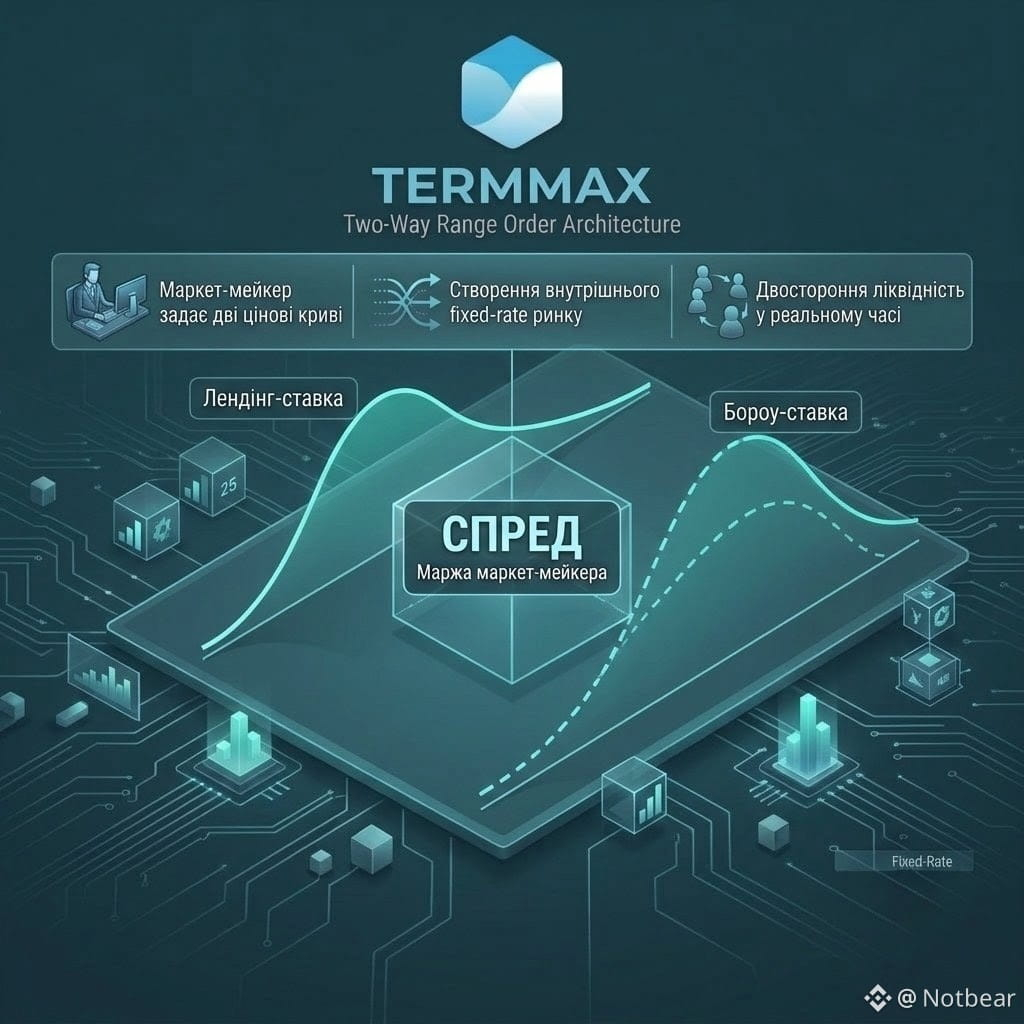
A Two-Way Range Order allows one participant to set two pricing curves at once.
The first determines the rate at which they are willing to lend an asset.
The second determines the rate at which they are willing to borrow it.
A spread is formed between these two curves.
That is, the participant is effectively creating not one side of the market, but a small two-sided fixed-rate market within a single construct.
What I like here is precisely the change in the role of the liquidity provider.
They are not just waiting for someone to come and borrow their asset. At the same time, they set the terms for both directions of capital flow.
And this is already a completely different model:
borrow rate → spread → lending rate
The more I look at TermMax’s architecture, the more obvious it becomes that a Range Order is not just a way to provide liquidity.
It’s a way to define your own credit pricing model.
@TermMax #TermMax
A Two-Way Range Order allows one participant to set two pricing curves at once.
The first determines the rate at which they are willing to lend an asset.
The second determines the rate at which they are willing to borrow it.
A spread is formed between these two curves.
That is, the participant is effectively creating not one side of the market, but a small two-sided fixed-rate market within a single construct.
What I like here is precisely the change in the role of the liquidity provider.
They are not just waiting for someone to come and borrow their asset. At the same time, they set the terms for both directions of capital flow.
And this is already a completely different model:
borrow rate → spread → lending rate
The more I look at TermMax’s architecture, the more obvious it becomes that a Range Order is not just a way to provide liquidity.
It’s a way to define your own credit pricing model.
@TermMax #TermMax
Can credit be simply recorded in a database?
And can it be done so that its individual parts become independent on-chain objects?
TermMax follows a second approach.
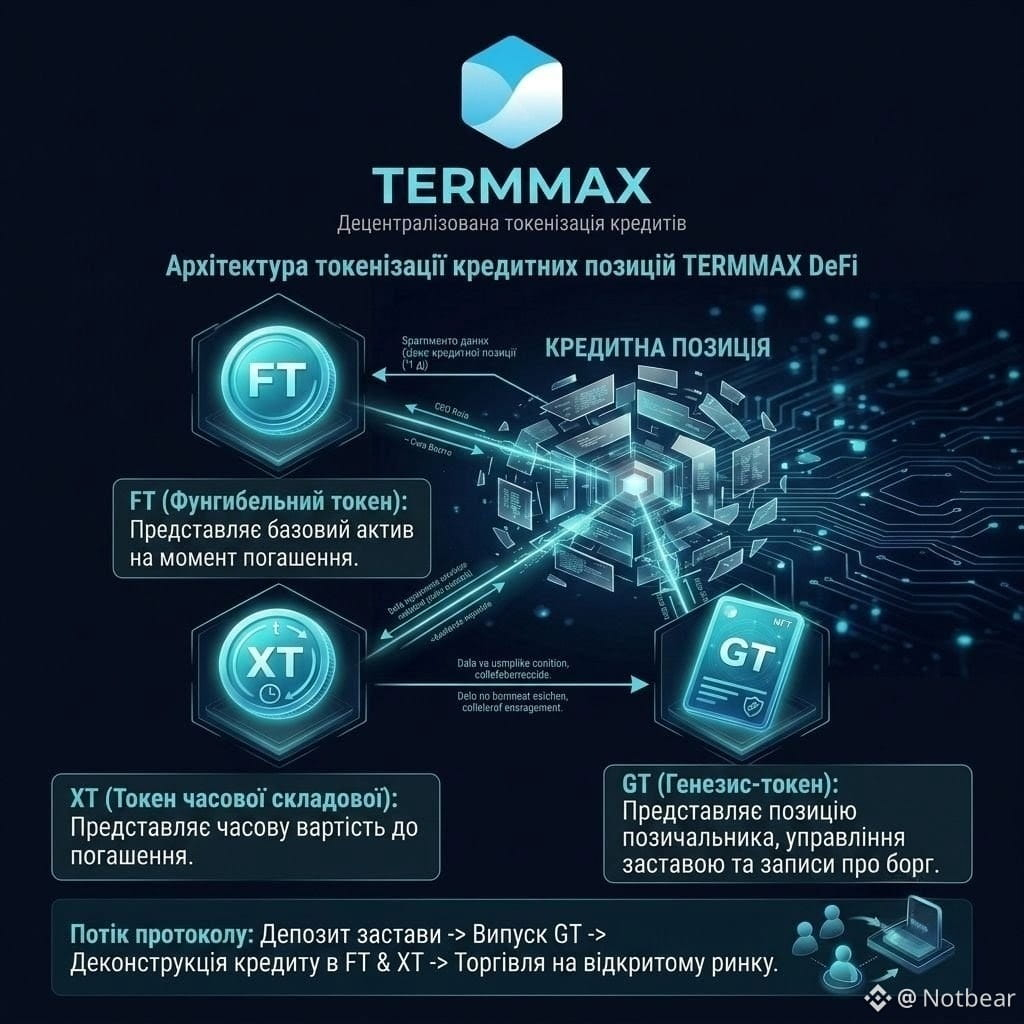
Here, a credit position is broken down into several components:
FT — a token associated with the right to receive the underlying asset at the moment of maturity.
XT — a component that reflects the time portion of the position and is linked to its expiration.
GT — an NFT that represents a specific borrower's position along with collateral and debt.
As a result, the credit stops being just a number inside a lending protocol.
Its economic parts receive their own representation on the blockchain.
For me, this is one of the most interesting details of the TermMax architecture.
Here, credit can be viewed as a set of composable on-chain components.
This design creates the foundation for further work with debt, yield, collateral, and maturity already at the blockchain level.
@TermMax #TermMax
And can it be done so that its individual parts become independent on-chain objects?
TermMax follows a second approach.
Here, a credit position is broken down into several components:
FT — a token associated with the right to receive the underlying asset at the moment of maturity.
XT — a component that reflects the time portion of the position and is linked to its expiration.
GT — an NFT that represents a specific borrower's position along with collateral and debt.
As a result, the credit stops being just a number inside a lending protocol.
Its economic parts receive their own representation on the blockchain.
For me, this is one of the most interesting details of the TermMax architecture.
Here, credit can be viewed as a set of composable on-chain components.
This design creates the foundation for further work with debt, yield, collateral, and maturity already at the blockchain level.
@TermMax #TermMax
In DeFi, there’s one thing that has always seemed inconvenient to me — you don’t know how much a loan will really cost until it’s finished.
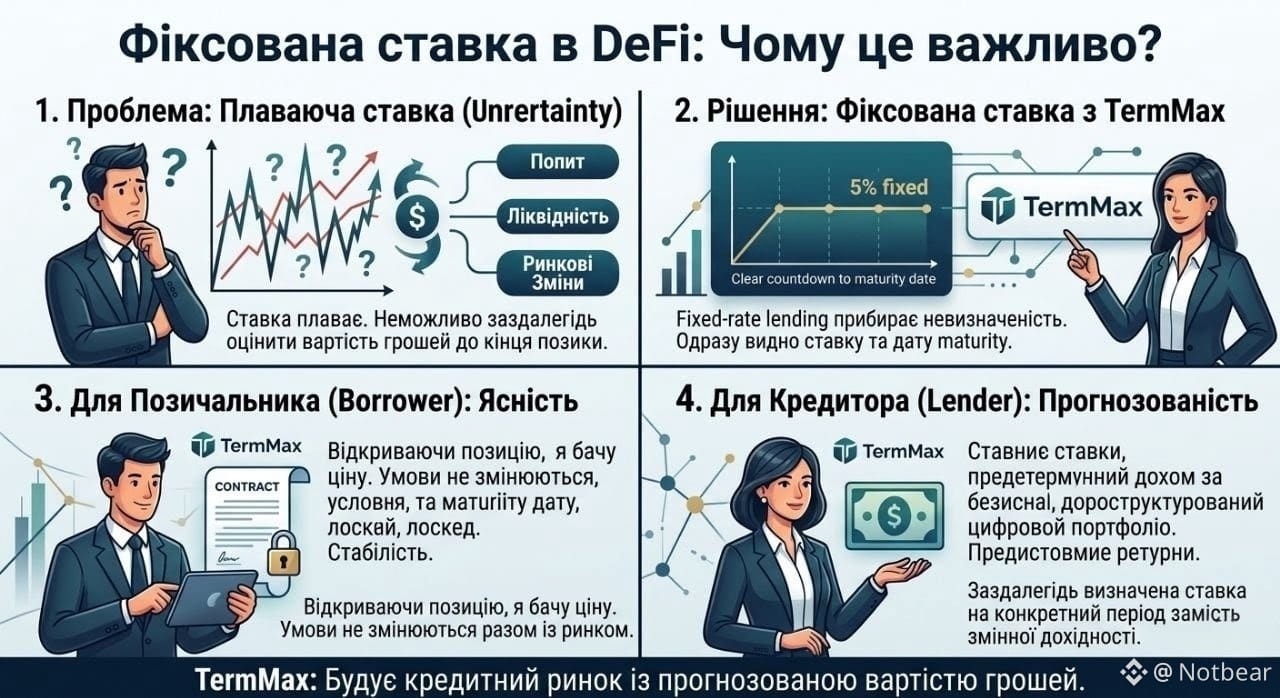
The rate changes with the market.
Demand for loans has increased — the cost of capital changed.
Liquidity moved — the rate changed.
Fixed-rate lending removes this uncertainty.
When I open a position, I immediately see the rate and the maturity date.
After that, these terms don’t move around with the market.
For lenders, it’s the mirror image: instead of constantly changing yield, they get a predetermined rate for a specific period.
So for me, the question isn’t which is better — floating or fixed.
The question is different: can DeFi become a fully-fledged credit market if it’s impossible to estimate the cost of money in advance?
TermMax is exactly building its mechanics around this problem.
@TermMax #TermMax
The rate changes with the market.
Demand for loans has increased — the cost of capital changed.
Liquidity moved — the rate changed.
Fixed-rate lending removes this uncertainty.
When I open a position, I immediately see the rate and the maturity date.
After that, these terms don’t move around with the market.
For lenders, it’s the mirror image: instead of constantly changing yield, they get a predetermined rate for a specific period.
So for me, the question isn’t which is better — floating or fixed.
The question is different: can DeFi become a fully-fledged credit market if it’s impossible to estimate the cost of money in advance?
TermMax is exactly building its mechanics around this problem.
@TermMax #TermMax
If you’ve decided to enter or exit bStocksCIS via Swap, there’s one setting I definitely wouldn’t ignore — MEV Protection.
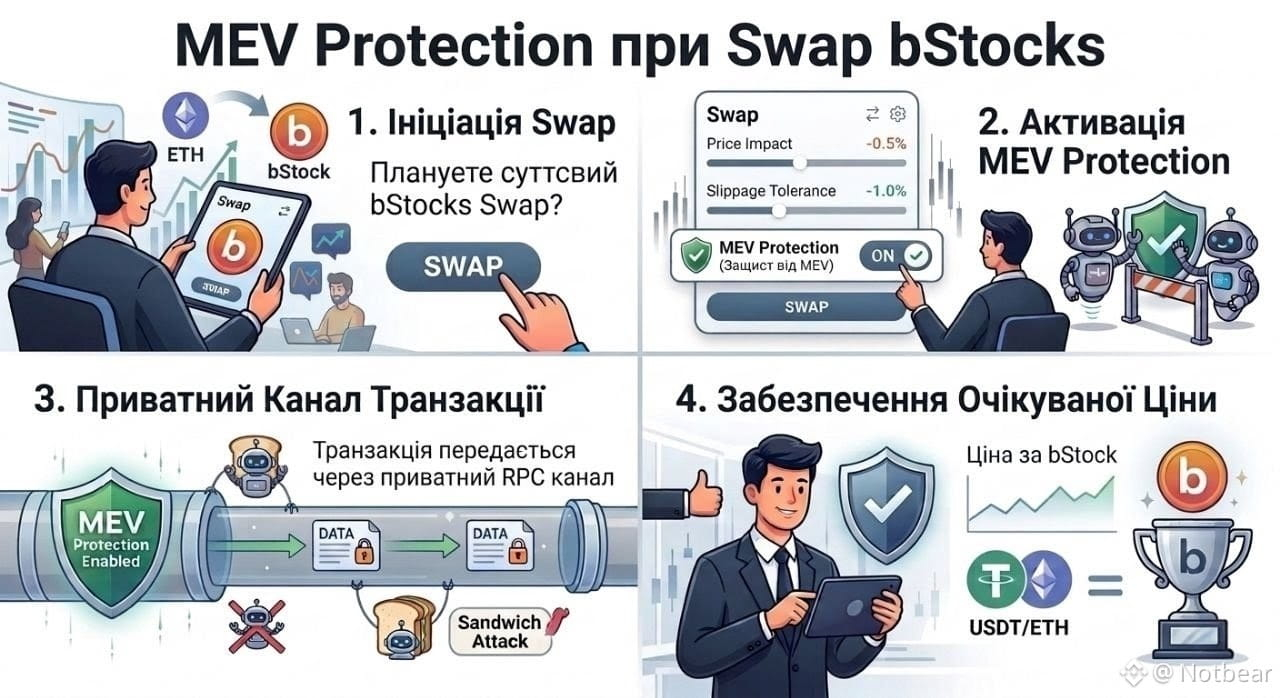
In large or rapidly moving trades, your transaction may be targeted by bots that try to front-run it or execute a sandwich attack. As a result, the actual Swap price you get may end up worse than the one you expected.
MEV Protection helps reduce the risk of such attacks by using private transaction relay mechanisms.
So before you Swap, I would look not only at the price and slippage, but also at whether MEV protection is enabled.
Especially when the bStock operation has a significant size.
One small setting can matter exactly at the moment when every fraction of price is important.
#bStocksCIS @BinanceCIS
In large or rapidly moving trades, your transaction may be targeted by bots that try to front-run it or execute a sandwich attack. As a result, the actual Swap price you get may end up worse than the one you expected.
MEV Protection helps reduce the risk of such attacks by using private transaction relay mechanisms.
So before you Swap, I would look not only at the price and slippage, but also at whether MEV protection is enabled.
Especially when the bStock operation has a significant size.
One small setting can matter exactly at the moment when every fraction of price is important.
#bStocksCIS @BinanceCIS
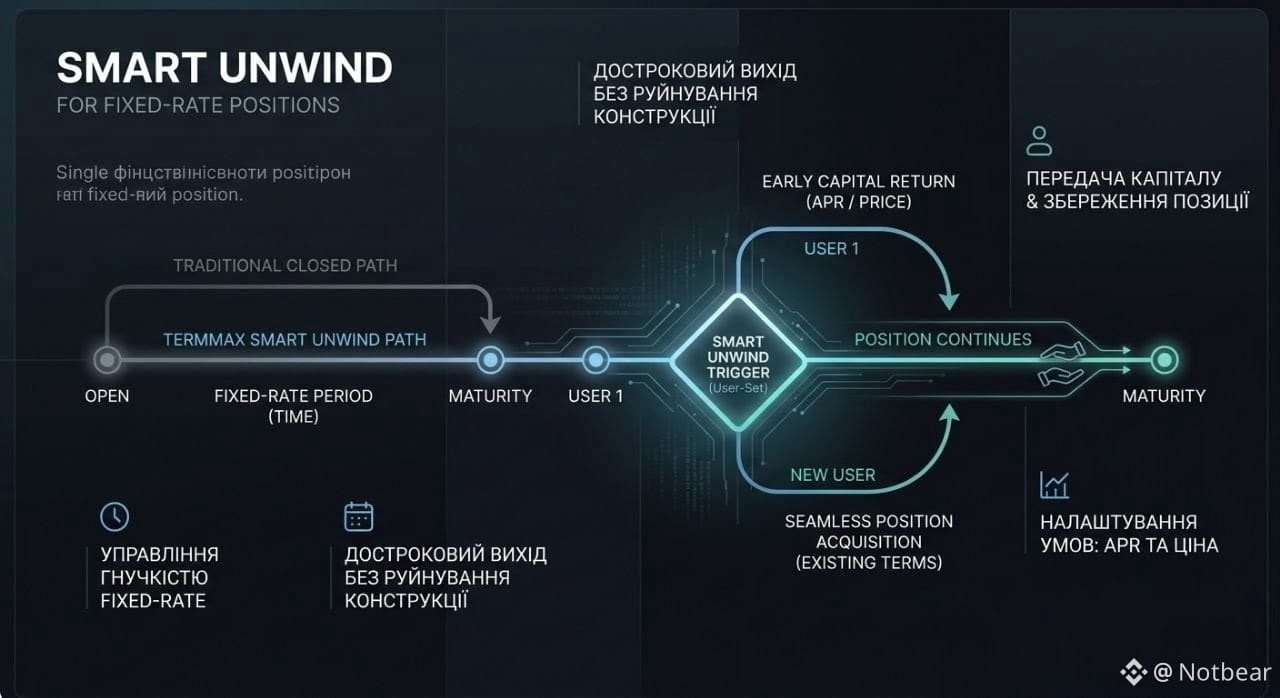
I thought a fixed-rate position was an agreement in principle: open, lock in the terms, and simply wait for maturity.
But in TermMax V2 there’s a mechanism that changes this logic — Smart Unwind.
The gist is simple: the position can be pre-configured for an early exit based on a certain APR or price.
When the market reaches the specified condition, another participant can take over the position.
For the first user, it’s an opportunity to get their capital back earlier. For a new one, it’s a chance to receive an already formed fixed-rate position under specific conditions.
I like this particular moment: maturity no longer looks like an endpoint for every participant.
Capital can move on, and the position itself can continue to work in the system.
In my view, Smart Unwind adds to fixed-rate lending what it often lacks — a flexible exit without breaking the position structure.
#termmax @TermMax
But in TermMax V2 there’s a mechanism that changes this logic — Smart Unwind.
The gist is simple: the position can be pre-configured for an early exit based on a certain APR or price.
When the market reaches the specified condition, another participant can take over the position.
For the first user, it’s an opportunity to get their capital back earlier. For a new one, it’s a chance to receive an already formed fixed-rate position under specific conditions.
I like this particular moment: maturity no longer looks like an endpoint for every participant.
Capital can move on, and the position itself can continue to work in the system.
In my view, Smart Unwind adds to fixed-rate lending what it often lacks — a flexible exit without breaking the position structure.
#termmax @TermMax
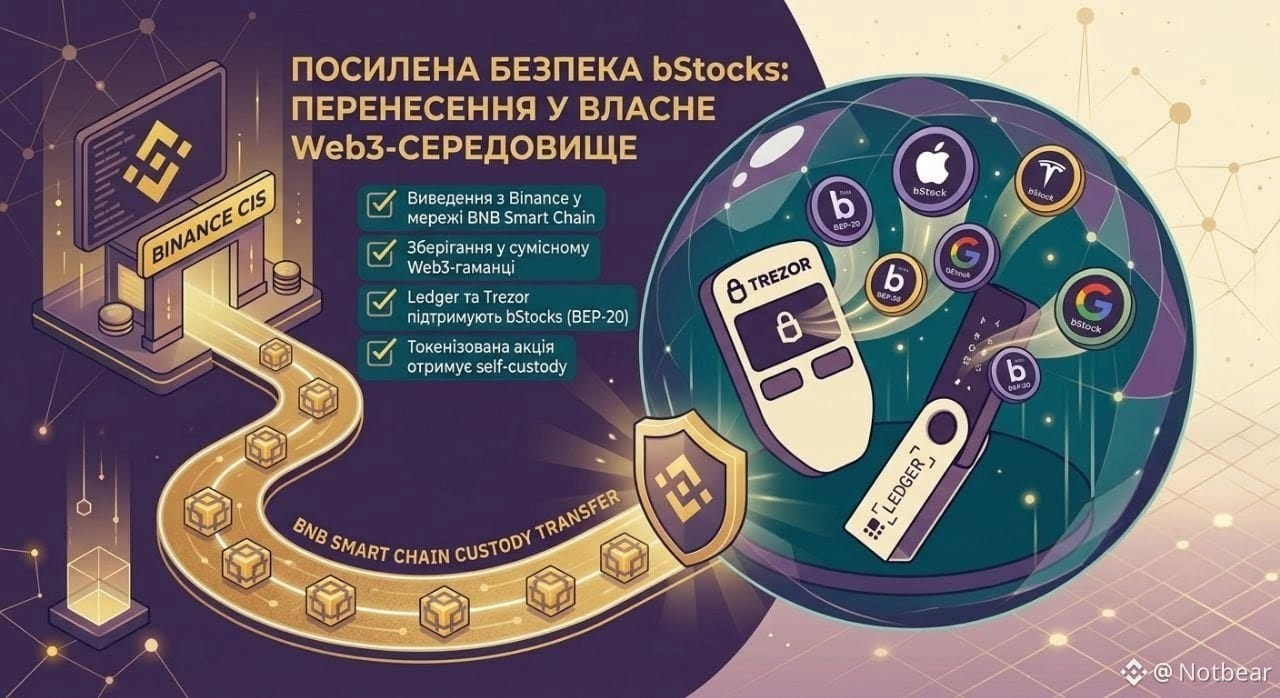
Friends, hello!
When the conversation turns to enhanced asset security, what’s the very first thing that comes to mind?
I immediately think of cold storage giants — Ledger and Trezor.
What happens if we’re talking not just about crypto, but about bStocks?
bStocks can be withdrawn from Binance on the BNB Smart Chain network and stored in a compatible Web3 wallet.
Ledger and Trezor support BNB Smart Chain and BEP-20 tokens.
After buying bStock, the asset doesn’t necessarily have to remain on the exchange. You can transfer it to your own custody and independently control access.
This is an extremely important feature• a tokenized share gains the ability to use self-custody.
At the same time, support for BEP-20 doesn’t automatically mean support for every bStock.
You need to check separately whether a specific asset can be withdrawn.
One more important point• the line between exchange custody and full control over the asset effectively becomes much thinner.
To me, bStocks look just like a space shuttle carrying tokenized shares—financial assets that can be moved into your own Web3 environment.
#bStocksCIS @BinanceCIS
When the conversation turns to enhanced asset security, what’s the very first thing that comes to mind?
I immediately think of cold storage giants — Ledger and Trezor.
What happens if we’re talking not just about crypto, but about bStocks?
bStocks can be withdrawn from Binance on the BNB Smart Chain network and stored in a compatible Web3 wallet.
Ledger and Trezor support BNB Smart Chain and BEP-20 tokens.
After buying bStock, the asset doesn’t necessarily have to remain on the exchange. You can transfer it to your own custody and independently control access.
This is an extremely important feature• a tokenized share gains the ability to use self-custody.
At the same time, support for BEP-20 doesn’t automatically mean support for every bStock.
You need to check separately whether a specific asset can be withdrawn.
One more important point• the line between exchange custody and full control over the asset effectively becomes much thinner.
To me, bStocks look just like a space shuttle carrying tokenized shares—financial assets that can be moved into your own Web3 environment.
#bStocksCIS @BinanceCIS
Fiery greetings, friends!
I dived under the hood of bStocks — there’s a lot of interesting stuff there.
I want to break down Multiplier in simple terms. It seems like a technical coefficient, but it plays an important role in bStocks’ architecture.
The interesting part starts during corporate events.
Let’s imagine a company is doing a stock split. For a traditional stock, everything is clear — the number of shares changes and the price is adjusted.
But a bStock lives on a blockchain.
You need to synchronize the economics of the real share with how the token is read on-chain.
That’s where Multiplier comes in.
It allows you to change the effective balance without rebuilding the token’s underlying record.
And dividends are also fascinating — the result of reinvestment can be reflected through Multiplier so the economic impact doesn’t get lost.
The token remains a token, but its economic value adapts to what happens with the real stock.
Multiplier is, for me, a bridge between a traditional share and its on-chain version.
Tokenization is more than just issuing a BEP-20 token.
#bStocksCIS @BinanceCIS
I dived under the hood of bStocks — there’s a lot of interesting stuff there.
I want to break down Multiplier in simple terms. It seems like a technical coefficient, but it plays an important role in bStocks’ architecture.
The interesting part starts during corporate events.
Let’s imagine a company is doing a stock split. For a traditional stock, everything is clear — the number of shares changes and the price is adjusted.
But a bStock lives on a blockchain.
You need to synchronize the economics of the real share with how the token is read on-chain.
That’s where Multiplier comes in.
It allows you to change the effective balance without rebuilding the token’s underlying record.
And dividends are also fascinating — the result of reinvestment can be reflected through Multiplier so the economic impact doesn’t get lost.
The token remains a token, but its economic value adapts to what happens with the real stock.
Multiplier is, for me, a bridge between a traditional share and its on-chain version.
Tokenization is more than just issuing a BEP-20 token.
#bStocksCIS @BinanceCIS

Does anyone know where slippage on bStocks comes from?
I figured it out and I’m ready to share my own research.
At first glance, you see the number $660.00 on the screen, you press “Buy” and expect to get bStock$ at that exact price.
But when the order is executed, the price may turn out to be different.
Why?
Let’s imagine that in the order book right now there are bStocks $MSFTB .
10 MSFTB — $660.00
15 MSFTB — $660.20
15 MSFTB — $660.50
I want to buy 40 MSFTB.
The first 10 I’ll get for $660.00, the next 15 for $660.20, and the last 15 already for $660.50.
As a result, the average price of my purchase will be higher than those $660.00 I saw at the beginning.
That is slippage.
So, slippage doesn’t happen because the system executes the order incorrectly.
The reason is simply that there may not be enough volume at the price you need.
I made an important conclusion for myself:
when you work with bStocks, it’s not enough to look only at the chart.
You should also look at what’s happening in the order book and how many orders are actually sitting near the current price.
Because the price on the screen is only an indicator.
And the actual execution depends on which orders are available at the moment when your order reaches the market.
#bStocksCIS @BinanceCIS
I figured it out and I’m ready to share my own research.
At first glance, you see the number $660.00 on the screen, you press “Buy” and expect to get bStock$ at that exact price.
But when the order is executed, the price may turn out to be different.
Why?
Let’s imagine that in the order book right now there are bStocks $MSFTB .
10 MSFTB — $660.00
15 MSFTB — $660.20
15 MSFTB — $660.50
I want to buy 40 MSFTB.
The first 10 I’ll get for $660.00, the next 15 for $660.20, and the last 15 already for $660.50.
As a result, the average price of my purchase will be higher than those $660.00 I saw at the beginning.
That is slippage.
So, slippage doesn’t happen because the system executes the order incorrectly.
The reason is simply that there may not be enough volume at the price you need.
I made an important conclusion for myself:
when you work with bStocks, it’s not enough to look only at the chart.
You should also look at what’s happening in the order book and how many orders are actually sitting near the current price.
Because the price on the screen is only an indicator.
And the actual execution depends on which orders are available at the moment when your order reaches the market.
#bStocksCIS @BinanceCIS
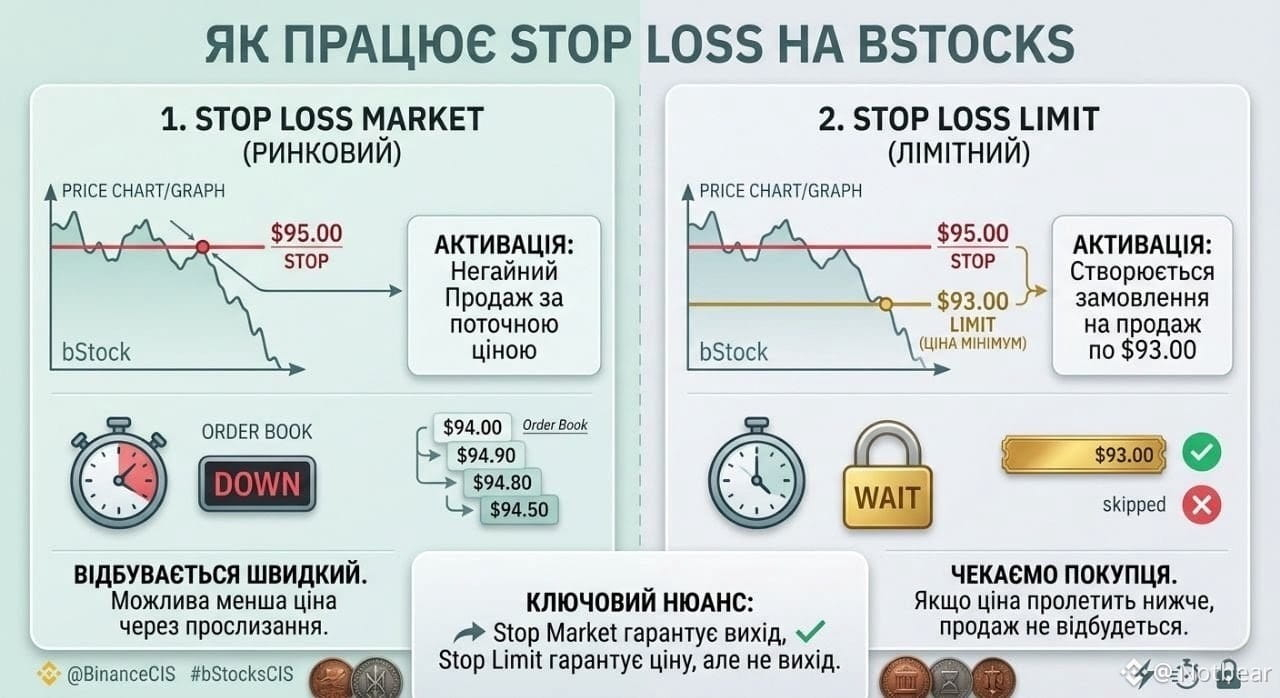
#bstockscis Friends, this is very important if you use a stop-loss for bStocks.
I myself used to think simply: set a stop — the price reached it — the position closed.
But there’s a nuance specifically in how the order is executed.
If you use a Stop Loss Market, once triggered, the order becomes a market order. It is executed at the available prices in the order book (the "stack").
For example, a bStock costs $100.00, and your stop is at $95.00.
That doesn’t mean the sale will necessarily happen at $95.00.
If the price moves sharply, the execution may occur at $94.80, $94.50, or another available price.
Whereas Stop Loss Limit works differently:
Stop — $95.00
Limit — $93.00
When the price reaches $95.00, a limit order is activated.
But if the bStock drops sharply, for example right to $92.50, an order at $93.00 may not find a buyer.
That is, it’s important to remember:
triggering the stop doesn’t always mean execution at the price you need.
I would always look at three things: the order type, liquidity, and what’s happening in the order book.
Especially when you’re working with bStocks and the market moves very fast.
@BinanceCIS #bStocksCIS
I myself used to think simply: set a stop — the price reached it — the position closed.
But there’s a nuance specifically in how the order is executed.
If you use a Stop Loss Market, once triggered, the order becomes a market order. It is executed at the available prices in the order book (the "stack").
For example, a bStock costs $100.00, and your stop is at $95.00.
That doesn’t mean the sale will necessarily happen at $95.00.
If the price moves sharply, the execution may occur at $94.80, $94.50, or another available price.
Whereas Stop Loss Limit works differently:
Stop — $95.00
Limit — $93.00
When the price reaches $95.00, a limit order is activated.
But if the bStock drops sharply, for example right to $92.50, an order at $93.00 may not find a buyer.
That is, it’s important to remember:
triggering the stop doesn’t always mean execution at the price you need.
I would always look at three things: the order type, liquidity, and what’s happening in the order book.
Especially when you’re working with bStocks and the market moves very fast.
@BinanceCIS #bStocksCIS
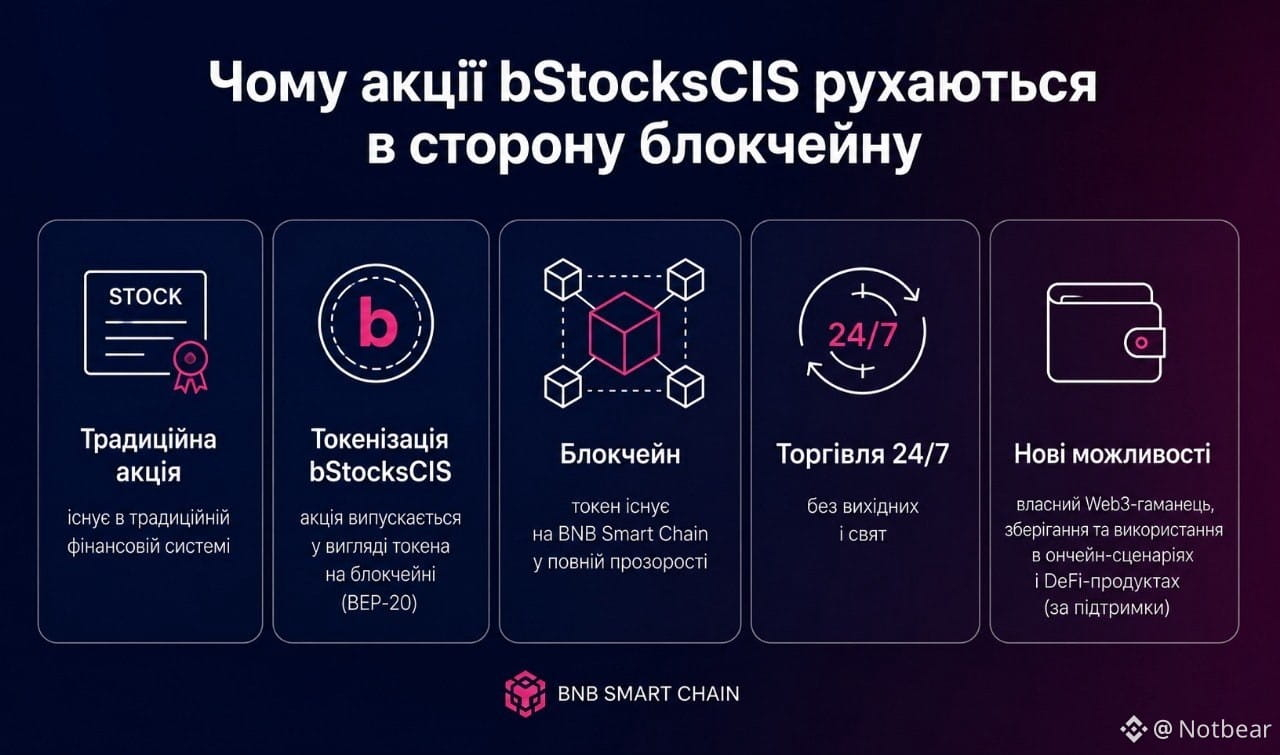
#bstockscis Shares bStocks are moving toward blockchain not for the sake of blockchain itself.
One thing that became interesting to me when I started looking into this model:
why move a traditional financial asset to Web3 at all?
If you look at bStocks, the logic becomes clearer.
The share itself remains tied to a real asset, but the way you interact with it is different now.
You can trade it 24/7, store it in a compatible Web3 wallet, and use it in the on-chain scenarios supported by the product.
And this is what’s more interesting to me than the fact of tokenization itself.
Here they are not trying to change the share.
They’re changing the environment in which it can be used.
A traditional asset receives digital infrastructure, and along with it—new ways to store, move, and use it.
So right now I’m looking at bStocks not as “stocks on the blockchain.”
For me, it’s more like an experiment in how far you can transfer traditional financial assets into an on-chain environment without changing the asset’s underlying nature.
And this direction—#bStocksCIS —is what I find most interesting to observe right now.
@BinanceCIS $NVDAB
One thing that became interesting to me when I started looking into this model:
why move a traditional financial asset to Web3 at all?
If you look at bStocks, the logic becomes clearer.
The share itself remains tied to a real asset, but the way you interact with it is different now.
You can trade it 24/7, store it in a compatible Web3 wallet, and use it in the on-chain scenarios supported by the product.
And this is what’s more interesting to me than the fact of tokenization itself.
Here they are not trying to change the share.
They’re changing the environment in which it can be used.
A traditional asset receives digital infrastructure, and along with it—new ways to store, move, and use it.
So right now I’m looking at bStocks not as “stocks on the blockchain.”
For me, it’s more like an experiment in how far you can transfer traditional financial assets into an on-chain environment without changing the asset’s underlying nature.
And this direction—#bStocksCIS —is what I find most interesting to observe right now.
@BinanceCIS $NVDAB
Greetings, colleagues!
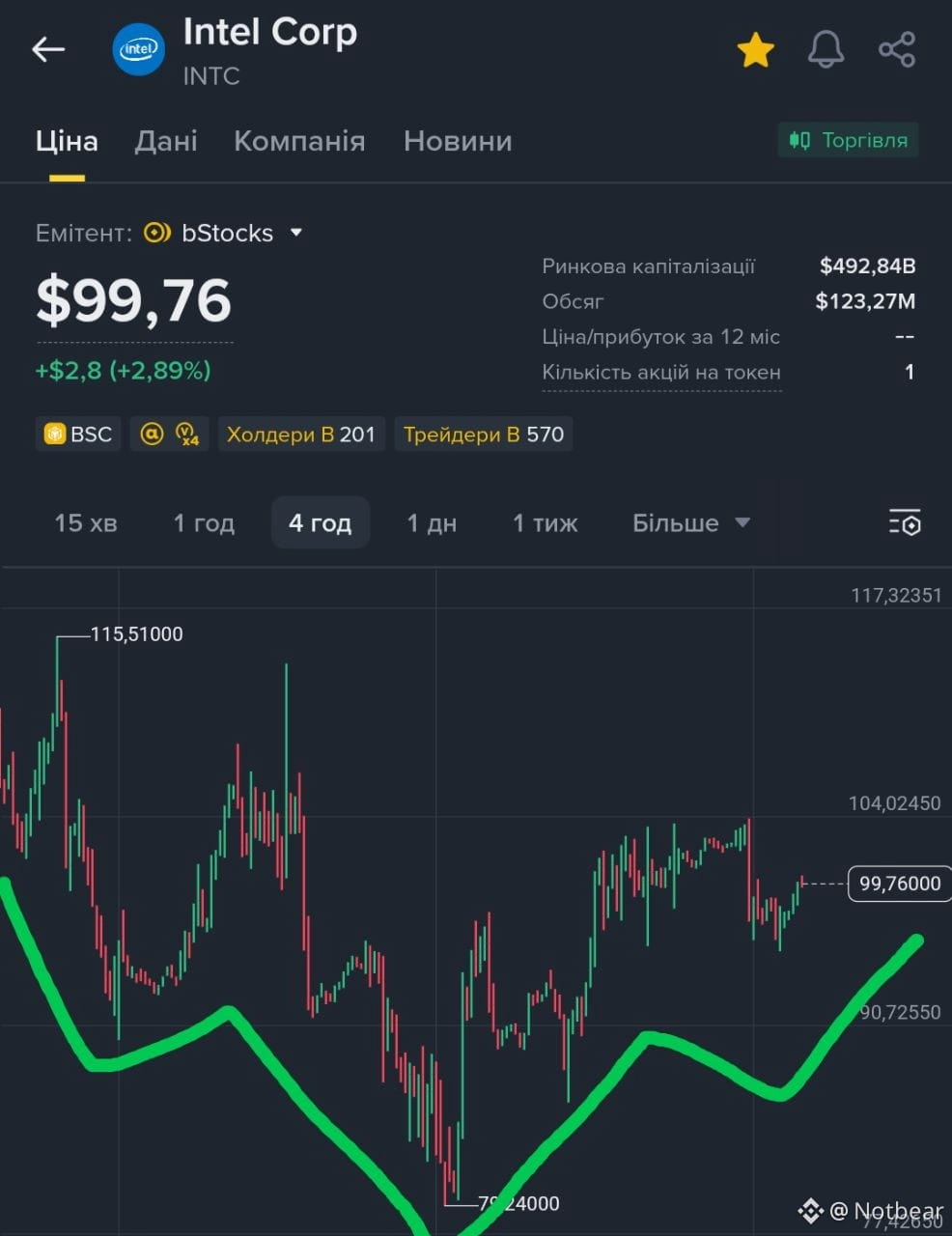
This time I found INTC in the bStocks format for myself and decided to figure out what’s happening with the company right now.
I studied the documents and materials they published on X, and I liked their narrative. They want to increase revenue, and in my opinion this could become a positive factor for the stock.
I also noticed the appointment of Dean Jarka as Executive Vice President and Chief Sales Officer. His job is to strengthen relationships with customers and boost sales.
For me, this could be a powerful catalyst for share buybacks and further price growth.
On the chart, you can already see that the price has started to slow down, so I became even more interested in watching how the market reacts.
And now to my goals.
My first buy zone was around $85 per share.
Next, I’ll keep track of the changes. If anything changes in my thesis or in the price—I'll definitely write to you here.
So I recommend subscribing if you’re interested in following my real experience rather than just reading theory.
#bStocksCIS @BinanceCIS
This time I found INTC in the bStocks format for myself and decided to figure out what’s happening with the company right now.
I studied the documents and materials they published on X, and I liked their narrative. They want to increase revenue, and in my opinion this could become a positive factor for the stock.
I also noticed the appointment of Dean Jarka as Executive Vice President and Chief Sales Officer. His job is to strengthen relationships with customers and boost sales.
For me, this could be a powerful catalyst for share buybacks and further price growth.
On the chart, you can already see that the price has started to slow down, so I became even more interested in watching how the market reacts.
And now to my goals.
My first buy zone was around $85 per share.
Next, I’ll keep track of the changes. If anything changes in my thesis or in the price—I'll definitely write to you here.
So I recommend subscribing if you’re interested in following my real experience rather than just reading theory.
#bStocksCIS @BinanceCIS
Boys, I know life isn’t easy, but let’s get down to business!
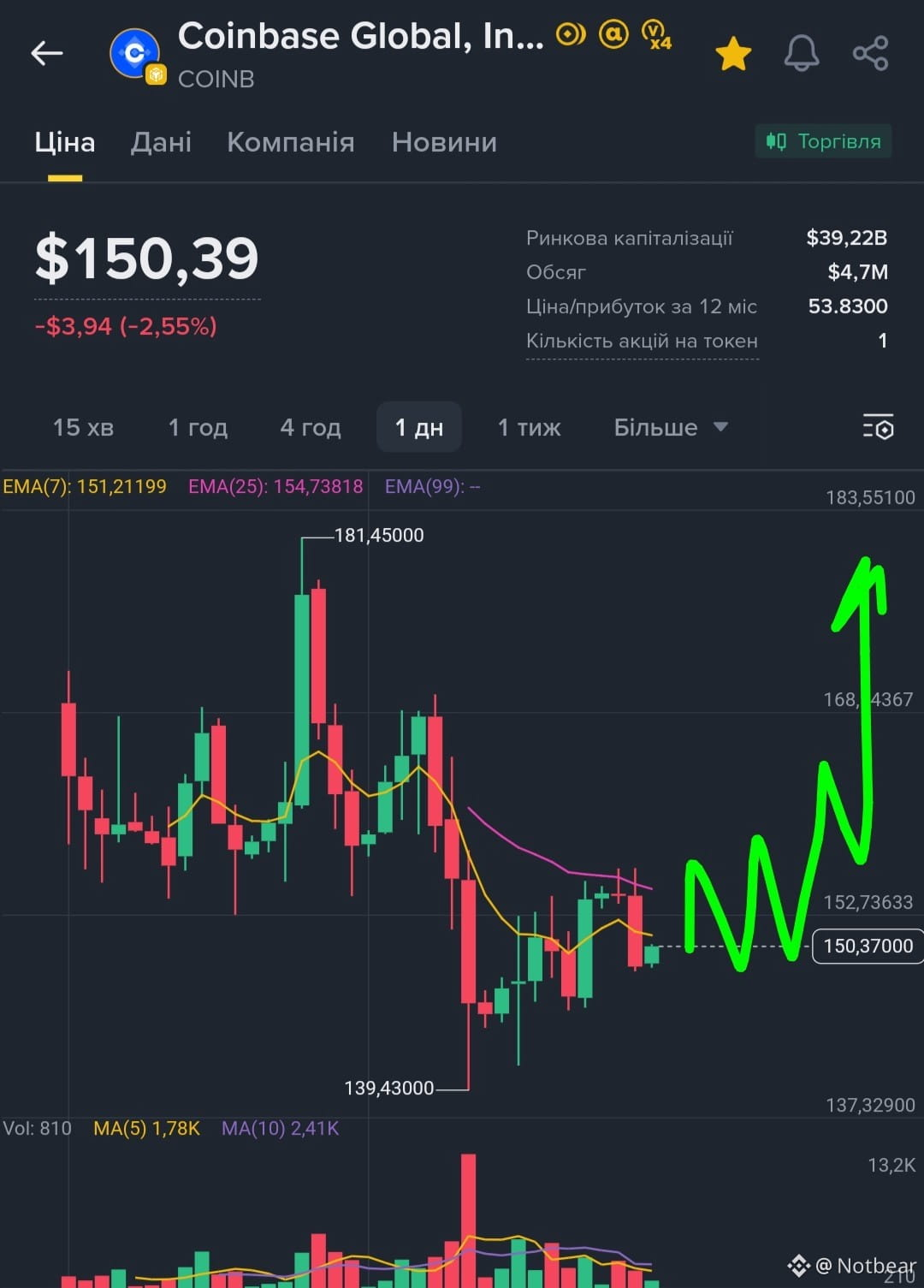
There’s one asset I’m currently trying out my own scenario on — COINB.
After the listing, I noticed that, in my opinion, the price is forming an accumulation range of 139–160.
So my strategy right now is simple, without complicated constructions:
139–160 is the zone where I plan to gradually build my position.
It’s become much more convenient for me to do this through bStocks because I can work specifically with COINB.
I expect that for a while the asset may remain in consolidation, and then—assuming confirmation—try to move into a new price range.
For me right now, the main thing isn’t to guess the future, but to have a clear plan:
zone → gradual accumulation → waiting → confirmation of the move.
If the structure changes, then my scenario will change too.
Make sure to subscribe to see a February drill, or don’t subscribe and you won’t see me pour a small budget into this one for an African city 🤪
#bStocksCIS @BinanceCIS
There’s one asset I’m currently trying out my own scenario on — COINB.
After the listing, I noticed that, in my opinion, the price is forming an accumulation range of 139–160.
So my strategy right now is simple, without complicated constructions:
139–160 is the zone where I plan to gradually build my position.
It’s become much more convenient for me to do this through bStocks because I can work specifically with COINB.
I expect that for a while the asset may remain in consolidation, and then—assuming confirmation—try to move into a new price range.
For me right now, the main thing isn’t to guess the future, but to have a clear plan:
zone → gradual accumulation → waiting → confirmation of the move.
If the structure changes, then my scenario will change too.
Make sure to subscribe to see a February drill, or don’t subscribe and you won’t see me pour a small budget into this one for an African city 🤪
#bStocksCIS @BinanceCIS
#bstockscis Guys, I prepared an awesome piece of info here—so grab some tea, something tasty—and let’s dive in to figure it out even better than anywhere else 👇
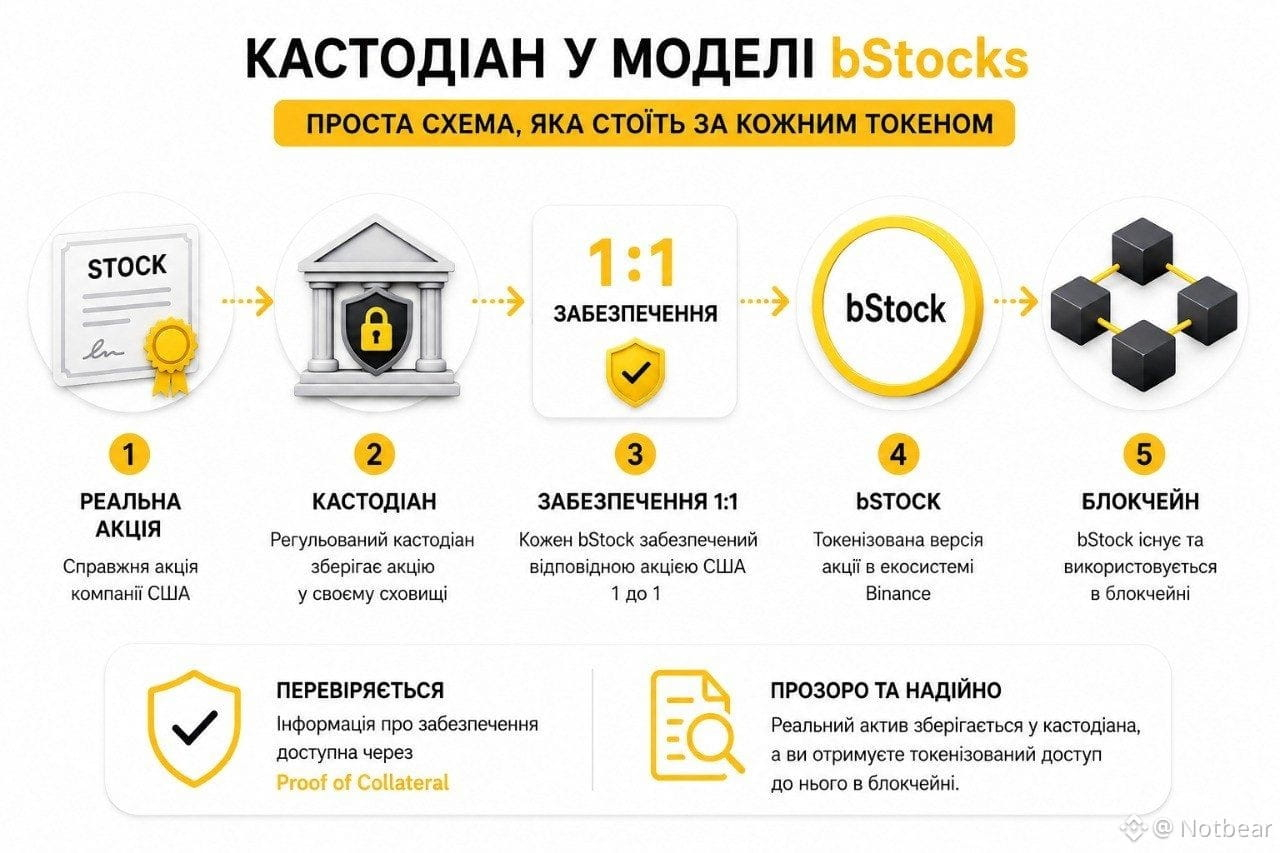
A custodian in the bStocks model is much easier than it sounds.
There’s a real share, and there’s also its tokenized version—a bStock.
But where is the actual share stored?
It’s held by a regulated custodian.
So the scheme is as simple as possible:
real share → custodian → 1:1 collateral → bStock on the blockchain.
In essence, the custodian is a kind of “vault” for the real share that stands behind the token.
And here’s the most interesting part: every bStock must be backed by the corresponding US share 1:1. The information about this collateral can be verified through Proof of Collateral.
So bStock isn’t just a token that showed up somewhere on the blockchain.
Behind it, there’s a whole chain:
share → storage → collateral → token → digital use.
That’s how the complex word “custodian” boils down to a very simple role:
it stores what stands behind the token.
#bStocksCIS @BinanceCIS
A custodian in the bStocks model is much easier than it sounds.
There’s a real share, and there’s also its tokenized version—a bStock.
But where is the actual share stored?
It’s held by a regulated custodian.
So the scheme is as simple as possible:
real share → custodian → 1:1 collateral → bStock on the blockchain.
In essence, the custodian is a kind of “vault” for the real share that stands behind the token.
And here’s the most interesting part: every bStock must be backed by the corresponding US share 1:1. The information about this collateral can be verified through Proof of Collateral.
So bStock isn’t just a token that showed up somewhere on the blockchain.
Behind it, there’s a whole chain:
share → storage → collateral → token → digital use.
That’s how the complex word “custodian” boils down to a very simple role:
it stores what stands behind the token.
#bStocksCIS @BinanceCIS
I’ve already figured out how bStocks differ from ETFs, and I want to explain it simply.
At first glance they look similar, but the mechanics are different.
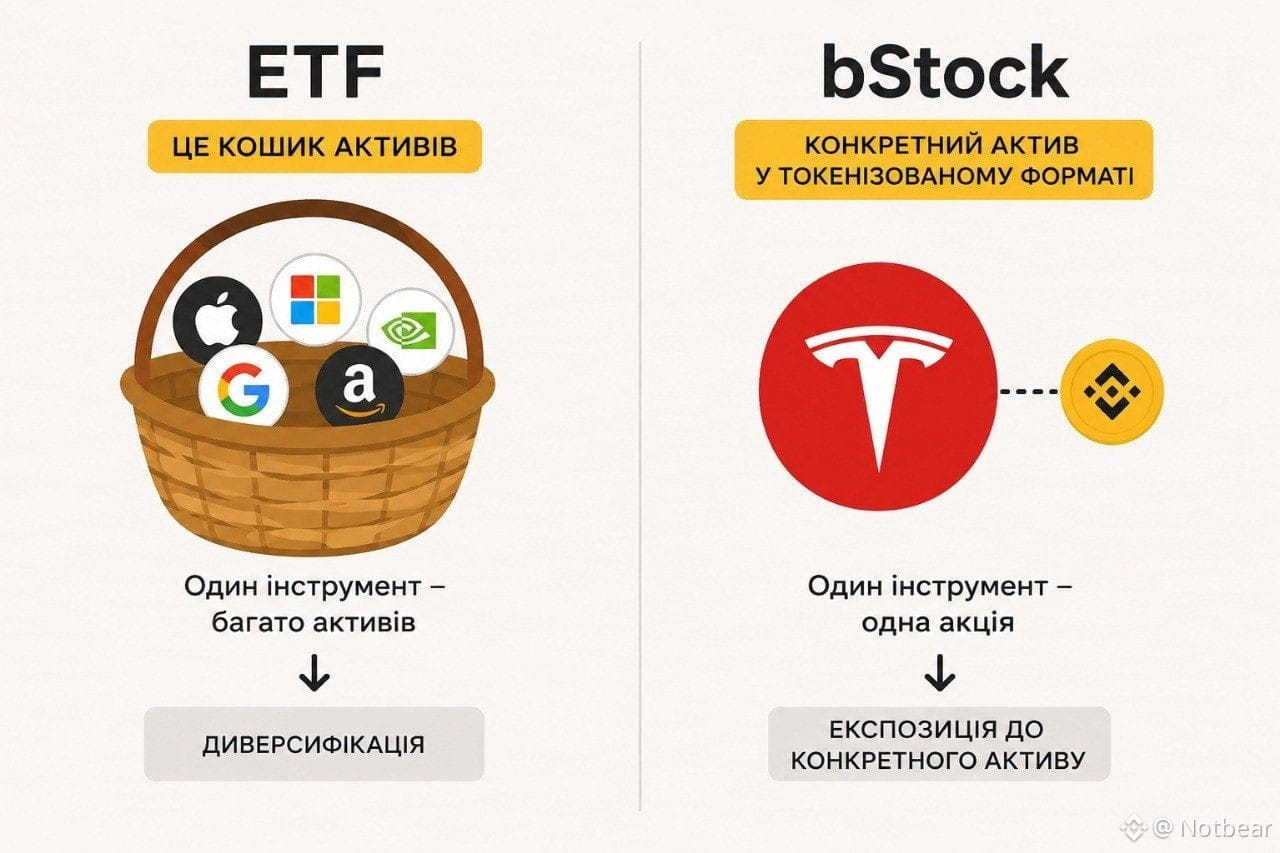
An ETF is a basket of assets.
One instrument can hold many stocks, so the main idea is diversification.
bStock is a specific underlying stock in a tokenized format.
So I stopped seeing them as competitors.
If you need exposure to an entire market segment at once, the ETF logic is clear.
If you need a specific asset in the Binance digital environment, then it’s a different task.
Another important difference is that bStocks are tied to blockchain infrastructure, so it’s not only the asset itself that matters, but also the digital environment where it exists.
For me the conclusion is simple:
ETF is about the basket and diversification.
bStock is about a specific asset and a tokenized format.
For example: $MSFTB
So the choice doesn’t start with the question “what’s better,” but with what problem I want to solve.
#bStocksCIS @BinanceCIS
At first glance they look similar, but the mechanics are different.
An ETF is a basket of assets.
One instrument can hold many stocks, so the main idea is diversification.
bStock is a specific underlying stock in a tokenized format.
So I stopped seeing them as competitors.
If you need exposure to an entire market segment at once, the ETF logic is clear.
If you need a specific asset in the Binance digital environment, then it’s a different task.
Another important difference is that bStocks are tied to blockchain infrastructure, so it’s not only the asset itself that matters, but also the digital environment where it exists.
For me the conclusion is simple:
ETF is about the basket and diversification.
bStock is about a specific asset and a tokenized format.
For example: $MSFTB
So the choice doesn’t start with the question “what’s better,” but with what problem I want to solve.
#bStocksCIS @BinanceCIS
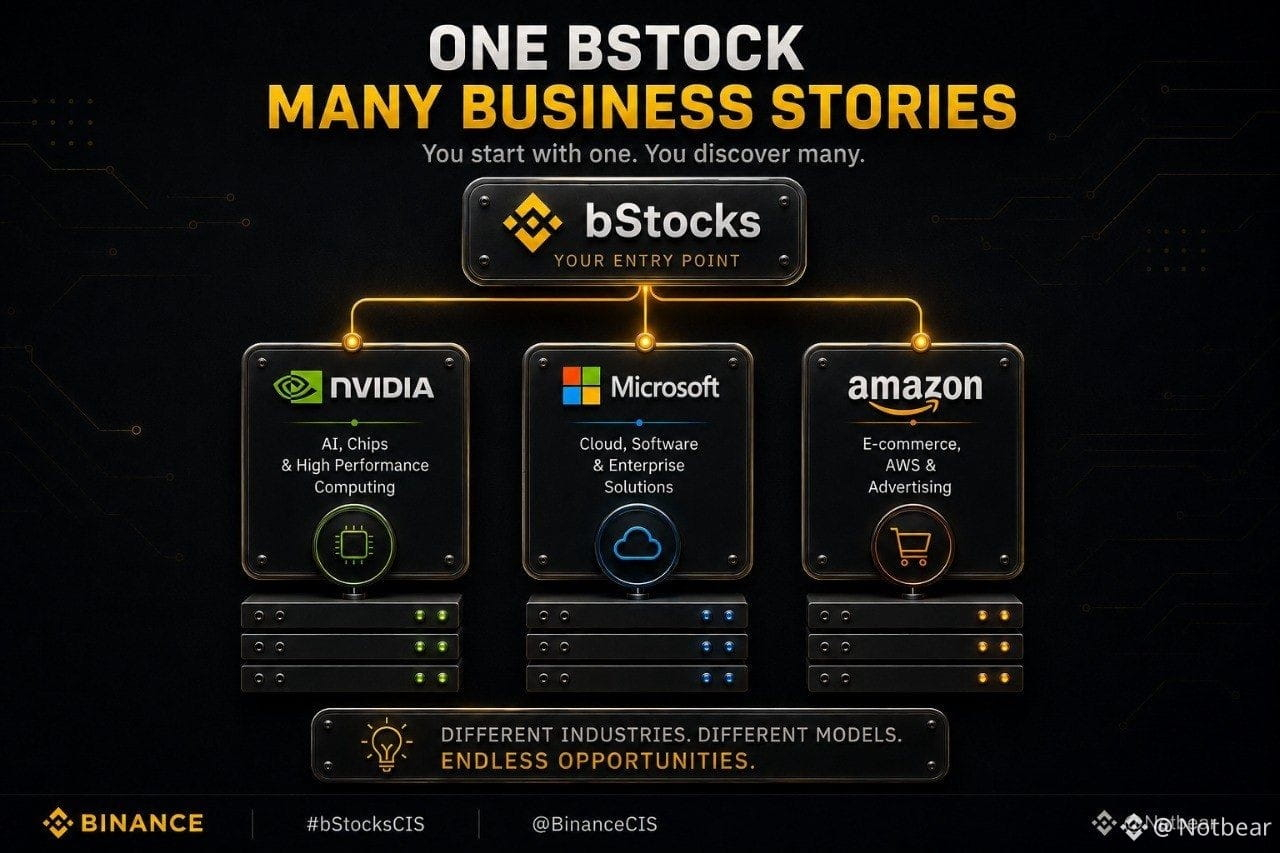
I entered bStocks through a single company, and left with a whole list of ideas.
At first, I was only interested in one bStock. I wanted to understand the company itself: what it earns from, what affects its growth, and why you should keep an eye on it.
And then I started looking at who else was nearby.
That’s how NVIDIA, Microsoft, and Amazon appeared on my list—and that’s when it got more interesting. Formally, these are different bStocks, but behind each one is a completely different business story.
$NVDAB — AI and chips.
$MSFTB — cloud, software, and corporate services.
$AMZNB — e-commerce, AWS, and advertising.
And that’s what I liked about bStocks: one company can become an entry point for exploring an entire group of businesses.
Now, if one bStock interests me, I look for a few more related companies and compare their business models and growth drivers.
This makes it easier to understand which exact story you want to see in your portfolio.
And which bStock would you start with?
#bStocksCIS @BinanceCIS
At first, I was only interested in one bStock. I wanted to understand the company itself: what it earns from, what affects its growth, and why you should keep an eye on it.
And then I started looking at who else was nearby.
That’s how NVIDIA, Microsoft, and Amazon appeared on my list—and that’s when it got more interesting. Formally, these are different bStocks, but behind each one is a completely different business story.
$NVDAB — AI and chips.
$MSFTB — cloud, software, and corporate services.
$AMZNB — e-commerce, AWS, and advertising.
And that’s what I liked about bStocks: one company can become an entry point for exploring an entire group of businesses.
Now, if one bStock interests me, I look for a few more related companies and compare their business models and growth drivers.
This makes it easier to understand which exact story you want to see in your portfolio.
And which bStock would you start with?
#bStocksCIS @BinanceCIS
#bStocksCIS $NVDAB
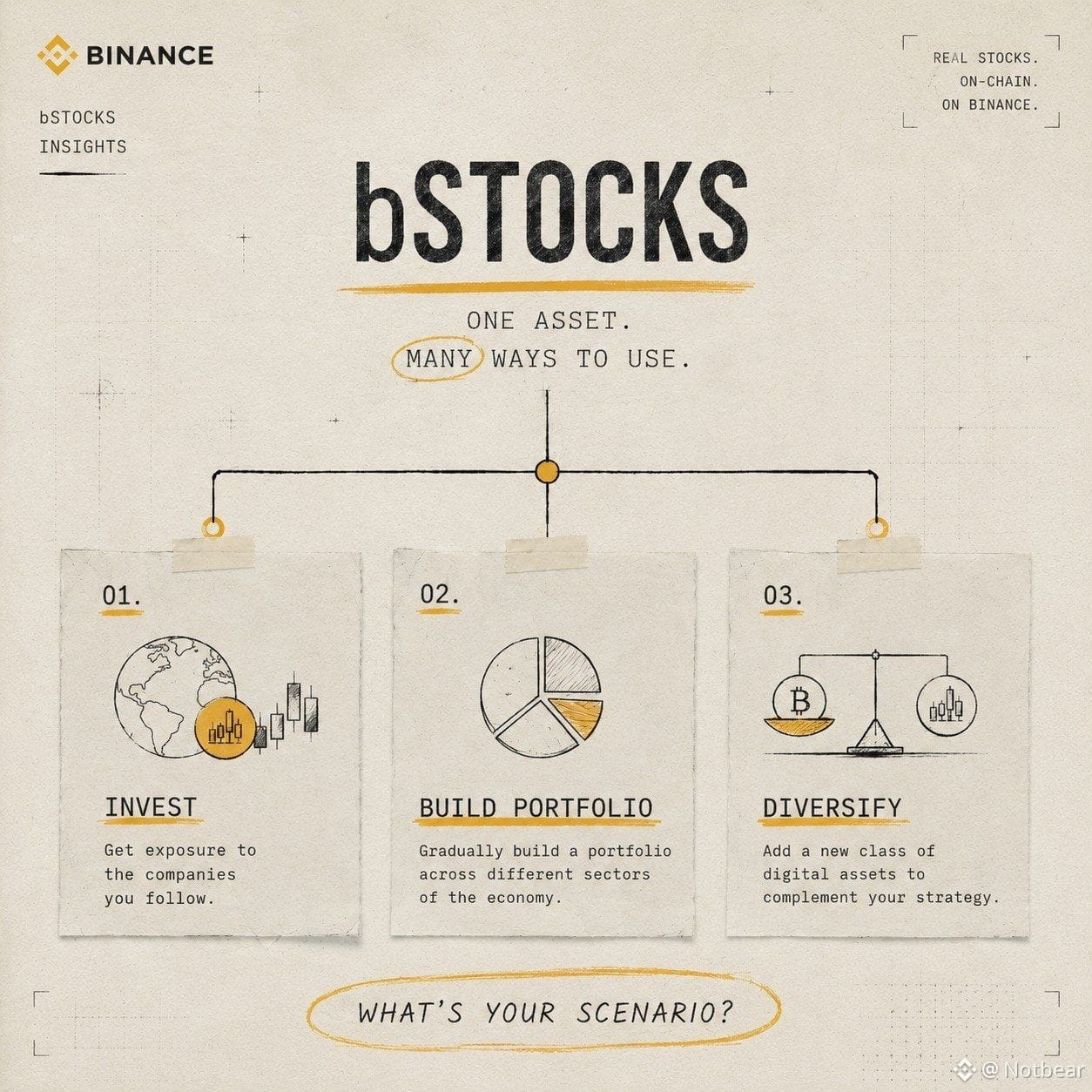
It always amazed me how two people can buy the same asset but use it in completely different ways.
When I started studying Binance bStocks, I realized: it’s not about the instrument itself, but the problem you want to solve.
For some, bStocks are a way to gain exposure to companies they’ve been following for a long time. For others, it’s an opportunity to gradually build a portfolio across different sectors of the economy. And someone else sees them as a new class of digital assets that complements an already existing strategy.
That’s exactly what I liked.
bStocks don’t force a single use case — they give you a choice, and everything else depends on the user’s goals.
At some point, I understood: we often evaluate financial instruments by their features. But it’s much more important to ask a different question: what task do I want to solve?
That answer is what determines what your use case for Binance bStocks will be.
And if you had to choose just one use case for Binance bStocks, what would it be?
#bStocksCIS @BinanceCIS
It always amazed me how two people can buy the same asset but use it in completely different ways.
When I started studying Binance bStocks, I realized: it’s not about the instrument itself, but the problem you want to solve.
For some, bStocks are a way to gain exposure to companies they’ve been following for a long time. For others, it’s an opportunity to gradually build a portfolio across different sectors of the economy. And someone else sees them as a new class of digital assets that complements an already existing strategy.
That’s exactly what I liked.
bStocks don’t force a single use case — they give you a choice, and everything else depends on the user’s goals.
At some point, I understood: we often evaluate financial instruments by their features. But it’s much more important to ask a different question: what task do I want to solve?
That answer is what determines what your use case for Binance bStocks will be.
And if you had to choose just one use case for Binance bStocks, what would it be?
#bStocksCIS @BinanceCIS
#bstockscis
Honestly, at first I thought that self-custody in Binance bStocks was just another Web3 feature. But the more I looked into it, the more I realized: its main value isn’t in the wallet itself, but in who controls the assets.
In the traditional model, after purchasing shares, an investor interacts with them through brokerage infrastructure. In Binance bStocks, tokenized shares are issued in BEP-20 format, so with product support they can be transferred to a compatible Web3 wallet and managed independently.
That one detail changed how I see things. Self-custody isn’t just the ability to “move an asset out.” It’s the right to decide where to store it, when to move it, and how to use it within the BNB Smart Chain ecosystem.
With freedom also comes responsibility: the security of access to the wallet entirely depends on the owner.
For me, that’s the most interesting idea behind Binance bStocks. Tokenization changes not only the format of the asset—it changes the very approach to ownership.
What about you: how do you feel about self-custody? An advantage or an extra responsibility?
#bStocksCIS @BinanceCIS
Honestly, at first I thought that self-custody in Binance bStocks was just another Web3 feature. But the more I looked into it, the more I realized: its main value isn’t in the wallet itself, but in who controls the assets.
In the traditional model, after purchasing shares, an investor interacts with them through brokerage infrastructure. In Binance bStocks, tokenized shares are issued in BEP-20 format, so with product support they can be transferred to a compatible Web3 wallet and managed independently.
That one detail changed how I see things. Self-custody isn’t just the ability to “move an asset out.” It’s the right to decide where to store it, when to move it, and how to use it within the BNB Smart Chain ecosystem.
With freedom also comes responsibility: the security of access to the wallet entirely depends on the owner.
For me, that’s the most interesting idea behind Binance bStocks. Tokenization changes not only the format of the asset—it changes the very approach to ownership.
What about you: how do you feel about self-custody? An advantage or an extra responsibility?
#bStocksCIS @BinanceCIS
🟡 Контроль активів
0%
🔵 Свобода зберігання
0%
🟢 Менше посередників
0%
0 votes • Voting closed
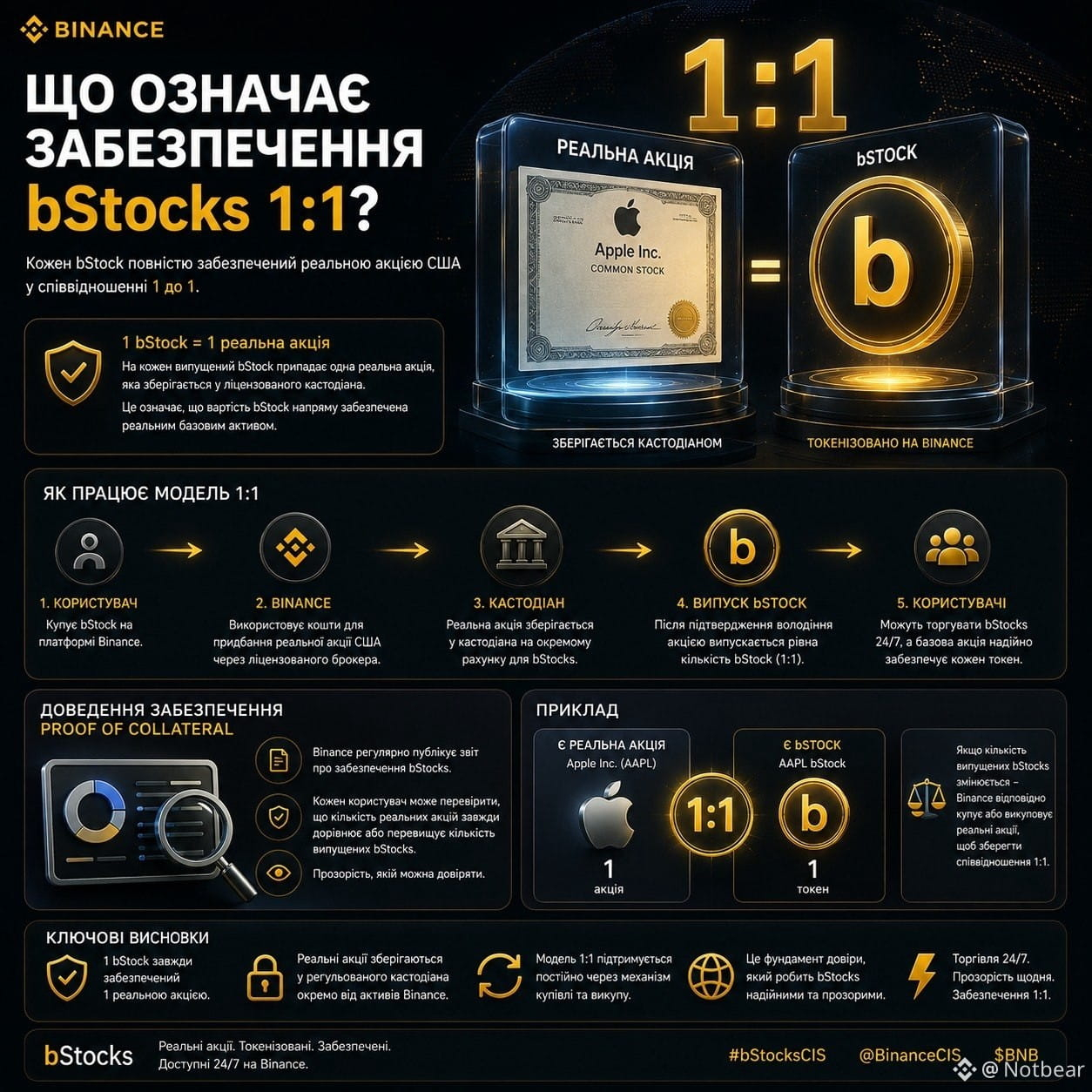
What does Binance bStocks 1:1 really mean?
Many people interpret the 1:1 label as a guarantee that the token price will always be exactly equal to the stock price. In reality, the meaning of this principle is completely different.
The 1:1 ratio defines the unit of representation for the asset. One Binance bStock corresponds to one underlying share, not a fraction of it or a basket of multiple assets. This keeps the product structure clear: when you analyze a specific company, you are working with its share, not with a derivative instrument that combines different assets.
This approach also simplifies the handling of corporate changes. When the characteristics of the underlying share change, the tokenized asset can reflect those changes without losing the logical link between them.
In my opinion, it’s this simplicity that’s the model’s strength. Instead of a complex multi-layer setup, Binance uses a straightforward principle: one token — one underlying asset. For the user, this means less ambiguity and more transparency about what exactly they are getting.
#bStocksCIS @BinanceCIS $NVDAB
Many people interpret the 1:1 label as a guarantee that the token price will always be exactly equal to the stock price. In reality, the meaning of this principle is completely different.
The 1:1 ratio defines the unit of representation for the asset. One Binance bStock corresponds to one underlying share, not a fraction of it or a basket of multiple assets. This keeps the product structure clear: when you analyze a specific company, you are working with its share, not with a derivative instrument that combines different assets.
This approach also simplifies the handling of corporate changes. When the characteristics of the underlying share change, the tokenized asset can reflect those changes without losing the logical link between them.
In my opinion, it’s this simplicity that’s the model’s strength. Instead of a complex multi-layer setup, Binance uses a straightforward principle: one token — one underlying asset. For the user, this means less ambiguity and more transparency about what exactly they are getting.
#bStocksCIS @BinanceCIS $NVDAB
Log in to explore more content