
Crypto Breaking
19.4k Posts

Crypto Breaking
 Square Verified+
Report
Block User
Get real-time cryptocurrency news, blockchain updates, market analysis, and expert insights. Explore the latest trends in Bitcoin, Ethereum, DeFi, and Web3.
6 Following
32.8K+ Followers
31.6K+ Liked
Posts
All
Quotes
Article
Why an Early Bitcoin Holder Burned $1M: Mystery ExplainedIn March, an almost-dead Bitcoin wallet suddenly resurfaced and moved about $1 million worth of BTC through a large centralized custodian—only for nearly the same amount to be sent back three weeks later. Less than two months after that brief “round trip,” the same stash was intentionally destroyed by sending it to an unspendable address.
The episode sits within a broader puzzle highlighted by blockchain researchers: multiple BTC-burning transactions in May, totaling 107 BTC (worth roughly $8.5 million at the time). New wallet-cluster analysis suggests the burn-related addresses were likely controlled by the same individual, raising the question of why someone would deliberately destroy coins that represent long-held value.
Key takeaways
One dormant wallet moved 20.00010537 BTC through an unidentified major custodian and then received 20.00006037 BTC back about three weeks later—an outcome difficult to square with typical trading.
Five separate wallets later burned their BTC, and Chainalysis reported “strong indicators of common ownership” linking them.
Most of the funds behind the burn can be traced back to Mt. Gox-era origins, suggesting an early adopter connection.
Researchers cannot confirm why the coins were destroyed; even CoinShares-class level of onchain forensics can’t determine intent from transaction history alone.
A possible clue emerges from repeated transfers clustered around similar dollar values (about $10,400), hinting at a planned approach—but not fully explaining the March round trip.
A dormant wallet returns—and immediately interacts with a custodian
Blockchain educator Bennet described a wallet that lay dormant for nearly 12 years before suddenly moving 20.00010537 BTC to “a custodian of some kind,” according to his analysis. Three weeks later, almost the entire balance returned, minus only a very small difference (about $3). Bennet characterized the pattern this way: the full balance went out to what appeared to be an exchange hot wallet and nearly the same amount came back three weeks later; then, seven weeks after the return, the funds were burned.
What makes the sequence notable is its symmetry. Burning is irreversible on-chain, but the “round trip” suggests the private keys behind the dormant wallet were actively used—not merely to let funds sit, but to interact with custodial infrastructure, retrieve the coins, and then choose a terminal outcome.
Bennet’s observation aligns with a timing link to a wider narrative of BTC destruction. Earlier coverage connected the broader mystery to 107 BTC burned in May, described as worth approximately $8.5 million at the time. The March event may be part of the same story, even though the chain of custody is obscured once the coins enter custodian systems.
Chainalysis: the burn wallets point to one controller
Chainalysis analysis, as summarized by Bennet and repeated in the coverage, indicates that five wallets ultimately responsible for destroying BTC show “strong indicators of common ownership.” In other words, the on-chain behavior suggests the same party controlled these addresses at some point.
The wallets were reportedly funded on the same day in April 2014. From there, each address sent BTC to the same deposit address at a large centralized exchange. Researchers also noted a rotational pattern: one address would transmit BTC to the exchange until its activity paused, then another would take over with transactions of similar cadence and dollar-equivalent value.
Chainalysis further reported that most of the funds could be traced back to Mt. Gox, implying an early Bitcoin holder background. While the connection suggests origin, it does not prove the coins were withdrawn directly from Mt. Gox at the time it ceased trading in February 2014—because the five wallets were funded in April. Bennet argued it’s plausible the owner was among those who managed to get their coins out before the collapse.
Equally important: the custodian remains unidentified. Chainalysis confirmed it is a large centralized exchange, but it does not publicly disclose the names of the services it identifies. Bennet’s interpretation is that the deposit address behaves like a static customer address within a custodian—one that doesn’t maintain a meaningful balance itself because deposits are swept and consolidated internally using an omnibus wallet approach. That design makes the coins’ subsequent fate hard to follow on the public blockchain.
The “$10,400” pattern—and why it may still be incomplete
One of the wallets involved in the burn later sent 19.6 BTC in 60 separate transactions to the same custodian between 2022 and 2024, according to the mempool-linked reference in the reporting. The BTC amounts varied widely—from roughly 0.15 BTC to 0.62 BTC—but when translated into dollars at the time of each transfer, the transactions were strikingly consistent.
Specifically, 58 of the 60 transfers were within 10% of approximately $10,400 per transaction. That implies the controller cared more about dollar totals than fixed BTC amounts. Bennet suggested the behavior could reflect a planned liquidation strategy.
However, the pattern has limits. The blockchain cannot prove whether those dollars were realized through a sale, held, or moved onward, because once funds hit a custodian they are mixed with many other inputs and consolidated internally. Researchers also noted that while the payment size was broadly constant, transaction frequency was not; transfers arrived in clusters rather than a perfectly regular automation schedule. Bennet viewed that as more consistent with sending a fixed-dollar amount when conditions required it, rather than a purely automated periodic process.
Still, even if the “$10,400” behavior hints at strategy, it doesn’t close the gap around the March event—particularly the fact that the wallet sent almost exactly the same amount out and got almost the same amount back shortly afterward.
The $1 million “round trip” doesn’t fit a simple trading explanation
After remaining untouched for roughly 12 years, the dormant wallet moved its entire balance of 20.00010537 BTC and received 20.00006037 BTC back—leaving a tiny difference of about 4,500 satoshis (around $3). The returned Bitcoin was split into three transactions of 7 BTC, 7 BTC, and 6.00006037 BTC, sent over three consecutive days.
Bennet argued that the use of round numbers may align with custodial withdrawal limits. More importantly, the coins did not just reappear somewhere else—they returned to the same address that had sent them to the custodian.
The transaction history also suggests the same private key holder controlled the wallet before and after the round trip. Bennet noted that using the BTC in March would have required the private key to authorize the custodian movement, and burning it in May required the key again. That shared key linkage makes the sequence particularly difficult to interpret as a straightforward exchange workflow where funds simply change hands.
The central tension is clear: if the activity were primarily about trading or liquidation, the near-identical “go out, come back” outcome appears unusually tight, especially given the custodial mixing that otherwise obscures on-chain details.
So what was the point of a deliberate burn?
Multiple explanations have been floated, but the available evidence doesn’t neatly select one. The liquidation theory helps rationalize earlier patterns—especially the “$10,400” clustering and the apparent rotational funding to the same custodian—but it does not readily explain why the controller would send roughly $1 million through the same infrastructure in March and then retrieve virtually all of it.
One alternative possibility is that the controller was testing an old custody setup or wallet—verifying that after a long dormancy, coins could still be moved through a major custodian and returned successfully. Yet that still leaves the subsequent decision to destroy the BTC.
Tax or compliance narratives could also be imaginable: someone might reorganize assets through recognized custody channels for record-keeping. But the reporting notes there is no evidence tying these actions to any specific regulatory or tax event.
Privacy is another candidate. Sending BTC through a custodian that sweeps deposits into an omnibus wallet can make on-chain tracing more difficult after the point of deposit. Still, privacy alone doesn’t clarify why the coins later ended up burned rather than merely secured.
Bennet also suggested a more personal motive: someone without heirs might have chosen to permanently reduce Bitcoin’s circulating supply by burning rather than destroying private keys. He also emphasized that this hypothesis is not provable purely via blockchain analysis.
Chainalysis, as cited in the coverage, effectively summed up the current limitation: it does not have a clear explanation for why the owner would move a long-dormant stash through a custodian, retrieve roughly the same amount, and then burn it deliberately.
In other words, the blockchain records the “what” with unusual clarity, but not the “why.”
The next thing to watch is whether more tracing work identifies the custodian involved in the March round trip and in the May burn-linked transfers, or whether additional wallet-cluster research finds consistent behavioral links across other dormant-to-active Bitcoin movements. Without that, the most important unknown remains intent—and intent is the one variable onchain forensics can’t conclusively measure.
This article was originally published as Why an Early Bitcoin Holder Burned $1M: Mystery Explained on Crypto Breaking News – your trusted source for crypto news, Bitcoin news, and blockchain updates.
Why an Early Bitcoin Holder Burned $1M: Mystery Explained
In March, an almost-dead Bitcoin wallet suddenly resurfaced and moved about $1 million worth of BTC through a large centralized custodian—only for nearly the same amount to be sent back three weeks later. Less than two months after that brief “round trip,” the same stash was intentionally destroyed by sending it to an unspendable address.
The episode sits within a broader puzzle highlighted by blockchain researchers: multiple BTC-burning transactions in May, totaling 107 BTC (worth roughly $8.5 million at the time). New wallet-cluster analysis suggests the burn-related addresses were likely controlled by the same individual, raising the question of why someone would deliberately destroy coins that represent long-held value.
Key takeaways
One dormant wallet moved 20.00010537 BTC through an unidentified major custodian and then received 20.00006037 BTC back about three weeks later—an outcome difficult to square with typical trading.
Five separate wallets later burned their BTC, and Chainalysis reported “strong indicators of common ownership” linking them.
Most of the funds behind the burn can be traced back to Mt. Gox-era origins, suggesting an early adopter connection.
Researchers cannot confirm why the coins were destroyed; even CoinShares-class level of onchain forensics can’t determine intent from transaction history alone.
A possible clue emerges from repeated transfers clustered around similar dollar values (about $10,400), hinting at a planned approach—but not fully explaining the March round trip.
A dormant wallet returns—and immediately interacts with a custodian
Blockchain educator Bennet described a wallet that lay dormant for nearly 12 years before suddenly moving 20.00010537 BTC to “a custodian of some kind,” according to his analysis. Three weeks later, almost the entire balance returned, minus only a very small difference (about $3). Bennet characterized the pattern this way: the full balance went out to what appeared to be an exchange hot wallet and nearly the same amount came back three weeks later; then, seven weeks after the return, the funds were burned.
What makes the sequence notable is its symmetry. Burning is irreversible on-chain, but the “round trip” suggests the private keys behind the dormant wallet were actively used—not merely to let funds sit, but to interact with custodial infrastructure, retrieve the coins, and then choose a terminal outcome.
Bennet’s observation aligns with a timing link to a wider narrative of BTC destruction. Earlier coverage connected the broader mystery to 107 BTC burned in May, described as worth approximately $8.5 million at the time. The March event may be part of the same story, even though the chain of custody is obscured once the coins enter custodian systems.
Chainalysis: the burn wallets point to one controller
Chainalysis analysis, as summarized by Bennet and repeated in the coverage, indicates that five wallets ultimately responsible for destroying BTC show “strong indicators of common ownership.” In other words, the on-chain behavior suggests the same party controlled these addresses at some point.
The wallets were reportedly funded on the same day in April 2014. From there, each address sent BTC to the same deposit address at a large centralized exchange. Researchers also noted a rotational pattern: one address would transmit BTC to the exchange until its activity paused, then another would take over with transactions of similar cadence and dollar-equivalent value.
Chainalysis further reported that most of the funds could be traced back to Mt. Gox, implying an early Bitcoin holder background. While the connection suggests origin, it does not prove the coins were withdrawn directly from Mt. Gox at the time it ceased trading in February 2014—because the five wallets were funded in April. Bennet argued it’s plausible the owner was among those who managed to get their coins out before the collapse.
Equally important: the custodian remains unidentified. Chainalysis confirmed it is a large centralized exchange, but it does not publicly disclose the names of the services it identifies. Bennet’s interpretation is that the deposit address behaves like a static customer address within a custodian—one that doesn’t maintain a meaningful balance itself because deposits are swept and consolidated internally using an omnibus wallet approach. That design makes the coins’ subsequent fate hard to follow on the public blockchain.
The “$10,400” pattern—and why it may still be incomplete
One of the wallets involved in the burn later sent 19.6 BTC in 60 separate transactions to the same custodian between 2022 and 2024, according to the mempool-linked reference in the reporting. The BTC amounts varied widely—from roughly 0.15 BTC to 0.62 BTC—but when translated into dollars at the time of each transfer, the transactions were strikingly consistent.
Specifically, 58 of the 60 transfers were within 10% of approximately $10,400 per transaction. That implies the controller cared more about dollar totals than fixed BTC amounts. Bennet suggested the behavior could reflect a planned liquidation strategy.
However, the pattern has limits. The blockchain cannot prove whether those dollars were realized through a sale, held, or moved onward, because once funds hit a custodian they are mixed with many other inputs and consolidated internally. Researchers also noted that while the payment size was broadly constant, transaction frequency was not; transfers arrived in clusters rather than a perfectly regular automation schedule. Bennet viewed that as more consistent with sending a fixed-dollar amount when conditions required it, rather than a purely automated periodic process.
Still, even if the “$10,400” behavior hints at strategy, it doesn’t close the gap around the March event—particularly the fact that the wallet sent almost exactly the same amount out and got almost the same amount back shortly afterward.
The $1 million “round trip” doesn’t fit a simple trading explanation
After remaining untouched for roughly 12 years, the dormant wallet moved its entire balance of 20.00010537 BTC and received 20.00006037 BTC back—leaving a tiny difference of about 4,500 satoshis (around $3). The returned Bitcoin was split into three transactions of 7 BTC, 7 BTC, and 6.00006037 BTC, sent over three consecutive days.
Bennet argued that the use of round numbers may align with custodial withdrawal limits. More importantly, the coins did not just reappear somewhere else—they returned to the same address that had sent them to the custodian.
The transaction history also suggests the same private key holder controlled the wallet before and after the round trip. Bennet noted that using the BTC in March would have required the private key to authorize the custodian movement, and burning it in May required the key again. That shared key linkage makes the sequence particularly difficult to interpret as a straightforward exchange workflow where funds simply change hands.
The central tension is clear: if the activity were primarily about trading or liquidation, the near-identical “go out, come back” outcome appears unusually tight, especially given the custodial mixing that otherwise obscures on-chain details.
So what was the point of a deliberate burn?
Multiple explanations have been floated, but the available evidence doesn’t neatly select one. The liquidation theory helps rationalize earlier patterns—especially the “$10,400” clustering and the apparent rotational funding to the same custodian—but it does not readily explain why the controller would send roughly $1 million through the same infrastructure in March and then retrieve virtually all of it.
One alternative possibility is that the controller was testing an old custody setup or wallet—verifying that after a long dormancy, coins could still be moved through a major custodian and returned successfully. Yet that still leaves the subsequent decision to destroy the BTC.
Tax or compliance narratives could also be imaginable: someone might reorganize assets through recognized custody channels for record-keeping. But the reporting notes there is no evidence tying these actions to any specific regulatory or tax event.
Privacy is another candidate. Sending BTC through a custodian that sweeps deposits into an omnibus wallet can make on-chain tracing more difficult after the point of deposit. Still, privacy alone doesn’t clarify why the coins later ended up burned rather than merely secured.
Bennet also suggested a more personal motive: someone without heirs might have chosen to permanently reduce Bitcoin’s circulating supply by burning rather than destroying private keys. He also emphasized that this hypothesis is not provable purely via blockchain analysis.
Chainalysis, as cited in the coverage, effectively summed up the current limitation: it does not have a clear explanation for why the owner would move a long-dormant stash through a custodian, retrieve roughly the same amount, and then burn it deliberately.
In other words, the blockchain records the “what” with unusual clarity, but not the “why.”
The next thing to watch is whether more tracing work identifies the custodian involved in the March round trip and in the May burn-linked transfers, or whether additional wallet-cluster research finds consistent behavioral links across other dormant-to-active Bitcoin movements. Without that, the most important unknown remains intent—and intent is the one variable onchain forensics can’t conclusively measure.
This article was originally published as Why an Early Bitcoin Holder Burned $1M: Mystery Explained on Crypto Breaking News – your trusted source for crypto news, Bitcoin news, and blockchain updates.
The episode sits within a broader puzzle highlighted by blockchain researchers: multiple BTC-burning transactions in May, totaling 107 BTC (worth roughly $8.5 million at the time). New wallet-cluster analysis suggests the burn-related addresses were likely controlled by the same individual, raising the question of why someone would deliberately destroy coins that represent long-held value.
Key takeaways
One dormant wallet moved 20.00010537 BTC through an unidentified major custodian and then received 20.00006037 BTC back about three weeks later—an outcome difficult to square with typical trading.
Five separate wallets later burned their BTC, and Chainalysis reported “strong indicators of common ownership” linking them.
Most of the funds behind the burn can be traced back to Mt. Gox-era origins, suggesting an early adopter connection.
Researchers cannot confirm why the coins were destroyed; even CoinShares-class level of onchain forensics can’t determine intent from transaction history alone.
A possible clue emerges from repeated transfers clustered around similar dollar values (about $10,400), hinting at a planned approach—but not fully explaining the March round trip.
A dormant wallet returns—and immediately interacts with a custodian
Blockchain educator Bennet described a wallet that lay dormant for nearly 12 years before suddenly moving 20.00010537 BTC to “a custodian of some kind,” according to his analysis. Three weeks later, almost the entire balance returned, minus only a very small difference (about $3). Bennet characterized the pattern this way: the full balance went out to what appeared to be an exchange hot wallet and nearly the same amount came back three weeks later; then, seven weeks after the return, the funds were burned.
What makes the sequence notable is its symmetry. Burning is irreversible on-chain, but the “round trip” suggests the private keys behind the dormant wallet were actively used—not merely to let funds sit, but to interact with custodial infrastructure, retrieve the coins, and then choose a terminal outcome.
Bennet’s observation aligns with a timing link to a wider narrative of BTC destruction. Earlier coverage connected the broader mystery to 107 BTC burned in May, described as worth approximately $8.5 million at the time. The March event may be part of the same story, even though the chain of custody is obscured once the coins enter custodian systems.
Chainalysis: the burn wallets point to one controller
Chainalysis analysis, as summarized by Bennet and repeated in the coverage, indicates that five wallets ultimately responsible for destroying BTC show “strong indicators of common ownership.” In other words, the on-chain behavior suggests the same party controlled these addresses at some point.
The wallets were reportedly funded on the same day in April 2014. From there, each address sent BTC to the same deposit address at a large centralized exchange. Researchers also noted a rotational pattern: one address would transmit BTC to the exchange until its activity paused, then another would take over with transactions of similar cadence and dollar-equivalent value.
Chainalysis further reported that most of the funds could be traced back to Mt. Gox, implying an early Bitcoin holder background. While the connection suggests origin, it does not prove the coins were withdrawn directly from Mt. Gox at the time it ceased trading in February 2014—because the five wallets were funded in April. Bennet argued it’s plausible the owner was among those who managed to get their coins out before the collapse.
Equally important: the custodian remains unidentified. Chainalysis confirmed it is a large centralized exchange, but it does not publicly disclose the names of the services it identifies. Bennet’s interpretation is that the deposit address behaves like a static customer address within a custodian—one that doesn’t maintain a meaningful balance itself because deposits are swept and consolidated internally using an omnibus wallet approach. That design makes the coins’ subsequent fate hard to follow on the public blockchain.
The “$10,400” pattern—and why it may still be incomplete
One of the wallets involved in the burn later sent 19.6 BTC in 60 separate transactions to the same custodian between 2022 and 2024, according to the mempool-linked reference in the reporting. The BTC amounts varied widely—from roughly 0.15 BTC to 0.62 BTC—but when translated into dollars at the time of each transfer, the transactions were strikingly consistent.
Specifically, 58 of the 60 transfers were within 10% of approximately $10,400 per transaction. That implies the controller cared more about dollar totals than fixed BTC amounts. Bennet suggested the behavior could reflect a planned liquidation strategy.
However, the pattern has limits. The blockchain cannot prove whether those dollars were realized through a sale, held, or moved onward, because once funds hit a custodian they are mixed with many other inputs and consolidated internally. Researchers also noted that while the payment size was broadly constant, transaction frequency was not; transfers arrived in clusters rather than a perfectly regular automation schedule. Bennet viewed that as more consistent with sending a fixed-dollar amount when conditions required it, rather than a purely automated periodic process.
Still, even if the “$10,400” behavior hints at strategy, it doesn’t close the gap around the March event—particularly the fact that the wallet sent almost exactly the same amount out and got almost the same amount back shortly afterward.
The $1 million “round trip” doesn’t fit a simple trading explanation
After remaining untouched for roughly 12 years, the dormant wallet moved its entire balance of 20.00010537 BTC and received 20.00006037 BTC back—leaving a tiny difference of about 4,500 satoshis (around $3). The returned Bitcoin was split into three transactions of 7 BTC, 7 BTC, and 6.00006037 BTC, sent over three consecutive days.
Bennet argued that the use of round numbers may align with custodial withdrawal limits. More importantly, the coins did not just reappear somewhere else—they returned to the same address that had sent them to the custodian.
The transaction history also suggests the same private key holder controlled the wallet before and after the round trip. Bennet noted that using the BTC in March would have required the private key to authorize the custodian movement, and burning it in May required the key again. That shared key linkage makes the sequence particularly difficult to interpret as a straightforward exchange workflow where funds simply change hands.
The central tension is clear: if the activity were primarily about trading or liquidation, the near-identical “go out, come back” outcome appears unusually tight, especially given the custodial mixing that otherwise obscures on-chain details.
So what was the point of a deliberate burn?
Multiple explanations have been floated, but the available evidence doesn’t neatly select one. The liquidation theory helps rationalize earlier patterns—especially the “$10,400” clustering and the apparent rotational funding to the same custodian—but it does not readily explain why the controller would send roughly $1 million through the same infrastructure in March and then retrieve virtually all of it.
One alternative possibility is that the controller was testing an old custody setup or wallet—verifying that after a long dormancy, coins could still be moved through a major custodian and returned successfully. Yet that still leaves the subsequent decision to destroy the BTC.
Tax or compliance narratives could also be imaginable: someone might reorganize assets through recognized custody channels for record-keeping. But the reporting notes there is no evidence tying these actions to any specific regulatory or tax event.
Privacy is another candidate. Sending BTC through a custodian that sweeps deposits into an omnibus wallet can make on-chain tracing more difficult after the point of deposit. Still, privacy alone doesn’t clarify why the coins later ended up burned rather than merely secured.
Bennet also suggested a more personal motive: someone without heirs might have chosen to permanently reduce Bitcoin’s circulating supply by burning rather than destroying private keys. He also emphasized that this hypothesis is not provable purely via blockchain analysis.
Chainalysis, as cited in the coverage, effectively summed up the current limitation: it does not have a clear explanation for why the owner would move a long-dormant stash through a custodian, retrieve roughly the same amount, and then burn it deliberately.
In other words, the blockchain records the “what” with unusual clarity, but not the “why.”
The next thing to watch is whether more tracing work identifies the custodian involved in the March round trip and in the May burn-linked transfers, or whether additional wallet-cluster research finds consistent behavioral links across other dormant-to-active Bitcoin movements. Without that, the most important unknown remains intent—and intent is the one variable onchain forensics can’t conclusively measure.
This article was originally published as Why an Early Bitcoin Holder Burned $1M: Mystery Explained on Crypto Breaking News – your trusted source for crypto news, Bitcoin news, and blockchain updates.
17

Article
Bitcoin Price Faces $80,000 Test As Technical And On-Chain Signals DivergeThe Bitcoin price is getting ready for another critical test near the $80,000 level, although there seems to be a confusing environment on the charts. The technical picture looks a bit weak in the short term, while on-chain metrics remain stable. That keeps the trading range for BTC quite narrow, from $77,000 to $80,000.
Key Takeaway
Bitcoin is heading toward an important resistance point at $80,000; a breakout here can take the price closer to $88,000-$90,000.
Near-term momentum looks weak as BTC trades close to key support levels at $77,000-$78,000.
There are no major developments on the chain front, with active addresses holding steady close to 680,000 and transactions ranging from 550,000 to 600,000 per day.
Below $77,329 could add more pressure to the bearish side, while failure to hold above $70,000-$71,000 may worsen the outlook.
Bitcoin Price Faces Resistance Near $80,000
Bitcoin recently rejected at the 50-week moving average, according to crypto analyst Ted Pillows. But Bitcoin managed to close above its 50-week exponential moving average (EMA), meaning the overall technical setup is not in breakdown territory just yet.
In his analysis, Pillows indicated that regaining control of the 50-week moving average might pave the way for Bitcoin toward $88,000-$90,000, while giving up the 50-week EMA may cause the price of Bitcoin to fall toward $74,000.
bitcoin:native got rejected from the 50W MA but managed to close above the 50W EMA.
If Bitcoin reclaims the 50W MA, a pump to $88,000-$90,000 could happen next.
If BTC loses the 50W EMA, it could drop to $74,000. pic.twitter.com/ngqkkBG6OH
— Ted (@TedPillows) August 31, 2026
The weekly chart puts the 50-week simple moving average (SMA) around $80,326.65, while the 50-week EMA sits near $77,329.10. That makes the current area particularly important. Bitcoin is trading between the two averages, with the 50-week EMA acting as nearby support and the 50-week SMA sitting just above $80,000 as resistance.
There is also a larger support zone below the market. The Bull Market Support Band is currently around $70,102-$71,052. A drop toward this area would mean a deeper pullback, while a weekly close below $70,102 would be a more serious warning for the broader bullish structure.
Daily Chart Shows Bitcoin Losing Some Momentum
The daily chart tells a similar story, with Bitcoin stuck between short-term support and key resistance levels. BTC is currently trading at $78,287, while the 9-day EMA is at $77,330. As long as it continues to trade above this moving average, short-term support holds up. The situation could change quickly if BTC closes below the 9-day EMA, which could put $75,000 back in focus, followed by the $70,000 area if selling pressure continues.
For the bulls, however, $80,000 remains the level to watch. Bitcoin’s daily Relative Strength Index (RSI) is around 70.34, putting momentum close to the traditional overbought zone. The RSI is still below its upper band near 75.95, though, so there is room for momentum to increase if Bitcoin manages to break higher. A move above the upper RSI band alongside a clean break above $80,000 would strengthen the bullish case.
The 4-hour chart is less encouraging in the short term. Bitcoin is trading below its 9-period EMA at $78,143, and the RSI is at 46.81. Also, the RSI is trading below its signal line at 48.72, implying bearish momentum in the short term.
However, the first level that needs to be watched is $77,900. Should the price find support at $77,900, there would be hope of pushing toward $80,000 once again. Breaking down from $77,900 would make a move toward $75,000 and $72,000 possible. Retaking $78,143 on the other side would improve the near-term picture.
Bitcoin On-Chain Activity Remains Steady
While the charts are showing some short-term weakness, Bitcoin’s network activity tells a different story. The analysis puts Bitcoin’s market capitalization at around $1.61 trillion, with BTC trading near $78,000. Despite recent consolidation, market capitalization has remained relatively stable.
That suggests Bitcoin’s overall valuation has not experienced a major breakdown while the price has moved sideways. Active addresses are also holding up relatively well. The provided Glassnode data shows around 680,000 active addresses, with activity generally fluctuating between approximately 640,000 and 680,000.
This is worth watching because a sharp and sustained decline in active addresses could point to weakening network participation. So far, however, there has not been a major drop of that kind.
Transaction activity also remains fairly healthy. Daily transactions generally sit between 550,000 and 600,000, although there have been periods where activity jumped toward 750,000-$900,000. In other words, Bitcoin’s price may be struggling to push higher, but the network itself is still seeing meaningful activity.
Bitcoin Price Outlook: $70,000 And $80,000 Are The Key Levels
Put everything together, and Bitcoin is essentially stuck between two major zones. On the other hand, bulls should aim for $80,000, and once a break above that level is seen, eyes will be on the next targets of $84,000, $87,000, and ultimately $90,000. Breaking above the 50-week moving average on a weekly chart at $80,326 again will send a positive signal to the market.
On the downside, the critical levels start with the 50-week EMA at $77,329. A breach of this level will add more downward pressure, with $75,000 becoming relevant. Beneath that is the range of $70,000-$71,000, which becomes increasingly more crucial. A close beneath $70,102 will weaken the overall bullish setup, putting Bitcoin back into the support zone of $63,400-$61,800.
For now, Bitcoin is caught in a tug-of-war. Short-term technical indicators are showing signs of weakness, but on-chain activity remains relatively stable. This means the upcoming move is very significant. Breaking out above $80,000 would help rekindle bullish sentiment toward the $90,000 area, whereas breaking down below the support levels would weaken the bullish setup significantly.
Disclaimer
This analysis is based on market trends and does not guarantee future results. It should not be treated as financial advice. Cryptocurrency investments involve risk, so always do your own research (DYOR) before investing.
[contact-form][contact-field label="Name" type="name" required="true"/][contact-field label="Email" type="email" required="true"/][contact-field label="Website" type="url"/][contact-field label="Message" type="textarea"/][/contact-form>
This article was originally published as Bitcoin Price Faces $80,000 Test As Technical And On-Chain Signals Diverge on Crypto Breaking News – your trusted source for crypto news, Bitcoin news, and blockchain updates.
Bitcoin Price Faces $80,000 Test As Technical And On-Chain Signals Diverge
The Bitcoin price is getting ready for another critical test near the $80,000 level, although there seems to be a confusing environment on the charts. The technical picture looks a bit weak in the short term, while on-chain metrics remain stable. That keeps the trading range for BTC quite narrow, from $77,000 to $80,000.
Key Takeaway
Bitcoin is heading toward an important resistance point at $80,000; a breakout here can take the price closer to $88,000-$90,000.
Near-term momentum looks weak as BTC trades close to key support levels at $77,000-$78,000.
There are no major developments on the chain front, with active addresses holding steady close to 680,000 and transactions ranging from 550,000 to 600,000 per day.
Below $77,329 could add more pressure to the bearish side, while failure to hold above $70,000-$71,000 may worsen the outlook.
Bitcoin Price Faces Resistance Near $80,000
Bitcoin recently rejected at the 50-week moving average, according to crypto analyst Ted Pillows. But Bitcoin managed to close above its 50-week exponential moving average (EMA), meaning the overall technical setup is not in breakdown territory just yet.
In his analysis, Pillows indicated that regaining control of the 50-week moving average might pave the way for Bitcoin toward $88,000-$90,000, while giving up the 50-week EMA may cause the price of Bitcoin to fall toward $74,000.
bitcoin:native got rejected from the 50W MA but managed to close above the 50W EMA.
If Bitcoin reclaims the 50W MA, a pump to $88,000-$90,000 could happen next.
If BTC loses the 50W EMA, it could drop to $74,000. pic.twitter.com/ngqkkBG6OH
— Ted (@TedPillows) August 31, 2026
The weekly chart puts the 50-week simple moving average (SMA) around $80,326.65, while the 50-week EMA sits near $77,329.10. That makes the current area particularly important. Bitcoin is trading between the two averages, with the 50-week EMA acting as nearby support and the 50-week SMA sitting just above $80,000 as resistance.
There is also a larger support zone below the market. The Bull Market Support Band is currently around $70,102-$71,052. A drop toward this area would mean a deeper pullback, while a weekly close below $70,102 would be a more serious warning for the broader bullish structure.
Daily Chart Shows Bitcoin Losing Some Momentum
The daily chart tells a similar story, with Bitcoin stuck between short-term support and key resistance levels. BTC is currently trading at $78,287, while the 9-day EMA is at $77,330. As long as it continues to trade above this moving average, short-term support holds up. The situation could change quickly if BTC closes below the 9-day EMA, which could put $75,000 back in focus, followed by the $70,000 area if selling pressure continues.
For the bulls, however, $80,000 remains the level to watch. Bitcoin’s daily Relative Strength Index (RSI) is around 70.34, putting momentum close to the traditional overbought zone. The RSI is still below its upper band near 75.95, though, so there is room for momentum to increase if Bitcoin manages to break higher. A move above the upper RSI band alongside a clean break above $80,000 would strengthen the bullish case.
The 4-hour chart is less encouraging in the short term. Bitcoin is trading below its 9-period EMA at $78,143, and the RSI is at 46.81. Also, the RSI is trading below its signal line at 48.72, implying bearish momentum in the short term.
However, the first level that needs to be watched is $77,900. Should the price find support at $77,900, there would be hope of pushing toward $80,000 once again. Breaking down from $77,900 would make a move toward $75,000 and $72,000 possible. Retaking $78,143 on the other side would improve the near-term picture.
Bitcoin On-Chain Activity Remains Steady
While the charts are showing some short-term weakness, Bitcoin’s network activity tells a different story. The analysis puts Bitcoin’s market capitalization at around $1.61 trillion, with BTC trading near $78,000. Despite recent consolidation, market capitalization has remained relatively stable.
That suggests Bitcoin’s overall valuation has not experienced a major breakdown while the price has moved sideways. Active addresses are also holding up relatively well. The provided Glassnode data shows around 680,000 active addresses, with activity generally fluctuating between approximately 640,000 and 680,000.
This is worth watching because a sharp and sustained decline in active addresses could point to weakening network participation. So far, however, there has not been a major drop of that kind.
Transaction activity also remains fairly healthy. Daily transactions generally sit between 550,000 and 600,000, although there have been periods where activity jumped toward 750,000-$900,000. In other words, Bitcoin’s price may be struggling to push higher, but the network itself is still seeing meaningful activity.
Bitcoin Price Outlook: $70,000 And $80,000 Are The Key Levels
Put everything together, and Bitcoin is essentially stuck between two major zones. On the other hand, bulls should aim for $80,000, and once a break above that level is seen, eyes will be on the next targets of $84,000, $87,000, and ultimately $90,000. Breaking above the 50-week moving average on a weekly chart at $80,326 again will send a positive signal to the market.
On the downside, the critical levels start with the 50-week EMA at $77,329. A breach of this level will add more downward pressure, with $75,000 becoming relevant. Beneath that is the range of $70,000-$71,000, which becomes increasingly more crucial. A close beneath $70,102 will weaken the overall bullish setup, putting Bitcoin back into the support zone of $63,400-$61,800.
For now, Bitcoin is caught in a tug-of-war. Short-term technical indicators are showing signs of weakness, but on-chain activity remains relatively stable. This means the upcoming move is very significant. Breaking out above $80,000 would help rekindle bullish sentiment toward the $90,000 area, whereas breaking down below the support levels would weaken the bullish setup significantly.
Disclaimer
This analysis is based on market trends and does not guarantee future results. It should not be treated as financial advice. Cryptocurrency investments involve risk, so always do your own research (DYOR) before investing.
[contact-form][contact-field label="Name" type="name" required="true"/][contact-field label="Email" type="email" required="true"/][contact-field label="Website" type="url"/][contact-field label="Message" type="textarea"/][/contact-form>
This article was originally published as Bitcoin Price Faces $80,000 Test As Technical And On-Chain Signals Diverge on Crypto Breaking News – your trusted source for crypto news, Bitcoin news, and blockchain updates.
Key Takeaway
Bitcoin is heading toward an important resistance point at $80,000; a breakout here can take the price closer to $88,000-$90,000.
Near-term momentum looks weak as BTC trades close to key support levels at $77,000-$78,000.
There are no major developments on the chain front, with active addresses holding steady close to 680,000 and transactions ranging from 550,000 to 600,000 per day.
Below $77,329 could add more pressure to the bearish side, while failure to hold above $70,000-$71,000 may worsen the outlook.
Bitcoin Price Faces Resistance Near $80,000
Bitcoin recently rejected at the 50-week moving average, according to crypto analyst Ted Pillows. But Bitcoin managed to close above its 50-week exponential moving average (EMA), meaning the overall technical setup is not in breakdown territory just yet.
In his analysis, Pillows indicated that regaining control of the 50-week moving average might pave the way for Bitcoin toward $88,000-$90,000, while giving up the 50-week EMA may cause the price of Bitcoin to fall toward $74,000.
bitcoin:native got rejected from the 50W MA but managed to close above the 50W EMA.
If Bitcoin reclaims the 50W MA, a pump to $88,000-$90,000 could happen next.
If BTC loses the 50W EMA, it could drop to $74,000. pic.twitter.com/ngqkkBG6OH
— Ted (@TedPillows) August 31, 2026
The weekly chart puts the 50-week simple moving average (SMA) around $80,326.65, while the 50-week EMA sits near $77,329.10. That makes the current area particularly important. Bitcoin is trading between the two averages, with the 50-week EMA acting as nearby support and the 50-week SMA sitting just above $80,000 as resistance.
There is also a larger support zone below the market. The Bull Market Support Band is currently around $70,102-$71,052. A drop toward this area would mean a deeper pullback, while a weekly close below $70,102 would be a more serious warning for the broader bullish structure.
Daily Chart Shows Bitcoin Losing Some Momentum
The daily chart tells a similar story, with Bitcoin stuck between short-term support and key resistance levels. BTC is currently trading at $78,287, while the 9-day EMA is at $77,330. As long as it continues to trade above this moving average, short-term support holds up. The situation could change quickly if BTC closes below the 9-day EMA, which could put $75,000 back in focus, followed by the $70,000 area if selling pressure continues.
For the bulls, however, $80,000 remains the level to watch. Bitcoin’s daily Relative Strength Index (RSI) is around 70.34, putting momentum close to the traditional overbought zone. The RSI is still below its upper band near 75.95, though, so there is room for momentum to increase if Bitcoin manages to break higher. A move above the upper RSI band alongside a clean break above $80,000 would strengthen the bullish case.
The 4-hour chart is less encouraging in the short term. Bitcoin is trading below its 9-period EMA at $78,143, and the RSI is at 46.81. Also, the RSI is trading below its signal line at 48.72, implying bearish momentum in the short term.
However, the first level that needs to be watched is $77,900. Should the price find support at $77,900, there would be hope of pushing toward $80,000 once again. Breaking down from $77,900 would make a move toward $75,000 and $72,000 possible. Retaking $78,143 on the other side would improve the near-term picture.
Bitcoin On-Chain Activity Remains Steady
While the charts are showing some short-term weakness, Bitcoin’s network activity tells a different story. The analysis puts Bitcoin’s market capitalization at around $1.61 trillion, with BTC trading near $78,000. Despite recent consolidation, market capitalization has remained relatively stable.
That suggests Bitcoin’s overall valuation has not experienced a major breakdown while the price has moved sideways. Active addresses are also holding up relatively well. The provided Glassnode data shows around 680,000 active addresses, with activity generally fluctuating between approximately 640,000 and 680,000.
This is worth watching because a sharp and sustained decline in active addresses could point to weakening network participation. So far, however, there has not been a major drop of that kind.
Transaction activity also remains fairly healthy. Daily transactions generally sit between 550,000 and 600,000, although there have been periods where activity jumped toward 750,000-$900,000. In other words, Bitcoin’s price may be struggling to push higher, but the network itself is still seeing meaningful activity.
Bitcoin Price Outlook: $70,000 And $80,000 Are The Key Levels
Put everything together, and Bitcoin is essentially stuck between two major zones. On the other hand, bulls should aim for $80,000, and once a break above that level is seen, eyes will be on the next targets of $84,000, $87,000, and ultimately $90,000. Breaking above the 50-week moving average on a weekly chart at $80,326 again will send a positive signal to the market.
On the downside, the critical levels start with the 50-week EMA at $77,329. A breach of this level will add more downward pressure, with $75,000 becoming relevant. Beneath that is the range of $70,000-$71,000, which becomes increasingly more crucial. A close beneath $70,102 will weaken the overall bullish setup, putting Bitcoin back into the support zone of $63,400-$61,800.
For now, Bitcoin is caught in a tug-of-war. Short-term technical indicators are showing signs of weakness, but on-chain activity remains relatively stable. This means the upcoming move is very significant. Breaking out above $80,000 would help rekindle bullish sentiment toward the $90,000 area, whereas breaking down below the support levels would weaken the bullish setup significantly.
Disclaimer
This analysis is based on market trends and does not guarantee future results. It should not be treated as financial advice. Cryptocurrency investments involve risk, so always do your own research (DYOR) before investing.
[contact-form][contact-field label="Name" type="name" required="true"/][contact-field label="Email" type="email" required="true"/][contact-field label="Website" type="url"/][contact-field label="Message" type="textarea"/][/contact-form>
This article was originally published as Bitcoin Price Faces $80,000 Test As Technical And On-Chain Signals Diverge on Crypto Breaking News – your trusted source for crypto news, Bitcoin news, and blockchain updates.
58
Article
Strategy’s First Corporate Bitcoin Buy Tops $370M Since JuneStrategy has resumed Bitcoin purchases after a brief pause, acquiring 4,603 BTC for $370 million, according to a Monday Form 8-K filed with the U.S. Securities and Exchange Commission. The transaction raises the company’s total treasury to 845,050 BTC.
In the filing, Strategy reports an average purchase price of $80,318 per Bitcoin, bringing cumulative acquisitions to $63.3 billion at an average cost of $75,413. The company funded the buy using net proceeds from a 602 million MSTR common stock sale, while also allocating part of those proceeds to corporate cash and share repurchases.
Key takeaways
Strategy bought 4,603 BTC for about $370 million at an average price of $80,318, lifting treasury holdings to 845,050 BTC.
The purchase was funded through net proceeds from a 602 million MSTR common stock sale, with additional uses including cash and STRC repurchases.
The deal marks Strategy’s first corporate Bitcoin acquisition since mid-June, when it purchased 1,587 BTC for roughly $100 million.
Preferred stock STRC remains central to Strategy’s funding model, and trading below par can constrain the company’s ability to raise capital via STRC sales.
A funded Bitcoin buy adds to Strategy’s 2026 accumulation
The SEC filing details how the 4,603 BTC acquisition was executed and financed. Strategy paid an average of $80,318 per Bitcoin, resulting in a total purchase price of $370 million. After this addition, its Bitcoin holdings stand at 845,050 BTC, reflecting ongoing accumulation rather than a shift to a hedging or diversification strategy.
Strategy also used the financing package to manage near-term corporate balance sheet priorities. The filing says $30 million of the net proceeds was directed to increase Strategy’s USD cash reserve, while $151.8 million went toward repurchasing preferred STRC stock. That split highlights a familiar pattern for the company: continuing BTC accumulation while simultaneously smoothing funding mechanics tied to preferred shares.
Why the STRC discount matters for future treasury moves
STRC—Strategy’s perpetual preferred stock—trades based on expectations for how the company will fund Bitcoin purchases and dividends. On Monday pre-market trading, Yahoo Finance data showed STRC changing hands at $97.33, about a 2.67% discount to its intended $100 par value.
In practice, that discount can affect Strategy’s ability to raise funds efficiently through STRC issuance. The article’s background context notes that trading below par limits how much capital the company can attract via STRC sales. If that continues, investors may watch whether Strategy compensates by adjusting nominal dividend expectations to keep STRC competitive—potentially increasing pressure on its cash flows.
Strategy’s preferred-share structure has been a key part of its “capital framework,” which it outlined in a prior SEC filing dated June 29. Earlier coverage from Cointelegraph described how Strategy’s framework allows Bitcoin sales to fund dividends and increased the annual dividend rate on STRC to 12%. The combination of BTC accumulation, dividend policy, and STRC market pricing is the balance Strategy is currently managing as it scales treasury size.
Signals from Saylor and what changed since mid-June
The new purchase comes after a pause. Strategy’s most recent previously reported corporate Bitcoin acquisition occurred in mid-June, when the company bought 1,587 BTC for roughly $100 million. The Monday filing therefore marks a clear resumption of corporate buying after that earlier tranche.
The timing also aligns with messaging from Strategy’s co-founder and executive chairman, Michael Saylor. Cointelegraph previously reported that Saylor had signaled the company was “back to Bitcoin buying.” On Sunday, he posted “We’re Back” in a widely viewed X post—an approach he has used before major treasury announcements.
While the purchase itself is confirmed by the SEC filing, the sequence of Saylor’s public signaling followed by an official 8-K underscores how investors often treat weekend social posts as potential precursors to larger corporate actions. For traders, the practical takeaway is that corporate treasury updates tied to preferred-stock financing may reintroduce event-driven volatility around MSTR and STRC even when spot market conditions are unchanged.
Market reaction and the next things investors should monitor
In pre-market trading on Monday, Nasdaq-traded MSTR was up less than 1%, after falling more than 7% on Friday, as reflected in the reporting context provided alongside the announcement. STRC, meanwhile, rose modestly in pre-market activity, up 0.44% to $97.33.
Looking ahead, investors should watch whether STRC continues to trade near its par value or remains discounted—because that can influence the company’s ability to fund future Bitcoin purchases using its preferred-share mechanism. The company’s next filings will also matter: Strategy has already shown it can adjust capital allocation across BTC purchases, cash reserves, and preferred-share repurchases, depending on where funding channels are most effective.
For now, the confirmed addition of 4,603 BTC provides another data point that Strategy’s treasury strategy is still actively tilted toward accumulation—while its financing structure, particularly STRC pricing versus par, remains a critical variable for how quickly it can scale further.
This article was originally published as Strategy’s First Corporate Bitcoin Buy Tops $370M Since June on Crypto Breaking News – your trusted source for crypto news, Bitcoin news, and blockchain updates.
Strategy’s First Corporate Bitcoin Buy Tops $370M Since June
Strategy has resumed Bitcoin purchases after a brief pause, acquiring 4,603 BTC for $370 million, according to a Monday Form 8-K filed with the U.S. Securities and Exchange Commission. The transaction raises the company’s total treasury to 845,050 BTC.
In the filing, Strategy reports an average purchase price of $80,318 per Bitcoin, bringing cumulative acquisitions to $63.3 billion at an average cost of $75,413. The company funded the buy using net proceeds from a 602 million MSTR common stock sale, while also allocating part of those proceeds to corporate cash and share repurchases.
Key takeaways
Strategy bought 4,603 BTC for about $370 million at an average price of $80,318, lifting treasury holdings to 845,050 BTC.
The purchase was funded through net proceeds from a 602 million MSTR common stock sale, with additional uses including cash and STRC repurchases.
The deal marks Strategy’s first corporate Bitcoin acquisition since mid-June, when it purchased 1,587 BTC for roughly $100 million.
Preferred stock STRC remains central to Strategy’s funding model, and trading below par can constrain the company’s ability to raise capital via STRC sales.
A funded Bitcoin buy adds to Strategy’s 2026 accumulation
The SEC filing details how the 4,603 BTC acquisition was executed and financed. Strategy paid an average of $80,318 per Bitcoin, resulting in a total purchase price of $370 million. After this addition, its Bitcoin holdings stand at 845,050 BTC, reflecting ongoing accumulation rather than a shift to a hedging or diversification strategy.
Strategy also used the financing package to manage near-term corporate balance sheet priorities. The filing says $30 million of the net proceeds was directed to increase Strategy’s USD cash reserve, while $151.8 million went toward repurchasing preferred STRC stock. That split highlights a familiar pattern for the company: continuing BTC accumulation while simultaneously smoothing funding mechanics tied to preferred shares.
Why the STRC discount matters for future treasury moves
STRC—Strategy’s perpetual preferred stock—trades based on expectations for how the company will fund Bitcoin purchases and dividends. On Monday pre-market trading, Yahoo Finance data showed STRC changing hands at $97.33, about a 2.67% discount to its intended $100 par value.
In practice, that discount can affect Strategy’s ability to raise funds efficiently through STRC issuance. The article’s background context notes that trading below par limits how much capital the company can attract via STRC sales. If that continues, investors may watch whether Strategy compensates by adjusting nominal dividend expectations to keep STRC competitive—potentially increasing pressure on its cash flows.
Strategy’s preferred-share structure has been a key part of its “capital framework,” which it outlined in a prior SEC filing dated June 29. Earlier coverage from Cointelegraph described how Strategy’s framework allows Bitcoin sales to fund dividends and increased the annual dividend rate on STRC to 12%. The combination of BTC accumulation, dividend policy, and STRC market pricing is the balance Strategy is currently managing as it scales treasury size.
Signals from Saylor and what changed since mid-June
The new purchase comes after a pause. Strategy’s most recent previously reported corporate Bitcoin acquisition occurred in mid-June, when the company bought 1,587 BTC for roughly $100 million. The Monday filing therefore marks a clear resumption of corporate buying after that earlier tranche.
The timing also aligns with messaging from Strategy’s co-founder and executive chairman, Michael Saylor. Cointelegraph previously reported that Saylor had signaled the company was “back to Bitcoin buying.” On Sunday, he posted “We’re Back” in a widely viewed X post—an approach he has used before major treasury announcements.
While the purchase itself is confirmed by the SEC filing, the sequence of Saylor’s public signaling followed by an official 8-K underscores how investors often treat weekend social posts as potential precursors to larger corporate actions. For traders, the practical takeaway is that corporate treasury updates tied to preferred-stock financing may reintroduce event-driven volatility around MSTR and STRC even when spot market conditions are unchanged.
Market reaction and the next things investors should monitor
In pre-market trading on Monday, Nasdaq-traded MSTR was up less than 1%, after falling more than 7% on Friday, as reflected in the reporting context provided alongside the announcement. STRC, meanwhile, rose modestly in pre-market activity, up 0.44% to $97.33.
Looking ahead, investors should watch whether STRC continues to trade near its par value or remains discounted—because that can influence the company’s ability to fund future Bitcoin purchases using its preferred-share mechanism. The company’s next filings will also matter: Strategy has already shown it can adjust capital allocation across BTC purchases, cash reserves, and preferred-share repurchases, depending on where funding channels are most effective.
For now, the confirmed addition of 4,603 BTC provides another data point that Strategy’s treasury strategy is still actively tilted toward accumulation—while its financing structure, particularly STRC pricing versus par, remains a critical variable for how quickly it can scale further.
This article was originally published as Strategy’s First Corporate Bitcoin Buy Tops $370M Since June on Crypto Breaking News – your trusted source for crypto news, Bitcoin news, and blockchain updates.
In the filing, Strategy reports an average purchase price of $80,318 per Bitcoin, bringing cumulative acquisitions to $63.3 billion at an average cost of $75,413. The company funded the buy using net proceeds from a 602 million MSTR common stock sale, while also allocating part of those proceeds to corporate cash and share repurchases.
Key takeaways
Strategy bought 4,603 BTC for about $370 million at an average price of $80,318, lifting treasury holdings to 845,050 BTC.
The purchase was funded through net proceeds from a 602 million MSTR common stock sale, with additional uses including cash and STRC repurchases.
The deal marks Strategy’s first corporate Bitcoin acquisition since mid-June, when it purchased 1,587 BTC for roughly $100 million.
Preferred stock STRC remains central to Strategy’s funding model, and trading below par can constrain the company’s ability to raise capital via STRC sales.
A funded Bitcoin buy adds to Strategy’s 2026 accumulation
The SEC filing details how the 4,603 BTC acquisition was executed and financed. Strategy paid an average of $80,318 per Bitcoin, resulting in a total purchase price of $370 million. After this addition, its Bitcoin holdings stand at 845,050 BTC, reflecting ongoing accumulation rather than a shift to a hedging or diversification strategy.
Strategy also used the financing package to manage near-term corporate balance sheet priorities. The filing says $30 million of the net proceeds was directed to increase Strategy’s USD cash reserve, while $151.8 million went toward repurchasing preferred STRC stock. That split highlights a familiar pattern for the company: continuing BTC accumulation while simultaneously smoothing funding mechanics tied to preferred shares.
Why the STRC discount matters for future treasury moves
STRC—Strategy’s perpetual preferred stock—trades based on expectations for how the company will fund Bitcoin purchases and dividends. On Monday pre-market trading, Yahoo Finance data showed STRC changing hands at $97.33, about a 2.67% discount to its intended $100 par value.
In practice, that discount can affect Strategy’s ability to raise funds efficiently through STRC issuance. The article’s background context notes that trading below par limits how much capital the company can attract via STRC sales. If that continues, investors may watch whether Strategy compensates by adjusting nominal dividend expectations to keep STRC competitive—potentially increasing pressure on its cash flows.
Strategy’s preferred-share structure has been a key part of its “capital framework,” which it outlined in a prior SEC filing dated June 29. Earlier coverage from Cointelegraph described how Strategy’s framework allows Bitcoin sales to fund dividends and increased the annual dividend rate on STRC to 12%. The combination of BTC accumulation, dividend policy, and STRC market pricing is the balance Strategy is currently managing as it scales treasury size.
Signals from Saylor and what changed since mid-June
The new purchase comes after a pause. Strategy’s most recent previously reported corporate Bitcoin acquisition occurred in mid-June, when the company bought 1,587 BTC for roughly $100 million. The Monday filing therefore marks a clear resumption of corporate buying after that earlier tranche.
The timing also aligns with messaging from Strategy’s co-founder and executive chairman, Michael Saylor. Cointelegraph previously reported that Saylor had signaled the company was “back to Bitcoin buying.” On Sunday, he posted “We’re Back” in a widely viewed X post—an approach he has used before major treasury announcements.
While the purchase itself is confirmed by the SEC filing, the sequence of Saylor’s public signaling followed by an official 8-K underscores how investors often treat weekend social posts as potential precursors to larger corporate actions. For traders, the practical takeaway is that corporate treasury updates tied to preferred-stock financing may reintroduce event-driven volatility around MSTR and STRC even when spot market conditions are unchanged.
Market reaction and the next things investors should monitor
In pre-market trading on Monday, Nasdaq-traded MSTR was up less than 1%, after falling more than 7% on Friday, as reflected in the reporting context provided alongside the announcement. STRC, meanwhile, rose modestly in pre-market activity, up 0.44% to $97.33.
Looking ahead, investors should watch whether STRC continues to trade near its par value or remains discounted—because that can influence the company’s ability to fund future Bitcoin purchases using its preferred-share mechanism. The company’s next filings will also matter: Strategy has already shown it can adjust capital allocation across BTC purchases, cash reserves, and preferred-share repurchases, depending on where funding channels are most effective.
For now, the confirmed addition of 4,603 BTC provides another data point that Strategy’s treasury strategy is still actively tilted toward accumulation—while its financing structure, particularly STRC pricing versus par, remains a critical variable for how quickly it can scale further.
This article was originally published as Strategy’s First Corporate Bitcoin Buy Tops $370M Since June on Crypto Breaking News – your trusted source for crypto news, Bitcoin news, and blockchain updates.
74
Article
Hyperliquid and Pump.fun Drive 90% of $638M Record Crypto Buybacks: FTCrypto projects are leaning harder into a strategy more familiar from traditional finance: buying back their own tokens. So far in 2026, projects have reportedly spent a record $638 million on token buybacks, according to data compiled by Allium Labs and cited by the Financial Times in a report released Monday.
That total highlights a clear concentration. Hyperliquid and Pump.fun together account for the majority of the year-to-date figure, with Hyperliquid responsible for roughly $370 million and Pump.fun nearly $200 million, as reported by the Financial Times based on Allium Labs’ dataset.
Key takeaways
Year-to-date token buybacks reached $638 million in 2026, per Allium Labs data cited by the Financial Times—up from $545 million over the same period in 2025.
Hyperliquid and Pump.fun dominate the activity, together accounting for roughly $570 million of the $638 million total.
Buybacks are still uncommon in crypto, but more issuers are now using revenue to fund repurchases and support token value.
Following an Ethena Foundation vote proposal for fee revenue to be used for ENA buybacks, ENA rose 10.7% on the day after the announcement, according to the report.
HYPE and PUMP have outperformed the broader crypto market decline so far in 2026, based on TradingView-reported performance data.
Record buybacks, concentrated among a few protocols
The Financial Times report framed token buybacks as the crypto analogue to share buybacks: instead of supporting equity prices directly, projects repurchase their own tokens in an effort to bolster token valuation and returns for existing holders.
While this approach remains relatively rare across the broader industry, the numbers show it is no longer an edge-case tactic. Allium Labs’ figures—reported by the Financial Times—indicate buyback spending has accelerated sharply over the past year, rising to $638 million year-to-date in 2026 from $545 million in the same period of 2025. The earlier baseline from Allium Labs cited by the Financial Times shows much lower activity in 2024, at just $366,000.
Crucially, the activity is not evenly distributed. Hyperliquid’s buyback spend of roughly $370 million and Pump.fun’s nearly $200 million together represent the bulk of the year’s token repurchase momentum, suggesting that revenue-rich protocols with clear treasury mechanics are currently driving most of the trend.
How Hyperliquid and Pump.fun are funding repurchases
The performance of HYPE and PUMP appears tightly linked to that repurchase intensity. According to TradingView data cited by the report, HYPE is up 145% year-to-date and PUMP is up 109% year-to-date during a period when Bitcoin fell 10% and total crypto market capitalization declined by 11.9%.
Hyperliquid’s structure is especially aggressive: the report states Hyperliquid spends about 99% of its revenue on token buybacks. It adds that Hyperliquid reported $169 million in second-quarter revenue on Aug. 6, directing $141 million toward HYPE buybacks, citing prior coverage from Cointelegraph (link provided in the source material).
Pump.fun’s approach is similar in spirit but less extreme in percentage terms. The report says Pump.fun allocates about 50% of its net protocol revenue for token repurchases. It also notes the launchpad has $420 million in annualized revenue, based on average daily revenue over the past 90 days, referencing data presented in the source article.
For investors, the key takeaway is that these are not one-off buyback announcements; both projects appear to embed repurchases into how they use revenue. That can matter because sustained buyback programs may influence token holder expectations differently than occasional treasury actions.
Ethena enters the buyback conversation
The broader market dynamic is also shifting. On Thursday, the Ethena Foundation opened a vote on a fee-switch proposal, under which 95% of the net revenue paid to it from Ethena’s core business lines would be used to repurchase ENA tokens, according to the report.
The same coverage noted that the ENA token rose 10.7% on the day after the proposal was opened, suggesting traders are actively pricing in the possibility that revenue earmarked for repurchases could tighten supply or otherwise support valuation.
This matters beyond one token. As governance proposals proliferate, buybacks could become a more common tool for protocols seeking to align treasury use with tokenholder interests—particularly when those protocols have measurable and recurring revenue streams that can be redirected.
Why this trend could spread further
Momentum around token buybacks is beginning to attract mainstream portfolio analysis within crypto. Earlier in August, Bitwise chief investment officer Matt Hougan said, as referenced in the source article, that “crypto valuations could double” in the next two years as protocols increasingly use revenue to fund token buybacks and burns, returning more value to investors.
That prediction is not a guarantee, but the underlying logic is straightforward: if revenue consistently converts into repurchases (and potentially burns), the token’s economic value proposition can become more direct, rather than relying solely on speculation about adoption or network effects.
Still, readers should treat this as an evolving sector experiment rather than a uniform playbook. The same data point can have different implications depending on how a protocol determines buyback size, whether repurchases are executed regularly, and how token supply mechanics work in practice. Even within the report’s examples, the buyback intensity varies—Hyperliquid’s stated near-total revenue dedication versus Pump.fun’s roughly half.
Going forward, the most useful signal to watch is whether the next wave of proposals and repurchase programs matches the consistency seen in Hyperliquid and Pump.fun—or whether buybacks remain occasional. As governance votes move from concept to execution, traders and long-term holders will likely focus on how reliably protocols convert revenue into buy pressure and how quickly markets respond when those programs begin.
This article was originally published as Hyperliquid and Pump.fun Drive 90% of $638M Record Crypto Buybacks: FT on Crypto Breaking News – your trusted source for crypto news, Bitcoin news, and blockchain updates.
Hyperliquid and Pump.fun Drive 90% of $638M Record Crypto Buybacks: FT
Crypto projects are leaning harder into a strategy more familiar from traditional finance: buying back their own tokens. So far in 2026, projects have reportedly spent a record $638 million on token buybacks, according to data compiled by Allium Labs and cited by the Financial Times in a report released Monday.
That total highlights a clear concentration. Hyperliquid and Pump.fun together account for the majority of the year-to-date figure, with Hyperliquid responsible for roughly $370 million and Pump.fun nearly $200 million, as reported by the Financial Times based on Allium Labs’ dataset.
Key takeaways
Year-to-date token buybacks reached $638 million in 2026, per Allium Labs data cited by the Financial Times—up from $545 million over the same period in 2025.
Hyperliquid and Pump.fun dominate the activity, together accounting for roughly $570 million of the $638 million total.
Buybacks are still uncommon in crypto, but more issuers are now using revenue to fund repurchases and support token value.
Following an Ethena Foundation vote proposal for fee revenue to be used for ENA buybacks, ENA rose 10.7% on the day after the announcement, according to the report.
HYPE and PUMP have outperformed the broader crypto market decline so far in 2026, based on TradingView-reported performance data.
Record buybacks, concentrated among a few protocols
The Financial Times report framed token buybacks as the crypto analogue to share buybacks: instead of supporting equity prices directly, projects repurchase their own tokens in an effort to bolster token valuation and returns for existing holders.
While this approach remains relatively rare across the broader industry, the numbers show it is no longer an edge-case tactic. Allium Labs’ figures—reported by the Financial Times—indicate buyback spending has accelerated sharply over the past year, rising to $638 million year-to-date in 2026 from $545 million in the same period of 2025. The earlier baseline from Allium Labs cited by the Financial Times shows much lower activity in 2024, at just $366,000.
Crucially, the activity is not evenly distributed. Hyperliquid’s buyback spend of roughly $370 million and Pump.fun’s nearly $200 million together represent the bulk of the year’s token repurchase momentum, suggesting that revenue-rich protocols with clear treasury mechanics are currently driving most of the trend.
How Hyperliquid and Pump.fun are funding repurchases
The performance of HYPE and PUMP appears tightly linked to that repurchase intensity. According to TradingView data cited by the report, HYPE is up 145% year-to-date and PUMP is up 109% year-to-date during a period when Bitcoin fell 10% and total crypto market capitalization declined by 11.9%.
Hyperliquid’s structure is especially aggressive: the report states Hyperliquid spends about 99% of its revenue on token buybacks. It adds that Hyperliquid reported $169 million in second-quarter revenue on Aug. 6, directing $141 million toward HYPE buybacks, citing prior coverage from Cointelegraph (link provided in the source material).
Pump.fun’s approach is similar in spirit but less extreme in percentage terms. The report says Pump.fun allocates about 50% of its net protocol revenue for token repurchases. It also notes the launchpad has $420 million in annualized revenue, based on average daily revenue over the past 90 days, referencing data presented in the source article.
For investors, the key takeaway is that these are not one-off buyback announcements; both projects appear to embed repurchases into how they use revenue. That can matter because sustained buyback programs may influence token holder expectations differently than occasional treasury actions.
Ethena enters the buyback conversation
The broader market dynamic is also shifting. On Thursday, the Ethena Foundation opened a vote on a fee-switch proposal, under which 95% of the net revenue paid to it from Ethena’s core business lines would be used to repurchase ENA tokens, according to the report.
The same coverage noted that the ENA token rose 10.7% on the day after the proposal was opened, suggesting traders are actively pricing in the possibility that revenue earmarked for repurchases could tighten supply or otherwise support valuation.
This matters beyond one token. As governance proposals proliferate, buybacks could become a more common tool for protocols seeking to align treasury use with tokenholder interests—particularly when those protocols have measurable and recurring revenue streams that can be redirected.
Why this trend could spread further
Momentum around token buybacks is beginning to attract mainstream portfolio analysis within crypto. Earlier in August, Bitwise chief investment officer Matt Hougan said, as referenced in the source article, that “crypto valuations could double” in the next two years as protocols increasingly use revenue to fund token buybacks and burns, returning more value to investors.
That prediction is not a guarantee, but the underlying logic is straightforward: if revenue consistently converts into repurchases (and potentially burns), the token’s economic value proposition can become more direct, rather than relying solely on speculation about adoption or network effects.
Still, readers should treat this as an evolving sector experiment rather than a uniform playbook. The same data point can have different implications depending on how a protocol determines buyback size, whether repurchases are executed regularly, and how token supply mechanics work in practice. Even within the report’s examples, the buyback intensity varies—Hyperliquid’s stated near-total revenue dedication versus Pump.fun’s roughly half.
Going forward, the most useful signal to watch is whether the next wave of proposals and repurchase programs matches the consistency seen in Hyperliquid and Pump.fun—or whether buybacks remain occasional. As governance votes move from concept to execution, traders and long-term holders will likely focus on how reliably protocols convert revenue into buy pressure and how quickly markets respond when those programs begin.
This article was originally published as Hyperliquid and Pump.fun Drive 90% of $638M Record Crypto Buybacks: FT on Crypto Breaking News – your trusted source for crypto news, Bitcoin news, and blockchain updates.
That total highlights a clear concentration. Hyperliquid and Pump.fun together account for the majority of the year-to-date figure, with Hyperliquid responsible for roughly $370 million and Pump.fun nearly $200 million, as reported by the Financial Times based on Allium Labs’ dataset.
Key takeaways
Year-to-date token buybacks reached $638 million in 2026, per Allium Labs data cited by the Financial Times—up from $545 million over the same period in 2025.
Hyperliquid and Pump.fun dominate the activity, together accounting for roughly $570 million of the $638 million total.
Buybacks are still uncommon in crypto, but more issuers are now using revenue to fund repurchases and support token value.
Following an Ethena Foundation vote proposal for fee revenue to be used for ENA buybacks, ENA rose 10.7% on the day after the announcement, according to the report.
HYPE and PUMP have outperformed the broader crypto market decline so far in 2026, based on TradingView-reported performance data.
Record buybacks, concentrated among a few protocols
The Financial Times report framed token buybacks as the crypto analogue to share buybacks: instead of supporting equity prices directly, projects repurchase their own tokens in an effort to bolster token valuation and returns for existing holders.
While this approach remains relatively rare across the broader industry, the numbers show it is no longer an edge-case tactic. Allium Labs’ figures—reported by the Financial Times—indicate buyback spending has accelerated sharply over the past year, rising to $638 million year-to-date in 2026 from $545 million in the same period of 2025. The earlier baseline from Allium Labs cited by the Financial Times shows much lower activity in 2024, at just $366,000.
Crucially, the activity is not evenly distributed. Hyperliquid’s buyback spend of roughly $370 million and Pump.fun’s nearly $200 million together represent the bulk of the year’s token repurchase momentum, suggesting that revenue-rich protocols with clear treasury mechanics are currently driving most of the trend.
How Hyperliquid and Pump.fun are funding repurchases
The performance of HYPE and PUMP appears tightly linked to that repurchase intensity. According to TradingView data cited by the report, HYPE is up 145% year-to-date and PUMP is up 109% year-to-date during a period when Bitcoin fell 10% and total crypto market capitalization declined by 11.9%.
Hyperliquid’s structure is especially aggressive: the report states Hyperliquid spends about 99% of its revenue on token buybacks. It adds that Hyperliquid reported $169 million in second-quarter revenue on Aug. 6, directing $141 million toward HYPE buybacks, citing prior coverage from Cointelegraph (link provided in the source material).
Pump.fun’s approach is similar in spirit but less extreme in percentage terms. The report says Pump.fun allocates about 50% of its net protocol revenue for token repurchases. It also notes the launchpad has $420 million in annualized revenue, based on average daily revenue over the past 90 days, referencing data presented in the source article.
For investors, the key takeaway is that these are not one-off buyback announcements; both projects appear to embed repurchases into how they use revenue. That can matter because sustained buyback programs may influence token holder expectations differently than occasional treasury actions.
Ethena enters the buyback conversation
The broader market dynamic is also shifting. On Thursday, the Ethena Foundation opened a vote on a fee-switch proposal, under which 95% of the net revenue paid to it from Ethena’s core business lines would be used to repurchase ENA tokens, according to the report.
The same coverage noted that the ENA token rose 10.7% on the day after the proposal was opened, suggesting traders are actively pricing in the possibility that revenue earmarked for repurchases could tighten supply or otherwise support valuation.
This matters beyond one token. As governance proposals proliferate, buybacks could become a more common tool for protocols seeking to align treasury use with tokenholder interests—particularly when those protocols have measurable and recurring revenue streams that can be redirected.
Why this trend could spread further
Momentum around token buybacks is beginning to attract mainstream portfolio analysis within crypto. Earlier in August, Bitwise chief investment officer Matt Hougan said, as referenced in the source article, that “crypto valuations could double” in the next two years as protocols increasingly use revenue to fund token buybacks and burns, returning more value to investors.
That prediction is not a guarantee, but the underlying logic is straightforward: if revenue consistently converts into repurchases (and potentially burns), the token’s economic value proposition can become more direct, rather than relying solely on speculation about adoption or network effects.
Still, readers should treat this as an evolving sector experiment rather than a uniform playbook. The same data point can have different implications depending on how a protocol determines buyback size, whether repurchases are executed regularly, and how token supply mechanics work in practice. Even within the report’s examples, the buyback intensity varies—Hyperliquid’s stated near-total revenue dedication versus Pump.fun’s roughly half.
Going forward, the most useful signal to watch is whether the next wave of proposals and repurchase programs matches the consistency seen in Hyperliquid and Pump.fun—or whether buybacks remain occasional. As governance votes move from concept to execution, traders and long-term holders will likely focus on how reliably protocols convert revenue into buy pressure and how quickly markets respond when those programs begin.
This article was originally published as Hyperliquid and Pump.fun Drive 90% of $638M Record Crypto Buybacks: FT on Crypto Breaking News – your trusted source for crypto news, Bitcoin news, and blockchain updates.
55

Article
Bitcoin Weekly Brief: Markets Price September Fed Hike—5 Key TakeawaysBitcoin is entering September facing a familiar squeeze: price is still trapped under a dense layer of resistance while macro expectations swing back toward tighter Federal Reserve policy. At the same time, volatility in traditional markets is intensifying, with oil reacting to new developments tied to the US and Iran.
For traders, the next catalysts are largely calendar-driven. The week ahead brings multiple US employment releases that can quickly shift interest-rate expectations, while Bitcoin’s technical landscape remains centered on reclaiming key levels below the $86,000 area and defending important moving averages.
Key takeaways
According to CME Group’s FedWatch Tool, markets assign just under a 60% probability to a 0.25% Fed rate hike in September—up from 41.4% a week earlier.
US labor-market data resumes focus this week, with August nonfarm payrolls expected to show job growth after a reported loss of 23,000 jobs in June.
Oil markets are reacting to renewed US strikes on Iran and to a reported US-Venezuela oil-supply arrangement, adding another layer of macro uncertainty.
Bitcoin remains pinned beneath a resistance band roughly spanning $81,000 to $86,000, with Glassnode describing that range as a key demand test.
On-chain data cited by CryptoQuant suggests large wallets drove August accumulation, while smaller holders were more likely to sell into strength.
Fed focus returns after Jackson Hole as jobs data looms
In the background, Bitcoin’s ability to move higher is tightly linked to rate expectations. The coming week is heavy with US employment indicators—an important bridge between the Federal Reserve’s recent messaging and its September decision.
Last week’s Jackson Hole economic symposium kept the Fed narrative in the spotlight, including new Fed chair Kevin Warsh’s first keynote speech. Warsh reportedly pushed back on the idea of forward guidance, calling it something that has “overstayed its welcome.” On inflation, he characterized current readings as still too high, despite the better-than-expected July CPI and PCE prints.
His broader point was that although headline measures have fallen from past highs, “underlying trends” have not improved enough to justify a shift toward a more relaxed stance. That message fed directly into derivatives pricing: the probability of a September 0.25% hike rose back toward a majority odds figure in the CME Group FedWatch framework—near 60% at the time of writing, up from 41.4% last week.
Labor market revisions could complicate the tightening story
Even with hawkish expectations returning, the employment calendar matters because it can quickly challenge the Fed’s path. Friday is set for the release of August nonfarm payrolls. The market expectation cited in this coverage is that the economy added 50,000 jobs last month, following a June contraction of 23,000 jobs.
Private-sector employment data is scheduled earlier in the week, followed by initial jobless claims on Thursday. Commentary highlighted by The Kobeissi Letter emphasized that the payrolls release would be the final batch of jobs data before the September rate call.
What could weigh on the tightening narrative are reported downward revisions to past employment figures. Kobeissi cited Bureau of Labor Statistics data noting an additional 79,000 jobs removed across the 12 months through March, framing the labor picture as weaker than initially reported for years. The same commentary referenced a record 911,000 revision last year and described a multi-year streak of annual downward adjustments.
For markets, that matters because it changes how investors interpret the current pace of hiring: if labor-market conditions are deteriorating more than previously thought, expectations for policy tightening can soften—even if inflation headlines look less alarming than before.
Oil volatility rises alongside geopolitical risk and a new supply arrangement
Beyond rates, macro risk has another driver: energy. The week begins with fresh volatility after renewed US strikes on Iran, which pushed Brent crude back above $90 per barrel and lifted WTI above $85, according to figures referenced in the report.
The coverage also points to spillover effects in equities, with Germany’s DAX down about 0.7% amid the broader uncertainty. President Donald Trump further heightened attention by implying that Iran’s Kharg Island oil hub was a target again, including a post on Truth Social accompanied by an AI-generated video depiction of an attack on oil infrastructure.
Energy headlines were not limited to conflict risk. The report cites coverage including a CNBC quotation of Venezuela’s interim president Delcy Rodriguez regarding a US-influenced oil-control arrangement tied to Venezuela’s reserves. The figures mentioned include a daily output target of 1.5 million barrels and total reserves involved of 65 billion barrels, described as worth around $5.4 trillion.
For crypto, the practical takeaway is not geopolitical detail—it’s the increased probability that oil-driven inflation concerns and risk sentiment can keep macro conditions choppy, influencing both USD liquidity and investor appetite for risk assets.
Bitcoin remains trapped under a resistance band as buy-side demand is tested
Technically, Bitcoin’s recent moves have been less about decisive trend change and more about defending key levels while sellers maintain influence overhead. The report notes late sell pressure into Sunday’s weekly close, including a brief dip below the 50-week exponential moving average (EMA) around $77,269, though support held, leading to a reclaim on the weekly close.
However, reclaiming a moving average alone is not the same as breaking the larger structure. The co-founder of Glassnode, Rafael Schultze-Kraft, highlighted in additional X commentary that Bitcoin still lacks a weekly-timeframe reclaim of the 50-week simple moving average (SMA) near $80,307—something he has previously associated with additional upside attempts in the past.
Meanwhile, the monthly picture looks even tougher. As August approaches its close, the coverage notes Bitcoin bulls face a major test because monthly gains for BTC/USD are hovering near 25%—a period where traders often expect confirmation through follow-through rather than just intraperiod spikes.
Analysis referenced from Rekt Capital argues that Bitcoin continues to hover beneath a “Macro Downtrending resistance” and remains in a pattern of “Macro Lower Highs.” In his view, a clean break above the pivotal resistance would carry implications for the broader four-year BTC cycle, potentially suggesting a shorter bear phase than prior cycles if the breakout holds.
Even so, resistance is not purely a line on a chart. The report highlights thickening ask liquidity on exchange order books extending into the $86,000 region, meaning a breakout may require stronger buy-side momentum to stick rather than wick and fade.
Glassnode’s research, cited in the coverage, describes “every overhead structure” it tracks now sitting between $81K and $86K—framing that zone as where recovery demand meets its most immediate challenge. In other words, bulls may be able to push price temporarily, but sustaining gains likely depends on whether new demand can absorb offers across that band.
Who buys matters: large-wallet accumulation vs smaller-wallet exits
While price action points to a demand test, the report also provides a clearer narrative for where that demand may come from. Glassnode data cited here calculated that about 1.05 million BTC held by long-term holders carry a cost basis between $83,000 and $86,000. Long-term holders are defined in the coverage as wallets that have not sold for six months or more. This range overlaps with the resistance zone being discussed, implying that supply from those holders could become an important factor if price approaches those levels again.
CryptoQuant’s additional findings offer a complementary layer by showing how different wallet cohorts behaved during August. According to the report, CryptoQuant data indicated that wallets with 100+ BTC added roughly 60,000 BTC from 1–30 August, while wallets with 1–100 BTC sold about 33,000 BTC and wallets under 1 BTC sold about 14,000 BTC.
The interpretation given in the coverage is that large holders absorbed the breakout impulse while smaller holders treated the rally as an exit opportunity. CryptoQuant also cautioned that this view would need reassessment if large holders begin selling recently acquired supply below $80,000.
Looking ahead, the most important thing for Bitcoin traders may be whether US employment data pulls back—or hardens—September rate expectations, and whether large-wallet accumulation can overpower the $81,000–$86,000 liquidity wall as the August monthly close approaches. The direction may become clearer once labor-market prints and Bitcoin’s monthly/resistance tests converge, but the key uncertainty remains whether demand is strong enough to hold above resistance rather than just briefly penetrate it.
This article was originally published as Bitcoin Weekly Brief: Markets Price September Fed Hike—5 Key Takeaways on Crypto Breaking News – your trusted source for crypto news, Bitcoin news, and blockchain updates.
Bitcoin Weekly Brief: Markets Price September Fed Hike—5 Key Takeaways
Bitcoin is entering September facing a familiar squeeze: price is still trapped under a dense layer of resistance while macro expectations swing back toward tighter Federal Reserve policy. At the same time, volatility in traditional markets is intensifying, with oil reacting to new developments tied to the US and Iran.
For traders, the next catalysts are largely calendar-driven. The week ahead brings multiple US employment releases that can quickly shift interest-rate expectations, while Bitcoin’s technical landscape remains centered on reclaiming key levels below the $86,000 area and defending important moving averages.
Key takeaways
According to CME Group’s FedWatch Tool, markets assign just under a 60% probability to a 0.25% Fed rate hike in September—up from 41.4% a week earlier.
US labor-market data resumes focus this week, with August nonfarm payrolls expected to show job growth after a reported loss of 23,000 jobs in June.
Oil markets are reacting to renewed US strikes on Iran and to a reported US-Venezuela oil-supply arrangement, adding another layer of macro uncertainty.
Bitcoin remains pinned beneath a resistance band roughly spanning $81,000 to $86,000, with Glassnode describing that range as a key demand test.
On-chain data cited by CryptoQuant suggests large wallets drove August accumulation, while smaller holders were more likely to sell into strength.
Fed focus returns after Jackson Hole as jobs data looms
In the background, Bitcoin’s ability to move higher is tightly linked to rate expectations. The coming week is heavy with US employment indicators—an important bridge between the Federal Reserve’s recent messaging and its September decision.
Last week’s Jackson Hole economic symposium kept the Fed narrative in the spotlight, including new Fed chair Kevin Warsh’s first keynote speech. Warsh reportedly pushed back on the idea of forward guidance, calling it something that has “overstayed its welcome.” On inflation, he characterized current readings as still too high, despite the better-than-expected July CPI and PCE prints.
His broader point was that although headline measures have fallen from past highs, “underlying trends” have not improved enough to justify a shift toward a more relaxed stance. That message fed directly into derivatives pricing: the probability of a September 0.25% hike rose back toward a majority odds figure in the CME Group FedWatch framework—near 60% at the time of writing, up from 41.4% last week.
Labor market revisions could complicate the tightening story
Even with hawkish expectations returning, the employment calendar matters because it can quickly challenge the Fed’s path. Friday is set for the release of August nonfarm payrolls. The market expectation cited in this coverage is that the economy added 50,000 jobs last month, following a June contraction of 23,000 jobs.
Private-sector employment data is scheduled earlier in the week, followed by initial jobless claims on Thursday. Commentary highlighted by The Kobeissi Letter emphasized that the payrolls release would be the final batch of jobs data before the September rate call.
What could weigh on the tightening narrative are reported downward revisions to past employment figures. Kobeissi cited Bureau of Labor Statistics data noting an additional 79,000 jobs removed across the 12 months through March, framing the labor picture as weaker than initially reported for years. The same commentary referenced a record 911,000 revision last year and described a multi-year streak of annual downward adjustments.
For markets, that matters because it changes how investors interpret the current pace of hiring: if labor-market conditions are deteriorating more than previously thought, expectations for policy tightening can soften—even if inflation headlines look less alarming than before.
Oil volatility rises alongside geopolitical risk and a new supply arrangement
Beyond rates, macro risk has another driver: energy. The week begins with fresh volatility after renewed US strikes on Iran, which pushed Brent crude back above $90 per barrel and lifted WTI above $85, according to figures referenced in the report.
The coverage also points to spillover effects in equities, with Germany’s DAX down about 0.7% amid the broader uncertainty. President Donald Trump further heightened attention by implying that Iran’s Kharg Island oil hub was a target again, including a post on Truth Social accompanied by an AI-generated video depiction of an attack on oil infrastructure.
Energy headlines were not limited to conflict risk. The report cites coverage including a CNBC quotation of Venezuela’s interim president Delcy Rodriguez regarding a US-influenced oil-control arrangement tied to Venezuela’s reserves. The figures mentioned include a daily output target of 1.5 million barrels and total reserves involved of 65 billion barrels, described as worth around $5.4 trillion.
For crypto, the practical takeaway is not geopolitical detail—it’s the increased probability that oil-driven inflation concerns and risk sentiment can keep macro conditions choppy, influencing both USD liquidity and investor appetite for risk assets.
Bitcoin remains trapped under a resistance band as buy-side demand is tested
Technically, Bitcoin’s recent moves have been less about decisive trend change and more about defending key levels while sellers maintain influence overhead. The report notes late sell pressure into Sunday’s weekly close, including a brief dip below the 50-week exponential moving average (EMA) around $77,269, though support held, leading to a reclaim on the weekly close.
However, reclaiming a moving average alone is not the same as breaking the larger structure. The co-founder of Glassnode, Rafael Schultze-Kraft, highlighted in additional X commentary that Bitcoin still lacks a weekly-timeframe reclaim of the 50-week simple moving average (SMA) near $80,307—something he has previously associated with additional upside attempts in the past.
Meanwhile, the monthly picture looks even tougher. As August approaches its close, the coverage notes Bitcoin bulls face a major test because monthly gains for BTC/USD are hovering near 25%—a period where traders often expect confirmation through follow-through rather than just intraperiod spikes.
Analysis referenced from Rekt Capital argues that Bitcoin continues to hover beneath a “Macro Downtrending resistance” and remains in a pattern of “Macro Lower Highs.” In his view, a clean break above the pivotal resistance would carry implications for the broader four-year BTC cycle, potentially suggesting a shorter bear phase than prior cycles if the breakout holds.
Even so, resistance is not purely a line on a chart. The report highlights thickening ask liquidity on exchange order books extending into the $86,000 region, meaning a breakout may require stronger buy-side momentum to stick rather than wick and fade.
Glassnode’s research, cited in the coverage, describes “every overhead structure” it tracks now sitting between $81K and $86K—framing that zone as where recovery demand meets its most immediate challenge. In other words, bulls may be able to push price temporarily, but sustaining gains likely depends on whether new demand can absorb offers across that band.
Who buys matters: large-wallet accumulation vs smaller-wallet exits
While price action points to a demand test, the report also provides a clearer narrative for where that demand may come from. Glassnode data cited here calculated that about 1.05 million BTC held by long-term holders carry a cost basis between $83,000 and $86,000. Long-term holders are defined in the coverage as wallets that have not sold for six months or more. This range overlaps with the resistance zone being discussed, implying that supply from those holders could become an important factor if price approaches those levels again.
CryptoQuant’s additional findings offer a complementary layer by showing how different wallet cohorts behaved during August. According to the report, CryptoQuant data indicated that wallets with 100+ BTC added roughly 60,000 BTC from 1–30 August, while wallets with 1–100 BTC sold about 33,000 BTC and wallets under 1 BTC sold about 14,000 BTC.
The interpretation given in the coverage is that large holders absorbed the breakout impulse while smaller holders treated the rally as an exit opportunity. CryptoQuant also cautioned that this view would need reassessment if large holders begin selling recently acquired supply below $80,000.
Looking ahead, the most important thing for Bitcoin traders may be whether US employment data pulls back—or hardens—September rate expectations, and whether large-wallet accumulation can overpower the $81,000–$86,000 liquidity wall as the August monthly close approaches. The direction may become clearer once labor-market prints and Bitcoin’s monthly/resistance tests converge, but the key uncertainty remains whether demand is strong enough to hold above resistance rather than just briefly penetrate it.
This article was originally published as Bitcoin Weekly Brief: Markets Price September Fed Hike—5 Key Takeaways on Crypto Breaking News – your trusted source for crypto news, Bitcoin news, and blockchain updates.
For traders, the next catalysts are largely calendar-driven. The week ahead brings multiple US employment releases that can quickly shift interest-rate expectations, while Bitcoin’s technical landscape remains centered on reclaiming key levels below the $86,000 area and defending important moving averages.
Key takeaways
According to CME Group’s FedWatch Tool, markets assign just under a 60% probability to a 0.25% Fed rate hike in September—up from 41.4% a week earlier.
US labor-market data resumes focus this week, with August nonfarm payrolls expected to show job growth after a reported loss of 23,000 jobs in June.
Oil markets are reacting to renewed US strikes on Iran and to a reported US-Venezuela oil-supply arrangement, adding another layer of macro uncertainty.
Bitcoin remains pinned beneath a resistance band roughly spanning $81,000 to $86,000, with Glassnode describing that range as a key demand test.
On-chain data cited by CryptoQuant suggests large wallets drove August accumulation, while smaller holders were more likely to sell into strength.
Fed focus returns after Jackson Hole as jobs data looms
In the background, Bitcoin’s ability to move higher is tightly linked to rate expectations. The coming week is heavy with US employment indicators—an important bridge between the Federal Reserve’s recent messaging and its September decision.
Last week’s Jackson Hole economic symposium kept the Fed narrative in the spotlight, including new Fed chair Kevin Warsh’s first keynote speech. Warsh reportedly pushed back on the idea of forward guidance, calling it something that has “overstayed its welcome.” On inflation, he characterized current readings as still too high, despite the better-than-expected July CPI and PCE prints.
His broader point was that although headline measures have fallen from past highs, “underlying trends” have not improved enough to justify a shift toward a more relaxed stance. That message fed directly into derivatives pricing: the probability of a September 0.25% hike rose back toward a majority odds figure in the CME Group FedWatch framework—near 60% at the time of writing, up from 41.4% last week.
Labor market revisions could complicate the tightening story
Even with hawkish expectations returning, the employment calendar matters because it can quickly challenge the Fed’s path. Friday is set for the release of August nonfarm payrolls. The market expectation cited in this coverage is that the economy added 50,000 jobs last month, following a June contraction of 23,000 jobs.
Private-sector employment data is scheduled earlier in the week, followed by initial jobless claims on Thursday. Commentary highlighted by The Kobeissi Letter emphasized that the payrolls release would be the final batch of jobs data before the September rate call.
What could weigh on the tightening narrative are reported downward revisions to past employment figures. Kobeissi cited Bureau of Labor Statistics data noting an additional 79,000 jobs removed across the 12 months through March, framing the labor picture as weaker than initially reported for years. The same commentary referenced a record 911,000 revision last year and described a multi-year streak of annual downward adjustments.
For markets, that matters because it changes how investors interpret the current pace of hiring: if labor-market conditions are deteriorating more than previously thought, expectations for policy tightening can soften—even if inflation headlines look less alarming than before.
Oil volatility rises alongside geopolitical risk and a new supply arrangement
Beyond rates, macro risk has another driver: energy. The week begins with fresh volatility after renewed US strikes on Iran, which pushed Brent crude back above $90 per barrel and lifted WTI above $85, according to figures referenced in the report.
The coverage also points to spillover effects in equities, with Germany’s DAX down about 0.7% amid the broader uncertainty. President Donald Trump further heightened attention by implying that Iran’s Kharg Island oil hub was a target again, including a post on Truth Social accompanied by an AI-generated video depiction of an attack on oil infrastructure.
Energy headlines were not limited to conflict risk. The report cites coverage including a CNBC quotation of Venezuela’s interim president Delcy Rodriguez regarding a US-influenced oil-control arrangement tied to Venezuela’s reserves. The figures mentioned include a daily output target of 1.5 million barrels and total reserves involved of 65 billion barrels, described as worth around $5.4 trillion.
For crypto, the practical takeaway is not geopolitical detail—it’s the increased probability that oil-driven inflation concerns and risk sentiment can keep macro conditions choppy, influencing both USD liquidity and investor appetite for risk assets.
Bitcoin remains trapped under a resistance band as buy-side demand is tested
Technically, Bitcoin’s recent moves have been less about decisive trend change and more about defending key levels while sellers maintain influence overhead. The report notes late sell pressure into Sunday’s weekly close, including a brief dip below the 50-week exponential moving average (EMA) around $77,269, though support held, leading to a reclaim on the weekly close.
However, reclaiming a moving average alone is not the same as breaking the larger structure. The co-founder of Glassnode, Rafael Schultze-Kraft, highlighted in additional X commentary that Bitcoin still lacks a weekly-timeframe reclaim of the 50-week simple moving average (SMA) near $80,307—something he has previously associated with additional upside attempts in the past.
Meanwhile, the monthly picture looks even tougher. As August approaches its close, the coverage notes Bitcoin bulls face a major test because monthly gains for BTC/USD are hovering near 25%—a period where traders often expect confirmation through follow-through rather than just intraperiod spikes.
Analysis referenced from Rekt Capital argues that Bitcoin continues to hover beneath a “Macro Downtrending resistance” and remains in a pattern of “Macro Lower Highs.” In his view, a clean break above the pivotal resistance would carry implications for the broader four-year BTC cycle, potentially suggesting a shorter bear phase than prior cycles if the breakout holds.
Even so, resistance is not purely a line on a chart. The report highlights thickening ask liquidity on exchange order books extending into the $86,000 region, meaning a breakout may require stronger buy-side momentum to stick rather than wick and fade.
Glassnode’s research, cited in the coverage, describes “every overhead structure” it tracks now sitting between $81K and $86K—framing that zone as where recovery demand meets its most immediate challenge. In other words, bulls may be able to push price temporarily, but sustaining gains likely depends on whether new demand can absorb offers across that band.
Who buys matters: large-wallet accumulation vs smaller-wallet exits
While price action points to a demand test, the report also provides a clearer narrative for where that demand may come from. Glassnode data cited here calculated that about 1.05 million BTC held by long-term holders carry a cost basis between $83,000 and $86,000. Long-term holders are defined in the coverage as wallets that have not sold for six months or more. This range overlaps with the resistance zone being discussed, implying that supply from those holders could become an important factor if price approaches those levels again.
CryptoQuant’s additional findings offer a complementary layer by showing how different wallet cohorts behaved during August. According to the report, CryptoQuant data indicated that wallets with 100+ BTC added roughly 60,000 BTC from 1–30 August, while wallets with 1–100 BTC sold about 33,000 BTC and wallets under 1 BTC sold about 14,000 BTC.
The interpretation given in the coverage is that large holders absorbed the breakout impulse while smaller holders treated the rally as an exit opportunity. CryptoQuant also cautioned that this view would need reassessment if large holders begin selling recently acquired supply below $80,000.
Looking ahead, the most important thing for Bitcoin traders may be whether US employment data pulls back—or hardens—September rate expectations, and whether large-wallet accumulation can overpower the $81,000–$86,000 liquidity wall as the August monthly close approaches. The direction may become clearer once labor-market prints and Bitcoin’s monthly/resistance tests converge, but the key uncertainty remains whether demand is strong enough to hold above resistance rather than just briefly penetrate it.
This article was originally published as Bitcoin Weekly Brief: Markets Price September Fed Hike—5 Key Takeaways on Crypto Breaking News – your trusted source for crypto news, Bitcoin news, and blockchain updates.
20
Article
Blockaid Flags $9.3M Lending Reserve Drain via Ankr Tokens, E-ModeFlow-based DeFi lending protocol More Markets suffered a reserve drainage of about $9.3 million in digital assets, according to security firm Blockaid. Blockaid said the attacker extracted roughly 15.5 million Wrapped Flow (WFLOW) tokens from the protocol’s mFlowWFLOW lending reserve on the Flow EVM network.
The incident, outlined in a Monday post on X by Blockaid (see Blockaid’s report), highlights how lending platforms that support liquid staking tokens can be vulnerable when borrowing mechanics are combined with liquidity and efficiency-mode features.
Key takeaways
$9.3 million worth of WFLOW was reportedly drained from More Markets’ mFlowWFLOW lending reserve on Flow EVM.
Blockaid attributes the attack to the use of ankrFLOW (Ankr Staked FLOW) and Aave V3 E-mode overborrowing conditions.
The exploitation contributed to total crypto hack losses of $139.7 million in August 2026, per DefiLlama.
While August thefts remain the third-largest month of 2026 so far, they are far below $254 million stolen in July, according to DefiLlama data.
More Markets has not publicly confirmed the incident or disclosed potential user losses as of publication.
How Blockaid says the Flow EVM exploit worked
In its analysis, Blockaid linked the theft to the borrowing and collateral logic used inside the protocol. The security firm said the attacker used Ankr Staked FLOW (ankrFLOW), a liquid staking token, together with E-mode—a feature associated with Aave V3.
E-mode (short for efficiency mode) is designed to increase borrowing power for certain asset pairs when their prices are expected to move together. Blockaid’s explanation focuses on the relationship between a liquid staking token and its underlying asset: if the tokenized staking position (ankrFLOW) behaves closely to the underlying FLOW, then the protocol may assign more favorable risk parameters under E-mode.
According to Blockaid, the attacker leveraged those assumptions to overborrow from the mFlowWFLOW reserve and drain liquidity. Blockaid’s public figures point to 15.5 million WFLOW tokens being pulled from the reserve and valued at about $9.3 million in the incident.
What the reserve drainage means for DeFi risk management
Incidents like this tend to raise a difficult question for DeFi lenders: how to balance the capital efficiency benefits of supporting liquid staking derivatives against the edge cases that can emerge when borrowing rules are pushed to their limits.
E-mode is meant to reflect a correlation between assets, but the way correlation is enforced on-chain can be exploited if attackers can find a path where collateral valuation, liquidity availability, or borrowed asset dynamics allow them to extract value faster than the system can correct risk exposure. In this case, Blockaid specifically cited E-mode plus the use of a liquid staking token to achieve an outcome that resulted in reserve depletion.
For users, the immediate practical takeaway is less about the specific tokens involved and more about the mechanics. When a lending market supports efficiency-mode pairings between liquid staking tokens and their underlying assets, traders and depositors should watch for whether the platform can demonstrate robust controls under volatile or abnormal borrowing conditions.
Hack totals for August remain elevated—yet down from July
The Flow EVM theft adds to the broader picture of crypto security losses in 2026. Blockaid’s report comes as overall monthly totals have remained high.
DefiLlama data shows that losses from cryptocurrency hacks reached $139.7 million in August, making it the third-largest month by value stolen so far in 2026. Even so, August’s total represents a substantial drop from $254 million stolen during July, according to the same DefiLlama dataset on hacks (see DefiLlama’s hacks dashboard).
That comparison matters for risk perceptions. A decline from one peak month does not imply fewer vulnerabilities overall—it may instead reflect differences in the types of exploits that surfaced, the speed of mitigation once attacks begin, or the particular concentration of high-value DeFi targets in each month.
Other network disruption: Cronos pauses after Tectonic exploit
Blockaid’s account of the More Markets drainage arrives amid other DeFi-related security actions. On Sunday, Cronos halted its network after a reported $75 million exploit targeting the DeFi lending protocol Tectonic, according to earlier coverage from Cointelegraph (see that report).
Taken together, the two incidents underscore how quickly lending infrastructures can draw attention from attackers and how governance and incident response—whether pausing a chain or adjusting protocol controls—can become a determining factor in whether additional losses are contained.
Unanswered questions for More Markets users
As of the time of publication, More Markets had not publicly confirmed the incident or disclosed whether any user losses occurred. Cointelegraph attempted to obtain additional details by contacting Blockaid, but received no response by publication. The outlet also was unable to reach More Markets for comment.
Readers should watch for a formal More Markets statement, any post-mortem describing which reserve controls were bypassed, and whether the platform (and related integrations) plans to adjust E-mode or liquid staking collateral parameters to reduce the chance of a repeat.
This article was originally published as Blockaid Flags $9.3M Lending Reserve Drain via Ankr Tokens, E-Mode on Crypto Breaking News – your trusted source for crypto news, Bitcoin news, and blockchain updates.
Blockaid Flags $9.3M Lending Reserve Drain via Ankr Tokens, E-Mode
Flow-based DeFi lending protocol More Markets suffered a reserve drainage of about $9.3 million in digital assets, according to security firm Blockaid. Blockaid said the attacker extracted roughly 15.5 million Wrapped Flow (WFLOW) tokens from the protocol’s mFlowWFLOW lending reserve on the Flow EVM network.
The incident, outlined in a Monday post on X by Blockaid (see Blockaid’s report), highlights how lending platforms that support liquid staking tokens can be vulnerable when borrowing mechanics are combined with liquidity and efficiency-mode features.
Key takeaways
$9.3 million worth of WFLOW was reportedly drained from More Markets’ mFlowWFLOW lending reserve on Flow EVM.
Blockaid attributes the attack to the use of ankrFLOW (Ankr Staked FLOW) and Aave V3 E-mode overborrowing conditions.
The exploitation contributed to total crypto hack losses of $139.7 million in August 2026, per DefiLlama.
While August thefts remain the third-largest month of 2026 so far, they are far below $254 million stolen in July, according to DefiLlama data.
More Markets has not publicly confirmed the incident or disclosed potential user losses as of publication.
How Blockaid says the Flow EVM exploit worked
In its analysis, Blockaid linked the theft to the borrowing and collateral logic used inside the protocol. The security firm said the attacker used Ankr Staked FLOW (ankrFLOW), a liquid staking token, together with E-mode—a feature associated with Aave V3.
E-mode (short for efficiency mode) is designed to increase borrowing power for certain asset pairs when their prices are expected to move together. Blockaid’s explanation focuses on the relationship between a liquid staking token and its underlying asset: if the tokenized staking position (ankrFLOW) behaves closely to the underlying FLOW, then the protocol may assign more favorable risk parameters under E-mode.
According to Blockaid, the attacker leveraged those assumptions to overborrow from the mFlowWFLOW reserve and drain liquidity. Blockaid’s public figures point to 15.5 million WFLOW tokens being pulled from the reserve and valued at about $9.3 million in the incident.
What the reserve drainage means for DeFi risk management
Incidents like this tend to raise a difficult question for DeFi lenders: how to balance the capital efficiency benefits of supporting liquid staking derivatives against the edge cases that can emerge when borrowing rules are pushed to their limits.
E-mode is meant to reflect a correlation between assets, but the way correlation is enforced on-chain can be exploited if attackers can find a path where collateral valuation, liquidity availability, or borrowed asset dynamics allow them to extract value faster than the system can correct risk exposure. In this case, Blockaid specifically cited E-mode plus the use of a liquid staking token to achieve an outcome that resulted in reserve depletion.
For users, the immediate practical takeaway is less about the specific tokens involved and more about the mechanics. When a lending market supports efficiency-mode pairings between liquid staking tokens and their underlying assets, traders and depositors should watch for whether the platform can demonstrate robust controls under volatile or abnormal borrowing conditions.
Hack totals for August remain elevated—yet down from July
The Flow EVM theft adds to the broader picture of crypto security losses in 2026. Blockaid’s report comes as overall monthly totals have remained high.
DefiLlama data shows that losses from cryptocurrency hacks reached $139.7 million in August, making it the third-largest month by value stolen so far in 2026. Even so, August’s total represents a substantial drop from $254 million stolen during July, according to the same DefiLlama dataset on hacks (see DefiLlama’s hacks dashboard).
That comparison matters for risk perceptions. A decline from one peak month does not imply fewer vulnerabilities overall—it may instead reflect differences in the types of exploits that surfaced, the speed of mitigation once attacks begin, or the particular concentration of high-value DeFi targets in each month.
Other network disruption: Cronos pauses after Tectonic exploit
Blockaid’s account of the More Markets drainage arrives amid other DeFi-related security actions. On Sunday, Cronos halted its network after a reported $75 million exploit targeting the DeFi lending protocol Tectonic, according to earlier coverage from Cointelegraph (see that report).
Taken together, the two incidents underscore how quickly lending infrastructures can draw attention from attackers and how governance and incident response—whether pausing a chain or adjusting protocol controls—can become a determining factor in whether additional losses are contained.
Unanswered questions for More Markets users
As of the time of publication, More Markets had not publicly confirmed the incident or disclosed whether any user losses occurred. Cointelegraph attempted to obtain additional details by contacting Blockaid, but received no response by publication. The outlet also was unable to reach More Markets for comment.
Readers should watch for a formal More Markets statement, any post-mortem describing which reserve controls were bypassed, and whether the platform (and related integrations) plans to adjust E-mode or liquid staking collateral parameters to reduce the chance of a repeat.
This article was originally published as Blockaid Flags $9.3M Lending Reserve Drain via Ankr Tokens, E-Mode on Crypto Breaking News – your trusted source for crypto news, Bitcoin news, and blockchain updates.
The incident, outlined in a Monday post on X by Blockaid (see Blockaid’s report), highlights how lending platforms that support liquid staking tokens can be vulnerable when borrowing mechanics are combined with liquidity and efficiency-mode features.
Key takeaways
$9.3 million worth of WFLOW was reportedly drained from More Markets’ mFlowWFLOW lending reserve on Flow EVM.
Blockaid attributes the attack to the use of ankrFLOW (Ankr Staked FLOW) and Aave V3 E-mode overborrowing conditions.
The exploitation contributed to total crypto hack losses of $139.7 million in August 2026, per DefiLlama.
While August thefts remain the third-largest month of 2026 so far, they are far below $254 million stolen in July, according to DefiLlama data.
More Markets has not publicly confirmed the incident or disclosed potential user losses as of publication.
How Blockaid says the Flow EVM exploit worked
In its analysis, Blockaid linked the theft to the borrowing and collateral logic used inside the protocol. The security firm said the attacker used Ankr Staked FLOW (ankrFLOW), a liquid staking token, together with E-mode—a feature associated with Aave V3.
E-mode (short for efficiency mode) is designed to increase borrowing power for certain asset pairs when their prices are expected to move together. Blockaid’s explanation focuses on the relationship between a liquid staking token and its underlying asset: if the tokenized staking position (ankrFLOW) behaves closely to the underlying FLOW, then the protocol may assign more favorable risk parameters under E-mode.
According to Blockaid, the attacker leveraged those assumptions to overborrow from the mFlowWFLOW reserve and drain liquidity. Blockaid’s public figures point to 15.5 million WFLOW tokens being pulled from the reserve and valued at about $9.3 million in the incident.
What the reserve drainage means for DeFi risk management
Incidents like this tend to raise a difficult question for DeFi lenders: how to balance the capital efficiency benefits of supporting liquid staking derivatives against the edge cases that can emerge when borrowing rules are pushed to their limits.
E-mode is meant to reflect a correlation between assets, but the way correlation is enforced on-chain can be exploited if attackers can find a path where collateral valuation, liquidity availability, or borrowed asset dynamics allow them to extract value faster than the system can correct risk exposure. In this case, Blockaid specifically cited E-mode plus the use of a liquid staking token to achieve an outcome that resulted in reserve depletion.
For users, the immediate practical takeaway is less about the specific tokens involved and more about the mechanics. When a lending market supports efficiency-mode pairings between liquid staking tokens and their underlying assets, traders and depositors should watch for whether the platform can demonstrate robust controls under volatile or abnormal borrowing conditions.
Hack totals for August remain elevated—yet down from July
The Flow EVM theft adds to the broader picture of crypto security losses in 2026. Blockaid’s report comes as overall monthly totals have remained high.
DefiLlama data shows that losses from cryptocurrency hacks reached $139.7 million in August, making it the third-largest month by value stolen so far in 2026. Even so, August’s total represents a substantial drop from $254 million stolen during July, according to the same DefiLlama dataset on hacks (see DefiLlama’s hacks dashboard).
That comparison matters for risk perceptions. A decline from one peak month does not imply fewer vulnerabilities overall—it may instead reflect differences in the types of exploits that surfaced, the speed of mitigation once attacks begin, or the particular concentration of high-value DeFi targets in each month.
Other network disruption: Cronos pauses after Tectonic exploit
Blockaid’s account of the More Markets drainage arrives amid other DeFi-related security actions. On Sunday, Cronos halted its network after a reported $75 million exploit targeting the DeFi lending protocol Tectonic, according to earlier coverage from Cointelegraph (see that report).
Taken together, the two incidents underscore how quickly lending infrastructures can draw attention from attackers and how governance and incident response—whether pausing a chain or adjusting protocol controls—can become a determining factor in whether additional losses are contained.
Unanswered questions for More Markets users
As of the time of publication, More Markets had not publicly confirmed the incident or disclosed whether any user losses occurred. Cointelegraph attempted to obtain additional details by contacting Blockaid, but received no response by publication. The outlet also was unable to reach More Markets for comment.
Readers should watch for a formal More Markets statement, any post-mortem describing which reserve controls were bypassed, and whether the platform (and related integrations) plans to adjust E-mode or liquid staking collateral parameters to reduce the chance of a repeat.
This article was originally published as Blockaid Flags $9.3M Lending Reserve Drain via Ankr Tokens, E-Mode on Crypto Breaking News – your trusted source for crypto news, Bitcoin news, and blockchain updates.
69
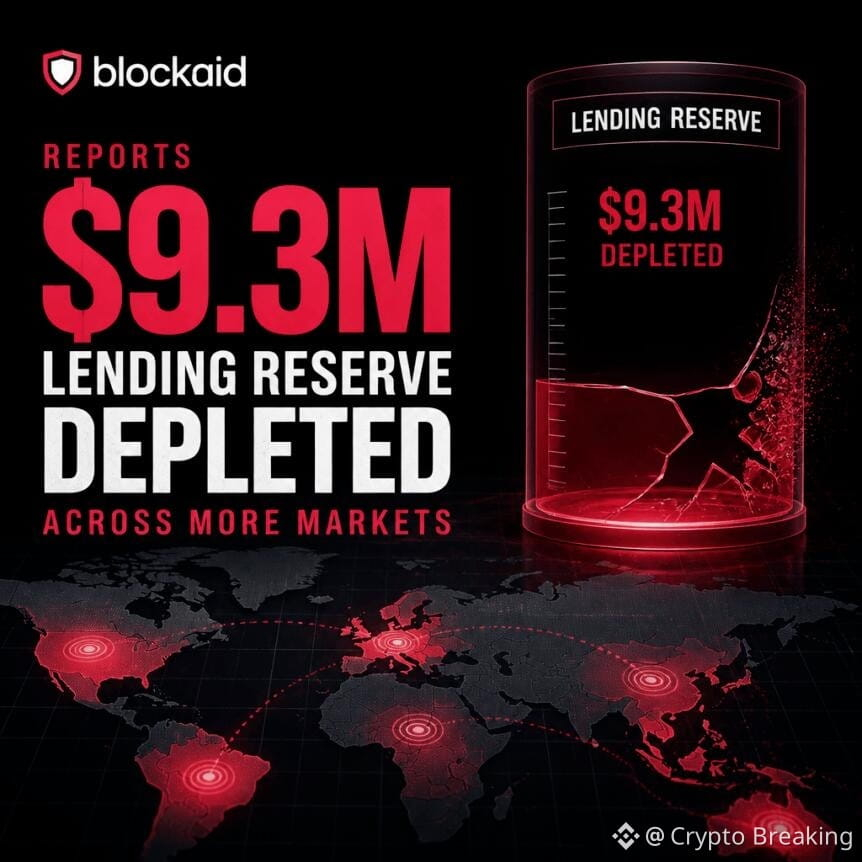
Article
Blockaid Reports $9.3M Lending Reserve Depleted Across More MarketsDeFi lending infrastructure has suffered another high-value breach on Flow EVM, with Blockaid reporting that the protocol More Markets lost roughly $9.3 million in assets from a lending reserve. The incident, described in a Monday post by Blockaid on X, centers on an overborrow strategy using a liquid staking token.
Blockaid said the attacker drained about 15.5 million Wrapped Flow (WFLOW) tokens—valued at approximately $9.3 million—from the mFlowWFLOW lending reserve. The exploit reportedly involved Ankr Staked FLOW (ankrFLOW), together with Aave V3’s “efficiency mode” (E-mode), to expand borrowing capacity beyond what the reserve should allow.
Key takeaways
Blockaid attributes the More Markets Flow EVM reserve drain to an overborrowing approach using Ankr Staked FLOW (ankrFLOW) and Aave V3 E-mode.
About 15.5 million Wrapped Flow (WFLOW), worth around $9.3 million, were taken from the mFlowWFLOW lending reserve.
The month-to-date total losses from crypto hacks reached $139.7 million in August, placing the month as the third-largest by stolen value so far in 2026.
The August figure is sharply lower than July’s $254 million in stolen funds, suggesting either fewer major breaches or reduced impact from exploits.
Cronos paused its network on Sunday following a separate reported $75 million exploit tied to the Tectonic DeFi lending protocol.
How the More Markets reserve was drained
According to Blockaid’s account of the event, the attacker targeted More Markets’ lending reserve that holds mFlowWFLOW. Blockaid said the stolen amount consisted of 15.5 million Wrapped Flow (WFLOW) tokens, which it valued at approximately $9.3 million based on blockchain data it shared publicly.
Blockaid further claimed that the exploit depended on two linked mechanisms: the use of Ankr Staked FLOW (ankrFLOW) and Aave V3’s E-mode. E-mode is designed to increase borrowing power for specific asset groups when their values are expected to move together—commonly a liquid staking token and its corresponding underlying token.
In practical terms, this means that when the protocol’s configuration treats certain pairs as sufficiently correlated, the borrowing limits can become more permissive. Blockaid’s report indicates the attacker leveraged that increased borrowing power to overextend against the reserve, resulting in the loss of WFLOW tokens from mFlowWFLOW.
E-mode designed for correlation—what this incident suggests
E-mode in Aave V3 is intended to make capital more efficient by rewarding users when asset prices track each other closely. Blockaid’s description of this exploit highlights a recurring risk in DeFi: when an attacker can obtain collateral exposure through a token wrapper or staking derivative, the assumed relationship between the assets may be insufficiently protective during the exploit window.
Blockaid specifically tied the strategy to Ankr Staked FLOW (ankrFLOW) in combination with E-mode for correlated assets. While E-mode is not inherently wrong—its goal is to reflect genuine market linkage—incidents like this underscore that protocols still need robust defenses around liquidation mechanics, borrowing limits, and whether the collateral’s behavior under stress matches the assumptions baked into risk parameters.
For investors and users, the takeaway is not that E-mode should be avoided, but that reliance on correlated asset groups can raise the stakes for monitoring. Protocol teams typically need to ensure that their accounting, oracle choices, and validation logic remain resilient when liquidity conditions change quickly.
Broader hack landscape: August losses mount
Blockaid’s reported loss adds to a fast-moving set of crypto-security events. DefiLlama’s data on hacks shows that total cryptocurrency losses from hacks reached $139.7 million in August, making it the third-largest month by value stolen so far in 2026.
The same DefiLlama dataset cited in the reporting indicates a meaningful change from earlier in the year: July saw approximately $254 million stolen. While August has a lower total than July, the ongoing frequency of incidents—spanning multiple ecosystems and chains—suggests that attackers remain active and that DeFi lending remains a frequent target.
Another DeFi lending event: Cronos halts after Tectonic exploit
Alongside the More Markets issue, the market also digested another major DeFi lending-related disruption. On Sunday, Cronos halted its blockchain network following a reported $75 million exploit targeting the DeFi lending protocol Tectonic.
That earlier incident, reported by Cointelegraph, involved a sizable compromise that prompted an emergency network pause by Cronos. Together, the two stories emphasize how quickly lending platforms can become central points of failure—especially when borrowing configurations intersect with token derivatives and liquidity-linked assumptions.
At the time of publication, More Markets had not publicly confirmed the incident or disclosed whether users suffered losses. Cointelegraph said it contacted Blockaid for more details but did not receive a response by publication, and it was unable to reach More Markets for comment.
Readers should watch for follow-up disclosures from More Markets regarding the affected reserve, whether funds were fully recovered, and any post-incident changes to collateral or E-mode configuration. For the wider DeFi community, the key uncertainty is how closely future risk models will account for real-world token behavior during fast-moving market or liquidity conditions.
This article was originally published as Blockaid Reports $9.3M Lending Reserve Depleted Across More Markets on Crypto Breaking News – your trusted source for crypto news, Bitcoin news, and blockchain updates.
Blockaid Reports $9.3M Lending Reserve Depleted Across More Markets
DeFi lending infrastructure has suffered another high-value breach on Flow EVM, with Blockaid reporting that the protocol More Markets lost roughly $9.3 million in assets from a lending reserve. The incident, described in a Monday post by Blockaid on X, centers on an overborrow strategy using a liquid staking token.
Blockaid said the attacker drained about 15.5 million Wrapped Flow (WFLOW) tokens—valued at approximately $9.3 million—from the mFlowWFLOW lending reserve. The exploit reportedly involved Ankr Staked FLOW (ankrFLOW), together with Aave V3’s “efficiency mode” (E-mode), to expand borrowing capacity beyond what the reserve should allow.
Key takeaways
Blockaid attributes the More Markets Flow EVM reserve drain to an overborrowing approach using Ankr Staked FLOW (ankrFLOW) and Aave V3 E-mode.
About 15.5 million Wrapped Flow (WFLOW), worth around $9.3 million, were taken from the mFlowWFLOW lending reserve.
The month-to-date total losses from crypto hacks reached $139.7 million in August, placing the month as the third-largest by stolen value so far in 2026.
The August figure is sharply lower than July’s $254 million in stolen funds, suggesting either fewer major breaches or reduced impact from exploits.
Cronos paused its network on Sunday following a separate reported $75 million exploit tied to the Tectonic DeFi lending protocol.
How the More Markets reserve was drained
According to Blockaid’s account of the event, the attacker targeted More Markets’ lending reserve that holds mFlowWFLOW. Blockaid said the stolen amount consisted of 15.5 million Wrapped Flow (WFLOW) tokens, which it valued at approximately $9.3 million based on blockchain data it shared publicly.
Blockaid further claimed that the exploit depended on two linked mechanisms: the use of Ankr Staked FLOW (ankrFLOW) and Aave V3’s E-mode. E-mode is designed to increase borrowing power for specific asset groups when their values are expected to move together—commonly a liquid staking token and its corresponding underlying token.
In practical terms, this means that when the protocol’s configuration treats certain pairs as sufficiently correlated, the borrowing limits can become more permissive. Blockaid’s report indicates the attacker leveraged that increased borrowing power to overextend against the reserve, resulting in the loss of WFLOW tokens from mFlowWFLOW.
E-mode designed for correlation—what this incident suggests
E-mode in Aave V3 is intended to make capital more efficient by rewarding users when asset prices track each other closely. Blockaid’s description of this exploit highlights a recurring risk in DeFi: when an attacker can obtain collateral exposure through a token wrapper or staking derivative, the assumed relationship between the assets may be insufficiently protective during the exploit window.
Blockaid specifically tied the strategy to Ankr Staked FLOW (ankrFLOW) in combination with E-mode for correlated assets. While E-mode is not inherently wrong—its goal is to reflect genuine market linkage—incidents like this underscore that protocols still need robust defenses around liquidation mechanics, borrowing limits, and whether the collateral’s behavior under stress matches the assumptions baked into risk parameters.
For investors and users, the takeaway is not that E-mode should be avoided, but that reliance on correlated asset groups can raise the stakes for monitoring. Protocol teams typically need to ensure that their accounting, oracle choices, and validation logic remain resilient when liquidity conditions change quickly.
Broader hack landscape: August losses mount
Blockaid’s reported loss adds to a fast-moving set of crypto-security events. DefiLlama’s data on hacks shows that total cryptocurrency losses from hacks reached $139.7 million in August, making it the third-largest month by value stolen so far in 2026.
The same DefiLlama dataset cited in the reporting indicates a meaningful change from earlier in the year: July saw approximately $254 million stolen. While August has a lower total than July, the ongoing frequency of incidents—spanning multiple ecosystems and chains—suggests that attackers remain active and that DeFi lending remains a frequent target.
Another DeFi lending event: Cronos halts after Tectonic exploit
Alongside the More Markets issue, the market also digested another major DeFi lending-related disruption. On Sunday, Cronos halted its blockchain network following a reported $75 million exploit targeting the DeFi lending protocol Tectonic.
That earlier incident, reported by Cointelegraph, involved a sizable compromise that prompted an emergency network pause by Cronos. Together, the two stories emphasize how quickly lending platforms can become central points of failure—especially when borrowing configurations intersect with token derivatives and liquidity-linked assumptions.
At the time of publication, More Markets had not publicly confirmed the incident or disclosed whether users suffered losses. Cointelegraph said it contacted Blockaid for more details but did not receive a response by publication, and it was unable to reach More Markets for comment.
Readers should watch for follow-up disclosures from More Markets regarding the affected reserve, whether funds were fully recovered, and any post-incident changes to collateral or E-mode configuration. For the wider DeFi community, the key uncertainty is how closely future risk models will account for real-world token behavior during fast-moving market or liquidity conditions.
This article was originally published as Blockaid Reports $9.3M Lending Reserve Depleted Across More Markets on Crypto Breaking News – your trusted source for crypto news, Bitcoin news, and blockchain updates.
Blockaid said the attacker drained about 15.5 million Wrapped Flow (WFLOW) tokens—valued at approximately $9.3 million—from the mFlowWFLOW lending reserve. The exploit reportedly involved Ankr Staked FLOW (ankrFLOW), together with Aave V3’s “efficiency mode” (E-mode), to expand borrowing capacity beyond what the reserve should allow.
Key takeaways
Blockaid attributes the More Markets Flow EVM reserve drain to an overborrowing approach using Ankr Staked FLOW (ankrFLOW) and Aave V3 E-mode.
About 15.5 million Wrapped Flow (WFLOW), worth around $9.3 million, were taken from the mFlowWFLOW lending reserve.
The month-to-date total losses from crypto hacks reached $139.7 million in August, placing the month as the third-largest by stolen value so far in 2026.
The August figure is sharply lower than July’s $254 million in stolen funds, suggesting either fewer major breaches or reduced impact from exploits.
Cronos paused its network on Sunday following a separate reported $75 million exploit tied to the Tectonic DeFi lending protocol.
How the More Markets reserve was drained
According to Blockaid’s account of the event, the attacker targeted More Markets’ lending reserve that holds mFlowWFLOW. Blockaid said the stolen amount consisted of 15.5 million Wrapped Flow (WFLOW) tokens, which it valued at approximately $9.3 million based on blockchain data it shared publicly.
Blockaid further claimed that the exploit depended on two linked mechanisms: the use of Ankr Staked FLOW (ankrFLOW) and Aave V3’s E-mode. E-mode is designed to increase borrowing power for specific asset groups when their values are expected to move together—commonly a liquid staking token and its corresponding underlying token.
In practical terms, this means that when the protocol’s configuration treats certain pairs as sufficiently correlated, the borrowing limits can become more permissive. Blockaid’s report indicates the attacker leveraged that increased borrowing power to overextend against the reserve, resulting in the loss of WFLOW tokens from mFlowWFLOW.
E-mode designed for correlation—what this incident suggests
E-mode in Aave V3 is intended to make capital more efficient by rewarding users when asset prices track each other closely. Blockaid’s description of this exploit highlights a recurring risk in DeFi: when an attacker can obtain collateral exposure through a token wrapper or staking derivative, the assumed relationship between the assets may be insufficiently protective during the exploit window.
Blockaid specifically tied the strategy to Ankr Staked FLOW (ankrFLOW) in combination with E-mode for correlated assets. While E-mode is not inherently wrong—its goal is to reflect genuine market linkage—incidents like this underscore that protocols still need robust defenses around liquidation mechanics, borrowing limits, and whether the collateral’s behavior under stress matches the assumptions baked into risk parameters.
For investors and users, the takeaway is not that E-mode should be avoided, but that reliance on correlated asset groups can raise the stakes for monitoring. Protocol teams typically need to ensure that their accounting, oracle choices, and validation logic remain resilient when liquidity conditions change quickly.
Broader hack landscape: August losses mount
Blockaid’s reported loss adds to a fast-moving set of crypto-security events. DefiLlama’s data on hacks shows that total cryptocurrency losses from hacks reached $139.7 million in August, making it the third-largest month by value stolen so far in 2026.
The same DefiLlama dataset cited in the reporting indicates a meaningful change from earlier in the year: July saw approximately $254 million stolen. While August has a lower total than July, the ongoing frequency of incidents—spanning multiple ecosystems and chains—suggests that attackers remain active and that DeFi lending remains a frequent target.
Another DeFi lending event: Cronos halts after Tectonic exploit
Alongside the More Markets issue, the market also digested another major DeFi lending-related disruption. On Sunday, Cronos halted its blockchain network following a reported $75 million exploit targeting the DeFi lending protocol Tectonic.
That earlier incident, reported by Cointelegraph, involved a sizable compromise that prompted an emergency network pause by Cronos. Together, the two stories emphasize how quickly lending platforms can become central points of failure—especially when borrowing configurations intersect with token derivatives and liquidity-linked assumptions.
At the time of publication, More Markets had not publicly confirmed the incident or disclosed whether users suffered losses. Cointelegraph said it contacted Blockaid for more details but did not receive a response by publication, and it was unable to reach More Markets for comment.
Readers should watch for follow-up disclosures from More Markets regarding the affected reserve, whether funds were fully recovered, and any post-incident changes to collateral or E-mode configuration. For the wider DeFi community, the key uncertainty is how closely future risk models will account for real-world token behavior during fast-moving market or liquidity conditions.
This article was originally published as Blockaid Reports $9.3M Lending Reserve Depleted Across More Markets on Crypto Breaking News – your trusted source for crypto news, Bitcoin news, and blockchain updates.
277
Article
Bitcoin Upgrades with Quantum-Ready Security; 18.9M SOL StoppedEfforts to make major blockchains more resilient against the long-discussed threat of quantum computing have accelerated, even as many Bitcoin users remain skeptical about how soon quantum risk becomes practical. This week, two separate threads underscored the direction of travel: experimental defenses for Bitcoin transactions and a new proposal aimed at upgrading Bitcoin’s signature technology.
At the same time, governance decisions and broader market signals continued to shape sentiment across the sector—from Solana’s vote to speed up disinflation to new disclosures and policy debates in the United States. Here are the developments investors and builders should keep on their radar.
Key takeaways
StarkWare researcher Avihu Levy tested an experimental quantum-resistant Bitcoin transaction on mainnet, using a scheme designed to protect outputs during the mempool exposure window.
Blockstream researchers published a Bitcoin Improvement Proposal (BIP) to incorporate the SHRINCS post-quantum signature scheme, significantly shrinking a large signature structure while still introducing trade-offs.
Solana validators approved “Double Disinflation” (SGP-0002), doubling annual disinflation to target 1.5% terminal inflation in about 2.8 years.
Polygon disclosed multiple security vulnerabilities fixed via recent hard forks, addressing risks that could have affected its proof-of-stake clients.
US consumer advocacy group Public Citizen claims investors are “underwater” by at least $4.7 billion in connection with Donald Trump-linked crypto ventures since 2022, with losses attributed to specific token products.
Experimental quantum protection reaches Bitcoin mainnet
Earlier coverage focused on how quantum capabilities could threaten cryptographic signatures and public-key systems over time. This week’s milestone came from the practical side: StarkWare researcher Avihu Levy tested an experimental quantum-resistant transaction on Bitcoin mainnet designed to reduce risk during a specific vulnerability period.
According to a Cointelegraph report, Levy’s test used “Quantum Safe Bitcoin (QSB)” to protect an output in the brief interval when public keys are exposed in the mempool. The approach combines hash-based one-time signatures with computational search techniques that bind an authorization to a specific transaction. In other words, the system is not merely trying to replace signatures wholesale—it is attempting to manage exposure timing relative to how Bitcoin transactions propagate and are validated.
Onchain data referenced in the same report indicates that StarkWare spent a 10,000-satoshi output protected by the QSB scheme. However, the article also highlighted that the mechanism behaves more like a fallback than a broadly usable production-level solution: each transaction reportedly took hours to complete and cost an estimated $150 to $200.
For investors and system designers, the key takeaway is that “quantum-resistance” in Bitcoin is not arriving as a single upgrade button. Instead, it is emerging as layered experiments that tackle specific threat windows first—before longer-term changes to core cryptography can be rolled out through protocol governance.
A BIP aims to upgrade Bitcoin signatures with SHRINCS
Beyond short-term mitigation strategies, the second story points to the longer roadmap: a proposed change to Bitcoin’s signature scheme intended to improve post-quantum security across all transactions.
As described in a Cointelegraph piece, Blockstream researchers published a Bitcoin Improvement Proposal introducing the SHRINCS signature scheme. The researchers reportedly reduced a large hash-based post-quantum signature “by about 13.23 times.” Even with that improvement, the signature size is still described as at least nine times larger than Bitcoin’s existing signatures, and the proposal includes multiple trade-offs.
The same report quotes Blockstream Research’s Jonas Nick, who called it “the first concrete proposal” for a post-quantum signature designed specifically for Bitcoin. Nick acknowledged that it is “not optimal along every axis,” but argued it could represent a reasonable trade-off among available options.
Why this matters for the Bitcoin ecosystem is straightforward: any post-quantum signature upgrade must be weighed against bandwidth, validation costs, implementation complexity, and compatibility with current constraints. A key question for readers is whether future iterations can close the gap between security goals and performance limitations, or whether staged approaches like Levy’s mempool-window protection will remain the practical near-term path for high-value use cases.
Solana accelerates disinflation via validator vote
While Bitcoin-focused news centered on cryptographic evolution, Solana’s latest governance decision shifted attention to monetary policy. Solana validators approved a proposal to double the network’s annual disinflation rate—aimed at reducing issuance faster without changing the broad disinflation direction.
Cointelegraph reported that participation reached 60.7% of eligible stake, with 67% support and 25.16% voting against (7.84% abstained). The measure—known as SGP-0002 or Double Disinflation—increases Solana’s annual disinflation rate from 15% to 30%.
Under the new schedule, Solana is expected to reach a 1.5% terminal inflation rate in about 2.8 years, compared with roughly 5.7 years under the previous schedule. The proposal is also projected to reduce issuance by 18.9 million SOL over the next six years, according to the report.
The vote arrives amid signs that network usage is continuing to expand. Cointelegraph cited onchain data presented by The Kobeissi Letter showing Solana processed a record 4.2 billion transactions in July, up 13.5% month over month. Transaction counts reportedly rose by roughly 2 billion since December, representing a 91% increase.
For traders and long-term holders, the immediate relevance is that monetary-policy acceleration can alter expectations around supply growth, even if it does not directly determine short-term price. For builders, higher throughput combined with faster disinflation can influence incentive structures and the economics of running apps, validators, and infrastructure.
Security disclosure: Polygon patches vulnerabilities through hard forks
In another infrastructure-related update, Polygon disclosed previously private security issues that could have disrupted its proof-of-stake network. The vulnerabilities were reportedly fixed through two recent hard forks—Austin and Kyoto—deployed privately first and then activated on mainnet before public disclosure.
Cointelegraph reported that the affected components included Polygon’s Bor and Heimdall clients. The disclosure from Polygon Labs’ Validators Support Team indicated risks such as denial-of-service vectors, validator resource exhaustion, and flaws related to checkpoint and milestone processing.
From an investor and validator perspective, disclosures like this matter because they reveal where reliability and operational risk can concentrate—even if the network continues to run. The most useful next step for market participants is to watch whether validator operations, client updates, and monitoring guidance translate into any follow-up performance or incident reporting after these forks.
US policy and consumer scrutiny: Public Citizen alleges $4.7B in losses
Outside technical upgrades, consumer advocacy continues to influence the regulatory and public narrative around crypto. Public Citizen, a nonprofit consumer organization, claims that US President Donald Trump and related digital asset ventures left investors at least an estimated $4.7 billion “underwater” since 2022.
According to a Cointelegraph report, the group’s new filing attributes losses to multiple Trump-linked products: $3.2 billion from the Official Trump (TRUMP) memecoin; at least $1 billion on the World Liberty Financial governance token; $450 million on Trump Media’s digital asset treasury; and $9.3 million on Trump’s NFT trading cards launched in 2022. The article adds that holders of a USD1 stablecoin were reportedly “sitting pretty on $0 losses.”
The report also notes that Trump’s crypto profits are described as one of the factors supporting the continued progress of the CLARITY Act debate, with Democrats reportedly seeking stronger protections intended to prevent elected officials from profiting through cryptocurrency issuances.
Even for readers who are not focused on US election-era politics, this category of claims tends to affect both compliance pressure on token issuers and the willingness of traditional financial institutions to engage with crypto-linked structures.
Looking ahead, quantum-resistance proposals will likely remain a multi-year, iterative process—starting with narrow defensive experiments and moving toward full signature upgrades through governance. Meanwhile, validator-led disinflation votes and security-related hard fork disclosures offer clearer near-term implications for network economics and reliability; those are the areas to watch closely for follow-on data and operational updates.
This article was originally published as Bitcoin Upgrades with Quantum-Ready Security; 18.9M SOL Stopped on Crypto Breaking News – your trusted source for crypto news, Bitcoin news, and blockchain updates.
Bitcoin Upgrades with Quantum-Ready Security; 18.9M SOL Stopped
Efforts to make major blockchains more resilient against the long-discussed threat of quantum computing have accelerated, even as many Bitcoin users remain skeptical about how soon quantum risk becomes practical. This week, two separate threads underscored the direction of travel: experimental defenses for Bitcoin transactions and a new proposal aimed at upgrading Bitcoin’s signature technology.
At the same time, governance decisions and broader market signals continued to shape sentiment across the sector—from Solana’s vote to speed up disinflation to new disclosures and policy debates in the United States. Here are the developments investors and builders should keep on their radar.
Key takeaways
StarkWare researcher Avihu Levy tested an experimental quantum-resistant Bitcoin transaction on mainnet, using a scheme designed to protect outputs during the mempool exposure window.
Blockstream researchers published a Bitcoin Improvement Proposal (BIP) to incorporate the SHRINCS post-quantum signature scheme, significantly shrinking a large signature structure while still introducing trade-offs.
Solana validators approved “Double Disinflation” (SGP-0002), doubling annual disinflation to target 1.5% terminal inflation in about 2.8 years.
Polygon disclosed multiple security vulnerabilities fixed via recent hard forks, addressing risks that could have affected its proof-of-stake clients.
US consumer advocacy group Public Citizen claims investors are “underwater” by at least $4.7 billion in connection with Donald Trump-linked crypto ventures since 2022, with losses attributed to specific token products.
Experimental quantum protection reaches Bitcoin mainnet
Earlier coverage focused on how quantum capabilities could threaten cryptographic signatures and public-key systems over time. This week’s milestone came from the practical side: StarkWare researcher Avihu Levy tested an experimental quantum-resistant transaction on Bitcoin mainnet designed to reduce risk during a specific vulnerability period.
According to a Cointelegraph report, Levy’s test used “Quantum Safe Bitcoin (QSB)” to protect an output in the brief interval when public keys are exposed in the mempool. The approach combines hash-based one-time signatures with computational search techniques that bind an authorization to a specific transaction. In other words, the system is not merely trying to replace signatures wholesale—it is attempting to manage exposure timing relative to how Bitcoin transactions propagate and are validated.
Onchain data referenced in the same report indicates that StarkWare spent a 10,000-satoshi output protected by the QSB scheme. However, the article also highlighted that the mechanism behaves more like a fallback than a broadly usable production-level solution: each transaction reportedly took hours to complete and cost an estimated $150 to $200.
For investors and system designers, the key takeaway is that “quantum-resistance” in Bitcoin is not arriving as a single upgrade button. Instead, it is emerging as layered experiments that tackle specific threat windows first—before longer-term changes to core cryptography can be rolled out through protocol governance.
A BIP aims to upgrade Bitcoin signatures with SHRINCS
Beyond short-term mitigation strategies, the second story points to the longer roadmap: a proposed change to Bitcoin’s signature scheme intended to improve post-quantum security across all transactions.
As described in a Cointelegraph piece, Blockstream researchers published a Bitcoin Improvement Proposal introducing the SHRINCS signature scheme. The researchers reportedly reduced a large hash-based post-quantum signature “by about 13.23 times.” Even with that improvement, the signature size is still described as at least nine times larger than Bitcoin’s existing signatures, and the proposal includes multiple trade-offs.
The same report quotes Blockstream Research’s Jonas Nick, who called it “the first concrete proposal” for a post-quantum signature designed specifically for Bitcoin. Nick acknowledged that it is “not optimal along every axis,” but argued it could represent a reasonable trade-off among available options.
Why this matters for the Bitcoin ecosystem is straightforward: any post-quantum signature upgrade must be weighed against bandwidth, validation costs, implementation complexity, and compatibility with current constraints. A key question for readers is whether future iterations can close the gap between security goals and performance limitations, or whether staged approaches like Levy’s mempool-window protection will remain the practical near-term path for high-value use cases.
Solana accelerates disinflation via validator vote
While Bitcoin-focused news centered on cryptographic evolution, Solana’s latest governance decision shifted attention to monetary policy. Solana validators approved a proposal to double the network’s annual disinflation rate—aimed at reducing issuance faster without changing the broad disinflation direction.
Cointelegraph reported that participation reached 60.7% of eligible stake, with 67% support and 25.16% voting against (7.84% abstained). The measure—known as SGP-0002 or Double Disinflation—increases Solana’s annual disinflation rate from 15% to 30%.
Under the new schedule, Solana is expected to reach a 1.5% terminal inflation rate in about 2.8 years, compared with roughly 5.7 years under the previous schedule. The proposal is also projected to reduce issuance by 18.9 million SOL over the next six years, according to the report.
The vote arrives amid signs that network usage is continuing to expand. Cointelegraph cited onchain data presented by The Kobeissi Letter showing Solana processed a record 4.2 billion transactions in July, up 13.5% month over month. Transaction counts reportedly rose by roughly 2 billion since December, representing a 91% increase.
For traders and long-term holders, the immediate relevance is that monetary-policy acceleration can alter expectations around supply growth, even if it does not directly determine short-term price. For builders, higher throughput combined with faster disinflation can influence incentive structures and the economics of running apps, validators, and infrastructure.
Security disclosure: Polygon patches vulnerabilities through hard forks
In another infrastructure-related update, Polygon disclosed previously private security issues that could have disrupted its proof-of-stake network. The vulnerabilities were reportedly fixed through two recent hard forks—Austin and Kyoto—deployed privately first and then activated on mainnet before public disclosure.
Cointelegraph reported that the affected components included Polygon’s Bor and Heimdall clients. The disclosure from Polygon Labs’ Validators Support Team indicated risks such as denial-of-service vectors, validator resource exhaustion, and flaws related to checkpoint and milestone processing.
From an investor and validator perspective, disclosures like this matter because they reveal where reliability and operational risk can concentrate—even if the network continues to run. The most useful next step for market participants is to watch whether validator operations, client updates, and monitoring guidance translate into any follow-up performance or incident reporting after these forks.
US policy and consumer scrutiny: Public Citizen alleges $4.7B in losses
Outside technical upgrades, consumer advocacy continues to influence the regulatory and public narrative around crypto. Public Citizen, a nonprofit consumer organization, claims that US President Donald Trump and related digital asset ventures left investors at least an estimated $4.7 billion “underwater” since 2022.
According to a Cointelegraph report, the group’s new filing attributes losses to multiple Trump-linked products: $3.2 billion from the Official Trump (TRUMP) memecoin; at least $1 billion on the World Liberty Financial governance token; $450 million on Trump Media’s digital asset treasury; and $9.3 million on Trump’s NFT trading cards launched in 2022. The article adds that holders of a USD1 stablecoin were reportedly “sitting pretty on $0 losses.”
The report also notes that Trump’s crypto profits are described as one of the factors supporting the continued progress of the CLARITY Act debate, with Democrats reportedly seeking stronger protections intended to prevent elected officials from profiting through cryptocurrency issuances.
Even for readers who are not focused on US election-era politics, this category of claims tends to affect both compliance pressure on token issuers and the willingness of traditional financial institutions to engage with crypto-linked structures.
Looking ahead, quantum-resistance proposals will likely remain a multi-year, iterative process—starting with narrow defensive experiments and moving toward full signature upgrades through governance. Meanwhile, validator-led disinflation votes and security-related hard fork disclosures offer clearer near-term implications for network economics and reliability; those are the areas to watch closely for follow-on data and operational updates.
This article was originally published as Bitcoin Upgrades with Quantum-Ready Security; 18.9M SOL Stopped on Crypto Breaking News – your trusted source for crypto news, Bitcoin news, and blockchain updates.
At the same time, governance decisions and broader market signals continued to shape sentiment across the sector—from Solana’s vote to speed up disinflation to new disclosures and policy debates in the United States. Here are the developments investors and builders should keep on their radar.
Key takeaways
StarkWare researcher Avihu Levy tested an experimental quantum-resistant Bitcoin transaction on mainnet, using a scheme designed to protect outputs during the mempool exposure window.
Blockstream researchers published a Bitcoin Improvement Proposal (BIP) to incorporate the SHRINCS post-quantum signature scheme, significantly shrinking a large signature structure while still introducing trade-offs.
Solana validators approved “Double Disinflation” (SGP-0002), doubling annual disinflation to target 1.5% terminal inflation in about 2.8 years.
Polygon disclosed multiple security vulnerabilities fixed via recent hard forks, addressing risks that could have affected its proof-of-stake clients.
US consumer advocacy group Public Citizen claims investors are “underwater” by at least $4.7 billion in connection with Donald Trump-linked crypto ventures since 2022, with losses attributed to specific token products.
Experimental quantum protection reaches Bitcoin mainnet
Earlier coverage focused on how quantum capabilities could threaten cryptographic signatures and public-key systems over time. This week’s milestone came from the practical side: StarkWare researcher Avihu Levy tested an experimental quantum-resistant transaction on Bitcoin mainnet designed to reduce risk during a specific vulnerability period.
According to a Cointelegraph report, Levy’s test used “Quantum Safe Bitcoin (QSB)” to protect an output in the brief interval when public keys are exposed in the mempool. The approach combines hash-based one-time signatures with computational search techniques that bind an authorization to a specific transaction. In other words, the system is not merely trying to replace signatures wholesale—it is attempting to manage exposure timing relative to how Bitcoin transactions propagate and are validated.
Onchain data referenced in the same report indicates that StarkWare spent a 10,000-satoshi output protected by the QSB scheme. However, the article also highlighted that the mechanism behaves more like a fallback than a broadly usable production-level solution: each transaction reportedly took hours to complete and cost an estimated $150 to $200.
For investors and system designers, the key takeaway is that “quantum-resistance” in Bitcoin is not arriving as a single upgrade button. Instead, it is emerging as layered experiments that tackle specific threat windows first—before longer-term changes to core cryptography can be rolled out through protocol governance.
A BIP aims to upgrade Bitcoin signatures with SHRINCS
Beyond short-term mitigation strategies, the second story points to the longer roadmap: a proposed change to Bitcoin’s signature scheme intended to improve post-quantum security across all transactions.
As described in a Cointelegraph piece, Blockstream researchers published a Bitcoin Improvement Proposal introducing the SHRINCS signature scheme. The researchers reportedly reduced a large hash-based post-quantum signature “by about 13.23 times.” Even with that improvement, the signature size is still described as at least nine times larger than Bitcoin’s existing signatures, and the proposal includes multiple trade-offs.
The same report quotes Blockstream Research’s Jonas Nick, who called it “the first concrete proposal” for a post-quantum signature designed specifically for Bitcoin. Nick acknowledged that it is “not optimal along every axis,” but argued it could represent a reasonable trade-off among available options.
Why this matters for the Bitcoin ecosystem is straightforward: any post-quantum signature upgrade must be weighed against bandwidth, validation costs, implementation complexity, and compatibility with current constraints. A key question for readers is whether future iterations can close the gap between security goals and performance limitations, or whether staged approaches like Levy’s mempool-window protection will remain the practical near-term path for high-value use cases.
Solana accelerates disinflation via validator vote
While Bitcoin-focused news centered on cryptographic evolution, Solana’s latest governance decision shifted attention to monetary policy. Solana validators approved a proposal to double the network’s annual disinflation rate—aimed at reducing issuance faster without changing the broad disinflation direction.
Cointelegraph reported that participation reached 60.7% of eligible stake, with 67% support and 25.16% voting against (7.84% abstained). The measure—known as SGP-0002 or Double Disinflation—increases Solana’s annual disinflation rate from 15% to 30%.
Under the new schedule, Solana is expected to reach a 1.5% terminal inflation rate in about 2.8 years, compared with roughly 5.7 years under the previous schedule. The proposal is also projected to reduce issuance by 18.9 million SOL over the next six years, according to the report.
The vote arrives amid signs that network usage is continuing to expand. Cointelegraph cited onchain data presented by The Kobeissi Letter showing Solana processed a record 4.2 billion transactions in July, up 13.5% month over month. Transaction counts reportedly rose by roughly 2 billion since December, representing a 91% increase.
For traders and long-term holders, the immediate relevance is that monetary-policy acceleration can alter expectations around supply growth, even if it does not directly determine short-term price. For builders, higher throughput combined with faster disinflation can influence incentive structures and the economics of running apps, validators, and infrastructure.
Security disclosure: Polygon patches vulnerabilities through hard forks
In another infrastructure-related update, Polygon disclosed previously private security issues that could have disrupted its proof-of-stake network. The vulnerabilities were reportedly fixed through two recent hard forks—Austin and Kyoto—deployed privately first and then activated on mainnet before public disclosure.
Cointelegraph reported that the affected components included Polygon’s Bor and Heimdall clients. The disclosure from Polygon Labs’ Validators Support Team indicated risks such as denial-of-service vectors, validator resource exhaustion, and flaws related to checkpoint and milestone processing.
From an investor and validator perspective, disclosures like this matter because they reveal where reliability and operational risk can concentrate—even if the network continues to run. The most useful next step for market participants is to watch whether validator operations, client updates, and monitoring guidance translate into any follow-up performance or incident reporting after these forks.
US policy and consumer scrutiny: Public Citizen alleges $4.7B in losses
Outside technical upgrades, consumer advocacy continues to influence the regulatory and public narrative around crypto. Public Citizen, a nonprofit consumer organization, claims that US President Donald Trump and related digital asset ventures left investors at least an estimated $4.7 billion “underwater” since 2022.
According to a Cointelegraph report, the group’s new filing attributes losses to multiple Trump-linked products: $3.2 billion from the Official Trump (TRUMP) memecoin; at least $1 billion on the World Liberty Financial governance token; $450 million on Trump Media’s digital asset treasury; and $9.3 million on Trump’s NFT trading cards launched in 2022. The article adds that holders of a USD1 stablecoin were reportedly “sitting pretty on $0 losses.”
The report also notes that Trump’s crypto profits are described as one of the factors supporting the continued progress of the CLARITY Act debate, with Democrats reportedly seeking stronger protections intended to prevent elected officials from profiting through cryptocurrency issuances.
Even for readers who are not focused on US election-era politics, this category of claims tends to affect both compliance pressure on token issuers and the willingness of traditional financial institutions to engage with crypto-linked structures.
Looking ahead, quantum-resistance proposals will likely remain a multi-year, iterative process—starting with narrow defensive experiments and moving toward full signature upgrades through governance. Meanwhile, validator-led disinflation votes and security-related hard fork disclosures offer clearer near-term implications for network economics and reliability; those are the areas to watch closely for follow-on data and operational updates.
This article was originally published as Bitcoin Upgrades with Quantum-Ready Security; 18.9M SOL Stopped on Crypto Breaking News – your trusted source for crypto news, Bitcoin news, and blockchain updates.
1
277

Article
Saylor Says “Strategy Is Back” as Bitcoin Buys Resume After PauseStrategy’s chief executive Michael Saylor has posted what market watchers are reading as a near-term signal for renewed corporate Bitcoin buying. In a recent social media message, Saylor wrote “We’re Back,” pointing to a potential return to accumulating BTC after a pause in Strategy’s routine purchases earlier this year.
The timing matters because Saylor has a history of sharing ambiguous weekend-style hints ahead of Monday morning announcements related to Strategy’s treasury activity. If that pattern holds, the post could be interpreted as a psychological nudge—suggesting the company is prepared to deploy capital again rather than continue its more conservative balance-sheet focus.
Key takeaways
Saylor’s “We’re Back” message on X is being treated by observers as a signal that Strategy may resume BTC accumulation.
Earlier in the year, Strategy paused its regular weekly buying cadence and shifted attention toward financing and balance-sheet strengthening.
Strategy’s large BTC treasury has recently benefited from Bitcoin reclaiming levels above $80,000, moving the company’s overall position back into paper profit.
If Strategy resumes purchasing, the change would mark a return to the company’s core playbook after a summer hiatus.
Why “We’re Back” is getting attention
Saylor’s post—shared on X—has drawn attention not only for its message, but for how Strategy typically communicates around treasury moves. Earlier coverage noted that Saylor has sometimes used cryptic weekend teasers that precede official updates when Strategy’s Monday announcements detail new corporate Bitcoin purchases.
Strategy’s investor base often watches these cues closely because they provide a sense of whether capital is likely to be deployed or retained. Even when the post does not specify the timing or size of future purchases, it can shape expectations heading into the next scheduled corporate updates.
The post can also be read as a repositioning signal. After a period of reduced Bitcoin buying activity, “We’re Back” suggests a return to the strategy’s defining mission: increasing exposure to Bitcoin through its treasury operations.
A pause in buying, followed by balance-sheet consolidation
Over roughly the past two months, Strategy deviated from its standard pattern of regular Bitcoin acquisition. Instead of expanding its BTC holdings, the company pivoted toward strengthening its balance sheet.
According to the reporting cited in the original coverage, Strategy’s management concentrated on stabilizing its preferred stock offerings, building a $5.1 billion US dollar reserve, and creating a $1.59 billion cash pool sourced from common stock offerings. In practical terms, this shift indicates that—at least during the hiatus—Strategy prioritized liquidity and capital market mechanics over direct BTC accumulation.
That change has significance for how investors assess Strategy’s near-term path. Corporate Bitcoin accumulation is not only a market decision; it also depends on the company’s ability to raise capital and manage funding costs. When buying slows, traders often interpret it as a temporary reallocation of resources—either due to market conditions, financing structure, or internal readiness to scale purchases again.
Bitcoin’s rebound improves the optics for Strategy’s treasury
The renewed focus on Bitcoin buying comes as the broader market has improved. The original article ties Strategy’s position to Bitcoin trading dynamics, stating that its industry-leading BTC treasury has been “deep in the red on paper” during a challenging stretch. More recently, it notes that macro momentum has helped push Bitcoin above the $80,000 threshold.
With Strategy reportedly holding more than 840,447 BTC at an average cost basis hovering around $75,385, Bitcoin’s move above $80,000 would translate into a return to positive territory for the company’s overall position—at least on an unrealized basis. That matters because it changes the psychological and strategic framing around accumulation. When the treasury sits under its cost basis, additional buying can feel more defensive; when it moves back above, management’s messaging often becomes more offensive and conviction-driven.
It also raises a practical question investors typically track: whether renewed purchasing signals a shift from capital preservation and financing stabilization back toward asset deployment at scale.
What to watch next
Saylor’s “We’re Back” statement may function as a multi-layer signal—both operationally (suggesting readiness to resume BTC accumulation) and psychologically (reinforcing a return to profitability narratives). Still, until Strategy publishes an official Monday update detailing treasury actions, investors should treat the post as a directional cue rather than confirmation of specific purchase terms.
The key next step for the market will be whether Strategy’s upcoming disclosures confirm resumed Bitcoin buying and whether the company’s capital allocation priorities shift from reserve-building and financing to further treasury expansion.
This article was originally published as Saylor Says “Strategy Is Back” as Bitcoin Buys Resume After Pause on Crypto Breaking News – your trusted source for crypto news, Bitcoin news, and blockchain updates.
Saylor Says “Strategy Is Back” as Bitcoin Buys Resume After Pause
Strategy’s chief executive Michael Saylor has posted what market watchers are reading as a near-term signal for renewed corporate Bitcoin buying. In a recent social media message, Saylor wrote “We’re Back,” pointing to a potential return to accumulating BTC after a pause in Strategy’s routine purchases earlier this year.
The timing matters because Saylor has a history of sharing ambiguous weekend-style hints ahead of Monday morning announcements related to Strategy’s treasury activity. If that pattern holds, the post could be interpreted as a psychological nudge—suggesting the company is prepared to deploy capital again rather than continue its more conservative balance-sheet focus.
Key takeaways
Saylor’s “We’re Back” message on X is being treated by observers as a signal that Strategy may resume BTC accumulation.
Earlier in the year, Strategy paused its regular weekly buying cadence and shifted attention toward financing and balance-sheet strengthening.
Strategy’s large BTC treasury has recently benefited from Bitcoin reclaiming levels above $80,000, moving the company’s overall position back into paper profit.
If Strategy resumes purchasing, the change would mark a return to the company’s core playbook after a summer hiatus.
Why “We’re Back” is getting attention
Saylor’s post—shared on X—has drawn attention not only for its message, but for how Strategy typically communicates around treasury moves. Earlier coverage noted that Saylor has sometimes used cryptic weekend teasers that precede official updates when Strategy’s Monday announcements detail new corporate Bitcoin purchases.
Strategy’s investor base often watches these cues closely because they provide a sense of whether capital is likely to be deployed or retained. Even when the post does not specify the timing or size of future purchases, it can shape expectations heading into the next scheduled corporate updates.
The post can also be read as a repositioning signal. After a period of reduced Bitcoin buying activity, “We’re Back” suggests a return to the strategy’s defining mission: increasing exposure to Bitcoin through its treasury operations.
A pause in buying, followed by balance-sheet consolidation
Over roughly the past two months, Strategy deviated from its standard pattern of regular Bitcoin acquisition. Instead of expanding its BTC holdings, the company pivoted toward strengthening its balance sheet.
According to the reporting cited in the original coverage, Strategy’s management concentrated on stabilizing its preferred stock offerings, building a $5.1 billion US dollar reserve, and creating a $1.59 billion cash pool sourced from common stock offerings. In practical terms, this shift indicates that—at least during the hiatus—Strategy prioritized liquidity and capital market mechanics over direct BTC accumulation.
That change has significance for how investors assess Strategy’s near-term path. Corporate Bitcoin accumulation is not only a market decision; it also depends on the company’s ability to raise capital and manage funding costs. When buying slows, traders often interpret it as a temporary reallocation of resources—either due to market conditions, financing structure, or internal readiness to scale purchases again.
Bitcoin’s rebound improves the optics for Strategy’s treasury
The renewed focus on Bitcoin buying comes as the broader market has improved. The original article ties Strategy’s position to Bitcoin trading dynamics, stating that its industry-leading BTC treasury has been “deep in the red on paper” during a challenging stretch. More recently, it notes that macro momentum has helped push Bitcoin above the $80,000 threshold.
With Strategy reportedly holding more than 840,447 BTC at an average cost basis hovering around $75,385, Bitcoin’s move above $80,000 would translate into a return to positive territory for the company’s overall position—at least on an unrealized basis. That matters because it changes the psychological and strategic framing around accumulation. When the treasury sits under its cost basis, additional buying can feel more defensive; when it moves back above, management’s messaging often becomes more offensive and conviction-driven.
It also raises a practical question investors typically track: whether renewed purchasing signals a shift from capital preservation and financing stabilization back toward asset deployment at scale.
What to watch next
Saylor’s “We’re Back” statement may function as a multi-layer signal—both operationally (suggesting readiness to resume BTC accumulation) and psychologically (reinforcing a return to profitability narratives). Still, until Strategy publishes an official Monday update detailing treasury actions, investors should treat the post as a directional cue rather than confirmation of specific purchase terms.
The key next step for the market will be whether Strategy’s upcoming disclosures confirm resumed Bitcoin buying and whether the company’s capital allocation priorities shift from reserve-building and financing to further treasury expansion.
This article was originally published as Saylor Says “Strategy Is Back” as Bitcoin Buys Resume After Pause on Crypto Breaking News – your trusted source for crypto news, Bitcoin news, and blockchain updates.
The timing matters because Saylor has a history of sharing ambiguous weekend-style hints ahead of Monday morning announcements related to Strategy’s treasury activity. If that pattern holds, the post could be interpreted as a psychological nudge—suggesting the company is prepared to deploy capital again rather than continue its more conservative balance-sheet focus.
Key takeaways
Saylor’s “We’re Back” message on X is being treated by observers as a signal that Strategy may resume BTC accumulation.
Earlier in the year, Strategy paused its regular weekly buying cadence and shifted attention toward financing and balance-sheet strengthening.
Strategy’s large BTC treasury has recently benefited from Bitcoin reclaiming levels above $80,000, moving the company’s overall position back into paper profit.
If Strategy resumes purchasing, the change would mark a return to the company’s core playbook after a summer hiatus.
Why “We’re Back” is getting attention
Saylor’s post—shared on X—has drawn attention not only for its message, but for how Strategy typically communicates around treasury moves. Earlier coverage noted that Saylor has sometimes used cryptic weekend teasers that precede official updates when Strategy’s Monday announcements detail new corporate Bitcoin purchases.
Strategy’s investor base often watches these cues closely because they provide a sense of whether capital is likely to be deployed or retained. Even when the post does not specify the timing or size of future purchases, it can shape expectations heading into the next scheduled corporate updates.
The post can also be read as a repositioning signal. After a period of reduced Bitcoin buying activity, “We’re Back” suggests a return to the strategy’s defining mission: increasing exposure to Bitcoin through its treasury operations.
A pause in buying, followed by balance-sheet consolidation
Over roughly the past two months, Strategy deviated from its standard pattern of regular Bitcoin acquisition. Instead of expanding its BTC holdings, the company pivoted toward strengthening its balance sheet.
According to the reporting cited in the original coverage, Strategy’s management concentrated on stabilizing its preferred stock offerings, building a $5.1 billion US dollar reserve, and creating a $1.59 billion cash pool sourced from common stock offerings. In practical terms, this shift indicates that—at least during the hiatus—Strategy prioritized liquidity and capital market mechanics over direct BTC accumulation.
That change has significance for how investors assess Strategy’s near-term path. Corporate Bitcoin accumulation is not only a market decision; it also depends on the company’s ability to raise capital and manage funding costs. When buying slows, traders often interpret it as a temporary reallocation of resources—either due to market conditions, financing structure, or internal readiness to scale purchases again.
Bitcoin’s rebound improves the optics for Strategy’s treasury
The renewed focus on Bitcoin buying comes as the broader market has improved. The original article ties Strategy’s position to Bitcoin trading dynamics, stating that its industry-leading BTC treasury has been “deep in the red on paper” during a challenging stretch. More recently, it notes that macro momentum has helped push Bitcoin above the $80,000 threshold.
With Strategy reportedly holding more than 840,447 BTC at an average cost basis hovering around $75,385, Bitcoin’s move above $80,000 would translate into a return to positive territory for the company’s overall position—at least on an unrealized basis. That matters because it changes the psychological and strategic framing around accumulation. When the treasury sits under its cost basis, additional buying can feel more defensive; when it moves back above, management’s messaging often becomes more offensive and conviction-driven.
It also raises a practical question investors typically track: whether renewed purchasing signals a shift from capital preservation and financing stabilization back toward asset deployment at scale.
What to watch next
Saylor’s “We’re Back” statement may function as a multi-layer signal—both operationally (suggesting readiness to resume BTC accumulation) and psychologically (reinforcing a return to profitability narratives). Still, until Strategy publishes an official Monday update detailing treasury actions, investors should treat the post as a directional cue rather than confirmation of specific purchase terms.
The key next step for the market will be whether Strategy’s upcoming disclosures confirm resumed Bitcoin buying and whether the company’s capital allocation priorities shift from reserve-building and financing to further treasury expansion.
This article was originally published as Saylor Says “Strategy Is Back” as Bitcoin Buys Resume After Pause on Crypto Breaking News – your trusted source for crypto news, Bitcoin news, and blockchain updates.
2
77
Verified

Article
Saylor Says Treasury Strategy Is “Back” to Bitcoin BuyingStrategy’s co-founder Michael Saylor has signaled—via a fresh post on X—that the firm may be preparing to resume buying Bitcoin. In his latest message, Saylor wrote “We’re Back,” prompting speculation that the company could return to its prior pattern of corporate accumulation announcements on Mondays.
For long-time watchers of Strategy’s moves, the timing matters. Earlier weekend-style signals from Saylor have often been followed by official updates tied to treasury activity at the start of the week, turning small social posts into something of a market barometer for what investors should expect next.
Key takeaways
Michael Saylor’s “We’re Back” post on X has reignited expectations that Strategy will restart Bitcoin buying.
Strategy paused its regular weekly Bitcoin purchases over the summer, shifting attention toward balance-sheet and capital-market actions.
Recent strength in Bitcoin has reportedly moved Strategy’s BTC treasury back into positive territory on paper after months of losses.
Investors will likely watch for whether Monday announcements confirm that the signal translates into renewed accumulation.
A weekend signal with a track record
In the post, Saylor described a return rather than a new thesis, reinforcing the idea that Strategy may be moving back toward Bitcoin accumulation after a period of restraint. The community interpretation is grounded in how Strategy has historically communicated: cryptic weekend hints have frequently preceded official Monday morning treasury purchase announcements.
The practical relevance for market participants is straightforward. Strategy’s Bitcoin buying has been closely watched because its scale and regularity can influence sentiment around corporate participation. Even when the underlying purchase mechanics are formalized only later, the lead time created by Saylor’s messaging can shift expectations well before any transaction details are released.
What Strategy changed during its summer pause
Over the past two months, Strategy reportedly stopped its routine weekly Bitcoin purchases, replacing the accumulation cadence with a broader focus on strengthening its financial foundation. Instead of expanding crypto holdings, management emphasized balance-sheet stability and funding structure adjustments.
According to the article, Strategy’s priorities during this period included stabilizing preferred stock offerings, building a US dollar reserve of $5.1 billion, and setting up a dedicated cash pool of $1.59 billion generated through large common stock offerings. Together, these steps suggest the firm treated the pause not as an abandonment of its approach, but as a financing reset—keeping liquidity available so that future buying could proceed on its preferred schedule.
That shift also aligned with a difficult stretch for Strategy’s on-paper position. With Bitcoin under pressure during parts of the summer, the firm’s large BTC treasury was said to be “deep in the red,” at least on mark-to-market measures.
Bitcoin’s move back above $80,000 and Strategy’s position
The renewed “We’re Back” narrative is now landing against a different backdrop for Bitcoin’s price. The article notes that recent macro momentum has pushed Bitcoin above the $80,000 threshold, a move that changes the immediate math for holders.
Strategy holds more than 840,447 Bitcoin, with an average cost basis hovering around $75,385, as described in the source text. With Bitcoin recovering, that reported cost-versus-market relationship has pushed the company’s overall BTC position back into positive territory for the first time in months.
This matters for two reasons. First, it removes some of the accounting pressure that tends to weigh on corporate crypto holders during drawdowns. Second, it can make a return to accumulation more strategically attractive: when the treasury is back above average cost, renewed buying can be framed less defensively and more as an offensive strategy—something investors typically prefer to see when evaluating risk-adjusted prospects.
Why “We’re Back” could mean more than a headline
While Saylor’s post is not a formal announcement of a specific purchase amount or exact timing, the statement carries multiple layers for Strategy stakeholders. Operationally, it can be read as a readiness check—suggesting the company is prepared to deploy its “dry powder” back into Bitcoin. Psychologically, it signals a re-energized approach after a period when market conditions and Strategy’s reported balance-sheet focus may have temporarily shifted attention away from routine accumulation.
Still, there’s an important distinction investors should keep in mind: a social media signal is an expectation, not execution. The real confirmation will come from official treasury disclosures that specify whether and when Strategy restarts buying activity, and how the company positions its financing tools alongside any resumed purchases.
That uncertainty is precisely why the post is notable. Strategy’s previous pattern—weekend teasers followed by Monday morning corporate actions—has created a framework in which traders and long-term observers can interpret early hints. If the pattern holds again, Saylor’s message may function as an early warning that accumulation could return as a central pillar of Strategy’s next phase.
For now, market participants are likely to watch Bitcoin closely as well as Strategy’s upcoming filings and announcements for confirmation. If the firm does resume its cadence, the move could reinforce the narrative that corporate treasury buying remains a key driver of crypto sentiment even after pauses designed to manage liquidity and capital-market conditions.
This article was originally published as Saylor Says Treasury Strategy Is “Back” to Bitcoin Buying on Crypto Breaking News – your trusted source for crypto news, Bitcoin news, and blockchain updates.
Saylor Says Treasury Strategy Is “Back” to Bitcoin Buying
Strategy’s co-founder Michael Saylor has signaled—via a fresh post on X—that the firm may be preparing to resume buying Bitcoin. In his latest message, Saylor wrote “We’re Back,” prompting speculation that the company could return to its prior pattern of corporate accumulation announcements on Mondays.
For long-time watchers of Strategy’s moves, the timing matters. Earlier weekend-style signals from Saylor have often been followed by official updates tied to treasury activity at the start of the week, turning small social posts into something of a market barometer for what investors should expect next.
Key takeaways
Michael Saylor’s “We’re Back” post on X has reignited expectations that Strategy will restart Bitcoin buying.
Strategy paused its regular weekly Bitcoin purchases over the summer, shifting attention toward balance-sheet and capital-market actions.
Recent strength in Bitcoin has reportedly moved Strategy’s BTC treasury back into positive territory on paper after months of losses.
Investors will likely watch for whether Monday announcements confirm that the signal translates into renewed accumulation.
A weekend signal with a track record
In the post, Saylor described a return rather than a new thesis, reinforcing the idea that Strategy may be moving back toward Bitcoin accumulation after a period of restraint. The community interpretation is grounded in how Strategy has historically communicated: cryptic weekend hints have frequently preceded official Monday morning treasury purchase announcements.
The practical relevance for market participants is straightforward. Strategy’s Bitcoin buying has been closely watched because its scale and regularity can influence sentiment around corporate participation. Even when the underlying purchase mechanics are formalized only later, the lead time created by Saylor’s messaging can shift expectations well before any transaction details are released.
What Strategy changed during its summer pause
Over the past two months, Strategy reportedly stopped its routine weekly Bitcoin purchases, replacing the accumulation cadence with a broader focus on strengthening its financial foundation. Instead of expanding crypto holdings, management emphasized balance-sheet stability and funding structure adjustments.
According to the article, Strategy’s priorities during this period included stabilizing preferred stock offerings, building a US dollar reserve of $5.1 billion, and setting up a dedicated cash pool of $1.59 billion generated through large common stock offerings. Together, these steps suggest the firm treated the pause not as an abandonment of its approach, but as a financing reset—keeping liquidity available so that future buying could proceed on its preferred schedule.
That shift also aligned with a difficult stretch for Strategy’s on-paper position. With Bitcoin under pressure during parts of the summer, the firm’s large BTC treasury was said to be “deep in the red,” at least on mark-to-market measures.
Bitcoin’s move back above $80,000 and Strategy’s position
The renewed “We’re Back” narrative is now landing against a different backdrop for Bitcoin’s price. The article notes that recent macro momentum has pushed Bitcoin above the $80,000 threshold, a move that changes the immediate math for holders.
Strategy holds more than 840,447 Bitcoin, with an average cost basis hovering around $75,385, as described in the source text. With Bitcoin recovering, that reported cost-versus-market relationship has pushed the company’s overall BTC position back into positive territory for the first time in months.
This matters for two reasons. First, it removes some of the accounting pressure that tends to weigh on corporate crypto holders during drawdowns. Second, it can make a return to accumulation more strategically attractive: when the treasury is back above average cost, renewed buying can be framed less defensively and more as an offensive strategy—something investors typically prefer to see when evaluating risk-adjusted prospects.
Why “We’re Back” could mean more than a headline
While Saylor’s post is not a formal announcement of a specific purchase amount or exact timing, the statement carries multiple layers for Strategy stakeholders. Operationally, it can be read as a readiness check—suggesting the company is prepared to deploy its “dry powder” back into Bitcoin. Psychologically, it signals a re-energized approach after a period when market conditions and Strategy’s reported balance-sheet focus may have temporarily shifted attention away from routine accumulation.
Still, there’s an important distinction investors should keep in mind: a social media signal is an expectation, not execution. The real confirmation will come from official treasury disclosures that specify whether and when Strategy restarts buying activity, and how the company positions its financing tools alongside any resumed purchases.
That uncertainty is precisely why the post is notable. Strategy’s previous pattern—weekend teasers followed by Monday morning corporate actions—has created a framework in which traders and long-term observers can interpret early hints. If the pattern holds again, Saylor’s message may function as an early warning that accumulation could return as a central pillar of Strategy’s next phase.
For now, market participants are likely to watch Bitcoin closely as well as Strategy’s upcoming filings and announcements for confirmation. If the firm does resume its cadence, the move could reinforce the narrative that corporate treasury buying remains a key driver of crypto sentiment even after pauses designed to manage liquidity and capital-market conditions.
This article was originally published as Saylor Says Treasury Strategy Is “Back” to Bitcoin Buying on Crypto Breaking News – your trusted source for crypto news, Bitcoin news, and blockchain updates.
For long-time watchers of Strategy’s moves, the timing matters. Earlier weekend-style signals from Saylor have often been followed by official updates tied to treasury activity at the start of the week, turning small social posts into something of a market barometer for what investors should expect next.
Key takeaways
Michael Saylor’s “We’re Back” post on X has reignited expectations that Strategy will restart Bitcoin buying.
Strategy paused its regular weekly Bitcoin purchases over the summer, shifting attention toward balance-sheet and capital-market actions.
Recent strength in Bitcoin has reportedly moved Strategy’s BTC treasury back into positive territory on paper after months of losses.
Investors will likely watch for whether Monday announcements confirm that the signal translates into renewed accumulation.
A weekend signal with a track record
In the post, Saylor described a return rather than a new thesis, reinforcing the idea that Strategy may be moving back toward Bitcoin accumulation after a period of restraint. The community interpretation is grounded in how Strategy has historically communicated: cryptic weekend hints have frequently preceded official Monday morning treasury purchase announcements.
The practical relevance for market participants is straightforward. Strategy’s Bitcoin buying has been closely watched because its scale and regularity can influence sentiment around corporate participation. Even when the underlying purchase mechanics are formalized only later, the lead time created by Saylor’s messaging can shift expectations well before any transaction details are released.
What Strategy changed during its summer pause
Over the past two months, Strategy reportedly stopped its routine weekly Bitcoin purchases, replacing the accumulation cadence with a broader focus on strengthening its financial foundation. Instead of expanding crypto holdings, management emphasized balance-sheet stability and funding structure adjustments.
According to the article, Strategy’s priorities during this period included stabilizing preferred stock offerings, building a US dollar reserve of $5.1 billion, and setting up a dedicated cash pool of $1.59 billion generated through large common stock offerings. Together, these steps suggest the firm treated the pause not as an abandonment of its approach, but as a financing reset—keeping liquidity available so that future buying could proceed on its preferred schedule.
That shift also aligned with a difficult stretch for Strategy’s on-paper position. With Bitcoin under pressure during parts of the summer, the firm’s large BTC treasury was said to be “deep in the red,” at least on mark-to-market measures.
Bitcoin’s move back above $80,000 and Strategy’s position
The renewed “We’re Back” narrative is now landing against a different backdrop for Bitcoin’s price. The article notes that recent macro momentum has pushed Bitcoin above the $80,000 threshold, a move that changes the immediate math for holders.
Strategy holds more than 840,447 Bitcoin, with an average cost basis hovering around $75,385, as described in the source text. With Bitcoin recovering, that reported cost-versus-market relationship has pushed the company’s overall BTC position back into positive territory for the first time in months.
This matters for two reasons. First, it removes some of the accounting pressure that tends to weigh on corporate crypto holders during drawdowns. Second, it can make a return to accumulation more strategically attractive: when the treasury is back above average cost, renewed buying can be framed less defensively and more as an offensive strategy—something investors typically prefer to see when evaluating risk-adjusted prospects.
Why “We’re Back” could mean more than a headline
While Saylor’s post is not a formal announcement of a specific purchase amount or exact timing, the statement carries multiple layers for Strategy stakeholders. Operationally, it can be read as a readiness check—suggesting the company is prepared to deploy its “dry powder” back into Bitcoin. Psychologically, it signals a re-energized approach after a period when market conditions and Strategy’s reported balance-sheet focus may have temporarily shifted attention away from routine accumulation.
Still, there’s an important distinction investors should keep in mind: a social media signal is an expectation, not execution. The real confirmation will come from official treasury disclosures that specify whether and when Strategy restarts buying activity, and how the company positions its financing tools alongside any resumed purchases.
That uncertainty is precisely why the post is notable. Strategy’s previous pattern—weekend teasers followed by Monday morning corporate actions—has created a framework in which traders and long-term observers can interpret early hints. If the pattern holds again, Saylor’s message may function as an early warning that accumulation could return as a central pillar of Strategy’s next phase.
For now, market participants are likely to watch Bitcoin closely as well as Strategy’s upcoming filings and announcements for confirmation. If the firm does resume its cadence, the move could reinforce the narrative that corporate treasury buying remains a key driver of crypto sentiment even after pauses designed to manage liquidity and capital-market conditions.
This article was originally published as Saylor Says Treasury Strategy Is “Back” to Bitcoin Buying on Crypto Breaking News – your trusted source for crypto news, Bitcoin news, and blockchain updates.
97

Article
Real Trump Coins Refutes GOLD Token Launch, Cites ‘Bad Actors’Real Trump Coins has denied involvement in the launch of a token called “Trump Digital GOLD,” after the project briefly promoted the Solana-based asset across its online channels before the promotion disappeared.
The company said the activity was carried out by “third-party bad actors” and stated it is working with authorities to investigate. The episode comes amid scrutiny of how crypto promotions can move fast—and sometimes leave little trace—before platforms delete posts.
Key takeaways
Real Trump Coins says it did not authorize or promote any digital token, following short-lived advertising for “Trump Digital GOLD.”
Promotion originated from the Real Trump Coins X account and RealTrumpCoins.com, though the posts were deleted after going live.
Blockchain data cited by Lookonchain indicates extreme concentration of supply among a small number of newly created wallets.
Real Trump Coins’ denial has prompted confusion among observers about how both the account and its website appeared to be advertising the token.
Token promotion appears, then vanishes
According to Cointelegraph, the Real Trump Coins X account promoted “Trump Digital GOLD” on Saturday and directed users to RealTrumpCoins.com, where the token was also advertised. The promotional posts were subsequently deleted.
As the incident unfolded, the X account began linking to a different domain, TrumpCoins.com, while RealTrumpCoins.com had still displayed the GOLD promotion for at least a period afterward. Cointelegraph also reported that at the time of publication, RealTrumpCoins.com continued to show the token advertisement.
In the meantime, Real Trump Coins’ X account bio had been updated to point to TrumpCoins.com, even as some audience members saw earlier posts—including at least one referenced by the reporting—that still pushed users toward RealTrumpCoins.com as late as Aug. 25.
Project denies authorization and cites “bad actors”
In an X post on Saturday, Real Trump Coins said it had not authorized any token launch or promotion, adding that it would not do so. The project’s statement also said it is working with authorities to investigate the matter.
That denial raises the central question for observers: whether the token promotion was the result of compromise on the project’s side, or whether there was another mechanism used to make the promotion appear affiliated with Real Trump Coins.
Concentration concerns highlighted by Lookonchain
Separate reporting and on-chain analysis framed the token as potentially suspicious based on distribution and sell activity. Lookonchain reported that the developer and newly created wallets controlled 82.45% of the token supply.
Lookonchain also said that 15 wallets tied to the team sold holdings worth about $330,000, resulting in an estimated $312,000 profit. Such concentration—paired with rapid selling by wallets linked to the launch—can be a red flag for traders because it often suggests the possibility of coordinated exits rather than broad, organic distribution.
While tokenomics alone do not prove wrongdoing, the combination of tight control by a small set of wallets and swift monetization typically heightens investor risk, especially when promotions appear to be connected to recognizable brand accounts.
Why the account-and-domain confusion matters
The incident has drawn attention not just for the token itself, but for how branding and audience access were leveraged. Cointelegraph noted that observers were confused by the relationship between the X account and the two different domains—RealTrumpCoins.com and TrumpCoins.com—particularly after posts were deleted.
Crypto users questioned how both the social account and the website appeared to be participating in the promotion, especially given that the X account reportedly linked to TrumpCoins.com while, in later checks, RealTrumpCoins.com still displayed the GOLD advertising.
This kind of mismatch can be a warning sign for anyone dealing with brand-adjacent token launches. If a reputable or officially connected account appears compromised—or if a token promotion is run through lookalike infrastructure—the practical effect is similar: consumers may assume endorsement where none exists.
Real Trump Coins’ continued activity and following behavior also drew notice from observers in the Cointelegraph report, including that Trump followed the Real Trump Coins X account and that the account was among a set of accounts the person followed. The significance of that detail is limited to what it implies socially, but in incidents like this it can still affect how quickly users decide whether to trust promotional content.
What to watch next
For investors and builders, the key unanswered items are whether Real Trump Coins will provide additional technical details on how the promotion occurred and what changes it will make to prevent repeat misuse. Until then, the episode underscores how quickly a token can surface alongside brand signals—and how crucial it is to verify authenticity through more than just a token’s earliest promotional footprints.
This article was originally published as Real Trump Coins Refutes GOLD Token Launch, Cites ‘Bad Actors’ on Crypto Breaking News – your trusted source for crypto news, Bitcoin news, and blockchain updates.
Real Trump Coins Refutes GOLD Token Launch, Cites ‘Bad Actors’
Real Trump Coins has denied involvement in the launch of a token called “Trump Digital GOLD,” after the project briefly promoted the Solana-based asset across its online channels before the promotion disappeared.
The company said the activity was carried out by “third-party bad actors” and stated it is working with authorities to investigate. The episode comes amid scrutiny of how crypto promotions can move fast—and sometimes leave little trace—before platforms delete posts.
Key takeaways
Real Trump Coins says it did not authorize or promote any digital token, following short-lived advertising for “Trump Digital GOLD.”
Promotion originated from the Real Trump Coins X account and RealTrumpCoins.com, though the posts were deleted after going live.
Blockchain data cited by Lookonchain indicates extreme concentration of supply among a small number of newly created wallets.
Real Trump Coins’ denial has prompted confusion among observers about how both the account and its website appeared to be advertising the token.
Token promotion appears, then vanishes
According to Cointelegraph, the Real Trump Coins X account promoted “Trump Digital GOLD” on Saturday and directed users to RealTrumpCoins.com, where the token was also advertised. The promotional posts were subsequently deleted.
As the incident unfolded, the X account began linking to a different domain, TrumpCoins.com, while RealTrumpCoins.com had still displayed the GOLD promotion for at least a period afterward. Cointelegraph also reported that at the time of publication, RealTrumpCoins.com continued to show the token advertisement.
In the meantime, Real Trump Coins’ X account bio had been updated to point to TrumpCoins.com, even as some audience members saw earlier posts—including at least one referenced by the reporting—that still pushed users toward RealTrumpCoins.com as late as Aug. 25.
Project denies authorization and cites “bad actors”
In an X post on Saturday, Real Trump Coins said it had not authorized any token launch or promotion, adding that it would not do so. The project’s statement also said it is working with authorities to investigate the matter.
That denial raises the central question for observers: whether the token promotion was the result of compromise on the project’s side, or whether there was another mechanism used to make the promotion appear affiliated with Real Trump Coins.
Concentration concerns highlighted by Lookonchain
Separate reporting and on-chain analysis framed the token as potentially suspicious based on distribution and sell activity. Lookonchain reported that the developer and newly created wallets controlled 82.45% of the token supply.
Lookonchain also said that 15 wallets tied to the team sold holdings worth about $330,000, resulting in an estimated $312,000 profit. Such concentration—paired with rapid selling by wallets linked to the launch—can be a red flag for traders because it often suggests the possibility of coordinated exits rather than broad, organic distribution.
While tokenomics alone do not prove wrongdoing, the combination of tight control by a small set of wallets and swift monetization typically heightens investor risk, especially when promotions appear to be connected to recognizable brand accounts.
Why the account-and-domain confusion matters
The incident has drawn attention not just for the token itself, but for how branding and audience access were leveraged. Cointelegraph noted that observers were confused by the relationship between the X account and the two different domains—RealTrumpCoins.com and TrumpCoins.com—particularly after posts were deleted.
Crypto users questioned how both the social account and the website appeared to be participating in the promotion, especially given that the X account reportedly linked to TrumpCoins.com while, in later checks, RealTrumpCoins.com still displayed the GOLD advertising.
This kind of mismatch can be a warning sign for anyone dealing with brand-adjacent token launches. If a reputable or officially connected account appears compromised—or if a token promotion is run through lookalike infrastructure—the practical effect is similar: consumers may assume endorsement where none exists.
Real Trump Coins’ continued activity and following behavior also drew notice from observers in the Cointelegraph report, including that Trump followed the Real Trump Coins X account and that the account was among a set of accounts the person followed. The significance of that detail is limited to what it implies socially, but in incidents like this it can still affect how quickly users decide whether to trust promotional content.
What to watch next
For investors and builders, the key unanswered items are whether Real Trump Coins will provide additional technical details on how the promotion occurred and what changes it will make to prevent repeat misuse. Until then, the episode underscores how quickly a token can surface alongside brand signals—and how crucial it is to verify authenticity through more than just a token’s earliest promotional footprints.
This article was originally published as Real Trump Coins Refutes GOLD Token Launch, Cites ‘Bad Actors’ on Crypto Breaking News – your trusted source for crypto news, Bitcoin news, and blockchain updates.
The company said the activity was carried out by “third-party bad actors” and stated it is working with authorities to investigate. The episode comes amid scrutiny of how crypto promotions can move fast—and sometimes leave little trace—before platforms delete posts.
Key takeaways
Real Trump Coins says it did not authorize or promote any digital token, following short-lived advertising for “Trump Digital GOLD.”
Promotion originated from the Real Trump Coins X account and RealTrumpCoins.com, though the posts were deleted after going live.
Blockchain data cited by Lookonchain indicates extreme concentration of supply among a small number of newly created wallets.
Real Trump Coins’ denial has prompted confusion among observers about how both the account and its website appeared to be advertising the token.
Token promotion appears, then vanishes
According to Cointelegraph, the Real Trump Coins X account promoted “Trump Digital GOLD” on Saturday and directed users to RealTrumpCoins.com, where the token was also advertised. The promotional posts were subsequently deleted.
As the incident unfolded, the X account began linking to a different domain, TrumpCoins.com, while RealTrumpCoins.com had still displayed the GOLD promotion for at least a period afterward. Cointelegraph also reported that at the time of publication, RealTrumpCoins.com continued to show the token advertisement.
In the meantime, Real Trump Coins’ X account bio had been updated to point to TrumpCoins.com, even as some audience members saw earlier posts—including at least one referenced by the reporting—that still pushed users toward RealTrumpCoins.com as late as Aug. 25.
Project denies authorization and cites “bad actors”
In an X post on Saturday, Real Trump Coins said it had not authorized any token launch or promotion, adding that it would not do so. The project’s statement also said it is working with authorities to investigate the matter.
That denial raises the central question for observers: whether the token promotion was the result of compromise on the project’s side, or whether there was another mechanism used to make the promotion appear affiliated with Real Trump Coins.
Concentration concerns highlighted by Lookonchain
Separate reporting and on-chain analysis framed the token as potentially suspicious based on distribution and sell activity. Lookonchain reported that the developer and newly created wallets controlled 82.45% of the token supply.
Lookonchain also said that 15 wallets tied to the team sold holdings worth about $330,000, resulting in an estimated $312,000 profit. Such concentration—paired with rapid selling by wallets linked to the launch—can be a red flag for traders because it often suggests the possibility of coordinated exits rather than broad, organic distribution.
While tokenomics alone do not prove wrongdoing, the combination of tight control by a small set of wallets and swift monetization typically heightens investor risk, especially when promotions appear to be connected to recognizable brand accounts.
Why the account-and-domain confusion matters
The incident has drawn attention not just for the token itself, but for how branding and audience access were leveraged. Cointelegraph noted that observers were confused by the relationship between the X account and the two different domains—RealTrumpCoins.com and TrumpCoins.com—particularly after posts were deleted.
Crypto users questioned how both the social account and the website appeared to be participating in the promotion, especially given that the X account reportedly linked to TrumpCoins.com while, in later checks, RealTrumpCoins.com still displayed the GOLD advertising.
This kind of mismatch can be a warning sign for anyone dealing with brand-adjacent token launches. If a reputable or officially connected account appears compromised—or if a token promotion is run through lookalike infrastructure—the practical effect is similar: consumers may assume endorsement where none exists.
Real Trump Coins’ continued activity and following behavior also drew notice from observers in the Cointelegraph report, including that Trump followed the Real Trump Coins X account and that the account was among a set of accounts the person followed. The significance of that detail is limited to what it implies socially, but in incidents like this it can still affect how quickly users decide whether to trust promotional content.
What to watch next
For investors and builders, the key unanswered items are whether Real Trump Coins will provide additional technical details on how the promotion occurred and what changes it will make to prevent repeat misuse. Until then, the episode underscores how quickly a token can surface alongside brand signals—and how crucial it is to verify authenticity through more than just a token’s earliest promotional footprints.
This article was originally published as Real Trump Coins Refutes GOLD Token Launch, Cites ‘Bad Actors’ on Crypto Breaking News – your trusted source for crypto news, Bitcoin news, and blockchain updates.
116
Article
Sber Considers USDT Lending as Digital Ruble Demand Comes Under ScrutinyRussia’s largest bank, Sber, is preparing to widen its crypto-backed lending by allowing additional collateral types, including Tether’s USDt stablecoin and Ether, alongside Bitcoin. The expansion is expected to roll out as Russia’s new regulated crypto market framework takes effect and the central bank authorizes which assets may be traded on regulated venues.
In a report carried by TASS, Sber deputy chairman Anatoly Popov said the bank will adjust its existing lending products and expand them gradually once the regulatory conditions are met. Specifically, Sber plans to add USDt and Ether as collateral after the Bank of Russia permits these assets for public exchange trading.
Key takeaways
Sber plans to accept Tether’s USDt and Ether as collateral for crypto-backed lending, in addition to Bitcoin.
The timing depends on Bank of Russia authorization for USDt and Ether to trade on regulated exchanges.
Russia’s regulated crypto framework is tied to provisions taking effect Sept. 1, following a law signed by Vladimir Putin on Aug. 4.
The move signals increased institutional use of major crypto assets in Russia’s banking sector under regulation.
Sber leadership has been more cautious about demand for the digital ruble than for broader crypto-linked services.
How Sber’s collateral plan fits Russia’s regulated crypto rollout
Russia’s approach to digital assets is moving toward a more structured market, with the Bank of Russia playing a central role in determining which cryptocurrencies can be traded on regulated exchanges. The law signed by President Vladimir Putin on Aug. 4 establishes the framework for regulated crypto activity, with core provisions scheduled to begin on Sept. 1.
According to TASS, Popov said Sber will “adapt its existing products” and extend their scope over time as the new rules come into force. The practical hinge is the Bank of Russia’s permission for specific assets to be listed for public trading on regulated platforms—once those approvals are granted, Sber intends to allow those same assets to be used as lending collateral.
This matters for borrowers and lenders because collateral eligibility can directly affect borrowing availability, loan terms, and the range of customers a bank can serve. If USDt and Ether are treated as eligible assets, Sber would be able to support a broader set of market participants than a Bitcoin-only model.
Bank of Russia’s exchange-eligibility criteria and the proposed asset list
The Bank of Russia’s regulatory work is focused on which crypto assets qualify for trading on regulated exchanges. Cointelegraph previously reported that the central bank proposed Bitcoin, Ether, and USDT (Tether’s token) for regulated exchange trading on Aug. 11. That proposal was said to include requirements such as market capitalization, trading volume, and a minimum of five years of price history on overseas markets.
While Sber’s lending plan is framed conditionally—collateral will be added after the Bank of Russia permits these assets—Sber’s readiness to expand suggests the bank is tracking the central bank’s evaluation closely. For market participants, the key question is not whether these assets are being discussed, but whether they ultimately receive authorization for regulated exchange trading under the final rubric.
If the approvals proceed as outlined in earlier proposals, it would create a clearer pipeline from regulated trading eligibility to mainstream institutional credit use, potentially reducing friction for clients who want to borrow against widely used crypto assets.
Bitcoin-first, then stablecoins and Ether: what changes for borrowers
Sber’s stated direction is incremental rather than abrupt: the bank will “gradually” expand its offerings as the legal framework takes effect. The inclusion of both a major stablecoin and Ether is notable because it would diversify collateral beyond a single volatile asset and—at least in principle—offer alternative risk profiles to borrowers.
Stablecoins like USDt are often treated by institutions as a more operationally convenient collateral type than assets that swing sharply with market conditions, though the exact risk treatment depends on the lender’s internal models and haircuts. Ether as collateral can similarly broaden access for users who hold or transact in DeFi- and smart-contract ecosystems.
In practical terms, adding USDt and Ether could also improve Sber’s ability to match lending demand with collateral supply among different customer groups—especially as Russia’s regulated crypto environment develops and more participants look to use compliant on-ramps and trading channels.
Sber’s separate stance on the digital ruble
Beyond crypto-backed lending, Sber’s leadership has also spoken about Russia’s central bank digital currency, the digital ruble. TASS reported that Sber’s chief financial officer Taras Skvortsov expressed skepticism about broad demand ahead of a wider rollout on Sept. 1.
Skvortsov reportedly said there was “little evidence of broad demand” for the digital ruble, arguing that there was no clear push from retail, corporate clients, or financial institutions. TASS further attributes the view to a lack of active interest beyond the central bank’s own role.
That contrast—cautious posture toward the CBDC while planning expansion of crypto-collateral lending—highlights the different adoption dynamics each instrument may face. While the digital ruble is designed as a regulated form of central bank money, Sber appears to be focusing on expanding services around crypto assets that already have established market behavior and (potentially, once authorized) clearer exchange rules.
For observers, the tension is worth watching: Russia’s financial system may see more immediate institutional utility from crypto assets (under regulation) than from CBDC adoption, depending on user demand, product usefulness, and how operational workflows fit into banks’ offerings.
What to watch next
Investors and market participants should closely monitor whether the Bank of Russia’s authorization process leads to USDt and Ether being approved for regulated exchange trading—because Sber’s ability to accept those assets as collateral depends directly on that decision. With core provisions of the crypto law set to begin on Sept. 1, the next key developments are the central bank’s final determinations and how quickly major banks translate regulatory eligibility into new lending terms.
This article was originally published as Sber Considers USDT Lending as Digital Ruble Demand Comes Under Scrutiny on Crypto Breaking News – your trusted source for crypto news, Bitcoin news, and blockchain updates.
Sber Considers USDT Lending as Digital Ruble Demand Comes Under Scrutiny
Russia’s largest bank, Sber, is preparing to widen its crypto-backed lending by allowing additional collateral types, including Tether’s USDt stablecoin and Ether, alongside Bitcoin. The expansion is expected to roll out as Russia’s new regulated crypto market framework takes effect and the central bank authorizes which assets may be traded on regulated venues.
In a report carried by TASS, Sber deputy chairman Anatoly Popov said the bank will adjust its existing lending products and expand them gradually once the regulatory conditions are met. Specifically, Sber plans to add USDt and Ether as collateral after the Bank of Russia permits these assets for public exchange trading.
Key takeaways
Sber plans to accept Tether’s USDt and Ether as collateral for crypto-backed lending, in addition to Bitcoin.
The timing depends on Bank of Russia authorization for USDt and Ether to trade on regulated exchanges.
Russia’s regulated crypto framework is tied to provisions taking effect Sept. 1, following a law signed by Vladimir Putin on Aug. 4.
The move signals increased institutional use of major crypto assets in Russia’s banking sector under regulation.
Sber leadership has been more cautious about demand for the digital ruble than for broader crypto-linked services.
How Sber’s collateral plan fits Russia’s regulated crypto rollout
Russia’s approach to digital assets is moving toward a more structured market, with the Bank of Russia playing a central role in determining which cryptocurrencies can be traded on regulated exchanges. The law signed by President Vladimir Putin on Aug. 4 establishes the framework for regulated crypto activity, with core provisions scheduled to begin on Sept. 1.
According to TASS, Popov said Sber will “adapt its existing products” and extend their scope over time as the new rules come into force. The practical hinge is the Bank of Russia’s permission for specific assets to be listed for public trading on regulated platforms—once those approvals are granted, Sber intends to allow those same assets to be used as lending collateral.
This matters for borrowers and lenders because collateral eligibility can directly affect borrowing availability, loan terms, and the range of customers a bank can serve. If USDt and Ether are treated as eligible assets, Sber would be able to support a broader set of market participants than a Bitcoin-only model.
Bank of Russia’s exchange-eligibility criteria and the proposed asset list
The Bank of Russia’s regulatory work is focused on which crypto assets qualify for trading on regulated exchanges. Cointelegraph previously reported that the central bank proposed Bitcoin, Ether, and USDT (Tether’s token) for regulated exchange trading on Aug. 11. That proposal was said to include requirements such as market capitalization, trading volume, and a minimum of five years of price history on overseas markets.
While Sber’s lending plan is framed conditionally—collateral will be added after the Bank of Russia permits these assets—Sber’s readiness to expand suggests the bank is tracking the central bank’s evaluation closely. For market participants, the key question is not whether these assets are being discussed, but whether they ultimately receive authorization for regulated exchange trading under the final rubric.
If the approvals proceed as outlined in earlier proposals, it would create a clearer pipeline from regulated trading eligibility to mainstream institutional credit use, potentially reducing friction for clients who want to borrow against widely used crypto assets.
Bitcoin-first, then stablecoins and Ether: what changes for borrowers
Sber’s stated direction is incremental rather than abrupt: the bank will “gradually” expand its offerings as the legal framework takes effect. The inclusion of both a major stablecoin and Ether is notable because it would diversify collateral beyond a single volatile asset and—at least in principle—offer alternative risk profiles to borrowers.
Stablecoins like USDt are often treated by institutions as a more operationally convenient collateral type than assets that swing sharply with market conditions, though the exact risk treatment depends on the lender’s internal models and haircuts. Ether as collateral can similarly broaden access for users who hold or transact in DeFi- and smart-contract ecosystems.
In practical terms, adding USDt and Ether could also improve Sber’s ability to match lending demand with collateral supply among different customer groups—especially as Russia’s regulated crypto environment develops and more participants look to use compliant on-ramps and trading channels.
Sber’s separate stance on the digital ruble
Beyond crypto-backed lending, Sber’s leadership has also spoken about Russia’s central bank digital currency, the digital ruble. TASS reported that Sber’s chief financial officer Taras Skvortsov expressed skepticism about broad demand ahead of a wider rollout on Sept. 1.
Skvortsov reportedly said there was “little evidence of broad demand” for the digital ruble, arguing that there was no clear push from retail, corporate clients, or financial institutions. TASS further attributes the view to a lack of active interest beyond the central bank’s own role.
That contrast—cautious posture toward the CBDC while planning expansion of crypto-collateral lending—highlights the different adoption dynamics each instrument may face. While the digital ruble is designed as a regulated form of central bank money, Sber appears to be focusing on expanding services around crypto assets that already have established market behavior and (potentially, once authorized) clearer exchange rules.
For observers, the tension is worth watching: Russia’s financial system may see more immediate institutional utility from crypto assets (under regulation) than from CBDC adoption, depending on user demand, product usefulness, and how operational workflows fit into banks’ offerings.
What to watch next
Investors and market participants should closely monitor whether the Bank of Russia’s authorization process leads to USDt and Ether being approved for regulated exchange trading—because Sber’s ability to accept those assets as collateral depends directly on that decision. With core provisions of the crypto law set to begin on Sept. 1, the next key developments are the central bank’s final determinations and how quickly major banks translate regulatory eligibility into new lending terms.
This article was originally published as Sber Considers USDT Lending as Digital Ruble Demand Comes Under Scrutiny on Crypto Breaking News – your trusted source for crypto news, Bitcoin news, and blockchain updates.
In a report carried by TASS, Sber deputy chairman Anatoly Popov said the bank will adjust its existing lending products and expand them gradually once the regulatory conditions are met. Specifically, Sber plans to add USDt and Ether as collateral after the Bank of Russia permits these assets for public exchange trading.
Key takeaways
Sber plans to accept Tether’s USDt and Ether as collateral for crypto-backed lending, in addition to Bitcoin.
The timing depends on Bank of Russia authorization for USDt and Ether to trade on regulated exchanges.
Russia’s regulated crypto framework is tied to provisions taking effect Sept. 1, following a law signed by Vladimir Putin on Aug. 4.
The move signals increased institutional use of major crypto assets in Russia’s banking sector under regulation.
Sber leadership has been more cautious about demand for the digital ruble than for broader crypto-linked services.
How Sber’s collateral plan fits Russia’s regulated crypto rollout
Russia’s approach to digital assets is moving toward a more structured market, with the Bank of Russia playing a central role in determining which cryptocurrencies can be traded on regulated exchanges. The law signed by President Vladimir Putin on Aug. 4 establishes the framework for regulated crypto activity, with core provisions scheduled to begin on Sept. 1.
According to TASS, Popov said Sber will “adapt its existing products” and extend their scope over time as the new rules come into force. The practical hinge is the Bank of Russia’s permission for specific assets to be listed for public trading on regulated platforms—once those approvals are granted, Sber intends to allow those same assets to be used as lending collateral.
This matters for borrowers and lenders because collateral eligibility can directly affect borrowing availability, loan terms, and the range of customers a bank can serve. If USDt and Ether are treated as eligible assets, Sber would be able to support a broader set of market participants than a Bitcoin-only model.
Bank of Russia’s exchange-eligibility criteria and the proposed asset list
The Bank of Russia’s regulatory work is focused on which crypto assets qualify for trading on regulated exchanges. Cointelegraph previously reported that the central bank proposed Bitcoin, Ether, and USDT (Tether’s token) for regulated exchange trading on Aug. 11. That proposal was said to include requirements such as market capitalization, trading volume, and a minimum of five years of price history on overseas markets.
While Sber’s lending plan is framed conditionally—collateral will be added after the Bank of Russia permits these assets—Sber’s readiness to expand suggests the bank is tracking the central bank’s evaluation closely. For market participants, the key question is not whether these assets are being discussed, but whether they ultimately receive authorization for regulated exchange trading under the final rubric.
If the approvals proceed as outlined in earlier proposals, it would create a clearer pipeline from regulated trading eligibility to mainstream institutional credit use, potentially reducing friction for clients who want to borrow against widely used crypto assets.
Bitcoin-first, then stablecoins and Ether: what changes for borrowers
Sber’s stated direction is incremental rather than abrupt: the bank will “gradually” expand its offerings as the legal framework takes effect. The inclusion of both a major stablecoin and Ether is notable because it would diversify collateral beyond a single volatile asset and—at least in principle—offer alternative risk profiles to borrowers.
Stablecoins like USDt are often treated by institutions as a more operationally convenient collateral type than assets that swing sharply with market conditions, though the exact risk treatment depends on the lender’s internal models and haircuts. Ether as collateral can similarly broaden access for users who hold or transact in DeFi- and smart-contract ecosystems.
In practical terms, adding USDt and Ether could also improve Sber’s ability to match lending demand with collateral supply among different customer groups—especially as Russia’s regulated crypto environment develops and more participants look to use compliant on-ramps and trading channels.
Sber’s separate stance on the digital ruble
Beyond crypto-backed lending, Sber’s leadership has also spoken about Russia’s central bank digital currency, the digital ruble. TASS reported that Sber’s chief financial officer Taras Skvortsov expressed skepticism about broad demand ahead of a wider rollout on Sept. 1.
Skvortsov reportedly said there was “little evidence of broad demand” for the digital ruble, arguing that there was no clear push from retail, corporate clients, or financial institutions. TASS further attributes the view to a lack of active interest beyond the central bank’s own role.
That contrast—cautious posture toward the CBDC while planning expansion of crypto-collateral lending—highlights the different adoption dynamics each instrument may face. While the digital ruble is designed as a regulated form of central bank money, Sber appears to be focusing on expanding services around crypto assets that already have established market behavior and (potentially, once authorized) clearer exchange rules.
For observers, the tension is worth watching: Russia’s financial system may see more immediate institutional utility from crypto assets (under regulation) than from CBDC adoption, depending on user demand, product usefulness, and how operational workflows fit into banks’ offerings.
What to watch next
Investors and market participants should closely monitor whether the Bank of Russia’s authorization process leads to USDt and Ether being approved for regulated exchange trading—because Sber’s ability to accept those assets as collateral depends directly on that decision. With core provisions of the crypto law set to begin on Sept. 1, the next key developments are the central bank’s final determinations and how quickly major banks translate regulatory eligibility into new lending terms.
This article was originally published as Sber Considers USDT Lending as Digital Ruble Demand Comes Under Scrutiny on Crypto Breaking News – your trusted source for crypto news, Bitcoin news, and blockchain updates.
90

Article
Real Trump Coins Denies GOLD Token Launch, Cites ‘Bad Actors’Real Trump Coins has denied any involvement in the brief launch and promotion of a Solana-based token called “Trump Digital GOLD,” which appeared across its online channels before disappearing. The company said the activity was driven by “third-party bad actors,” adding that it is working with authorities to investigate.
The denial followed a short-lived marketing push from the Real Trump Coins X account on Saturday. That account promoted the token and directed users to RealTrumpCoins.com, where GOLD was also advertised. The posts were later deleted, and the X account now points to a different domain, TrumpCoins.com.
Key takeaways
Real Trump Coins says it never authorized the “Trump Digital GOLD” token and is investigating the incident with authorities.
Blockchain analytics highlighted a highly concentrated token allocation, with team-linked wallets reportedly controlling the majority of supply.
Both the X account activity and the RealTrumpCoins.com promotion created confusion about whether any platform compromise occurred.
The token’s rapid disappearance after promotion underscores how quickly scam tokens can be distributed and then pulled.
Denial and escalation to authorities
In an X post on Saturday, Real Trump Coins stated: “Trump Coins has not authorized and will not launch, promote, or authorize any digital token.” The statement also said the team is working with authorities to investigate what happened.
The company’s message came after the Real Trump Coins X account promoted GOLD and users were routed to RealTrumpCoins.com. Observers noted that the X posts were subsequently removed and that the account’s linked domain changed, suggesting either a rapid corrective action—or that attackers may have shifted infrastructure to reduce traceability.
Real Trump Coins also clarified through its denial that it will not stand behind any token promotion that appears under its brand. For investors and token buyers, that distinction matters because brand-adjacent campaigns are often used to build short-term credibility for new tokens.
What Lookonchain’s wallet analysis suggests
Separate from the brand dispute, blockchain analytics reported unusually tight control over the token’s initial distribution. According to Lookonchain, the developer and newly created wallets controlled 82.45% of GOLD’s supply.
Lookonchain further reported that 15 wallets associated with the team sold their holdings for about $330,000, estimating profits around $312,000. Such concentration is a common red flag in token launches that operate more like coordinated distribution events than community-driven projects, particularly when promotions are short-lived.
This kind of structure typically enables insiders to move supply quickly—especially when liquidity is limited—while public buyers may only have brief windows to react to the promotion. Even if the brand claims innocence, the on-chain pattern described by Lookonchain indicates that GOLD’s rollout behaved like a pre-planned distribution rather than a distributed issuance.
Why the X account and domain mismatch raised questions
Crypto observers were unsettled by how closely the token promotion appeared to track Real Trump Coins’ online identity. One point of confusion was the apparent linkage between the X account and the brand’s web presence.
At the time the incident was being discussed, the Real Trump Coins X profile bio had been updated to link to TrumpCoins.com, while at least one earlier post still directed customers to RealTrumpCoins.com as recently as Aug. 25. That earlier post remained online at the time of publication.
In addition, some observers noted that Real Trump Coins was still following the Real Trump Coins X account—one of several accounts (53) it reportedly followed. That detail matters because it can imply either long-standing relationships between accounts or overlapping community management, raising further questions about whether the promotional activity could have been compromised or hijacked.
RuneCrypto_, an X user, publicly questioned how both the account and the domain could have been affected, pointing to the inconsistency between the X bio link and the continued RealTrumpCoins.com promotion.
As of the time of reporting, RealTrumpCoins.com still displayed the GOLD promotion, while the X account had shifted its linked destination to TrumpCoins.com. That sequence suggests the web and social layers were not aligned at the same time—either due to attacker behavior, partial cleanup by the legitimate operator, or asynchronous removal after deletion of the token posts.
How quickly these campaigns move—and what to watch next
The Real Trump Coins denial and the subsequent deletion of posts illustrate a pattern seen in many token scams: promotional content spreads quickly, routes users to a branded website to increase trust, and then is removed once attention rises or funds begin moving.
The on-chain reporting from Lookonchain adds another layer for observers: even if a brand operator did not authorize the token, insider-style wallet concentration and rapid selling can make such events damaging to retail participants. Buyers may be exposed before they fully understand what is legitimate and what is unauthorized.
Moving forward, investors and community members should watch for several practical signals: whether Real Trump Coins publicly provides follow-up findings from its investigation, whether the token contract receives any official takedown or blacklisting responses, and how the involved wallets behave after the initial promotion window.
This article was originally published as Real Trump Coins Denies GOLD Token Launch, Cites ‘Bad Actors’ on Crypto Breaking News – your trusted source for crypto news, Bitcoin news, and blockchain updates.
Real Trump Coins Denies GOLD Token Launch, Cites ‘Bad Actors’
Real Trump Coins has denied any involvement in the brief launch and promotion of a Solana-based token called “Trump Digital GOLD,” which appeared across its online channels before disappearing. The company said the activity was driven by “third-party bad actors,” adding that it is working with authorities to investigate.
The denial followed a short-lived marketing push from the Real Trump Coins X account on Saturday. That account promoted the token and directed users to RealTrumpCoins.com, where GOLD was also advertised. The posts were later deleted, and the X account now points to a different domain, TrumpCoins.com.
Key takeaways
Real Trump Coins says it never authorized the “Trump Digital GOLD” token and is investigating the incident with authorities.
Blockchain analytics highlighted a highly concentrated token allocation, with team-linked wallets reportedly controlling the majority of supply.
Both the X account activity and the RealTrumpCoins.com promotion created confusion about whether any platform compromise occurred.
The token’s rapid disappearance after promotion underscores how quickly scam tokens can be distributed and then pulled.
Denial and escalation to authorities
In an X post on Saturday, Real Trump Coins stated: “Trump Coins has not authorized and will not launch, promote, or authorize any digital token.” The statement also said the team is working with authorities to investigate what happened.
The company’s message came after the Real Trump Coins X account promoted GOLD and users were routed to RealTrumpCoins.com. Observers noted that the X posts were subsequently removed and that the account’s linked domain changed, suggesting either a rapid corrective action—or that attackers may have shifted infrastructure to reduce traceability.
Real Trump Coins also clarified through its denial that it will not stand behind any token promotion that appears under its brand. For investors and token buyers, that distinction matters because brand-adjacent campaigns are often used to build short-term credibility for new tokens.
What Lookonchain’s wallet analysis suggests
Separate from the brand dispute, blockchain analytics reported unusually tight control over the token’s initial distribution. According to Lookonchain, the developer and newly created wallets controlled 82.45% of GOLD’s supply.
Lookonchain further reported that 15 wallets associated with the team sold their holdings for about $330,000, estimating profits around $312,000. Such concentration is a common red flag in token launches that operate more like coordinated distribution events than community-driven projects, particularly when promotions are short-lived.
This kind of structure typically enables insiders to move supply quickly—especially when liquidity is limited—while public buyers may only have brief windows to react to the promotion. Even if the brand claims innocence, the on-chain pattern described by Lookonchain indicates that GOLD’s rollout behaved like a pre-planned distribution rather than a distributed issuance.
Why the X account and domain mismatch raised questions
Crypto observers were unsettled by how closely the token promotion appeared to track Real Trump Coins’ online identity. One point of confusion was the apparent linkage between the X account and the brand’s web presence.
At the time the incident was being discussed, the Real Trump Coins X profile bio had been updated to link to TrumpCoins.com, while at least one earlier post still directed customers to RealTrumpCoins.com as recently as Aug. 25. That earlier post remained online at the time of publication.
In addition, some observers noted that Real Trump Coins was still following the Real Trump Coins X account—one of several accounts (53) it reportedly followed. That detail matters because it can imply either long-standing relationships between accounts or overlapping community management, raising further questions about whether the promotional activity could have been compromised or hijacked.
RuneCrypto_, an X user, publicly questioned how both the account and the domain could have been affected, pointing to the inconsistency between the X bio link and the continued RealTrumpCoins.com promotion.
As of the time of reporting, RealTrumpCoins.com still displayed the GOLD promotion, while the X account had shifted its linked destination to TrumpCoins.com. That sequence suggests the web and social layers were not aligned at the same time—either due to attacker behavior, partial cleanup by the legitimate operator, or asynchronous removal after deletion of the token posts.
How quickly these campaigns move—and what to watch next
The Real Trump Coins denial and the subsequent deletion of posts illustrate a pattern seen in many token scams: promotional content spreads quickly, routes users to a branded website to increase trust, and then is removed once attention rises or funds begin moving.
The on-chain reporting from Lookonchain adds another layer for observers: even if a brand operator did not authorize the token, insider-style wallet concentration and rapid selling can make such events damaging to retail participants. Buyers may be exposed before they fully understand what is legitimate and what is unauthorized.
Moving forward, investors and community members should watch for several practical signals: whether Real Trump Coins publicly provides follow-up findings from its investigation, whether the token contract receives any official takedown or blacklisting responses, and how the involved wallets behave after the initial promotion window.
This article was originally published as Real Trump Coins Denies GOLD Token Launch, Cites ‘Bad Actors’ on Crypto Breaking News – your trusted source for crypto news, Bitcoin news, and blockchain updates.
The denial followed a short-lived marketing push from the Real Trump Coins X account on Saturday. That account promoted the token and directed users to RealTrumpCoins.com, where GOLD was also advertised. The posts were later deleted, and the X account now points to a different domain, TrumpCoins.com.
Key takeaways
Real Trump Coins says it never authorized the “Trump Digital GOLD” token and is investigating the incident with authorities.
Blockchain analytics highlighted a highly concentrated token allocation, with team-linked wallets reportedly controlling the majority of supply.
Both the X account activity and the RealTrumpCoins.com promotion created confusion about whether any platform compromise occurred.
The token’s rapid disappearance after promotion underscores how quickly scam tokens can be distributed and then pulled.
Denial and escalation to authorities
In an X post on Saturday, Real Trump Coins stated: “Trump Coins has not authorized and will not launch, promote, or authorize any digital token.” The statement also said the team is working with authorities to investigate what happened.
The company’s message came after the Real Trump Coins X account promoted GOLD and users were routed to RealTrumpCoins.com. Observers noted that the X posts were subsequently removed and that the account’s linked domain changed, suggesting either a rapid corrective action—or that attackers may have shifted infrastructure to reduce traceability.
Real Trump Coins also clarified through its denial that it will not stand behind any token promotion that appears under its brand. For investors and token buyers, that distinction matters because brand-adjacent campaigns are often used to build short-term credibility for new tokens.
What Lookonchain’s wallet analysis suggests
Separate from the brand dispute, blockchain analytics reported unusually tight control over the token’s initial distribution. According to Lookonchain, the developer and newly created wallets controlled 82.45% of GOLD’s supply.
Lookonchain further reported that 15 wallets associated with the team sold their holdings for about $330,000, estimating profits around $312,000. Such concentration is a common red flag in token launches that operate more like coordinated distribution events than community-driven projects, particularly when promotions are short-lived.
This kind of structure typically enables insiders to move supply quickly—especially when liquidity is limited—while public buyers may only have brief windows to react to the promotion. Even if the brand claims innocence, the on-chain pattern described by Lookonchain indicates that GOLD’s rollout behaved like a pre-planned distribution rather than a distributed issuance.
Why the X account and domain mismatch raised questions
Crypto observers were unsettled by how closely the token promotion appeared to track Real Trump Coins’ online identity. One point of confusion was the apparent linkage between the X account and the brand’s web presence.
At the time the incident was being discussed, the Real Trump Coins X profile bio had been updated to link to TrumpCoins.com, while at least one earlier post still directed customers to RealTrumpCoins.com as recently as Aug. 25. That earlier post remained online at the time of publication.
In addition, some observers noted that Real Trump Coins was still following the Real Trump Coins X account—one of several accounts (53) it reportedly followed. That detail matters because it can imply either long-standing relationships between accounts or overlapping community management, raising further questions about whether the promotional activity could have been compromised or hijacked.
RuneCrypto_, an X user, publicly questioned how both the account and the domain could have been affected, pointing to the inconsistency between the X bio link and the continued RealTrumpCoins.com promotion.
As of the time of reporting, RealTrumpCoins.com still displayed the GOLD promotion, while the X account had shifted its linked destination to TrumpCoins.com. That sequence suggests the web and social layers were not aligned at the same time—either due to attacker behavior, partial cleanup by the legitimate operator, or asynchronous removal after deletion of the token posts.
How quickly these campaigns move—and what to watch next
The Real Trump Coins denial and the subsequent deletion of posts illustrate a pattern seen in many token scams: promotional content spreads quickly, routes users to a branded website to increase trust, and then is removed once attention rises or funds begin moving.
The on-chain reporting from Lookonchain adds another layer for observers: even if a brand operator did not authorize the token, insider-style wallet concentration and rapid selling can make such events damaging to retail participants. Buyers may be exposed before they fully understand what is legitimate and what is unauthorized.
Moving forward, investors and community members should watch for several practical signals: whether Real Trump Coins publicly provides follow-up findings from its investigation, whether the token contract receives any official takedown or blacklisting responses, and how the involved wallets behave after the initial promotion window.
This article was originally published as Real Trump Coins Denies GOLD Token Launch, Cites ‘Bad Actors’ on Crypto Breaking News – your trusted source for crypto news, Bitcoin news, and blockchain updates.
160
Article
Sber explores USDT-backed lending as Russia weighs digital ruble demandSber, Russia’s largest bank, is looking to widen the collateral it accepts for its crypto-backed lending products. According to a Friday report by TASS, the bank’s deputy chairman Anatoly Popov said Sber plans to add Tether’s USDt stablecoin and Ether, alongside Bitcoin, once the Bank of Russia clears those assets for public trading.
The move is tied to the rollout of Russia’s newly regulated crypto market. President Vladimir Putin signed a crypto law on Aug. 4, with core provisions scheduled to take effect Sept. 1. Under that framework, the central bank is set to decide which digital assets may be traded on regulated exchanges—an authority that directly affects what can be used as collateral in mainstream financial products.
Key takeaways
Sber plans to expand crypto-backed lending collateral to include USDT and Ether in addition to Bitcoin.
The bank said it will add the new collateral assets after the Bank of Russia permits them for public trading.
Russia’s regulated crypto market begins under a law signed by President Vladimir Putin on Aug. 4, with key provisions starting Sept. 1.
The central bank has proposed Bitcoin, Ether, and USDT for regulated exchange trading based on criteria including market capitalization and trading history.
Sber has shown caution toward wider demand for Russia’s digital ruble (CBDC), according to earlier remarks reported by TASS.
Collateral expansion depends on the central bank’s approved asset list
Popov told TASS that Sber intends to adapt its existing crypto lending offerings and “gradually expand” as the country’s new crypto rules come into force. The timing hinges on regulatory clearance: Sber said it will introduce additional collateral after the Bank of Russia allows the relevant assets to be traded publicly.
This is a notable shift in practical terms. While Bitcoin has often been the first digital asset banks explore for custody, settlement, and lending structures, collateral diversification can materially change risk management and client accessibility. A stablecoin and a major smart-contract asset broaden the set of options available to borrowers who want to align collateral with their own exposure or business needs.
Why Russia’s regulated market rules are the trigger
Russia’s new law restructures the digital-asset landscape by giving the Bank of Russia authority to determine which crypto assets may trade on regulated exchanges. As described in earlier coverage cited by Cointelegraph, the central bank’s role is central to creating an official, compliance-oriented market rather than leaving trading primarily to informal or offshore venues.
Cointelegraph previously reported that the Bank of Russia proposed Bitcoin, Ether, and USDT for regulated exchange trading on Aug. 11. The proposal was said to be based on requirements that included market capitalization, trading volume, and at least five years of price history on overseas markets. If regulators follow through on the proposal, it would effectively clear the path for banks like Sber to consider these assets within domestic, regulated finance.
For Sber, that linkage between exchange eligibility and banking collateral is likely to reduce legal and operational uncertainty. Instead of testing collateral on a largely gray basis, the bank can align lending terms with assets that regulators treat as eligible for public trading.
CBDC skepticism highlights Sber’s cautious stance
Sber’s crypto collateral plans arrive alongside a separate, more skeptical view of Russia’s central bank digital currency. TASS previously reported comments from Sber’s chief financial officer Taras Skvortsov suggesting the bank had not seen strong demand for the digital ruble.
Skvortsov said Sber sees “little evidence of broad demand” for the CBDC, and that neither retail nor corporate clients nor financial institutions were pushing for it. In the same reported remarks, he indicated there was no clear interest in the instrument beyond the central bank’s involvement.
While crypto-backed lending and CBDCs are different products with different regulatory aims, the contrast is instructive for readers watching how Russian institutions prioritize digital finance tools. Sber appears willing to expand where it sees a clearer regulatory pathway for market-based assets, while remaining unconvinced that the CBDC will quickly find broad use before or after its wider rollout.
What investors and borrowers should watch next
Sber’s announcement effectively points to a sequence of events: regulators must approve the assets for public exchange trading under the new framework, and then banks can operationalize those assets as collateral. That means the key near-term uncertainty is not whether Sber wants to broaden collateral, but whether and when the Bank of Russia finalizes the eligibility of USDT and Ether for regulated venues.
As the Sept. 1 implementation window approaches, market participants should monitor regulatory updates from the central bank—particularly any steps that confirm which assets become eligible on regulated exchanges. Those decisions will likely determine how quickly Russian financial institutions can move from pilot-style crypto services to more scalable lending structures that incorporate stablecoins and non-Bitcoin assets.
This article was originally published as Sber explores USDT-backed lending as Russia weighs digital ruble demand on Crypto Breaking News – your trusted source for crypto news, Bitcoin news, and blockchain updates.
Sber explores USDT-backed lending as Russia weighs digital ruble demand
Sber, Russia’s largest bank, is looking to widen the collateral it accepts for its crypto-backed lending products. According to a Friday report by TASS, the bank’s deputy chairman Anatoly Popov said Sber plans to add Tether’s USDt stablecoin and Ether, alongside Bitcoin, once the Bank of Russia clears those assets for public trading.
The move is tied to the rollout of Russia’s newly regulated crypto market. President Vladimir Putin signed a crypto law on Aug. 4, with core provisions scheduled to take effect Sept. 1. Under that framework, the central bank is set to decide which digital assets may be traded on regulated exchanges—an authority that directly affects what can be used as collateral in mainstream financial products.
Key takeaways
Sber plans to expand crypto-backed lending collateral to include USDT and Ether in addition to Bitcoin.
The bank said it will add the new collateral assets after the Bank of Russia permits them for public trading.
Russia’s regulated crypto market begins under a law signed by President Vladimir Putin on Aug. 4, with key provisions starting Sept. 1.
The central bank has proposed Bitcoin, Ether, and USDT for regulated exchange trading based on criteria including market capitalization and trading history.
Sber has shown caution toward wider demand for Russia’s digital ruble (CBDC), according to earlier remarks reported by TASS.
Collateral expansion depends on the central bank’s approved asset list
Popov told TASS that Sber intends to adapt its existing crypto lending offerings and “gradually expand” as the country’s new crypto rules come into force. The timing hinges on regulatory clearance: Sber said it will introduce additional collateral after the Bank of Russia allows the relevant assets to be traded publicly.
This is a notable shift in practical terms. While Bitcoin has often been the first digital asset banks explore for custody, settlement, and lending structures, collateral diversification can materially change risk management and client accessibility. A stablecoin and a major smart-contract asset broaden the set of options available to borrowers who want to align collateral with their own exposure or business needs.
Why Russia’s regulated market rules are the trigger
Russia’s new law restructures the digital-asset landscape by giving the Bank of Russia authority to determine which crypto assets may trade on regulated exchanges. As described in earlier coverage cited by Cointelegraph, the central bank’s role is central to creating an official, compliance-oriented market rather than leaving trading primarily to informal or offshore venues.
Cointelegraph previously reported that the Bank of Russia proposed Bitcoin, Ether, and USDT for regulated exchange trading on Aug. 11. The proposal was said to be based on requirements that included market capitalization, trading volume, and at least five years of price history on overseas markets. If regulators follow through on the proposal, it would effectively clear the path for banks like Sber to consider these assets within domestic, regulated finance.
For Sber, that linkage between exchange eligibility and banking collateral is likely to reduce legal and operational uncertainty. Instead of testing collateral on a largely gray basis, the bank can align lending terms with assets that regulators treat as eligible for public trading.
CBDC skepticism highlights Sber’s cautious stance
Sber’s crypto collateral plans arrive alongside a separate, more skeptical view of Russia’s central bank digital currency. TASS previously reported comments from Sber’s chief financial officer Taras Skvortsov suggesting the bank had not seen strong demand for the digital ruble.
Skvortsov said Sber sees “little evidence of broad demand” for the CBDC, and that neither retail nor corporate clients nor financial institutions were pushing for it. In the same reported remarks, he indicated there was no clear interest in the instrument beyond the central bank’s involvement.
While crypto-backed lending and CBDCs are different products with different regulatory aims, the contrast is instructive for readers watching how Russian institutions prioritize digital finance tools. Sber appears willing to expand where it sees a clearer regulatory pathway for market-based assets, while remaining unconvinced that the CBDC will quickly find broad use before or after its wider rollout.
What investors and borrowers should watch next
Sber’s announcement effectively points to a sequence of events: regulators must approve the assets for public exchange trading under the new framework, and then banks can operationalize those assets as collateral. That means the key near-term uncertainty is not whether Sber wants to broaden collateral, but whether and when the Bank of Russia finalizes the eligibility of USDT and Ether for regulated venues.
As the Sept. 1 implementation window approaches, market participants should monitor regulatory updates from the central bank—particularly any steps that confirm which assets become eligible on regulated exchanges. Those decisions will likely determine how quickly Russian financial institutions can move from pilot-style crypto services to more scalable lending structures that incorporate stablecoins and non-Bitcoin assets.
This article was originally published as Sber explores USDT-backed lending as Russia weighs digital ruble demand on Crypto Breaking News – your trusted source for crypto news, Bitcoin news, and blockchain updates.
The move is tied to the rollout of Russia’s newly regulated crypto market. President Vladimir Putin signed a crypto law on Aug. 4, with core provisions scheduled to take effect Sept. 1. Under that framework, the central bank is set to decide which digital assets may be traded on regulated exchanges—an authority that directly affects what can be used as collateral in mainstream financial products.
Key takeaways
Sber plans to expand crypto-backed lending collateral to include USDT and Ether in addition to Bitcoin.
The bank said it will add the new collateral assets after the Bank of Russia permits them for public trading.
Russia’s regulated crypto market begins under a law signed by President Vladimir Putin on Aug. 4, with key provisions starting Sept. 1.
The central bank has proposed Bitcoin, Ether, and USDT for regulated exchange trading based on criteria including market capitalization and trading history.
Sber has shown caution toward wider demand for Russia’s digital ruble (CBDC), according to earlier remarks reported by TASS.
Collateral expansion depends on the central bank’s approved asset list
Popov told TASS that Sber intends to adapt its existing crypto lending offerings and “gradually expand” as the country’s new crypto rules come into force. The timing hinges on regulatory clearance: Sber said it will introduce additional collateral after the Bank of Russia allows the relevant assets to be traded publicly.
This is a notable shift in practical terms. While Bitcoin has often been the first digital asset banks explore for custody, settlement, and lending structures, collateral diversification can materially change risk management and client accessibility. A stablecoin and a major smart-contract asset broaden the set of options available to borrowers who want to align collateral with their own exposure or business needs.
Why Russia’s regulated market rules are the trigger
Russia’s new law restructures the digital-asset landscape by giving the Bank of Russia authority to determine which crypto assets may trade on regulated exchanges. As described in earlier coverage cited by Cointelegraph, the central bank’s role is central to creating an official, compliance-oriented market rather than leaving trading primarily to informal or offshore venues.
Cointelegraph previously reported that the Bank of Russia proposed Bitcoin, Ether, and USDT for regulated exchange trading on Aug. 11. The proposal was said to be based on requirements that included market capitalization, trading volume, and at least five years of price history on overseas markets. If regulators follow through on the proposal, it would effectively clear the path for banks like Sber to consider these assets within domestic, regulated finance.
For Sber, that linkage between exchange eligibility and banking collateral is likely to reduce legal and operational uncertainty. Instead of testing collateral on a largely gray basis, the bank can align lending terms with assets that regulators treat as eligible for public trading.
CBDC skepticism highlights Sber’s cautious stance
Sber’s crypto collateral plans arrive alongside a separate, more skeptical view of Russia’s central bank digital currency. TASS previously reported comments from Sber’s chief financial officer Taras Skvortsov suggesting the bank had not seen strong demand for the digital ruble.
Skvortsov said Sber sees “little evidence of broad demand” for the CBDC, and that neither retail nor corporate clients nor financial institutions were pushing for it. In the same reported remarks, he indicated there was no clear interest in the instrument beyond the central bank’s involvement.
While crypto-backed lending and CBDCs are different products with different regulatory aims, the contrast is instructive for readers watching how Russian institutions prioritize digital finance tools. Sber appears willing to expand where it sees a clearer regulatory pathway for market-based assets, while remaining unconvinced that the CBDC will quickly find broad use before or after its wider rollout.
What investors and borrowers should watch next
Sber’s announcement effectively points to a sequence of events: regulators must approve the assets for public exchange trading under the new framework, and then banks can operationalize those assets as collateral. That means the key near-term uncertainty is not whether Sber wants to broaden collateral, but whether and when the Bank of Russia finalizes the eligibility of USDT and Ether for regulated venues.
As the Sept. 1 implementation window approaches, market participants should monitor regulatory updates from the central bank—particularly any steps that confirm which assets become eligible on regulated exchanges. Those decisions will likely determine how quickly Russian financial institutions can move from pilot-style crypto services to more scalable lending structures that incorporate stablecoins and non-Bitcoin assets.
This article was originally published as Sber explores USDT-backed lending as Russia weighs digital ruble demand on Crypto Breaking News – your trusted source for crypto news, Bitcoin news, and blockchain updates.
117

Article
Polygon Reveals Security Issues Patched via Recent Hard ForksPolygon Labs has published details of multiple security vulnerabilities that could have threatened the reliability of its Proof-of-Stake (PoS) network—after fixing the issues via two recent hard forks and then disclosing the underlying risks.
According to a Thursday disclosure posted by Polygon Labs’ Validators Support Team, the flaws impacted the network’s Bor and Heimdall clients and ranged from denial-of-service (DoS) vectors to bugs that could interfere with validator and checkpoint-related processing.
Key takeaways
Polygon disclosed security issues affecting both Bor and Heimdall clients, including DoS risks and validator resource exhaustion.
The fixes were delivered through two hard forks—Austin for Bor and Kyoto for Heimdall—and were tested before activation on mainnet.
Polygon said it has seen no evidence of the vulnerabilities being exploited on mainnet.
After the hard fork activation heights, nodes running older client versions will fall out of consensus and must upgrade to rejoin the canonical chain.
Upgrades are already live on mainnet: Bor v2.10.0 for PoS nodes and Heimdall v0.11.0 for validators and full nodes.
What Polygon disclosed: Bor and Heimdall risks
In its security release, Polygon described vulnerabilities that could have disrupted network operation by increasing the amount of work validators and other components had to perform, potentially leading to slowdowns or instability.
The disclosure states that Heimdall carried the most severe issue. Polygon said that a specially crafted transaction could compel validators to carry out excessive processing work, creating a realistic possibility of network disruption.
For Bor, Polygon’s disclosure highlights two separate denial-of-service risks addressed by the Austin hard fork. While the release does not expand on every implementation detail in the summary provided, it characterizes the potential impact as slowing block processing or causing nodes to crash—outcomes that can degrade throughput and availability in a validator-driven system.
Alongside these issues, Polygon also pointed to flaws tied to checkpoint and milestone processing. These components are important in PoS systems that must consistently advance state and maintain coordination across epochs and consensus-critical milestones. Errors in those flows can create cascading failures if left unpatched.
How Polygon rolled out the fixes
Polygon said the vulnerabilities were addressed through two hard forks: Austin for the Bor client and Kyoto for Heimdall. The company added that the updates were deployed privately first, with testing before activation on mainnet, and that the details were made public only after the network upgrades were already in place.
Crucially for operators, Polygon indicated that none of the disclosed vulnerabilities had been observed being exploited on mainnet. The report frames the disclosure as a proactive measure—Polygon says it pushed the fixes before publishing the full technical details.
Upgrade requirements: staying in consensus after activation
Polygon also made the practical implications explicit: nodes that continue running older versions of either client past the hard fork activation heights will no longer be in consensus with the canonical network.
To avoid being cut off from the main chain, Polygon said that:
Bor v2.10.0 is required for all Polygon PoS nodes.
Heimdall v0.11.0 is required for validators and full nodes.
Polygon further stated that both upgrades are already active on mainnet, meaning operators who haven’t updated need to act promptly to ensure their infrastructure remains compatible with the post-fork network rules.
Why this matters for PoS operators and users
Hard forks can feel disruptive even when they’re planned, but this disclosure underscores a different dimension of PoS security: availability and resource pressure are not theoretical. Heimdall’s described transaction-based forcing of excessive validator work highlights how adversaries can sometimes target compute limits rather than attempting to directly rewrite or steal consensus control.
Similarly, Bor DoS risks—ranging from block processing slowdowns to potential node crashes—suggest that operational stability depends on more than just validator correctness. A network can degrade even if the core consensus mechanism remains intact, simply by overwhelming nodes with workload or triggering instability.
For end users, these incidents mostly affect the system indirectly through reliability: delays, degraded performance, or node downtime can reduce how smoothly transactions propagate and are confirmed. For validators and infrastructure providers, the key takeaway is more immediate: compatibility after hard fork activation is mandatory, and the disclosed issues increase the importance of keeping client software current.
Token performance remains separate from the engineering update
At the time of writing, Polygon’s native token, POL—formerly known as MATIC—was trading around $0.10, down about 4% over the past week but up 44% over the past month and 2.3% year to date, based on CoinGecko data.
Readers should watch next for validator/operator confirmations that post-fork upgrades are stable across the network—especially because Polygon’s disclosure emphasizes resource exhaustion and processing-path bugs that, even if not exploited, are the kinds of issues that can surface as infrastructure strain under load.
This article was originally published as Polygon Reveals Security Issues Patched via Recent Hard Forks on Crypto Breaking News – your trusted source for crypto news, Bitcoin news, and blockchain updates.
Polygon Reveals Security Issues Patched via Recent Hard Forks
Polygon Labs has published details of multiple security vulnerabilities that could have threatened the reliability of its Proof-of-Stake (PoS) network—after fixing the issues via two recent hard forks and then disclosing the underlying risks.
According to a Thursday disclosure posted by Polygon Labs’ Validators Support Team, the flaws impacted the network’s Bor and Heimdall clients and ranged from denial-of-service (DoS) vectors to bugs that could interfere with validator and checkpoint-related processing.
Key takeaways
Polygon disclosed security issues affecting both Bor and Heimdall clients, including DoS risks and validator resource exhaustion.
The fixes were delivered through two hard forks—Austin for Bor and Kyoto for Heimdall—and were tested before activation on mainnet.
Polygon said it has seen no evidence of the vulnerabilities being exploited on mainnet.
After the hard fork activation heights, nodes running older client versions will fall out of consensus and must upgrade to rejoin the canonical chain.
Upgrades are already live on mainnet: Bor v2.10.0 for PoS nodes and Heimdall v0.11.0 for validators and full nodes.
What Polygon disclosed: Bor and Heimdall risks
In its security release, Polygon described vulnerabilities that could have disrupted network operation by increasing the amount of work validators and other components had to perform, potentially leading to slowdowns or instability.
The disclosure states that Heimdall carried the most severe issue. Polygon said that a specially crafted transaction could compel validators to carry out excessive processing work, creating a realistic possibility of network disruption.
For Bor, Polygon’s disclosure highlights two separate denial-of-service risks addressed by the Austin hard fork. While the release does not expand on every implementation detail in the summary provided, it characterizes the potential impact as slowing block processing or causing nodes to crash—outcomes that can degrade throughput and availability in a validator-driven system.
Alongside these issues, Polygon also pointed to flaws tied to checkpoint and milestone processing. These components are important in PoS systems that must consistently advance state and maintain coordination across epochs and consensus-critical milestones. Errors in those flows can create cascading failures if left unpatched.
How Polygon rolled out the fixes
Polygon said the vulnerabilities were addressed through two hard forks: Austin for the Bor client and Kyoto for Heimdall. The company added that the updates were deployed privately first, with testing before activation on mainnet, and that the details were made public only after the network upgrades were already in place.
Crucially for operators, Polygon indicated that none of the disclosed vulnerabilities had been observed being exploited on mainnet. The report frames the disclosure as a proactive measure—Polygon says it pushed the fixes before publishing the full technical details.
Upgrade requirements: staying in consensus after activation
Polygon also made the practical implications explicit: nodes that continue running older versions of either client past the hard fork activation heights will no longer be in consensus with the canonical network.
To avoid being cut off from the main chain, Polygon said that:
Bor v2.10.0 is required for all Polygon PoS nodes.
Heimdall v0.11.0 is required for validators and full nodes.
Polygon further stated that both upgrades are already active on mainnet, meaning operators who haven’t updated need to act promptly to ensure their infrastructure remains compatible with the post-fork network rules.
Why this matters for PoS operators and users
Hard forks can feel disruptive even when they’re planned, but this disclosure underscores a different dimension of PoS security: availability and resource pressure are not theoretical. Heimdall’s described transaction-based forcing of excessive validator work highlights how adversaries can sometimes target compute limits rather than attempting to directly rewrite or steal consensus control.
Similarly, Bor DoS risks—ranging from block processing slowdowns to potential node crashes—suggest that operational stability depends on more than just validator correctness. A network can degrade even if the core consensus mechanism remains intact, simply by overwhelming nodes with workload or triggering instability.
For end users, these incidents mostly affect the system indirectly through reliability: delays, degraded performance, or node downtime can reduce how smoothly transactions propagate and are confirmed. For validators and infrastructure providers, the key takeaway is more immediate: compatibility after hard fork activation is mandatory, and the disclosed issues increase the importance of keeping client software current.
Token performance remains separate from the engineering update
At the time of writing, Polygon’s native token, POL—formerly known as MATIC—was trading around $0.10, down about 4% over the past week but up 44% over the past month and 2.3% year to date, based on CoinGecko data.
Readers should watch next for validator/operator confirmations that post-fork upgrades are stable across the network—especially because Polygon’s disclosure emphasizes resource exhaustion and processing-path bugs that, even if not exploited, are the kinds of issues that can surface as infrastructure strain under load.
This article was originally published as Polygon Reveals Security Issues Patched via Recent Hard Forks on Crypto Breaking News – your trusted source for crypto news, Bitcoin news, and blockchain updates.
According to a Thursday disclosure posted by Polygon Labs’ Validators Support Team, the flaws impacted the network’s Bor and Heimdall clients and ranged from denial-of-service (DoS) vectors to bugs that could interfere with validator and checkpoint-related processing.
Key takeaways
Polygon disclosed security issues affecting both Bor and Heimdall clients, including DoS risks and validator resource exhaustion.
The fixes were delivered through two hard forks—Austin for Bor and Kyoto for Heimdall—and were tested before activation on mainnet.
Polygon said it has seen no evidence of the vulnerabilities being exploited on mainnet.
After the hard fork activation heights, nodes running older client versions will fall out of consensus and must upgrade to rejoin the canonical chain.
Upgrades are already live on mainnet: Bor v2.10.0 for PoS nodes and Heimdall v0.11.0 for validators and full nodes.
What Polygon disclosed: Bor and Heimdall risks
In its security release, Polygon described vulnerabilities that could have disrupted network operation by increasing the amount of work validators and other components had to perform, potentially leading to slowdowns or instability.
The disclosure states that Heimdall carried the most severe issue. Polygon said that a specially crafted transaction could compel validators to carry out excessive processing work, creating a realistic possibility of network disruption.
For Bor, Polygon’s disclosure highlights two separate denial-of-service risks addressed by the Austin hard fork. While the release does not expand on every implementation detail in the summary provided, it characterizes the potential impact as slowing block processing or causing nodes to crash—outcomes that can degrade throughput and availability in a validator-driven system.
Alongside these issues, Polygon also pointed to flaws tied to checkpoint and milestone processing. These components are important in PoS systems that must consistently advance state and maintain coordination across epochs and consensus-critical milestones. Errors in those flows can create cascading failures if left unpatched.
How Polygon rolled out the fixes
Polygon said the vulnerabilities were addressed through two hard forks: Austin for the Bor client and Kyoto for Heimdall. The company added that the updates were deployed privately first, with testing before activation on mainnet, and that the details were made public only after the network upgrades were already in place.
Crucially for operators, Polygon indicated that none of the disclosed vulnerabilities had been observed being exploited on mainnet. The report frames the disclosure as a proactive measure—Polygon says it pushed the fixes before publishing the full technical details.
Upgrade requirements: staying in consensus after activation
Polygon also made the practical implications explicit: nodes that continue running older versions of either client past the hard fork activation heights will no longer be in consensus with the canonical network.
To avoid being cut off from the main chain, Polygon said that:
Bor v2.10.0 is required for all Polygon PoS nodes.
Heimdall v0.11.0 is required for validators and full nodes.
Polygon further stated that both upgrades are already active on mainnet, meaning operators who haven’t updated need to act promptly to ensure their infrastructure remains compatible with the post-fork network rules.
Why this matters for PoS operators and users
Hard forks can feel disruptive even when they’re planned, but this disclosure underscores a different dimension of PoS security: availability and resource pressure are not theoretical. Heimdall’s described transaction-based forcing of excessive validator work highlights how adversaries can sometimes target compute limits rather than attempting to directly rewrite or steal consensus control.
Similarly, Bor DoS risks—ranging from block processing slowdowns to potential node crashes—suggest that operational stability depends on more than just validator correctness. A network can degrade even if the core consensus mechanism remains intact, simply by overwhelming nodes with workload or triggering instability.
For end users, these incidents mostly affect the system indirectly through reliability: delays, degraded performance, or node downtime can reduce how smoothly transactions propagate and are confirmed. For validators and infrastructure providers, the key takeaway is more immediate: compatibility after hard fork activation is mandatory, and the disclosed issues increase the importance of keeping client software current.
Token performance remains separate from the engineering update
At the time of writing, Polygon’s native token, POL—formerly known as MATIC—was trading around $0.10, down about 4% over the past week but up 44% over the past month and 2.3% year to date, based on CoinGecko data.
Readers should watch next for validator/operator confirmations that post-fork upgrades are stable across the network—especially because Polygon’s disclosure emphasizes resource exhaustion and processing-path bugs that, even if not exploited, are the kinds of issues that can surface as infrastructure strain under load.
This article was originally published as Polygon Reveals Security Issues Patched via Recent Hard Forks on Crypto Breaking News – your trusted source for crypto news, Bitcoin news, and blockchain updates.
100

Article
Polygon Reports Security Flaws Patched in Latest Hard ForksPolygon has published details of multiple previously undisclosed security vulnerabilities that could have affected its proof-of-stake (PoS) infrastructure, including issues spanning node-to-node denial-of-service risk and validator processing bottlenecks. Polygon said the problems were addressed ahead of public disclosure through two recent hard forks and corresponding client upgrades.
In a Thursday post on the Polygon forum, Polygon Labs’ Validators Support Team outlined how flaws in the Bor and Heimdall clients were fixed via the Austin and Kyoto hard forks. The disclosure also notes that none of the vulnerabilities have been observed exploited on Polygon mainnet.
Key takeaways
Polygon disclosed vulnerabilities affecting both Bor and Heimdall clients, with potential denial-of-service and validator processing disruption.
The issues were reportedly resolved through Austin (Bor) and Kyoto (Heimdall) hard forks, which were tested before activation.
Polygon stated that no exploitation was observed on mainnet, and upgrades were deployed proactively before details became public.
Running outdated client versions after hard fork activation heights means nodes will fall out of consensus and must upgrade to rejoin.
Polygon requires Bor v2.10.0 for PoS nodes and Heimdall v0.11.0 for validators and full nodes.
What Polygon disclosed about the Bor client
According to Polygon’s disclosure, the Austin hard fork addressed two denial-of-service related risks tied to the Bor client. Denial-of-service flaws in blockchain clients are particularly concerning because they can degrade performance by increasing resource consumption during block handling, and in severe cases could contribute to node instability.
Polygon said these Bor issues could have impacted block processing or caused nodes to crash, depending on how an attacker might have triggered the problematic behavior. Polygon did not state that the vulnerabilities were exploited in the wild, but emphasized that the fixes were deployed in advance of the public release of technical details.
The Heimdall vulnerability that could overload validator processing
The disclosure highlighted a more severe problem affecting the Heimdall client. Polygon said a specially crafted transaction could force validators to perform excessive processing work. In a PoS environment, anything that causes disproportionate workload on validators can become a network reliability issue, since validators must process consensus-related data within practical performance limits.
Polygon framed the Heimdall flaw as one that could potentially disrupt network operation by pushing validators into an inefficient or overly burdensome processing path. The issue was addressed through the Kyoto hard fork, with corresponding updates rolled out before the information was disclosed publicly.
Hard fork mechanics and why upgrades matter
Polygon’s disclosure is explicit about the operational consequences for participants who do not update. Nodes running older versions of either Bor or Heimdall past the relevant hard fork activation heights are described as falling out of consensus and needing to upgrade to return to the canonical network.
Polygon stated that Bor v2.10.0 is required for all Polygon PoS nodes, and Heimdall v0.11.0 is required for validators and full nodes. Both upgrades are reported as already active on mainnet.
For infrastructure operators, this means security preparedness is also a liveness requirement: even if a node is not directly affected by an attack scenario, outdated software can still become unable to participate in consensus after protocol changes. In practice, the operational takeaway is to confirm client versions are aligned with the post-fork requirements and monitoring is in place to catch missed upgrades.
No evidence of mainnet exploitation, but a reminder on proactive patching
Polygon said none of the vulnerabilities described in the disclosure were observed being exploited on mainnet. The company also characterized the fixes as proactive—implemented through hard forks and client upgrades before the detailed vulnerability information was released.
This approach matters because it reduces the window in which real-world attackers could attempt to take advantage of known weaknesses. However, it also raises the bar for ongoing maintenance: even when the attack surface is addressed through upgrades, participants must still keep pace with protocol and client version changes to maintain connectivity and consensus participation.
At the time of writing, Polygon’s native token (POL)—formerly known as MATIC—was trading around $0.10. CoinGecko data shows it was down about 4% over the previous week, up 44% over the past month, and up 2.3% year to date, according to CoinGecko’s price statistics.
Readers should watch for operational confirmations from validators and node operators that their Heimdall and Bor upgrades remain stable post-fork. The next practical question is whether Polygon will publish additional details or guidance on mitigation practices beyond the required version upgrades—especially given that denial-of-service and validator workload vulnerabilities can be sensitive to implementation changes and monitoring thresholds.
This article was originally published as Polygon Reports Security Flaws Patched in Latest Hard Forks on Crypto Breaking News – your trusted source for crypto news, Bitcoin news, and blockchain updates.
Polygon Reports Security Flaws Patched in Latest Hard Forks
Polygon has published details of multiple previously undisclosed security vulnerabilities that could have affected its proof-of-stake (PoS) infrastructure, including issues spanning node-to-node denial-of-service risk and validator processing bottlenecks. Polygon said the problems were addressed ahead of public disclosure through two recent hard forks and corresponding client upgrades.
In a Thursday post on the Polygon forum, Polygon Labs’ Validators Support Team outlined how flaws in the Bor and Heimdall clients were fixed via the Austin and Kyoto hard forks. The disclosure also notes that none of the vulnerabilities have been observed exploited on Polygon mainnet.
Key takeaways
Polygon disclosed vulnerabilities affecting both Bor and Heimdall clients, with potential denial-of-service and validator processing disruption.
The issues were reportedly resolved through Austin (Bor) and Kyoto (Heimdall) hard forks, which were tested before activation.
Polygon stated that no exploitation was observed on mainnet, and upgrades were deployed proactively before details became public.
Running outdated client versions after hard fork activation heights means nodes will fall out of consensus and must upgrade to rejoin.
Polygon requires Bor v2.10.0 for PoS nodes and Heimdall v0.11.0 for validators and full nodes.
What Polygon disclosed about the Bor client
According to Polygon’s disclosure, the Austin hard fork addressed two denial-of-service related risks tied to the Bor client. Denial-of-service flaws in blockchain clients are particularly concerning because they can degrade performance by increasing resource consumption during block handling, and in severe cases could contribute to node instability.
Polygon said these Bor issues could have impacted block processing or caused nodes to crash, depending on how an attacker might have triggered the problematic behavior. Polygon did not state that the vulnerabilities were exploited in the wild, but emphasized that the fixes were deployed in advance of the public release of technical details.
The Heimdall vulnerability that could overload validator processing
The disclosure highlighted a more severe problem affecting the Heimdall client. Polygon said a specially crafted transaction could force validators to perform excessive processing work. In a PoS environment, anything that causes disproportionate workload on validators can become a network reliability issue, since validators must process consensus-related data within practical performance limits.
Polygon framed the Heimdall flaw as one that could potentially disrupt network operation by pushing validators into an inefficient or overly burdensome processing path. The issue was addressed through the Kyoto hard fork, with corresponding updates rolled out before the information was disclosed publicly.
Hard fork mechanics and why upgrades matter
Polygon’s disclosure is explicit about the operational consequences for participants who do not update. Nodes running older versions of either Bor or Heimdall past the relevant hard fork activation heights are described as falling out of consensus and needing to upgrade to return to the canonical network.
Polygon stated that Bor v2.10.0 is required for all Polygon PoS nodes, and Heimdall v0.11.0 is required for validators and full nodes. Both upgrades are reported as already active on mainnet.
For infrastructure operators, this means security preparedness is also a liveness requirement: even if a node is not directly affected by an attack scenario, outdated software can still become unable to participate in consensus after protocol changes. In practice, the operational takeaway is to confirm client versions are aligned with the post-fork requirements and monitoring is in place to catch missed upgrades.
No evidence of mainnet exploitation, but a reminder on proactive patching
Polygon said none of the vulnerabilities described in the disclosure were observed being exploited on mainnet. The company also characterized the fixes as proactive—implemented through hard forks and client upgrades before the detailed vulnerability information was released.
This approach matters because it reduces the window in which real-world attackers could attempt to take advantage of known weaknesses. However, it also raises the bar for ongoing maintenance: even when the attack surface is addressed through upgrades, participants must still keep pace with protocol and client version changes to maintain connectivity and consensus participation.
At the time of writing, Polygon’s native token (POL)—formerly known as MATIC—was trading around $0.10. CoinGecko data shows it was down about 4% over the previous week, up 44% over the past month, and up 2.3% year to date, according to CoinGecko’s price statistics.
Readers should watch for operational confirmations from validators and node operators that their Heimdall and Bor upgrades remain stable post-fork. The next practical question is whether Polygon will publish additional details or guidance on mitigation practices beyond the required version upgrades—especially given that denial-of-service and validator workload vulnerabilities can be sensitive to implementation changes and monitoring thresholds.
This article was originally published as Polygon Reports Security Flaws Patched in Latest Hard Forks on Crypto Breaking News – your trusted source for crypto news, Bitcoin news, and blockchain updates.
In a Thursday post on the Polygon forum, Polygon Labs’ Validators Support Team outlined how flaws in the Bor and Heimdall clients were fixed via the Austin and Kyoto hard forks. The disclosure also notes that none of the vulnerabilities have been observed exploited on Polygon mainnet.
Key takeaways
Polygon disclosed vulnerabilities affecting both Bor and Heimdall clients, with potential denial-of-service and validator processing disruption.
The issues were reportedly resolved through Austin (Bor) and Kyoto (Heimdall) hard forks, which were tested before activation.
Polygon stated that no exploitation was observed on mainnet, and upgrades were deployed proactively before details became public.
Running outdated client versions after hard fork activation heights means nodes will fall out of consensus and must upgrade to rejoin.
Polygon requires Bor v2.10.0 for PoS nodes and Heimdall v0.11.0 for validators and full nodes.
What Polygon disclosed about the Bor client
According to Polygon’s disclosure, the Austin hard fork addressed two denial-of-service related risks tied to the Bor client. Denial-of-service flaws in blockchain clients are particularly concerning because they can degrade performance by increasing resource consumption during block handling, and in severe cases could contribute to node instability.
Polygon said these Bor issues could have impacted block processing or caused nodes to crash, depending on how an attacker might have triggered the problematic behavior. Polygon did not state that the vulnerabilities were exploited in the wild, but emphasized that the fixes were deployed in advance of the public release of technical details.
The Heimdall vulnerability that could overload validator processing
The disclosure highlighted a more severe problem affecting the Heimdall client. Polygon said a specially crafted transaction could force validators to perform excessive processing work. In a PoS environment, anything that causes disproportionate workload on validators can become a network reliability issue, since validators must process consensus-related data within practical performance limits.
Polygon framed the Heimdall flaw as one that could potentially disrupt network operation by pushing validators into an inefficient or overly burdensome processing path. The issue was addressed through the Kyoto hard fork, with corresponding updates rolled out before the information was disclosed publicly.
Hard fork mechanics and why upgrades matter
Polygon’s disclosure is explicit about the operational consequences for participants who do not update. Nodes running older versions of either Bor or Heimdall past the relevant hard fork activation heights are described as falling out of consensus and needing to upgrade to return to the canonical network.
Polygon stated that Bor v2.10.0 is required for all Polygon PoS nodes, and Heimdall v0.11.0 is required for validators and full nodes. Both upgrades are reported as already active on mainnet.
For infrastructure operators, this means security preparedness is also a liveness requirement: even if a node is not directly affected by an attack scenario, outdated software can still become unable to participate in consensus after protocol changes. In practice, the operational takeaway is to confirm client versions are aligned with the post-fork requirements and monitoring is in place to catch missed upgrades.
No evidence of mainnet exploitation, but a reminder on proactive patching
Polygon said none of the vulnerabilities described in the disclosure were observed being exploited on mainnet. The company also characterized the fixes as proactive—implemented through hard forks and client upgrades before the detailed vulnerability information was released.
This approach matters because it reduces the window in which real-world attackers could attempt to take advantage of known weaknesses. However, it also raises the bar for ongoing maintenance: even when the attack surface is addressed through upgrades, participants must still keep pace with protocol and client version changes to maintain connectivity and consensus participation.
At the time of writing, Polygon’s native token (POL)—formerly known as MATIC—was trading around $0.10. CoinGecko data shows it was down about 4% over the previous week, up 44% over the past month, and up 2.3% year to date, according to CoinGecko’s price statistics.
Readers should watch for operational confirmations from validators and node operators that their Heimdall and Bor upgrades remain stable post-fork. The next practical question is whether Polygon will publish additional details or guidance on mitigation practices beyond the required version upgrades—especially given that denial-of-service and validator workload vulnerabilities can be sensitive to implementation changes and monitoring thresholds.
This article was originally published as Polygon Reports Security Flaws Patched in Latest Hard Forks on Crypto Breaking News – your trusted source for crypto news, Bitcoin news, and blockchain updates.
102
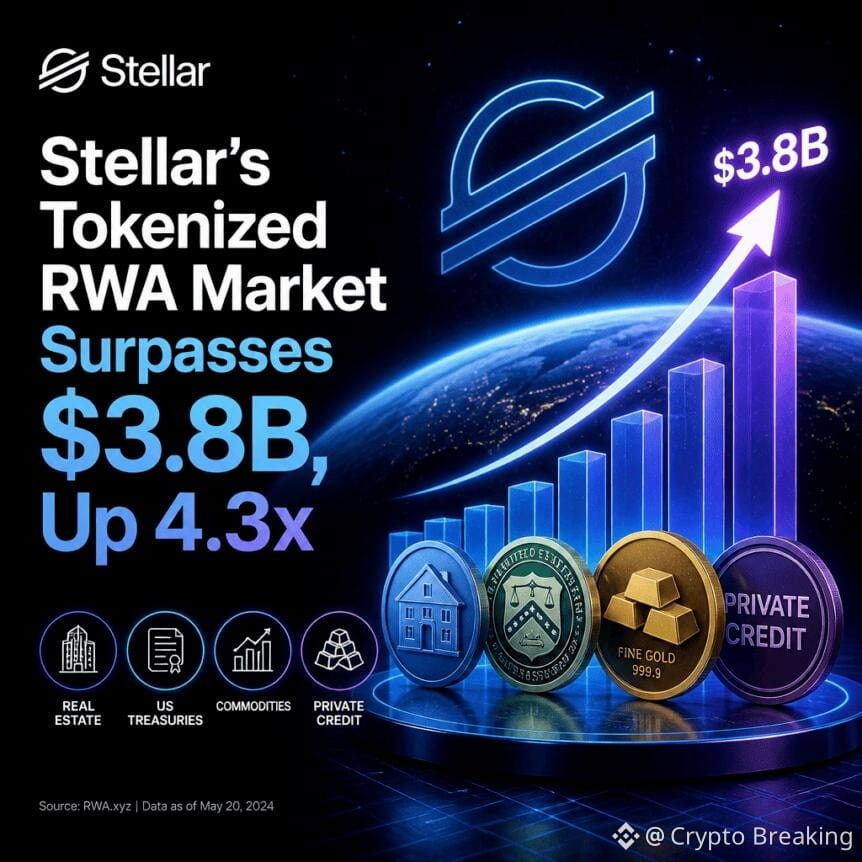
Article
Stellar’s Tokenized RWA Market Surpasses $3.8B, Up 4.3xTokenized real-world assets (RWAs) on the Stellar blockchain have surged to nearly $4 billion in 2026, according to a Dune Analytics dashboard maintained by Stellar. The jump—about 360% over the year—marks a significant acceleration in how major issuers are positioning tokenized debt and government-linked instruments on public chains.
As of Aug. 29, Stellar’s RWA market cap stood at $3.996 billion, spanning US Treasurys, private and public credit, non-US government debt, and other tokenized asset classes. However, the ecosystem’s growth has not been mirrored by Stellar’s native token: XLM is down roughly 11% year to date, trading near $0.18, according to CoinGecko data.
Key takeaways
Stellar’s tokenized RWA market cap reached $3.996 billion as of Aug. 29, nearly $4 billion after a ~360% rise in 2026, per a Dune Analytics dashboard.
RWA liquidity and exposure on Stellar remain concentrated: Spiko led with about $1.55 billion, followed by Realiz, Tradable, Franklin Templeton, and Ondo.
Non-US government debt is gaining traction, with Stellar holding roughly $490 million as of Aug. 20, including tokenized Mexican CETES and Brazilian bonds issued via Etherfuse.
Institutional integrations are a major driver, including planned DTCC connectivity that could bring tokenized assets to Stellar in the first half of 2027.
Stellar’s RWA and payment-related expansion is progressing even as XLM underperforms on the year, suggesting broader tokenization momentum isn’t automatically translating into token price strength.
RWA market cap surges toward $4B on Stellar
The Dune Analytics dashboard indicates Stellar’s RWA value grew from $868.8 million at the end of the prior year to nearly $4 billion by late August 2026. The composition reflects the typical early pattern for RWA growth on public networks: a mix of government-linked instruments, credit products, and a smaller set of highly visible issuers.
The market remains skewed toward a handful of participants. As of Aug. 27, Spiko accounted for $1.55 billion of the total RWA value on Stellar, with Realiz at $559 million, Tradable at $548 million, Franklin Templeton at $546 million, and Ondo at $535 million. For investors and developers, the concentration matters: it can accelerate liquidity and credibility when adoption expands, but it also means momentum may be sensitive to changes at a small number of institutions.
Stellar’s overall RWA positioning also ties into broader debt tokenization themes, where on-chain issuance can streamline settlement, distribution, and compliance controls—especially when established financial players already have distribution and custody relationships.
Non-US government debt becomes a noticeable share
While tokenized Treasurys often attract the most attention, Stellar’s data highlights momentum in non-US government instruments. The Stellar Development Foundation pointed to RWA.xyz data, saying Stellar held about $490 million in non-US government debt as of Aug. 20.
That figure includes tokenized Mexican CETES and Brazilian government bonds issued via Etherfuse. The shift is important because it expands the range of sovereign-linked assets accessible on-chain and can broaden demand beyond US-centric portfolios. It also indicates that tokenization pipelines on Stellar are extending into markets where local instruments are packaged for global access.
For participants tracking adoption, the key question is whether these categories keep growing at a similar pace—and whether additional sovereign and quasi-sovereign issuances follow the same onboarding patterns.
Institutional integrations and payments push the pipeline
The RWA expansion aligns with a series of institutional moves aimed at bringing regulated tokenized products onto Stellar infrastructure. One notable thread is DTCC’s plan to connect its tokenization service to Stellar. In May, DTCC announced plans to make tokenized assets available on Stellar in the first half of 2027, with DTC-tokenized assets expected to follow that timeline. Earlier reporting associated the potential expansion with tokenized US Treasurys and broader exposure such as major index ETFs and Russell 1000-related assets.
Another step toward scaling credit offerings came in July. Tokenization platform Tradable said it plans to bring up to $1 billion in private credit assets to Stellar. The integration is designed to support compliance, investor onboarding, and asset lifecycle management, building on Tradable’s already-tokenized private credit of $1.7 billion across nearly 30 positions. That matters because credit products often require more operational work than simpler treasury-style instruments; faster lifecycle handling can reduce friction for issuers and improve the consistency of the user experience.
Stellar’s growth story also extends beyond tokenized securities into regulated dollar remittance and payment rails. In June, MoneyGram launched MGUSD, its dollar stablecoin, on Stellar. The launch allows users to hold dollar-denominated balances and move funds through MoneyGram’s global payments network, adding an everyday utility layer alongside RWA issuance.
MGUSD joins roughly $438 million in reserve-verified stablecoins already issued on Stellar, according to the same Dune dashboard. Taken together, RWA issuance and stablecoin payment capacity can reinforce each other: stablecoin balances can help with settlement and liquidity, while on-chain RWAs can create additional demand for compliant dollar exposure.
Growth in RWAs doesn’t automatically lift XLM
Despite Stellar’s rapid expansion in tokenized assets, the network’s native token has struggled to keep pace. CoinGecko data shows XLM down about 11% year to date, trading near $0.18. This divergence is a reminder that blockchain ecosystem metrics and token performance do not always move together in the short term.
Several dynamics can explain the gap: token price depends on broader market conditions, risk appetite, liquidity, and speculative flows, while RWA growth is often driven by institutional issuance schedules and product onboarding timelines. In other words, increased RWA capitalization is not necessarily the same as increased immediate demand for XLM.
What to watch next is whether upcoming institutional integrations—particularly DTCC’s planned connectivity—lead to faster onboarding of high-profile tokenized products, and whether stablecoin and payment usage continues to expand in parallel with the RWA balance sheet growth.
For readers tracking Stellar, the near-term indicators to monitor are category-level growth within the RWA dashboard (especially non-US government debt), the rollout pace for major institutional integrations expected in 2027, and whether tokenization-driven activity translates into deeper on-chain demand across liquidity and payment flows.
This article was originally published as Stellar’s Tokenized RWA Market Surpasses $3.8B, Up 4.3x on Crypto Breaking News – your trusted source for crypto news, Bitcoin news, and blockchain updates.
Stellar’s Tokenized RWA Market Surpasses $3.8B, Up 4.3x
Tokenized real-world assets (RWAs) on the Stellar blockchain have surged to nearly $4 billion in 2026, according to a Dune Analytics dashboard maintained by Stellar. The jump—about 360% over the year—marks a significant acceleration in how major issuers are positioning tokenized debt and government-linked instruments on public chains.
As of Aug. 29, Stellar’s RWA market cap stood at $3.996 billion, spanning US Treasurys, private and public credit, non-US government debt, and other tokenized asset classes. However, the ecosystem’s growth has not been mirrored by Stellar’s native token: XLM is down roughly 11% year to date, trading near $0.18, according to CoinGecko data.
Key takeaways
Stellar’s tokenized RWA market cap reached $3.996 billion as of Aug. 29, nearly $4 billion after a ~360% rise in 2026, per a Dune Analytics dashboard.
RWA liquidity and exposure on Stellar remain concentrated: Spiko led with about $1.55 billion, followed by Realiz, Tradable, Franklin Templeton, and Ondo.
Non-US government debt is gaining traction, with Stellar holding roughly $490 million as of Aug. 20, including tokenized Mexican CETES and Brazilian bonds issued via Etherfuse.
Institutional integrations are a major driver, including planned DTCC connectivity that could bring tokenized assets to Stellar in the first half of 2027.
Stellar’s RWA and payment-related expansion is progressing even as XLM underperforms on the year, suggesting broader tokenization momentum isn’t automatically translating into token price strength.
RWA market cap surges toward $4B on Stellar
The Dune Analytics dashboard indicates Stellar’s RWA value grew from $868.8 million at the end of the prior year to nearly $4 billion by late August 2026. The composition reflects the typical early pattern for RWA growth on public networks: a mix of government-linked instruments, credit products, and a smaller set of highly visible issuers.
The market remains skewed toward a handful of participants. As of Aug. 27, Spiko accounted for $1.55 billion of the total RWA value on Stellar, with Realiz at $559 million, Tradable at $548 million, Franklin Templeton at $546 million, and Ondo at $535 million. For investors and developers, the concentration matters: it can accelerate liquidity and credibility when adoption expands, but it also means momentum may be sensitive to changes at a small number of institutions.
Stellar’s overall RWA positioning also ties into broader debt tokenization themes, where on-chain issuance can streamline settlement, distribution, and compliance controls—especially when established financial players already have distribution and custody relationships.
Non-US government debt becomes a noticeable share
While tokenized Treasurys often attract the most attention, Stellar’s data highlights momentum in non-US government instruments. The Stellar Development Foundation pointed to RWA.xyz data, saying Stellar held about $490 million in non-US government debt as of Aug. 20.
That figure includes tokenized Mexican CETES and Brazilian government bonds issued via Etherfuse. The shift is important because it expands the range of sovereign-linked assets accessible on-chain and can broaden demand beyond US-centric portfolios. It also indicates that tokenization pipelines on Stellar are extending into markets where local instruments are packaged for global access.
For participants tracking adoption, the key question is whether these categories keep growing at a similar pace—and whether additional sovereign and quasi-sovereign issuances follow the same onboarding patterns.
Institutional integrations and payments push the pipeline
The RWA expansion aligns with a series of institutional moves aimed at bringing regulated tokenized products onto Stellar infrastructure. One notable thread is DTCC’s plan to connect its tokenization service to Stellar. In May, DTCC announced plans to make tokenized assets available on Stellar in the first half of 2027, with DTC-tokenized assets expected to follow that timeline. Earlier reporting associated the potential expansion with tokenized US Treasurys and broader exposure such as major index ETFs and Russell 1000-related assets.
Another step toward scaling credit offerings came in July. Tokenization platform Tradable said it plans to bring up to $1 billion in private credit assets to Stellar. The integration is designed to support compliance, investor onboarding, and asset lifecycle management, building on Tradable’s already-tokenized private credit of $1.7 billion across nearly 30 positions. That matters because credit products often require more operational work than simpler treasury-style instruments; faster lifecycle handling can reduce friction for issuers and improve the consistency of the user experience.
Stellar’s growth story also extends beyond tokenized securities into regulated dollar remittance and payment rails. In June, MoneyGram launched MGUSD, its dollar stablecoin, on Stellar. The launch allows users to hold dollar-denominated balances and move funds through MoneyGram’s global payments network, adding an everyday utility layer alongside RWA issuance.
MGUSD joins roughly $438 million in reserve-verified stablecoins already issued on Stellar, according to the same Dune dashboard. Taken together, RWA issuance and stablecoin payment capacity can reinforce each other: stablecoin balances can help with settlement and liquidity, while on-chain RWAs can create additional demand for compliant dollar exposure.
Growth in RWAs doesn’t automatically lift XLM
Despite Stellar’s rapid expansion in tokenized assets, the network’s native token has struggled to keep pace. CoinGecko data shows XLM down about 11% year to date, trading near $0.18. This divergence is a reminder that blockchain ecosystem metrics and token performance do not always move together in the short term.
Several dynamics can explain the gap: token price depends on broader market conditions, risk appetite, liquidity, and speculative flows, while RWA growth is often driven by institutional issuance schedules and product onboarding timelines. In other words, increased RWA capitalization is not necessarily the same as increased immediate demand for XLM.
What to watch next is whether upcoming institutional integrations—particularly DTCC’s planned connectivity—lead to faster onboarding of high-profile tokenized products, and whether stablecoin and payment usage continues to expand in parallel with the RWA balance sheet growth.
For readers tracking Stellar, the near-term indicators to monitor are category-level growth within the RWA dashboard (especially non-US government debt), the rollout pace for major institutional integrations expected in 2027, and whether tokenization-driven activity translates into deeper on-chain demand across liquidity and payment flows.
This article was originally published as Stellar’s Tokenized RWA Market Surpasses $3.8B, Up 4.3x on Crypto Breaking News – your trusted source for crypto news, Bitcoin news, and blockchain updates.
As of Aug. 29, Stellar’s RWA market cap stood at $3.996 billion, spanning US Treasurys, private and public credit, non-US government debt, and other tokenized asset classes. However, the ecosystem’s growth has not been mirrored by Stellar’s native token: XLM is down roughly 11% year to date, trading near $0.18, according to CoinGecko data.
Key takeaways
Stellar’s tokenized RWA market cap reached $3.996 billion as of Aug. 29, nearly $4 billion after a ~360% rise in 2026, per a Dune Analytics dashboard.
RWA liquidity and exposure on Stellar remain concentrated: Spiko led with about $1.55 billion, followed by Realiz, Tradable, Franklin Templeton, and Ondo.
Non-US government debt is gaining traction, with Stellar holding roughly $490 million as of Aug. 20, including tokenized Mexican CETES and Brazilian bonds issued via Etherfuse.
Institutional integrations are a major driver, including planned DTCC connectivity that could bring tokenized assets to Stellar in the first half of 2027.
Stellar’s RWA and payment-related expansion is progressing even as XLM underperforms on the year, suggesting broader tokenization momentum isn’t automatically translating into token price strength.
RWA market cap surges toward $4B on Stellar
The Dune Analytics dashboard indicates Stellar’s RWA value grew from $868.8 million at the end of the prior year to nearly $4 billion by late August 2026. The composition reflects the typical early pattern for RWA growth on public networks: a mix of government-linked instruments, credit products, and a smaller set of highly visible issuers.
The market remains skewed toward a handful of participants. As of Aug. 27, Spiko accounted for $1.55 billion of the total RWA value on Stellar, with Realiz at $559 million, Tradable at $548 million, Franklin Templeton at $546 million, and Ondo at $535 million. For investors and developers, the concentration matters: it can accelerate liquidity and credibility when adoption expands, but it also means momentum may be sensitive to changes at a small number of institutions.
Stellar’s overall RWA positioning also ties into broader debt tokenization themes, where on-chain issuance can streamline settlement, distribution, and compliance controls—especially when established financial players already have distribution and custody relationships.
Non-US government debt becomes a noticeable share
While tokenized Treasurys often attract the most attention, Stellar’s data highlights momentum in non-US government instruments. The Stellar Development Foundation pointed to RWA.xyz data, saying Stellar held about $490 million in non-US government debt as of Aug. 20.
That figure includes tokenized Mexican CETES and Brazilian government bonds issued via Etherfuse. The shift is important because it expands the range of sovereign-linked assets accessible on-chain and can broaden demand beyond US-centric portfolios. It also indicates that tokenization pipelines on Stellar are extending into markets where local instruments are packaged for global access.
For participants tracking adoption, the key question is whether these categories keep growing at a similar pace—and whether additional sovereign and quasi-sovereign issuances follow the same onboarding patterns.
Institutional integrations and payments push the pipeline
The RWA expansion aligns with a series of institutional moves aimed at bringing regulated tokenized products onto Stellar infrastructure. One notable thread is DTCC’s plan to connect its tokenization service to Stellar. In May, DTCC announced plans to make tokenized assets available on Stellar in the first half of 2027, with DTC-tokenized assets expected to follow that timeline. Earlier reporting associated the potential expansion with tokenized US Treasurys and broader exposure such as major index ETFs and Russell 1000-related assets.
Another step toward scaling credit offerings came in July. Tokenization platform Tradable said it plans to bring up to $1 billion in private credit assets to Stellar. The integration is designed to support compliance, investor onboarding, and asset lifecycle management, building on Tradable’s already-tokenized private credit of $1.7 billion across nearly 30 positions. That matters because credit products often require more operational work than simpler treasury-style instruments; faster lifecycle handling can reduce friction for issuers and improve the consistency of the user experience.
Stellar’s growth story also extends beyond tokenized securities into regulated dollar remittance and payment rails. In June, MoneyGram launched MGUSD, its dollar stablecoin, on Stellar. The launch allows users to hold dollar-denominated balances and move funds through MoneyGram’s global payments network, adding an everyday utility layer alongside RWA issuance.
MGUSD joins roughly $438 million in reserve-verified stablecoins already issued on Stellar, according to the same Dune dashboard. Taken together, RWA issuance and stablecoin payment capacity can reinforce each other: stablecoin balances can help with settlement and liquidity, while on-chain RWAs can create additional demand for compliant dollar exposure.
Growth in RWAs doesn’t automatically lift XLM
Despite Stellar’s rapid expansion in tokenized assets, the network’s native token has struggled to keep pace. CoinGecko data shows XLM down about 11% year to date, trading near $0.18. This divergence is a reminder that blockchain ecosystem metrics and token performance do not always move together in the short term.
Several dynamics can explain the gap: token price depends on broader market conditions, risk appetite, liquidity, and speculative flows, while RWA growth is often driven by institutional issuance schedules and product onboarding timelines. In other words, increased RWA capitalization is not necessarily the same as increased immediate demand for XLM.
What to watch next is whether upcoming institutional integrations—particularly DTCC’s planned connectivity—lead to faster onboarding of high-profile tokenized products, and whether stablecoin and payment usage continues to expand in parallel with the RWA balance sheet growth.
For readers tracking Stellar, the near-term indicators to monitor are category-level growth within the RWA dashboard (especially non-US government debt), the rollout pace for major institutional integrations expected in 2027, and whether tokenization-driven activity translates into deeper on-chain demand across liquidity and payment flows.
This article was originally published as Stellar’s Tokenized RWA Market Surpasses $3.8B, Up 4.3x on Crypto Breaking News – your trusted source for crypto news, Bitcoin news, and blockchain updates.
51
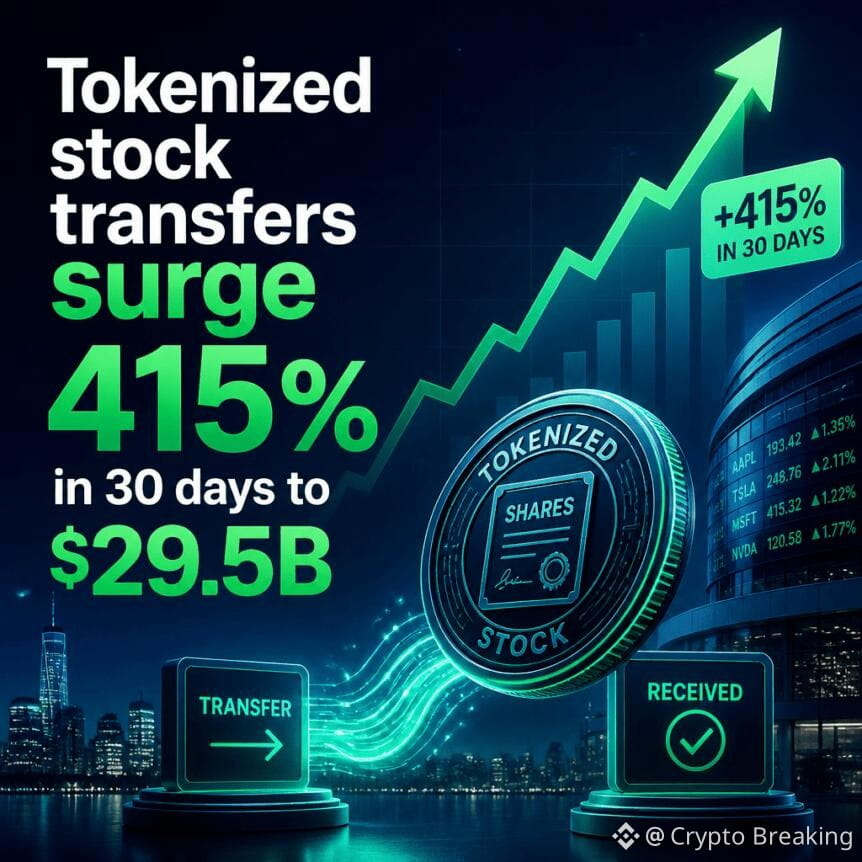
Article
Tokenized stock transfers surge 415% in 30 days to $29.5BTokenized stock markets have accelerated sharply over the past month, according to onchain analytics from RWA.xyz. Over the last 30 days, monthly transfer volume for tokenized equities rose by more than 415% to $29.5 billion, signaling that activity is moving beyond early experimentation.
RWA.xyz data also shows the ecosystem is widening: monthly active addresses jumped by more than 209% to about 1.3 million, and the number of tokenized stock holders increased 167% to 2.36 million. At the same time, the total value of tokenized stocks distributed onchain edged up to $2.54 billion—up 1.45% over 30 days and roughly 637% compared with a year earlier.
Key takeaways
Monthly tokenized stock transfers rose more than 415% to $29.5 billion, per RWA.xyz.
Monthly active addresses climbed over 209% to around 1.3 million, while holders grew 167% to 2.36 million.
Total distributed tokenized stock value reached $2.54 billion, about 637% higher than a year ago.
Ondo, Kraken, and Binance collectively accounted for roughly 81% of distributed value in the RWA.xyz dataset.
New product launches from major crypto platforms are expanding how tokenized stocks can be traded, held, and used in DeFi-style workflows.
Activity surges across transfers, holders, and usage
The growth figures from RWA.xyz point to broad-based expansion rather than a single spike. Transfer volume is up dramatically, but that increase lines up with other engagement metrics—particularly active addresses and holder count—suggesting more wallets are participating and not just cycling through limited liquidity.
Distributed value, while smaller in percentage terms over 30 days (+1.45%), is still notable in absolute terms at $2.54 billion. Importantly, the year-over-year change indicates the market’s baseline has risen substantially: distributed tokenized stocks are up roughly 637% from $344 million a year ago, implying that the current acceleration is occurring on top of already-growing distribution.
Among individual offerings tracked on RWA.xyz, Securitize Corp. leads with about $163 million in distributed tokenized stock value. Strategy PP Variable xStock follows at $136 million, and an Ondo-tokenized version of Circle Internet Group sits around $109 million.
Big platforms dominate distributed tokenized stock value
On the platform side, the distribution is concentrated. Ondo leads with $842.8 million in distributed value, while Kraken’s xStocks account for $609.3 million and Binance’s bStocks come in at $599.9 million. Together, those three platforms represent roughly 81% of the market in the RWA.xyz dataset—underscoring that much of tokenized equities’ liquidity and distribution still flows through a handful of issuers and distribution rails.
This matters for participants because platform concentration can shape token availability, custody and wallet experiences, and integration depth with other onchain services. If activity is growing rapidly, a large share of that growth is likely benefiting the dominant platforms first—especially those that already have the widest distribution and the most straightforward pathways for token holders to move assets onchain.
Why August’s product momentum is pulling tokenized stocks deeper onchain
The latest surge aligns with a broader pattern: crypto platforms are increasingly packaging tokenized equities into onchain trading and portfolio workflows, and expanding the ways those assets can be used beyond simple buy-and-hold.
On Aug. 24, Coinbase’s tokenized US stocks launched on Base, enabling eligible non-US users to trade the assets around the clock and use them across decentralized finance applications. The B20 token set includes major companies such as Nvidia, Apple, Meta, and Alphabet, and the assets can be held in self-custody wallets—an important feature for onchain utility because it allows tokens to interact with broader wallet-based infrastructure.
A day later, Bitwise introduced automated portfolios built from Coinbase’s tokenized stocks. The offering is designed for eligible non-US investors who want exposure to preset strategies while keeping the underlying assets in their own wallets. The initial portfolios target themes such as the “Magnificent Seven,” robotics and artificial intelligence.
Other exchanges and DeFi-adjacent products have expanded similarly. In July, Bybit added tokenized shares—such as Nvidia, Apple, and Tesla—as collateral for margin loans. Meanwhile, Arcus, a Robinhood-backed decentralized exchange, launched more than 95 stock tokens and perpetual markets on Robinhood Chain, demonstrating how tokenized equities are increasingly being treated as instruments for active trading rather than standalone blockchain assets.
RWA.xyz’s activity jump appears to reflect these shifts. When tokenized equities become easier to acquire across major ecosystems, and when they can be used in more onchain-compatible ways (for example, for collateral or within structured portfolios), wallet adoption typically follows. Higher active address counts and holder growth are consistent with that expansion of onchain utility.
What to watch next as tokenized equities integrate with crypto rails
The data shows a sector that is getting more participants and more transaction volume, but it also highlights how concentrated distribution remains among a small set of major platforms. Going forward, investors and builders should watch whether activity growth continues to translate into sustained distributed value, and whether new integrations broaden beyond the current top issuers—especially as tokenized stocks are increasingly positioned for trading, portfolio automation, and collateralized lending on mainstream crypto networks.
This article was originally published as Tokenized stock transfers surge 415% in 30 days to $29.5B on Crypto Breaking News – your trusted source for crypto news, Bitcoin news, and blockchain updates.
Tokenized stock transfers surge 415% in 30 days to $29.5B
Tokenized stock markets have accelerated sharply over the past month, according to onchain analytics from RWA.xyz. Over the last 30 days, monthly transfer volume for tokenized equities rose by more than 415% to $29.5 billion, signaling that activity is moving beyond early experimentation.
RWA.xyz data also shows the ecosystem is widening: monthly active addresses jumped by more than 209% to about 1.3 million, and the number of tokenized stock holders increased 167% to 2.36 million. At the same time, the total value of tokenized stocks distributed onchain edged up to $2.54 billion—up 1.45% over 30 days and roughly 637% compared with a year earlier.
Key takeaways
Monthly tokenized stock transfers rose more than 415% to $29.5 billion, per RWA.xyz.
Monthly active addresses climbed over 209% to around 1.3 million, while holders grew 167% to 2.36 million.
Total distributed tokenized stock value reached $2.54 billion, about 637% higher than a year ago.
Ondo, Kraken, and Binance collectively accounted for roughly 81% of distributed value in the RWA.xyz dataset.
New product launches from major crypto platforms are expanding how tokenized stocks can be traded, held, and used in DeFi-style workflows.
Activity surges across transfers, holders, and usage
The growth figures from RWA.xyz point to broad-based expansion rather than a single spike. Transfer volume is up dramatically, but that increase lines up with other engagement metrics—particularly active addresses and holder count—suggesting more wallets are participating and not just cycling through limited liquidity.
Distributed value, while smaller in percentage terms over 30 days (+1.45%), is still notable in absolute terms at $2.54 billion. Importantly, the year-over-year change indicates the market’s baseline has risen substantially: distributed tokenized stocks are up roughly 637% from $344 million a year ago, implying that the current acceleration is occurring on top of already-growing distribution.
Among individual offerings tracked on RWA.xyz, Securitize Corp. leads with about $163 million in distributed tokenized stock value. Strategy PP Variable xStock follows at $136 million, and an Ondo-tokenized version of Circle Internet Group sits around $109 million.
Big platforms dominate distributed tokenized stock value
On the platform side, the distribution is concentrated. Ondo leads with $842.8 million in distributed value, while Kraken’s xStocks account for $609.3 million and Binance’s bStocks come in at $599.9 million. Together, those three platforms represent roughly 81% of the market in the RWA.xyz dataset—underscoring that much of tokenized equities’ liquidity and distribution still flows through a handful of issuers and distribution rails.
This matters for participants because platform concentration can shape token availability, custody and wallet experiences, and integration depth with other onchain services. If activity is growing rapidly, a large share of that growth is likely benefiting the dominant platforms first—especially those that already have the widest distribution and the most straightforward pathways for token holders to move assets onchain.
Why August’s product momentum is pulling tokenized stocks deeper onchain
The latest surge aligns with a broader pattern: crypto platforms are increasingly packaging tokenized equities into onchain trading and portfolio workflows, and expanding the ways those assets can be used beyond simple buy-and-hold.
On Aug. 24, Coinbase’s tokenized US stocks launched on Base, enabling eligible non-US users to trade the assets around the clock and use them across decentralized finance applications. The B20 token set includes major companies such as Nvidia, Apple, Meta, and Alphabet, and the assets can be held in self-custody wallets—an important feature for onchain utility because it allows tokens to interact with broader wallet-based infrastructure.
A day later, Bitwise introduced automated portfolios built from Coinbase’s tokenized stocks. The offering is designed for eligible non-US investors who want exposure to preset strategies while keeping the underlying assets in their own wallets. The initial portfolios target themes such as the “Magnificent Seven,” robotics and artificial intelligence.
Other exchanges and DeFi-adjacent products have expanded similarly. In July, Bybit added tokenized shares—such as Nvidia, Apple, and Tesla—as collateral for margin loans. Meanwhile, Arcus, a Robinhood-backed decentralized exchange, launched more than 95 stock tokens and perpetual markets on Robinhood Chain, demonstrating how tokenized equities are increasingly being treated as instruments for active trading rather than standalone blockchain assets.
RWA.xyz’s activity jump appears to reflect these shifts. When tokenized equities become easier to acquire across major ecosystems, and when they can be used in more onchain-compatible ways (for example, for collateral or within structured portfolios), wallet adoption typically follows. Higher active address counts and holder growth are consistent with that expansion of onchain utility.
What to watch next as tokenized equities integrate with crypto rails
The data shows a sector that is getting more participants and more transaction volume, but it also highlights how concentrated distribution remains among a small set of major platforms. Going forward, investors and builders should watch whether activity growth continues to translate into sustained distributed value, and whether new integrations broaden beyond the current top issuers—especially as tokenized stocks are increasingly positioned for trading, portfolio automation, and collateralized lending on mainstream crypto networks.
This article was originally published as Tokenized stock transfers surge 415% in 30 days to $29.5B on Crypto Breaking News – your trusted source for crypto news, Bitcoin news, and blockchain updates.
RWA.xyz data also shows the ecosystem is widening: monthly active addresses jumped by more than 209% to about 1.3 million, and the number of tokenized stock holders increased 167% to 2.36 million. At the same time, the total value of tokenized stocks distributed onchain edged up to $2.54 billion—up 1.45% over 30 days and roughly 637% compared with a year earlier.
Key takeaways
Monthly tokenized stock transfers rose more than 415% to $29.5 billion, per RWA.xyz.
Monthly active addresses climbed over 209% to around 1.3 million, while holders grew 167% to 2.36 million.
Total distributed tokenized stock value reached $2.54 billion, about 637% higher than a year ago.
Ondo, Kraken, and Binance collectively accounted for roughly 81% of distributed value in the RWA.xyz dataset.
New product launches from major crypto platforms are expanding how tokenized stocks can be traded, held, and used in DeFi-style workflows.
Activity surges across transfers, holders, and usage
The growth figures from RWA.xyz point to broad-based expansion rather than a single spike. Transfer volume is up dramatically, but that increase lines up with other engagement metrics—particularly active addresses and holder count—suggesting more wallets are participating and not just cycling through limited liquidity.
Distributed value, while smaller in percentage terms over 30 days (+1.45%), is still notable in absolute terms at $2.54 billion. Importantly, the year-over-year change indicates the market’s baseline has risen substantially: distributed tokenized stocks are up roughly 637% from $344 million a year ago, implying that the current acceleration is occurring on top of already-growing distribution.
Among individual offerings tracked on RWA.xyz, Securitize Corp. leads with about $163 million in distributed tokenized stock value. Strategy PP Variable xStock follows at $136 million, and an Ondo-tokenized version of Circle Internet Group sits around $109 million.
Big platforms dominate distributed tokenized stock value
On the platform side, the distribution is concentrated. Ondo leads with $842.8 million in distributed value, while Kraken’s xStocks account for $609.3 million and Binance’s bStocks come in at $599.9 million. Together, those three platforms represent roughly 81% of the market in the RWA.xyz dataset—underscoring that much of tokenized equities’ liquidity and distribution still flows through a handful of issuers and distribution rails.
This matters for participants because platform concentration can shape token availability, custody and wallet experiences, and integration depth with other onchain services. If activity is growing rapidly, a large share of that growth is likely benefiting the dominant platforms first—especially those that already have the widest distribution and the most straightforward pathways for token holders to move assets onchain.
Why August’s product momentum is pulling tokenized stocks deeper onchain
The latest surge aligns with a broader pattern: crypto platforms are increasingly packaging tokenized equities into onchain trading and portfolio workflows, and expanding the ways those assets can be used beyond simple buy-and-hold.
On Aug. 24, Coinbase’s tokenized US stocks launched on Base, enabling eligible non-US users to trade the assets around the clock and use them across decentralized finance applications. The B20 token set includes major companies such as Nvidia, Apple, Meta, and Alphabet, and the assets can be held in self-custody wallets—an important feature for onchain utility because it allows tokens to interact with broader wallet-based infrastructure.
A day later, Bitwise introduced automated portfolios built from Coinbase’s tokenized stocks. The offering is designed for eligible non-US investors who want exposure to preset strategies while keeping the underlying assets in their own wallets. The initial portfolios target themes such as the “Magnificent Seven,” robotics and artificial intelligence.
Other exchanges and DeFi-adjacent products have expanded similarly. In July, Bybit added tokenized shares—such as Nvidia, Apple, and Tesla—as collateral for margin loans. Meanwhile, Arcus, a Robinhood-backed decentralized exchange, launched more than 95 stock tokens and perpetual markets on Robinhood Chain, demonstrating how tokenized equities are increasingly being treated as instruments for active trading rather than standalone blockchain assets.
RWA.xyz’s activity jump appears to reflect these shifts. When tokenized equities become easier to acquire across major ecosystems, and when they can be used in more onchain-compatible ways (for example, for collateral or within structured portfolios), wallet adoption typically follows. Higher active address counts and holder growth are consistent with that expansion of onchain utility.
What to watch next as tokenized equities integrate with crypto rails
The data shows a sector that is getting more participants and more transaction volume, but it also highlights how concentrated distribution remains among a small set of major platforms. Going forward, investors and builders should watch whether activity growth continues to translate into sustained distributed value, and whether new integrations broaden beyond the current top issuers—especially as tokenized stocks are increasingly positioned for trading, portfolio automation, and collateralized lending on mainstream crypto networks.
This article was originally published as Tokenized stock transfers surge 415% in 30 days to $29.5B on Crypto Breaking News – your trusted source for crypto news, Bitcoin news, and blockchain updates.
43
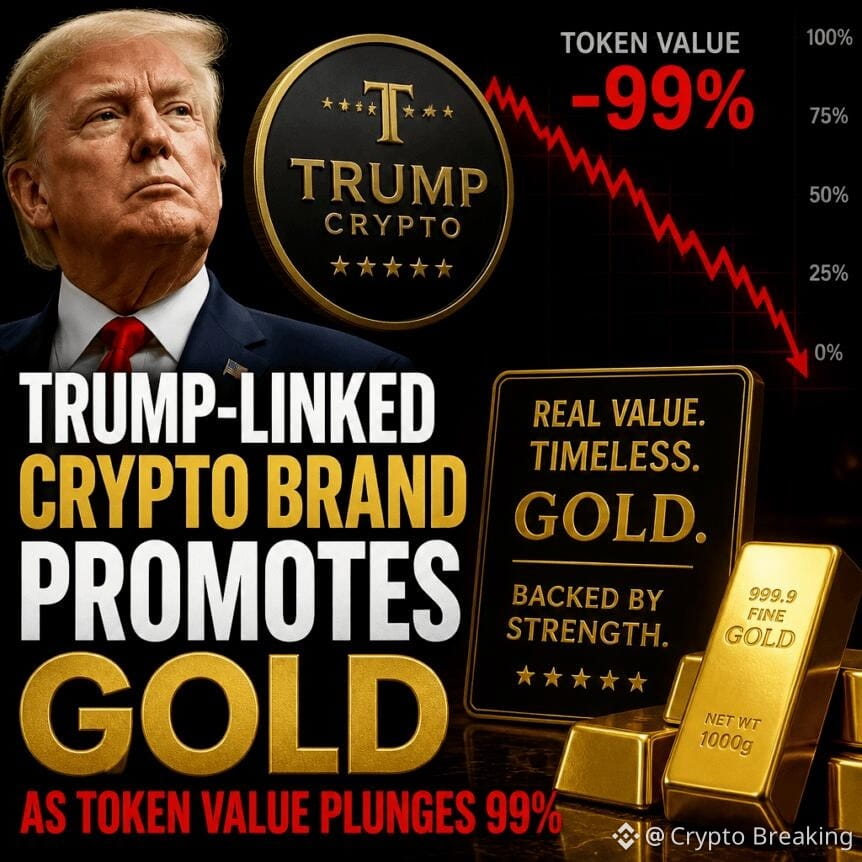
Article
Trump-Linked Crypto Brand Promotes GOLD as Token Value Plunges 99%A Solana token marketed through a Trump-linked brand appears to have collapsed shortly after launch, igniting fresh questions about who controlled the project and what happened to the liquidity once trading began. The episode centers on a token called “Trump Digital GOLD” and the Real Trump Coins brand, which publicly promoted the launch before deleting related posts.
According to blockchain analytics firm Lookonchain, the token’s supply was heavily concentrated in a small number of wallets controlled by the developer, with early buyers later selling into the market. The sharp drop in value—paired with the rapid sell activity—has led analysts to describe the launch as highly suspicious and potentially a “rug” style event.
Key takeaways
Lookonchain says the GOLD token’s developer held about 82.45% of the total supply at launch, raising immediate red flags for traders.
Lookonchain reports that a group of 15 newly created wallets acquired large amounts of GOLD and then sold all tokens shortly afterward.
DEX Screener data cited by Lookonchain shows GOLD’s market capitalization fell from roughly $50 million to $500,000 within hours.
Real Trump Coins promoted the token on X before deleting related posts, fueling speculation the account or promotion may have been compromised.
How the GOLD launch unraveled so quickly
GOLD first came onto the radar early Saturday when the Real Trump Coins X account announced the token launch and directed users to buy via RealTrumpCoins.com. The post appeared with the Real Trump Coins account connected to—at least by follow—Trump’s official presence on X, lending the promotion extra attention.
Lookonchain flagged the activity shortly afterward, pointing to unusual on-chain behavior. In its analysis, the firm said the developer controlled 600 million GOLD tokens and that 15 newly created wallets collectively spent $18,657 to purchase about 224.5 million GOLD.
Lookonchain also emphasized that the team’s wallet concentration was extreme, stating that the group controlled 82.45% of the total supply. That type of distribution pattern can be a major risk factor because it increases the likelihood that early insiders can influence price through coordinated selling.
Further on-chain tracking from Lookonchain later claimed those 15 wallets sold all 224.5 million GOLD for 3,178 SOL, which it estimated at roughly $330,000. The report describes that selloff as occurring after the initial purchases were made.
As a result, GOLD’s price appears to have deteriorated rapidly. Lookonchain cited DEX Screener to describe a collapse in market value, with market capitalization dropping from around $50 million to about $500,000 by the time of publication. Lookonchain characterized the outcome in its own commentary, estimating profits for the wallets at approximately $312,000—about 17 times their initial investment.
Ongoing website promotion after X posts vanished
While traders were watching the on-chain data, the promotional footprint of the brand itself became another point of controversy. Lookonchain reported that Real Trump Coins’ related X posts were deleted on Saturday, after Trump-linked brand activity initially circulated.
Despite the social-media deletions, the Real Trump Coins website continued promoting “GOLD” at the time of publication. The page advertised a 4% trading fee and claimed that 99% of trading fees would be used to buy back the token, positioning the plan as a method to push GOLD toward a top-10 market capitalization ranking.
This mismatch—social promotion disappearing while the website remained—helped fuel speculation among community members and analysts about what exactly happened behind the scenes, including whether the X account was compromised or whether the token’s development team had acted against the interests suggested by the website’s marketing.
What is Real Trump Coins?
Real Trump Coins is a brand that Donald Trump publicly promoted in September 2024, according to coverage linked by the article via TrumpTruth.org. At the time, Trump described RealTrumpCoins.com as the exclusive place to buy his silver medallions.
The Real Trump Coins website also states that the products are not manufactured, distributed, or sold by the Trump Organization. That detail matters for readers because it frames the brand as separate from the Trump Organization’s direct operational control—an important distinction when investors assess perceived affiliation and responsibility.
In the hours after the GOLD launch, multiple observers took to X with competing theories. Some claimed the Real Trump Coins X account was hacked, while others characterized the GOLD token launch itself as a scam based on its trading and supply dynamics. The broader conversation included allegations from community accounts about an external hacking actor, though such claims weren’t verified in the reports cited.
Why the episode matters for Trump-linked crypto narratives
Beyond the specific token, the GOLD incident adds to a wider pattern of scrutiny around crypto ventures associated with political figures. The article ties this environment to how the U.S. is debating crypto oversight, including whether tokens are treated under securities or commodity frameworks.
According to the account described in the source text, Trump urged lawmakers on Aug. 19 to pass a “fair version” of the proposed CLARITY Act, aimed at creating a clearer regulatory structure for digital assets. The same context highlights that Trump and his family have backed or launched multiple crypto-related efforts, including the Official Trump (TRUMP) memecoin and World Liberty Financial, while the White House has denied impropriety.
For market participants, these developments are relevant because brand-driven promotions can attract users who assume the marketing implies legitimacy. When a token launch exhibits insider control and rapid sell behavior, it can undermine trust not only in the individual project but also in how political or widely known brands are perceived in the crypto space.
Readers should watch whether GOLD’s token contracts and liquidity evolve in a way that clarifies control and intent—especially any changes to wallet distributions, trading activity, or official follow-ups from the Real Trump Coins team. Until then, the combination of concentrated supply control and abrupt market collapse remains the strongest signal that traders should treat similar “branded” launches on Solana with exceptional caution.
This article was originally published as Trump-Linked Crypto Brand Promotes GOLD as Token Value Plunges 99% on Crypto Breaking News – your trusted source for crypto news, Bitcoin news, and blockchain updates.
Trump-Linked Crypto Brand Promotes GOLD as Token Value Plunges 99%
A Solana token marketed through a Trump-linked brand appears to have collapsed shortly after launch, igniting fresh questions about who controlled the project and what happened to the liquidity once trading began. The episode centers on a token called “Trump Digital GOLD” and the Real Trump Coins brand, which publicly promoted the launch before deleting related posts.
According to blockchain analytics firm Lookonchain, the token’s supply was heavily concentrated in a small number of wallets controlled by the developer, with early buyers later selling into the market. The sharp drop in value—paired with the rapid sell activity—has led analysts to describe the launch as highly suspicious and potentially a “rug” style event.
Key takeaways
Lookonchain says the GOLD token’s developer held about 82.45% of the total supply at launch, raising immediate red flags for traders.
Lookonchain reports that a group of 15 newly created wallets acquired large amounts of GOLD and then sold all tokens shortly afterward.
DEX Screener data cited by Lookonchain shows GOLD’s market capitalization fell from roughly $50 million to $500,000 within hours.
Real Trump Coins promoted the token on X before deleting related posts, fueling speculation the account or promotion may have been compromised.
How the GOLD launch unraveled so quickly
GOLD first came onto the radar early Saturday when the Real Trump Coins X account announced the token launch and directed users to buy via RealTrumpCoins.com. The post appeared with the Real Trump Coins account connected to—at least by follow—Trump’s official presence on X, lending the promotion extra attention.
Lookonchain flagged the activity shortly afterward, pointing to unusual on-chain behavior. In its analysis, the firm said the developer controlled 600 million GOLD tokens and that 15 newly created wallets collectively spent $18,657 to purchase about 224.5 million GOLD.
Lookonchain also emphasized that the team’s wallet concentration was extreme, stating that the group controlled 82.45% of the total supply. That type of distribution pattern can be a major risk factor because it increases the likelihood that early insiders can influence price through coordinated selling.
Further on-chain tracking from Lookonchain later claimed those 15 wallets sold all 224.5 million GOLD for 3,178 SOL, which it estimated at roughly $330,000. The report describes that selloff as occurring after the initial purchases were made.
As a result, GOLD’s price appears to have deteriorated rapidly. Lookonchain cited DEX Screener to describe a collapse in market value, with market capitalization dropping from around $50 million to about $500,000 by the time of publication. Lookonchain characterized the outcome in its own commentary, estimating profits for the wallets at approximately $312,000—about 17 times their initial investment.
Ongoing website promotion after X posts vanished
While traders were watching the on-chain data, the promotional footprint of the brand itself became another point of controversy. Lookonchain reported that Real Trump Coins’ related X posts were deleted on Saturday, after Trump-linked brand activity initially circulated.
Despite the social-media deletions, the Real Trump Coins website continued promoting “GOLD” at the time of publication. The page advertised a 4% trading fee and claimed that 99% of trading fees would be used to buy back the token, positioning the plan as a method to push GOLD toward a top-10 market capitalization ranking.
This mismatch—social promotion disappearing while the website remained—helped fuel speculation among community members and analysts about what exactly happened behind the scenes, including whether the X account was compromised or whether the token’s development team had acted against the interests suggested by the website’s marketing.
What is Real Trump Coins?
Real Trump Coins is a brand that Donald Trump publicly promoted in September 2024, according to coverage linked by the article via TrumpTruth.org. At the time, Trump described RealTrumpCoins.com as the exclusive place to buy his silver medallions.
The Real Trump Coins website also states that the products are not manufactured, distributed, or sold by the Trump Organization. That detail matters for readers because it frames the brand as separate from the Trump Organization’s direct operational control—an important distinction when investors assess perceived affiliation and responsibility.
In the hours after the GOLD launch, multiple observers took to X with competing theories. Some claimed the Real Trump Coins X account was hacked, while others characterized the GOLD token launch itself as a scam based on its trading and supply dynamics. The broader conversation included allegations from community accounts about an external hacking actor, though such claims weren’t verified in the reports cited.
Why the episode matters for Trump-linked crypto narratives
Beyond the specific token, the GOLD incident adds to a wider pattern of scrutiny around crypto ventures associated with political figures. The article ties this environment to how the U.S. is debating crypto oversight, including whether tokens are treated under securities or commodity frameworks.
According to the account described in the source text, Trump urged lawmakers on Aug. 19 to pass a “fair version” of the proposed CLARITY Act, aimed at creating a clearer regulatory structure for digital assets. The same context highlights that Trump and his family have backed or launched multiple crypto-related efforts, including the Official Trump (TRUMP) memecoin and World Liberty Financial, while the White House has denied impropriety.
For market participants, these developments are relevant because brand-driven promotions can attract users who assume the marketing implies legitimacy. When a token launch exhibits insider control and rapid sell behavior, it can undermine trust not only in the individual project but also in how political or widely known brands are perceived in the crypto space.
Readers should watch whether GOLD’s token contracts and liquidity evolve in a way that clarifies control and intent—especially any changes to wallet distributions, trading activity, or official follow-ups from the Real Trump Coins team. Until then, the combination of concentrated supply control and abrupt market collapse remains the strongest signal that traders should treat similar “branded” launches on Solana with exceptional caution.
This article was originally published as Trump-Linked Crypto Brand Promotes GOLD as Token Value Plunges 99% on Crypto Breaking News – your trusted source for crypto news, Bitcoin news, and blockchain updates.
According to blockchain analytics firm Lookonchain, the token’s supply was heavily concentrated in a small number of wallets controlled by the developer, with early buyers later selling into the market. The sharp drop in value—paired with the rapid sell activity—has led analysts to describe the launch as highly suspicious and potentially a “rug” style event.
Key takeaways
Lookonchain says the GOLD token’s developer held about 82.45% of the total supply at launch, raising immediate red flags for traders.
Lookonchain reports that a group of 15 newly created wallets acquired large amounts of GOLD and then sold all tokens shortly afterward.
DEX Screener data cited by Lookonchain shows GOLD’s market capitalization fell from roughly $50 million to $500,000 within hours.
Real Trump Coins promoted the token on X before deleting related posts, fueling speculation the account or promotion may have been compromised.
How the GOLD launch unraveled so quickly
GOLD first came onto the radar early Saturday when the Real Trump Coins X account announced the token launch and directed users to buy via RealTrumpCoins.com. The post appeared with the Real Trump Coins account connected to—at least by follow—Trump’s official presence on X, lending the promotion extra attention.
Lookonchain flagged the activity shortly afterward, pointing to unusual on-chain behavior. In its analysis, the firm said the developer controlled 600 million GOLD tokens and that 15 newly created wallets collectively spent $18,657 to purchase about 224.5 million GOLD.
Lookonchain also emphasized that the team’s wallet concentration was extreme, stating that the group controlled 82.45% of the total supply. That type of distribution pattern can be a major risk factor because it increases the likelihood that early insiders can influence price through coordinated selling.
Further on-chain tracking from Lookonchain later claimed those 15 wallets sold all 224.5 million GOLD for 3,178 SOL, which it estimated at roughly $330,000. The report describes that selloff as occurring after the initial purchases were made.
As a result, GOLD’s price appears to have deteriorated rapidly. Lookonchain cited DEX Screener to describe a collapse in market value, with market capitalization dropping from around $50 million to about $500,000 by the time of publication. Lookonchain characterized the outcome in its own commentary, estimating profits for the wallets at approximately $312,000—about 17 times their initial investment.
Ongoing website promotion after X posts vanished
While traders were watching the on-chain data, the promotional footprint of the brand itself became another point of controversy. Lookonchain reported that Real Trump Coins’ related X posts were deleted on Saturday, after Trump-linked brand activity initially circulated.
Despite the social-media deletions, the Real Trump Coins website continued promoting “GOLD” at the time of publication. The page advertised a 4% trading fee and claimed that 99% of trading fees would be used to buy back the token, positioning the plan as a method to push GOLD toward a top-10 market capitalization ranking.
This mismatch—social promotion disappearing while the website remained—helped fuel speculation among community members and analysts about what exactly happened behind the scenes, including whether the X account was compromised or whether the token’s development team had acted against the interests suggested by the website’s marketing.
What is Real Trump Coins?
Real Trump Coins is a brand that Donald Trump publicly promoted in September 2024, according to coverage linked by the article via TrumpTruth.org. At the time, Trump described RealTrumpCoins.com as the exclusive place to buy his silver medallions.
The Real Trump Coins website also states that the products are not manufactured, distributed, or sold by the Trump Organization. That detail matters for readers because it frames the brand as separate from the Trump Organization’s direct operational control—an important distinction when investors assess perceived affiliation and responsibility.
In the hours after the GOLD launch, multiple observers took to X with competing theories. Some claimed the Real Trump Coins X account was hacked, while others characterized the GOLD token launch itself as a scam based on its trading and supply dynamics. The broader conversation included allegations from community accounts about an external hacking actor, though such claims weren’t verified in the reports cited.
Why the episode matters for Trump-linked crypto narratives
Beyond the specific token, the GOLD incident adds to a wider pattern of scrutiny around crypto ventures associated with political figures. The article ties this environment to how the U.S. is debating crypto oversight, including whether tokens are treated under securities or commodity frameworks.
According to the account described in the source text, Trump urged lawmakers on Aug. 19 to pass a “fair version” of the proposed CLARITY Act, aimed at creating a clearer regulatory structure for digital assets. The same context highlights that Trump and his family have backed or launched multiple crypto-related efforts, including the Official Trump (TRUMP) memecoin and World Liberty Financial, while the White House has denied impropriety.
For market participants, these developments are relevant because brand-driven promotions can attract users who assume the marketing implies legitimacy. When a token launch exhibits insider control and rapid sell behavior, it can undermine trust not only in the individual project but also in how political or widely known brands are perceived in the crypto space.
Readers should watch whether GOLD’s token contracts and liquidity evolve in a way that clarifies control and intent—especially any changes to wallet distributions, trading activity, or official follow-ups from the Real Trump Coins team. Until then, the combination of concentrated supply control and abrupt market collapse remains the strongest signal that traders should treat similar “branded” launches on Solana with exceptional caution.
This article was originally published as Trump-Linked Crypto Brand Promotes GOLD as Token Value Plunges 99% on Crypto Breaking News – your trusted source for crypto news, Bitcoin news, and blockchain updates.
96
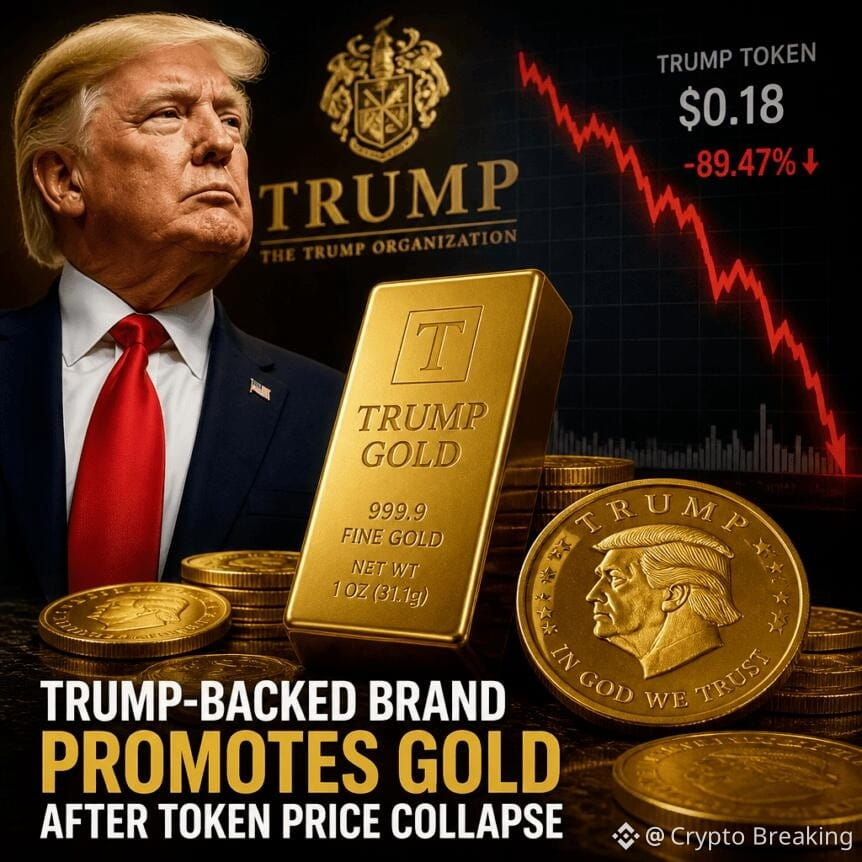
Article
Trump-Backed Brand Promotes Gold After Token Price CollapseA Solana token promoted under the Real Trump Coins brand collapsed within hours of its launch, according to blockchain analytics and on-chain activity. The episode has quickly sparked scrutiny over the token’s legitimacy and raised questions about whether the brand’s social accounts or website were compromised.
Real Trump Coins—an outlet that US President Donald Trump publicly promoted in 2024—advertised a “Trump Digital GOLD” token on X before deleting related posts on Saturday. Blockchain analytics firm Lookonchain later flagged the launch, alleging that the team behind the token controlled a large portion of the supply and used newly created wallets to dump holdings shortly after launch, causing the token’s value to plunge.
Key takeaways
Lookonchain says GOLD’s developer and associated wallets controlled about 82.45% of the token supply at the time of the analysis.
After being acquired by 15 newly created wallets, 224.5 million GOLD was reportedly sold for 3,178 SOL (about $330,000 at the time), contributing to a rapid price collapse.
DE X Screener data cited in the reports shows GOLD’s market capitalization dropped from roughly $50 million to about $500,000 within hours.
Real Trump Coins’ website continued promoting the GOLD token after the X posts were deleted, leaving observers to question who initiated the launch and promotion.
The incident adds to broader concerns around Trump-linked crypto brands as US policymakers debate a regulatory framework for digital assets.
GOLD launch on Solana ends in rapid sell-off
The token surfaced early Saturday after the Real Trump Coins X account—an account that Trump’s official profile follows—posted about the GOLD launch and directed users to RealTrumpCoins.com. Shortly after, Lookonchain flagged the activity, drawing attention to wallet distribution and the token’s early trading behavior.
In a thread referencing the on-chain setup, Lookonchain said the developer held 600 million GOLD while 15 newly created wallets spent $18,657 to buy an additional 224.5 million tokens. Lookonchain also warned that the team “currently controls 82.45% of the total supply,” advising traders to exercise caution.
Lookonchain later reported that those 15 wallets sold all 224.5 million GOLD for 3,178 SOL, describing it as an apparent rug-style extraction of value soon after acquisition. The same analysis estimated the wallets’ profit at roughly $312,000—about 17 times the initial amount invested.
As selling spread, the token’s valuation deteriorated quickly. According to DEX Screener data referenced in the reporting, GOLD’s market capitalization fell from about $50 million to around $500,000 at the time of publication.
For traders, the takeaway is not just that the token declined, but how quickly supply concentration and early transfers translated into market impact. Such a pattern—large holdings clustered near the deployer paired with rapid post-launch selling—often leaves retail buyers with limited exit liquidity.
Real Trump Coins keeps marketing GOLD after X deletion
Real Trump Coins’ connection to the episode matters because Trump has previously promoted the brand. The company’s site continued advertising GOLD at the time of publication, including a claim that it would charge a 4% trading fee and that it would use 99% of those fees to buy back the token in an attempt to push it toward a top-10 ranking by market capitalization.
However, observers noted a mismatch between marketing on the website and the behavior of the brand’s X account. Lookonchain reported that Real Trump Coins promoted GOLD on X and then deleted the related posts on Saturday.
That combination—public promotion followed by deletion, while the website remains active—has fueled speculation that either the token launch was mishandled, or that the brand’s online presence may have been compromised. Some crypto commentators went further, describing the setup as an apparent scam or rug pull, though the reports in circulation included claims that were not independently substantiated within the available facts.
The immediate practical concern for users is how to verify whether token promotions stem from legitimate operators or from unauthorized actors. In incidents like this, “official-looking” social posts may not be enough, and the contract’s distribution, liquidity conditions, and wallet behavior can become the more reliable indicators.
Why the Real Trump Coins tie is under scrutiny
Real Trump Coins was publicly promoted by Donald Trump in September 2024, when he highlighted RealTrumpCoins.com during announcements related to his silver medallions. The website’s terms state that its products are not manufactured, distributed, or sold by the Trump Organization.
Even with that disclaimer, the GOLD incident revived attention on the ecosystem of Trump-linked crypto activity and the potential governance and conflict-of-interest concerns that come with high-profile endorsements. The episode lands as Trump continues to press Congress on crypto oversight, including legislation aimed at establishing a regulatory framework and clarifying whether tokens should be treated as securities or commodities.
In the weeks and months preceding the broader regulatory debate, Trump and his family have backed or launched multiple crypto ventures, including the Official Trump memecoin and World Liberty Financial. The White House has denied impropriety in connection with these efforts, but incidents like the GOLD collapse inevitably intensify public scrutiny of how legitimacy is communicated to retail investors.
Earlier reporting on these policy efforts has emphasized that lawmakers’ decisions could shape how token issuers and promoters are regulated—especially when promotional reach overlaps with political visibility. In that context, the GOLD episode is less about one token’s fate and more about the recurring problem of investor harm when marketing appears to outpace verification.
What to watch next
For now, traders and observers will likely focus on whether the GOLD token’s contract and wallet flows show any further coordinated activity, and whether Real Trump Coins addresses the on-chain behavior that Lookonchain highlighted. More broadly, the incident underscores how quickly reputational risk can spread when high-profile branding intersects with on-chain launches—especially in the absence of clear, verifiable operator confirmation.
This article was originally published as Trump-Backed Brand Promotes Gold After Token Price Collapse on Crypto Breaking News – your trusted source for crypto news, Bitcoin news, and blockchain updates.
Trump-Backed Brand Promotes Gold After Token Price Collapse
A Solana token promoted under the Real Trump Coins brand collapsed within hours of its launch, according to blockchain analytics and on-chain activity. The episode has quickly sparked scrutiny over the token’s legitimacy and raised questions about whether the brand’s social accounts or website were compromised.
Real Trump Coins—an outlet that US President Donald Trump publicly promoted in 2024—advertised a “Trump Digital GOLD” token on X before deleting related posts on Saturday. Blockchain analytics firm Lookonchain later flagged the launch, alleging that the team behind the token controlled a large portion of the supply and used newly created wallets to dump holdings shortly after launch, causing the token’s value to plunge.
Key takeaways
Lookonchain says GOLD’s developer and associated wallets controlled about 82.45% of the token supply at the time of the analysis.
After being acquired by 15 newly created wallets, 224.5 million GOLD was reportedly sold for 3,178 SOL (about $330,000 at the time), contributing to a rapid price collapse.
DE X Screener data cited in the reports shows GOLD’s market capitalization dropped from roughly $50 million to about $500,000 within hours.
Real Trump Coins’ website continued promoting the GOLD token after the X posts were deleted, leaving observers to question who initiated the launch and promotion.
The incident adds to broader concerns around Trump-linked crypto brands as US policymakers debate a regulatory framework for digital assets.
GOLD launch on Solana ends in rapid sell-off
The token surfaced early Saturday after the Real Trump Coins X account—an account that Trump’s official profile follows—posted about the GOLD launch and directed users to RealTrumpCoins.com. Shortly after, Lookonchain flagged the activity, drawing attention to wallet distribution and the token’s early trading behavior.
In a thread referencing the on-chain setup, Lookonchain said the developer held 600 million GOLD while 15 newly created wallets spent $18,657 to buy an additional 224.5 million tokens. Lookonchain also warned that the team “currently controls 82.45% of the total supply,” advising traders to exercise caution.
Lookonchain later reported that those 15 wallets sold all 224.5 million GOLD for 3,178 SOL, describing it as an apparent rug-style extraction of value soon after acquisition. The same analysis estimated the wallets’ profit at roughly $312,000—about 17 times the initial amount invested.
As selling spread, the token’s valuation deteriorated quickly. According to DEX Screener data referenced in the reporting, GOLD’s market capitalization fell from about $50 million to around $500,000 at the time of publication.
For traders, the takeaway is not just that the token declined, but how quickly supply concentration and early transfers translated into market impact. Such a pattern—large holdings clustered near the deployer paired with rapid post-launch selling—often leaves retail buyers with limited exit liquidity.
Real Trump Coins keeps marketing GOLD after X deletion
Real Trump Coins’ connection to the episode matters because Trump has previously promoted the brand. The company’s site continued advertising GOLD at the time of publication, including a claim that it would charge a 4% trading fee and that it would use 99% of those fees to buy back the token in an attempt to push it toward a top-10 ranking by market capitalization.
However, observers noted a mismatch between marketing on the website and the behavior of the brand’s X account. Lookonchain reported that Real Trump Coins promoted GOLD on X and then deleted the related posts on Saturday.
That combination—public promotion followed by deletion, while the website remains active—has fueled speculation that either the token launch was mishandled, or that the brand’s online presence may have been compromised. Some crypto commentators went further, describing the setup as an apparent scam or rug pull, though the reports in circulation included claims that were not independently substantiated within the available facts.
The immediate practical concern for users is how to verify whether token promotions stem from legitimate operators or from unauthorized actors. In incidents like this, “official-looking” social posts may not be enough, and the contract’s distribution, liquidity conditions, and wallet behavior can become the more reliable indicators.
Why the Real Trump Coins tie is under scrutiny
Real Trump Coins was publicly promoted by Donald Trump in September 2024, when he highlighted RealTrumpCoins.com during announcements related to his silver medallions. The website’s terms state that its products are not manufactured, distributed, or sold by the Trump Organization.
Even with that disclaimer, the GOLD incident revived attention on the ecosystem of Trump-linked crypto activity and the potential governance and conflict-of-interest concerns that come with high-profile endorsements. The episode lands as Trump continues to press Congress on crypto oversight, including legislation aimed at establishing a regulatory framework and clarifying whether tokens should be treated as securities or commodities.
In the weeks and months preceding the broader regulatory debate, Trump and his family have backed or launched multiple crypto ventures, including the Official Trump memecoin and World Liberty Financial. The White House has denied impropriety in connection with these efforts, but incidents like the GOLD collapse inevitably intensify public scrutiny of how legitimacy is communicated to retail investors.
Earlier reporting on these policy efforts has emphasized that lawmakers’ decisions could shape how token issuers and promoters are regulated—especially when promotional reach overlaps with political visibility. In that context, the GOLD episode is less about one token’s fate and more about the recurring problem of investor harm when marketing appears to outpace verification.
What to watch next
For now, traders and observers will likely focus on whether the GOLD token’s contract and wallet flows show any further coordinated activity, and whether Real Trump Coins addresses the on-chain behavior that Lookonchain highlighted. More broadly, the incident underscores how quickly reputational risk can spread when high-profile branding intersects with on-chain launches—especially in the absence of clear, verifiable operator confirmation.
This article was originally published as Trump-Backed Brand Promotes Gold After Token Price Collapse on Crypto Breaking News – your trusted source for crypto news, Bitcoin news, and blockchain updates.
Real Trump Coins—an outlet that US President Donald Trump publicly promoted in 2024—advertised a “Trump Digital GOLD” token on X before deleting related posts on Saturday. Blockchain analytics firm Lookonchain later flagged the launch, alleging that the team behind the token controlled a large portion of the supply and used newly created wallets to dump holdings shortly after launch, causing the token’s value to plunge.
Key takeaways
Lookonchain says GOLD’s developer and associated wallets controlled about 82.45% of the token supply at the time of the analysis.
After being acquired by 15 newly created wallets, 224.5 million GOLD was reportedly sold for 3,178 SOL (about $330,000 at the time), contributing to a rapid price collapse.
DE X Screener data cited in the reports shows GOLD’s market capitalization dropped from roughly $50 million to about $500,000 within hours.
Real Trump Coins’ website continued promoting the GOLD token after the X posts were deleted, leaving observers to question who initiated the launch and promotion.
The incident adds to broader concerns around Trump-linked crypto brands as US policymakers debate a regulatory framework for digital assets.
GOLD launch on Solana ends in rapid sell-off
The token surfaced early Saturday after the Real Trump Coins X account—an account that Trump’s official profile follows—posted about the GOLD launch and directed users to RealTrumpCoins.com. Shortly after, Lookonchain flagged the activity, drawing attention to wallet distribution and the token’s early trading behavior.
In a thread referencing the on-chain setup, Lookonchain said the developer held 600 million GOLD while 15 newly created wallets spent $18,657 to buy an additional 224.5 million tokens. Lookonchain also warned that the team “currently controls 82.45% of the total supply,” advising traders to exercise caution.
Lookonchain later reported that those 15 wallets sold all 224.5 million GOLD for 3,178 SOL, describing it as an apparent rug-style extraction of value soon after acquisition. The same analysis estimated the wallets’ profit at roughly $312,000—about 17 times the initial amount invested.
As selling spread, the token’s valuation deteriorated quickly. According to DEX Screener data referenced in the reporting, GOLD’s market capitalization fell from about $50 million to around $500,000 at the time of publication.
For traders, the takeaway is not just that the token declined, but how quickly supply concentration and early transfers translated into market impact. Such a pattern—large holdings clustered near the deployer paired with rapid post-launch selling—often leaves retail buyers with limited exit liquidity.
Real Trump Coins keeps marketing GOLD after X deletion
Real Trump Coins’ connection to the episode matters because Trump has previously promoted the brand. The company’s site continued advertising GOLD at the time of publication, including a claim that it would charge a 4% trading fee and that it would use 99% of those fees to buy back the token in an attempt to push it toward a top-10 ranking by market capitalization.
However, observers noted a mismatch between marketing on the website and the behavior of the brand’s X account. Lookonchain reported that Real Trump Coins promoted GOLD on X and then deleted the related posts on Saturday.
That combination—public promotion followed by deletion, while the website remains active—has fueled speculation that either the token launch was mishandled, or that the brand’s online presence may have been compromised. Some crypto commentators went further, describing the setup as an apparent scam or rug pull, though the reports in circulation included claims that were not independently substantiated within the available facts.
The immediate practical concern for users is how to verify whether token promotions stem from legitimate operators or from unauthorized actors. In incidents like this, “official-looking” social posts may not be enough, and the contract’s distribution, liquidity conditions, and wallet behavior can become the more reliable indicators.
Why the Real Trump Coins tie is under scrutiny
Real Trump Coins was publicly promoted by Donald Trump in September 2024, when he highlighted RealTrumpCoins.com during announcements related to his silver medallions. The website’s terms state that its products are not manufactured, distributed, or sold by the Trump Organization.
Even with that disclaimer, the GOLD incident revived attention on the ecosystem of Trump-linked crypto activity and the potential governance and conflict-of-interest concerns that come with high-profile endorsements. The episode lands as Trump continues to press Congress on crypto oversight, including legislation aimed at establishing a regulatory framework and clarifying whether tokens should be treated as securities or commodities.
In the weeks and months preceding the broader regulatory debate, Trump and his family have backed or launched multiple crypto ventures, including the Official Trump memecoin and World Liberty Financial. The White House has denied impropriety in connection with these efforts, but incidents like the GOLD collapse inevitably intensify public scrutiny of how legitimacy is communicated to retail investors.
Earlier reporting on these policy efforts has emphasized that lawmakers’ decisions could shape how token issuers and promoters are regulated—especially when promotional reach overlaps with political visibility. In that context, the GOLD episode is less about one token’s fate and more about the recurring problem of investor harm when marketing appears to outpace verification.
What to watch next
For now, traders and observers will likely focus on whether the GOLD token’s contract and wallet flows show any further coordinated activity, and whether Real Trump Coins addresses the on-chain behavior that Lookonchain highlighted. More broadly, the incident underscores how quickly reputational risk can spread when high-profile branding intersects with on-chain launches—especially in the absence of clear, verifiable operator confirmation.
This article was originally published as Trump-Backed Brand Promotes Gold After Token Price Collapse on Crypto Breaking News – your trusted source for crypto news, Bitcoin news, and blockchain updates.
112
Log in to explore more content
Join global crypto users on Binance Square
⚡️ Get latest and useful information about crypto.
💬 Trusted by the world’s largest crypto exchange.
👍 Discover real insights from verified creators.
Email / Phone number
Trending Topics
BitcoinUp23%InAugustOutperformingGoldAndStocks
8,564 views
373 Discussing
#bitcoinup23%inaugustoutperforminggoldandstocks
🚨 BITCOIN UP 23% IN AUGUST — NOW THE $80K BATTLE BEGINS
Bitcoin is closing out August with a ~23% monthly gain, putting BTC ahead of major traditional assets and keeping the bullish narrative alive. 📈
So what's driving the move?
🏦 Institutional demand: Spot ETF flows continue to be an important source of buying pressure.
💵 Macro: Dollar and Treasury-market dynamics have supported risk appetite.
📊 Sentiment: Improving crypto regulation and adoption expectations are helping confidence.
But now comes the important part. 👀
BTC is consolidating around $80K.
🟢 Support: $78K–$79K
🔴 Resistance: $80.8K–$83.3K
A strong daily close above the resistance zone could open the door to another leg higher.
But if sellers keep defending $80K–$83K, don't be surprised by profit-taking or sideways chop.
The move is strong. The breakout still needs confirmation.
🔥 Do you think BTC breaks $83K next, or are we due for another pullback?
$BTC $ETH $XAU
#bitcoin #BTC #CryptoMarket #BitcoinAugust #CryptoNews #Trading #Write2Earn
S1R0Z
·2 Likes
·507 views
BitcoinHolds$78K
7,475 views
82 Discussing
SaylorHintsStrategyBitcoinBuy
2M views
10,180 Discussing