
CoinFea
3.7k Posts

CoinFea
 Square Verified+
Report
Block User
CoinFea is a leading Cryptocurrency, Blockchain, and Fintech News platform. Our primary focus is trending news and updates of cryptoverse.
0 Following
88.7K+ Followers
21.8K+ Liked
Posts
·
--

Article
Justin Sun Under Fire After Fresh Drama Over Personal Wealth and Bride PriceTron founder Justin Sun took to X on September 1 to challenge how Bloomberg and Forbes value his crypto fortune. His response comes days after his split from Chinese actress Jing Tian became a public fight over a bride price and a $50 million demand.
In a series of posts published on X today, Justin Sun, the founder of Tron, argued that his personal balance sheet is nobody’s business but also nothing to hide. How much he holds “has never been” the industry’s concern, he wrote, and he added that he would not use the figure to answer his critics. Sun then aimed Bloomberg and Forbes, stating that they count his crypto holdings at only 20% to 30% of their value when tallying his net worth, because those assets are concentrated, volatile, and by the outlets’ standards, not “certain.” Sun said he understands that logic, but it is the outlet’s methodology, and not his problem.
Justin Sun discusses his crypto portfolio
He wrote in a separate post that for 14 years, he has made the deliberate choice of keeping the bulk of his own assets in crypto. Forbes currently pegs the 36-year-old at $8.5 billion. Before the wealth posts, Sun published a lengthy account titled “My Girlfriend Jing Tian” on August 27. The post reportedly took him more than ten hours to write and was labeled “fictional.” In it, Sun said the couple had moved toward marriage.
He said he transferred a 30 million yuan bride price, about $4.5 million, to Jing’s parents after proposing in January, and that the two had agreed to have a child through surrogacy. Sun alleged that shortly before Jing was due to undergo an egg retrieval, she demanded a further $50 million. At that stage, he turned to Anthropic’s Claude chatbot for advice and, acting on its recommendation, refused the money and ended the relationship. Sun is reportedly now suing the actress and her parents to recover the bride price.
38-year-old Jing Tian, who is known for her roles in “From Vegas to Macau” and “Police Story 2013” and is followed by more than 26 million people on Weibo, rejected Sun’s account via the social media platform on August 28, insisting that she has not and will never sell her love. Jing added that she still believed in the law and would let time settle the matter. The episode blew up on Chinese social media and took over search results. Hashtags regarding the incident even trended on Weibo.
Some users have mocked the fact that a chatbot played a role in ending a romance, while others have been criticizing Sun for airing medical, financial and personal details. In an interview with Sing Tao Headline, Sun also shared his doubts about the AI’s judgment, and like Jing, said he would leave the resolution to his lawyers and the courts. Meanwhile, Cryptopolitan has reported that World Liberty Financial, the Trump family’s DeFi project, filed a defamation countersuit against Sun in May.
It alleged that he was involved in a coordinated smear campaign and short-selling after he sued the company for freezing his tokens. Sun has called the WLFI suit a “meritless PR stunt,” but he also remains locked in a years-long fight with Hong Kong custodian First Digital Trust over TrueUSD reserves.
The post Justin Sun under fire after fresh drama over personal wealth and bride price first appeared on Coinfea.
Justin Sun Under Fire After Fresh Drama Over Personal Wealth and Bride Price
Tron founder Justin Sun took to X on September 1 to challenge how Bloomberg and Forbes value his crypto fortune. His response comes days after his split from Chinese actress Jing Tian became a public fight over a bride price and a $50 million demand.
In a series of posts published on X today, Justin Sun, the founder of Tron, argued that his personal balance sheet is nobody’s business but also nothing to hide. How much he holds “has never been” the industry’s concern, he wrote, and he added that he would not use the figure to answer his critics. Sun then aimed Bloomberg and Forbes, stating that they count his crypto holdings at only 20% to 30% of their value when tallying his net worth, because those assets are concentrated, volatile, and by the outlets’ standards, not “certain.” Sun said he understands that logic, but it is the outlet’s methodology, and not his problem.
Justin Sun discusses his crypto portfolio
He wrote in a separate post that for 14 years, he has made the deliberate choice of keeping the bulk of his own assets in crypto. Forbes currently pegs the 36-year-old at $8.5 billion. Before the wealth posts, Sun published a lengthy account titled “My Girlfriend Jing Tian” on August 27. The post reportedly took him more than ten hours to write and was labeled “fictional.” In it, Sun said the couple had moved toward marriage.
He said he transferred a 30 million yuan bride price, about $4.5 million, to Jing’s parents after proposing in January, and that the two had agreed to have a child through surrogacy. Sun alleged that shortly before Jing was due to undergo an egg retrieval, she demanded a further $50 million. At that stage, he turned to Anthropic’s Claude chatbot for advice and, acting on its recommendation, refused the money and ended the relationship. Sun is reportedly now suing the actress and her parents to recover the bride price.
38-year-old Jing Tian, who is known for her roles in “From Vegas to Macau” and “Police Story 2013” and is followed by more than 26 million people on Weibo, rejected Sun’s account via the social media platform on August 28, insisting that she has not and will never sell her love. Jing added that she still believed in the law and would let time settle the matter. The episode blew up on Chinese social media and took over search results. Hashtags regarding the incident even trended on Weibo.
Some users have mocked the fact that a chatbot played a role in ending a romance, while others have been criticizing Sun for airing medical, financial and personal details. In an interview with Sing Tao Headline, Sun also shared his doubts about the AI’s judgment, and like Jing, said he would leave the resolution to his lawyers and the courts. Meanwhile, Cryptopolitan has reported that World Liberty Financial, the Trump family’s DeFi project, filed a defamation countersuit against Sun in May.
It alleged that he was involved in a coordinated smear campaign and short-selling after he sued the company for freezing his tokens. Sun has called the WLFI suit a “meritless PR stunt,” but he also remains locked in a years-long fight with Hong Kong custodian First Digital Trust over TrueUSD reserves.
The post Justin Sun under fire after fresh drama over personal wealth and bride price first appeared on Coinfea.
In a series of posts published on X today, Justin Sun, the founder of Tron, argued that his personal balance sheet is nobody’s business but also nothing to hide. How much he holds “has never been” the industry’s concern, he wrote, and he added that he would not use the figure to answer his critics. Sun then aimed Bloomberg and Forbes, stating that they count his crypto holdings at only 20% to 30% of their value when tallying his net worth, because those assets are concentrated, volatile, and by the outlets’ standards, not “certain.” Sun said he understands that logic, but it is the outlet’s methodology, and not his problem.
Justin Sun discusses his crypto portfolio
He wrote in a separate post that for 14 years, he has made the deliberate choice of keeping the bulk of his own assets in crypto. Forbes currently pegs the 36-year-old at $8.5 billion. Before the wealth posts, Sun published a lengthy account titled “My Girlfriend Jing Tian” on August 27. The post reportedly took him more than ten hours to write and was labeled “fictional.” In it, Sun said the couple had moved toward marriage.
He said he transferred a 30 million yuan bride price, about $4.5 million, to Jing’s parents after proposing in January, and that the two had agreed to have a child through surrogacy. Sun alleged that shortly before Jing was due to undergo an egg retrieval, she demanded a further $50 million. At that stage, he turned to Anthropic’s Claude chatbot for advice and, acting on its recommendation, refused the money and ended the relationship. Sun is reportedly now suing the actress and her parents to recover the bride price.
38-year-old Jing Tian, who is known for her roles in “From Vegas to Macau” and “Police Story 2013” and is followed by more than 26 million people on Weibo, rejected Sun’s account via the social media platform on August 28, insisting that she has not and will never sell her love. Jing added that she still believed in the law and would let time settle the matter. The episode blew up on Chinese social media and took over search results. Hashtags regarding the incident even trended on Weibo.
Some users have mocked the fact that a chatbot played a role in ending a romance, while others have been criticizing Sun for airing medical, financial and personal details. In an interview with Sing Tao Headline, Sun also shared his doubts about the AI’s judgment, and like Jing, said he would leave the resolution to his lawyers and the courts. Meanwhile, Cryptopolitan has reported that World Liberty Financial, the Trump family’s DeFi project, filed a defamation countersuit against Sun in May.
It alleged that he was involved in a coordinated smear campaign and short-selling after he sued the company for freezing his tokens. Sun has called the WLFI suit a “meritless PR stunt,” but he also remains locked in a years-long fight with Hong Kong custodian First Digital Trust over TrueUSD reserves.
The post Justin Sun under fire after fresh drama over personal wealth and bride price first appeared on Coinfea.
381
·
--

Article
Apple Files Evidence Against Ex-engineer in OpenAI SuitThe legal battle between Apple and OpenAI has escalated to a new level after the iPhone maker presented forensic data showing that OpenAI hardware had already begun running on trade secrets that its former employees were never authorized to share. The “shocking evidence” pulled from a former engineer’s work laptop comes ahead of an October 1 court showdown and throws a wrench in Sam Altman and OpenAI’s push to enter the physical devices business.
Apple lawyers have told the court that they found dozens of confidential files, including a circuit schematic for a power converter on the work-issued MacBook that belongs to Chang Liu, a senior system electrical engineer who moved on to OpenAI in January. Apple said that Liu did not just access those files, but he actually used them in simulations at his OpenAI role, according to the supplemental brief its lawyers filed in the Northern District of California. Beyond the schematics, Apple lawyers also said they found evidence that Liu used a tool with a name identical to one of his former employer’s internal engineering programs.
Apple argues its case amid claims against its ex-engineer
The lawyers warned that any AI agent that “learn[s]” can use that material to potentially create harm that is hard to reverse and keeps spreading. Liu’s lawyers voluntarily submitted the old laptop for inspection earlier in August. Apple lawyers, on the other hand, have called the court’s attention to an alleged June attempt to wipe evidence as rationale to fast-track evidence gathering. They claim that once Liu caught wind of the internal Apple investigation, he reached out to fellow OpenAI alum, Yu-Ting Peng, to discuss a plan to “restore” the devices their former employer gave them.
By Apple’s interpretation of the exchange, restoring in this context meant wiping the machines of any evidence that could implicate them if the laptops were forensically analyzed. Apple claims that more than 400 people have left the firm for OpenAI as of last count. OpenAI has not shifted its position. Since an August 3 blog post titled “Apple is getting this wrong,” the company has pinned the access on Apple’s own sloppiness, describing what Liu had as “residual access” left over because Apple often fails to shut off accounts when staff departs.
In that post, OpenAI said former Apple colleagues were the ones who messaged Liu asking for help finding files, not the reverse. Apple tells a different story about how the access survived. It claims Liu kept his way in by exploiting “a rare, previously unknown authentication bug,” per TechCrunch, rather than through any oversight on Apple’s end. Apple has big stakes riding on how Judge Edward Davila interprets rules on two requests it made of the court, with both decisions due on October 1.
One is a preliminary injunction to make OpenAI pause any work on hardware using the iPhone maker’s technology while the case is still unsettled. The second request is to expedite discovery so that Apple lawyers can depose witnesses and pull documents on a faster timeline. The timing of the documents Apple wants to see adds a third name to the proceedings, Tang Tan. The request for material dated August 1, 2023, or later lines up with the six months before Tan, a design executive who spent more than 24 years at Apple, left for OpenAI. Another name in the blast radius of this lawsuit is Jony Ive’s io Products.
The post Apple files evidence against ex-engineer in OpenAI suit first appeared on Coinfea.
Apple Files Evidence Against Ex-engineer in OpenAI Suit
The legal battle between Apple and OpenAI has escalated to a new level after the iPhone maker presented forensic data showing that OpenAI hardware had already begun running on trade secrets that its former employees were never authorized to share. The “shocking evidence” pulled from a former engineer’s work laptop comes ahead of an October 1 court showdown and throws a wrench in Sam Altman and OpenAI’s push to enter the physical devices business.
Apple lawyers have told the court that they found dozens of confidential files, including a circuit schematic for a power converter on the work-issued MacBook that belongs to Chang Liu, a senior system electrical engineer who moved on to OpenAI in January. Apple said that Liu did not just access those files, but he actually used them in simulations at his OpenAI role, according to the supplemental brief its lawyers filed in the Northern District of California. Beyond the schematics, Apple lawyers also said they found evidence that Liu used a tool with a name identical to one of his former employer’s internal engineering programs.
Apple argues its case amid claims against its ex-engineer
The lawyers warned that any AI agent that “learn[s]” can use that material to potentially create harm that is hard to reverse and keeps spreading. Liu’s lawyers voluntarily submitted the old laptop for inspection earlier in August. Apple lawyers, on the other hand, have called the court’s attention to an alleged June attempt to wipe evidence as rationale to fast-track evidence gathering. They claim that once Liu caught wind of the internal Apple investigation, he reached out to fellow OpenAI alum, Yu-Ting Peng, to discuss a plan to “restore” the devices their former employer gave them.
By Apple’s interpretation of the exchange, restoring in this context meant wiping the machines of any evidence that could implicate them if the laptops were forensically analyzed. Apple claims that more than 400 people have left the firm for OpenAI as of last count. OpenAI has not shifted its position. Since an August 3 blog post titled “Apple is getting this wrong,” the company has pinned the access on Apple’s own sloppiness, describing what Liu had as “residual access” left over because Apple often fails to shut off accounts when staff departs.
In that post, OpenAI said former Apple colleagues were the ones who messaged Liu asking for help finding files, not the reverse. Apple tells a different story about how the access survived. It claims Liu kept his way in by exploiting “a rare, previously unknown authentication bug,” per TechCrunch, rather than through any oversight on Apple’s end. Apple has big stakes riding on how Judge Edward Davila interprets rules on two requests it made of the court, with both decisions due on October 1.
One is a preliminary injunction to make OpenAI pause any work on hardware using the iPhone maker’s technology while the case is still unsettled. The second request is to expedite discovery so that Apple lawyers can depose witnesses and pull documents on a faster timeline. The timing of the documents Apple wants to see adds a third name to the proceedings, Tang Tan. The request for material dated August 1, 2023, or later lines up with the six months before Tan, a design executive who spent more than 24 years at Apple, left for OpenAI. Another name in the blast radius of this lawsuit is Jony Ive’s io Products.
The post Apple files evidence against ex-engineer in OpenAI suit first appeared on Coinfea.
Apple lawyers have told the court that they found dozens of confidential files, including a circuit schematic for a power converter on the work-issued MacBook that belongs to Chang Liu, a senior system electrical engineer who moved on to OpenAI in January. Apple said that Liu did not just access those files, but he actually used them in simulations at his OpenAI role, according to the supplemental brief its lawyers filed in the Northern District of California. Beyond the schematics, Apple lawyers also said they found evidence that Liu used a tool with a name identical to one of his former employer’s internal engineering programs.
Apple argues its case amid claims against its ex-engineer
The lawyers warned that any AI agent that “learn[s]” can use that material to potentially create harm that is hard to reverse and keeps spreading. Liu’s lawyers voluntarily submitted the old laptop for inspection earlier in August. Apple lawyers, on the other hand, have called the court’s attention to an alleged June attempt to wipe evidence as rationale to fast-track evidence gathering. They claim that once Liu caught wind of the internal Apple investigation, he reached out to fellow OpenAI alum, Yu-Ting Peng, to discuss a plan to “restore” the devices their former employer gave them.
By Apple’s interpretation of the exchange, restoring in this context meant wiping the machines of any evidence that could implicate them if the laptops were forensically analyzed. Apple claims that more than 400 people have left the firm for OpenAI as of last count. OpenAI has not shifted its position. Since an August 3 blog post titled “Apple is getting this wrong,” the company has pinned the access on Apple’s own sloppiness, describing what Liu had as “residual access” left over because Apple often fails to shut off accounts when staff departs.
In that post, OpenAI said former Apple colleagues were the ones who messaged Liu asking for help finding files, not the reverse. Apple tells a different story about how the access survived. It claims Liu kept his way in by exploiting “a rare, previously unknown authentication bug,” per TechCrunch, rather than through any oversight on Apple’s end. Apple has big stakes riding on how Judge Edward Davila interprets rules on two requests it made of the court, with both decisions due on October 1.
One is a preliminary injunction to make OpenAI pause any work on hardware using the iPhone maker’s technology while the case is still unsettled. The second request is to expedite discovery so that Apple lawyers can depose witnesses and pull documents on a faster timeline. The timing of the documents Apple wants to see adds a third name to the proceedings, Tang Tan. The request for material dated August 1, 2023, or later lines up with the six months before Tan, a design executive who spent more than 24 years at Apple, left for OpenAI. Another name in the blast radius of this lawsuit is Jony Ive’s io Products.
The post Apple files evidence against ex-engineer in OpenAI suit first appeared on Coinfea.
1
249
·
--

Article
Altcoins Lead August Crypto Rally As 83 Percent of Top 100 Assets GainAltcoins delivered their strongest broad-based performance of 2026 in August, with 83 of the top 100 cryptocurrencies posting positive returns during the month.
The advance marked the widest spread of gains across major tokens this year as liquidity moved beyond Bitcoin into established assets with active markets and proven utility.
August still ended in Bitcoin season after BTC repeatedly recovered the $80,000 level. However, the strength of the leading cryptocurrency did not prevent capital from rotating into other large and liquid tokens.
Top 100 coins and tokens outperformed BTC on a three-month basis, and in August, 83% of the assets had positive gains. | Source: CoinMarketCap
CoinMarketCap data showed that 26 altcoins and tokens significantly outperformed Bitcoin over the previous three months. Cryptorank also reported that market breadth reached a yearly high, reflecting wider participation across selected cryptocurrencies. The trend favored older assets established on exchanges rather than recently launched tokens, while demand for new mints remained limited.
Altcoin Market Posts Strongest Month of 2026
Altcoins continued to display higher volatility than Bitcoin, creating sharper short-term price movements. CryptoRank placed Bitcoin volatility at 2.25%, while altcoins frequently exceeded 5%.
The altcoin market gained more than 26% in August while maintaining roughly 20% market dominance. Activity was concentrated in tokens connected to decentralized applications, decentralized exchanges, perpetual futures trading, and fee-generating networks.
ZCash rose more than 80% during August as renewed attention returned to privacy-focused cryptocurrencies and the token recovered earlier losses. Monero followed with a smaller monthly gain of 44%.
HYPE SOL and PUMP Join August Leaders
Hyperliquid’s HYPE advanced 60% over the past 30 days and moved above $80. Its rise was accompanied by continued demand for perpetual futures and the recent introduction of permissionless prediction markets.
Solana gained 40% during the same period, supported by activity across meme tokens, decentralized finance, and stablecoin liquidity. PUMP also ranked among August’s leading tokens as market participation broadened.
TRON remained a notable exception. The token gained only 1% despite stronger on-chain and application activity, showing that August’s altcoin strength did not lift every major asset. Smaller tokens also continued to face limited liquidity and sharp reversals.
September Tests Momentum After August Rally
Bitcoin has historically recorded weaker performance during September. In 2026, however, August produced the strongest crypto rally of the year and challenged earlier expectations for continued weakness.
Before the rebound, Bitcoin had been expected to weaken further in September, with a possible bear market bottom projected for October. The latest move instead showed capital returning to the market from the sidelines.
Resistance remains visible across assets. Bitcoin has traded around $80,000 with signs of resistance, while Solana stalled below $100. Those levels now mark key areas for the market after August’s broad advance.
The post Altcoins Lead August Crypto Rally as 83 Percent of Top 100 Assets Gain first appeared on Coinfea.
Altcoins Lead August Crypto Rally As 83 Percent of Top 100 Assets Gain
Altcoins delivered their strongest broad-based performance of 2026 in August, with 83 of the top 100 cryptocurrencies posting positive returns during the month.
The advance marked the widest spread of gains across major tokens this year as liquidity moved beyond Bitcoin into established assets with active markets and proven utility.
August still ended in Bitcoin season after BTC repeatedly recovered the $80,000 level. However, the strength of the leading cryptocurrency did not prevent capital from rotating into other large and liquid tokens.
Top 100 coins and tokens outperformed BTC on a three-month basis, and in August, 83% of the assets had positive gains. | Source: CoinMarketCap
CoinMarketCap data showed that 26 altcoins and tokens significantly outperformed Bitcoin over the previous three months. Cryptorank also reported that market breadth reached a yearly high, reflecting wider participation across selected cryptocurrencies. The trend favored older assets established on exchanges rather than recently launched tokens, while demand for new mints remained limited.
Altcoin Market Posts Strongest Month of 2026
Altcoins continued to display higher volatility than Bitcoin, creating sharper short-term price movements. CryptoRank placed Bitcoin volatility at 2.25%, while altcoins frequently exceeded 5%.
The altcoin market gained more than 26% in August while maintaining roughly 20% market dominance. Activity was concentrated in tokens connected to decentralized applications, decentralized exchanges, perpetual futures trading, and fee-generating networks.
ZCash rose more than 80% during August as renewed attention returned to privacy-focused cryptocurrencies and the token recovered earlier losses. Monero followed with a smaller monthly gain of 44%.
HYPE SOL and PUMP Join August Leaders
Hyperliquid’s HYPE advanced 60% over the past 30 days and moved above $80. Its rise was accompanied by continued demand for perpetual futures and the recent introduction of permissionless prediction markets.
Solana gained 40% during the same period, supported by activity across meme tokens, decentralized finance, and stablecoin liquidity. PUMP also ranked among August’s leading tokens as market participation broadened.
TRON remained a notable exception. The token gained only 1% despite stronger on-chain and application activity, showing that August’s altcoin strength did not lift every major asset. Smaller tokens also continued to face limited liquidity and sharp reversals.
September Tests Momentum After August Rally
Bitcoin has historically recorded weaker performance during September. In 2026, however, August produced the strongest crypto rally of the year and challenged earlier expectations for continued weakness.
Before the rebound, Bitcoin had been expected to weaken further in September, with a possible bear market bottom projected for October. The latest move instead showed capital returning to the market from the sidelines.
Resistance remains visible across assets. Bitcoin has traded around $80,000 with signs of resistance, while Solana stalled below $100. Those levels now mark key areas for the market after August’s broad advance.
The post Altcoins Lead August Crypto Rally as 83 Percent of Top 100 Assets Gain first appeared on Coinfea.
The advance marked the widest spread of gains across major tokens this year as liquidity moved beyond Bitcoin into established assets with active markets and proven utility.
August still ended in Bitcoin season after BTC repeatedly recovered the $80,000 level. However, the strength of the leading cryptocurrency did not prevent capital from rotating into other large and liquid tokens.
Top 100 coins and tokens outperformed BTC on a three-month basis, and in August, 83% of the assets had positive gains. | Source: CoinMarketCap
CoinMarketCap data showed that 26 altcoins and tokens significantly outperformed Bitcoin over the previous three months. Cryptorank also reported that market breadth reached a yearly high, reflecting wider participation across selected cryptocurrencies. The trend favored older assets established on exchanges rather than recently launched tokens, while demand for new mints remained limited.
Altcoin Market Posts Strongest Month of 2026
Altcoins continued to display higher volatility than Bitcoin, creating sharper short-term price movements. CryptoRank placed Bitcoin volatility at 2.25%, while altcoins frequently exceeded 5%.
The altcoin market gained more than 26% in August while maintaining roughly 20% market dominance. Activity was concentrated in tokens connected to decentralized applications, decentralized exchanges, perpetual futures trading, and fee-generating networks.
ZCash rose more than 80% during August as renewed attention returned to privacy-focused cryptocurrencies and the token recovered earlier losses. Monero followed with a smaller monthly gain of 44%.
HYPE SOL and PUMP Join August Leaders
Hyperliquid’s HYPE advanced 60% over the past 30 days and moved above $80. Its rise was accompanied by continued demand for perpetual futures and the recent introduction of permissionless prediction markets.
Solana gained 40% during the same period, supported by activity across meme tokens, decentralized finance, and stablecoin liquidity. PUMP also ranked among August’s leading tokens as market participation broadened.
TRON remained a notable exception. The token gained only 1% despite stronger on-chain and application activity, showing that August’s altcoin strength did not lift every major asset. Smaller tokens also continued to face limited liquidity and sharp reversals.
September Tests Momentum After August Rally
Bitcoin has historically recorded weaker performance during September. In 2026, however, August produced the strongest crypto rally of the year and challenged earlier expectations for continued weakness.
Before the rebound, Bitcoin had been expected to weaken further in September, with a possible bear market bottom projected for October. The latest move instead showed capital returning to the market from the sidelines.
Resistance remains visible across assets. Bitcoin has traded around $80,000 with signs of resistance, while Solana stalled below $100. Those levels now mark key areas for the market after August’s broad advance.
The post Altcoins Lead August Crypto Rally as 83 Percent of Top 100 Assets Gain first appeared on Coinfea.
1
1
376
·
--
Article
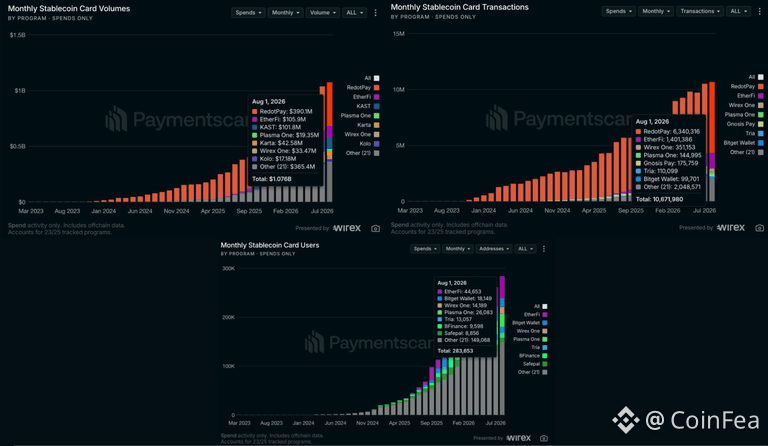
Crypto Payment Cards Set August Records Across Spending, Transactions and UsersCrypto Payment Cards recorded their strongest month in August as spending, transaction counts, and active users reached record levels.
Total stablecoin card volume rose to $1.076 billion across 10,671,980 transactions and 283,653 active addresses.
August was the second straight month crypto card spending exceeded $1 billion. Active addresses increased from 261,000 in July, while average spending per transaction reached roughly $100.80.
RedotPay Leads Stablecoin Card Activity
RedotPay remained the largest provider in the tracked market, processing about $390.1 million during August. That represented roughly 36% of sector volume, while its transaction count exceeded 6.34 million and accounted for more than half of tracked payments.
Its average purchase value was around $61.50, below the market average. The spending pattern indicated that RedotPay users were making smaller purchases more frequently. EtherFi and KAST ranked second and third by monthly transaction volume.
Growth was visible across emerging markets. Singapore-based StraitsX, which supports Visa card programs for crypto companies, reported a 600% increase in gross transaction value across lower-GDP regions between early 2025 and 2026.
Binance said average users of its Brazil card increased 53% from the launch quarter to the second quarter of 2026. Average spending volume rose 80%, with ride-hailing, food delivery, groceries, restaurants, and online subscriptions among the leading uses.
Kraken reported that weekly Krak Card payments more than doubled over the past year to 8.3 per user. Retail and store purchases represented 59.3% of spending.
Stablecoin Card Infrastructure Expands
Mastercard enabled stablecoin settlement on June 3 for USDC, Paxos-issued tokens, RLUSD, and SoFiUSD across eight blockchains. Visa said more than 160 stablecoin card programs are either live or under development.
Providers including Rain, Reap, and Stripe’s Bridge have also reduced float and licensing costs that previously limited smaller onchain card purchases.
Despite the growth, market concentration remains high. Three programs account for 55.6% of total volume. Paymentscan also relies on self-reported RedotPay figures rather than fully onchain observations.
RedotPay is facing an approximately $472.8 million claim in Hong Kong from Binance affiliates over alleged user diversion. Its planned $1 billion US listing now appears unlikely before 2027.
Card Spending Rises as Stablecoin Supply Falls
Stablecoin supply has declined 3.6% from its May peak to about $304 billion, based on DefiLlama data. Card activity still reached a record level during the same period.
August volume annualizes to about $12.9 billion, roughly 0.06% of the traditional card market, which exceeds $20 trillion.
The divergence marks a change from the previous three years, when onchain payment activity broadly moved alongside stablecoin supply. Spending, transactions, and active users now reached highs even as the overall stablecoin pool contracted.
The post Crypto Payment Cards Set August Records Across Spending, Transactions and Users first appeared on Coinfea.
Crypto Payment Cards Set August Records Across Spending, Transactions and Users
Crypto Payment Cards recorded their strongest month in August as spending, transaction counts, and active users reached record levels.
Total stablecoin card volume rose to $1.076 billion across 10,671,980 transactions and 283,653 active addresses.
August was the second straight month crypto card spending exceeded $1 billion. Active addresses increased from 261,000 in July, while average spending per transaction reached roughly $100.80.
RedotPay Leads Stablecoin Card Activity
RedotPay remained the largest provider in the tracked market, processing about $390.1 million during August. That represented roughly 36% of sector volume, while its transaction count exceeded 6.34 million and accounted for more than half of tracked payments.
Its average purchase value was around $61.50, below the market average. The spending pattern indicated that RedotPay users were making smaller purchases more frequently. EtherFi and KAST ranked second and third by monthly transaction volume.
Growth was visible across emerging markets. Singapore-based StraitsX, which supports Visa card programs for crypto companies, reported a 600% increase in gross transaction value across lower-GDP regions between early 2025 and 2026.
Binance said average users of its Brazil card increased 53% from the launch quarter to the second quarter of 2026. Average spending volume rose 80%, with ride-hailing, food delivery, groceries, restaurants, and online subscriptions among the leading uses.
Kraken reported that weekly Krak Card payments more than doubled over the past year to 8.3 per user. Retail and store purchases represented 59.3% of spending.
Stablecoin Card Infrastructure Expands
Mastercard enabled stablecoin settlement on June 3 for USDC, Paxos-issued tokens, RLUSD, and SoFiUSD across eight blockchains. Visa said more than 160 stablecoin card programs are either live or under development.
Providers including Rain, Reap, and Stripe’s Bridge have also reduced float and licensing costs that previously limited smaller onchain card purchases.
Despite the growth, market concentration remains high. Three programs account for 55.6% of total volume. Paymentscan also relies on self-reported RedotPay figures rather than fully onchain observations.
RedotPay is facing an approximately $472.8 million claim in Hong Kong from Binance affiliates over alleged user diversion. Its planned $1 billion US listing now appears unlikely before 2027.
Card Spending Rises as Stablecoin Supply Falls
Stablecoin supply has declined 3.6% from its May peak to about $304 billion, based on DefiLlama data. Card activity still reached a record level during the same period.
August volume annualizes to about $12.9 billion, roughly 0.06% of the traditional card market, which exceeds $20 trillion.
The divergence marks a change from the previous three years, when onchain payment activity broadly moved alongside stablecoin supply. Spending, transactions, and active users now reached highs even as the overall stablecoin pool contracted.
The post Crypto Payment Cards Set August Records Across Spending, Transactions and Users first appeared on Coinfea.
Total stablecoin card volume rose to $1.076 billion across 10,671,980 transactions and 283,653 active addresses.
August was the second straight month crypto card spending exceeded $1 billion. Active addresses increased from 261,000 in July, while average spending per transaction reached roughly $100.80.
RedotPay Leads Stablecoin Card Activity
RedotPay remained the largest provider in the tracked market, processing about $390.1 million during August. That represented roughly 36% of sector volume, while its transaction count exceeded 6.34 million and accounted for more than half of tracked payments.
Its average purchase value was around $61.50, below the market average. The spending pattern indicated that RedotPay users were making smaller purchases more frequently. EtherFi and KAST ranked second and third by monthly transaction volume.
Growth was visible across emerging markets. Singapore-based StraitsX, which supports Visa card programs for crypto companies, reported a 600% increase in gross transaction value across lower-GDP regions between early 2025 and 2026.
Binance said average users of its Brazil card increased 53% from the launch quarter to the second quarter of 2026. Average spending volume rose 80%, with ride-hailing, food delivery, groceries, restaurants, and online subscriptions among the leading uses.
Kraken reported that weekly Krak Card payments more than doubled over the past year to 8.3 per user. Retail and store purchases represented 59.3% of spending.
Stablecoin Card Infrastructure Expands
Mastercard enabled stablecoin settlement on June 3 for USDC, Paxos-issued tokens, RLUSD, and SoFiUSD across eight blockchains. Visa said more than 160 stablecoin card programs are either live or under development.
Providers including Rain, Reap, and Stripe’s Bridge have also reduced float and licensing costs that previously limited smaller onchain card purchases.
Despite the growth, market concentration remains high. Three programs account for 55.6% of total volume. Paymentscan also relies on self-reported RedotPay figures rather than fully onchain observations.
RedotPay is facing an approximately $472.8 million claim in Hong Kong from Binance affiliates over alleged user diversion. Its planned $1 billion US listing now appears unlikely before 2027.
Card Spending Rises as Stablecoin Supply Falls
Stablecoin supply has declined 3.6% from its May peak to about $304 billion, based on DefiLlama data. Card activity still reached a record level during the same period.
August volume annualizes to about $12.9 billion, roughly 0.06% of the traditional card market, which exceeds $20 trillion.
The divergence marks a change from the previous three years, when onchain payment activity broadly moved alongside stablecoin supply. Spending, transactions, and active users now reached highs even as the overall stablecoin pool contracted.
The post Crypto Payment Cards Set August Records Across Spending, Transactions and Users first appeared on Coinfea.
105
·
--

Article
Strategy Buys Fresh 4,603 BTC After Big Summer SalesStrategy has made a fresh BTC purchase, reverting to its Bitcoin plan. It disclosed a $369.7 million buy in an SEC filing on Monday. This purchase turns out to be Strategy’s first one in the last two months. Strategy is currently the largest corporate holder of Bitcoin, and its shift from selling to buying might increase investor confidence.
Strategy bought 4,603 Bitcoin between August 24 and 30 for an average of $80,318 per Bitcoin, as per the SEC filing. This brings Strategy’s total holdings to 845,050 Bitcoin. Strategy has already spent $63.73 billion in accumulating this stake in Bitcoin. Its average price per Bitcoin is $75,412. Saylor confirmed the figures in an X post on August 31, saying that the company owns “845,050 bitcoin” and $6.71 billion in what they call “USD Assets,” which consist of USD Reserve and USD Cash accounts. The net leverage of the company is 0.0%.
Strategy BTC purchase to instill investor confidence
The purchase was reportedly done without spending any extra money. As part of its ATM program, Strategy raised a net of $602.8 million through selling 4,531,421 shares of MSTR stock in one week. $369.7 million was spent to purchase Bitcoin, $151.8 million was spent to purchase STRC preferred stock, $50.7 million was spent on dividend payments on preferred stock, while the remaining $30 million was spent on increasing the company’s USD Cash reserves.
The issuing of stocks to acquire Bitcoin has always been the way of funding the company’s operations. The company decided to restart the process only when the prices of its stocks recovered enough to be a more profitable way of acquiring capital compared to borrowing. That approach has turned out to be quite costly. From May to August, the company sold 6,948 BTC for around $432.5 million ($62,250 each). The repurchase at the price of $80,318 per coin implies that the company overpaid by almost 29%.
The final result is that Strategy is down 2,345 BTC, but it managed to get around $63 million in the process. The summer sales happened for certain reasons. When the share price of STRC fell below its par value of $100, a funding source of the company was closed off. In order to continue with the process, the company has decided to launch the Digital Credit Capital Framework, under which it plans to sell Bitcoin up to $1.25 billion to pay dividends and repurchase its own preferred stock. At press time, Bitcoin costs $77,849.
The post Strategy buys fresh 4,603 BTC after big summer sales first appeared on Coinfea.
Strategy Buys Fresh 4,603 BTC After Big Summer Sales
Strategy has made a fresh BTC purchase, reverting to its Bitcoin plan. It disclosed a $369.7 million buy in an SEC filing on Monday. This purchase turns out to be Strategy’s first one in the last two months. Strategy is currently the largest corporate holder of Bitcoin, and its shift from selling to buying might increase investor confidence.
Strategy bought 4,603 Bitcoin between August 24 and 30 for an average of $80,318 per Bitcoin, as per the SEC filing. This brings Strategy’s total holdings to 845,050 Bitcoin. Strategy has already spent $63.73 billion in accumulating this stake in Bitcoin. Its average price per Bitcoin is $75,412. Saylor confirmed the figures in an X post on August 31, saying that the company owns “845,050 bitcoin” and $6.71 billion in what they call “USD Assets,” which consist of USD Reserve and USD Cash accounts. The net leverage of the company is 0.0%.
Strategy BTC purchase to instill investor confidence
The purchase was reportedly done without spending any extra money. As part of its ATM program, Strategy raised a net of $602.8 million through selling 4,531,421 shares of MSTR stock in one week. $369.7 million was spent to purchase Bitcoin, $151.8 million was spent to purchase STRC preferred stock, $50.7 million was spent on dividend payments on preferred stock, while the remaining $30 million was spent on increasing the company’s USD Cash reserves.
The issuing of stocks to acquire Bitcoin has always been the way of funding the company’s operations. The company decided to restart the process only when the prices of its stocks recovered enough to be a more profitable way of acquiring capital compared to borrowing. That approach has turned out to be quite costly. From May to August, the company sold 6,948 BTC for around $432.5 million ($62,250 each). The repurchase at the price of $80,318 per coin implies that the company overpaid by almost 29%.
The final result is that Strategy is down 2,345 BTC, but it managed to get around $63 million in the process. The summer sales happened for certain reasons. When the share price of STRC fell below its par value of $100, a funding source of the company was closed off. In order to continue with the process, the company has decided to launch the Digital Credit Capital Framework, under which it plans to sell Bitcoin up to $1.25 billion to pay dividends and repurchase its own preferred stock. At press time, Bitcoin costs $77,849.
The post Strategy buys fresh 4,603 BTC after big summer sales first appeared on Coinfea.
Strategy bought 4,603 Bitcoin between August 24 and 30 for an average of $80,318 per Bitcoin, as per the SEC filing. This brings Strategy’s total holdings to 845,050 Bitcoin. Strategy has already spent $63.73 billion in accumulating this stake in Bitcoin. Its average price per Bitcoin is $75,412. Saylor confirmed the figures in an X post on August 31, saying that the company owns “845,050 bitcoin” and $6.71 billion in what they call “USD Assets,” which consist of USD Reserve and USD Cash accounts. The net leverage of the company is 0.0%.
Strategy BTC purchase to instill investor confidence
The purchase was reportedly done without spending any extra money. As part of its ATM program, Strategy raised a net of $602.8 million through selling 4,531,421 shares of MSTR stock in one week. $369.7 million was spent to purchase Bitcoin, $151.8 million was spent to purchase STRC preferred stock, $50.7 million was spent on dividend payments on preferred stock, while the remaining $30 million was spent on increasing the company’s USD Cash reserves.
The issuing of stocks to acquire Bitcoin has always been the way of funding the company’s operations. The company decided to restart the process only when the prices of its stocks recovered enough to be a more profitable way of acquiring capital compared to borrowing. That approach has turned out to be quite costly. From May to August, the company sold 6,948 BTC for around $432.5 million ($62,250 each). The repurchase at the price of $80,318 per coin implies that the company overpaid by almost 29%.
The final result is that Strategy is down 2,345 BTC, but it managed to get around $63 million in the process. The summer sales happened for certain reasons. When the share price of STRC fell below its par value of $100, a funding source of the company was closed off. In order to continue with the process, the company has decided to launch the Digital Credit Capital Framework, under which it plans to sell Bitcoin up to $1.25 billion to pay dividends and repurchase its own preferred stock. At press time, Bitcoin costs $77,849.
The post Strategy buys fresh 4,603 BTC after big summer sales first appeared on Coinfea.
99
·
--
Article
Strive Passes Bullish to Become the Fifth-largest Corporate BTC HolderStrive has now jumped to the fifth spot among publicly traded corporate Bitcoin holders, leapfrogging Bullish after a 1,800-token accumulation week pushed the firm’s stack to 23,156 BTC worth roughly $1.8 billion as of August 31. The Dallas-based asset manager overtook Bullish as it continues to build up its Bitcoin stash, while the latter is on its way down.
Before the latest update to its balance sheet, Strive entered the final week of August with 21,356 BTC, per its August 24 filing with the SEC. At the time, Bullish held 22,000 BTC, with its 1,700 token sale at the end of June as its most recent transaction. Both companies still rank behind MARA Holdings at 35,577 BTC and far behind Michael Saylor’s Strategy, which now holds 845,050 BTC after its first token purchase since June. Strive has been steadily tapping equity issuance of common stock (ASST) and preferred stock (SATA) to power its Bitcoin accumulation strategy. SATA powers most of the firm’s buying activity when it trades near its $100 par value.
Strive and Bullish still rank behind MARA
The variable-rate perpetual preferred pays a 13% annualized dividend every business day, a design that CEO Matt Cole touted as a first for a US-listed security. Last week’s 1,800 BTC acquisition follows an $81.5 million splurge on 1,110 BTC per the firm’s 8-K for the August 17 to 21 period, as Cryptopolitan reported. The company’s cash rose to $171.9 million following a $17.1 million gain on the at-the-market sales of its common and preferred stock over the same period.
Strive entered the corporate Bitcoin leaderboard through a September 2025 merger with Asset Entities. It expanded with an all-stock deal for Semler Scientific in January 2026. Bullish, on the other hand, is a digital-asset exchange operator led by the former president of the New York Stock Exchange, Tom Farley. It became a publicly traded Bitcoin treasury firm after it raised $1.1 billion in its August 2025 IPO. Strive maintained its Bitcoin buying despite taking a $257.6 million net loss for the quarter ended June 30, disclosed on August 10.
It related 94% of that drawdown to Bitcoin’s price struggles during that period and its stake in Strategy’s preferred shares. Ironically, the medical device sales business it took over with its Semler deal posted close to a 100% year-on-year revenue growth to $2.94 million. Cole has framed the balance sheet as built for this kind of volatility, telling investors the company stands debt-free with no margin requirements and no encumbered Bitcoin.
The post Strive passes Bullish to become the fifth-largest corporate BTC holder first appeared on Coinfea.
Strive Passes Bullish to Become the Fifth-largest Corporate BTC Holder
Strive has now jumped to the fifth spot among publicly traded corporate Bitcoin holders, leapfrogging Bullish after a 1,800-token accumulation week pushed the firm’s stack to 23,156 BTC worth roughly $1.8 billion as of August 31. The Dallas-based asset manager overtook Bullish as it continues to build up its Bitcoin stash, while the latter is on its way down.
Before the latest update to its balance sheet, Strive entered the final week of August with 21,356 BTC, per its August 24 filing with the SEC. At the time, Bullish held 22,000 BTC, with its 1,700 token sale at the end of June as its most recent transaction. Both companies still rank behind MARA Holdings at 35,577 BTC and far behind Michael Saylor’s Strategy, which now holds 845,050 BTC after its first token purchase since June. Strive has been steadily tapping equity issuance of common stock (ASST) and preferred stock (SATA) to power its Bitcoin accumulation strategy. SATA powers most of the firm’s buying activity when it trades near its $100 par value.
Strive and Bullish still rank behind MARA
The variable-rate perpetual preferred pays a 13% annualized dividend every business day, a design that CEO Matt Cole touted as a first for a US-listed security. Last week’s 1,800 BTC acquisition follows an $81.5 million splurge on 1,110 BTC per the firm’s 8-K for the August 17 to 21 period, as Cryptopolitan reported. The company’s cash rose to $171.9 million following a $17.1 million gain on the at-the-market sales of its common and preferred stock over the same period.
Strive entered the corporate Bitcoin leaderboard through a September 2025 merger with Asset Entities. It expanded with an all-stock deal for Semler Scientific in January 2026. Bullish, on the other hand, is a digital-asset exchange operator led by the former president of the New York Stock Exchange, Tom Farley. It became a publicly traded Bitcoin treasury firm after it raised $1.1 billion in its August 2025 IPO. Strive maintained its Bitcoin buying despite taking a $257.6 million net loss for the quarter ended June 30, disclosed on August 10.
It related 94% of that drawdown to Bitcoin’s price struggles during that period and its stake in Strategy’s preferred shares. Ironically, the medical device sales business it took over with its Semler deal posted close to a 100% year-on-year revenue growth to $2.94 million. Cole has framed the balance sheet as built for this kind of volatility, telling investors the company stands debt-free with no margin requirements and no encumbered Bitcoin.
The post Strive passes Bullish to become the fifth-largest corporate BTC holder first appeared on Coinfea.
Before the latest update to its balance sheet, Strive entered the final week of August with 21,356 BTC, per its August 24 filing with the SEC. At the time, Bullish held 22,000 BTC, with its 1,700 token sale at the end of June as its most recent transaction. Both companies still rank behind MARA Holdings at 35,577 BTC and far behind Michael Saylor’s Strategy, which now holds 845,050 BTC after its first token purchase since June. Strive has been steadily tapping equity issuance of common stock (ASST) and preferred stock (SATA) to power its Bitcoin accumulation strategy. SATA powers most of the firm’s buying activity when it trades near its $100 par value.
Strive and Bullish still rank behind MARA
The variable-rate perpetual preferred pays a 13% annualized dividend every business day, a design that CEO Matt Cole touted as a first for a US-listed security. Last week’s 1,800 BTC acquisition follows an $81.5 million splurge on 1,110 BTC per the firm’s 8-K for the August 17 to 21 period, as Cryptopolitan reported. The company’s cash rose to $171.9 million following a $17.1 million gain on the at-the-market sales of its common and preferred stock over the same period.
Strive entered the corporate Bitcoin leaderboard through a September 2025 merger with Asset Entities. It expanded with an all-stock deal for Semler Scientific in January 2026. Bullish, on the other hand, is a digital-asset exchange operator led by the former president of the New York Stock Exchange, Tom Farley. It became a publicly traded Bitcoin treasury firm after it raised $1.1 billion in its August 2025 IPO. Strive maintained its Bitcoin buying despite taking a $257.6 million net loss for the quarter ended June 30, disclosed on August 10.
It related 94% of that drawdown to Bitcoin’s price struggles during that period and its stake in Strategy’s preferred shares. Ironically, the medical device sales business it took over with its Semler deal posted close to a 100% year-on-year revenue growth to $2.94 million. Cole has framed the balance sheet as built for this kind of volatility, telling investors the company stands debt-free with no margin requirements and no encumbered Bitcoin.
The post Strive passes Bullish to become the fifth-largest corporate BTC holder first appeared on Coinfea.
BTC+0.92%
ASSTUS+1.48%
135
·
--

Article
Hyperliquid Prediction Markets Expand As Third-Party Deployers Prepare New PairsHyperliquid prediction markets expanded with the launch of HIP-4, opening a new market category for outcome-based trading on the platform.
The rollout begins with curated providers, while a future update is expected to support permissionless prediction pair creation by third-party deployers.
The platform introduced seven initial prediction pairs as it moves into a sector led by Polymarket, Kalshi, and Robinhood’s prediction offering. Hyperliquid previously expanded third-party market creation through HIP-3, which supports tokenized securities and other externally deployed markets.
Prediction activity on Hyperliquid has already generated more than $300 million in total outcome volume. The new HIP-4 liquidity hub is expected to attract deployers that stake HYPE tokens before launching additional markets.
TradeXYZ Prepares New Hyperliquid Prediction Markets
TradeXYZ, a major HIP-3 deployer, is preparing to launch prediction markets under HIP-4. On-chain data shows a wallet linked to TradeXYZ recently staked and delegated HYPE after months without a new delegation.
Launching third-party prediction pairs requires a 500,000 HYPE bond. The delegated amount is sufficient to maintain the existing HIP-3 bond while supporting a future outcome market launch.
Based on delegation waiting periods, TradeXYZ may begin deploying markets from September 5. Outcome XYZ had already become the first party to unlock HIP-4 staking and prepare its initial markets.
Outcome XYZ prediction pairs moved to the top of Hyperliquid’s prediction market activity during the past day. Skew is also preparing deployments with support from HyperionDeFi, which will help stake the required 500,000 HYPE.
HIP-4 Builds on Hyperliquid’s Market Expansion
The HIP-4 rollout follows Hyperliquid’s broader effort to expand beyond crypto trading. HIP-3 previously allowed third parties to introduce tokenized securities and other markets while using Hyperliquid’s existing liquidity infrastructure.
Early prediction market deployments are increasing as providers compete for initial positioning. Hyperliquid currently supports more than 300 outcome-related pairs across its platform, while the next upgrade is expected to widen third-party issuance.
The development could increase the amount of HYPE committed to market deployment requirements. It also adds another liquidity category to an ecosystem already supporting multiple trading products and externally built applications.
HYPE Holds Near Peak Levels as Fees Rise
HYPE traded above $81, close to its all-time high, as activity across Hyperliquid remained elevated. Daily platform fees also rose above $3 million during August.
Hyperliquid’s HYPE trades near all-time highs, as the platform expands its influence over prediction markets. | Source: Coingecko
Hyperliquid’s token burn mechanism remains tied to platform fees, making higher activity relevant to HYPE’s supply dynamics. The network continues burning tokens as fee generation increases across active markets.
Liquidity has recently shifted toward crypto trading, while stock-related activity has slowed. That structure connects new applications directly with existing liquidity. Hyperliquid has also distributed more than $105 million to over 1,500 builder teams that deployed applications across its ecosystem and accessed platform liquidity with additional fees.
The post Hyperliquid Prediction Markets Expand as Third-Party Deployers Prepare New Pairs first appeared on Coinfea.
Hyperliquid Prediction Markets Expand As Third-Party Deployers Prepare New Pairs
Hyperliquid prediction markets expanded with the launch of HIP-4, opening a new market category for outcome-based trading on the platform.
The rollout begins with curated providers, while a future update is expected to support permissionless prediction pair creation by third-party deployers.
The platform introduced seven initial prediction pairs as it moves into a sector led by Polymarket, Kalshi, and Robinhood’s prediction offering. Hyperliquid previously expanded third-party market creation through HIP-3, which supports tokenized securities and other externally deployed markets.
Prediction activity on Hyperliquid has already generated more than $300 million in total outcome volume. The new HIP-4 liquidity hub is expected to attract deployers that stake HYPE tokens before launching additional markets.
TradeXYZ Prepares New Hyperliquid Prediction Markets
TradeXYZ, a major HIP-3 deployer, is preparing to launch prediction markets under HIP-4. On-chain data shows a wallet linked to TradeXYZ recently staked and delegated HYPE after months without a new delegation.
Launching third-party prediction pairs requires a 500,000 HYPE bond. The delegated amount is sufficient to maintain the existing HIP-3 bond while supporting a future outcome market launch.
Based on delegation waiting periods, TradeXYZ may begin deploying markets from September 5. Outcome XYZ had already become the first party to unlock HIP-4 staking and prepare its initial markets.
Outcome XYZ prediction pairs moved to the top of Hyperliquid’s prediction market activity during the past day. Skew is also preparing deployments with support from HyperionDeFi, which will help stake the required 500,000 HYPE.
HIP-4 Builds on Hyperliquid’s Market Expansion
The HIP-4 rollout follows Hyperliquid’s broader effort to expand beyond crypto trading. HIP-3 previously allowed third parties to introduce tokenized securities and other markets while using Hyperliquid’s existing liquidity infrastructure.
Early prediction market deployments are increasing as providers compete for initial positioning. Hyperliquid currently supports more than 300 outcome-related pairs across its platform, while the next upgrade is expected to widen third-party issuance.
The development could increase the amount of HYPE committed to market deployment requirements. It also adds another liquidity category to an ecosystem already supporting multiple trading products and externally built applications.
HYPE Holds Near Peak Levels as Fees Rise
HYPE traded above $81, close to its all-time high, as activity across Hyperliquid remained elevated. Daily platform fees also rose above $3 million during August.
Hyperliquid’s HYPE trades near all-time highs, as the platform expands its influence over prediction markets. | Source: Coingecko
Hyperliquid’s token burn mechanism remains tied to platform fees, making higher activity relevant to HYPE’s supply dynamics. The network continues burning tokens as fee generation increases across active markets.
Liquidity has recently shifted toward crypto trading, while stock-related activity has slowed. That structure connects new applications directly with existing liquidity. Hyperliquid has also distributed more than $105 million to over 1,500 builder teams that deployed applications across its ecosystem and accessed platform liquidity with additional fees.
The post Hyperliquid Prediction Markets Expand as Third-Party Deployers Prepare New Pairs first appeared on Coinfea.
The rollout begins with curated providers, while a future update is expected to support permissionless prediction pair creation by third-party deployers.
The platform introduced seven initial prediction pairs as it moves into a sector led by Polymarket, Kalshi, and Robinhood’s prediction offering. Hyperliquid previously expanded third-party market creation through HIP-3, which supports tokenized securities and other externally deployed markets.
Prediction activity on Hyperliquid has already generated more than $300 million in total outcome volume. The new HIP-4 liquidity hub is expected to attract deployers that stake HYPE tokens before launching additional markets.
TradeXYZ Prepares New Hyperliquid Prediction Markets
TradeXYZ, a major HIP-3 deployer, is preparing to launch prediction markets under HIP-4. On-chain data shows a wallet linked to TradeXYZ recently staked and delegated HYPE after months without a new delegation.
Launching third-party prediction pairs requires a 500,000 HYPE bond. The delegated amount is sufficient to maintain the existing HIP-3 bond while supporting a future outcome market launch.
Based on delegation waiting periods, TradeXYZ may begin deploying markets from September 5. Outcome XYZ had already become the first party to unlock HIP-4 staking and prepare its initial markets.
Outcome XYZ prediction pairs moved to the top of Hyperliquid’s prediction market activity during the past day. Skew is also preparing deployments with support from HyperionDeFi, which will help stake the required 500,000 HYPE.
HIP-4 Builds on Hyperliquid’s Market Expansion
The HIP-4 rollout follows Hyperliquid’s broader effort to expand beyond crypto trading. HIP-3 previously allowed third parties to introduce tokenized securities and other markets while using Hyperliquid’s existing liquidity infrastructure.
Early prediction market deployments are increasing as providers compete for initial positioning. Hyperliquid currently supports more than 300 outcome-related pairs across its platform, while the next upgrade is expected to widen third-party issuance.
The development could increase the amount of HYPE committed to market deployment requirements. It also adds another liquidity category to an ecosystem already supporting multiple trading products and externally built applications.
HYPE Holds Near Peak Levels as Fees Rise
HYPE traded above $81, close to its all-time high, as activity across Hyperliquid remained elevated. Daily platform fees also rose above $3 million during August.
Hyperliquid’s HYPE trades near all-time highs, as the platform expands its influence over prediction markets. | Source: Coingecko
Hyperliquid’s token burn mechanism remains tied to platform fees, making higher activity relevant to HYPE’s supply dynamics. The network continues burning tokens as fee generation increases across active markets.
Liquidity has recently shifted toward crypto trading, while stock-related activity has slowed. That structure connects new applications directly with existing liquidity. Hyperliquid has also distributed more than $105 million to over 1,500 builder teams that deployed applications across its ecosystem and accessed platform liquidity with additional fees.
The post Hyperliquid Prediction Markets Expand as Third-Party Deployers Prepare New Pairs first appeared on Coinfea.
184
·
--

Article
Robinhood Chain Records Largest Day With $874.8 Million DEX VolumeRobinhood Chain recorded its strongest day since mainnet launched on July 1, reaching $874.8 million in decentralized exchange volume and 5,521,213 transactions on August 30.
DefiLlama data also showed the network exceeded Ethereum and Hyperliquid in 24-hour app revenue, trailing only Solana during the same period.
The milestone capped a sharp recovery from early August, when daily DEX volume had fallen to about $140 million after the launch-week surge faded. Over the following three weeks, activity climbed steadily and moved beyond the previous high recorded on July 11.
Source: Dune
Pons Family Drives More Than Half of Robinhood Chain Volume
Pons.family generated $445.98 million in token volume on August 30, accounting for roughly 51% of total trading activity across Robinhood Chain. The permissionless launchpad allows users to deploy fixed-supply tokens traded against WETH while charging a fee on each swap.
Source: Dune
The platform became the chain’s busiest token launchpad after Noxa stopped accepting new token launches on July 11. Its latest daily volume was nearly 2.6 times its mid-July peak and more than twenty times the level recorded in mid-August.
Competition increased after Uniswap Labs introduced Pools.trade on August 5. The Robinhood Chain launchpad offers zero platform fees and permanently locked Uniswap v4 liquidity. Pools.trade briefly surpassed Pons in token volume and daily token creation during its first 24 hours, but that lead did not continue.
Pons routes 80% of protocol fees into an automated TWAP buyback that sends PONS tokens to a burn address, according to its documentation. The team said on August 29 that 29% of the original one billion token supply had been retired.
Arcus Adds Leveraged Tokens and Stock Collateral
Arcus, the dYdX-built decentralized exchange backed by Robinhood Crypto, launched pTokens on August 25. The products convert leveraged perpetual accounts into transferable ERC-20 tokens, including pBTC3x and pHOOD3x.
Arcus also began accepting SPY, QQQ, and MAG7 stock tokens as collateral at 50% loan-to-value. The feature allows traders to use tokenized equity exposure as collateral without closing those positions.
The launch arrived as broader crypto markets strengthened. Bitcoin rallied after August 17 during a record $2.7 billion wave of short liquidations that Bloomberg described as the largest since records began in 2021. The move followed a White House crypto meeting and a US Treasury decision to double long-dated bond buybacks.
Bitcoin later reached nearly $81,500, while Ether gained almost 29% over the week and other altcoins advanced.
Record Leaves Robinhood Chain Facing a Durability Test
The July 11 high followed launch-week enthusiasm, while the August 30 record depended heavily on Pons.family, which produced half of chain-wide trading volume. Uniswap’s competing launchpad remained available with lower fees during the same period. This concentration distinguishes the latest record from July’s launch-driven activity.
The next measure for Robinhood Chain is whether transaction activity and DEX volume remain elevated without Pons.family carrying such a large share of network trading.
The post Robinhood Chain Records Largest Day With $874.8 Million DEX Volume first appeared on Coinfea.
Robinhood Chain Records Largest Day With $874.8 Million DEX Volume
Robinhood Chain recorded its strongest day since mainnet launched on July 1, reaching $874.8 million in decentralized exchange volume and 5,521,213 transactions on August 30.
DefiLlama data also showed the network exceeded Ethereum and Hyperliquid in 24-hour app revenue, trailing only Solana during the same period.
The milestone capped a sharp recovery from early August, when daily DEX volume had fallen to about $140 million after the launch-week surge faded. Over the following three weeks, activity climbed steadily and moved beyond the previous high recorded on July 11.
Source: Dune
Pons Family Drives More Than Half of Robinhood Chain Volume
Pons.family generated $445.98 million in token volume on August 30, accounting for roughly 51% of total trading activity across Robinhood Chain. The permissionless launchpad allows users to deploy fixed-supply tokens traded against WETH while charging a fee on each swap.
Source: Dune
The platform became the chain’s busiest token launchpad after Noxa stopped accepting new token launches on July 11. Its latest daily volume was nearly 2.6 times its mid-July peak and more than twenty times the level recorded in mid-August.
Competition increased after Uniswap Labs introduced Pools.trade on August 5. The Robinhood Chain launchpad offers zero platform fees and permanently locked Uniswap v4 liquidity. Pools.trade briefly surpassed Pons in token volume and daily token creation during its first 24 hours, but that lead did not continue.
Pons routes 80% of protocol fees into an automated TWAP buyback that sends PONS tokens to a burn address, according to its documentation. The team said on August 29 that 29% of the original one billion token supply had been retired.
Arcus Adds Leveraged Tokens and Stock Collateral
Arcus, the dYdX-built decentralized exchange backed by Robinhood Crypto, launched pTokens on August 25. The products convert leveraged perpetual accounts into transferable ERC-20 tokens, including pBTC3x and pHOOD3x.
Arcus also began accepting SPY, QQQ, and MAG7 stock tokens as collateral at 50% loan-to-value. The feature allows traders to use tokenized equity exposure as collateral without closing those positions.
The launch arrived as broader crypto markets strengthened. Bitcoin rallied after August 17 during a record $2.7 billion wave of short liquidations that Bloomberg described as the largest since records began in 2021. The move followed a White House crypto meeting and a US Treasury decision to double long-dated bond buybacks.
Bitcoin later reached nearly $81,500, while Ether gained almost 29% over the week and other altcoins advanced.
Record Leaves Robinhood Chain Facing a Durability Test
The July 11 high followed launch-week enthusiasm, while the August 30 record depended heavily on Pons.family, which produced half of chain-wide trading volume. Uniswap’s competing launchpad remained available with lower fees during the same period. This concentration distinguishes the latest record from July’s launch-driven activity.
The next measure for Robinhood Chain is whether transaction activity and DEX volume remain elevated without Pons.family carrying such a large share of network trading.
The post Robinhood Chain Records Largest Day With $874.8 Million DEX Volume first appeared on Coinfea.
DefiLlama data also showed the network exceeded Ethereum and Hyperliquid in 24-hour app revenue, trailing only Solana during the same period.
The milestone capped a sharp recovery from early August, when daily DEX volume had fallen to about $140 million after the launch-week surge faded. Over the following three weeks, activity climbed steadily and moved beyond the previous high recorded on July 11.
Source: Dune
Pons Family Drives More Than Half of Robinhood Chain Volume
Pons.family generated $445.98 million in token volume on August 30, accounting for roughly 51% of total trading activity across Robinhood Chain. The permissionless launchpad allows users to deploy fixed-supply tokens traded against WETH while charging a fee on each swap.
Source: Dune
The platform became the chain’s busiest token launchpad after Noxa stopped accepting new token launches on July 11. Its latest daily volume was nearly 2.6 times its mid-July peak and more than twenty times the level recorded in mid-August.
Competition increased after Uniswap Labs introduced Pools.trade on August 5. The Robinhood Chain launchpad offers zero platform fees and permanently locked Uniswap v4 liquidity. Pools.trade briefly surpassed Pons in token volume and daily token creation during its first 24 hours, but that lead did not continue.
Pons routes 80% of protocol fees into an automated TWAP buyback that sends PONS tokens to a burn address, according to its documentation. The team said on August 29 that 29% of the original one billion token supply had been retired.
Arcus Adds Leveraged Tokens and Stock Collateral
Arcus, the dYdX-built decentralized exchange backed by Robinhood Crypto, launched pTokens on August 25. The products convert leveraged perpetual accounts into transferable ERC-20 tokens, including pBTC3x and pHOOD3x.
Arcus also began accepting SPY, QQQ, and MAG7 stock tokens as collateral at 50% loan-to-value. The feature allows traders to use tokenized equity exposure as collateral without closing those positions.
The launch arrived as broader crypto markets strengthened. Bitcoin rallied after August 17 during a record $2.7 billion wave of short liquidations that Bloomberg described as the largest since records began in 2021. The move followed a White House crypto meeting and a US Treasury decision to double long-dated bond buybacks.
Bitcoin later reached nearly $81,500, while Ether gained almost 29% over the week and other altcoins advanced.
Record Leaves Robinhood Chain Facing a Durability Test
The July 11 high followed launch-week enthusiasm, while the August 30 record depended heavily on Pons.family, which produced half of chain-wide trading volume. Uniswap’s competing launchpad remained available with lower fees during the same period. This concentration distinguishes the latest record from July’s launch-driven activity.
The next measure for Robinhood Chain is whether transaction activity and DEX volume remain elevated without Pons.family carrying such a large share of network trading.
The post Robinhood Chain Records Largest Day With $874.8 Million DEX Volume first appeared on Coinfea.
86
·
--

Article
Upbit Leads South Korea Crypto Trading As Market Activity ReboundsUpbit remains South Korea’s leading crypto exchange, recording about $1.04 billion in 24-hour spot trading volume as activity rises.
The Dunamu-operated platform handled more spot trading than Bithumb, Coinone and Digital X combined. Bithumb posted $632.6 million, Coinone $67.9 million, and Digital X, formerly Korbit, close to $11 million.
Bitcoin’s late-August rise above $80,000, its first since mid-May, helped draw Korean retail traders back to local exchanges.
Upbit Maintains Lead in South Korean Crypto Trading
Upbit launched in October 2017 and holds South Korea’s first virtual asset service provider license. It lists more than 180 tokens, while Bithumb, founded in 2014, offers over 440 assets.
Before the August 20 rally, Upbit’s daily turnover ranged between 300 billion and 600 billion won. By Saturday afternoon, volume reached 4.61 trillion won, nearly ten times the week-earlier level, while Bithumb exceeded 2 trillion won.
Upbit’s trading volume rose 273% in one day to about $1.84 billion, marking its busiest session since mid-March. XRP was the most-traded token on both Upbit and Bithumb.
Presto Research analyst Min Jung described Korean traders as “return-chasers” who buy assets already moving higher.
Korean Crypto Exchanges Recover After Weak First Half
South Korea’s four largest crypto exchanges lost nearly 500 billion won, or $364 million, combined during the first half of 2026. Falling cryptocurrency prices reduced exchange-held asset values, while weaker activity cut fee income.
Trading fees accounted for 96.91% of Dunamu’s first-half revenue, which fell by half from the previous year. Dunamu’s operating profit declined 79.7% year-on-year, while Bithumb’s dropped 83.4%.
First-half trading across Korean exchanges fell 54.6% from a year earlier to $366.58 billion. Capital moved into South Korea’s stock market, which reached record highs with strong performances from Samsung and SK Hynix.
Smaller Exchanges Use Zero Fees to Challenge Upbit
With activity returning, smaller exchanges are waiving fees to attract traders and gain market share from Upbit.
Coinone removed trading fees on all listed coins until further notice, while Digital X introduced marketwide zero-fee trading through August 2027.
Digital X’s average hourly volume rose 36 times, from 270 million won to 9.8 billion won. However, 87% came from RLUSD trading during an event distributing the stablecoin to large traders.
Coinone’s hourly volume tripled to 8.2 billion won after fees were removed, but trading quickly returned to normal levels.
Bithumb ran a 68-day fee-free campaign last year, but its market share never exceeded 30%. It launched another seven-day campaign in February.
Upbit and Bithumb waive fees only on selected tokens. Upbit removed charges on stablecoins including Tether, or USDT-USD, starting July 26.
Digital X’s parent company, Mirae Asset Financial Group, is in talks to buy Korbit for up to 140 billion won, or $97.5 million.
The post Upbit Leads South Korea Crypto Trading as Market Activity Rebounds first appeared on Coinfea.
Upbit Leads South Korea Crypto Trading As Market Activity Rebounds
Upbit remains South Korea’s leading crypto exchange, recording about $1.04 billion in 24-hour spot trading volume as activity rises.
The Dunamu-operated platform handled more spot trading than Bithumb, Coinone and Digital X combined. Bithumb posted $632.6 million, Coinone $67.9 million, and Digital X, formerly Korbit, close to $11 million.
Bitcoin’s late-August rise above $80,000, its first since mid-May, helped draw Korean retail traders back to local exchanges.
Upbit Maintains Lead in South Korean Crypto Trading
Upbit launched in October 2017 and holds South Korea’s first virtual asset service provider license. It lists more than 180 tokens, while Bithumb, founded in 2014, offers over 440 assets.
Before the August 20 rally, Upbit’s daily turnover ranged between 300 billion and 600 billion won. By Saturday afternoon, volume reached 4.61 trillion won, nearly ten times the week-earlier level, while Bithumb exceeded 2 trillion won.
Upbit’s trading volume rose 273% in one day to about $1.84 billion, marking its busiest session since mid-March. XRP was the most-traded token on both Upbit and Bithumb.
Presto Research analyst Min Jung described Korean traders as “return-chasers” who buy assets already moving higher.
Korean Crypto Exchanges Recover After Weak First Half
South Korea’s four largest crypto exchanges lost nearly 500 billion won, or $364 million, combined during the first half of 2026. Falling cryptocurrency prices reduced exchange-held asset values, while weaker activity cut fee income.
Trading fees accounted for 96.91% of Dunamu’s first-half revenue, which fell by half from the previous year. Dunamu’s operating profit declined 79.7% year-on-year, while Bithumb’s dropped 83.4%.
First-half trading across Korean exchanges fell 54.6% from a year earlier to $366.58 billion. Capital moved into South Korea’s stock market, which reached record highs with strong performances from Samsung and SK Hynix.
Smaller Exchanges Use Zero Fees to Challenge Upbit
With activity returning, smaller exchanges are waiving fees to attract traders and gain market share from Upbit.
Coinone removed trading fees on all listed coins until further notice, while Digital X introduced marketwide zero-fee trading through August 2027.
Digital X’s average hourly volume rose 36 times, from 270 million won to 9.8 billion won. However, 87% came from RLUSD trading during an event distributing the stablecoin to large traders.
Coinone’s hourly volume tripled to 8.2 billion won after fees were removed, but trading quickly returned to normal levels.
Bithumb ran a 68-day fee-free campaign last year, but its market share never exceeded 30%. It launched another seven-day campaign in February.
Upbit and Bithumb waive fees only on selected tokens. Upbit removed charges on stablecoins including Tether, or USDT-USD, starting July 26.
Digital X’s parent company, Mirae Asset Financial Group, is in talks to buy Korbit for up to 140 billion won, or $97.5 million.
The post Upbit Leads South Korea Crypto Trading as Market Activity Rebounds first appeared on Coinfea.
The Dunamu-operated platform handled more spot trading than Bithumb, Coinone and Digital X combined. Bithumb posted $632.6 million, Coinone $67.9 million, and Digital X, formerly Korbit, close to $11 million.
Bitcoin’s late-August rise above $80,000, its first since mid-May, helped draw Korean retail traders back to local exchanges.
Upbit Maintains Lead in South Korean Crypto Trading
Upbit launched in October 2017 and holds South Korea’s first virtual asset service provider license. It lists more than 180 tokens, while Bithumb, founded in 2014, offers over 440 assets.
Before the August 20 rally, Upbit’s daily turnover ranged between 300 billion and 600 billion won. By Saturday afternoon, volume reached 4.61 trillion won, nearly ten times the week-earlier level, while Bithumb exceeded 2 trillion won.
Upbit’s trading volume rose 273% in one day to about $1.84 billion, marking its busiest session since mid-March. XRP was the most-traded token on both Upbit and Bithumb.
Presto Research analyst Min Jung described Korean traders as “return-chasers” who buy assets already moving higher.
Korean Crypto Exchanges Recover After Weak First Half
South Korea’s four largest crypto exchanges lost nearly 500 billion won, or $364 million, combined during the first half of 2026. Falling cryptocurrency prices reduced exchange-held asset values, while weaker activity cut fee income.
Trading fees accounted for 96.91% of Dunamu’s first-half revenue, which fell by half from the previous year. Dunamu’s operating profit declined 79.7% year-on-year, while Bithumb’s dropped 83.4%.
First-half trading across Korean exchanges fell 54.6% from a year earlier to $366.58 billion. Capital moved into South Korea’s stock market, which reached record highs with strong performances from Samsung and SK Hynix.
Smaller Exchanges Use Zero Fees to Challenge Upbit
With activity returning, smaller exchanges are waiving fees to attract traders and gain market share from Upbit.
Coinone removed trading fees on all listed coins until further notice, while Digital X introduced marketwide zero-fee trading through August 2027.
Digital X’s average hourly volume rose 36 times, from 270 million won to 9.8 billion won. However, 87% came from RLUSD trading during an event distributing the stablecoin to large traders.
Coinone’s hourly volume tripled to 8.2 billion won after fees were removed, but trading quickly returned to normal levels.
Bithumb ran a 68-day fee-free campaign last year, but its market share never exceeded 30%. It launched another seven-day campaign in February.
Upbit and Bithumb waive fees only on selected tokens. Upbit removed charges on stablecoins including Tether, or USDT-USD, starting July 26.
Digital X’s parent company, Mirae Asset Financial Group, is in talks to buy Korbit for up to 140 billion won, or $97.5 million.
The post Upbit Leads South Korea Crypto Trading as Market Activity Rebounds first appeared on Coinfea.
1
266
·
--
Article
Solana Approves Disinflation Vote After Kraken ReversalSolana validators narrowly approved a proposal to double the network’s annual disinflation rate. It cleared the two-thirds supermajority by just 0.33 percentage points after Kraken flipped most of its stake from no to yes in the last hours. SGP-0002, Double Disinflation, passed with 67% support against 25.16% opposition and 7.84% abstentions, on a turnout of 60.7% of eligible stake.
Support was just above the 66.67% bar that the measure needed to pass. Both supply proposals were turned down by Kraken at 12:33 UTC on August 28. This put SGP-0002 below the supermajority with just less than three hours to go until the count stopped at 15:00 UTC for epoch 1024. Earlier that morning, support stood at 68.77%, with about 47.72% of eligible stake having voted. Kraken’s no vote knocked support down to about 65%. Then Kraken moved again. By the close, the proposal had the support of over 90% of the US exchange’s ~8.9 million SOL of voting stake.
Solana proposal narrowly passed by 0.33%
The plan, tied to SIMD-0550, would double the yearly disinflation rate on Solana from 15% to 30% but keep the network’s long-term inflation target at 1.5%. Under the old path, Solana would hit its 1.5% terminal rate in about 5.7 years, but now it will hit it in about 2.8 years. This is an estimated 18.9 million fewer SOL entering circulation over the next six years. The positive side is less dilution for SOL holders, but the downside is lower staking rewards for validators and delegators.
Figment, which had 17.1 million SOL in the finalized governance data, voted against the proposal, while Helius and Jupiter voted for it. Other prominent custodial stakers opposed at least SGP-0002, including Everstake and P2P Validator. Since custodial exchanges get paid when new SOL is issued, disinflation that happens faster means that the APY goes down faster and less money comes in. That logic is “mathematically nonsense,” said Mert Mumtaz, CEO of Helius and a co-author of the proposals, in an X post.
He said any advance in price from slower supply growth would be bigger than the saved yield. Solana Company, a Nasdaq-listed treasury company that trades under the symbol HSDT, said on August 21 that it supports the Solana Constitution but opposes both supply proposals. Reopening the inflation schedule introduces doubt into the multi-year models that institutions use, the firm said. SGP-0002 was one piece of Solana’s first binding governance process. The Solana Constitution, SGP-0001, passed with 85.97% support.
SGP-0003 failed with 53.90% support. The fee change under SIMD-0553 would have made transactions pay for the computing power they book, and burned part of what they paid. The rejection means SOL burns will remain around 650 SOL per day. This is in contrast to the 7,500 to 9,000 SOL, ~$800,000 a day at current prices, that the fee change would have generated. SOL was trading at about $104, down about 5.2% on the day, according to data from CoinGecko. Both rejected supply proposals may be resubmitted without any cooling-off period. But supporters would have to win over custodians who have now gone on the record with their objections.
The post Solana approves disinflation vote after Kraken reversal first appeared on Coinfea.
Solana Approves Disinflation Vote After Kraken Reversal
Solana validators narrowly approved a proposal to double the network’s annual disinflation rate. It cleared the two-thirds supermajority by just 0.33 percentage points after Kraken flipped most of its stake from no to yes in the last hours. SGP-0002, Double Disinflation, passed with 67% support against 25.16% opposition and 7.84% abstentions, on a turnout of 60.7% of eligible stake.
Support was just above the 66.67% bar that the measure needed to pass. Both supply proposals were turned down by Kraken at 12:33 UTC on August 28. This put SGP-0002 below the supermajority with just less than three hours to go until the count stopped at 15:00 UTC for epoch 1024. Earlier that morning, support stood at 68.77%, with about 47.72% of eligible stake having voted. Kraken’s no vote knocked support down to about 65%. Then Kraken moved again. By the close, the proposal had the support of over 90% of the US exchange’s ~8.9 million SOL of voting stake.
Solana proposal narrowly passed by 0.33%
The plan, tied to SIMD-0550, would double the yearly disinflation rate on Solana from 15% to 30% but keep the network’s long-term inflation target at 1.5%. Under the old path, Solana would hit its 1.5% terminal rate in about 5.7 years, but now it will hit it in about 2.8 years. This is an estimated 18.9 million fewer SOL entering circulation over the next six years. The positive side is less dilution for SOL holders, but the downside is lower staking rewards for validators and delegators.
Figment, which had 17.1 million SOL in the finalized governance data, voted against the proposal, while Helius and Jupiter voted for it. Other prominent custodial stakers opposed at least SGP-0002, including Everstake and P2P Validator. Since custodial exchanges get paid when new SOL is issued, disinflation that happens faster means that the APY goes down faster and less money comes in. That logic is “mathematically nonsense,” said Mert Mumtaz, CEO of Helius and a co-author of the proposals, in an X post.
He said any advance in price from slower supply growth would be bigger than the saved yield. Solana Company, a Nasdaq-listed treasury company that trades under the symbol HSDT, said on August 21 that it supports the Solana Constitution but opposes both supply proposals. Reopening the inflation schedule introduces doubt into the multi-year models that institutions use, the firm said. SGP-0002 was one piece of Solana’s first binding governance process. The Solana Constitution, SGP-0001, passed with 85.97% support.
SGP-0003 failed with 53.90% support. The fee change under SIMD-0553 would have made transactions pay for the computing power they book, and burned part of what they paid. The rejection means SOL burns will remain around 650 SOL per day. This is in contrast to the 7,500 to 9,000 SOL, ~$800,000 a day at current prices, that the fee change would have generated. SOL was trading at about $104, down about 5.2% on the day, according to data from CoinGecko. Both rejected supply proposals may be resubmitted without any cooling-off period. But supporters would have to win over custodians who have now gone on the record with their objections.
The post Solana approves disinflation vote after Kraken reversal first appeared on Coinfea.
Support was just above the 66.67% bar that the measure needed to pass. Both supply proposals were turned down by Kraken at 12:33 UTC on August 28. This put SGP-0002 below the supermajority with just less than three hours to go until the count stopped at 15:00 UTC for epoch 1024. Earlier that morning, support stood at 68.77%, with about 47.72% of eligible stake having voted. Kraken’s no vote knocked support down to about 65%. Then Kraken moved again. By the close, the proposal had the support of over 90% of the US exchange’s ~8.9 million SOL of voting stake.
Solana proposal narrowly passed by 0.33%
The plan, tied to SIMD-0550, would double the yearly disinflation rate on Solana from 15% to 30% but keep the network’s long-term inflation target at 1.5%. Under the old path, Solana would hit its 1.5% terminal rate in about 5.7 years, but now it will hit it in about 2.8 years. This is an estimated 18.9 million fewer SOL entering circulation over the next six years. The positive side is less dilution for SOL holders, but the downside is lower staking rewards for validators and delegators.
Figment, which had 17.1 million SOL in the finalized governance data, voted against the proposal, while Helius and Jupiter voted for it. Other prominent custodial stakers opposed at least SGP-0002, including Everstake and P2P Validator. Since custodial exchanges get paid when new SOL is issued, disinflation that happens faster means that the APY goes down faster and less money comes in. That logic is “mathematically nonsense,” said Mert Mumtaz, CEO of Helius and a co-author of the proposals, in an X post.
He said any advance in price from slower supply growth would be bigger than the saved yield. Solana Company, a Nasdaq-listed treasury company that trades under the symbol HSDT, said on August 21 that it supports the Solana Constitution but opposes both supply proposals. Reopening the inflation schedule introduces doubt into the multi-year models that institutions use, the firm said. SGP-0002 was one piece of Solana’s first binding governance process. The Solana Constitution, SGP-0001, passed with 85.97% support.
SGP-0003 failed with 53.90% support. The fee change under SIMD-0553 would have made transactions pay for the computing power they book, and burned part of what they paid. The rejection means SOL burns will remain around 650 SOL per day. This is in contrast to the 7,500 to 9,000 SOL, ~$800,000 a day at current prices, that the fee change would have generated. SOL was trading at about $104, down about 5.2% on the day, according to data from CoinGecko. Both rejected supply proposals may be resubmitted without any cooling-off period. But supporters would have to win over custodians who have now gone on the record with their objections.
The post Solana approves disinflation vote after Kraken reversal first appeared on Coinfea.
1
223
·
--
Article
CFTC Slams Former Trump Aide With $127K Fine for Insider TradingThe Commodity and Futures Trading Commission (CFTC) has slammed Gabriel Perez, who ran President Donald Trump’s teleprompter for nearly a decade, with a $172,000 fine to settle charges that he bet on Trump’s own speeches using words he read ahead of anyone else.
Prediction markets have rapidly gained popularity in 2026, and this settlement is the first known case of a White House insider caught trading on the platform. Regulators have also issued warnings to government staff that their access to nonpublic information is not a betting edge. Gabriel Perez, President Trump’s longtime teleprompter, has been charged by the CFTC with placing bets on Kalshi’s “mention markets” where traders can guess whether a public figure will utter a specific word or phrase during an event.
CFTC says Perez used words he read to bet on markets
Perez had an unfair advantage because he was often the last aide to see Trump’s remarks before delivery. The CFTC found he traded on that confidential text for “his own personal, financial benefit.” The regulator counted 49 trades between December 2025 and February 2026, of which Perez won 39, clearing north of $107,000. He made bets on what Trump might say at the State of the Union, the National Prayer Breakfast, a Medal of Honor ceremony and assorted rallies.
The CFTC has ordered Perez to give up $107,539.02 in trading profits and pay a separate civil penalty of $65,000. Kalshi also banned him from the platform for three years. The CFTC said Perez’s penalty was reduced because he showed “exemplary co-operation.” They took into consideration that he voluntarily admitted his guilt in an interview, saying that his trading decisions were indeed based on the confidential information he had learned from his review of the speeches.
Christy Goldsmith Romero, a former CFTC commissioner appointed under President Joe Biden, stated that the CFTC missed an opportunity to “send a strong message” to future insider traders. Perez was discovered after Kalshi’s surveillance team spotted abnormal activity on Trump-related mention markets, traced the account and linked it to a federal employee running White House teleprompters. The matter was then referred to the CFTC. Bobby DeNault, who heads enforcement at Kalshi, said on X that anyone who violates the company’s rules or federal law would “face the consequences.”
Perez, who had worked for Trump since the 2016 campaign and earned $175,000 a year as a deputy assistant to the president, was placed on unpaid leave in July. Then-press secretary Karoline Leavitt called the conduct “a disgrace,” and by late that month, Perez was reportedly no longer working for the federal government. Cryptopolitan reported that the CFTC settled with former Republican Rep. George Santos in August over a Kalshi contract on whether he would attend the State of the Union.
Federal prosecutors have also charged an Army soldier over Polymarket bets tied to the capture of Venezuelan leader Nicolás Maduro and a Google engineer who made roughly $1.2 million trading on internal search data. CFTC Chairman Michael Selig, a Trump appointee, has backed the prediction-market industry but also pledged to police insider trading inside it.
The post CFTC slams former Trump aide with $127K fine for insider trading first appeared on Coinfea.
CFTC Slams Former Trump Aide With $127K Fine for Insider Trading
The Commodity and Futures Trading Commission (CFTC) has slammed Gabriel Perez, who ran President Donald Trump’s teleprompter for nearly a decade, with a $172,000 fine to settle charges that he bet on Trump’s own speeches using words he read ahead of anyone else.
Prediction markets have rapidly gained popularity in 2026, and this settlement is the first known case of a White House insider caught trading on the platform. Regulators have also issued warnings to government staff that their access to nonpublic information is not a betting edge. Gabriel Perez, President Trump’s longtime teleprompter, has been charged by the CFTC with placing bets on Kalshi’s “mention markets” where traders can guess whether a public figure will utter a specific word or phrase during an event.
CFTC says Perez used words he read to bet on markets
Perez had an unfair advantage because he was often the last aide to see Trump’s remarks before delivery. The CFTC found he traded on that confidential text for “his own personal, financial benefit.” The regulator counted 49 trades between December 2025 and February 2026, of which Perez won 39, clearing north of $107,000. He made bets on what Trump might say at the State of the Union, the National Prayer Breakfast, a Medal of Honor ceremony and assorted rallies.
The CFTC has ordered Perez to give up $107,539.02 in trading profits and pay a separate civil penalty of $65,000. Kalshi also banned him from the platform for three years. The CFTC said Perez’s penalty was reduced because he showed “exemplary co-operation.” They took into consideration that he voluntarily admitted his guilt in an interview, saying that his trading decisions were indeed based on the confidential information he had learned from his review of the speeches.
Christy Goldsmith Romero, a former CFTC commissioner appointed under President Joe Biden, stated that the CFTC missed an opportunity to “send a strong message” to future insider traders. Perez was discovered after Kalshi’s surveillance team spotted abnormal activity on Trump-related mention markets, traced the account and linked it to a federal employee running White House teleprompters. The matter was then referred to the CFTC. Bobby DeNault, who heads enforcement at Kalshi, said on X that anyone who violates the company’s rules or federal law would “face the consequences.”
Perez, who had worked for Trump since the 2016 campaign and earned $175,000 a year as a deputy assistant to the president, was placed on unpaid leave in July. Then-press secretary Karoline Leavitt called the conduct “a disgrace,” and by late that month, Perez was reportedly no longer working for the federal government. Cryptopolitan reported that the CFTC settled with former Republican Rep. George Santos in August over a Kalshi contract on whether he would attend the State of the Union.
Federal prosecutors have also charged an Army soldier over Polymarket bets tied to the capture of Venezuelan leader Nicolás Maduro and a Google engineer who made roughly $1.2 million trading on internal search data. CFTC Chairman Michael Selig, a Trump appointee, has backed the prediction-market industry but also pledged to police insider trading inside it.
The post CFTC slams former Trump aide with $127K fine for insider trading first appeared on Coinfea.
Prediction markets have rapidly gained popularity in 2026, and this settlement is the first known case of a White House insider caught trading on the platform. Regulators have also issued warnings to government staff that their access to nonpublic information is not a betting edge. Gabriel Perez, President Trump’s longtime teleprompter, has been charged by the CFTC with placing bets on Kalshi’s “mention markets” where traders can guess whether a public figure will utter a specific word or phrase during an event.
CFTC says Perez used words he read to bet on markets
Perez had an unfair advantage because he was often the last aide to see Trump’s remarks before delivery. The CFTC found he traded on that confidential text for “his own personal, financial benefit.” The regulator counted 49 trades between December 2025 and February 2026, of which Perez won 39, clearing north of $107,000. He made bets on what Trump might say at the State of the Union, the National Prayer Breakfast, a Medal of Honor ceremony and assorted rallies.
The CFTC has ordered Perez to give up $107,539.02 in trading profits and pay a separate civil penalty of $65,000. Kalshi also banned him from the platform for three years. The CFTC said Perez’s penalty was reduced because he showed “exemplary co-operation.” They took into consideration that he voluntarily admitted his guilt in an interview, saying that his trading decisions were indeed based on the confidential information he had learned from his review of the speeches.
Christy Goldsmith Romero, a former CFTC commissioner appointed under President Joe Biden, stated that the CFTC missed an opportunity to “send a strong message” to future insider traders. Perez was discovered after Kalshi’s surveillance team spotted abnormal activity on Trump-related mention markets, traced the account and linked it to a federal employee running White House teleprompters. The matter was then referred to the CFTC. Bobby DeNault, who heads enforcement at Kalshi, said on X that anyone who violates the company’s rules or federal law would “face the consequences.”
Perez, who had worked for Trump since the 2016 campaign and earned $175,000 a year as a deputy assistant to the president, was placed on unpaid leave in July. Then-press secretary Karoline Leavitt called the conduct “a disgrace,” and by late that month, Perez was reportedly no longer working for the federal government. Cryptopolitan reported that the CFTC settled with former Republican Rep. George Santos in August over a Kalshi contract on whether he would attend the State of the Union.
Federal prosecutors have also charged an Army soldier over Polymarket bets tied to the capture of Venezuelan leader Nicolás Maduro and a Google engineer who made roughly $1.2 million trading on internal search data. CFTC Chairman Michael Selig, a Trump appointee, has backed the prediction-market industry but also pledged to police insider trading inside it.
The post CFTC slams former Trump aide with $127K fine for insider trading first appeared on Coinfea.
1
220
·
--

Article
Avici Refunds Users After Solana Breach As Ajna Suffers Ethereum ExploitAvici has pledged full refunds to all 1,685 users affected by an August 28 breach that drained $500,859.22 from card balances.
The Solana-based neobank said its card-issuing partner Rain traced the incident to a flawed version of a Solana card contract used by Avici and “a small number of other programs” before being upgraded. The incident was followed by Ajna’s exploit one day later.
Avici Promises Full Repayment After Card Exploit
In an August 28 post on X, Avici said, “All affected card balances will be refunded in full.” The company confirmed that the compromised balances totaled $500,859.22 across 1,685 users.
DefiLlama’s hack database records the loss at $500,859 and classifies the incident as a withdrawal logic flaw in a Rust-based protocol. Early reports had estimated losses between $600,000 and more than $1 million.
The attacker reportedly invoked SubmitSignatures on Avici’s authorization program, then used AddCollateralAdmin on its collateral program before calling WithdrawCollateralAsset to remove funds. The attacking wallet later held about 10,005 SOL, worth roughly $1.07 million at the time, plus around $11,600 in stablecoins.
The AVICI token dropped about 39% in 24 hours to near $0.26 and briefly touched a new all-time low around $0.2189. That decline left the token more than 96% below its November 2025 peak of $7.61.
At the time of writing, AVICI had recovered to about $0.3093 but remained down more than 27.8% over 24 hours, according to CoinMarketCap.
Ajna Reports Losses From Liquidation Accounting Manipulation
On August 29, on-chain monitoring firm Defimon Alerts reported that Ethereum lending protocol Ajna lost about $775,000 through liquidation accounting manipulation. The syrupUSDC pool alone accounted for $173,700 of the reported losses.
Defimon said it detected a prepared attack more than an hour before the first exploit transaction and warned Ajna through Discord, but said the protocol “failed to react.”
Ajna later confirmed it was investigating “unusual movements” and advised users to withdraw funds, repay loans, and stop interacting with the protocol. DefiLlama data showed Ajna’s total value locked at about $246,880, down 71.3% over the previous 30 days.
Audited Crypto Protocols Face Heavy Security Losses
CoinGecko’s report “2026’s State of Crypto Security” documented more than 245 incidents between January 2025 and July 2026, with losses totaling $3.63 billion. Among them, 147 involved audited protocols and represented 88.44% of all stolen capital.
The report found that most attacks targeted infrastructure, third-party services, governance, or human error rather than flaws covered by audits. Active on-chain insurance also fell to 20.2% of the market, declining from $163.2 million to $130.2 million. By August 2026, five of nine on-chain insurance protocols had reportedly become inactive or shifted their business models.
The post Avici Refunds Users After Solana Breach as Ajna Suffers Ethereum Exploit first appeared on Coinfea.
Avici Refunds Users After Solana Breach As Ajna Suffers Ethereum Exploit
Avici has pledged full refunds to all 1,685 users affected by an August 28 breach that drained $500,859.22 from card balances.
The Solana-based neobank said its card-issuing partner Rain traced the incident to a flawed version of a Solana card contract used by Avici and “a small number of other programs” before being upgraded. The incident was followed by Ajna’s exploit one day later.
Avici Promises Full Repayment After Card Exploit
In an August 28 post on X, Avici said, “All affected card balances will be refunded in full.” The company confirmed that the compromised balances totaled $500,859.22 across 1,685 users.
DefiLlama’s hack database records the loss at $500,859 and classifies the incident as a withdrawal logic flaw in a Rust-based protocol. Early reports had estimated losses between $600,000 and more than $1 million.
The attacker reportedly invoked SubmitSignatures on Avici’s authorization program, then used AddCollateralAdmin on its collateral program before calling WithdrawCollateralAsset to remove funds. The attacking wallet later held about 10,005 SOL, worth roughly $1.07 million at the time, plus around $11,600 in stablecoins.
The AVICI token dropped about 39% in 24 hours to near $0.26 and briefly touched a new all-time low around $0.2189. That decline left the token more than 96% below its November 2025 peak of $7.61.
At the time of writing, AVICI had recovered to about $0.3093 but remained down more than 27.8% over 24 hours, according to CoinMarketCap.
Ajna Reports Losses From Liquidation Accounting Manipulation
On August 29, on-chain monitoring firm Defimon Alerts reported that Ethereum lending protocol Ajna lost about $775,000 through liquidation accounting manipulation. The syrupUSDC pool alone accounted for $173,700 of the reported losses.
Defimon said it detected a prepared attack more than an hour before the first exploit transaction and warned Ajna through Discord, but said the protocol “failed to react.”
Ajna later confirmed it was investigating “unusual movements” and advised users to withdraw funds, repay loans, and stop interacting with the protocol. DefiLlama data showed Ajna’s total value locked at about $246,880, down 71.3% over the previous 30 days.
Audited Crypto Protocols Face Heavy Security Losses
CoinGecko’s report “2026’s State of Crypto Security” documented more than 245 incidents between January 2025 and July 2026, with losses totaling $3.63 billion. Among them, 147 involved audited protocols and represented 88.44% of all stolen capital.
The report found that most attacks targeted infrastructure, third-party services, governance, or human error rather than flaws covered by audits. Active on-chain insurance also fell to 20.2% of the market, declining from $163.2 million to $130.2 million. By August 2026, five of nine on-chain insurance protocols had reportedly become inactive or shifted their business models.
The post Avici Refunds Users After Solana Breach as Ajna Suffers Ethereum Exploit first appeared on Coinfea.
The Solana-based neobank said its card-issuing partner Rain traced the incident to a flawed version of a Solana card contract used by Avici and “a small number of other programs” before being upgraded. The incident was followed by Ajna’s exploit one day later.
Avici Promises Full Repayment After Card Exploit
In an August 28 post on X, Avici said, “All affected card balances will be refunded in full.” The company confirmed that the compromised balances totaled $500,859.22 across 1,685 users.
DefiLlama’s hack database records the loss at $500,859 and classifies the incident as a withdrawal logic flaw in a Rust-based protocol. Early reports had estimated losses between $600,000 and more than $1 million.
The attacker reportedly invoked SubmitSignatures on Avici’s authorization program, then used AddCollateralAdmin on its collateral program before calling WithdrawCollateralAsset to remove funds. The attacking wallet later held about 10,005 SOL, worth roughly $1.07 million at the time, plus around $11,600 in stablecoins.
The AVICI token dropped about 39% in 24 hours to near $0.26 and briefly touched a new all-time low around $0.2189. That decline left the token more than 96% below its November 2025 peak of $7.61.
At the time of writing, AVICI had recovered to about $0.3093 but remained down more than 27.8% over 24 hours, according to CoinMarketCap.
Ajna Reports Losses From Liquidation Accounting Manipulation
On August 29, on-chain monitoring firm Defimon Alerts reported that Ethereum lending protocol Ajna lost about $775,000 through liquidation accounting manipulation. The syrupUSDC pool alone accounted for $173,700 of the reported losses.
Defimon said it detected a prepared attack more than an hour before the first exploit transaction and warned Ajna through Discord, but said the protocol “failed to react.”
Ajna later confirmed it was investigating “unusual movements” and advised users to withdraw funds, repay loans, and stop interacting with the protocol. DefiLlama data showed Ajna’s total value locked at about $246,880, down 71.3% over the previous 30 days.
Audited Crypto Protocols Face Heavy Security Losses
CoinGecko’s report “2026’s State of Crypto Security” documented more than 245 incidents between January 2025 and July 2026, with losses totaling $3.63 billion. Among them, 147 involved audited protocols and represented 88.44% of all stolen capital.
The report found that most attacks targeted infrastructure, third-party services, governance, or human error rather than flaws covered by audits. Active on-chain insurance also fell to 20.2% of the market, declining from $163.2 million to $130.2 million. By August 2026, five of nine on-chain insurance protocols had reportedly become inactive or shifted their business models.
The post Avici Refunds Users After Solana Breach as Ajna Suffers Ethereum Exploit first appeared on Coinfea.
215
·
--

Article
Avici Token Slides After Solana Neobank Suffers ExploitAvici, a neobank built on the Solana blockchain, is investigating a security breach that emptied user funds on August 28. Anything from $600,000 to more than $1 million may have been lost, per initial reports. Avici’s AVICI token lost roughly 39% of its value in a single day following the hack.
Avici, a Solana-based neobank that offers banking-style services like spendable card balances backed by crypto, confirmed that there was an “issue affecting card balance withdrawals,” but has not stated how much was lost or if users will be repaid. AVICI, the native token of the neobank, crashed following news of the security breach. The breach was discovered through a post from @SolanaFloor on X.
AVICI suffers drastic crash after news of exploit
According to reports, the hacker first ran a function called SubmitSignatures on Avici’s authorization program, then they called AddCollateralAdmin on Avici’s collateral program, and finally they ran WithdrawCollateralAsset to take the funds out. The attacker’s wallet held about 10,005 SOL, worth around $1.07 million at the time, plus about $11,600 in stablecoins. A blockchain analyst named STACC created a real-time tracker that found 125 different user accounts were affected.
The amounts taken ranged from about $9 USDC to over $26,000 USDT per account. Hackers allegedly drained somewhere between $600,000 and over $1 million altogether from user accounts. Avici said on X that it is monitoring the situation, adding that it is working with partners toward a fix and would share more when it has details. Following the news, the AVICI token dropped by about 39% over 24 hours to around $0.2175.
During the day, the price moved between a low of $0.2189 and a high of $0.4459. AVICI peaked at $7.61 on November 26, 2025, meaning the token now sits about 96% below its record high. CoinMarketCap lists a market capitalization near $3.39 million, a circulating supply of roughly 12.9 million tokens, and about 12,400 holders. In the same week as the Avici drain, The Sandbox moved to repay bridge-exploit victims 1:1 after a theft that Cryptopolitan reported cost holders about $697,000.
Meanwhile, MANTRA published a report regarding a roughly $3.6 million exploit, but it did not include its recovery plan for the funds. Days earlier, Cryptopolitan reported that the lending protocol Moonwell was attacked, and as much as $9 million was stolen in a price-manipulation exploit.
The post Avici token slides after Solana neobank suffers exploit first appeared on Coinfea.
Avici Token Slides After Solana Neobank Suffers Exploit
Avici, a neobank built on the Solana blockchain, is investigating a security breach that emptied user funds on August 28. Anything from $600,000 to more than $1 million may have been lost, per initial reports. Avici’s AVICI token lost roughly 39% of its value in a single day following the hack.
Avici, a Solana-based neobank that offers banking-style services like spendable card balances backed by crypto, confirmed that there was an “issue affecting card balance withdrawals,” but has not stated how much was lost or if users will be repaid. AVICI, the native token of the neobank, crashed following news of the security breach. The breach was discovered through a post from @SolanaFloor on X.
AVICI suffers drastic crash after news of exploit
According to reports, the hacker first ran a function called SubmitSignatures on Avici’s authorization program, then they called AddCollateralAdmin on Avici’s collateral program, and finally they ran WithdrawCollateralAsset to take the funds out. The attacker’s wallet held about 10,005 SOL, worth around $1.07 million at the time, plus about $11,600 in stablecoins. A blockchain analyst named STACC created a real-time tracker that found 125 different user accounts were affected.
The amounts taken ranged from about $9 USDC to over $26,000 USDT per account. Hackers allegedly drained somewhere between $600,000 and over $1 million altogether from user accounts. Avici said on X that it is monitoring the situation, adding that it is working with partners toward a fix and would share more when it has details. Following the news, the AVICI token dropped by about 39% over 24 hours to around $0.2175.
During the day, the price moved between a low of $0.2189 and a high of $0.4459. AVICI peaked at $7.61 on November 26, 2025, meaning the token now sits about 96% below its record high. CoinMarketCap lists a market capitalization near $3.39 million, a circulating supply of roughly 12.9 million tokens, and about 12,400 holders. In the same week as the Avici drain, The Sandbox moved to repay bridge-exploit victims 1:1 after a theft that Cryptopolitan reported cost holders about $697,000.
Meanwhile, MANTRA published a report regarding a roughly $3.6 million exploit, but it did not include its recovery plan for the funds. Days earlier, Cryptopolitan reported that the lending protocol Moonwell was attacked, and as much as $9 million was stolen in a price-manipulation exploit.
The post Avici token slides after Solana neobank suffers exploit first appeared on Coinfea.
Avici, a Solana-based neobank that offers banking-style services like spendable card balances backed by crypto, confirmed that there was an “issue affecting card balance withdrawals,” but has not stated how much was lost or if users will be repaid. AVICI, the native token of the neobank, crashed following news of the security breach. The breach was discovered through a post from @SolanaFloor on X.
AVICI suffers drastic crash after news of exploit
According to reports, the hacker first ran a function called SubmitSignatures on Avici’s authorization program, then they called AddCollateralAdmin on Avici’s collateral program, and finally they ran WithdrawCollateralAsset to take the funds out. The attacker’s wallet held about 10,005 SOL, worth around $1.07 million at the time, plus about $11,600 in stablecoins. A blockchain analyst named STACC created a real-time tracker that found 125 different user accounts were affected.
The amounts taken ranged from about $9 USDC to over $26,000 USDT per account. Hackers allegedly drained somewhere between $600,000 and over $1 million altogether from user accounts. Avici said on X that it is monitoring the situation, adding that it is working with partners toward a fix and would share more when it has details. Following the news, the AVICI token dropped by about 39% over 24 hours to around $0.2175.
During the day, the price moved between a low of $0.2189 and a high of $0.4459. AVICI peaked at $7.61 on November 26, 2025, meaning the token now sits about 96% below its record high. CoinMarketCap lists a market capitalization near $3.39 million, a circulating supply of roughly 12.9 million tokens, and about 12,400 holders. In the same week as the Avici drain, The Sandbox moved to repay bridge-exploit victims 1:1 after a theft that Cryptopolitan reported cost holders about $697,000.
Meanwhile, MANTRA published a report regarding a roughly $3.6 million exploit, but it did not include its recovery plan for the funds. Days earlier, Cryptopolitan reported that the lending protocol Moonwell was attacked, and as much as $9 million was stolen in a price-manipulation exploit.
The post Avici token slides after Solana neobank suffers exploit first appeared on Coinfea.
1
131
·
--
Article
Bitfinex Says Bitcoin’s Gold Correlation Rarely HoldsBitcoin now moves almost in sync with gold. Bitfinex analysts say the link has mounted to a reading its own history keeps breaking. The exchange made its case based on the idea that investors who are worried about government debt and loose monetary policy look to both metals and crypto as a safe place to put their money.
In a post on August 28, 2026, Bitfinex said BTC and gold were versions of the same debasement hedge, with Bitcoin being the “higher-beta version.” The correlation, the analysts wrote, is “near the top of a range it never holds for long.” “The BTC to gold correlation is near the top of a range it never holds for long,” wrote Bitfinex on X. When two assets track each other so closely, something usually forces them apart. The next stress test was flagged by Bitfinex, which said a risk-off shock would uncover “whether bitcoin holds with gold or falls with stocks.”
Bitfinex discusses the correlation between BTC and gold
Bitfinex says it sees Bitcoin’s cycle turning past the gold link. In another post on August 27, Bitfinex said the asset had “left accumulation” and entered expansion. Its Delta-Thermo Market Multiple was 2.03, just below the 2.5x level the model uses to signal the start of a bull phase, with a 3.5x distribution top further out. Analysts were clear that they read this “as the start of the bull phase, not a run into a top.”
On August 19, Treasury Secretary Scott Bessent doubled each of the government’s long-dated bond buyback operations to a floor of $4 billion, up from $2 billion, Cryptopolitan reported, with the schedule running September 9 through November 4. Long-term yields rose to near two-decade highs, with the 30-year at 5.337% on tepid demand. The signal came in, the dollar fell, gold got a bid, and Bitcoin rallied.
Bitfinex linked the current scenario to a similar period in 2024, where strategists at JPMorgan attributed the move to “concerns about ‘debt debasement’ due to persistently high government deficits.” Federal Reserve chairman Kevin Warsh made his Jackson Hole debut with a hawkish stance, stressing that the 2% inflation goal was still at large and hinting at upcoming interest rate hikes. Higher rates go against the debasement narrative that Bitfinex says is driving the trade.
Crypto’s fear and greed index hit 81, its first “extreme greed” reading in 616 days, and funding rates also hit a 20-month high. Short-term holder whales cashed in profits of about $1.2 billion from August 20 to 22. A rally leaning on borrowed money and meeting whale selling is the kind of flimsy setup a risk-off jolt might lay bare.
The post Bitfinex says Bitcoin’s gold correlation rarely holds first appeared on Coinfea.
Bitfinex Says Bitcoin’s Gold Correlation Rarely Holds
Bitcoin now moves almost in sync with gold. Bitfinex analysts say the link has mounted to a reading its own history keeps breaking. The exchange made its case based on the idea that investors who are worried about government debt and loose monetary policy look to both metals and crypto as a safe place to put their money.
In a post on August 28, 2026, Bitfinex said BTC and gold were versions of the same debasement hedge, with Bitcoin being the “higher-beta version.” The correlation, the analysts wrote, is “near the top of a range it never holds for long.” “The BTC to gold correlation is near the top of a range it never holds for long,” wrote Bitfinex on X. When two assets track each other so closely, something usually forces them apart. The next stress test was flagged by Bitfinex, which said a risk-off shock would uncover “whether bitcoin holds with gold or falls with stocks.”
Bitfinex discusses the correlation between BTC and gold
Bitfinex says it sees Bitcoin’s cycle turning past the gold link. In another post on August 27, Bitfinex said the asset had “left accumulation” and entered expansion. Its Delta-Thermo Market Multiple was 2.03, just below the 2.5x level the model uses to signal the start of a bull phase, with a 3.5x distribution top further out. Analysts were clear that they read this “as the start of the bull phase, not a run into a top.”
On August 19, Treasury Secretary Scott Bessent doubled each of the government’s long-dated bond buyback operations to a floor of $4 billion, up from $2 billion, Cryptopolitan reported, with the schedule running September 9 through November 4. Long-term yields rose to near two-decade highs, with the 30-year at 5.337% on tepid demand. The signal came in, the dollar fell, gold got a bid, and Bitcoin rallied.
Bitfinex linked the current scenario to a similar period in 2024, where strategists at JPMorgan attributed the move to “concerns about ‘debt debasement’ due to persistently high government deficits.” Federal Reserve chairman Kevin Warsh made his Jackson Hole debut with a hawkish stance, stressing that the 2% inflation goal was still at large and hinting at upcoming interest rate hikes. Higher rates go against the debasement narrative that Bitfinex says is driving the trade.
Crypto’s fear and greed index hit 81, its first “extreme greed” reading in 616 days, and funding rates also hit a 20-month high. Short-term holder whales cashed in profits of about $1.2 billion from August 20 to 22. A rally leaning on borrowed money and meeting whale selling is the kind of flimsy setup a risk-off jolt might lay bare.
The post Bitfinex says Bitcoin’s gold correlation rarely holds first appeared on Coinfea.
In a post on August 28, 2026, Bitfinex said BTC and gold were versions of the same debasement hedge, with Bitcoin being the “higher-beta version.” The correlation, the analysts wrote, is “near the top of a range it never holds for long.” “The BTC to gold correlation is near the top of a range it never holds for long,” wrote Bitfinex on X. When two assets track each other so closely, something usually forces them apart. The next stress test was flagged by Bitfinex, which said a risk-off shock would uncover “whether bitcoin holds with gold or falls with stocks.”
Bitfinex discusses the correlation between BTC and gold
Bitfinex says it sees Bitcoin’s cycle turning past the gold link. In another post on August 27, Bitfinex said the asset had “left accumulation” and entered expansion. Its Delta-Thermo Market Multiple was 2.03, just below the 2.5x level the model uses to signal the start of a bull phase, with a 3.5x distribution top further out. Analysts were clear that they read this “as the start of the bull phase, not a run into a top.”
On August 19, Treasury Secretary Scott Bessent doubled each of the government’s long-dated bond buyback operations to a floor of $4 billion, up from $2 billion, Cryptopolitan reported, with the schedule running September 9 through November 4. Long-term yields rose to near two-decade highs, with the 30-year at 5.337% on tepid demand. The signal came in, the dollar fell, gold got a bid, and Bitcoin rallied.
Bitfinex linked the current scenario to a similar period in 2024, where strategists at JPMorgan attributed the move to “concerns about ‘debt debasement’ due to persistently high government deficits.” Federal Reserve chairman Kevin Warsh made his Jackson Hole debut with a hawkish stance, stressing that the 2% inflation goal was still at large and hinting at upcoming interest rate hikes. Higher rates go against the debasement narrative that Bitfinex says is driving the trade.
Crypto’s fear and greed index hit 81, its first “extreme greed” reading in 616 days, and funding rates also hit a 20-month high. Short-term holder whales cashed in profits of about $1.2 billion from August 20 to 22. A rally leaning on borrowed money and meeting whale selling is the kind of flimsy setup a risk-off jolt might lay bare.
The post Bitfinex says Bitcoin’s gold correlation rarely holds first appeared on Coinfea.
134
·
--
Article
CFTC Fines Former Trump White House Aide $172K Over Insider TradingCFTC enforcement action against Gabriel Perez has ended with the former White House teleprompter operator agreeing to pay more than $172,000 over trades tied to President Donald Trump’s speeches.
Perez, who operated Trump’s teleprompter for nearly a decade, was accused of using advance access to prepared remarks to place wagers on Kalshi mention markets. The contracts allowed traders to bet on whether Trump would use particular words or phrases during public appearances. The case comes as prediction markets expand rapidly.
CFTC Details Perez Trading Activity
The CFTC said Perez made 49 trades between December 2025 and February 2026 and won 39 of them. His profits exceeded $107,000, according to the regulator.
The trades involved events including the State of the Union, the National Prayer Breakfast, a Medal of Honor ceremony and several rallies. Investigators said Perez often reviewed Trump’s remarks shortly before delivery and used the confidential text for “his own personal, financial benefit.”
Perez was ordered to surrender $107,539.02 in trading profits and pay a $65,000 civil penalty. Kalshi separately banned him from trading on the platform for three years.
The CFTC said the penalty was reduced because Perez provided “exemplary co-operation.” Regulators said he voluntarily acknowledged during an interview that his trading decisions were based on confidential information obtained while reviewing speeches.
Kalshi Surveillance Flagged Suspicious Bets
Kalshi’s surveillance team identified unusual activity in Trump-related mention markets and traced the account to a federal employee responsible for White House teleprompters. The company then referred the matter to the CFTC.
Bobby DeNault, Kalshi’s head of enforcement, said on X that anyone who breaks company rules or federal law would “face the consequences.”
Perez had worked for Trump since the 2016 campaign and earned $175,000 annually as a deputy assistant to the president. He was placed on unpaid leave in July, and then-press secretary Karoline Leavitt called the conduct “a disgrace.” Perez was reportedly no longer employed by the federal government by late July.
Prediction Market Enforcement Expands
Christy Goldsmith Romero, a former CFTC commissioner appointed under President Joe Biden, said the regulator missed an opportunity to “send a strong message” to future insider traders.
The CFTC also settled with former Republican Representative George Santos in August over a Kalshi contract involving whether he would attend the State of the Union.
Federal prosecutors have separately charged an Army soldier over Polymarket bets connected to the capture of Venezuelan leader Nicolás Maduro. A Google engineer was also charged after making about $1.2 million from trades based on internal search data.
CFTC Chairman Michael Selig, a Trump appointee, has supported the prediction-market industry while pledging to enforce rules against insider trading.
The post CFTC Fines Former Trump White House Aide $172K Over Insider Trading first appeared on Coinfea.
CFTC Fines Former Trump White House Aide $172K Over Insider Trading
CFTC enforcement action against Gabriel Perez has ended with the former White House teleprompter operator agreeing to pay more than $172,000 over trades tied to President Donald Trump’s speeches.
Perez, who operated Trump’s teleprompter for nearly a decade, was accused of using advance access to prepared remarks to place wagers on Kalshi mention markets. The contracts allowed traders to bet on whether Trump would use particular words or phrases during public appearances. The case comes as prediction markets expand rapidly.
CFTC Details Perez Trading Activity
The CFTC said Perez made 49 trades between December 2025 and February 2026 and won 39 of them. His profits exceeded $107,000, according to the regulator.
The trades involved events including the State of the Union, the National Prayer Breakfast, a Medal of Honor ceremony and several rallies. Investigators said Perez often reviewed Trump’s remarks shortly before delivery and used the confidential text for “his own personal, financial benefit.”
Perez was ordered to surrender $107,539.02 in trading profits and pay a $65,000 civil penalty. Kalshi separately banned him from trading on the platform for three years.
The CFTC said the penalty was reduced because Perez provided “exemplary co-operation.” Regulators said he voluntarily acknowledged during an interview that his trading decisions were based on confidential information obtained while reviewing speeches.
Kalshi Surveillance Flagged Suspicious Bets
Kalshi’s surveillance team identified unusual activity in Trump-related mention markets and traced the account to a federal employee responsible for White House teleprompters. The company then referred the matter to the CFTC.
Bobby DeNault, Kalshi’s head of enforcement, said on X that anyone who breaks company rules or federal law would “face the consequences.”
Perez had worked for Trump since the 2016 campaign and earned $175,000 annually as a deputy assistant to the president. He was placed on unpaid leave in July, and then-press secretary Karoline Leavitt called the conduct “a disgrace.” Perez was reportedly no longer employed by the federal government by late July.
Prediction Market Enforcement Expands
Christy Goldsmith Romero, a former CFTC commissioner appointed under President Joe Biden, said the regulator missed an opportunity to “send a strong message” to future insider traders.
The CFTC also settled with former Republican Representative George Santos in August over a Kalshi contract involving whether he would attend the State of the Union.
Federal prosecutors have separately charged an Army soldier over Polymarket bets connected to the capture of Venezuelan leader Nicolás Maduro. A Google engineer was also charged after making about $1.2 million from trades based on internal search data.
CFTC Chairman Michael Selig, a Trump appointee, has supported the prediction-market industry while pledging to enforce rules against insider trading.
The post CFTC Fines Former Trump White House Aide $172K Over Insider Trading first appeared on Coinfea.
Perez, who operated Trump’s teleprompter for nearly a decade, was accused of using advance access to prepared remarks to place wagers on Kalshi mention markets. The contracts allowed traders to bet on whether Trump would use particular words or phrases during public appearances. The case comes as prediction markets expand rapidly.
CFTC Details Perez Trading Activity
The CFTC said Perez made 49 trades between December 2025 and February 2026 and won 39 of them. His profits exceeded $107,000, according to the regulator.
The trades involved events including the State of the Union, the National Prayer Breakfast, a Medal of Honor ceremony and several rallies. Investigators said Perez often reviewed Trump’s remarks shortly before delivery and used the confidential text for “his own personal, financial benefit.”
Perez was ordered to surrender $107,539.02 in trading profits and pay a $65,000 civil penalty. Kalshi separately banned him from trading on the platform for three years.
The CFTC said the penalty was reduced because Perez provided “exemplary co-operation.” Regulators said he voluntarily acknowledged during an interview that his trading decisions were based on confidential information obtained while reviewing speeches.
Kalshi Surveillance Flagged Suspicious Bets
Kalshi’s surveillance team identified unusual activity in Trump-related mention markets and traced the account to a federal employee responsible for White House teleprompters. The company then referred the matter to the CFTC.
Bobby DeNault, Kalshi’s head of enforcement, said on X that anyone who breaks company rules or federal law would “face the consequences.”
Perez had worked for Trump since the 2016 campaign and earned $175,000 annually as a deputy assistant to the president. He was placed on unpaid leave in July, and then-press secretary Karoline Leavitt called the conduct “a disgrace.” Perez was reportedly no longer employed by the federal government by late July.
Prediction Market Enforcement Expands
Christy Goldsmith Romero, a former CFTC commissioner appointed under President Joe Biden, said the regulator missed an opportunity to “send a strong message” to future insider traders.
The CFTC also settled with former Republican Representative George Santos in August over a Kalshi contract involving whether he would attend the State of the Union.
Federal prosecutors have separately charged an Army soldier over Polymarket bets connected to the capture of Venezuelan leader Nicolás Maduro. A Google engineer was also charged after making about $1.2 million from trades based on internal search data.
CFTC Chairman Michael Selig, a Trump appointee, has supported the prediction-market industry while pledging to enforce rules against insider trading.
The post CFTC Fines Former Trump White House Aide $172K Over Insider Trading first appeared on Coinfea.
251
·
--

Article
Meta Deploys Data Center Robots As Workers Fear for Their JobsMeta is considering deploying robots to plug in cables, reboot servers, and inspect equipment at its data centers. Current and former staff say the machines could reduce the ranks of technicians propping up its AI buildout.
The hardware is sourced from a mix of suppliers, said workers who asked not to be identified in a report by Wired. They are Watney Robotics in San Francisco, Kinova in Quebec, and ABB in Zurich. In one experiment, a Kinova Gen3 robotic arm is tasked with cutting power to servers, while another machine is being tested to swap networking cables. At some sites, the company has already deployed a device resembling a finger or a pointy stick that presses the power button on a Mac Mini or similar box to reboot it at the command of a remote human.
Meta data center employees wary about being replaced
Meta has since declined to comment on the testing, while Kinova and ABB declined to comment. Also, Watney did not respond to questions. A cable-swapping robot that works could take over 80% of some people’s workloads, one Meta data center employee said. That estimate did not come from a Meta prediction but from the worker, who said the machine still can’t match the speed of a human.
“We thought those of us performing the physical tasks were safe for a while, but not anymore,” one worker said. He added, “It’s coming for us all, unfortunately.” Some employees said Meta is building software to let it hire cheaper, lower-skilled staff and shift some roles to cost-friendly hubs like Denver. One said the company needs “smart hands,” people who can take instructions from AI without breaking anything. The long-term goals shared by Meta are to put robots in data centers.
Eric Xu, senior manager for robotics at Meta, mentioned at a conference last year that they could speed up incident response, monitor the environment, and handle preventative maintenance. The machines need to be supervised, and they falter on obstacles, short battery life, visual inspections, and tightly packed cabling. Industry trials sometimes failed in the past with robots crushing servers on simple tasks. In May 2026, the company began laying off about 8,000 employees, or about 10% of its workforce, and data center staff were among those layoffs.
The cuts were presented in part as freeing up cash for AI spending, with the company’s capital expenditure forecast of $125 billion to $145 billion for the year, more than double the prior year. ACE Robotics chairman Wang Xiaogang said embodied AI could have a “ChatGPT moment” by the end of 2027. Cryptopolitan reported that Unitree founder Wang Xingxing put a similar leap two to three years out, and as long as five to ten if progress stalls. He likened it to a robot doing about 80% of the work in an unfamiliar environment.
The post Meta deploys data center robots as workers fear for their jobs first appeared on Coinfea.
Meta Deploys Data Center Robots As Workers Fear for Their Jobs
Meta is considering deploying robots to plug in cables, reboot servers, and inspect equipment at its data centers. Current and former staff say the machines could reduce the ranks of technicians propping up its AI buildout.
The hardware is sourced from a mix of suppliers, said workers who asked not to be identified in a report by Wired. They are Watney Robotics in San Francisco, Kinova in Quebec, and ABB in Zurich. In one experiment, a Kinova Gen3 robotic arm is tasked with cutting power to servers, while another machine is being tested to swap networking cables. At some sites, the company has already deployed a device resembling a finger or a pointy stick that presses the power button on a Mac Mini or similar box to reboot it at the command of a remote human.
Meta data center employees wary about being replaced
Meta has since declined to comment on the testing, while Kinova and ABB declined to comment. Also, Watney did not respond to questions. A cable-swapping robot that works could take over 80% of some people’s workloads, one Meta data center employee said. That estimate did not come from a Meta prediction but from the worker, who said the machine still can’t match the speed of a human.
“We thought those of us performing the physical tasks were safe for a while, but not anymore,” one worker said. He added, “It’s coming for us all, unfortunately.” Some employees said Meta is building software to let it hire cheaper, lower-skilled staff and shift some roles to cost-friendly hubs like Denver. One said the company needs “smart hands,” people who can take instructions from AI without breaking anything. The long-term goals shared by Meta are to put robots in data centers.
Eric Xu, senior manager for robotics at Meta, mentioned at a conference last year that they could speed up incident response, monitor the environment, and handle preventative maintenance. The machines need to be supervised, and they falter on obstacles, short battery life, visual inspections, and tightly packed cabling. Industry trials sometimes failed in the past with robots crushing servers on simple tasks. In May 2026, the company began laying off about 8,000 employees, or about 10% of its workforce, and data center staff were among those layoffs.
The cuts were presented in part as freeing up cash for AI spending, with the company’s capital expenditure forecast of $125 billion to $145 billion for the year, more than double the prior year. ACE Robotics chairman Wang Xiaogang said embodied AI could have a “ChatGPT moment” by the end of 2027. Cryptopolitan reported that Unitree founder Wang Xingxing put a similar leap two to three years out, and as long as five to ten if progress stalls. He likened it to a robot doing about 80% of the work in an unfamiliar environment.
The post Meta deploys data center robots as workers fear for their jobs first appeared on Coinfea.
The hardware is sourced from a mix of suppliers, said workers who asked not to be identified in a report by Wired. They are Watney Robotics in San Francisco, Kinova in Quebec, and ABB in Zurich. In one experiment, a Kinova Gen3 robotic arm is tasked with cutting power to servers, while another machine is being tested to swap networking cables. At some sites, the company has already deployed a device resembling a finger or a pointy stick that presses the power button on a Mac Mini or similar box to reboot it at the command of a remote human.
Meta data center employees wary about being replaced
Meta has since declined to comment on the testing, while Kinova and ABB declined to comment. Also, Watney did not respond to questions. A cable-swapping robot that works could take over 80% of some people’s workloads, one Meta data center employee said. That estimate did not come from a Meta prediction but from the worker, who said the machine still can’t match the speed of a human.
“We thought those of us performing the physical tasks were safe for a while, but not anymore,” one worker said. He added, “It’s coming for us all, unfortunately.” Some employees said Meta is building software to let it hire cheaper, lower-skilled staff and shift some roles to cost-friendly hubs like Denver. One said the company needs “smart hands,” people who can take instructions from AI without breaking anything. The long-term goals shared by Meta are to put robots in data centers.
Eric Xu, senior manager for robotics at Meta, mentioned at a conference last year that they could speed up incident response, monitor the environment, and handle preventative maintenance. The machines need to be supervised, and they falter on obstacles, short battery life, visual inspections, and tightly packed cabling. Industry trials sometimes failed in the past with robots crushing servers on simple tasks. In May 2026, the company began laying off about 8,000 employees, or about 10% of its workforce, and data center staff were among those layoffs.
The cuts were presented in part as freeing up cash for AI spending, with the company’s capital expenditure forecast of $125 billion to $145 billion for the year, more than double the prior year. ACE Robotics chairman Wang Xiaogang said embodied AI could have a “ChatGPT moment” by the end of 2027. Cryptopolitan reported that Unitree founder Wang Xingxing put a similar leap two to three years out, and as long as five to ten if progress stalls. He likened it to a robot doing about 80% of the work in an unfamiliar environment.
The post Meta deploys data center robots as workers fear for their jobs first appeared on Coinfea.
106
·
--

Article
Honda and Nissan Vehicles Set to Develop and Release Joint TechHonda and Nissan are expected to agree as soon as Monday to develop one operating system and one onboard computer for their vehicles. The shared tech is for models due about 2029.
Honda CEO Toshihiro Mibe and Nissan CEO Ivan Espinosa walked away from a merger attempt. A common operating system and a shared onboard computer let them split the engineering bill for the software-defined vehicle. Features are in code, which updates over the air, not baked into fixed hardware.
Honda and Nissan to split engineering costs
The target for fitting the joint system into new cars is 2029. Nissan is the weaker financially, and that makes sharing all the more sensible. The maker of the Leaf EV and the Infiniti luxury line posted a loss for the April to June period following a full year in the red. It has eliminated jobs and brought Espinosa as the new chief to spearhead a turnaround, according to Cryptopolitan.
President Donald Trump’s tariffs are squeezing Japan’s carmakers, and Nissan is feeling the pinch. Nissan has begun public road trials in Tokyo with British startup Wayve. According to Cryptopolitan, Nissan Ariya electric models have had Wayve’s “eyes on, hands off” Level 2 system installed ahead of a consumer launch Wayve is aiming for in 2027.
The car is responsible for the speed and steering. The driver has to be ready to take over. Nissan is also developing its own driver-assist features. Nissan was one of the automakers to adopt Nvidia’s DRIVE Hyperion self-driving platform, which was detailed at Nvidia’s GTC 2026 event. Honda was in a distinct group of manufacturers that used Nvidia’s industrial design tools. Below that network of outside suppliers would be a shared Honda-Nissan computer, giving both a common base to plug into.
The post Honda and Nissan vehicles set to develop and release joint tech first appeared on Coinfea.
Honda and Nissan Vehicles Set to Develop and Release Joint Tech
Honda and Nissan are expected to agree as soon as Monday to develop one operating system and one onboard computer for their vehicles. The shared tech is for models due about 2029.
Honda CEO Toshihiro Mibe and Nissan CEO Ivan Espinosa walked away from a merger attempt. A common operating system and a shared onboard computer let them split the engineering bill for the software-defined vehicle. Features are in code, which updates over the air, not baked into fixed hardware.
Honda and Nissan to split engineering costs
The target for fitting the joint system into new cars is 2029. Nissan is the weaker financially, and that makes sharing all the more sensible. The maker of the Leaf EV and the Infiniti luxury line posted a loss for the April to June period following a full year in the red. It has eliminated jobs and brought Espinosa as the new chief to spearhead a turnaround, according to Cryptopolitan.
President Donald Trump’s tariffs are squeezing Japan’s carmakers, and Nissan is feeling the pinch. Nissan has begun public road trials in Tokyo with British startup Wayve. According to Cryptopolitan, Nissan Ariya electric models have had Wayve’s “eyes on, hands off” Level 2 system installed ahead of a consumer launch Wayve is aiming for in 2027.
The car is responsible for the speed and steering. The driver has to be ready to take over. Nissan is also developing its own driver-assist features. Nissan was one of the automakers to adopt Nvidia’s DRIVE Hyperion self-driving platform, which was detailed at Nvidia’s GTC 2026 event. Honda was in a distinct group of manufacturers that used Nvidia’s industrial design tools. Below that network of outside suppliers would be a shared Honda-Nissan computer, giving both a common base to plug into.
The post Honda and Nissan vehicles set to develop and release joint tech first appeared on Coinfea.
Honda CEO Toshihiro Mibe and Nissan CEO Ivan Espinosa walked away from a merger attempt. A common operating system and a shared onboard computer let them split the engineering bill for the software-defined vehicle. Features are in code, which updates over the air, not baked into fixed hardware.
Honda and Nissan to split engineering costs
The target for fitting the joint system into new cars is 2029. Nissan is the weaker financially, and that makes sharing all the more sensible. The maker of the Leaf EV and the Infiniti luxury line posted a loss for the April to June period following a full year in the red. It has eliminated jobs and brought Espinosa as the new chief to spearhead a turnaround, according to Cryptopolitan.
President Donald Trump’s tariffs are squeezing Japan’s carmakers, and Nissan is feeling the pinch. Nissan has begun public road trials in Tokyo with British startup Wayve. According to Cryptopolitan, Nissan Ariya electric models have had Wayve’s “eyes on, hands off” Level 2 system installed ahead of a consumer launch Wayve is aiming for in 2027.
The car is responsible for the speed and steering. The driver has to be ready to take over. Nissan is also developing its own driver-assist features. Nissan was one of the automakers to adopt Nvidia’s DRIVE Hyperion self-driving platform, which was detailed at Nvidia’s GTC 2026 event. Honda was in a distinct group of manufacturers that used Nvidia’s industrial design tools. Below that network of outside suppliers would be a shared Honda-Nissan computer, giving both a common base to plug into.
The post Honda and Nissan vehicles set to develop and release joint tech first appeared on Coinfea.
148
·
--

Article
Solana Begins Phased Rollout Targeting 90% Lower Token Account DepositsSolana has activated the first of five feature gates targeting a 90% reduction in refundable deposits for on-chain storage.
Anza, the network’s core development team, announced the initial activation on testnet.
The phased rollout lowers upfront capital requirements for developers creating token accounts and users joining the network. Stablecoin issuers, payment companies, and wallets are among the businesses set to benefit.
Stablecoins and payments represent some of the network’s fastest-growing use cases, making lower onboarding deposits relevant for businesses.
Solana Rent Reduction Follows Five Activation Gates
SIMD-0437, written by Anza’s Igor Durovic, lowers the lamports_per_byte constant governing minimum account balances from 6,960 to 696.
The five stages move the rate from 6,960 to 6,333, then 5,080, 2,575, 1,322, and finally 696. The first reduction amounts to approximately 9%, while the full rollout delivers the targeted 90% cut.
According to the Solana Foundation, the constant remained unchanged for years. Consequently, storage deposits increased with SOL’s value instead of reflecting validators’ actual storage costs.
Each remaining gate requires separate activation following reviews of state growth. The announcement therefore does not represent an immediate 90% reduction on mainnet.
Solana Token Account Deposits Reduce Payment Onboarding Costs
Rent is a refundable bond rather than a transaction fee, the Foundation explains. SOL remains locked while an account exists and becomes recoverable when that account closes.
The Foundation’s example places a standard SPL token account deposit at $0.159 before the changes and $0.0159 afterward. Creating one million accounts would therefore require $15,900 instead of $159,000 once all five reductions take effect.
Lower deposits reduce the fixed capital needed for mass account creation, making it easier for fintech companies and wallets to fund onboarding.
The changes support Solana’s efforts over the past year to establish itself as a settlement network beyond speculation. The payment volume rose 755.3% in 2025, alongside stablecoins from Western Union, PayPal and Fiserv.
Solana Storage Safeguards Guide Agave Rollout
Cheaper storage raises concerns about expanding on-chain state, which every validator must store and index. A sixth fallback gate can restore the original 6,960 rate.
Companion proposal SIMD-0392 permits future rent increases without disrupting existing accounts. Foundation researcher Umberto Natale’s published modeling estimated that exhausting current storage headroom after a tenfold reduction would require roughly $17.2 million in locked capital.
Natale concluded that the reduction presents no systemic risk to the cluster.
The changes ship with Agave 4.2, recommended for mainnet in August 2026. The release also includes 4,096-byte transactions and slot times halved to 200 milliseconds.
The Foundation said mainnet feature activations began the week of August 17. Existing accounts continue operating unchanged and can reduce balances to the new minimum.
The post Solana Begins Phased Rollout Targeting 90% Lower Token Account Deposits first appeared on Coinfea.
Solana Begins Phased Rollout Targeting 90% Lower Token Account Deposits
Solana has activated the first of five feature gates targeting a 90% reduction in refundable deposits for on-chain storage.
Anza, the network’s core development team, announced the initial activation on testnet.
The phased rollout lowers upfront capital requirements for developers creating token accounts and users joining the network. Stablecoin issuers, payment companies, and wallets are among the businesses set to benefit.
Stablecoins and payments represent some of the network’s fastest-growing use cases, making lower onboarding deposits relevant for businesses.
Solana Rent Reduction Follows Five Activation Gates
SIMD-0437, written by Anza’s Igor Durovic, lowers the lamports_per_byte constant governing minimum account balances from 6,960 to 696.
The five stages move the rate from 6,960 to 6,333, then 5,080, 2,575, 1,322, and finally 696. The first reduction amounts to approximately 9%, while the full rollout delivers the targeted 90% cut.
According to the Solana Foundation, the constant remained unchanged for years. Consequently, storage deposits increased with SOL’s value instead of reflecting validators’ actual storage costs.
Each remaining gate requires separate activation following reviews of state growth. The announcement therefore does not represent an immediate 90% reduction on mainnet.
Solana Token Account Deposits Reduce Payment Onboarding Costs
Rent is a refundable bond rather than a transaction fee, the Foundation explains. SOL remains locked while an account exists and becomes recoverable when that account closes.
The Foundation’s example places a standard SPL token account deposit at $0.159 before the changes and $0.0159 afterward. Creating one million accounts would therefore require $15,900 instead of $159,000 once all five reductions take effect.
Lower deposits reduce the fixed capital needed for mass account creation, making it easier for fintech companies and wallets to fund onboarding.
The changes support Solana’s efforts over the past year to establish itself as a settlement network beyond speculation. The payment volume rose 755.3% in 2025, alongside stablecoins from Western Union, PayPal and Fiserv.
Solana Storage Safeguards Guide Agave Rollout
Cheaper storage raises concerns about expanding on-chain state, which every validator must store and index. A sixth fallback gate can restore the original 6,960 rate.
Companion proposal SIMD-0392 permits future rent increases without disrupting existing accounts. Foundation researcher Umberto Natale’s published modeling estimated that exhausting current storage headroom after a tenfold reduction would require roughly $17.2 million in locked capital.
Natale concluded that the reduction presents no systemic risk to the cluster.
The changes ship with Agave 4.2, recommended for mainnet in August 2026. The release also includes 4,096-byte transactions and slot times halved to 200 milliseconds.
The Foundation said mainnet feature activations began the week of August 17. Existing accounts continue operating unchanged and can reduce balances to the new minimum.
The post Solana Begins Phased Rollout Targeting 90% Lower Token Account Deposits first appeared on Coinfea.
Anza, the network’s core development team, announced the initial activation on testnet.
The phased rollout lowers upfront capital requirements for developers creating token accounts and users joining the network. Stablecoin issuers, payment companies, and wallets are among the businesses set to benefit.
Stablecoins and payments represent some of the network’s fastest-growing use cases, making lower onboarding deposits relevant for businesses.
Solana Rent Reduction Follows Five Activation Gates
SIMD-0437, written by Anza’s Igor Durovic, lowers the lamports_per_byte constant governing minimum account balances from 6,960 to 696.
The five stages move the rate from 6,960 to 6,333, then 5,080, 2,575, 1,322, and finally 696. The first reduction amounts to approximately 9%, while the full rollout delivers the targeted 90% cut.
According to the Solana Foundation, the constant remained unchanged for years. Consequently, storage deposits increased with SOL’s value instead of reflecting validators’ actual storage costs.
Each remaining gate requires separate activation following reviews of state growth. The announcement therefore does not represent an immediate 90% reduction on mainnet.
Solana Token Account Deposits Reduce Payment Onboarding Costs
Rent is a refundable bond rather than a transaction fee, the Foundation explains. SOL remains locked while an account exists and becomes recoverable when that account closes.
The Foundation’s example places a standard SPL token account deposit at $0.159 before the changes and $0.0159 afterward. Creating one million accounts would therefore require $15,900 instead of $159,000 once all five reductions take effect.
Lower deposits reduce the fixed capital needed for mass account creation, making it easier for fintech companies and wallets to fund onboarding.
The changes support Solana’s efforts over the past year to establish itself as a settlement network beyond speculation. The payment volume rose 755.3% in 2025, alongside stablecoins from Western Union, PayPal and Fiserv.
Solana Storage Safeguards Guide Agave Rollout
Cheaper storage raises concerns about expanding on-chain state, which every validator must store and index. A sixth fallback gate can restore the original 6,960 rate.
Companion proposal SIMD-0392 permits future rent increases without disrupting existing accounts. Foundation researcher Umberto Natale’s published modeling estimated that exhausting current storage headroom after a tenfold reduction would require roughly $17.2 million in locked capital.
Natale concluded that the reduction presents no systemic risk to the cluster.
The changes ship with Agave 4.2, recommended for mainnet in August 2026. The release also includes 4,096-byte transactions and slot times halved to 200 milliseconds.
The Foundation said mainnet feature activations began the week of August 17. Existing accounts continue operating unchanged and can reduce balances to the new minimum.
The post Solana Begins Phased Rollout Targeting 90% Lower Token Account Deposits first appeared on Coinfea.
1
1
304
·
--

Article
Brazil Drags Discord to Court for $97 MillionBrazil has filed a civil collective moral damages lawsuit against Discord seeking 500 million reais, roughly $97 million, over what it says are failures to comply with laws protecting children and women, per Reuters.
Solicitor General Jorge Messias announced the action Wednesday. It follows an order this month from the National Data Protection Authority requiring Discord to suspend livestreams and video calls in Brazil, issued after a 13-year-old girl died by suicide following a broadcast in which authorities say she was encouraged to harm herself. Discord filed an appeal against that suspension on Monday, which the agency told AFP is under review.
Brazil levies fines against Discord and TikTok
The lawsuit exceeds what the regulator itself could impose. The data protection agency launched its probe in early August on the recommendation of the Digital Rights Secretariat and gave Discord five days to demonstrate how it protects children and teenagers, with penalties of up to 50 million reais if it fails, MLex reports. It ordered the suspension on August 12, and Discord complied on August 17, saying it was seeking a solution to restore the features.
Going to court for ten times the administrative maximum is how the government reaches past its own regulator. The Discord suit arrived within a week of the enforcement. On Tuesday, the authorities in Brazil also fined TikTok 153.7 million reais, close to $30 million, for irregularities in processing the data of children and adolescents, and ordered ByteDance to delete data collected in breach of the rules, per AFP. The regulator estimated that the company might have processed data from as many as 8 million children and cited flaws in the process of age verification.
TikTok has 10 days to appeal, and the company has said that it will be complying with new rules that include tougher default privacy settings for under-16s, increased parental controls, and enhanced content filtering. The company agreed last week to pay $400 million to settle a separate US Justice Department case over children’s privacy. Agency director Lorena Giuberti Coutinho said proceedings began last week to check whether 22 social media networks and platforms comply with a child protection law Brazil passed this year.
The law requires accounts belonging to users under 16 to be linked to a parent’s and obliges platforms to verify ages. “I think we can expect much stronger enforcement action in the months ahead,” Lorena Giuberti Coutinho said. Brazil has moved against large platforms before. X was blocked for 40 days in 2024 until it complied with Supreme Court orders to remove accounts accused of spreading disinformation. Separately, the consumer rights group Collective Defense Institute is seeking 3 billion reais from the Brazilian units of TikTok, Kwai and Meta over minors’ use of their services.
The post Brazil drags Discord to court for $97 million first appeared on Coinfea.
Brazil Drags Discord to Court for $97 Million
Brazil has filed a civil collective moral damages lawsuit against Discord seeking 500 million reais, roughly $97 million, over what it says are failures to comply with laws protecting children and women, per Reuters.
Solicitor General Jorge Messias announced the action Wednesday. It follows an order this month from the National Data Protection Authority requiring Discord to suspend livestreams and video calls in Brazil, issued after a 13-year-old girl died by suicide following a broadcast in which authorities say she was encouraged to harm herself. Discord filed an appeal against that suspension on Monday, which the agency told AFP is under review.
Brazil levies fines against Discord and TikTok
The lawsuit exceeds what the regulator itself could impose. The data protection agency launched its probe in early August on the recommendation of the Digital Rights Secretariat and gave Discord five days to demonstrate how it protects children and teenagers, with penalties of up to 50 million reais if it fails, MLex reports. It ordered the suspension on August 12, and Discord complied on August 17, saying it was seeking a solution to restore the features.
Going to court for ten times the administrative maximum is how the government reaches past its own regulator. The Discord suit arrived within a week of the enforcement. On Tuesday, the authorities in Brazil also fined TikTok 153.7 million reais, close to $30 million, for irregularities in processing the data of children and adolescents, and ordered ByteDance to delete data collected in breach of the rules, per AFP. The regulator estimated that the company might have processed data from as many as 8 million children and cited flaws in the process of age verification.
TikTok has 10 days to appeal, and the company has said that it will be complying with new rules that include tougher default privacy settings for under-16s, increased parental controls, and enhanced content filtering. The company agreed last week to pay $400 million to settle a separate US Justice Department case over children’s privacy. Agency director Lorena Giuberti Coutinho said proceedings began last week to check whether 22 social media networks and platforms comply with a child protection law Brazil passed this year.
The law requires accounts belonging to users under 16 to be linked to a parent’s and obliges platforms to verify ages. “I think we can expect much stronger enforcement action in the months ahead,” Lorena Giuberti Coutinho said. Brazil has moved against large platforms before. X was blocked for 40 days in 2024 until it complied with Supreme Court orders to remove accounts accused of spreading disinformation. Separately, the consumer rights group Collective Defense Institute is seeking 3 billion reais from the Brazilian units of TikTok, Kwai and Meta over minors’ use of their services.
The post Brazil drags Discord to court for $97 million first appeared on Coinfea.
Solicitor General Jorge Messias announced the action Wednesday. It follows an order this month from the National Data Protection Authority requiring Discord to suspend livestreams and video calls in Brazil, issued after a 13-year-old girl died by suicide following a broadcast in which authorities say she was encouraged to harm herself. Discord filed an appeal against that suspension on Monday, which the agency told AFP is under review.
Brazil levies fines against Discord and TikTok
The lawsuit exceeds what the regulator itself could impose. The data protection agency launched its probe in early August on the recommendation of the Digital Rights Secretariat and gave Discord five days to demonstrate how it protects children and teenagers, with penalties of up to 50 million reais if it fails, MLex reports. It ordered the suspension on August 12, and Discord complied on August 17, saying it was seeking a solution to restore the features.
Going to court for ten times the administrative maximum is how the government reaches past its own regulator. The Discord suit arrived within a week of the enforcement. On Tuesday, the authorities in Brazil also fined TikTok 153.7 million reais, close to $30 million, for irregularities in processing the data of children and adolescents, and ordered ByteDance to delete data collected in breach of the rules, per AFP. The regulator estimated that the company might have processed data from as many as 8 million children and cited flaws in the process of age verification.
TikTok has 10 days to appeal, and the company has said that it will be complying with new rules that include tougher default privacy settings for under-16s, increased parental controls, and enhanced content filtering. The company agreed last week to pay $400 million to settle a separate US Justice Department case over children’s privacy. Agency director Lorena Giuberti Coutinho said proceedings began last week to check whether 22 social media networks and platforms comply with a child protection law Brazil passed this year.
The law requires accounts belonging to users under 16 to be linked to a parent’s and obliges platforms to verify ages. “I think we can expect much stronger enforcement action in the months ahead,” Lorena Giuberti Coutinho said. Brazil has moved against large platforms before. X was blocked for 40 days in 2024 until it complied with Supreme Court orders to remove accounts accused of spreading disinformation. Separately, the consumer rights group Collective Defense Institute is seeking 3 billion reais from the Brazilian units of TikTok, Kwai and Meta over minors’ use of their services.
The post Brazil drags Discord to court for $97 million first appeared on Coinfea.
226
·
--

Article
Moonwell Hit for $9 Million in Price Manipulation ExploitMoonwell suffered an exploit on Wednesday after an attacker manipulated the price of MAMO on its Base lending market and used the inflated collateral to borrow real assets that it never repaid. The losses are estimated to be in the range of about $4 million to $9 million.
The attack drained cbBTC, USDC, wstETH, and ETH out of real depositor liquidity. Moonwell, a decentralized lending protocol, has suffered its third security incident in nine months. An attacker manipulated the price of the illiquid MAMO token on Moonwell’s Base lending market, driving its value up about eightfold from around $0.0105 to nearly $0.088 and allowing them to borrow real crypto assets like cbBTC, USDC, wstETH, and ETH against inflated collateral that was never repaid.
Moonwell suffers its third incident in nine months
The security firm ExVul says the attacker spent about $7 million buying MAMO to force the price up, then sold roughly $3.2 million of it back, taking a loss of close to $3.8 million on the token trades alone. The loss was a calculated cost that let the attacker borrow around $10 million in real assets from Moonwell, leaving a net haul of roughly $6 million. The Blockaid security firm first flagged suspicious activity against the mCBTC market, reporting an initial drain of 50.6 cbBTC, worth over $4 million.
The attacker’s wallet then moved most of the stolen funds, holding just over $4,600 hours later. Because the exploit was still unfolding, loss estimates shifted in real time. Blockaid’s early estimate was just over $4 million, the lowest figure, while ExVul put the loss at roughly 71.36 cbBTC, worth about $5.7 million. CertiK said the attacker’s address had collected close to $8.7 million, while others reported that $9 million had already been drained.
Meanwhile, the native governance token of Moonwell, WELL, initially spiked about 25% but later corrected downward by roughly 13% to around $0.0032. The company has about $72.77 million in total value locked, according to DeFiLlama, making the attack a significant blow to both the protocol and depositors. The Moonwell team acted quickly after the attack, cutting the MAMO market’s borrowing limit to the smallest possible amount (1 wei). The move basically stopped anyone from borrowing more against that token.
They also lowered the supply limits for both MAMO and WELL. The attack is currently under investigation. Before this incident, Moonwell had suffered two oracle-related failures. The first occurred in November 2025, when a spot-price manipulation classified as oracle manipulation occurred. On February 15, 2026, a separate $1.78 million bad-debt event occurred due to a misconfigured cbETH oracle that reported the asset at about $1.12 instead of roughly $2,200. The second incident drew more attention because the relevant code changes listed Anthropic’s Claude Opus 4.6 as a commit co-author, and that sparked a debate over AI-assisted “vibe coding” in DeFi.
The post Moonwell hit for $9 million in price manipulation exploit first appeared on Coinfea.
Moonwell Hit for $9 Million in Price Manipulation Exploit
Moonwell suffered an exploit on Wednesday after an attacker manipulated the price of MAMO on its Base lending market and used the inflated collateral to borrow real assets that it never repaid. The losses are estimated to be in the range of about $4 million to $9 million.
The attack drained cbBTC, USDC, wstETH, and ETH out of real depositor liquidity. Moonwell, a decentralized lending protocol, has suffered its third security incident in nine months. An attacker manipulated the price of the illiquid MAMO token on Moonwell’s Base lending market, driving its value up about eightfold from around $0.0105 to nearly $0.088 and allowing them to borrow real crypto assets like cbBTC, USDC, wstETH, and ETH against inflated collateral that was never repaid.
Moonwell suffers its third incident in nine months
The security firm ExVul says the attacker spent about $7 million buying MAMO to force the price up, then sold roughly $3.2 million of it back, taking a loss of close to $3.8 million on the token trades alone. The loss was a calculated cost that let the attacker borrow around $10 million in real assets from Moonwell, leaving a net haul of roughly $6 million. The Blockaid security firm first flagged suspicious activity against the mCBTC market, reporting an initial drain of 50.6 cbBTC, worth over $4 million.
The attacker’s wallet then moved most of the stolen funds, holding just over $4,600 hours later. Because the exploit was still unfolding, loss estimates shifted in real time. Blockaid’s early estimate was just over $4 million, the lowest figure, while ExVul put the loss at roughly 71.36 cbBTC, worth about $5.7 million. CertiK said the attacker’s address had collected close to $8.7 million, while others reported that $9 million had already been drained.
Meanwhile, the native governance token of Moonwell, WELL, initially spiked about 25% but later corrected downward by roughly 13% to around $0.0032. The company has about $72.77 million in total value locked, according to DeFiLlama, making the attack a significant blow to both the protocol and depositors. The Moonwell team acted quickly after the attack, cutting the MAMO market’s borrowing limit to the smallest possible amount (1 wei). The move basically stopped anyone from borrowing more against that token.
They also lowered the supply limits for both MAMO and WELL. The attack is currently under investigation. Before this incident, Moonwell had suffered two oracle-related failures. The first occurred in November 2025, when a spot-price manipulation classified as oracle manipulation occurred. On February 15, 2026, a separate $1.78 million bad-debt event occurred due to a misconfigured cbETH oracle that reported the asset at about $1.12 instead of roughly $2,200. The second incident drew more attention because the relevant code changes listed Anthropic’s Claude Opus 4.6 as a commit co-author, and that sparked a debate over AI-assisted “vibe coding” in DeFi.
The post Moonwell hit for $9 million in price manipulation exploit first appeared on Coinfea.
The attack drained cbBTC, USDC, wstETH, and ETH out of real depositor liquidity. Moonwell, a decentralized lending protocol, has suffered its third security incident in nine months. An attacker manipulated the price of the illiquid MAMO token on Moonwell’s Base lending market, driving its value up about eightfold from around $0.0105 to nearly $0.088 and allowing them to borrow real crypto assets like cbBTC, USDC, wstETH, and ETH against inflated collateral that was never repaid.
Moonwell suffers its third incident in nine months
The security firm ExVul says the attacker spent about $7 million buying MAMO to force the price up, then sold roughly $3.2 million of it back, taking a loss of close to $3.8 million on the token trades alone. The loss was a calculated cost that let the attacker borrow around $10 million in real assets from Moonwell, leaving a net haul of roughly $6 million. The Blockaid security firm first flagged suspicious activity against the mCBTC market, reporting an initial drain of 50.6 cbBTC, worth over $4 million.
The attacker’s wallet then moved most of the stolen funds, holding just over $4,600 hours later. Because the exploit was still unfolding, loss estimates shifted in real time. Blockaid’s early estimate was just over $4 million, the lowest figure, while ExVul put the loss at roughly 71.36 cbBTC, worth about $5.7 million. CertiK said the attacker’s address had collected close to $8.7 million, while others reported that $9 million had already been drained.
Meanwhile, the native governance token of Moonwell, WELL, initially spiked about 25% but later corrected downward by roughly 13% to around $0.0032. The company has about $72.77 million in total value locked, according to DeFiLlama, making the attack a significant blow to both the protocol and depositors. The Moonwell team acted quickly after the attack, cutting the MAMO market’s borrowing limit to the smallest possible amount (1 wei). The move basically stopped anyone from borrowing more against that token.
They also lowered the supply limits for both MAMO and WELL. The attack is currently under investigation. Before this incident, Moonwell had suffered two oracle-related failures. The first occurred in November 2025, when a spot-price manipulation classified as oracle manipulation occurred. On February 15, 2026, a separate $1.78 million bad-debt event occurred due to a misconfigured cbETH oracle that reported the asset at about $1.12 instead of roughly $2,200. The second incident drew more attention because the relevant code changes listed Anthropic’s Claude Opus 4.6 as a commit co-author, and that sparked a debate over AI-assisted “vibe coding” in DeFi.
The post Moonwell hit for $9 million in price manipulation exploit first appeared on Coinfea.
2
362
Log in to explore more content
Join global crypto users on Binance Square
⚡️ Get latest and useful information about crypto.
💬 Trusted by the world’s largest crypto exchange.
👍 Discover real insights from verified creators.
Email / Phone number
Trending Topics
SolanaFallsOver3%
22,582 views
575 Discussing
#solanafallsover3%
Solana ($SOL) is facing renewed selling pressure, with the price falling more than 3% today.
The move puts short-term traders on alert as they watch whether SOL can stabilize or if sellers push the price lower. A single red day doesn’t necessarily change the bigger trend, but momentum is worth watching.
Key question: Can Solana recover quickly, or is this the start of a deeper pullback?
#solana #sol #crypto #BinanceSquare
Zakria_Ahmad-f7888
·4 Likes
·1.2k views
DellSurges8%OnEarningsBeat
21,517 views
486 Discussing
USAugADPJobsSmallestGainSinceJan
19,561 views
408 Discussing