


Author: Jose Antonio Lanz
Compiled by: ShenChao TechFlow
ShenChao Brief: Bitcoin options worth $6.44 billion will expire in a concentrated settlement on Deribit this Friday, corresponding to 81,700 contracts, with a put/call ratio of 0.83—overall leaning bullish. The biggest pain point (max pain) is around $70,000, far below the current coin price; however, most contracts are out of the money, will expire worthless, and historically, expirations of similar size have often not caused any obvious shock to prices.
Bitcoin options worth $6.44 billion will expire this Friday on the crypto derivatives exchange Deribit. That’s a pretty huge number—coming as the Bitcoin market heats up again and market sentiment shifts after a quiet spell in the crypto winter. But will this expiration really affect Bitcoin’s price?
Bitcoin options expiry events are just one of many catalysts that crypto traders closely watch. It coincides with the second day of the Jackson Hole economic policy symposium—where newly appointed Fed Chair Kevin Warsh will deliver his first keynote as head of the central bank—while Bitcoin’s upward move is also entering its first real test of price resistance above $80,000.
Why an expiry of this scale matters is that the institutions selling these options must hedge their exposure by actually buying or selling Bitcoin as prices move; but a $6.44 billion ledger is enough to generate independent hedging cash flows, and on its own can roil the market, regardless of any news backdrop.
These $6.44 billion correspond to 81,700 contracts—44,639 call options versus 37,061 put options, giving a put/call ratio of 0.83, a distribution that leans bullish. The figure implies that nearly one-fifth of Deribit’s total outstanding Bitcoin open interest is concentrated to expire in a single session.
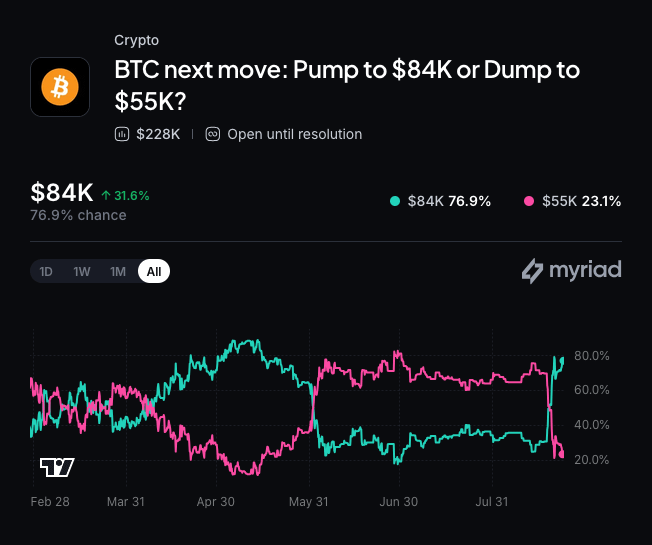
This $6.44 billion figure is a nominal number, not the actual amount of money changing hands. Most contracts on Friday are deeply out of the money, meaning no settlement will be triggered and they’ll simply expire. The heaviest-weight strike prices—$75,000 and $80,000—mark where the option sellers hold their largest positions, not the price level that the market is destined to hit.
Traders focus on a price called “max pain,” the strike at which the maximum volume of contracts expires worthless. Deribit’s max pain for the August 28 expiry is around $70,000—about $9,000 to $11,000 below today’s Bitcoin price.
Not everyone is preparing for chaos. Frank Hepworth, CEO of New Market Trading, told TheStreet that expiration week “always sounds more scary than it is,” noting that on Friday 62% of contracts are headed for expiring worthless, while the size of the September expiry has already shown itself to be nearly twice as large.
Hepworth notes that if the pullback sparked by this week’s hot PCE data continues into Friday, the key price level to watch is Bitcoin’s 200-day moving average (around $69,000).
Large expiries do not automatically push Bitcoin’s price. In the $15 billion expiry in June 2025, the max pain point was at $102,000 and implied volatility was at the lowest level since October 2023, yet Bitcoin barely moved at all.
The $13.3 billion Deribit expiry in December was met with a similarly muted market reaction, even though the biggest pain point was near $100,000 to $102,000.
The difference in Friday’s setup is where the pressure sits, not how far the max pain point is from the spot price. Bitcoin’s trading price is already close enough to the $75,000 and $80,000 strike levels to keep market makers’ hedging active; and this expiry is also happening in sync with the rest of this week’s catalysts, including Wednesday’s spot Bitcoin and Ethereum ETF inflows, as well as Warsh’s speech at Jackson Hole on Friday.
Deribit’s contracts will settle Friday at 08:00 UTC, roughly overlapping with the time window when Warsh takes the stage at Jackson Hole. According to Hepworth, the options book for September has been accumulating toward a direction approaching nearly double the size seen a week from Friday—setting up a bigger test in three weeks.