
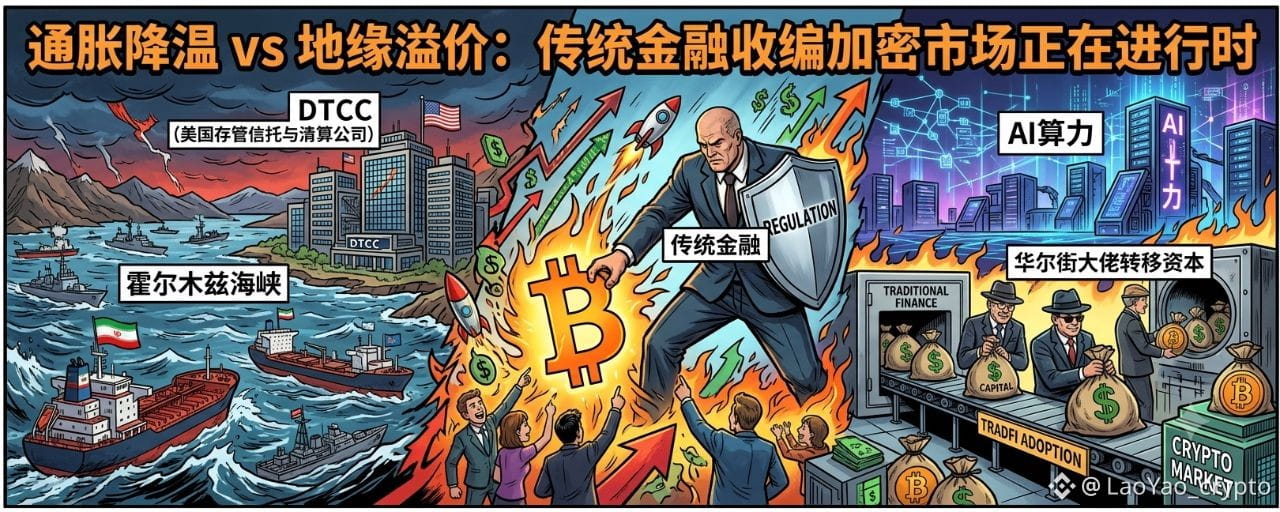
Over the past 24 hours, the situation in the Middle East has remained the key variable for global markets. Capital markets have been caught in a back-and-forth tug-of-war between "cooling inflation expectations" and "geopolitical risk premium";
The crypto market continues to trade weakly in a range; the pattern of investors pooling around the top names while the industry tracks diverge is becoming increasingly clear.
And with the U.S. Depository Trust & Clearing Corporation (DTCC) teaming up with Wall Street to pilot stock tokenization, Wall Street settlements are entering the blockchain era.
This also means that traditional finance has moved to bring the crypto market under its wing—an ongoing process.
🧱 Geopolitical chessboard:
Escalation in the Iran-U.S. conflict — Trump says he currently has no intention of negotiating with Iran
Late Wednesday evening, the U.S. military launched a new round of “second wave” airstrikes—marking the eighth consecutive day of U.S. strikes on Iran.
The Islamic Revolutionary Guard Corps reiterates that the Strait of Hormuz will continue to remain closed to maritime traffic. Tehran has also warned that it does not rule out blocking more energy routes, making the energy game the core bargaining chip of this round of conflict.
On the 15th, Trump clearly said he currently has no intention of negotiating with Iran, but he revealed that contacts on both sides have not been interrupted. His representative—“about an hour ago”—still had dealings with Iran. He said bluntly that Iran “violates the agreement every time it reaches one,” casting doubt on the sincerity of the negotiations.
🧘 The heart-study of the crypto world:
War is not the goal—it is the final bargaining chip in negotiations over interests.
Escalation of conflict does not mean both sides refuse to negotiate;
Frequent release of tough signals doesn’t necessarily mean an endless escalation of war.
What truly affects the capital market is never the gunfire—it’s when the market starts believing which outcome.
💹 Capital map: a macro picture with intertwined longs and shorts
The biggest change in global markets today isn’t war escalation or PPI falling—it’s that capital has started trying to rebalance the two pricing logics: “geopolitical risk” and “improving liquidity.”
📈 U.S. stocks: inflation data cools; technology and bank stocks rebound steadily.
- Nasdaq +0.62%
- S&P 500 +0.38%
- Dow Jones +0.29%
🛢️ Crude oil: narrow-range consolidation near highs
WTI holds near $79 per barrel, while Brent hovers around $85 per barrel.
Geopolitical risk supports oil prices, and concerns about secondary inflation have not fully faded.
🥇 Precious metals: Gold strong, silver weak
Gold trends higher while silver is clearly weaker; the gold-to-silver ratio keeps widening.
💵 FX: the U.S. dollar falls, non-U.S. currencies strengthen
PPI data drags down the U.S. dollar index; the yen remains weak under pressure from the U.S.-Japan interest-rate spread; the euro and the pound edge higher slightly; the renminbi appreciates in parallel.
🏛️ Wall Street settlement enters the blockchain era
U.S. Depository Trust & Clearing Corporation (DTCC) recently announced that it has started a stock-and-Treasury tokenization pilot with nearly 40 financial institutions, marking a major step forward for Wall Street toward blockchain-based settlement. The program allows eligible securities to be converted between traditional and tokenized forms while preserving full legal rights.
The participating pilot institutions include JPMorgan, Goldman Sachs, BlackRock, Vanguard Group, and the New York Stock Exchange, among others. They will tokenize the selected assets held in DTCC custody, and then complete trade settlement on blockchain networks.
The first basket of assets includes major ETFs such as Microsoft shares, Circle equity, QQQ and SPY, plus Treasury ETF and U.S. government bonds. DTCC plans to officially launch this service in October this year; at that time, financial institutions will be able to tokenize eligible securities held in their clearinghouse custody.
① The U.S. June PPI year-on-year rate is 5.5%, with a clear slowdown in the pace of increase
Below expectations at 6.2%; the prior figure was also revised down from 6.5% to 6.0%.
This is the first time since August 2025 that U.S. PPI has declined, and also the largest drop since April 2025. A 6.4% plunge in energy prices is the main driver.
② Fed Chair Waller continues to send hawkish signals
At a Senate hearing, he said bluntly, “I’m not satisfied with any inflation indicator,” emphasizing that recent data has not fully reflected underlying inflation pressure. He implied that he will review the balance sheet and use interest-rate tools to address persistent inflation.
③ SpaceX’s stock price first falls below its IPO offering price
Down for four consecutive trading days; it touched $133.35 intraday, a sharp drop from last month’s high of $225, and market enthusiasm has clearly cooled off.
④ Anthropic is preparing for an IPO roadshow; the earliest listing is in October
If it ultimately lands, it will be the OpenAI that leads the originally planned schedule by being pushed back to 2027, becoming the first AI giant to list on the U.S. stock market.
🧘 The heart-study of the crypto world
Capital never changes direction because of news; it only reprices because of expectations.
Once the market starts believing inflation can come down, even if the war continues, risk assets may still rise.
So the biggest enemy of investing isn’t the news—it’s emotions.
💸 Web3 roundup: structural differentiation amid weak consolidation
Over the past 24 hours, the crypto market as a whole has shown the operating characteristics of “weak consolidation, funds clumping at the top, and a bifurcated competitive landscape.”
The crypto market hasn’t shown a trend-driven rally, but its internal structure is quietly changing:
Institutions continue to flow back into BTC; capital is beginning to refocus on the ETH ecosystem, while regulatory policy is gradually becoming a new long-term driving force.
$BTC Trading in a narrow range around 65K; spot ETF turns to net inflows; clear signs of institutional funds returning; market share remains strong.
$ETH Extending the uptrend and reclaiming the $1,900 level, with clearly stronger elasticity than BTC; funds are showing a structural switch.
① Japan (Financial Instruments and Exchange Act) amendment takes effect
Crypto assets are officially included in the category of financial products. The tax system is changed to about 20% separated taxation, while insider-trading restrictions are also introduced—compliance takes another step forward.
② The U.S. and the U.K. jointly issue a regulatory statement on stablecoins
Both sides plan to coordinate cross-border payments, settlement, and capital-market regulatory alignment. They will make it clear that stablecoins must be fully backed 1:1 by high-quality liquid assets, and that reserves must be isolated from the issuer’s own funds, ensuring holders’ priority claims and redemption rights.
③ Bitmine’s ETH staking revenue in the last quarter was $45.7 million
This accounts for 98% of its total revenue; it has already staked about 4.9 million ETH. Tom Lee, the helm, expects that once all staking is completed, annualized returns could reach $284 million.
④ Musk commits to fully open-source X after completing a security review
It claims it will achieve complete “no exceptions” open-source release and will introduce third-party audits to verify that the actual running system matches the open-source code, thereby rebuilding user trust.
🧘 The heart-study of the crypto world
Regulation and decentralization are never opposites—they are interdependent.
A truly mature financial system is not one without regulation; it is one that builds a trustworthy framework between innovation and security.
Web3 will eventually change finance; but what truly pushes the industry into the mainstream is still institutional building, not just a technical revolution.
🧘 Conclusion:
From an investor’s perspective, what truly deserves attention is never what happened today, but what capital is starting to believe again.
War can create panic; inflation can change interest rates; AI can reshape industries, while regulation is rebuilding the financial order.
Understanding the news only tells you what is happening in the world; understanding how capital prices things is what helps you understand why the market rises or falls.
Investment, in essence, is not forecasting the future; it is insisting on judgments about trends in a noisy world.
📌 LaoYao(@LaoYao_crypto o)
Using the heart-study as a blade, it dissects the truth deep within the power structure of the crypto world.