


Author: Climber, Golden Finance
Inscription
Inscriptions are digital cultural products native to the blockchain. They are created by writing content into satoshi (the smallest unit of Bitcoin) using the Ordinals protocol and can be viewed using the Ordinals Explorer. Inscriptions do not require the use of separate tokens, sidechains, or changes to Bitcoin.
Ordinals, a protocol created by software engineer Casey Rodarmor on the Bitcoin mainnet, was officially launched on January 21 this year. It is a system for numbering the smallest unit of Bitcoin, Satoshi. Satoshi is numbered according to the order in which they are mined and transferred, and the transfer scheme is based on the order of transaction input and output, so it is called "Ordinals".
The Ordinals protocol is a system for numbering sats, giving each sat a serial number and tracking them in transactions. In short, users can attach additional data and make transactions through Ordinals, a process called "recording".
Ordinals are recorded directly on a single satoshi and then included in blocks on the Bitcoin blockchain. Ordinals reside entirely on the blockchain, without the need for sidechains or separate tokens. In this sense, Ordinals records inherit the simplicity, immutability, security, and durability of Bitcoin itself.
Ordinals allow users to create ordinals by attaching additional data, that is, in addition to JPEG, PDF, video and audio content can also be used to create ordinals, making individual Satoshis unique NFTs.
Ordinals opens up new use cases for Bitcoin, such as NFTs and new token standards. Digital artworks created with Ordinals also have many advantages over other NFTs.
Bitcoin Ordinals is a system that allows people to order, identify "satoshis" and inscribe digital content to create digital art. Satoshi is the smallest unit of Bitcoin, which is 0.00000001 Bitcoin, which means that 1 Bitcoin is 100 million Satoshi.
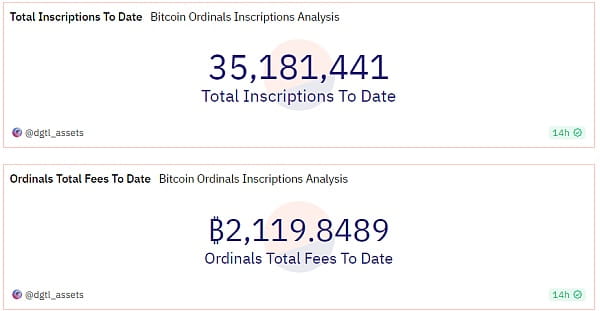
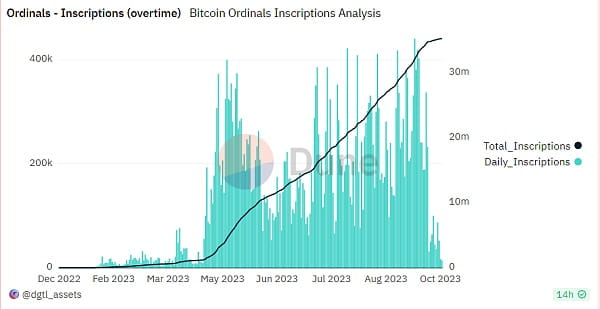
According to Dune data, the total number of Bitcoin inscriptions has reached 35 million, and the total cost generated is 2119.8 BTC. From the perspective of quantity growth, it has been in a steady upward trend since its birth.
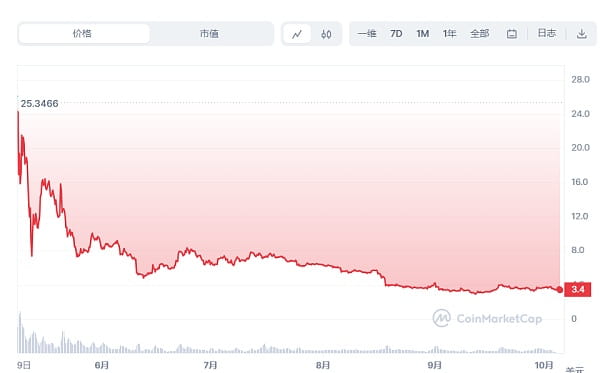
However, its token ORDI has fallen from a high of $25.34 to $3.4, a drop of 86.7%.
Meme
The crypto market is still in a deep bear phase in 2023, but there are still currencies that have increased by thousands or tens of thousands of times, and the most representative of them is PEPE.
Meme coins generally refer to cryptocurrencies that have no actual use cases or application value, but attract users and investors through "hot topics" and "fun" on social media and the Internet. These currencies are usually highly volatile and risky.
Most popular meme tokens are dog-themed, but this year’s most popular one, PEPE, is frog-themed.
PEPE is a deflationary meme coin launched on Ethereum. The cryptocurrency was created as a tribute to the Pepe the Frog internet meme created by Matt Furie, which became popular in the early 2000s.
The project aims to capitalize on the popularity of meme coins like Shiba Inu and Dogecoin and strives to establish itself as one of the top meme-based cryptocurrencies. PEPE appeals to the cryptocurrency community by instituting a tax exemption policy, a redistribution system that rewards long-term stakeholders, and a burn mechanism that maintains the scarcity of PEPE coins.
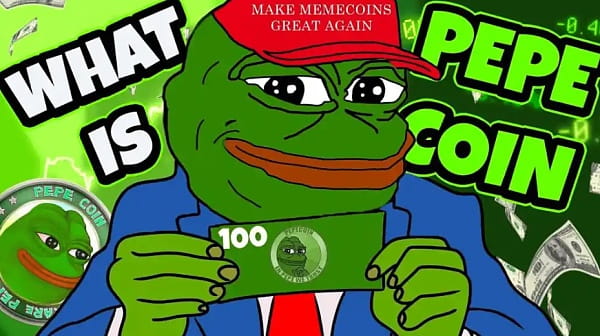
The MEME official Twitter account published its first tweet on April 5, and then launched PEPE trading on April 15. The initial price of PEPE was about $0.000000001, and the total supply was 420.69 trillion.
Its token economics are as follows:
Total supply = 42.69 trillion
93.1% supply liquidity pool = 391.66 trillion (LP token destruction)
6.9% to the team = 29.03 trillion
In April this year, news about profits from investing in the token broke out one after another. They included: a Smart Money address bought 2.52 trillion PEPE (currently worth $816,000) with 0.013 ETH (about $25), making a profit of 32,000 times; Smart Money starting with 0x4a spent 0.125 ETH (about $251) to buy 5.9 trillion PEPE, and the literal market value reached about $1.7 million in just 4 days, an increase of more than 6,000 times.
After PEPE went viral, it also triggered a new wave of meme fever. Since PEPE could be traded on April 15, it has continuously set new highs, and has successively exploded myths of getting rich by 100 times and 1,000 times, and has been listed on CEXs such as Binance and OKX. The market value has also exceeded 1.3 billion US dollars, which has completely ignited the meme coin craze in the market. The community began to rush to various local dogs crazily, and even pushed Uniswap's daily activity to a new high since May 2021.
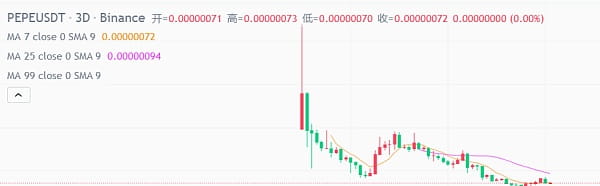
However, after PEPE was launched on Binance in early May, it entered an infinite plunge mode, and its profit growth since its birth has dropped to 1082.06%.
The news that the PEPE team dumped the tokens and ran away in August this year made it even more difficult to recover. The media reported that three former PEPE team members were accused of stealing 16 trillion PEPE tokens and selling them on various cryptocurrency exchanges, and then deleted their social media accounts. After the incident, the token price fell by nearly 20%, causing panic among investors.
Although the official said that the remaining 10 trillion tokens in the multi-signature will be transferred from the old multi-signature to the new wallet, the developers will store them safely in the new wallet. After eliminating the internal contradictions, the prospects of PEPE are bright. It is planning to use the remaining tokens to purchase the PEPE domain name, and the remaining tokens will be destroyed in the future.
But judging from the results, PEPE is clearly heading into the dark night. For ordinary investors, losses have become an established fact.
The new Pepe token is essentially what the old Pepe token should be, meaningless and worthless, and investors should treat it more rationally.