
Captain
7.2k Posts

Captain
Report
Block User
Latest News , Chart , Information .
X : bnbcaptain
Open Trade
Frequent Trader
7.1 Years
8 Following
24.7K+ Followers
38.7K+ Liked
Posts
Portfolio
All
Quotes
Videos
Live
·
--
See translation
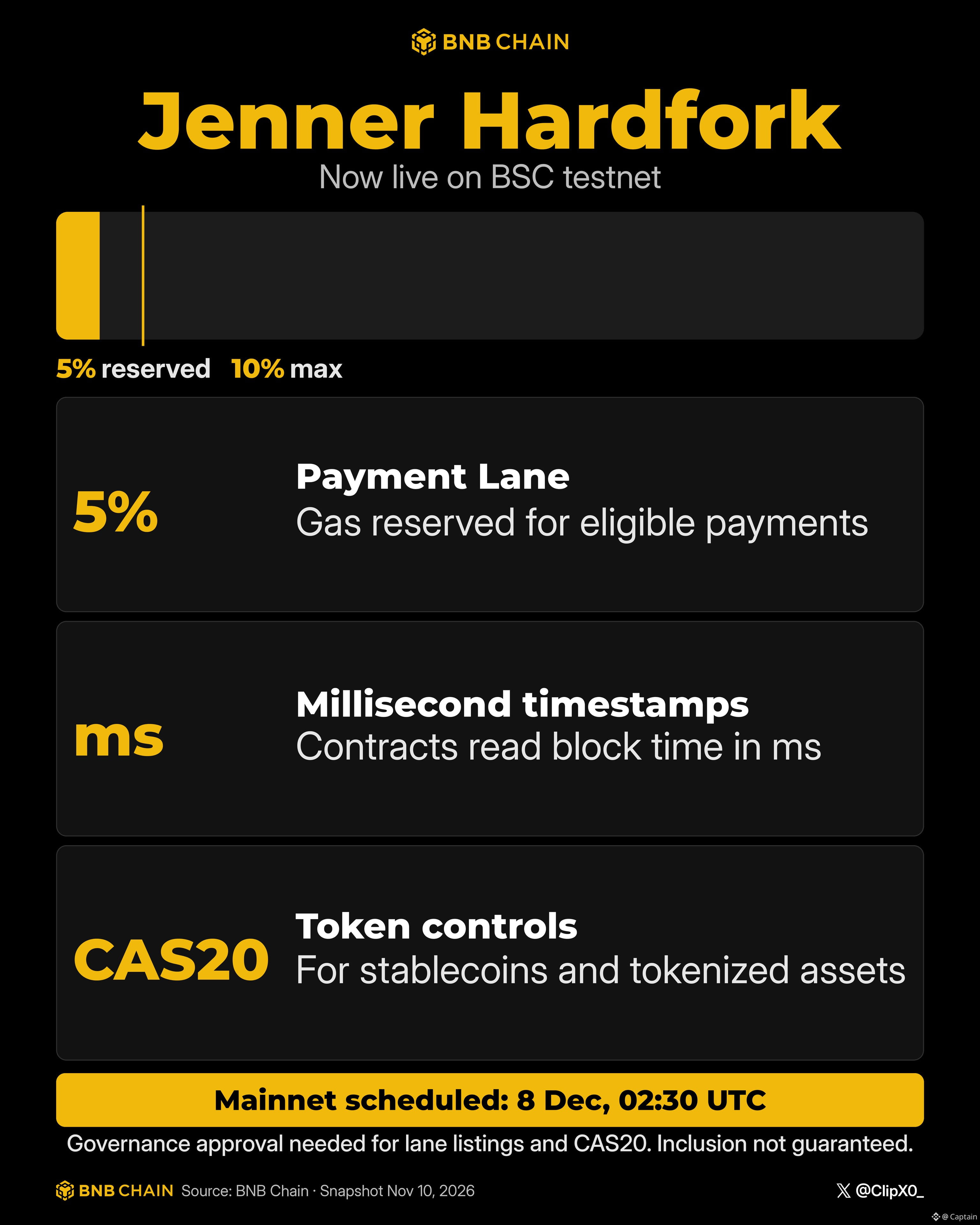
Jenner is the next BSC upgrade, with three changes for payments, timing and tokens. It's been live on testnet since Oct 29, and mainnet is scheduled for Dec 8, 2026, 02:30 UTC, so it isn't on mainnet yet.
• Payment Lane: 5% of each block's gas is reserved for payments as a group, and other transactions can't use that slice. When blocks get busy, payments still have reserved room. It covers payments as a group, not any single payment, and fees and ordering don't change.
• What qualifies: nonzero $BNB transfers to wallets with no code. Token and stablecoin payments qualify only after governance lists their contracts, and that list starts empty. Governance can raise the share to 10% max.
• Millisecond timestamps: contracts can read block time in milliseconds via a precompile at 0x70, while block.timestamp still returns seconds. Apps that depend on timing, like quote expiry or auction cutoffs, get a finer clock. Blocks are not any faster.
• CAS20: a token standard built into the protocol, with allowlists, blocklists, pausing and separate mint, burn and seizure roles, and it stays BEP-20 compatible. Issuers of stablecoins and tokenized assets get these controls built in, and wallets that already support BEP-20 can work with them. Token creation opens only after governance appoints an admin, and the controls alone don't make a token legally compliant.
Which of the three matters most for what you're building?
53
·
--
See translation
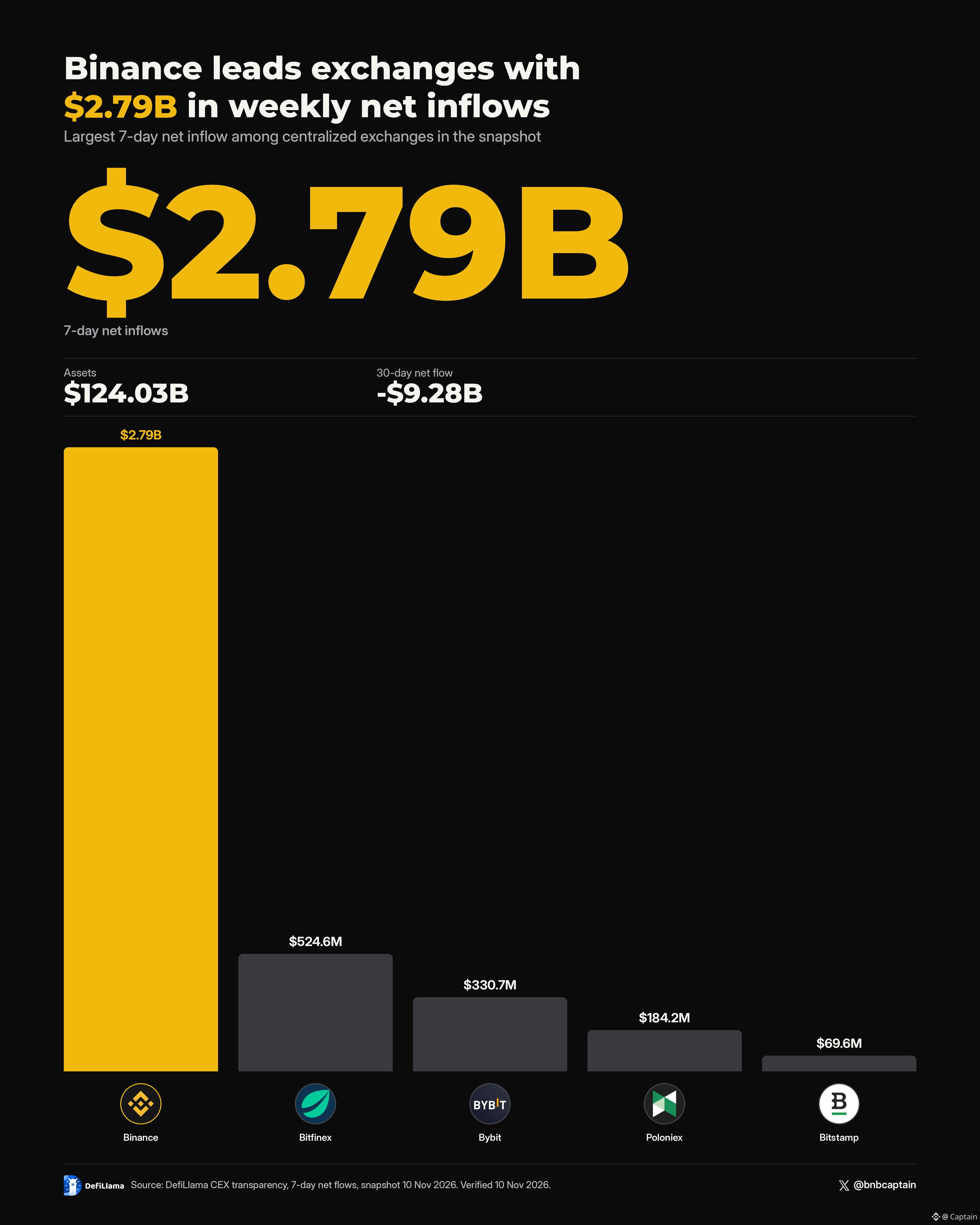
Binance had the largest 7-day net inflow among centralized exchanges: +$2.79B.
• Bitfinex: +$524.6M
• Bybit: +$330.7M
• Poloniex: +$184.2M
• Bitstamp: +$69.6M
• Binance assets: $124.03B
• Binance 30-day net flow: -$9.28B
What do you make of the 7-day vs 30-day split?
Binance had the largest 7-day net inflow among centralized exchanges: +$2.79B.
• Bitfinex: +$524.6M
• Bybit: +$330.7M
• Poloniex: +$184.2M
• Bitstamp: +$69.6M
• Binance assets: $124.03B
• Binance 30-day net flow: -$9.28B
What do you make of the 7-day vs 30-day split?
• Bitfinex: +$524.6M
• Bybit: +$330.7M
• Poloniex: +$184.2M
• Bitstamp: +$69.6M
• Binance assets: $124.03B
• Binance 30-day net flow: -$9.28B
What do you make of the 7-day vs 30-day split?
50
·
--
See translation
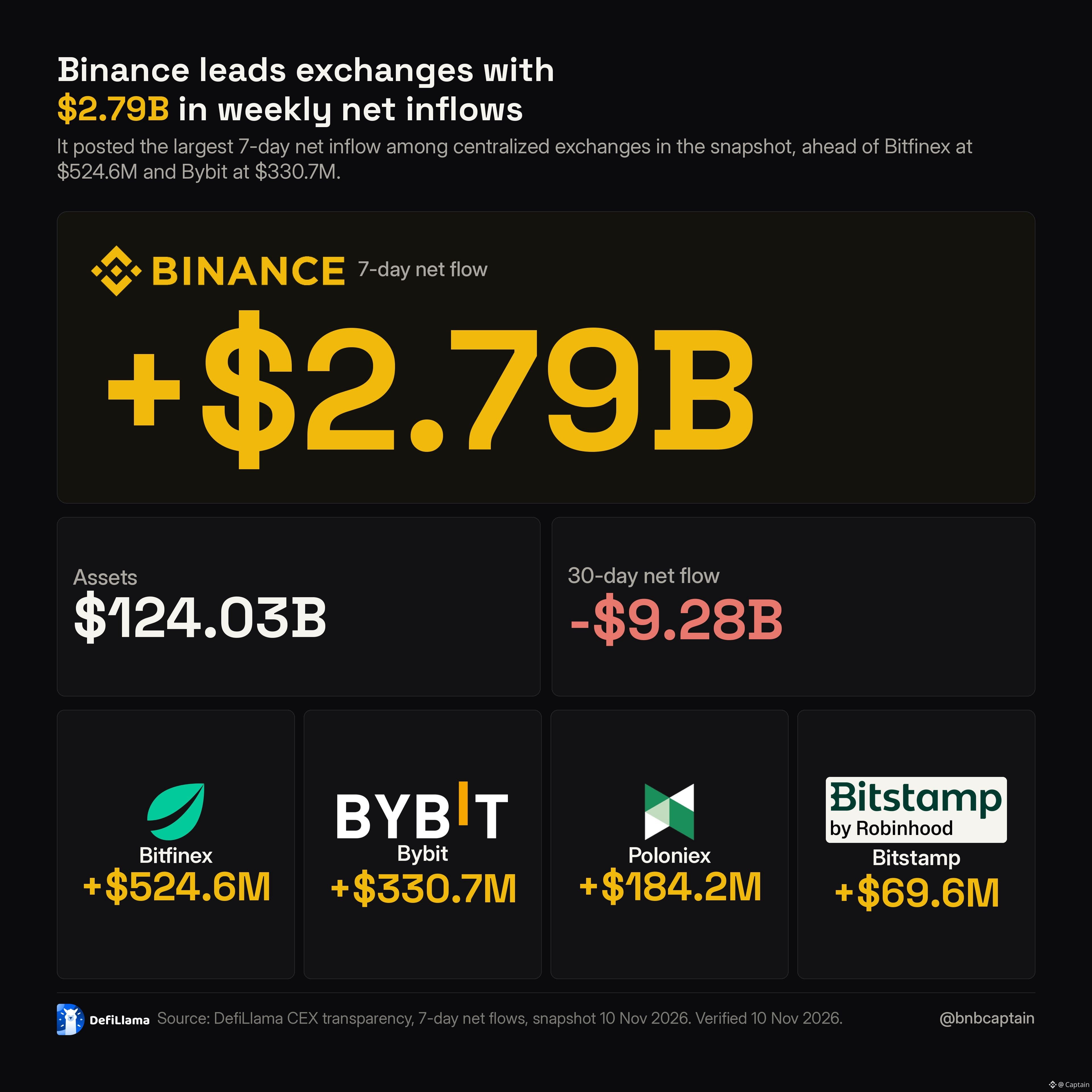
Binance had the largest 7-day net inflow among centralized exchanges: +$2.79B.
• Bitfinex: +$524.6M
• Bybit: +$330.7M
• Poloniex: +$184.2M
• Bitstamp: +$69.6M
• Binance assets: $124.03B
• Binance 30-day net flow: -$9.28B
What do you make of the 7-day vs 30-day split?
Binance had the largest 7-day net inflow among centralized exchanges: +$2.79B.
• Bitfinex: +$524.6M
• Bybit: +$330.7M
• Poloniex: +$184.2M
• Bitstamp: +$69.6M
• Binance assets: $124.03B
• Binance 30-day net flow: -$9.28B
What do you make of the 7-day vs 30-day split?
• Bitfinex: +$524.6M
• Bybit: +$330.7M
• Poloniex: +$184.2M
• Bitstamp: +$69.6M
• Binance assets: $124.03B
• Binance 30-day net flow: -$9.28B
What do you make of the 7-day vs 30-day split?
73
·
--
See translation
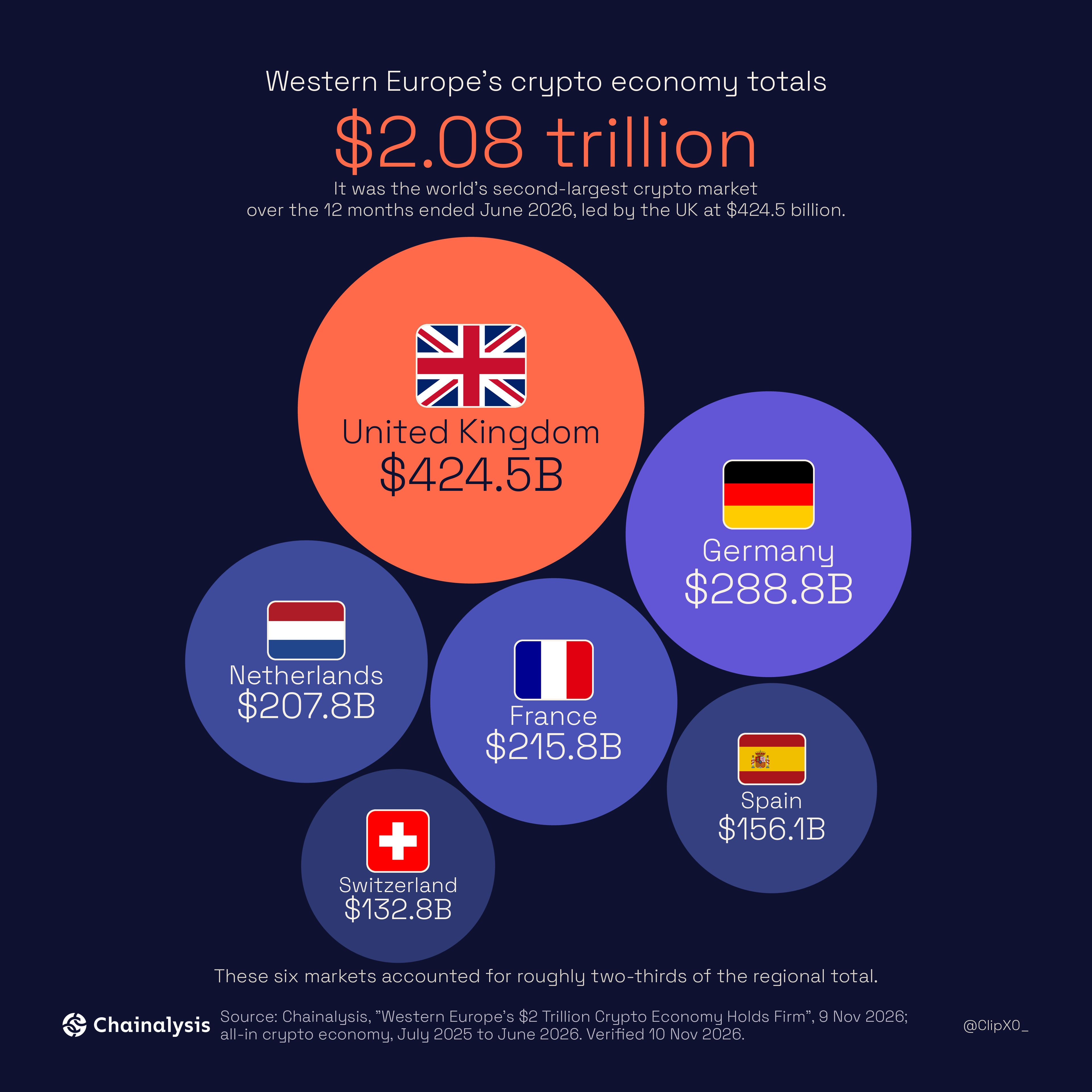
Western Europe's crypto economy totaled $2.08 trillion from July 2025 to June 2026, the second-largest region in the world.
• UK: $424.5B
• Germany: $288.8B
• France: $215.8B
• Netherlands: $207.8B
• Spain: $156.1B
• Switzerland: $132.8B
Which of these markets are you in?
Western Europe's crypto economy totaled $2.08 trillion from July 2025 to June 2026, the second-largest region in the world.
• UK: $424.5B
• Germany: $288.8B
• France: $215.8B
• Netherlands: $207.8B
• Spain: $156.1B
• Switzerland: $132.8B
Which of these markets are you in?
• UK: $424.5B
• Germany: $288.8B
• France: $215.8B
• Netherlands: $207.8B
• Spain: $156.1B
• Switzerland: $132.8B
Which of these markets are you in?
131
·
--
See translation
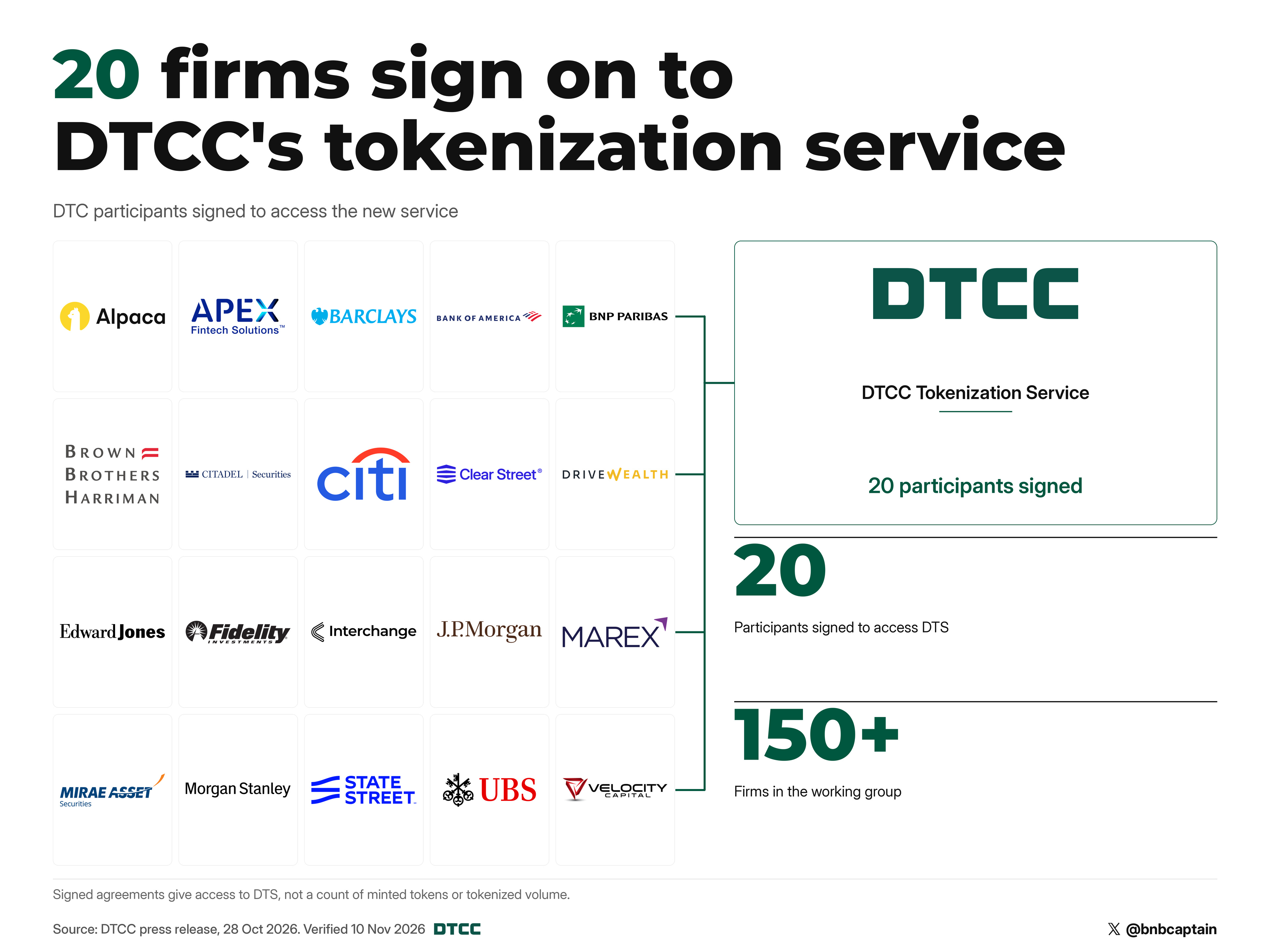
DTCC's tokenization service is live, and 20 DTC participants have signed agreements to access it.
• 20 DTC participants signed
• Built with input from more than 150 firms
Which firms do you expect to join next?
DTCC's tokenization service is live, and 20 DTC participants have signed agreements to access it.
• 20 DTC participants signed
• Built with input from more than 150 firms
Which firms do you expect to join next?
• 20 DTC participants signed
• Built with input from more than 150 firms
Which firms do you expect to join next?
121
·
--
See translation
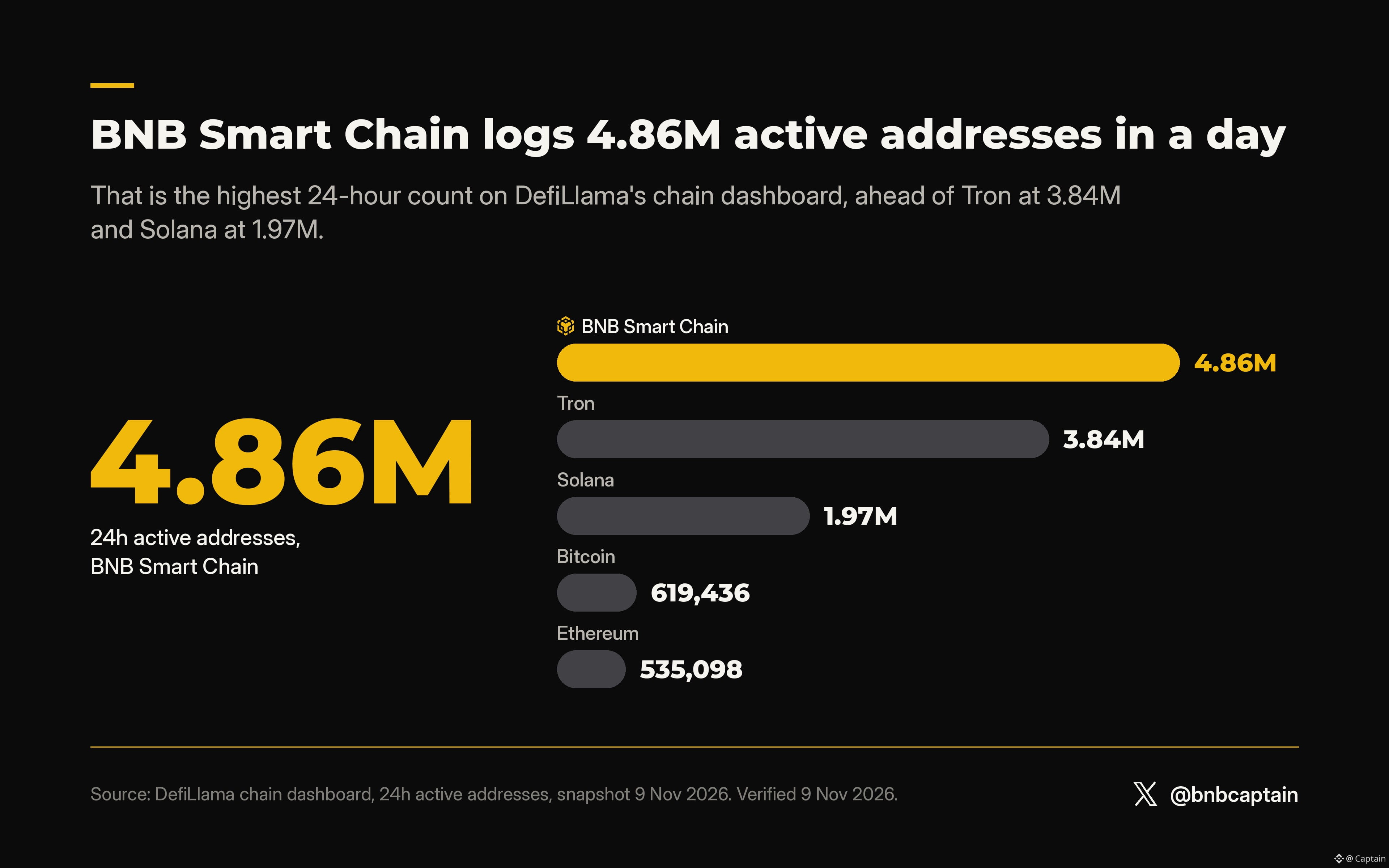
BNB Smart Chain logged 4.86M active addresses in 24h, the highest count on DefiLlama's chain dashboard.
- BSC: 4.86M
- Tron: 3.84M
- Solana: 1.97M
- Bitcoin: 619,436
- Ethereum: 535,098
Which chain do you use most for onchain activity? $BNB
BNB Smart Chain logged 4.86M active addresses in 24h, the highest count on DefiLlama's chain dashboard.
- BSC: 4.86M
- Tron: 3.84M
- Solana: 1.97M
- Bitcoin: 619,436
- Ethereum: 535,098
Which chain do you use most for onchain activity? $BNB
- BSC: 4.86M
- Tron: 3.84M
- Solana: 1.97M
- Bitcoin: 619,436
- Ethereum: 535,098
Which chain do you use most for onchain activity? $BNB
1
111
·
--
See translation
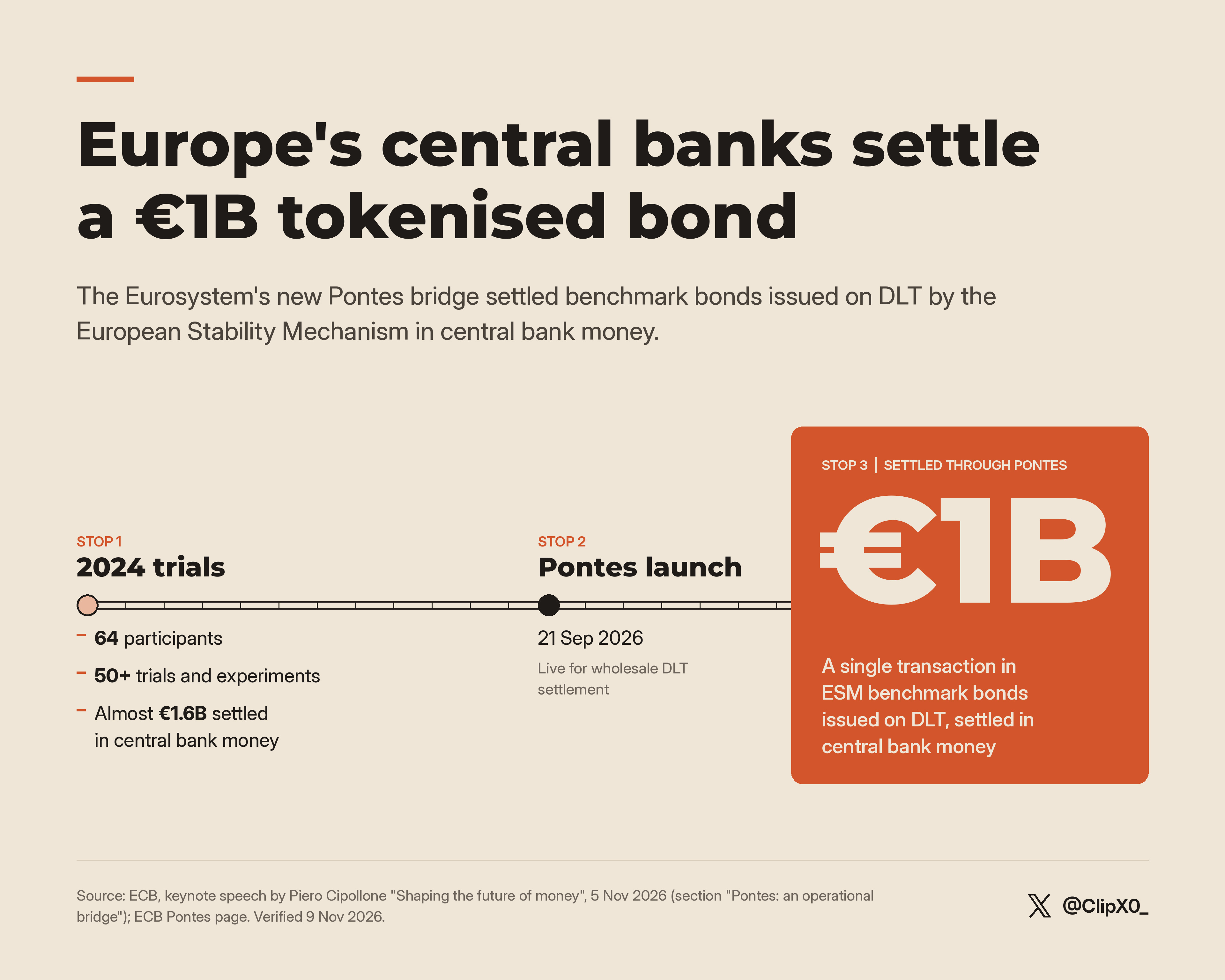
The Eurosystem's Pontes bridge settled a €1 billion transaction in ESM benchmark bonds issued on DLT, in central bank money.
- Pontes went live on 21 September 2026 for wholesale DLT settlement
- The bonds were issued on DLT by the European Stability Mechanism
- Settlement was in central bank money
Is this the path for wholesale markets?
- Pontes went live on 21 September 2026 for wholesale DLT settlement
- The bonds were issued on DLT by the European Stability Mechanism
- Settlement was in central bank money
Is this the path for wholesale markets?
126
·
--
See translation
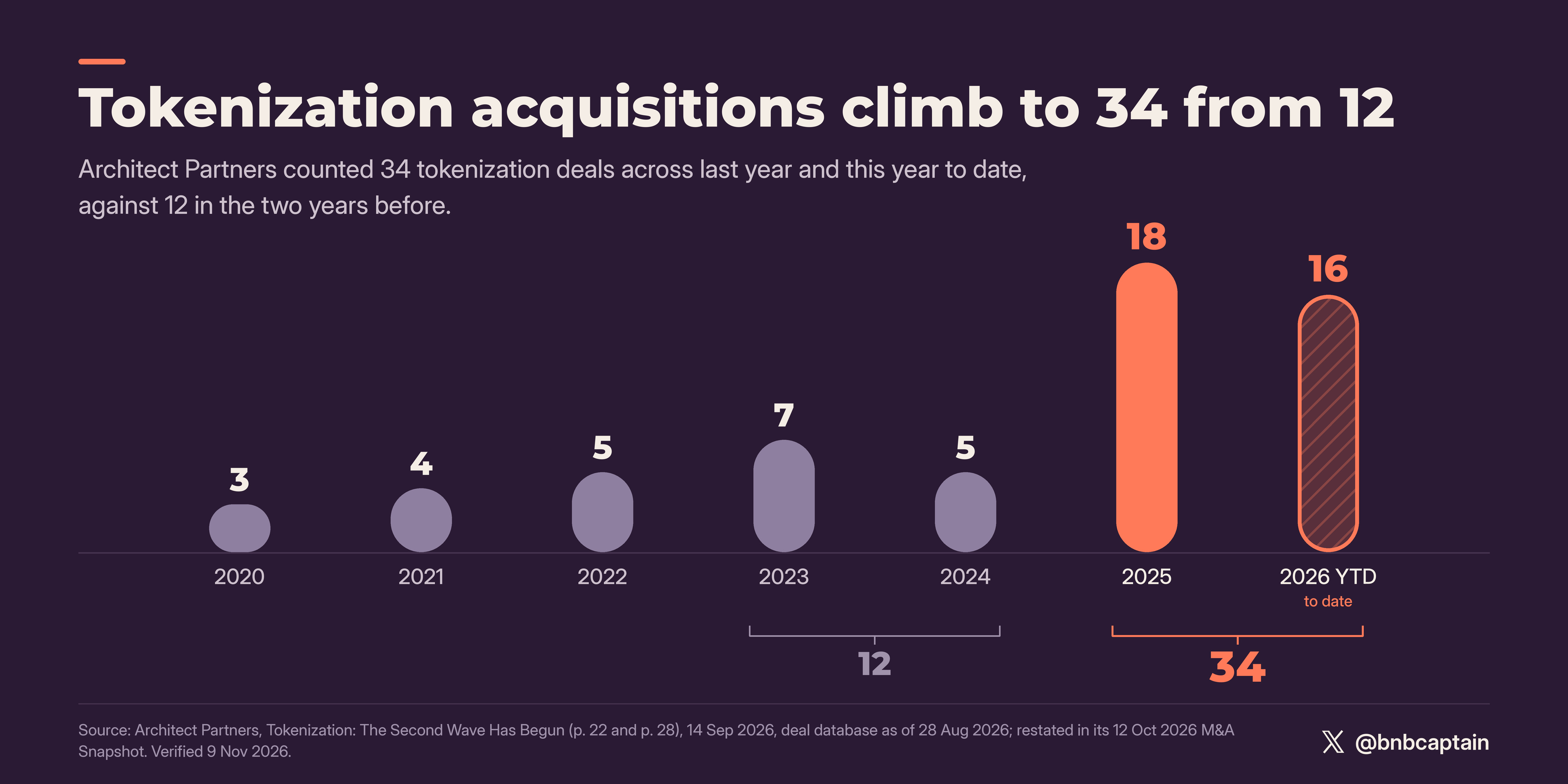
Architect Partners counted 34 tokenization acquisitions in 2025 and 2026 to date, against 12 in 2023 and 2024.
- 2023: 7
- 2024: 5
- 2025: 18
- 2026 to 28 Aug: 16
2026 is a partial year, so the 2025 and 2026 counts are not like for like.
Architect Partners counted 34 tokenization acquisitions in 2025 and 2026 to date, against 12 in 2023 and 2024.
- 2023: 7
- 2024: 5
- 2025: 18
- 2026 to 28 Aug: 16
2026 is a partial year, so the 2025 and 2026 counts are not like for like.
- 2023: 7
- 2024: 5
- 2025: 18
- 2026 to 28 Aug: 16
2026 is a partial year, so the 2025 and 2026 counts are not like for like.
484
·
--
See translation
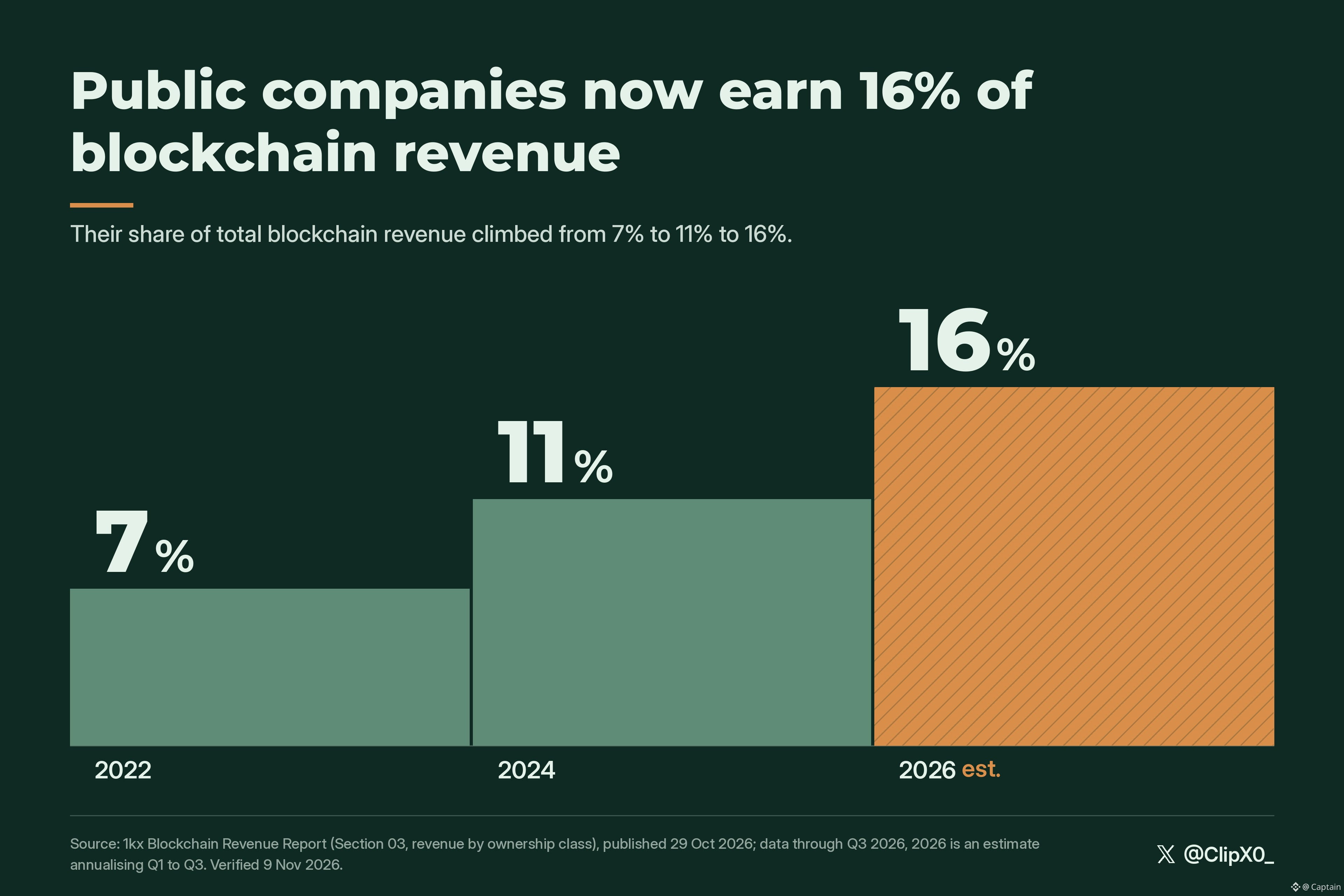
Public companies' share of total blockchain revenue climbed from 7% in 2022 to an estimated 16% in 2026.
- 2022: 7%
- 2024: 11%
- 2026 est.: 16%
The 2026 figure annualises Q1 to Q3. A larger share does not mean public-company blockchain revenue rose in dollars.
Public companies' share of total blockchain revenue climbed from 7% in 2022 to an estimated 16% in 2026.
- 2022: 7%
- 2024: 11%
- 2026 est.: 16%
The 2026 figure annualises Q1 to Q3. A larger share does not mean public-company blockchain revenue rose in dollars.
- 2022: 7%
- 2024: 11%
- 2026 est.: 16%
The 2026 figure annualises Q1 to Q3. A larger share does not mean public-company blockchain revenue rose in dollars.
137
·
--
See translation
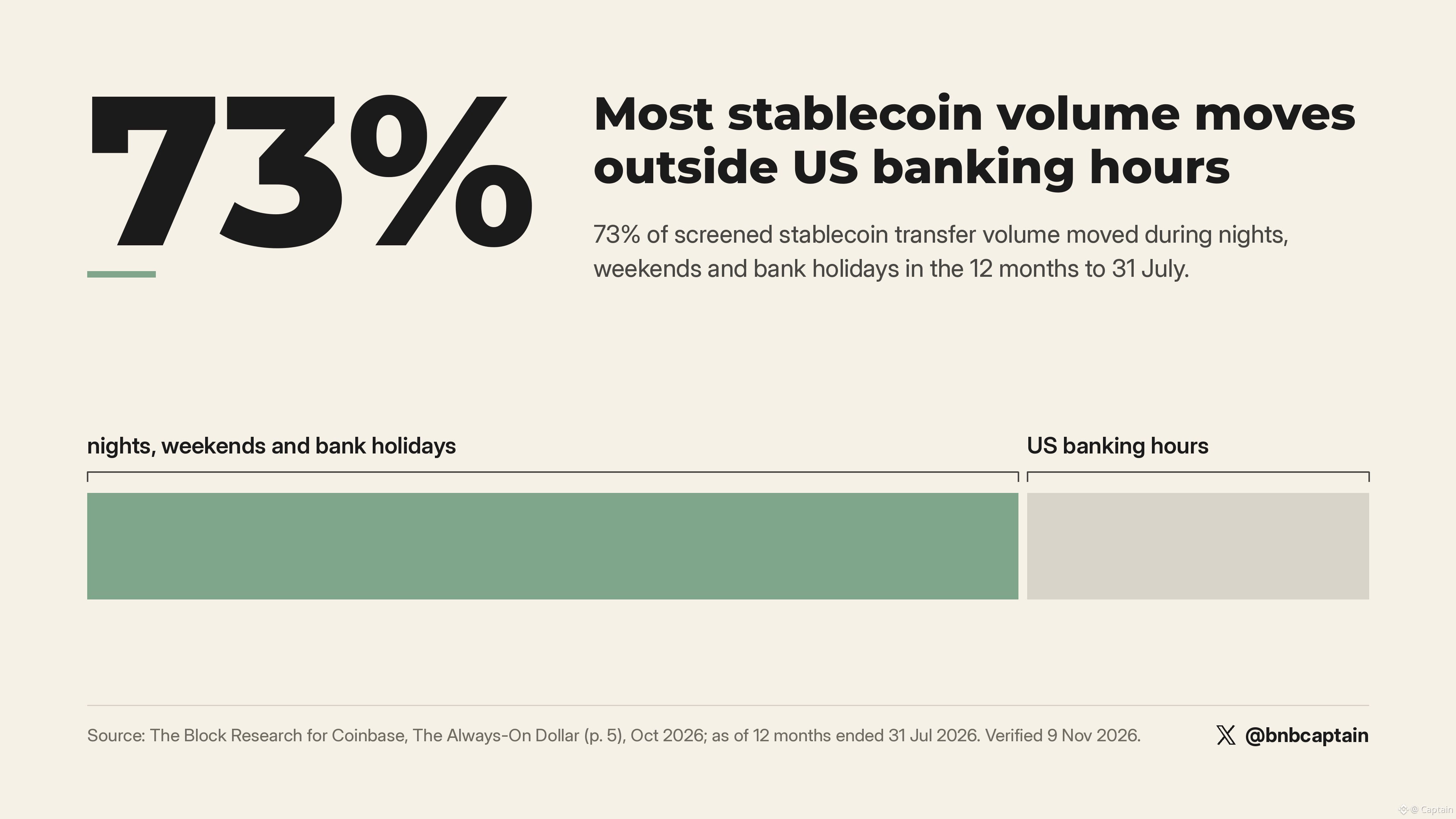
73% of industry-wide screened stablecoin transfer volume moved outside US banking hours over the 12 months ended 31 July 2026.
That includes nights, weekends, and bank holidays. Automated transactions are included.
The figures were published in October 2026.
73% of industry-wide screened stablecoin transfer volume moved outside US banking hours over the 12 months ended 31 July 2026.
That includes nights, weekends, and bank holidays. Automated transactions are included.
The figures were published in October 2026.
That includes nights, weekends, and bank holidays. Automated transactions are included.
The figures were published in October 2026.
142
·
--
See translation
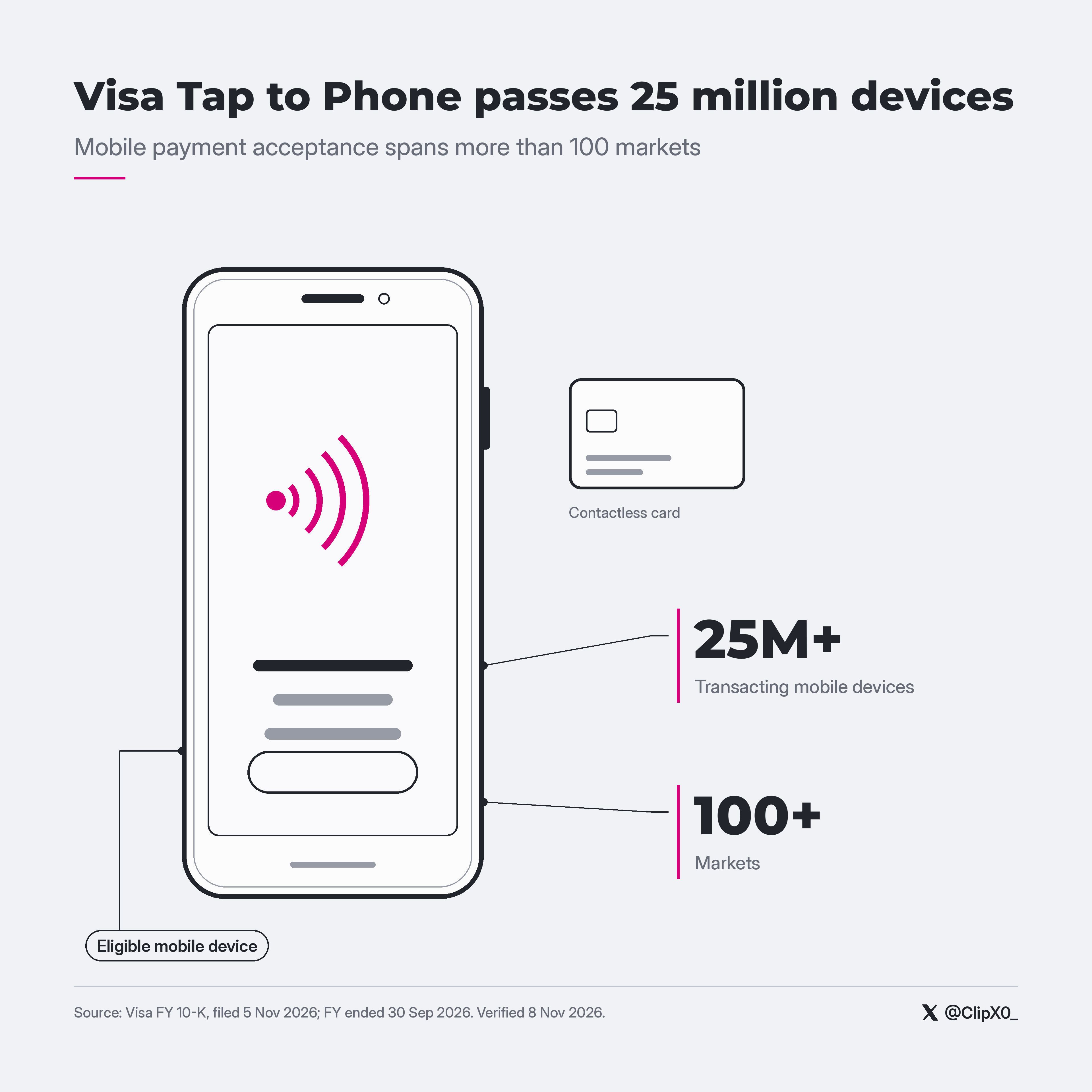
Visa said Tap to Phone surpassed 25 million transacting devices across more than 100 markets in fiscal 2026, ended 30 September.
It lets sellers accept contactless payments on eligible phones, without a dedicated terminal.
Visa disclosed the figures in its 10-K, filed 5 November 2026.
Visa said Tap to Phone surpassed 25 million transacting devices across more than 100 markets in fiscal 2026, ended 30 September.
It lets sellers accept contactless payments on eligible phones, without a dedicated terminal.
Visa disclosed the figures in its 10-K, filed 5 November 2026.
It lets sellers accept contactless payments on eligible phones, without a dedicated terminal.
Visa disclosed the figures in its 10-K, filed 5 November 2026.
71
·
--
See translation
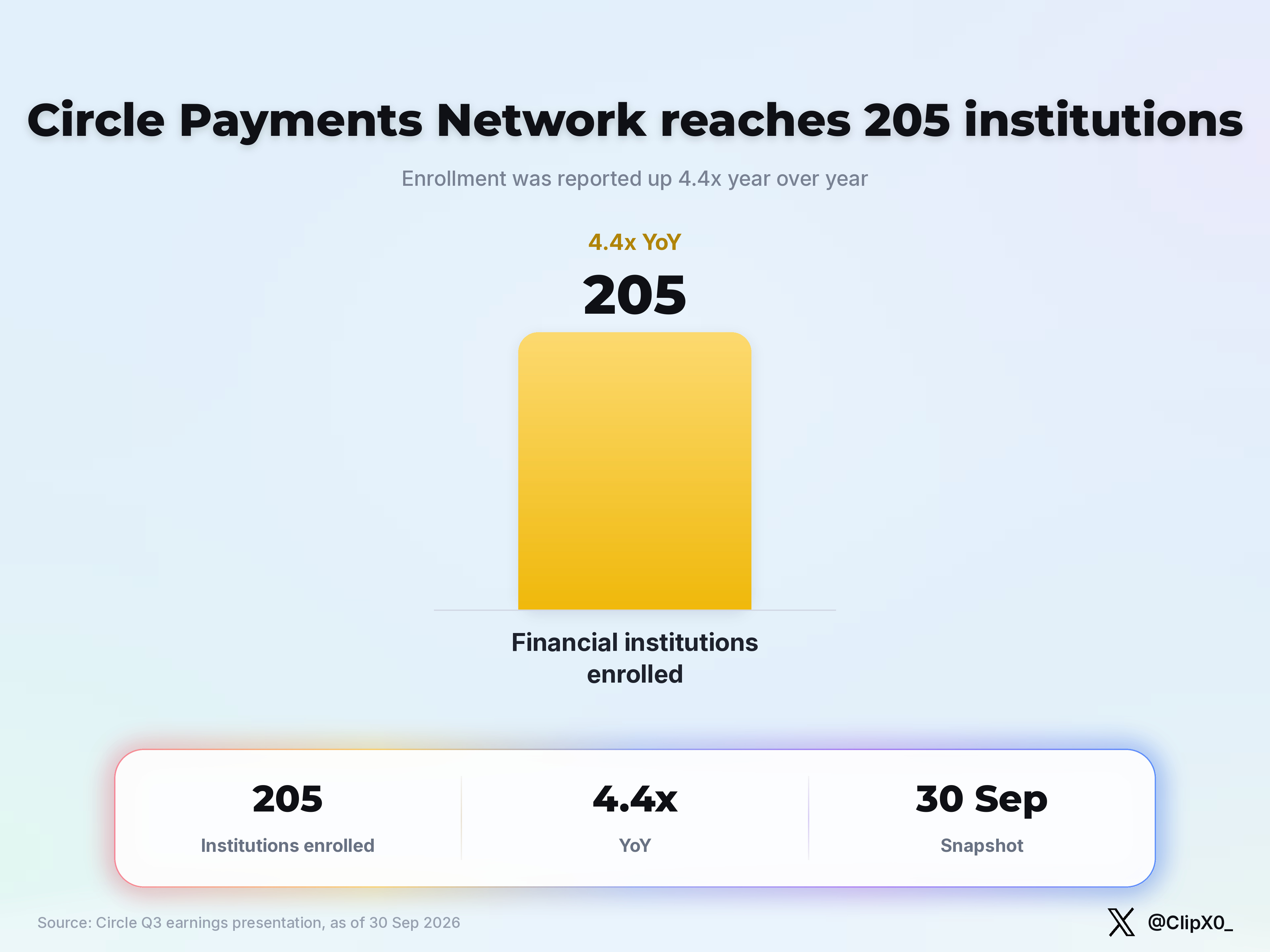
Circle reported 205 financial institutions enrolled on its Payments Network as of 30 September 2026.
Enrollment was reported up 4.4x year over year.
That is cumulative enrollment, not active usage. The figure was published on 4 November 2026.
Circle reported 205 financial institutions enrolled on its Payments Network as of 30 September 2026.
Enrollment was reported up 4.4x year over year.
That is cumulative enrollment, not active usage. The figure was published on 4 November 2026.
Enrollment was reported up 4.4x year over year.
That is cumulative enrollment, not active usage. The figure was published on 4 November 2026.
467
·
--
See translation
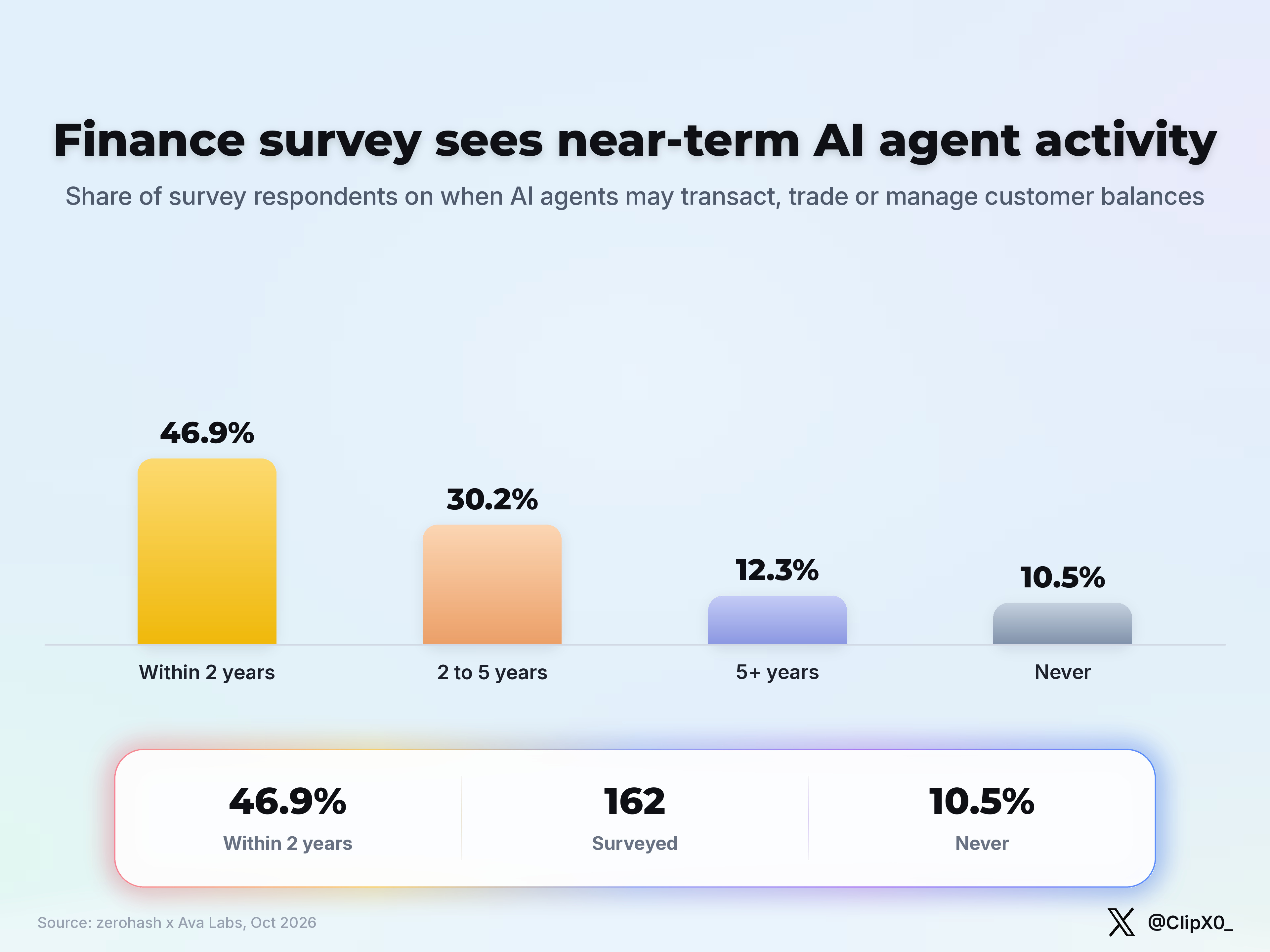
An August-September 2026 finance survey asked respondents when they expect AI agents to routinely transact, trade, or manage customer balances.
Nearly half of respondents, 46.9%, said this would happen within 2 years. Another 30.2% pointed to a 2 to 5 year timeline, so 77.1% expect it to become routine within five years. A further 12.3% said it would take 5 years or more, and 10.5% said never.
The findings are based on 162 respondents and come from Zero Hash and Ava Labs, published in October 2026.
162
·
--
See translation
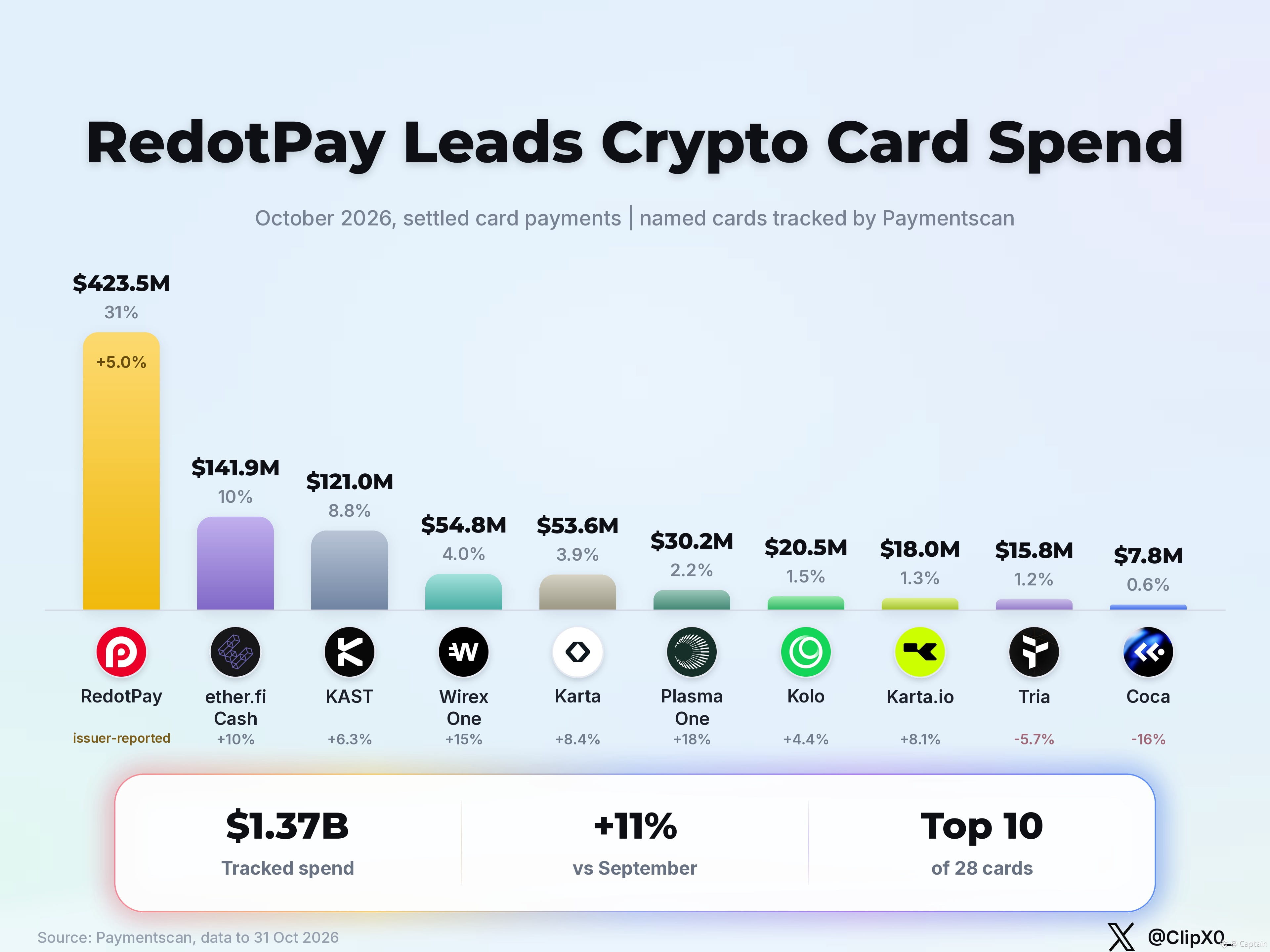
RedotPay led crypto card spend in October among named cards tracked by Paymentscan.
Settled payments on RedotPay reached $423.5 million, or about 31% of tracked spend. That figure is issuer-reported, and it was up 5.0% from the prior period. ether.fi Cash followed at $141.9 million (10%, up 10%), then KAST at $121.0 million (8.8%, up 6.3%).
Across the set, tracked spend was $1.37 billion, up 11% from September. The chart covers the top 10 of 28 cards, with data through 31 October 2026 from Paymentscan.
$ETH
56
·
--
See translation
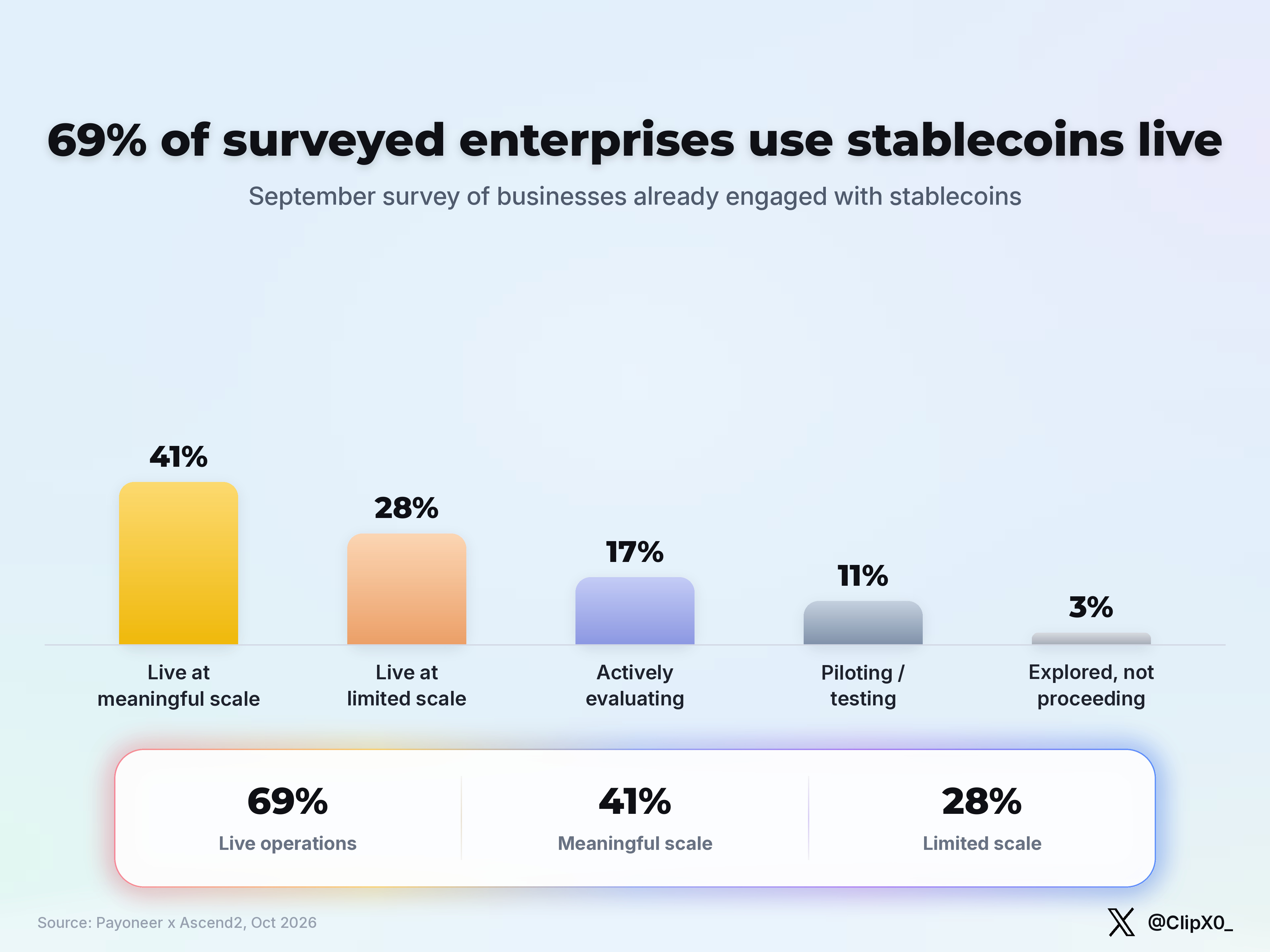
A September survey of US cross-border businesses with stablecoin experience found that most are already using them in real operations, not just testing the idea.
69% of respondents said they are live: 41% at meaningful scale and 28% at limited scale. The rest of the sample was still earlier in the process, with 17% actively evaluating, 11% piloting or testing, and 3% saying they explored stablecoins but are not proceeding.
The findings come from Payoneer and Ascend2, published in October 2026.
$USDT $USDC
1
163
·
--
See translation
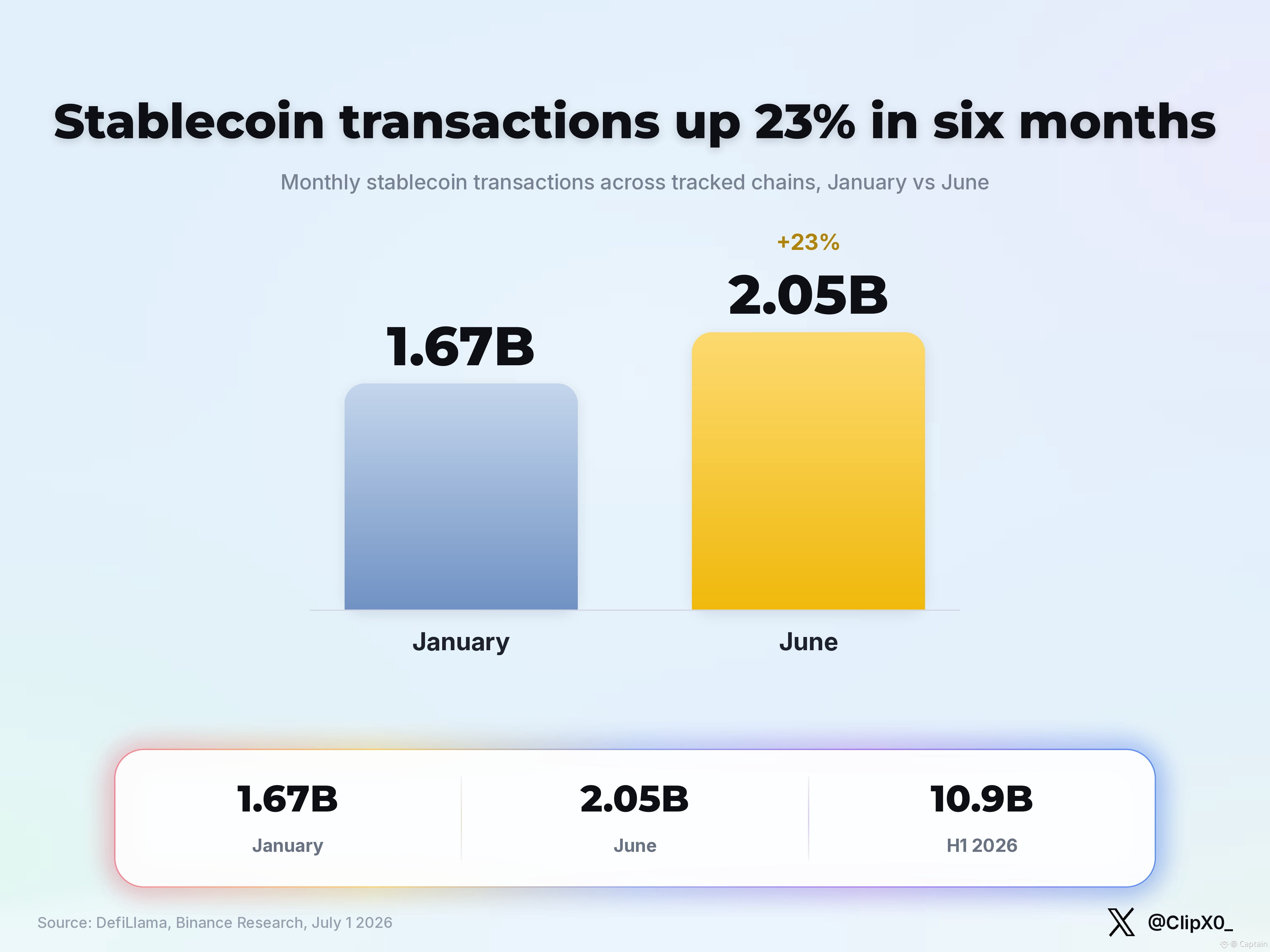
Stablecoin activity picked up across tracked chains in the first half of 2026.
Monthly stablecoin transactions rose from 1.67 billion in January to 2.05 billion in June, a 23% increase over those six months. In total, 10.9 billion stablecoin transactions were processed over H1 2026.
The figures come from DefiLlama and Binance Research, as of July 1, 2026.
$USDT $BNB
Monthly stablecoin transactions rose from 1.67 billion in January to 2.05 billion in June, a 23% increase over those six months. In total, 10.9 billion stablecoin transactions were processed over H1 2026.
The figures come from DefiLlama and Binance Research, as of July 1, 2026.
$USDT $BNB
171
·
--
See translation
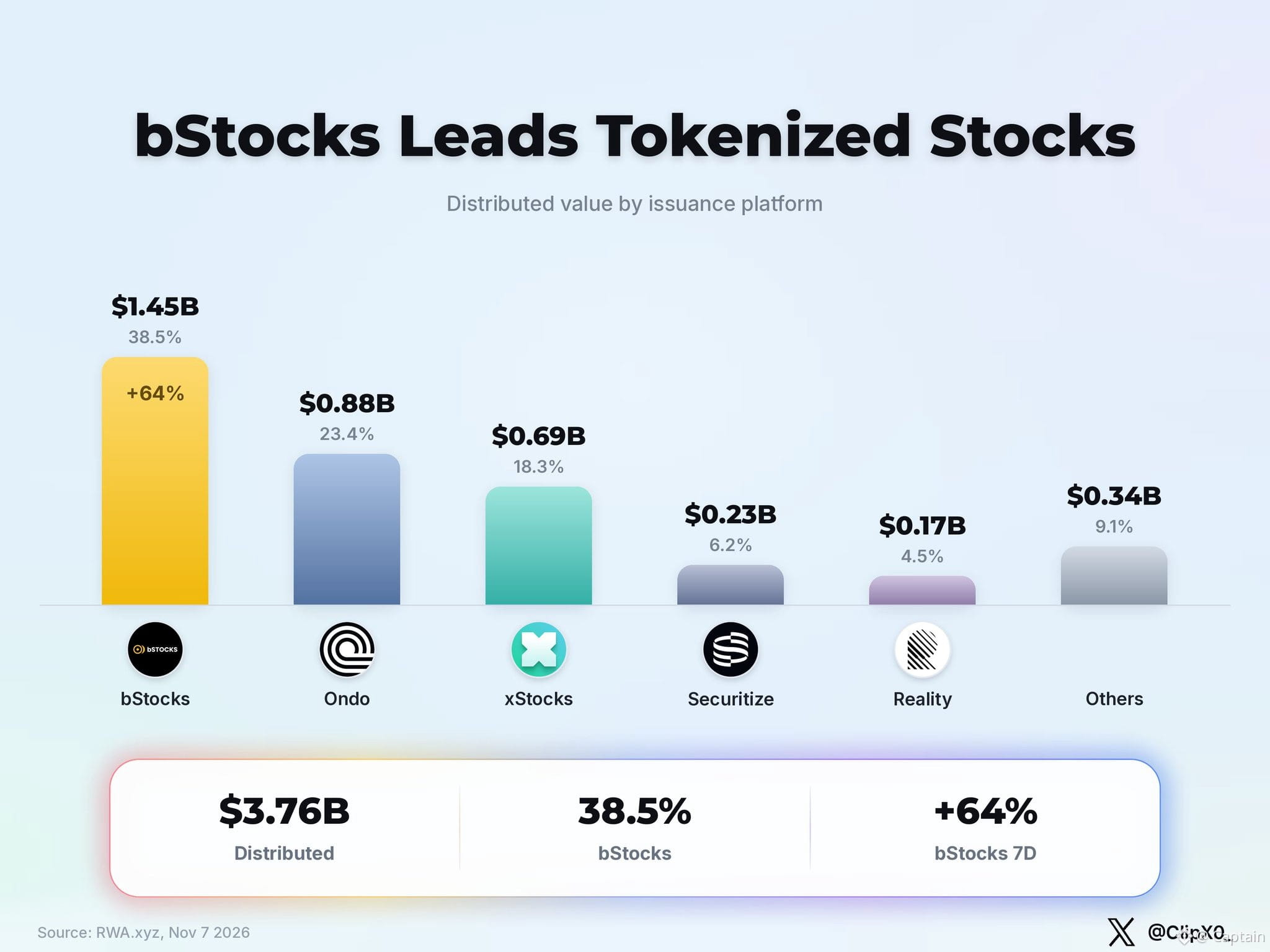
Tokenized stocks by
issuance platform.
➤ bStocks $1.45B
➤ Ondo $0.88B
➤ xStocks $0.69B
bStocks leads at 38.5%
of the $3.76B total,
up 64% over 7 days.
@binance @_RichardTeng
@heyibinance @cz_binance
@BNBCHAIN
X : @bnbcaptain
Tokenized stocks by
issuance platform.
➤ bStocks $1.45B
➤ Ondo $0.88B
➤ xStocks $0.69B
bStocks leads at 38.5%
of the $3.76B total,
up 64% over 7 days.
@binance @_RichardTeng
@heyibinance @cz_binance
@BNBCHAIN
X : @bnbcaptain
issuance platform.
➤ bStocks $1.45B
➤ Ondo $0.88B
➤ xStocks $0.69B
bStocks leads at 38.5%
of the $3.76B total,
up 64% over 7 days.
@binance @_RichardTeng
@heyibinance @cz_binance
@BNBCHAIN
X : @bnbcaptain
1
647
·
--
See translation
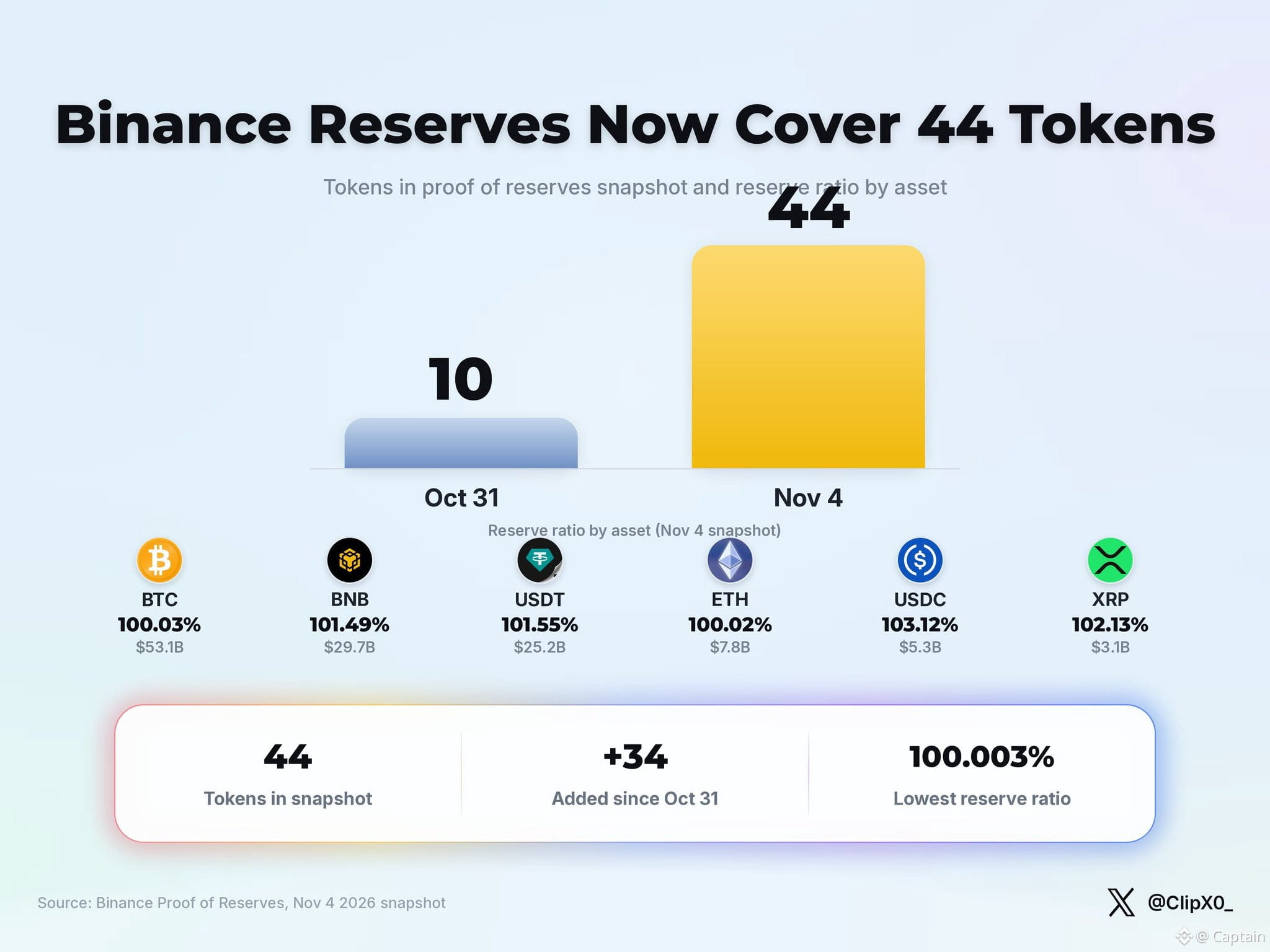
@binance proof of reserves
snapshot now covers 44 tokens,
up from 10 on Oct 31.
➤ BTC 100.03%
➤ BNB 101.49%
➤ USDT 101.55%
Every listed ratio is
above 100%.
@_RichardTeng @heyibinance
@cz_binance
X : @bnbcaptain
@binance proof of reserves
snapshot now covers 44 tokens,
up from 10 on Oct 31.
➤ BTC 100.03%
➤ BNB 101.49%
➤ USDT 101.55%
Every listed ratio is
above 100%.
@_RichardTeng @heyibinance
@cz_binance
X : @bnbcaptain
snapshot now covers 44 tokens,
up from 10 on Oct 31.
➤ BTC 100.03%
➤ BNB 101.49%
➤ USDT 101.55%
Every listed ratio is
above 100%.
@_RichardTeng @heyibinance
@cz_binance
X : @bnbcaptain
250
·
--
See translation
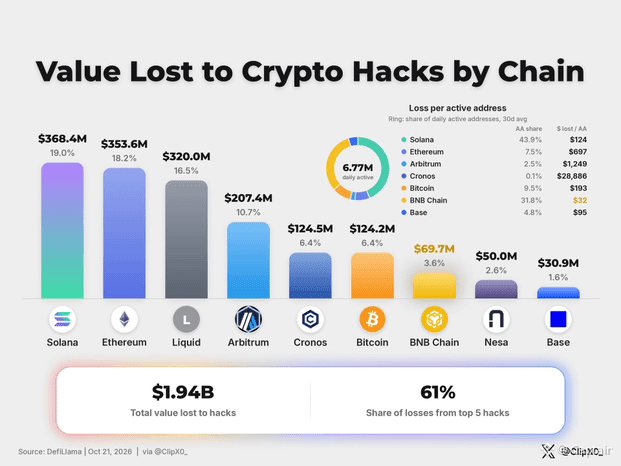
$1.94B lost to Crypto Hack in 2026 so far,
Top 5 hacks alone make up 61% of it.
➤ Solana: $368.4M (19.0%)
➤ Ethereum: $353.6M (18.2%)
➤ Liquid: $320.0M (16.5%)
➤ Arbitrum: $207.4M (10.7%)
➤ Cronos: $124.5M (6.4%)
➤ Bitcoin: $124.2M (6.4%)
➤ BNB Chain: $69.7M (3.6%)
➤ Nesa: $50.0M (2.6%)
➤ Base: $30.9M (1.6%)
Lost per active address ranges from $0.10 on BNBChain to $4.59 on Arbitrum.
If the hacked funds share among all active address by network then BNBChain users will lose 0.10
Where Arbitrum user will lose $ 4.6
Device and exchange hacks are excluded @DefiLlama
$BNB
465
·
--
See translation
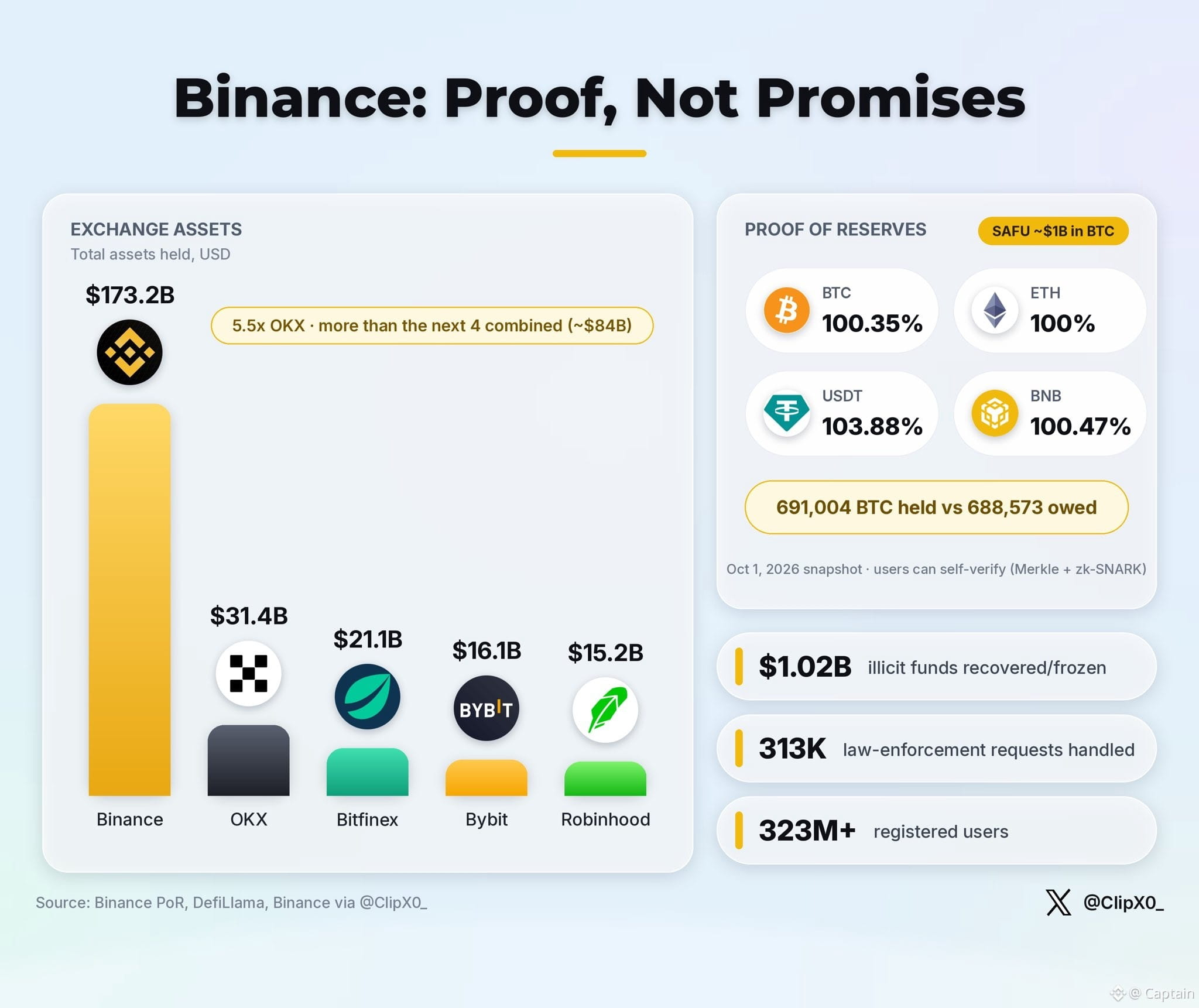
FUD is cheap. Proof isn't.
Binance holds 100%+ of user BTC, ETH, USDT and BNB as of the Oct 1 snapshot.
$173.2B in assets, more than the next 4 exchanges combined.
Don't trust, verify
> $1.02B in illicit funds recovered or frozen
> 313K law-enforcement requests handled
> 323M+ registered users
@heyibinance @cz_binance @binance @_RichardTeng
X : @bnbcaptain
368
Log in to explore more content
Join global crypto users on Binance Square
⚡️ Get latest and useful information about crypto.
💬 Trusted by the world’s largest crypto exchange.
👍 Discover real insights from verified creators.
Email / Phone number
Trending Topics
HotCPIDecemberHikePriced
3,593 views
191 Discussing
CPI Market Watch | US CPI Rises 0.4% in October, Hotter Than 0.3% Forecast
Binance News
·10 Likes
·12.7k views
AnthropicRejectsIPODelayValuationinQuestion
132,618 views
1,234 Discussing
NvidiaInvestigatesAfterHuang’sAffairApology
377,651 views
2,713 Discussing