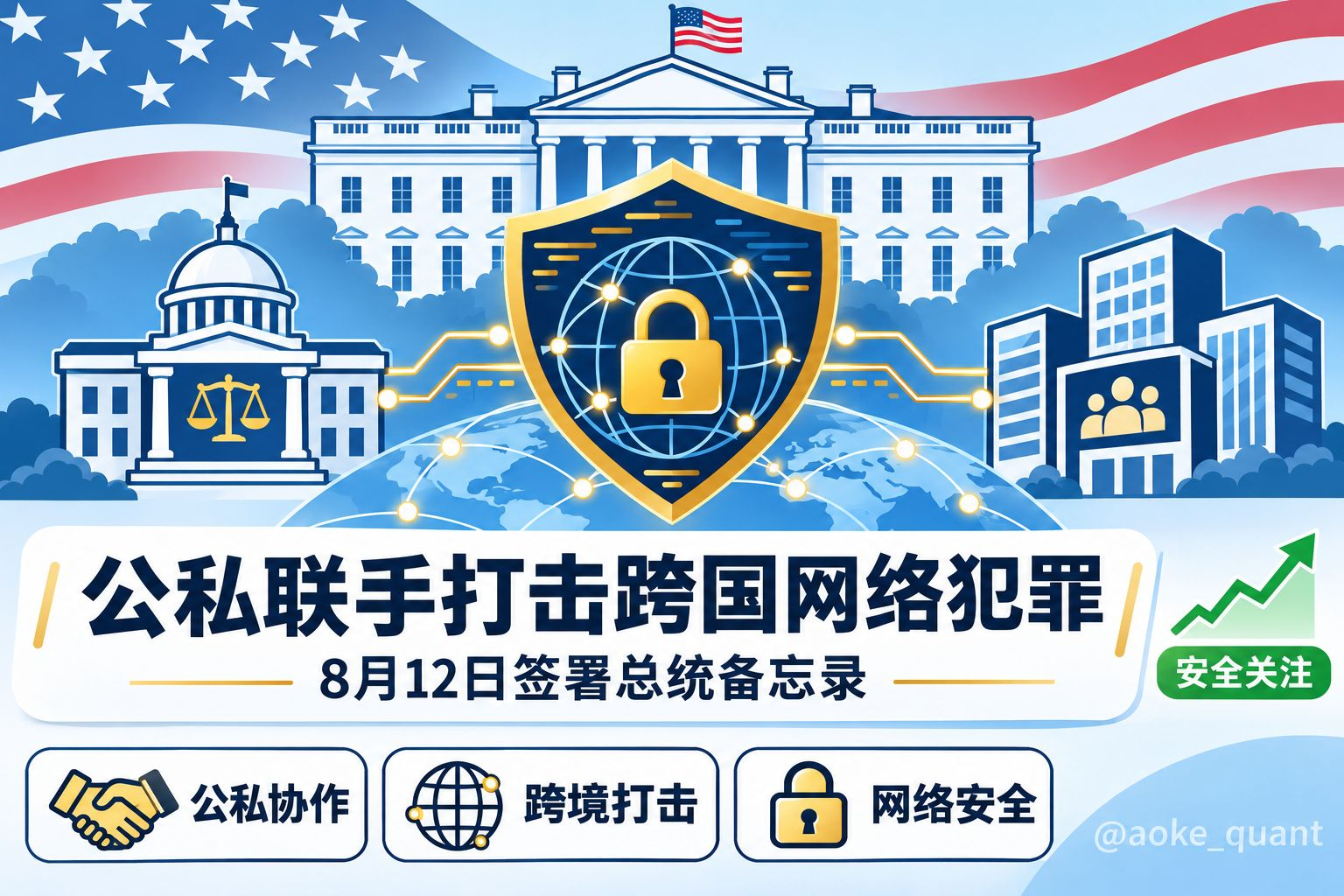
Trump administration moves to implement private-sector participation in combating transnational cybercrime
On August 12 this year, Trump signed the National Security Presidential Memorandum on “Expanding the Capacity to Combat Transnational Cybercrime,” calling for a cyber operations program led by the federal government and involving private cybersecurity firms, jointly overseen by the Department of Justice and the Department of Homeland Security. Several anonymous sources familiar with the matter have disclosed that the U.S. government has begun the implementation process and is selecting oversight personnel to review missions involving private companies. This marks the policy’s shift from signing to preparations for execution. At its core, the facts are these: vetted U.S. companies may, under contracts with the Department of Justice or the Department of Homeland Security, gather intelligence and disrupt systems used by foreign criminal hacking groups. Each mission requires written approval. The memorandum identifies hacking networks involved in digital extortion, financial fraud, and attacks on U.S. critical infrastructure as priority targets, and calls for cyber tools to be used to find, target, and destroy their digital infrastructure, communications networks, and financial channels. There is already a precedent for such cooperation: cybersecurity firm CrowdStrike recently provided intelligence support to an FBI operation targeting North Korea’s “laptop farms.”
Breaking down the logic: The White House believes that more fully harnessing industry capabilities could help combat criminal organizations faster and on a larger scale, but implementation faces several unresolved challenges. First, funding and compensation: the memorandum itself provides no funding, payment arrangements are still being studied, and recovered stolen cryptocurrency may have to be returned to victims, shrinking the pool of funds available to pay companies. Second, the allocation of liability: it remains unclear how risks would be shared if a target is misidentified, an operation exceeds its authorization, or an innocent third party’s systems are harmed. Third, target identification: the memorandum excludes groups directly linked to foreign governments, making identification very difficult in places where the line between intelligence agencies and criminal hackers is blurred. Other risks include cross-border coordination, conflicts of interest between departments, and possible retaliation against participating companies.
The potential impact on crypto markets should be clearly distinguished between fact and inference: the memorandum itself targets criminal hacking groups; the following is a reasonable inference based on its provisions. First, if payment is tied to operational results and includes recovering stolen crypto assets, cybersecurity firms specializing in on-chain forensics and asset tracing may secure more government contracts and gain greater visibility for their services. Second, sustained efforts to suppress ransomware and financial-fraud infrastructure could, over the medium to long term, reduce the frequency of crypto theft by hackers and lessen the repeated impact of such negative events on market sentiment. Third, the memorandum mentions dismantling criminal organizations’ financial channels. If enforcement reaches on-chain tools such as mixers, it could trigger another round of debate over compliance boundaries and regulatory uncertainty. The actual impact will depend on the implementation details and the specifics of the first missions.
Editor’s observation: In the short term, this development is more likely to affect the crypto market’s narrative and sentiment than to cause a direct shock. Implementation still requires fundamental questions to be resolved, including who pays, how authorization works, and how liability is allocated. One former U.S. official bluntly said that the economic incentives involved remain unclear. In terms of direction, however, the United States is institutionalizing offensive cyber operations involving public-private cooperation. One cybersecurity company executive described the move as potentially transformative, saying it could impose costs on adversaries and create a new deterrent. For the crypto industry, the value of security and compliance capabilities may be amplified further during this policy cycle. The appointments of officials overseeing the program, payment plans, and disclosures about the first missions warrant continued attention.
#特朗普政府启动打击网络犯罪项目 #BTC #ETH #BNB
On August 12 this year, Trump signed the National Security Presidential Memorandum on “Expanding the Capacity to Combat Transnational Cybercrime,” calling for a cyber operations program led by the federal government and involving private cybersecurity firms, jointly overseen by the Department of Justice and the Department of Homeland Security. Several anonymous sources familiar with the matter have disclosed that the U.S. government has begun the implementation process and is selecting oversight personnel to review missions involving private companies. This marks the policy’s shift from signing to preparations for execution. At its core, the facts are these: vetted U.S. companies may, under contracts with the Department of Justice or the Department of Homeland Security, gather intelligence and disrupt systems used by foreign criminal hacking groups. Each mission requires written approval. The memorandum identifies hacking networks involved in digital extortion, financial fraud, and attacks on U.S. critical infrastructure as priority targets, and calls for cyber tools to be used to find, target, and destroy their digital infrastructure, communications networks, and financial channels. There is already a precedent for such cooperation: cybersecurity firm CrowdStrike recently provided intelligence support to an FBI operation targeting North Korea’s “laptop farms.”
Breaking down the logic: The White House believes that more fully harnessing industry capabilities could help combat criminal organizations faster and on a larger scale, but implementation faces several unresolved challenges. First, funding and compensation: the memorandum itself provides no funding, payment arrangements are still being studied, and recovered stolen cryptocurrency may have to be returned to victims, shrinking the pool of funds available to pay companies. Second, the allocation of liability: it remains unclear how risks would be shared if a target is misidentified, an operation exceeds its authorization, or an innocent third party’s systems are harmed. Third, target identification: the memorandum excludes groups directly linked to foreign governments, making identification very difficult in places where the line between intelligence agencies and criminal hackers is blurred. Other risks include cross-border coordination, conflicts of interest between departments, and possible retaliation against participating companies.
The potential impact on crypto markets should be clearly distinguished between fact and inference: the memorandum itself targets criminal hacking groups; the following is a reasonable inference based on its provisions. First, if payment is tied to operational results and includes recovering stolen crypto assets, cybersecurity firms specializing in on-chain forensics and asset tracing may secure more government contracts and gain greater visibility for their services. Second, sustained efforts to suppress ransomware and financial-fraud infrastructure could, over the medium to long term, reduce the frequency of crypto theft by hackers and lessen the repeated impact of such negative events on market sentiment. Third, the memorandum mentions dismantling criminal organizations’ financial channels. If enforcement reaches on-chain tools such as mixers, it could trigger another round of debate over compliance boundaries and regulatory uncertainty. The actual impact will depend on the implementation details and the specifics of the first missions.
Editor’s observation: In the short term, this development is more likely to affect the crypto market’s narrative and sentiment than to cause a direct shock. Implementation still requires fundamental questions to be resolved, including who pays, how authorization works, and how liability is allocated. One former U.S. official bluntly said that the economic incentives involved remain unclear. In terms of direction, however, the United States is institutionalizing offensive cyber operations involving public-private cooperation. One cybersecurity company executive described the move as potentially transformative, saying it could impose costs on adversaries and create a new deterrent. For the crypto industry, the value of security and compliance capabilities may be amplified further during this policy cycle. The appointments of officials overseeing the program, payment plans, and disclosures about the first missions warrant continued attention.
#特朗普政府启动打击网络犯罪项目 #BTC #ETH #BNB