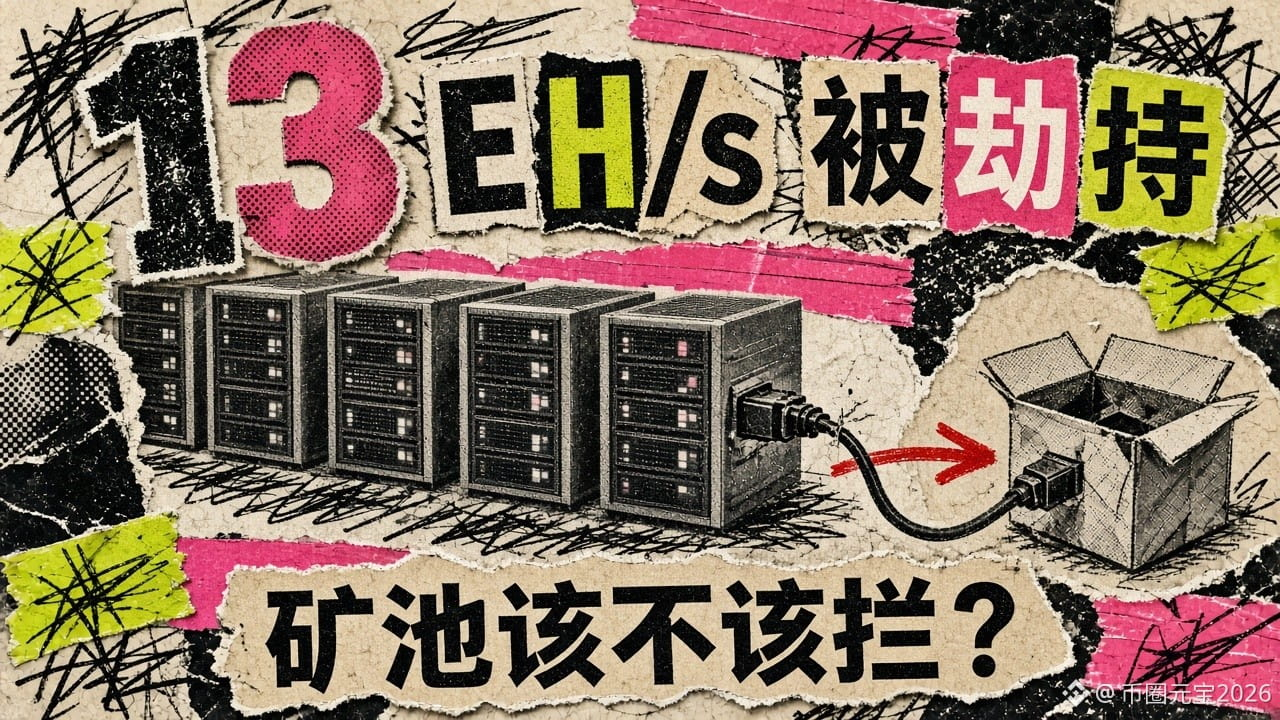
BTC mining rigs hijacked: 13 EH/s. Everyone says the hacker got nothing, but on-chain data shows they’ve already received 0.162 BTC. Should the pool have blocked the payment?
First, the on-chain facts: The attacker’s receiving address, bc1qphukp…pcddrr, received 0.08088977 BTC in the coinbase transaction of block 975,995 (Beijing time, 11/16 01:22; mempool.space lists it as mined by OCEAN pool). At 06:54 Beijing time, OCEAN mined block 976,029 and sent another 0.08113106 BTC. That’s 0.16202083 BTC in total, worth about $10,540 at the current price. As of this post, not a single satoshi has been moved.
What happened, with primary sources for every item:
1. On 11/15 at 11:08 Beijing time, hosting provider CoreX Hosting sounded the alarm on X: a large number of mining rigs had been redirected to OCEAN pool, with the receiving address being the one above.
2. Media estimates put the affected hashrate at about 13 EH/s, or roughly 64,000 machines. Based on mempool.space’s current estimate of about 933 EH/s for the entire network, that’s about 1.4% of the total.
3. On 11/16 at 01:25 Beijing time, Luxor officially confirmed on X that the issue was with its mining rig management tool, Commander. More than a dozen customer accounts were affected, a patch was deployed within two hours, and neither the pool nor LuxOS was affected. Affected customers would be fully compensated at the rate they would have earned from “normal mining.”
What many people are getting wrong: Plenty of posts say, “The attacker didn’t mine a block, so it was all for nothing.” But OCEAN isn’t solo mining, where you only get paid if you mine a block yourself. When the pool finds a block, it pays a group of miner addresses directly in the coinbase transaction, according to their shares (the coinbase transaction in block 975,995 had 19 outputs; block 976,029 had 20). As long as the hijacked hashrate submitted shares to OCEAN, the attacker got a cut whenever OCEAN found a block. The second payment arrived about 5.5 hours after Luxor announced the fix.
Breaking down the mechanics: The attacker didn’t access private keys or wallets; they simply used the management software to change the “pool address + payout address” on the mining rigs. Who paid? The hijacked mining operations—their machines worked for nothing during the period they were compromised (Luxor says it will compensate them as if they had mined normally). Who made money? The attacker, who received a share of the block rewards.
My take: I think the remote management software is what should be under scrutiny, not the pool. A hijack of about 13 EH/s has yielded only about 0.162 BTC so far—a pretty bad deal. But if the same kind of access were used to change an exchange API or withdrawal address, the loss wouldn’t be just a few thousand dollars.
The strongest counterargument: OCEAN assembles its own block templates and decides who to pay. CoreX had publicly identified this address on X about 14 hours before the block was mined, so the pool could have withheld this payment. “Neutrality” and “censorship resistance” shouldn’t be an excuse to pay out to stolen hashrate.
Save this: 4 checks for remote access permissions
1. Mining rig dashboards, hosting panels, and any tool that allows remote login: change default passwords, enable 2FA, and disable remote access you don’t use.
2. Exchange API keys: enable read and trading permissions only, not withdrawals, and restrict access to an IP whitelist.
3. Exchange withdrawals: enable a withdrawal address whitelist and keep only addresses you’ve personally verified.
4. Check your receiving/withdrawal addresses once a week against your own offline record, comparing the first 6 and last 6 characters exactly.
Follow Yuanbao for major crypto news broken down into verifiable numbers on the day it happens—no trade calls.
Should the pool have blocked the payment? Reply 1 if yes, 2 if no.
$BTC
#安全警报 #比特币挖矿 #BTC
First, the on-chain facts: The attacker’s receiving address, bc1qphukp…pcddrr, received 0.08088977 BTC in the coinbase transaction of block 975,995 (Beijing time, 11/16 01:22; mempool.space lists it as mined by OCEAN pool). At 06:54 Beijing time, OCEAN mined block 976,029 and sent another 0.08113106 BTC. That’s 0.16202083 BTC in total, worth about $10,540 at the current price. As of this post, not a single satoshi has been moved.
What happened, with primary sources for every item:
1. On 11/15 at 11:08 Beijing time, hosting provider CoreX Hosting sounded the alarm on X: a large number of mining rigs had been redirected to OCEAN pool, with the receiving address being the one above.
2. Media estimates put the affected hashrate at about 13 EH/s, or roughly 64,000 machines. Based on mempool.space’s current estimate of about 933 EH/s for the entire network, that’s about 1.4% of the total.
3. On 11/16 at 01:25 Beijing time, Luxor officially confirmed on X that the issue was with its mining rig management tool, Commander. More than a dozen customer accounts were affected, a patch was deployed within two hours, and neither the pool nor LuxOS was affected. Affected customers would be fully compensated at the rate they would have earned from “normal mining.”
What many people are getting wrong: Plenty of posts say, “The attacker didn’t mine a block, so it was all for nothing.” But OCEAN isn’t solo mining, where you only get paid if you mine a block yourself. When the pool finds a block, it pays a group of miner addresses directly in the coinbase transaction, according to their shares (the coinbase transaction in block 975,995 had 19 outputs; block 976,029 had 20). As long as the hijacked hashrate submitted shares to OCEAN, the attacker got a cut whenever OCEAN found a block. The second payment arrived about 5.5 hours after Luxor announced the fix.
Breaking down the mechanics: The attacker didn’t access private keys or wallets; they simply used the management software to change the “pool address + payout address” on the mining rigs. Who paid? The hijacked mining operations—their machines worked for nothing during the period they were compromised (Luxor says it will compensate them as if they had mined normally). Who made money? The attacker, who received a share of the block rewards.
My take: I think the remote management software is what should be under scrutiny, not the pool. A hijack of about 13 EH/s has yielded only about 0.162 BTC so far—a pretty bad deal. But if the same kind of access were used to change an exchange API or withdrawal address, the loss wouldn’t be just a few thousand dollars.
The strongest counterargument: OCEAN assembles its own block templates and decides who to pay. CoreX had publicly identified this address on X about 14 hours before the block was mined, so the pool could have withheld this payment. “Neutrality” and “censorship resistance” shouldn’t be an excuse to pay out to stolen hashrate.
Save this: 4 checks for remote access permissions
1. Mining rig dashboards, hosting panels, and any tool that allows remote login: change default passwords, enable 2FA, and disable remote access you don’t use.
2. Exchange API keys: enable read and trading permissions only, not withdrawals, and restrict access to an IP whitelist.
3. Exchange withdrawals: enable a withdrawal address whitelist and keep only addresses you’ve personally verified.
4. Check your receiving/withdrawal addresses once a week against your own offline record, comparing the first 6 and last 6 characters exactly.
Follow Yuanbao for major crypto news broken down into verifiable numbers on the day it happens—no trade calls.
Should the pool have blocked the payment? Reply 1 if yes, 2 if no.
$BTC
#安全警报 #比特币挖矿 #BTC