
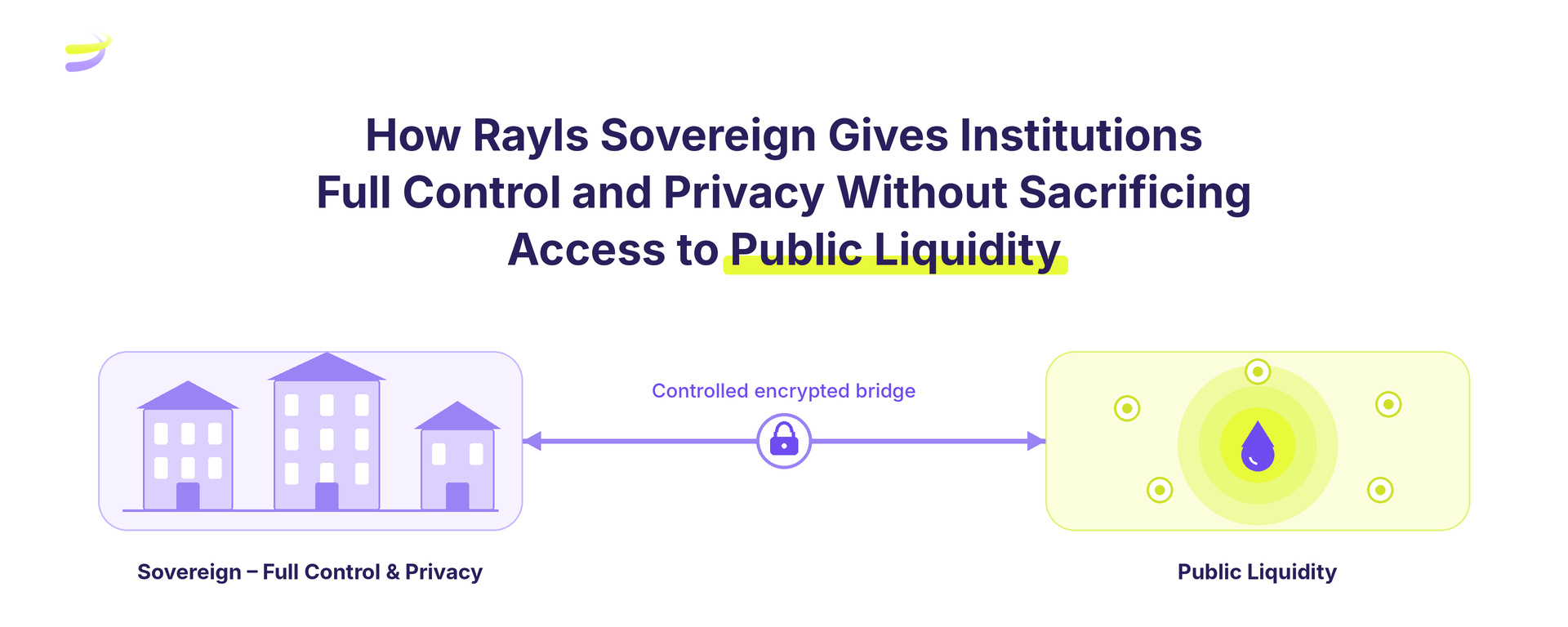

How Rayls Sovereign Gives Institutions Full Control and Privacy Without Sacrificing Access to Public Liquidity
I’ve noticed one problem that keeps coming up whenever I talk to people from traditional finance: they understand the benefits of blockchain, but they almost always stop at the same question.
“If I use a blockchain, will my clients’ data and internal activity become public?”
It’s a fair question. On public blockchains, everything is visible. For tightly regulated banks and institutions, exposing client balances or counterparty positions is not an option. At the same time, building a completely private chain often ends up creating an isolated “island” that is cut off from liquidity and other institutions.
Rayls Sovereign is designed to address this dilemma.
What is Rayls Sovereign?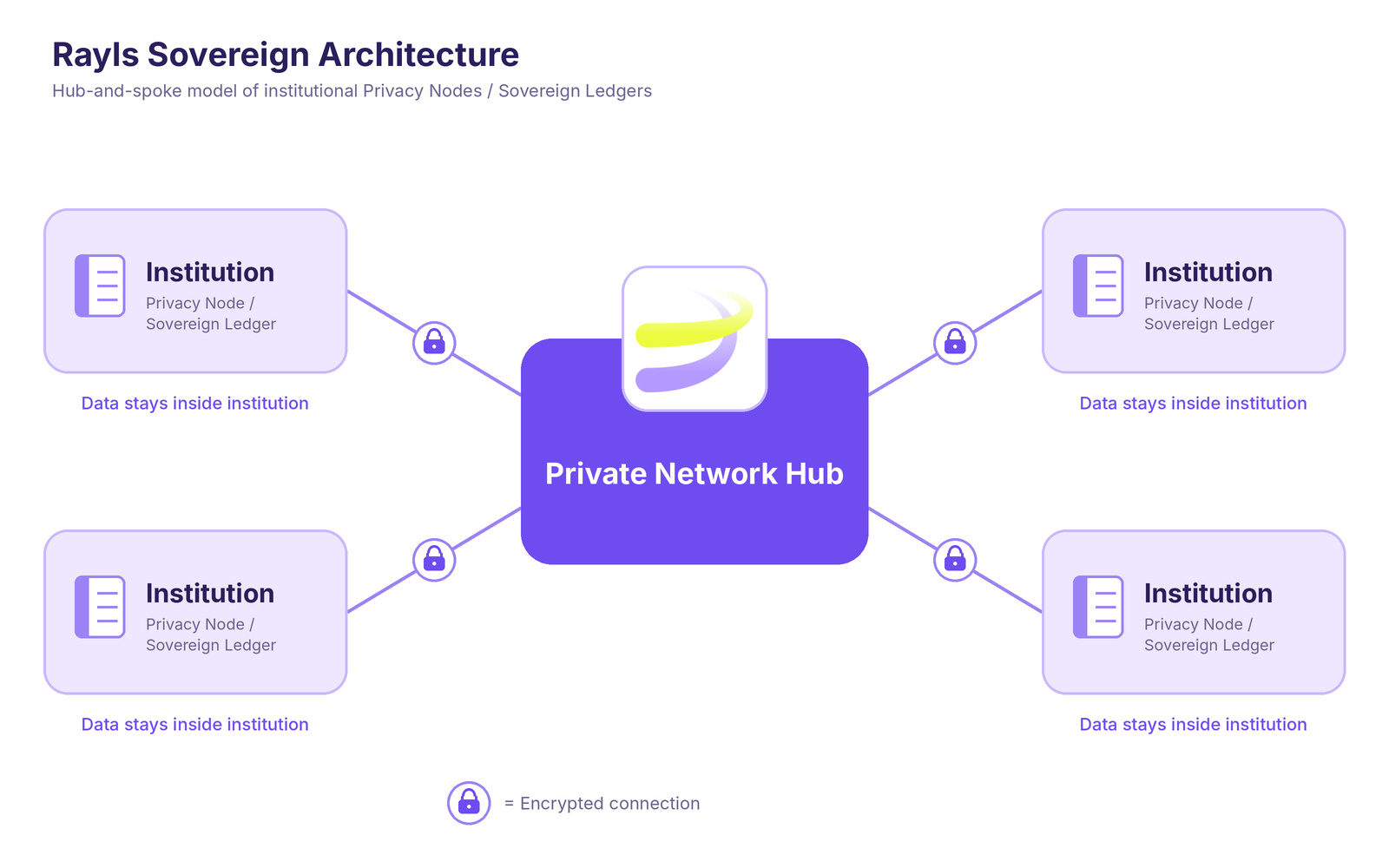
According to Rayls’ official documentation, Sovereign is a private EVM-compatible blockchain that is installed and operated by the institution itself, inside its own environment (on-premises or private cloud). Data, keys, and governance remain under the institution’s control. No external party can access its internal ledger.
In simple terms, it’s like a tokenized core banking system that still sits inside the institution’s own perimeter.
The architecture follows a hub-and-spoke model. Each institution runs its own Sovereign (previously called a Privacy Node) and connects to a Private Network Hub. Only encrypted messages leave the institution.
What can institutions do with it?
Based on the official docs, institutions can do several practical things inside Sovereign:
- Issue tokens (ERC-20, ERC-721, or ERC-1155) privately.
- Manage balances and internal transfers between divisions or clients.
- Run smart contracts to enforce business rules, such as freezing assets or locking funds.
All of this internal activity stays invisible to the outside. Institutions can also integrate Sovereign with their existing systems (core banking, ERP, etc.) through APIs.
How do they stay connected to the outside world?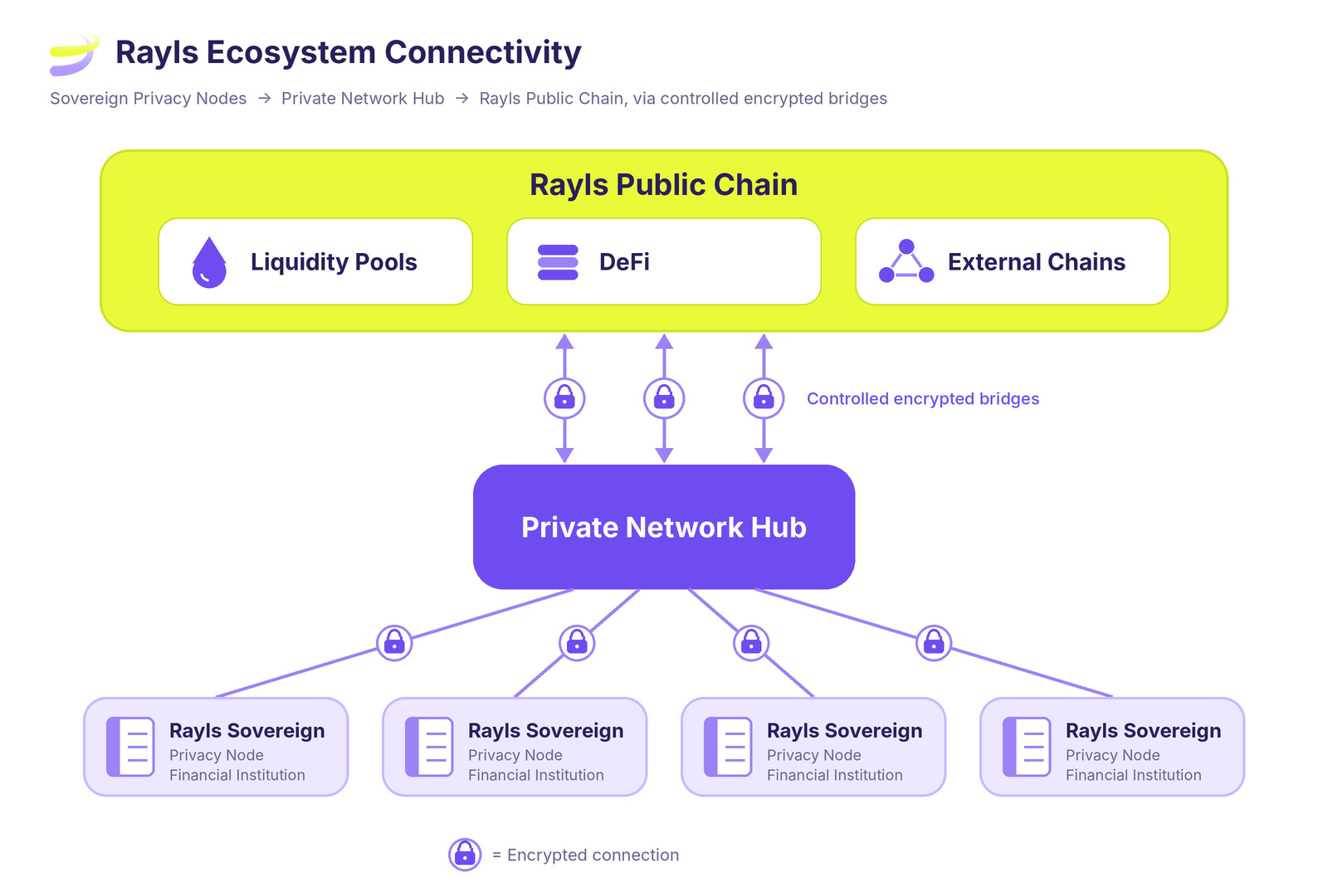
This is the part I find most important. Institutions don’t have to choose between being completely closed or completely open. There are two controlled paths:
1. To other institutions via Rayls Private Networks.
Multiple Sovereigns can connect through a Private Network Hub. Messages are encrypted. The Hub only routes and verifies proofs it cannot see the content of the transactions.
2. To public liquidity via the Rayls Public Chain.
Institutions can open a connection when they need liquidity or want to interact with a broader market. Only the minimum required data leaves the Sovereign.
The institution decides when to open the door and what is allowed to leave.
Is it already in production?
According to Rayls’ official blog and website, Sovereign (previously known as the Privacy Node) has been used by more than 30 financial institutions since 2024. Some examples they highlight include:
- Núclea (one of Brazil’s largest payment market infrastructures) tokenizing corporate receivables at a rate of around 40,000 assets per month.
- XP issuing the USDXP stablecoin on Sovereign.
- Banco Central do Brasil using the infrastructure in the Drex CBDC pilot, which involved 16 major banks.
- Testing by Kinexys (J.P. Morgan) and participation in the Bank of England & BIS Innovation Hub.
I don’t treat these as definitive proof that every claim is perfect, but they do show that the approach has moved beyond pure experimentation and into real institutional environments.
Closing
What I take from the documentation and how Rayls describes Sovereign is an attempt to give institutions two things that are usually hard to combine: full control over their own data and systems, and the ability to stay connected to other institutions and public liquidity on their own terms.
For someone new to blockchain, the idea is simple. Institutions don’t have to put their entire operations into a glass room that everyone can see into. They can keep a private space of their own and open the door only when needed.
---
Sources
1. Rayls Docs – A Warm Introduction to Rayls Sovereign
https://docs.rayls.com/docs/a-warm-introduction-rayls-sovereign
2. Rayls Docs – Rayls Sovereign Architecture and Components
https://docs.rayls.com/docs/rayls-sovereign-architecture
3. Rayls Blog – Introducing Rayls Sovereign
https://www.rayls.com/blog/introducing-rayls-sovereign-the-onchain-gateway-for-institutions
4. Rayls – What is Rayls?
https://www.rayls.com/what-is-rayls
5. Rayls – Sovereign Product Page
https://www.rayls.com/products/sovereign
6. Rayls Blog – XP Launches USDXP
https://www.rayls.com/blog/xp-launches-usdxp-stablecoin-on-rayls-infrastructure