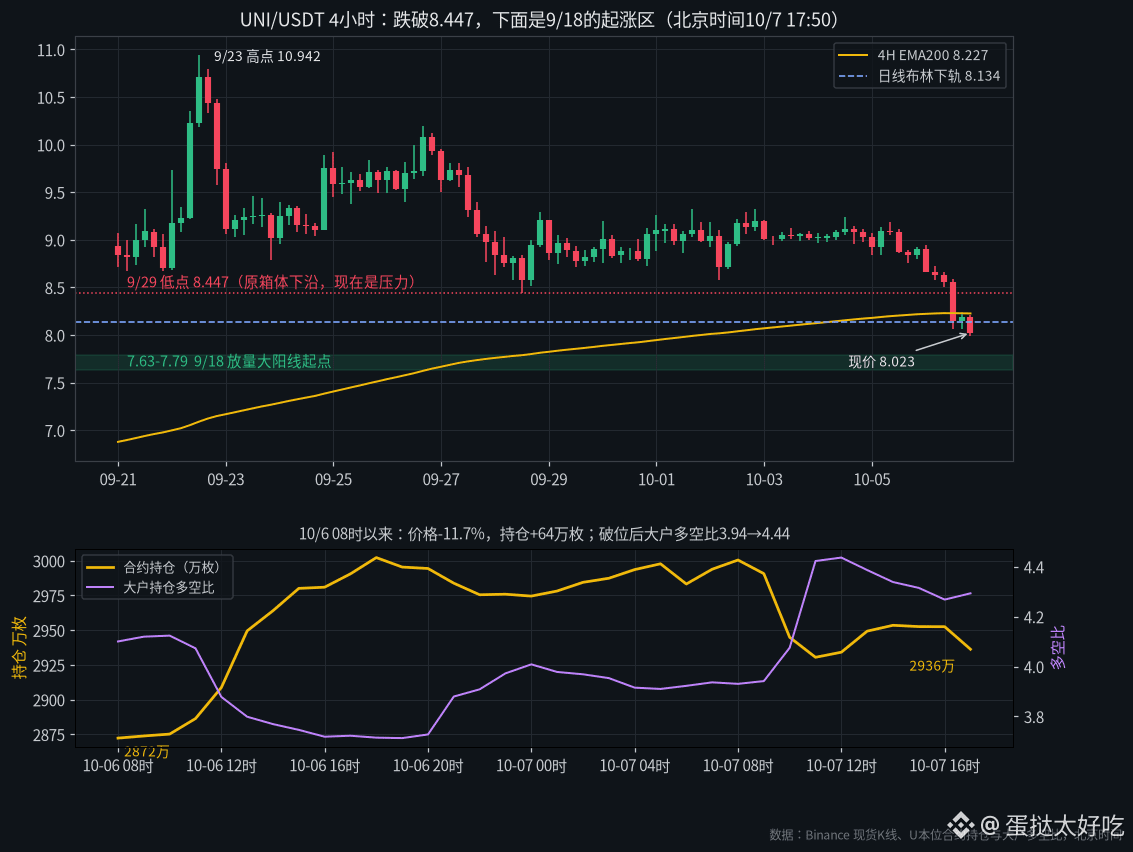
The ones buying the dip at $UNI aren’t retail traders—they’re whales. In the three hours after the price broke below 8.447 this morning, the whales’ long-to-short position ratio climbed from 3.94 to 4.44, while the share of retail accounts going long actually fell from 62.8% to 60.9%.
Since 8 a.m. yesterday, UNI has dropped from 9.083 to 8.023, down 11.7%, yet open interest in futures rose from 28.72 million tokens to 29.36 million, an increase of 640,000. The 1-hour candle at 9 a.m. saw 1.166 million tokens traded—4.6 times the average volume of the previous 48 hours—and plunged straight through the series of lows between 8.447 and 8.58 that had held since September 29. Open interest fell by only 700,000 tokens. Leverage has barely been flushed out; it has simply shifted into whale hands.
The daily Bollinger lower band is at 8.134, and the current price is already below it. Over the past 260 days, UNI has closed below the lower band nine times, all during downtrends below the daily EMA50. This time, the EMA50 is still at 7.311, and the trend from 2.316 on June 2 to 10.942 on September 23 remains intact. If today’s close is at the current price, it’ll be the first time this has happened during an uptrend—there’s no historical example to follow. The 4-hour EMA200 is at 8.227, and that was lost this morning too.
The next support zone is 7.63–7.79, where the big bullish candle on September 18 began its rally. Subtracting one daily ATR (0.684) from 8.447 gives 7.763, right in that zone. Conversely, if the daily candle closes back above 8.447, this breakdown will have failed.
Whales bought in at 8.1–8.2, and the price has already fallen below their cost basis. I’m not following them in here; I’ll wait and see what happens at 7.63–7.79. If the long-to-short ratio is still holding above 4 then, that’s when I’ll make a move. If it drops back to 3.7 first, it means even the whales can’t hold on.
#UNI #Altcoins
Since 8 a.m. yesterday, UNI has dropped from 9.083 to 8.023, down 11.7%, yet open interest in futures rose from 28.72 million tokens to 29.36 million, an increase of 640,000. The 1-hour candle at 9 a.m. saw 1.166 million tokens traded—4.6 times the average volume of the previous 48 hours—and plunged straight through the series of lows between 8.447 and 8.58 that had held since September 29. Open interest fell by only 700,000 tokens. Leverage has barely been flushed out; it has simply shifted into whale hands.
The daily Bollinger lower band is at 8.134, and the current price is already below it. Over the past 260 days, UNI has closed below the lower band nine times, all during downtrends below the daily EMA50. This time, the EMA50 is still at 7.311, and the trend from 2.316 on June 2 to 10.942 on September 23 remains intact. If today’s close is at the current price, it’ll be the first time this has happened during an uptrend—there’s no historical example to follow. The 4-hour EMA200 is at 8.227, and that was lost this morning too.
The next support zone is 7.63–7.79, where the big bullish candle on September 18 began its rally. Subtracting one daily ATR (0.684) from 8.447 gives 7.763, right in that zone. Conversely, if the daily candle closes back above 8.447, this breakdown will have failed.
Whales bought in at 8.1–8.2, and the price has already fallen below their cost basis. I’m not following them in here; I’ll wait and see what happens at 7.63–7.79. If the long-to-short ratio is still holding above 4 then, that’s when I’ll make a move. If it drops back to 3.7 first, it means even the whales can’t hold on.
#UNI #Altcoins