

易琳Ten
116 Posts

易琳Ten
Report
Block User
交易是修行,盈利是结果,纪律是信仰。🐺📈
65 Following
21.4K+ Followers
8.1K+ Liked
Posts
All
Quotes
Videos
PINNED
·
--
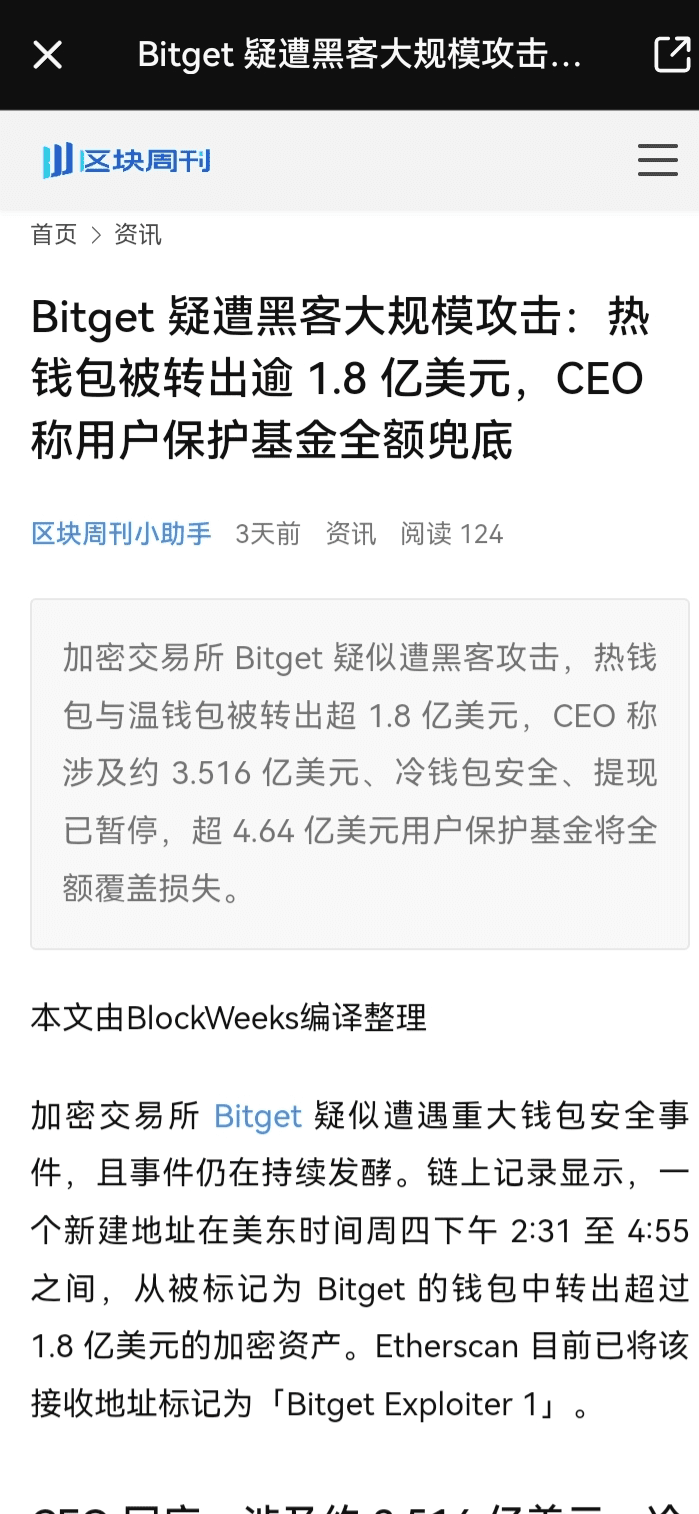
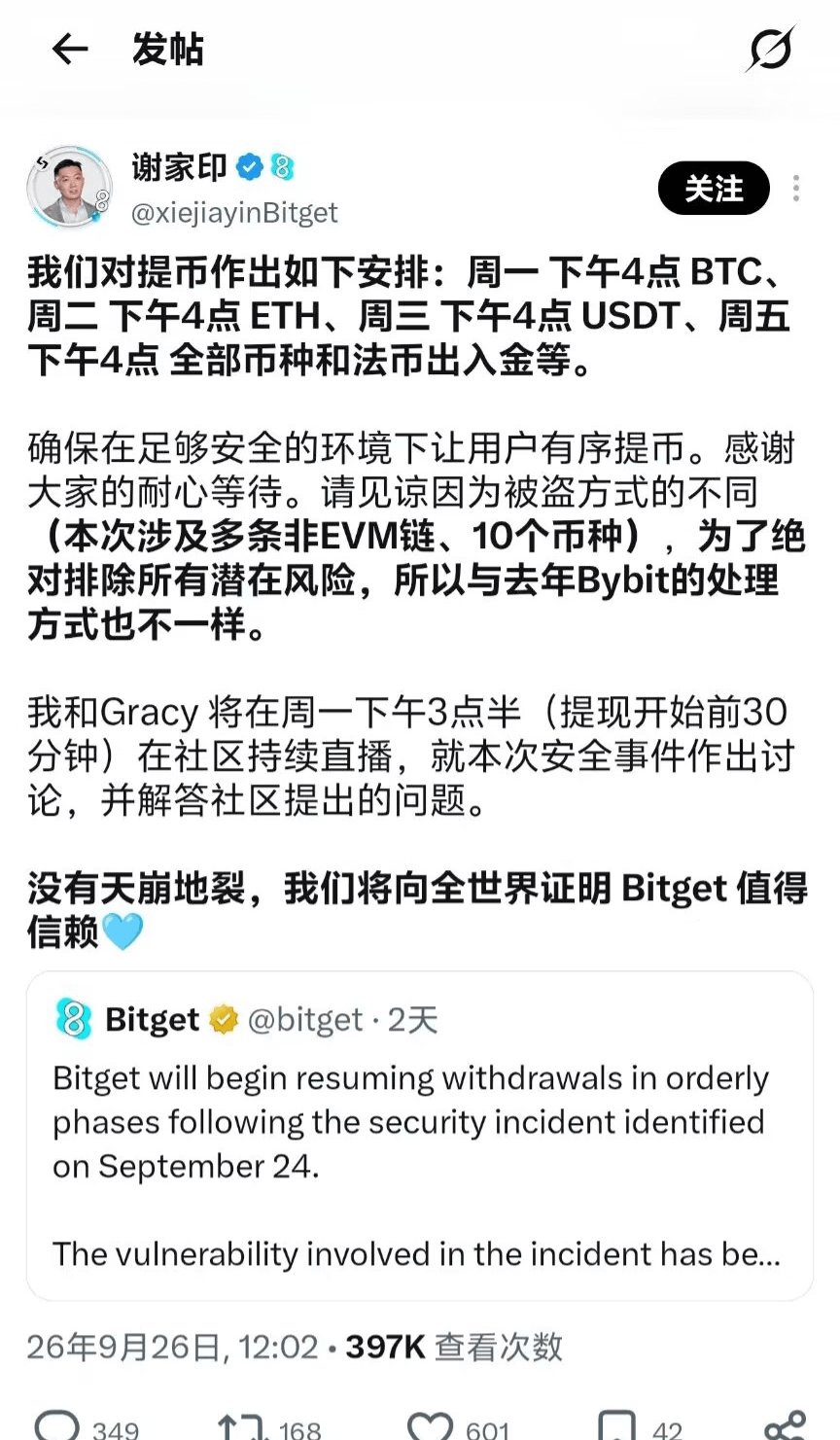
This wave of hacking incidents has caused losses of up to $300 million.
For Bitget, the real test may only be starting.
What matters most for an exchange?
Not traffic, not narratives, but users’ trust in security.
Once trust develops cracks, users may reduce their capital holdings and trading frequency, and future growth and ecosystem narratives may face even greater pressure.
In competing with top exchanges like Binance, the difficulty may rise further.
Whether this incident will ultimately change Bitget’s position in the industry still needs to be verified over time.
But one thing is certain:
For centralized exchanges, losses from security incidents are not just money—it’s also trust.
Bitget: whether it can weather this crisis next is the real test.
This wave of hacking incidents has caused losses of up to $300 million.
For Bitget, the real test may only be starting.
What matters most for an exchange?
Not traffic, not narratives, but users’ trust in security.
Once trust develops cracks, users may reduce their capital holdings and trading frequency, and future growth and ecosystem narratives may face even greater pressure.
In competing with top exchanges like Binance, the difficulty may rise further.
Whether this incident will ultimately change Bitget’s position in the industry still needs to be verified over time.
But one thing is certain:
For centralized exchanges, losses from security incidents are not just money—it’s also trust.
Bitget: whether it can weather this crisis next is the real test.
For Bitget, the real test may only be starting.
What matters most for an exchange?
Not traffic, not narratives, but users’ trust in security.
Once trust develops cracks, users may reduce their capital holdings and trading frequency, and future growth and ecosystem narratives may face even greater pressure.
In competing with top exchanges like Binance, the difficulty may rise further.
Whether this incident will ultimately change Bitget’s position in the industry still needs to be verified over time.
But one thing is certain:
For centralized exchanges, losses from security incidents are not just money—it’s also trust.
Bitget: whether it can weather this crisis next is the real test.

1.6k
22
93
1.6k
·
--
🍂 As September comes to a close and October begins anew! ✨
As September draws to a close, looking back on the turbulence and dormancy we’ve walked through, every act of steadfastness is an accumulation of growth; every time we settle, we’re gathering the strength to move forward. 📊
Don’t be anxious due to a brief period of silence, and don’t waver because of market fluctuations. Stay patient, hold fast to your convictions; walk together within consensus, and grow through volatility. 🕊️
🍁 Farewell to September—hello to October!
May we always stay together with one heart, with steady steps, and live up to the time, and to our perseverance. Through the storms of the market, we quietly await the blooming of what’s meant for us! 💛🦋
🍂 As September comes to a close and October begins anew! ✨
As September draws to a close, looking back on the turbulence and dormancy we’ve walked through, every act of steadfastness is an accumulation of growth; every time we settle, we’re gathering the strength to move forward. 📊
Don’t be anxious due to a brief period of silence, and don’t waver because of market fluctuations. Stay patient, hold fast to your convictions; walk together within consensus, and grow through volatility. 🕊️
🍁 Farewell to September—hello to October!
May we always stay together with one heart, with steady steps, and live up to the time, and to our perseverance. Through the storms of the market, we quietly await the blooming of what’s meant for us! 💛🦋
As September draws to a close, looking back on the turbulence and dormancy we’ve walked through, every act of steadfastness is an accumulation of growth; every time we settle, we’re gathering the strength to move forward. 📊
Don’t be anxious due to a brief period of silence, and don’t waver because of market fluctuations. Stay patient, hold fast to your convictions; walk together within consensus, and grow through volatility. 🕊️
🍁 Farewell to September—hello to October!
May we always stay together with one heart, with steady steps, and live up to the time, and to our perseverance. Through the storms of the market, we quietly await the blooming of what’s meant for us! 💛🦋

7
19
·
--
Follow, like, and share
Follow, like, and share🧧🧧🧧🧧🎁
Follow, like, and share
Follow, like, and share🧧🧧🧧🧧🎁
Follow, like, and share🧧🧧🧧🧧🎁
易琳Ten
·
--
#zec The ZEC long positions in my hand all got closed. Did yours? I'm afraid of the waterfall.

2
190
·
--
Bullish
The market shifts in an instant—messages and news keep coming one after another, and capital battles are becoming even more intense.
When the market is hot, be more alert to FOMO emotions. Don’t chase at the top blindly. Don’t go all-in with oversized positions. And don’t let leverage magnify greed.
The market is always full of opportunities. What’s truly scarce is capital, discipline, and patience.
Understand the logic of capital, manage your own position size, and wait for your trading opportunities.
Don’t go crazy because of a sudden surge, and don’t panic because of a steep drop. Protect your principal, steady your mindset, wait patiently, and align your actions with your knowledge.
May we stay clear-headed amid volatility, move forward steadily in the competition, with a consistently green account and long-term wins through compounding! 💰📈
The market shifts in an instant—messages and news keep coming one after another, and capital battles are becoming even more intense.
When the market is hot, be more alert to FOMO emotions. Don’t chase at the top blindly. Don’t go all-in with oversized positions. And don’t let leverage magnify greed.
The market is always full of opportunities. What’s truly scarce is capital, discipline, and patience.
Understand the logic of capital, manage your own position size, and wait for your trading opportunities.
Don’t go crazy because of a sudden surge, and don’t panic because of a steep drop. Protect your principal, steady your mindset, wait patiently, and align your actions with your knowledge.
May we stay clear-headed amid volatility, move forward steadily in the competition, with a consistently green account and long-term wins through compounding! 💰📈
When the market is hot, be more alert to FOMO emotions. Don’t chase at the top blindly. Don’t go all-in with oversized positions. And don’t let leverage magnify greed.
The market is always full of opportunities. What’s truly scarce is capital, discipline, and patience.
Understand the logic of capital, manage your own position size, and wait for your trading opportunities.
Don’t go crazy because of a sudden surge, and don’t panic because of a steep drop. Protect your principal, steady your mindset, wait patiently, and align your actions with your knowledge.
May we stay clear-headed amid volatility, move forward steadily in the competition, with a consistently green account and long-term wins through compounding! 💰📈

1.7k
43
111
1.7k
·
--
#zec The ZEC long positions in my hand all got closed. Did yours? I'm afraid of the waterfall.
#zec The ZEC long positions in my hand all got closed. Did yours? I'm afraid of the waterfall.

878
14
47
878
·
--

Article
Trading Core ❤ PrinciplesTrading core principles
1. Hold the line—survive first, then make money.
The first rule of trading isn’t quick profits—it’s long-term survival.
Never add to losing trades. Cut losses immediately after a mistake. Eliminate high-leverage gambling.
Don’t let losses drive emotions. Don’t retaliate with an oversized position. Don’t borrow to try to get even.
Staying alive is the market’s biggest trump card.
2. Take profits and keep taking—lock them in for safety.
Paper gains are all just imaginary. The profits you lock in are the real, hard money.
If your position is in profit, take profit in batches. Never let winning gains turn into losses.
Ditch the fantasy of getting rich overnight. Small gains accumulated steadily with compounding is the only path to growing capital.
Trading Core ❤ Principles
Trading core principles
1. Hold the line—survive first, then make money.
The first rule of trading isn’t quick profits—it’s long-term survival.
Never add to losing trades. Cut losses immediately after a mistake. Eliminate high-leverage gambling.
Don’t let losses drive emotions. Don’t retaliate with an oversized position. Don’t borrow to try to get even.
Staying alive is the market’s biggest trump card.
2. Take profits and keep taking—lock them in for safety.
Paper gains are all just imaginary. The profits you lock in are the real, hard money.
If your position is in profit, take profit in batches. Never let winning gains turn into losses.
Ditch the fantasy of getting rich overnight. Small gains accumulated steadily with compounding is the only path to growing capital.
1. Hold the line—survive first, then make money.
The first rule of trading isn’t quick profits—it’s long-term survival.
Never add to losing trades. Cut losses immediately after a mistake. Eliminate high-leverage gambling.
Don’t let losses drive emotions. Don’t retaliate with an oversized position. Don’t borrow to try to get even.
Staying alive is the market’s biggest trump card.
2. Take profits and keep taking—lock them in for safety.
Paper gains are all just imaginary. The profits you lock in are the real, hard money.
If your position is in profit, take profit in batches. Never let winning gains turn into losses.
Ditch the fantasy of getting rich overnight. Small gains accumulated steadily with compounding is the only path to growing capital.
988
4
50
988
·
--
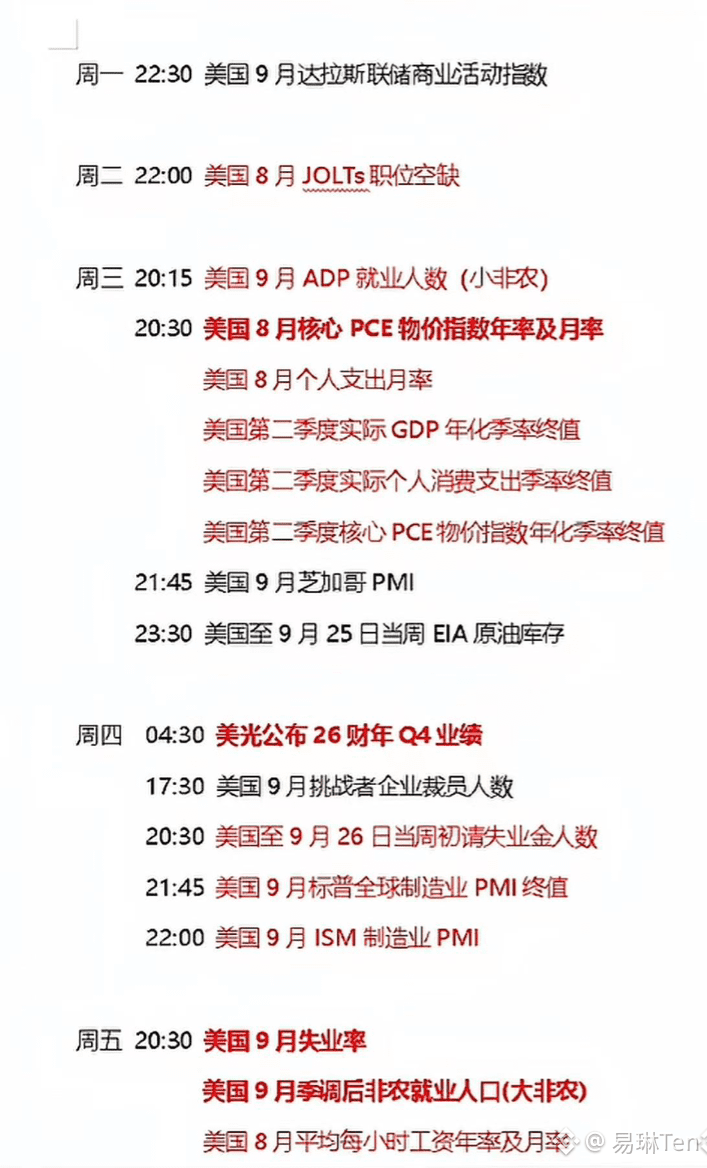
This week, the United States will release a lot of important data—big ones are coming.
This week, the United States will release a lot of important data—big ones are coming.
3.5k
34
99
3.5k
·
--
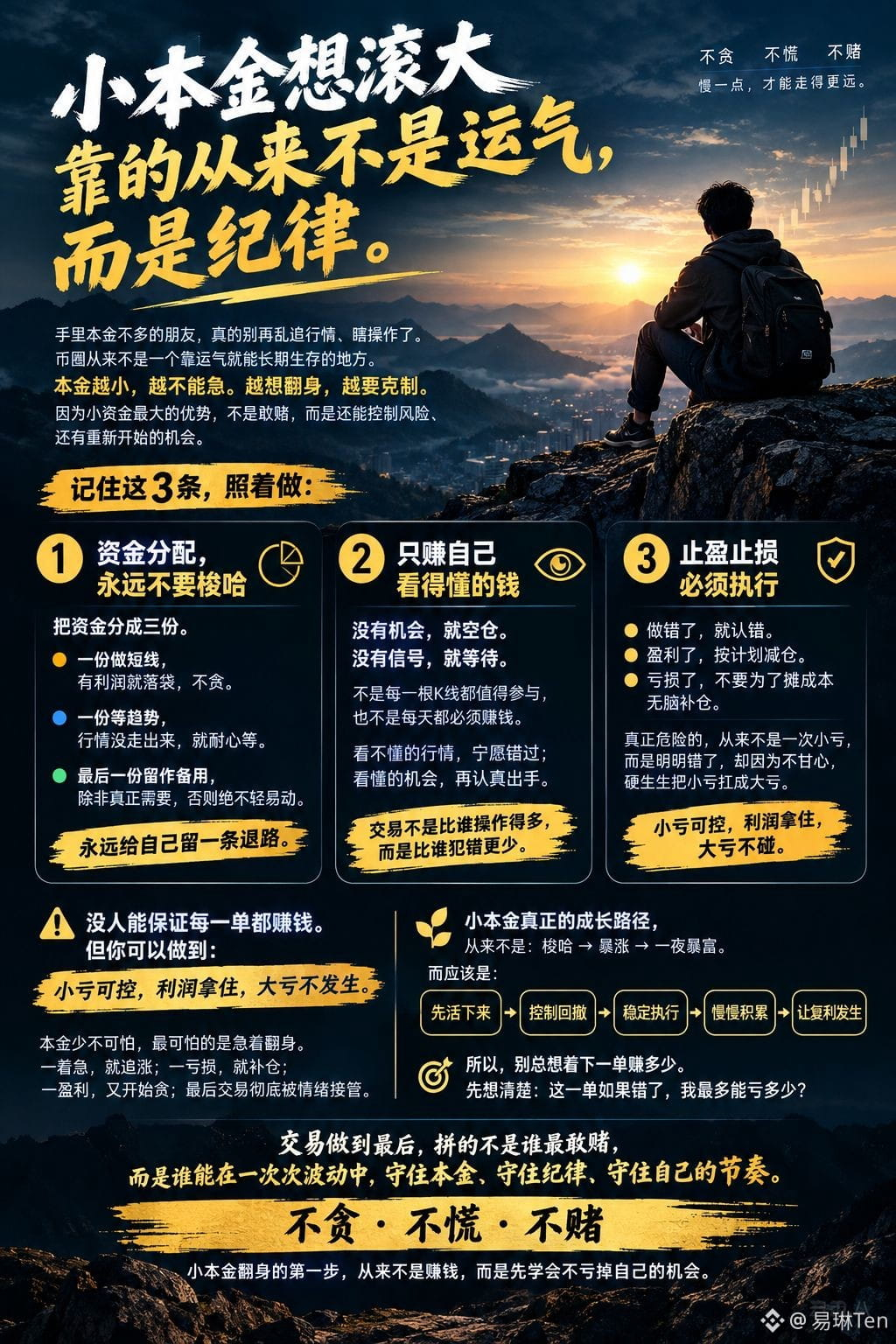
To grow the principal, you don’t rely on luck—you rely on discipline
If you don’t have much capital, really stop chasing charts blindly and making random trades.
The crypto market has never been a place where you can survive long-term by luck alone.
The smaller your principal, the less you can afford to be anxious.
The more you want to turn things around, the more you must restrain yourself.
Because the biggest advantage of small capital isn’t that you’re bold enough to gamble—it’s that you can control risk and still have a chance to start over.
Remember these 3 rules:
① Capital allocation—never go all-in
Divide your capital into three parts.
One part for short-term trades: when you have profit, take it off the table—don’t get greedy to the very end;
One part for waiting for trends: if the market hasn’t moved in your expected direction, be patient and wait;
The last part as a reserve: unless it’s truly necessary, never touch it lightly.
Always leave yourself a way to retreat.
② Only make money from what you can understand
If there’s no opportunity, stay in cash.
If there’s no signal, wait.
Not every candlestick is worth participating in,
And you don’t have to make money every day.
If you don’t understand the market, it’s better to miss it;
Only after you understand the opportunity should you act seriously.
Trading isn’t about who makes more moves—it’s about who makes fewer mistakes.
③ Take-profit and stop-loss must be executed
If you’re wrong, admit it.
If you’re in profit, reduce your position according to the plan.
If you’re at a loss, don’t mindlessly add just to average down.
The real danger has never been a single small loss.
It’s when you’re clearly wrong, but because you’re unwilling to accept it, you stubbornly turn a small loss into a big one.
No one can guarantee that every trade will be profitable.
But you can do this:
Keep small losses under control, hold onto profits, and never touch big losses.
Having a small principal isn’t scary.
What’s truly terrifying is trying to turn things around in a rush.
When you’re anxious, you chase the surge.
When you have a loss, you add.
When you get a win, you start getting greedy again.
In the end, your trading is completely taken over by emotions.
The real growth path for small capital has never been:
All-in → a sudden surge → a fortune overnight.
It should be:
First survive → control drawdowns → execute steadily → accumulate slowly → let compounding work.
So don’t always think about how much you’ll make on the next trade.
First ask yourself:
If this trade is wrong, what’s the maximum I can afford to lose?
In the end, trading isn’t about who’s most willing to gamble.
It’s about who can, through repeated fluctuations, keep their principal, keep their discipline, and keep their own rhythm.
Don’t be greedy. Don’t panic. Don’t gamble.
The first step in turning around with a small principal has never been making money—it’s learning how not to lose your chance first.
To grow the principal, you don’t rely on luck—you rely on discipline
If you don’t have much capital, really stop chasing charts blindly and making random trades.
The crypto market has never been a place where you can survive long-term by luck alone.
The smaller your principal, the less you can afford to be anxious.
The more you want to turn things around, the more you must restrain yourself.
Because the biggest advantage of small capital isn’t that you’re bold enough to gamble—it’s that you can control risk and still have a chance to start over.
Remember these 3 rules:
① Capital allocation—never go all-in
Divide your capital into three parts.
One part for short-term trades: when you have profit, take it off the table—don’t get greedy to the very end;
One part for waiting for trends: if the market hasn’t moved in your expected direction, be patient and wait;
The last part as a reserve: unless it’s truly necessary, never touch it lightly.
Always leave yourself a way to retreat.
② Only make money from what you can understand
If there’s no opportunity, stay in cash.
If there’s no signal, wait.
Not every candlestick is worth participating in,
And you don’t have to make money every day.
If you don’t understand the market, it’s better to miss it;
Only after you understand the opportunity should you act seriously.
Trading isn’t about who makes more moves—it’s about who makes fewer mistakes.
③ Take-profit and stop-loss must be executed
If you’re wrong, admit it.
If you’re in profit, reduce your position according to the plan.
If you’re at a loss, don’t mindlessly add just to average down.
The real danger has never been a single small loss.
It’s when you’re clearly wrong, but because you’re unwilling to accept it, you stubbornly turn a small loss into a big one.
No one can guarantee that every trade will be profitable.
But you can do this:
Keep small losses under control, hold onto profits, and never touch big losses.
Having a small principal isn’t scary.
What’s truly terrifying is trying to turn things around in a rush.
When you’re anxious, you chase the surge.
When you have a loss, you add.
When you get a win, you start getting greedy again.
In the end, your trading is completely taken over by emotions.
The real growth path for small capital has never been:
All-in → a sudden surge → a fortune overnight.
It should be:
First survive → control drawdowns → execute steadily → accumulate slowly → let compounding work.
So don’t always think about how much you’ll make on the next trade.
First ask yourself:
If this trade is wrong, what’s the maximum I can afford to lose?
In the end, trading isn’t about who’s most willing to gamble.
It’s about who can, through repeated fluctuations, keep their principal, keep their discipline, and keep their own rhythm.
Don’t be greedy. Don’t panic. Don’t gamble.
The first step in turning around with a small principal has never been making money—it’s learning how not to lose your chance first.
If you don’t have much capital, really stop chasing charts blindly and making random trades.
The crypto market has never been a place where you can survive long-term by luck alone.
The smaller your principal, the less you can afford to be anxious.
The more you want to turn things around, the more you must restrain yourself.
Because the biggest advantage of small capital isn’t that you’re bold enough to gamble—it’s that you can control risk and still have a chance to start over.
Remember these 3 rules:
① Capital allocation—never go all-in
Divide your capital into three parts.
One part for short-term trades: when you have profit, take it off the table—don’t get greedy to the very end;
One part for waiting for trends: if the market hasn’t moved in your expected direction, be patient and wait;
The last part as a reserve: unless it’s truly necessary, never touch it lightly.
Always leave yourself a way to retreat.
② Only make money from what you can understand
If there’s no opportunity, stay in cash.
If there’s no signal, wait.
Not every candlestick is worth participating in,
And you don’t have to make money every day.
If you don’t understand the market, it’s better to miss it;
Only after you understand the opportunity should you act seriously.
Trading isn’t about who makes more moves—it’s about who makes fewer mistakes.
③ Take-profit and stop-loss must be executed
If you’re wrong, admit it.
If you’re in profit, reduce your position according to the plan.
If you’re at a loss, don’t mindlessly add just to average down.
The real danger has never been a single small loss.
It’s when you’re clearly wrong, but because you’re unwilling to accept it, you stubbornly turn a small loss into a big one.
No one can guarantee that every trade will be profitable.
But you can do this:
Keep small losses under control, hold onto profits, and never touch big losses.
Having a small principal isn’t scary.
What’s truly terrifying is trying to turn things around in a rush.
When you’re anxious, you chase the surge.
When you have a loss, you add.
When you get a win, you start getting greedy again.
In the end, your trading is completely taken over by emotions.
The real growth path for small capital has never been:
All-in → a sudden surge → a fortune overnight.
It should be:
First survive → control drawdowns → execute steadily → accumulate slowly → let compounding work.
So don’t always think about how much you’ll make on the next trade.
First ask yourself:
If this trade is wrong, what’s the maximum I can afford to lose?
In the end, trading isn’t about who’s most willing to gamble.
It’s about who can, through repeated fluctuations, keep their principal, keep their discipline, and keep their own rhythm.
Don’t be greedy. Don’t panic. Don’t gamble.
The first step in turning around with a small principal has never been making money—it’s learning how not to lose your chance first.
2.5k
12
142
2.5k
·
--
When you have something, you should cherish it well.
Research by psychologists like Robert Emmons and others has found that actively focusing on things in life that you have to be grateful for helps boost positive emotions and well-being.
The biggest mistake people make in life is taking what they have for granted.
If your parents are still here, spend more time with them; if your loved one is still there, cherish them well; if your body is healthy, don’t recklessly overdraw it.
Because nothing you have is permanent, and every reunion has its time limit.
True appreciation isn’t something you regret only after losing it—it’s knowing, while you still have it, that it’s worth cherishing.
Cherish the person in front of you, cherish what’s happening right now, and cherish everything you have at this moment.
When you have something, you should cherish it well.
Research by psychologists like Robert Emmons and others has found that actively focusing on things in life that you have to be grateful for helps boost positive emotions and well-being.
The biggest mistake people make in life is taking what they have for granted.
If your parents are still here, spend more time with them; if your loved one is still there, cherish them well; if your body is healthy, don’t recklessly overdraw it.
Because nothing you have is permanent, and every reunion has its time limit.
True appreciation isn’t something you regret only after losing it—it’s knowing, while you still have it, that it’s worth cherishing.
Cherish the person in front of you, cherish what’s happening right now, and cherish everything you have at this moment.
Research by psychologists like Robert Emmons and others has found that actively focusing on things in life that you have to be grateful for helps boost positive emotions and well-being.
The biggest mistake people make in life is taking what they have for granted.
If your parents are still here, spend more time with them; if your loved one is still there, cherish them well; if your body is healthy, don’t recklessly overdraw it.
Because nothing you have is permanent, and every reunion has its time limit.
True appreciation isn’t something you regret only after losing it—it’s knowing, while you still have it, that it’s worth cherishing.
Cherish the person in front of you, cherish what’s happening right now, and cherish everything you have at this moment.
2.8k
15
127
2.8k
·
--
Life is like tea,
with both bitterness and sweetness in balance.
Life is like tea; it requires a calm heart and patient waiting.
When it sinks, accept it with composure—learn to build strength.
When it rises, stay unruffled—learn to let things settle.
Hold your temper steady, and only then can you become truly great.
Life is like tea,
with both bitterness and sweetness in balance.
Life is like tea; it requires a calm heart and patient waiting.
When it sinks, accept it with composure—learn to build strength.
When it rises, stay unruffled—learn to let things settle.
Hold your temper steady, and only then can you become truly great.
with both bitterness and sweetness in balance.
Life is like tea; it requires a calm heart and patient waiting.
When it sinks, accept it with composure—learn to build strength.
When it rises, stay unruffled—learn to let things settle.
Hold your temper steady, and only then can you become truly great.

3
4
607
·
--
What do you know is the most fascinating part of trading?
In business, with different ways of thinking, you need time to communicate and put in all your effort to persuade others.
In trading, is it different in how you think?
No arguing, no persuading, no explanations.
You have your judgment, and I have my logic.
You are bullish, and I am bearish.
The market is the arena, and price is the referee.
No need to persuade anyone, and no need to prove anything to anyone.
If the direction is right, take the profit that belongs to you.
If the direction is wrong, accept the market’s lesson.
Trading is a quiet contest.
What do you know is the most fascinating part of trading?
In business, with different ways of thinking, you need time to communicate and put in all your effort to persuade others.
In trading, is it different in how you think?
No arguing, no persuading, no explanations.
You have your judgment, and I have my logic.
You are bullish, and I am bearish.
The market is the arena, and price is the referee.
No need to persuade anyone, and no need to prove anything to anyone.
If the direction is right, take the profit that belongs to you.
If the direction is wrong, accept the market’s lesson.
Trading is a quiet contest.
In business, with different ways of thinking, you need time to communicate and put in all your effort to persuade others.
In trading, is it different in how you think?
No arguing, no persuading, no explanations.
You have your judgment, and I have my logic.
You are bullish, and I am bearish.
The market is the arena, and price is the referee.
No need to persuade anyone, and no need to prove anything to anyone.
If the direction is right, take the profit that belongs to you.
If the direction is wrong, accept the market’s lesson.
Trading is a quiet contest.

4
745
·
--
Trade
Be content and always happy,
steady compounding returns,
slow and steady progress.
Trade
Be content and always happy,
steady compounding returns,
slow and steady progress.
Be content and always happy,
steady compounding returns,
slow and steady progress.

1
861
·
--
See the mindset when profits turn into give-back.
See the mindset when profits turn into give-back.
1
335
·
--
Bullish
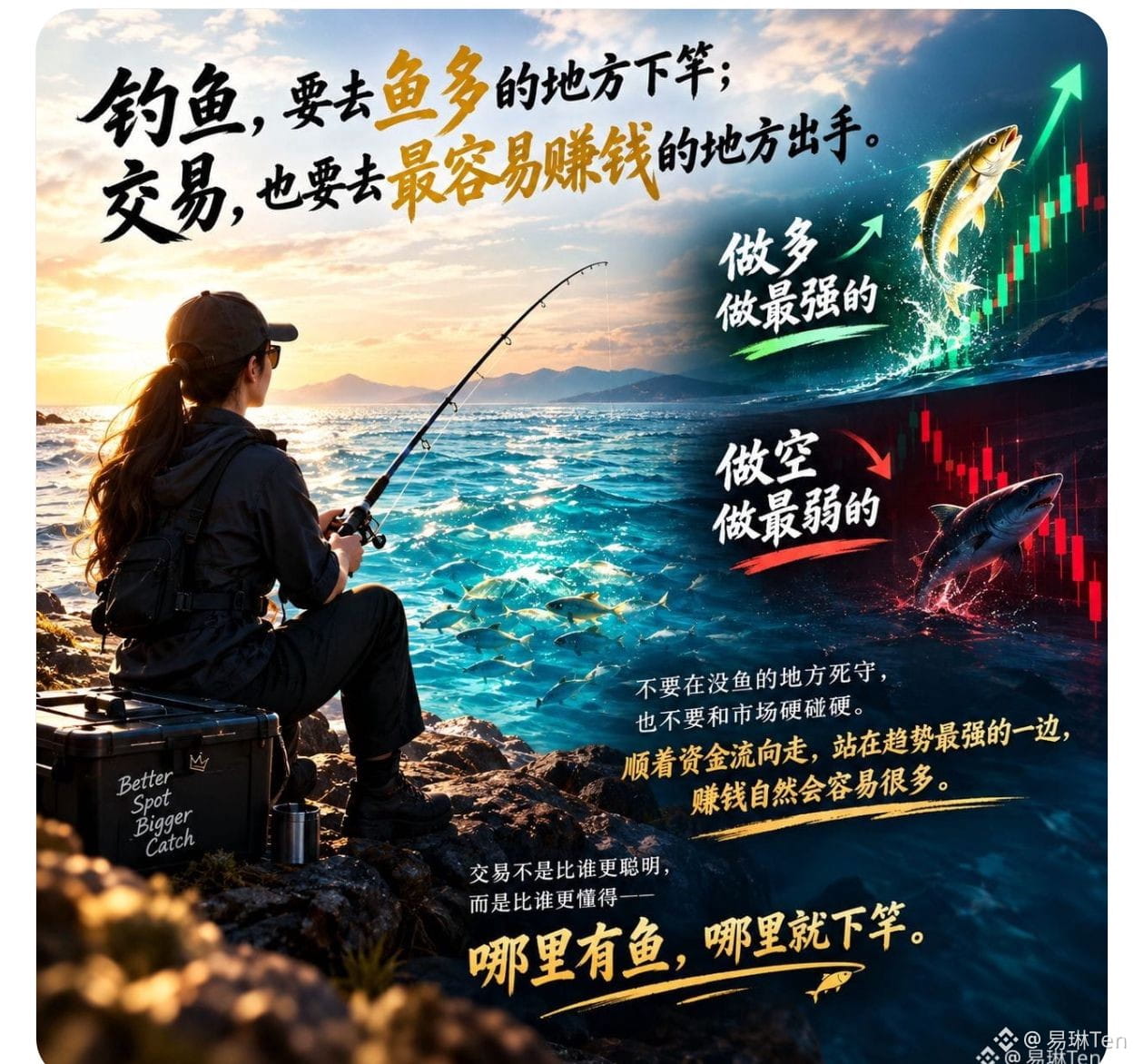
To fish, go to the places with more fish and cast your line;
for trading, go to the places where it’s easiest to make money.
For going long, choose the strongest;
for going short, choose the weakest.
Don’t hold your ground in a place with no fish, and don’t clash head-on with the market.
Follow the flow of capital, stand on the side where the trend is strongest—making money naturally becomes much easier.
Trading isn’t about who’s smarter,
but about who understands better—where there are fish, that’s where you cast your line. 🎣📈
To fish, go to the places with more fish and cast your line;
for trading, go to the places where it’s easiest to make money.
For going long, choose the strongest;
for going short, choose the weakest.
Don’t hold your ground in a place with no fish, and don’t clash head-on with the market.
Follow the flow of capital, stand on the side where the trend is strongest—making money naturally becomes much easier.
Trading isn’t about who’s smarter,
but about who understands better—where there are fish, that’s where you cast your line. 🎣📈
for trading, go to the places where it’s easiest to make money.
For going long, choose the strongest;
for going short, choose the weakest.
Don’t hold your ground in a place with no fish, and don’t clash head-on with the market.
Follow the flow of capital, stand on the side where the trend is strongest—making money naturally becomes much easier.
Trading isn’t about who’s smarter,
but about who understands better—where there are fish, that’s where you cast your line. 🎣📈
2
670
·
--
Risk control isn’t about guessing every day whether the market will suddenly crash.
Real risk control is:
how big your position is,
where you set your stop-loss,
what your worst-case loss will be,
and what you do after you’re wrong and the trade goes against you.
As for whether the market will suddenly fall—that’s the market’s business.
Risk control isn’t about guessing every day whether the market will suddenly crash.
Real risk control is:
how big your position is,
where you set your stop-loss,
what your worst-case loss will be,
and what you do after you’re wrong and the trade goes against you.
As for whether the market will suddenly fall—that’s the market’s business.
Real risk control is:
how big your position is,
where you set your stop-loss,
what your worst-case loss will be,
and what you do after you’re wrong and the trade goes against you.
As for whether the market will suddenly fall—that’s the market’s business.

1
339
·
--
Real growth in trading comes from slowly growing small capital
By practicing with small capital and gradually building it up,
what you’re really going through is a process of honing your mindset and understanding compounding.
Many people always want to get rich overnight,
thinking they can make A8, A9 directly from a single trade.
But from the underlying logic of trading, that directly goes against trading principles.
Why do so many people who suddenly get rich end up back at square one?
Because they received a large unexpected windfall,
but they didn’t build the kind of mindset, discipline, and understanding that matches that wealth.
The power of compounding never comes from extreme returns,
but from having long enough time for “pretty good” performance.
What truly matters isn’t how much you made in one year,
but whether you can go through wave after wave of volatility and still stay in the game.
A strategy that keeps you anxious every night and makes you change your plan frequently,
no matter how excellent it sounds in theory,
is hard to carry out consistently over the long run.
Trading isn’t about who can make the most money in one night,
but about who can last long enough—so that time turns “pretty good” returns into astonishing results.
It’s okay to go slower.
Stability is the real starting point of compounding.
Real growth in trading comes from slowly growing small capital
By practicing with small capital and gradually building it up,
what you’re really going through is a process of honing your mindset and understanding compounding.
Many people always want to get rich overnight,
thinking they can make A8, A9 directly from a single trade.
But from the underlying logic of trading, that directly goes against trading principles.
Why do so many people who suddenly get rich end up back at square one?
Because they received a large unexpected windfall,
but they didn’t build the kind of mindset, discipline, and understanding that matches that wealth.
The power of compounding never comes from extreme returns,
but from having long enough time for “pretty good” performance.
What truly matters isn’t how much you made in one year,
but whether you can go through wave after wave of volatility and still stay in the game.
A strategy that keeps you anxious every night and makes you change your plan frequently,
no matter how excellent it sounds in theory,
is hard to carry out consistently over the long run.
Trading isn’t about who can make the most money in one night,
but about who can last long enough—so that time turns “pretty good” returns into astonishing results.
It’s okay to go slower.
Stability is the real starting point of compounding.
By practicing with small capital and gradually building it up,
what you’re really going through is a process of honing your mindset and understanding compounding.
Many people always want to get rich overnight,
thinking they can make A8, A9 directly from a single trade.
But from the underlying logic of trading, that directly goes against trading principles.
Why do so many people who suddenly get rich end up back at square one?
Because they received a large unexpected windfall,
but they didn’t build the kind of mindset, discipline, and understanding that matches that wealth.
The power of compounding never comes from extreme returns,
but from having long enough time for “pretty good” performance.
What truly matters isn’t how much you made in one year,
but whether you can go through wave after wave of volatility and still stay in the game.
A strategy that keeps you anxious every night and makes you change your plan frequently,
no matter how excellent it sounds in theory,
is hard to carry out consistently over the long run.
Trading isn’t about who can make the most money in one night,
but about who can last long enough—so that time turns “pretty good” returns into astonishing results.
It’s okay to go slower.
Stability is the real starting point of compounding.

1
751
·
--
Control your desires, manage your fears
You think you’re researching the market.
In fact, the market is researching you.
Research your greed,
research your fear,
research your luck of the draw,
research when you’ll lose control.
Control your desires, manage your fears
You think you’re researching the market.
In fact, the market is researching you.
Research your greed,
research your fear,
research your luck of the draw,
research when you’ll lose control.
You think you’re researching the market.
In fact, the market is researching you.
Research your greed,
research your fear,
research your luck of the draw,
research when you’ll lose control.

4
6
1.1k
·
--
The Highest Realm of Trading: Ultimate Simplicity
You must rid yourself of all tedious, distracting clutter.
A trading career is radically different from ordinary life. Trading, at its core, is a minimalist way of living.
You should proactively eliminate unnecessary distractions from your life, keeping your private life simple and calm. Only then will you have enough energy to repeatedly make rational, composed decisions that are fully thought through.
In fact, trading and life influence each other:
If life is chaotic, your trading judgments are more likely to become distorted; if your trading routine is frantic and messy, it will also drag down your personal life.
So a truly mature trader should align their life rhythm with their trading rhythm.
Especially watch out for—decision fatigue.
What this industry fears most is not a lack of opportunities, but making too many meaningless decisions every day, and then—through exhaustion, anxiety, and impulsiveness—ending up with wrong judgments.
Trading doesn’t require you to make life complicated. Instead, you should remove everything that’s irrelevant.
Save energy for what truly matters:
waiting, judging, execution, and controlling risk.
The Highest Realm of Trading: Ultimate Simplicity
You must rid yourself of all tedious, distracting clutter.
A trading career is radically different from ordinary life. Trading, at its core, is a minimalist way of living.
You should proactively eliminate unnecessary distractions from your life, keeping your private life simple and calm. Only then will you have enough energy to repeatedly make rational, composed decisions that are fully thought through.
In fact, trading and life influence each other:
If life is chaotic, your trading judgments are more likely to become distorted; if your trading routine is frantic and messy, it will also drag down your personal life.
So a truly mature trader should align their life rhythm with their trading rhythm.
Especially watch out for—decision fatigue.
What this industry fears most is not a lack of opportunities, but making too many meaningless decisions every day, and then—through exhaustion, anxiety, and impulsiveness—ending up with wrong judgments.
Trading doesn’t require you to make life complicated. Instead, you should remove everything that’s irrelevant.
Save energy for what truly matters:
waiting, judging, execution, and controlling risk.
You must rid yourself of all tedious, distracting clutter.
A trading career is radically different from ordinary life. Trading, at its core, is a minimalist way of living.
You should proactively eliminate unnecessary distractions from your life, keeping your private life simple and calm. Only then will you have enough energy to repeatedly make rational, composed decisions that are fully thought through.
In fact, trading and life influence each other:
If life is chaotic, your trading judgments are more likely to become distorted; if your trading routine is frantic and messy, it will also drag down your personal life.
So a truly mature trader should align their life rhythm with their trading rhythm.
Especially watch out for—decision fatigue.
What this industry fears most is not a lack of opportunities, but making too many meaningless decisions every day, and then—through exhaustion, anxiety, and impulsiveness—ending up with wrong judgments.
Trading doesn’t require you to make life complicated. Instead, you should remove everything that’s irrelevant.
Save energy for what truly matters:
waiting, judging, execution, and controlling risk.

4
1
10
2k
·
--
Trading is never only a battle of IQ
Traditional IQ tests measure language, logic, and spatial reasoning—but they cannot determine whether a trader can stand at the top of the market.
Truly top-tier trading ability comes from three core qualities:
First, probability intuition.
It’s not about predicting the future, but quickly judging win rates amid uncertainty—knowing when to act and when to wait.
Second, emotional control.
When facing massive unrealized losses, consecutive stop-outs, and market panic, you can still stay calm and not be driven by greed or fear.
Third, pattern recognition.
From complex price fluctuations, capital flows, and market sentiment, capture patterns that others can’t see.
These abilities can’t be copied by a few books or a few indicators. It’s more like a “brain trading system” formed through long-term training—your prefrontal cortex handles rational decisions, the amygdala handles emotional reactions, and truly excellent traders can keep both in balance.
So in the end, what the market tests is not just knowledge and techniques, but a person’s cognitive structure, psychological resilience, and the ability to handle uncertainty.
Trading is a war between a person and their own brain. True experts win themselves first, then win the market.
Trading is never only a battle of IQ
Traditional IQ tests measure language, logic, and spatial reasoning—but they cannot determine whether a trader can stand at the top of the market.
Truly top-tier trading ability comes from three core qualities:
First, probability intuition.
It’s not about predicting the future, but quickly judging win rates amid uncertainty—knowing when to act and when to wait.
Second, emotional control.
When facing massive unrealized losses, consecutive stop-outs, and market panic, you can still stay calm and not be driven by greed or fear.
Third, pattern recognition.
From complex price fluctuations, capital flows, and market sentiment, capture patterns that others can’t see.
These abilities can’t be copied by a few books or a few indicators. It’s more like a “brain trading system” formed through long-term training—your prefrontal cortex handles rational decisions, the amygdala handles emotional reactions, and truly excellent traders can keep both in balance.
So in the end, what the market tests is not just knowledge and techniques, but a person’s cognitive structure, psychological resilience, and the ability to handle uncertainty.
Trading is a war between a person and their own brain. True experts win themselves first, then win the market.
Traditional IQ tests measure language, logic, and spatial reasoning—but they cannot determine whether a trader can stand at the top of the market.
Truly top-tier trading ability comes from three core qualities:
First, probability intuition.
It’s not about predicting the future, but quickly judging win rates amid uncertainty—knowing when to act and when to wait.
Second, emotional control.
When facing massive unrealized losses, consecutive stop-outs, and market panic, you can still stay calm and not be driven by greed or fear.
Third, pattern recognition.
From complex price fluctuations, capital flows, and market sentiment, capture patterns that others can’t see.
These abilities can’t be copied by a few books or a few indicators. It’s more like a “brain trading system” formed through long-term training—your prefrontal cortex handles rational decisions, the amygdala handles emotional reactions, and truly excellent traders can keep both in balance.
So in the end, what the market tests is not just knowledge and techniques, but a person’s cognitive structure, psychological resilience, and the ability to handle uncertainty.
Trading is a war between a person and their own brain. True experts win themselves first, then win the market.

1
9
1k
·
--

Article
The 20 Books a Trader Is Truly Worth ReadingWhen the market is quiet and the action is light, it’s the best time to enhance your understanding.
Truly excellent traders don’t read books to look for a “sure-win shortcut,” but to understand:
Why does the world run this way?
Why does wealth come into being?
Why do cycles repeat?
Where will future opportunities arise?
Ordinary traders study prices; great traders study the market; and top traders study—history, cycles, human nature, technology, and the future.
The following 20 books are worth reading for everyone who wants to stay in the market long-term.
Part One: Understanding the Past—How the World Was Formed
The 20 Books a Trader Is Truly Worth Reading
When the market is quiet and the action is light, it’s the best time to enhance your understanding.
Truly excellent traders don’t read books to look for a “sure-win shortcut,” but to understand:
Why does the world run this way?
Why does wealth come into being?
Why do cycles repeat?
Where will future opportunities arise?
Ordinary traders study prices; great traders study the market; and top traders study—history, cycles, human nature, technology, and the future.
The following 20 books are worth reading for everyone who wants to stay in the market long-term.
Part One: Understanding the Past—How the World Was Formed
Truly excellent traders don’t read books to look for a “sure-win shortcut,” but to understand:
Why does the world run this way?
Why does wealth come into being?
Why do cycles repeat?
Where will future opportunities arise?
Ordinary traders study prices; great traders study the market; and top traders study—history, cycles, human nature, technology, and the future.
The following 20 books are worth reading for everyone who wants to stay in the market long-term.
Part One: Understanding the Past—How the World Was Formed
2
6
923
Log in to explore more content
Join global crypto users on Binance Square
⚡️ Get latest and useful information about crypto.
💬 Trusted by the world’s largest crypto exchange.
👍 Discover real insights from verified creators.
Email / Phone number