



Bitcoin is often described through its strongest narratives: digital scarcity, decentralization, protection from inflation, and an alternative to the traditional financial system. These are all valid interpretive keys, but none of them alone is enough to explain price behavior.
To understand Bitcoin’s performance, especially in the short and medium term, we also need to look at global liquidity. Beyond philosophy and technology, BTC is now a financial asset traded in a global market. Therefore, its price is affected by the amount of available capital, the cost of money, the strength of the dollar, and the level of investor confidence.
In other words, Bitcoin was born as an alternative to the system, but today its price is significantly influenced by the very system it aims to surpass. This is not necessarily a weakness: it is also a sign that Bitcoin has entered a more mature phase.

Bitcoin: digital gold or liquidity-sensitive asset?
Bitcoin’s most well-known feature is its limited supply. There can never be more than 21 million BTC, and this rule does not depend on a central bank, a government, or a political decision. This is where the digital gold narrative comes from: a scarce good, non-manipulable and potentially suitable for preserving value over the long term.
However, when you look at the price, the picture becomes more complex. Bitcoin does not always behave like a safe-haven asset. In several market phases it moves like an asset that is highly sensitive to liquidity: when there is an abundance of capital in the system and investors are willing to take on more risk, BTC often tends to benefit. When liquidity instead shrinks, rates rise and the dollar strengthens, Bitcoin tends to suffer.
This is a dynamic we have already seen several times. When money circulates easily, capital looks for opportunities with greater potential and also moves into crypto. In periods of monetary tightening, on the other hand, investors become more cautious and reduce their exposure to the most volatile assets.
What is global liquidity and what does M2 indicate?
When we talk about global liquidity, we refer to the amount of money and easily usable instruments present in the financial system. One of the most closely watched indicators is M2, which includes money in circulation, deposits, and other forms of liquidity. It is not a perfect measure, but it helps to understand how much fuel is available for the markets.
This relationship, however, is not automatic. It is not enough to say that if liquidity increases, Bitcoin goes up. It also matters where that liquidity goes. If the money remains parked in monetary or bond instruments considered safe, BTC can stay weak even in a context of rising liquidity. If instead investors return to seeking opportunities in more dynamic markets, Bitcoin can react strongly.
Liquidity, therefore, is the fuel. But the willingness to use it is also needed. Without confidence, without risk appetite and without inflows, liquidity alone is not enough to sustain a new bullish cycle.
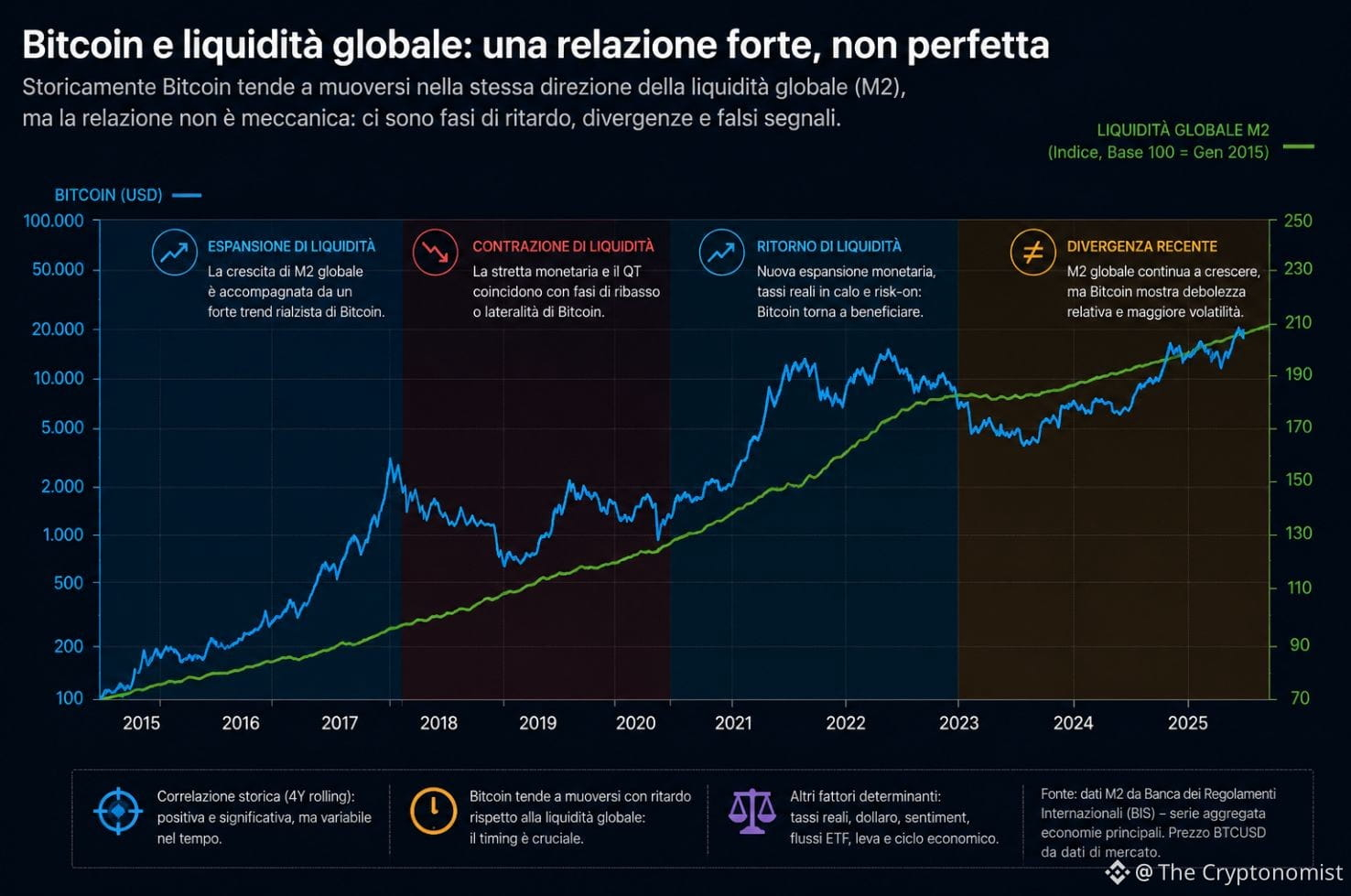
Figure 1 – Trend of the price of Bitcoin and global M2 liquidity between 2015 and 2025: the historical correlation is significant, but lags, divergences and other macroeconomic factors make the relationship not always linear.
How interest rates and the dollar influence Bitcoin
Another decisive element is the level of real rates, that is, the yield on financial instruments net of inflation. When these returns are high, holding Bitcoin becomes less attractive for many institutional investors. Not because the long-term narrative disappears, but because the opportunity cost increases.
If an investor can obtain an attractive return from relatively safe instruments, they must have very strong conviction to take on exposure to a volatile asset, with no coupon and subject to sharp drawdowns. Conversely, when the market starts to expect lower rates or a more accommodative monetary policy, capital tends to look for alternatives with greater growth potential. In that context, Bitcoin often returns to the center of attention.
The dollar also plays a fundamental role. A strong dollar tends to reduce appetite for risky assets, while a weaker dollar can favor technology, commodities and crypto. Bitcoin is decentralized, but the market in which it is traded remains deeply tied to the dollar and to expectations about the Federal Reserve.
Spot Bitcoin ETFs: how they have changed the market
The arrival of spot Bitcoin ETFs has significantly changed the structure of demand. Previously, most capital flowed through crypto exchanges, stablecoins, private wallets and sector investors. Today, instead, a growing share can enter BTC through regulated instruments that are simple to buy and familiar to traditional finance.
However, there is also a downside: if Bitcoin enters traditional portfolios, it is also managed according to traditional logic. It can be bought when confidence in the markets increases, but it can be sold quickly when investors reduce their exposure to the most volatile assets. The ETF therefore makes Bitcoin more mature and liquid, but also more sensitive to institutional finance flows.
Why more liquidity does not always mean a rise in Bitcoin
The key point is that global liquidity matters a lot, but it never acts alone. There are phases in which liquidity increases because the system is healthy, confidence is growing and investors are looking for new opportunities. In these contexts, Bitcoin often tends to perform well, because it is perceived as an asset capable of amplifying market moves.
However, there are also phases in which liquidity increases for defensive reasons: banking stress, systemic risks, emergency interventions by central banks. In these cases, capital may not immediately flow into Bitcoin. It may first move toward the dollar, Treasuries, gold or cash, that is, toward instruments perceived as safer.
This explains why the relationship between Bitcoin and liquidity can show lags, divergences and false signals. The decisive variable is not only how much liquidity exists, but in what market climate it is injected. Bitcoin tends to benefit from liquidity when that liquidity meets confidence, risk appetite and concrete inflows into the crypto sector.
Can Bitcoin still be considered digital gold?
The question becomes inevitable: if Bitcoin depends so much on liquidity, can it still be considered digital gold? The answer is not clear-cut. Bitcoin retains unique monetary characteristics: limited supply, transparent rules, independence from central banks and the absence of a central authority that can arbitrarily change its issuance.
At the same time, the market does not price it solely on the basis of these characteristics. It also prices it based on flows, rates, the dollar, ETFs, leverage and sentiment. Bitcoin is therefore two things at the same time: an alternative monetary asset in the long term and an asset that is highly sensitive to liquidity in the short and medium term.
This dual nature is one of the reasons why it is so difficult to classify. It is not simply gold. It is not simply technology. It is not simply currency. It is a new type of macro-digital asset, in which programmed scarcity and global liquidity meet.
Global liquidity and the price of Bitcoin: conclusions
To understand where Bitcoin might go, it is not enough to look at the BTC/USD chart. You need to observe the broader context: real rates, expectations about the Federal Reserve, the strength of the dollar, net flows of spot ETFs, growth or contraction of global liquidity, and the behavior of equity markets.
The great contradiction is precisely this: Bitcoin was created to be independent of the traditional monetary system, but today its price is deeply influenced by central bank decisions, bond yields, the dollar and institutional flows. Perhaps this is not a weakness. Perhaps it is the price of adoption.
The more Bitcoin enters global finance, the more relevant it becomes. But the more relevant it becomes, the more it is influenced by the same forces that move other major financial assets. In this sense, to truly understand where the price of BTC can go, ignoring the level of global liquidity would certainly be a mistake.
Until next time and happy trading!
Andrea Unger