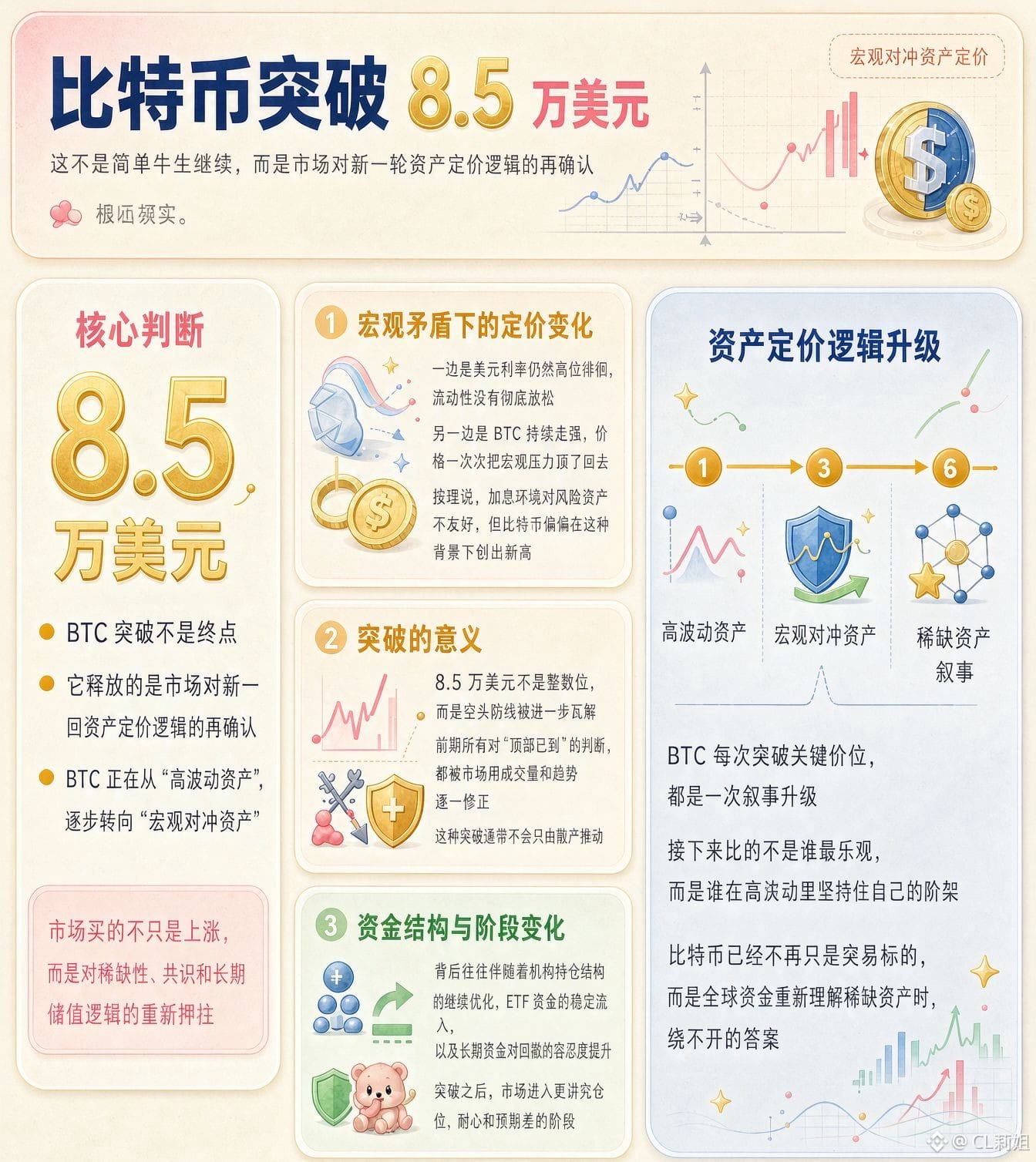

#比特币突破8.5万美元 , if this node is only summarized as “the bull market continues,” it actually feels too light. Because when you look at it from a larger framework, this time BTC’s upside breakout is not truly about the price itself—it’s about the market reaffirming a new round of asset-pricing logic.
The core contradiction in the recent crypto market has always been quite clear: on one side, U.S. dollar interest rates remain elevated and liquidity hasn’t fully loosened; on the other side, BTC keeps strengthening, repeatedly “pushing back” macro pressure. In theory, a rate-hike environment should be unfriendly to risk assets, but Bitcoin has nonetheless set new highs in this backdrop. This suggests BTC is gradually shifting from being priced as a “high-volatility asset” to a “macro-hedging asset.” What the market is buying isn’t just the rise, but a renewed bet on scarcity, consensus, and the long-term store-of-value thesis.
The most important thing about breaking $85,000 is not the integer figure—it’s what it means: the short-seller defensive line has been further dismantled, and all prior judgments that “the top is already in” have been corrected one by one by the market through trading volume and trend. More importantly, such breakouts usually aren’t driven only by retail investors. Behind the scenes, institutional positioning structures often continue to optimize, ETF inflows tend to remain steady, and long-term capital becomes more tolerant of drawdowns.
But the truly sophisticated take is not to only stare at “how high it goes,” but to ask “who is taking the bid.” If the previous phase was a sentiment-driven repair, then after the $85,000 breakout, the market enters a stage that’s more particular about positioning, patience, and expectation gaps. In other words, what’s being compared next isn’t who is the most optimistic, but who can hold their framework steady amid high volatility.
I’ve always believed that every time BTC breaks a key price level, it’s an upgrade of the narrative. $85,000 isn’t the endpoint; it’s more like the market telling us that Bitcoin is no longer just a trading instrument. It has become the answer that global capital can’t avoid when it re-interprets scarce assets. #加密市场 #加密货币 $BTC
The core contradiction in the recent crypto market has always been quite clear: on one side, U.S. dollar interest rates remain elevated and liquidity hasn’t fully loosened; on the other side, BTC keeps strengthening, repeatedly “pushing back” macro pressure. In theory, a rate-hike environment should be unfriendly to risk assets, but Bitcoin has nonetheless set new highs in this backdrop. This suggests BTC is gradually shifting from being priced as a “high-volatility asset” to a “macro-hedging asset.” What the market is buying isn’t just the rise, but a renewed bet on scarcity, consensus, and the long-term store-of-value thesis.
The most important thing about breaking $85,000 is not the integer figure—it’s what it means: the short-seller defensive line has been further dismantled, and all prior judgments that “the top is already in” have been corrected one by one by the market through trading volume and trend. More importantly, such breakouts usually aren’t driven only by retail investors. Behind the scenes, institutional positioning structures often continue to optimize, ETF inflows tend to remain steady, and long-term capital becomes more tolerant of drawdowns.
But the truly sophisticated take is not to only stare at “how high it goes,” but to ask “who is taking the bid.” If the previous phase was a sentiment-driven repair, then after the $85,000 breakout, the market enters a stage that’s more particular about positioning, patience, and expectation gaps. In other words, what’s being compared next isn’t who is the most optimistic, but who can hold their framework steady amid high volatility.
I’ve always believed that every time BTC breaks a key price level, it’s an upgrade of the narrative. $85,000 isn’t the endpoint; it’s more like the market telling us that Bitcoin is no longer just a trading instrument. It has become the answer that global capital can’t avoid when it re-interprets scarce assets. #加密市场 #加密货币 $BTC