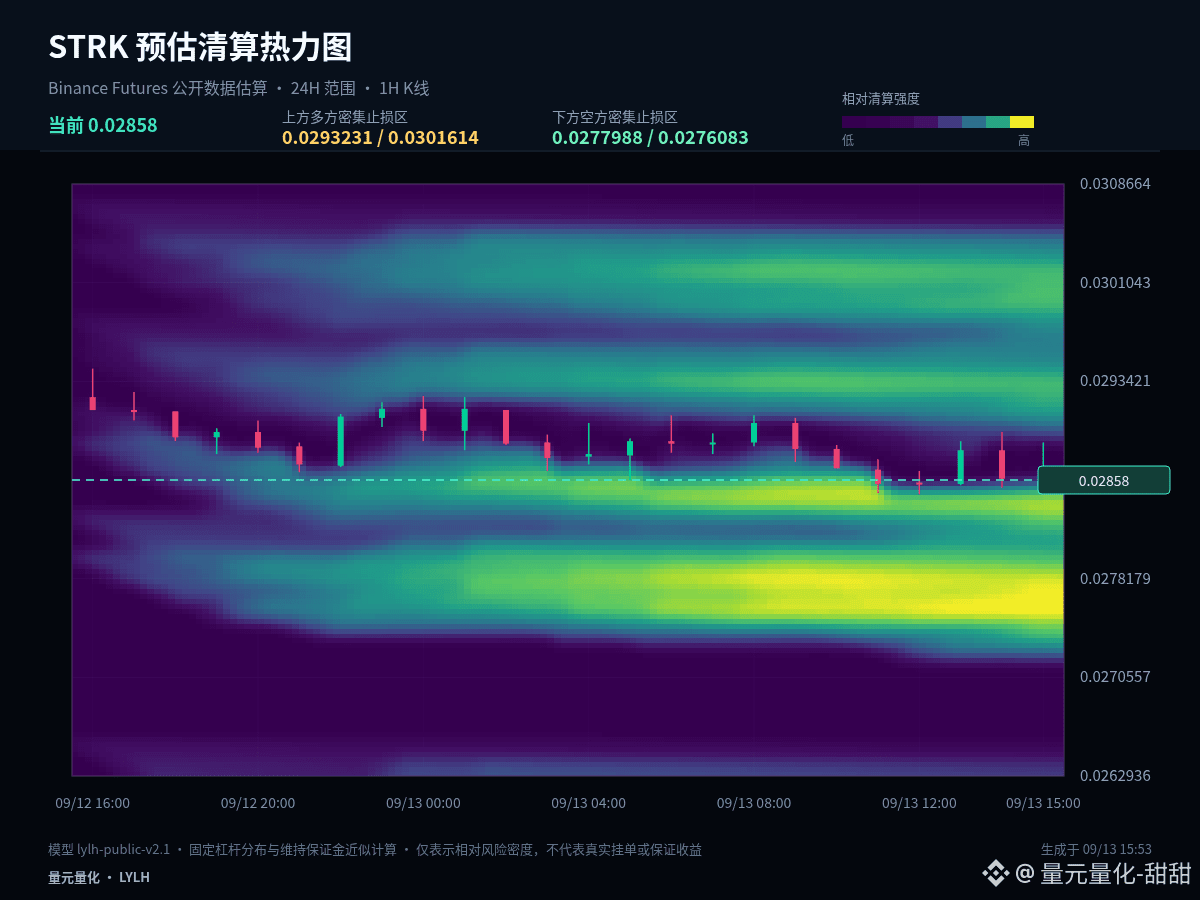
$STRK #STRK In the past 24 hours, the high-low amplitude is about 3.4%, and the current price is 0.0286. This is not a calm range suitable for casually opening a position. When volatility expands, you should adjust your position first, then discuss direction.
$STRK #STRK is testing the lower bound of the last 24-hour range. The price may look lower, but the true trading value depends on whether the support/absorption continues, not just on the feeling that it’s “cheap.”
The current price is near the lower end of the last 24-hour volatility range. 1 hour: -0.07%, 24 hours: -2.12%. The key to analyzing the downside is not to bottom-fish early, but to watch whether it can quickly reclaim after breaking down. Being able to reclaim means selling pressure is being absorbed. If it keeps lingering below the lower bound, it indicates that weakness hasn’t ended.
For the short term, first watch whether 0.0285 can form continuous buy support. Then watch whether 0.02898 can be reclaimed again. The former determines whether the sell-off will slow down; the latter determines whether the rebound can strengthen. Without confirmation on both, it’s not advisable to judge opportunities based only on the magnitude of the drop.
In a high-volatility phase, the execution principle is to reduce per-trade exposure, avoid chasing prices back and forth in the middle of the range, and write the invalidation conditions before entering. If the price doesn’t provide confirmation, it’s better to do fewer trades than to compensate for uncertainty with a larger position.
Execution-wise, set clear conditions: after breaking above 0.02946, it needs confirmation—not just a brief spike and then chasing. After probing down to 0.0285, you need to see whether it can be quickly reclaimed—not simply pick up as soon as it dips. When the middle zone doesn’t offer sufficient reward-to-risk, waiting is also part of the strategy.
Risk control still comes before any conclusion: only execute when conditions appear; if the setup fails, reassess promptly. The greater the volatility, the more restrained the per-trade position should be. The above is a scenario analysis based on current 1-hour and 24-hour data, and does not constitute any promise of returns.
#CanadaOSFISaysTokenizedDepositsEqualTraditionalDeposits
$STRK #STRK is testing the lower bound of the last 24-hour range. The price may look lower, but the true trading value depends on whether the support/absorption continues, not just on the feeling that it’s “cheap.”
The current price is near the lower end of the last 24-hour volatility range. 1 hour: -0.07%, 24 hours: -2.12%. The key to analyzing the downside is not to bottom-fish early, but to watch whether it can quickly reclaim after breaking down. Being able to reclaim means selling pressure is being absorbed. If it keeps lingering below the lower bound, it indicates that weakness hasn’t ended.
For the short term, first watch whether 0.0285 can form continuous buy support. Then watch whether 0.02898 can be reclaimed again. The former determines whether the sell-off will slow down; the latter determines whether the rebound can strengthen. Without confirmation on both, it’s not advisable to judge opportunities based only on the magnitude of the drop.
In a high-volatility phase, the execution principle is to reduce per-trade exposure, avoid chasing prices back and forth in the middle of the range, and write the invalidation conditions before entering. If the price doesn’t provide confirmation, it’s better to do fewer trades than to compensate for uncertainty with a larger position.
Execution-wise, set clear conditions: after breaking above 0.02946, it needs confirmation—not just a brief spike and then chasing. After probing down to 0.0285, you need to see whether it can be quickly reclaimed—not simply pick up as soon as it dips. When the middle zone doesn’t offer sufficient reward-to-risk, waiting is also part of the strategy.
Risk control still comes before any conclusion: only execute when conditions appear; if the setup fails, reassess promptly. The greater the volatility, the more restrained the per-trade position should be. The above is a scenario analysis based on current 1-hour and 24-hour data, and does not constitute any promise of returns.
#CanadaOSFISaysTokenizedDepositsEqualTraditionalDeposits