How much back-end cost does Dusk Network’s native issuance really cut? I did the math
A friend of mine works at a brokerage firm handling corporate actions. Every dividend season, it’s like someone drains all the life out of him—interest accrual, withholding taxes, dividend distributions, shareholder voting—each step requires manual reconciliation. By the time everything is done, the costs are absurd. He jokes that half the manpower in the securities industry is spent on “helping customers count money.”
The native issuance approach of <c-1/>@Dusk Network targets exactly this sore spot. Traditional packaged RWA setups do an SPV off-chain and issue a token on-chain as a “shadow.” Then corporate actions still have to be manually triggered. Dusk, on the other hand, has assets created directly on-chain. Dividend and interest calculations are handled automatically by smart contracts, and the conditions for shareholder voting are written into the contracts. Once the time comes, everything runs automatically—so the whole manual reconciliation workflow disappears. What gets saved isn’t just a small amount of fees; it’s the entire back-office processing pipeline.
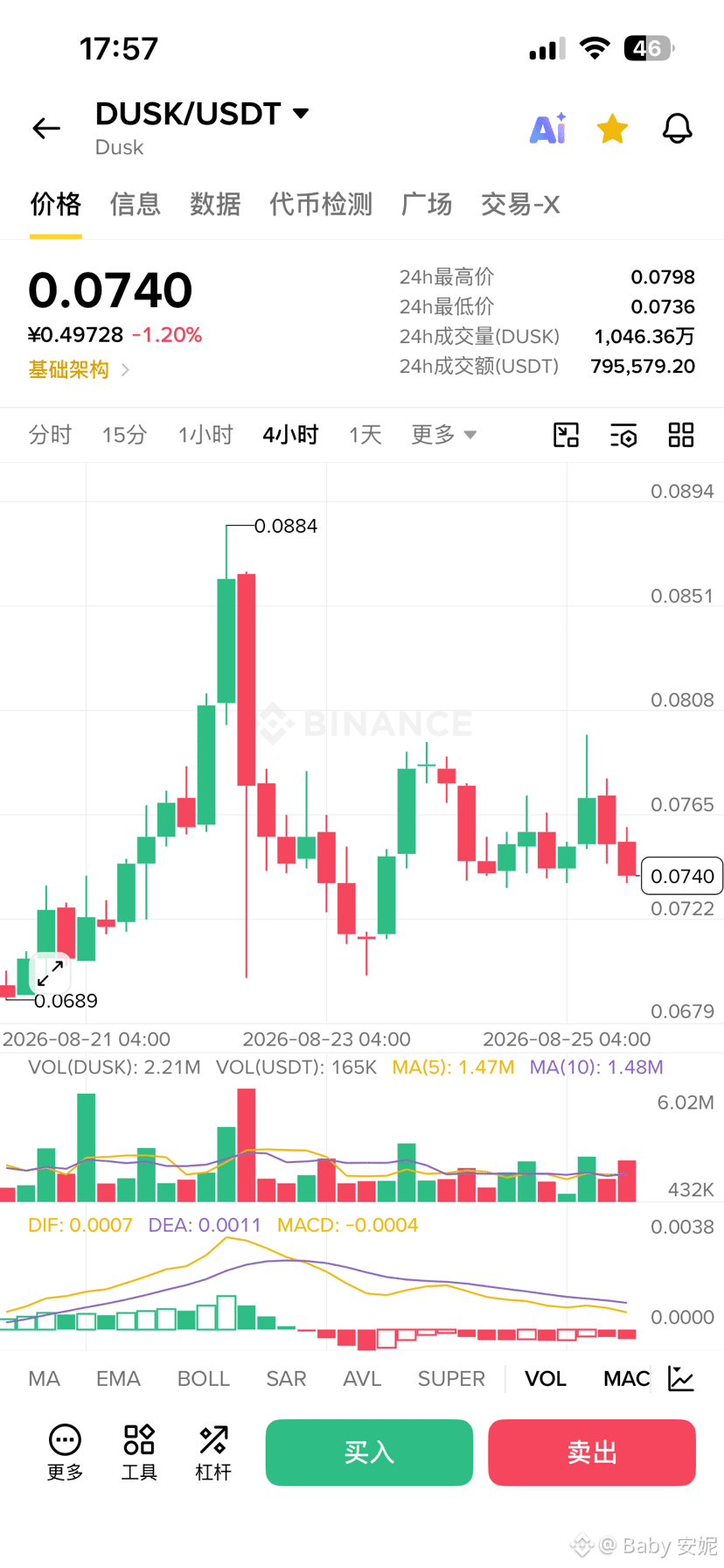
Technically, you can’t avoid the Hedger module. It combines homomorphic encryption with zero-knowledge proofs. In the encrypted state, the contract can still compute dividends and interest without exposing each holder’s position details to the entire network. Market makers don’t need to keep huge bridge capital either, and settlement speed can be compressed from T+2 down to a few seconds. DUSK’s market cap is around $37 million, but if this accounting logic is truly deployed at scale, the back-end cost for traditional brokerages could drop significantly.
That said, the problem isn’t small either. Smart-contract automation of corporate actions sounds great—until an interest-accrual rule has a bug, and then money is sent incorrectly and can’t be recovered. How much legal force “code as law” carries in European courts is also unclear, and nobody can say for sure. The native issuance path is headed in the right direction, but whether institutions dare to hand over their lifeline to code—well, I’m still watching and waiting.
#dusk $DUSK