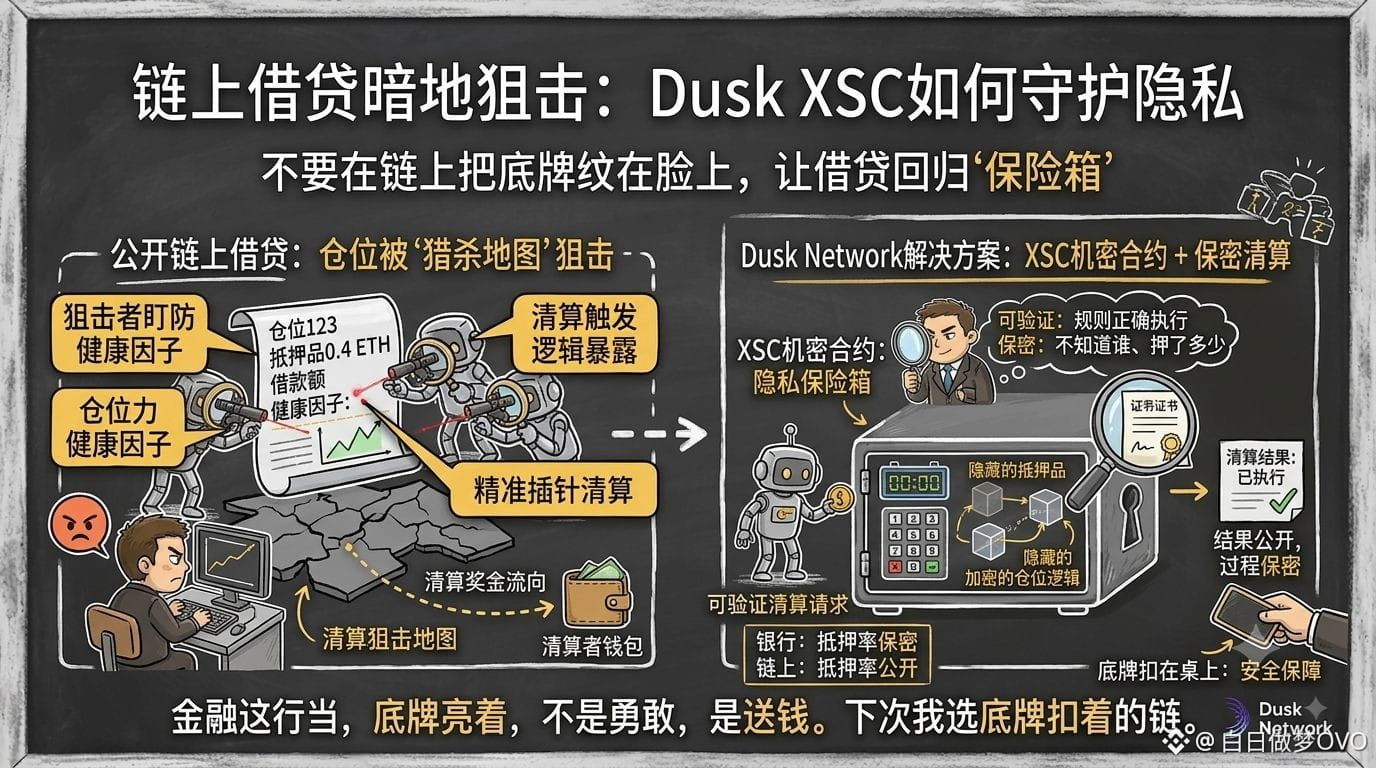
I really couldn’t take it this afternoon. I added margin on a lending agreement; the transfer was just on-chain, and a price spike immediately liquidated my position. When I look back at the blocks, that liquidation watched my health factor the whole time—more than my girlfriend knows my limits. It was just waiting for that one second before I topped up. The liquidation bonus it took; I lost 0.4 ETH. 😤
This incident made me understand a simple truth: on-chain lending looks decentralized, but in practice your collateral, your borrowing amount, and your liquidation threshold are all laid out in plain sight—pretty much like tattooing your bank card password on your face. In traditional finance, would a bank send your mortgage loan-to-value ratio to hedge funds? No. But that’s exactly what on-chain does.
Dusk Network gives me the feeling that it’s like installing a password-secured safe into a lending protocol. Its XSC confidential contract standard can hide your collateral status, borrowing terms, and the liquidation-trigger logic inside the contract—nobody outside can see what’s in the safe. And when liquidation truly happens, the safe opens: the outcome is public, but the process is confidential. This kind of verifiable computation, put simply, means you can confirm that the rules were executed correctly, but you don’t need to know exactly who it was, how much they posted, or precisely when they got liquidated. Like a vending machine: the items come out, but it doesn’t tell you how many coins you paid or which button you pressed.
Some people might complain: if everything is hidden, how can it be regulated? Actually, it’s not evading regulation—it’s handing regulators a more precise audit tool. They can obtain compliance proof, but passersby can’t use your position as a hunting map. Institutions trying to put lending on-chain won’t be able to clear the privacy hurdle, so they simply won’t dare to play.
Let this 0.4 ETH serve as the price of a lesson. Next time I run into on-chain lending, I’ll definitely first check which chain can let me keep my cards on the table. In this business, when your cards are face-up, it’s not courage—it’s just handing out money. #dusk $DUSK @Dusk