New DeFi protocol, small team, big claims: that combination has earned a specific and mostly deserved stereotype, one audit rushed out before launch, a bug bounty page that exists mostly for show, and a headline exploit within the first year that nobody saw coming because nobody was really looking. It's a pattern repeated often enough that skepticism toward any new lending protocol is a reasonable default position.
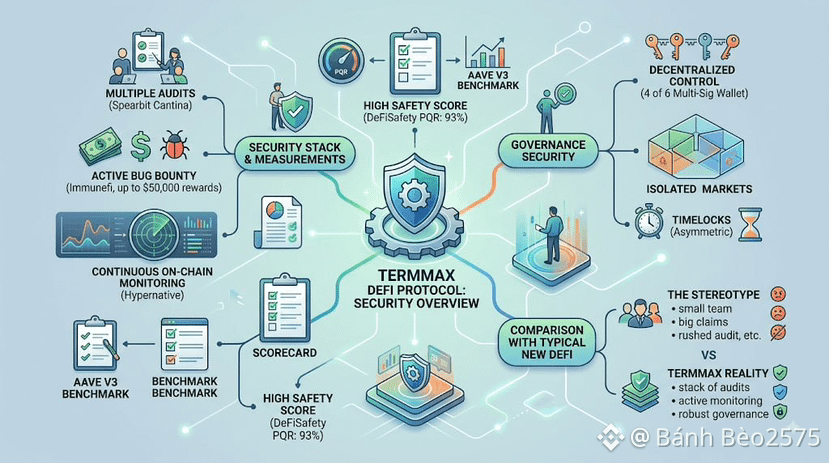
TermMax sits awkwardly inside that stereotype, mostly because it doesn't match the pattern on the specifics that actually matter. The protocol runs multiple rounds of audits through Spearbit's Cantina competitions rather than a single pre-launch review, keeps an active Immunefi bug bounty with critical vulnerability rewards reaching up to $50,000, and layers Hypernative's continuous on-chain monitoring on top of both, watching for suspicious activity in real time rather than relying purely on point in time reviews. TermMax reports a DeFiSafety PQR score of 93%, a figure the team explicitly compares to Aave V3, a protocol most of the industry treats as the security benchmark.
Governance security gets similar treatment: a 4 of 6 multi-signature wallet for critical admin functions, isolated markets so a problem in one collateral pair can't cascade into every other market on the protocol, asymmetric timelocks on risky parameter changes. None of that is unusual for the most established names in DeFi lending. It's genuinely uncommon for a protocol that only launched in April 2025.
Stacked audits and a high safety score reduce the odds of a specific class of failure without eliminating risk entirely, and TermMax's own risk disclosures say as much. What they do is put TermMax outside the "new and under scrutinized" bucket the stereotype assumes by default, a distinction worth making before writing off a young protocol on age alone.
@TermMax #TermMax
$BTW $STBL $STAR
TermMax sits awkwardly inside that stereotype, mostly because it doesn't match the pattern on the specifics that actually matter. The protocol runs multiple rounds of audits through Spearbit's Cantina competitions rather than a single pre-launch review, keeps an active Immunefi bug bounty with critical vulnerability rewards reaching up to $50,000, and layers Hypernative's continuous on-chain monitoring on top of both, watching for suspicious activity in real time rather than relying purely on point in time reviews. TermMax reports a DeFiSafety PQR score of 93%, a figure the team explicitly compares to Aave V3, a protocol most of the industry treats as the security benchmark.
Governance security gets similar treatment: a 4 of 6 multi-signature wallet for critical admin functions, isolated markets so a problem in one collateral pair can't cascade into every other market on the protocol, asymmetric timelocks on risky parameter changes. None of that is unusual for the most established names in DeFi lending. It's genuinely uncommon for a protocol that only launched in April 2025.
Stacked audits and a high safety score reduce the odds of a specific class of failure without eliminating risk entirely, and TermMax's own risk disclosures say as much. What they do is put TermMax outside the "new and under scrutinized" bucket the stereotype assumes by default, a distinction worth making before writing off a young protocol on age alone.
@TermMax #TermMax
$BTW $STBL $STAR