
When you first step into crypto, you notice something odd. Many blockchains live apart. Ethereum, Solana and Cosmos each run on their own rules. Tokens and apps on one chain rarely work on another. It feels limiting, almost like separate towns with locked borders.
Injective tries to change that. It aims to turn those separate islands into something closer to a connected region. Not perfect unity, but close enough that people can move around without a long detour.
Injective began in 2018. It is built on Cosmos tech, though it doesn’t stay inside that zone. The team set out to build a system that can hold pieces from many places at once. It keeps its own identity but reaches outward toward Ethereum, Solana and other chains. The focus is simple: let assets and apps from different chains work together with less stress.
The reason this matters becomes obvious the moment you try to move a token between chains. Say you hold a token on Ethereum and want to do something with it on Solana but That’s not easy. Ethereum uses ERC-20, Solana uses SPL and the two formats don’t speak the same language. You need a bridge, or a wrapped version of the token, or in some cases a middleman. That adds fees, steps and risk. Liquidity ends up scattered. People lose time. Developers face limits they never wanted.
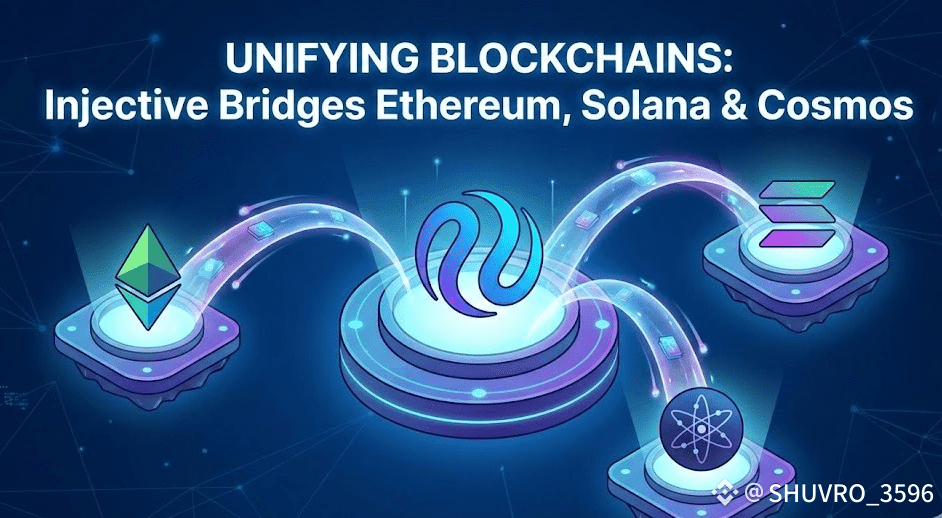
Injective tackles this with a mix of upgrades and smart choices. It brings in tokens from Ethereum, Solana and Cosmos through bridges and IBC support. Once a token reaches Injective, it sits inside a network that knows how to work with assets from many places at once. That alone makes life easier for users who used to jump across tools and chains just to move one asset.
The more interesting part came when Injective launched support for Ethereum-style smart contracts inside its own network and developers who build with Solidity can run their code on Injective without rewriting it for a new chain. It opens the door for a blend of Ethereum and Cosmos ideas in one place. Injective also works toward a multi-VM model, drawing from Ethereum tools and Cosmos tools side by side. Over time, Solana’s style may also fit into that mix. This sort of patchwork might sound messy at first, yet it gives developers more room instead of less.
Several upgrades rolled out in the last couple of years. A major bridge update made it possible to move assets from Ethereum, Solana and Cosmos with one click and very low cost. Another upgrade introduced inEVM on mainnet, letting Ethereum smart contracts run natively. Later came native EVM support directly inside Injective’s chain, tying together speed, low fees and broad compatibility. These shifts show steady progress rather than vague ideas. Bit by bit, Injective has turned interoperability into something people can use today.
The experience for users changes in clear ways. Moving assets feels easier. You no longer need a long chain of steps or a wrapped version of your token. Liquidity from different networks meets in one place, so trades feel more open and less boxed in. Developers keep their familiar tools but gain a wider surface to build on. Costs drop because Injective processes transactions quickly, without the chaos of heavy gas fees.
Still, nothing in crypto lands without a few points to watch. Bridges always come with complexity. Users must stay careful when moving funds. Not every app on Ethereum or Solana will run on Injective without some tweaks. And as the system grows to support more environments, keeping everything in harmony may get harder.
Even with those challenges, there’s a sense that this direction makes sense. For years, blockchains grew in isolation. People built strong communities, but they stayed locked inside single chains. As crypto expands, that model feels outdated. Liquidity splits. Innovation slows. Users bounce between systems that barely talk.
Injective pushes against that. By tying together Ethereum, Solana and Cosmos-based networks and it invites a future where blockchains cooperate instead of standing apart. Assets move with fewer hoops. Ideas travel more freely between developers. Markets open. People gain more ways to use what they already have.
What stands out is the way Injective advances through real features rather than slogans. Bridging that actually works. Contract support that actually runs. Speed and cost improvements that people can see. It brings a sense of practicality to a field that often leans on bold claims.
For anyone tired of chain silos or endless bridge confusion and Injective offers a path that feels closer to how crypto should work. Not perfect, not fully unified but far more connected than before. It shows that cross-chain finance does not have to be complicated and it can feel almost natural when the right pieces fall into place.
