


Author: Cathy
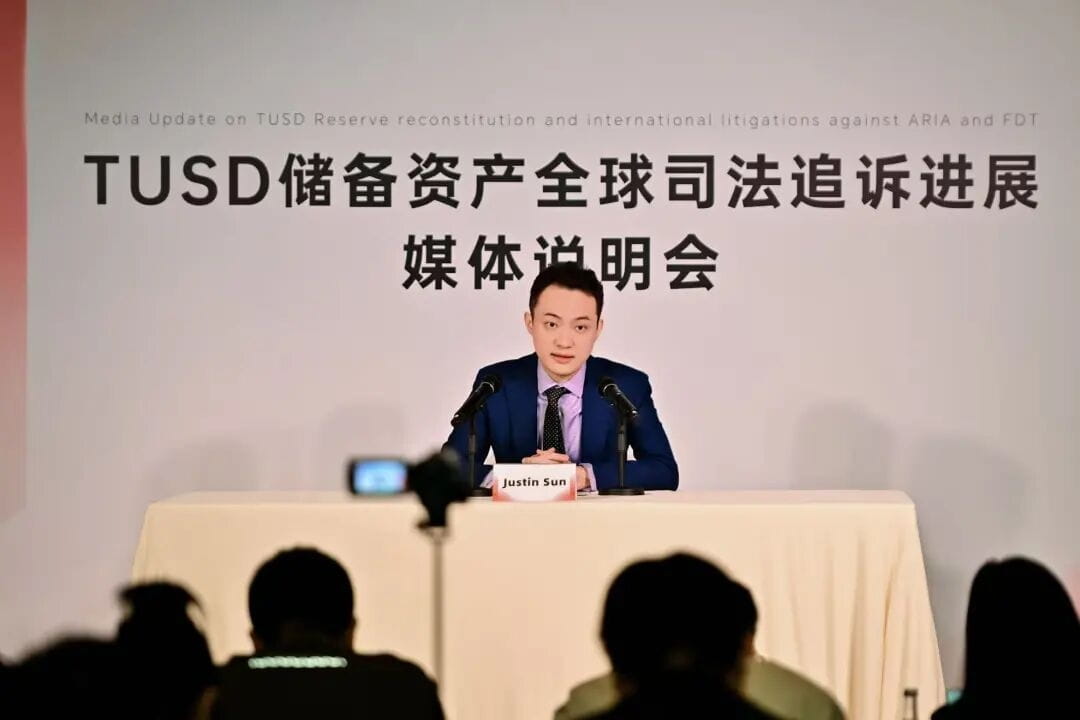
$500 million, saving a systemic crisis.
In January 2024, the stablecoin TUSD found itself at a critical moment—$456 million in reserves 'disappeared', the price plummeted to $0.97, panic spread, and a chain liquidation was imminent.
Sun Yuchen decisively injected $500 million in emergency liquidity, stabilizing TUSD and preventing a collapse that could have affected the entire DeFi ecosystem.
Almost two years later, on October 17, 2025, the Dubai International Financial Centre Digital Economy Court (hereinafter referred to as the Dubai Court) issued a global asset freeze order, freezing $456 million in assets of the parties involved. This rights protection campaign spanning Hong Kong, Singapore, and Dubai has finally made decisive progress.
This is not only the first global asset freezing order issued by an international court in cryptocurrency history but also a milestone in the process of legalizing digital finance.
01
How 456 million dollars 'disappeared'
In December 2020, the Asian consortium Techteryx acquired the operational rights of the TUSD stablecoin.
In the transaction, the seller TrueCoin made a guarantee: TUSD's dollar reserves are fully present in the custody account, and there are no liens or rights burdens.
However, this statement encountered real challenges during subsequent operational delivery.
To maintain continuity of operations, Techteryx did not immediately change custodians and continued to entrust the Hong Kong trust institution First Digital Trust (FDT) with managing dollar reserves.
In early 2021, Techteryx tried to find value-added channels for hundreds of millions of dollars on its books. A financial advisor recommended the Aria Commodities Finance Fund (Aria CFF), registered in the Cayman Islands, a fund investing in commodity trade financing.
The directive is clear: funds must enter the regulated Aria CFF fund account in the Cayman Islands.
But problems arose during the execution phase.
According to evidence disclosed by the Dubai court, between 2021 and 2022, FDT transferred 456 million dollars to Dubai's Aria Commodities DMCC six times, a privately owned trading company wholly owned by Matthew Brittain's wife.
Matthew Brittain himself is the manager of the Cayman Aria Fund, and the couple effectively controls the entire funding chain.
This is not a simple operational error, but a qualitative change in the legal nature.
The Cayman Aria CFF is a regulated fund, and investors hold fund shares. In contrast, Dubai's Aria DMCC is just a regular trading company, and once funds enter, they become unsecured debt.
The lawsuit revealed more details. FDT's CEO Vincent Chok received about 15.5 million dollars in undisclosed commissions through an intermediary entity, which is suspected to be the fundamental reason for his breach of trust directives.
02
Crisis outbreak
In 2023, when Techteryx requested redemption of its investment, Aria DMCC refused. The reason was 'smart'—it could not release funds in a short time due to compliance considerations.
This is a cunning procrastination tactic, attempting to package the 'asset misappropriation case' as an 'anti-money laundering compliance case.'
The reality is that this money has long been invested in illiquid long-term projects and cannot be monetized in the short term.
In January 2024, the crisis fully erupted.
The world's largest trading platform, Binance, removed TUSD from Launchpool and opted to support FDUSD, which was interpreted by the market as a risk signal. A panic sell-off ensued. On January 15, TUSD's price severely de-pegged, falling below 0.97 dollars at one point.
What is even more frightening is the chain reaction: TUSD is widely used as collateral in DeFi lending protocols such as Aave and Compound. Once the price de-pegs, it will trigger tens of billions of dollars in cascading liquidations, potentially severely damaging the entire DeFi ecosystem.
03
Sun Yuchen's decisive action
At the critical moment of life and death, Sun Yuchen acted decisively.
He provided Techteryx with about 500 million dollars in emergency liquidity support, structured as a loan with priority repayment rights. The funds were used directly to meet user redemption demands, ensuring that TUSD maintained its 1:1 redemption capability.
By adopting a 'first extinguish the fire, then hold accountable' approach, TUSD successfully weathered the run on the bank.
As the founder of the TRON ecosystem, Sun Yuchen understands the systemic importance of TUSD. Once it collapses, it would not only severely damage the TRON ecosystem but could also trigger a domino effect in the DeFi market. This rescue demonstrated a strategic vision that transcends short-term interests—stabilizing the situation with capital first, and then recovering losses through legal means. According to prior agreements, any funds recovered from Aria in the future will be prioritized for repaying this emergency loan.
After stabilizing the situation, Sun Yuchen offered a reward of 50 million dollars on social media for clues about the whereabouts of Aria's funds, sending a clear message to the entire industry: misappropriators will pay the price.
04
Global pursuit: A legal battle involving three locations
Stabilizing the market is just the first step; recovering assets is key. With Sun Yuchen's support, Techteryx initiated a legal action for 'global asset preservation,' with the battlefield spanning three jurisdictions.
First stop: Hong Kong
Techteryx sued FDT and its CEO in the High Court of Hong Kong, accusing them of breaching the trust contract, fraudulent misappropriation of funds, and collecting illegal commissions. The main purpose of the Hong Kong litigation is to establish FDT's legal liability.
It was precisely through the litigation in Hong Kong that TUSD was able to obtain bank transaction records proving the flow of funds to Dubai and the 'kickback' commissions.
Second stop: Singapore
Meanwhile, Techteryx and the original TUSD owner TrueCoin were arbitrating issues regarding the acquisition payment and hidden assets at the Singapore International Arbitration Centre. The Singapore court once issued a stay order, suspending part of the Hong Kong litigation to maintain the priority of arbitration.
Third stop: Dubai
Since the funds ultimately flowed to Dubai, Techteryx directly filed a lawsuit in the Dubai International Financial Centre (DIFC) Digital Economy Court.
The core demand is clear: to request the court to confirm that the 456 million dollars held by Aria DMCC legally belongs to Techteryx and to apply for a global freezing order.
05
Breakthrough progress: Issuing a global asset freezing order
In October 2025, the Dubai court made a landmark ruling.
The court issued a global asset freezing order, freezing assets worth 456 million dollars held by Aria DMCC and its affiliates worldwide.
The court found that FDT's action of transferring funds to Aria DMCC violated trust directives. According to common law principles, when a third party knowingly or should reasonably know that the source of funds is improper while receiving trust assets, they automatically become a 'presumed trustee' of those assets. Legally, this money never belonged to Aria DMCC.
The court paid special attention to the 'securitization' plan that Aria DMCC is promoting—attempting to package non-liquid assets such as mining machines and debts into notes for sale. The court found that this is a means to 'launder' illegal assets and transfer them to good-faith third parties, constituting a very high risk of asset dissipation.
The Dubai court established its power as an 'auxiliary jurisdiction' under relevant laws: even if the main litigation is conducted abroad, as long as the defendant has assets in Dubai, the Dubai court has the authority to issue a global freezing order.
This established Dubai's status as a global center for the 'long-arm jurisdiction' of digital asset rights protection.
The enforcement of the freezing order was unprecedented: freezing assets worth 456 million dollars globally, prohibiting any form of asset transfer, requiring disclosure of the ultimate destination of funds under punitive notice, and if the order is violated, company executives may face imprisonment.
This created a strong personal deterrent for Matthew Brittain and other effective controllers.
06
Redefining rights protection for crypto assets
The significance of this rights protection campaign far exceeds the 456 million dollars itself.
Breaking the myth of offshore trust 'exemption from liability'
The Dubai court's ruling indicates that when custodians are aware of issues with the flow of funds, even involving利益输送, they must bear legal responsibility. This also compels all stablecoin issuers to re-examine custody agreements, shifting from 'nominal holding' to 'penetrating monitoring.'
Establishing a new judicial position for Dubai
By issuing a global freezing order, Dubai conveyed a clear message to global crypto enterprises: this is not only a crypto-friendly registration location but also an emerging judicial center capable of handling complex cross-border asset disputes. Compared to the U.S. SEC's administrative enforcement focused on fines, Dubai offers a more commercialized and judicialized path for dispute resolution.
Setting an industry benchmark for rights protection
Sun Yuchen proved that even when faced with complex offshore trust structures, cross-border fund misappropriations, and jurisdictional challenges, as long as there are enough resources invested and legal strategies in place, justice will eventually prevail.
07
Summary
The 456 million dollar rights protection case of TUSD reflects the transition of crypto finance from savage growth to institutional reconstruction.
Sun Yuchen, through the dual means of '500 million dollars to stabilize the market + global legal encirclement,' not only saved TUSD but also completed a textbook-level crisis management and asset recovery.
The freezing of assets is just the first step in recovery; how to monetize the frozen illiquid assets and fill the previous loans remains a challenge for subsequent enforcement.
But for the entire industry, this case has become the sword of Damocles hanging over all dishonest custodians and asset misappropriators.
In the crypto world, the flow of funds is not untraceable, and the long arm of the law is also learning to cross the boundaries of nations and codes.