


Author: The DeFi Edge; Translation: Golden Finance xiaozou
Up, down, up, down – the volatility we’re seeing is enough to drive traders crazy. On-chain trading activity in the third quarter was arguably the most subdued since the current bear market. This article is the latest issue of the DeFi Edge quarterly review article. Let us summarize the development of DeFi in the third quarter.
First, let’s look at some data for this quarter:
DeFi TVL fell from 77 billion to 69 billion (a drop of approximately 10.38%).
The market capitalization of stablecoins also fell from $128 billion to $123 billion (a drop of about 3.5%).
BTC fell 14% ($25,000) and ETH fell 19% ($1,530).
The total cryptocurrency market capitalization fell about 9% to $1.119 trillion.
Despite the downward trend in overall economic activity, there are still some bright spots worth noting.
1. Three major narratives in the third quarter
Some of the key narratives in the third quarter were pre-existing, while others were new.
(1) Real-world assets
DeFi investing is often accompanied by risks such as vulnerability exploits. If the returns are significant, then the risk is worth it. One metric we track is the median DeFi APY, which has fallen below 2%.
Contrast this with U.S. Treasury yields — the safest dollar yields. The 3-month Treasury bill has a rate of 5%. One of the main reasons DeFi TVL is so low is that the risk is not proportional to the reward.
If yields remain low, capital will continue to withdraw from DeFi. In addition to printing money (in this case, tokens), we need new sources of income.
Understand real-world assets...
RWA (Real World Assets) brings traditional assets to the blockchain through tokenization. While all charts of DeFi are trending downward, the RWA-related charts have been trending upward. RWA may become a new source of income in the field.
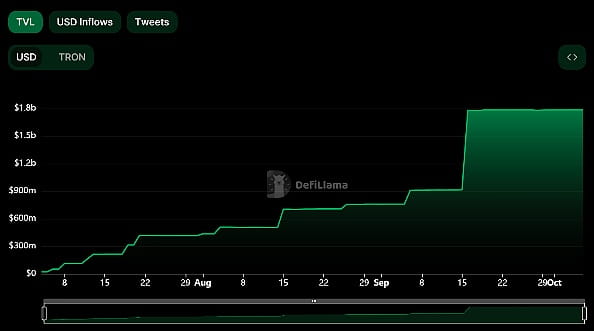
The 1-month TVL trend of the top 9 protocols in the RWA category is shown in green. Top protocols like stUSDT and Ondo have shown huge growth.
Below is the TVL chart of the stUSDT protocol.
In theory, we can tokenize all kinds of assets. Whether it’s precious metals or real estate. However, the best asset to bring on-chain is the US Treasury Bill.
MakerDAO is the first to bring Treasury yields to the chain. They will lend DAI to groups that invest in short-term Treasury bills. The yield on short-term Treasury bills is transmitted on the chain through interest payments on DAI loans.
The results are clear. In the third quarter, the MKR price rose from $830 to $1530. This is really impressive for an old dinosaur coin in a bear market.
Now, other protocols are following suit. Frax has launched a non-profit dedicated to handling US Treasury bills and other RWAs. Pendle is joining the narrative by creating the fUSDC and sDAI markets.
(2)SocialFi
Tokenizing influencer accounts? Didn’t we already try this in 2021 with Bitclout?
Regardless, this new space brought much-needed activity and interest to an otherwise dull market. This was a surprising narrative in the third quarter.
Leading the way is Friend.tech.
Friend.tech 101: It lets anyone publish "keys". These keys can be used for exchange. The key holder can enter the key publisher's private group to chat. In theory you will get exclusive alpha from these guys.
Friend.tech became popular immediately after its launch. Here are some numbers:
The number of unique users is approximately 138,000.
The cumulative number of transactions was approximately 3.4 million.
The cumulative agreement cost is $6.18 million.
Here are a few reasons why it has become popular.
Potential airdrop.
There is a mobile app.
Fun social game.
There are opportunities to make money.
An app ecosystem has been established on FT.
Once this narrative caught on, competitors emerged. New SocialFi protocols began to emerge on different chains. Post.tech appeared on Arbitrum, FanTech appeared on Mantle, StarsArena appeared on Avalance, and so on.
The figure below shows the proportion of active entities in different SocialFi protocols.
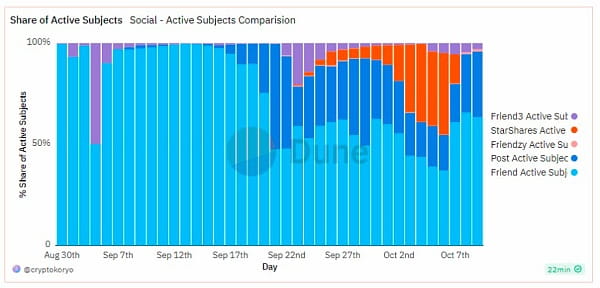
The graph tells the story of FT starting the narrative, and then competitors entering the market. Friend.tech dominated the market, although Friend3 also has a certain share in the graph. Then Post.tech appeared on Arbitrum. It has a significant share of users (about 20% on October 5).
Stars Arena (the new name for Star Shares) is the latest major challenger and attracted a lot of users. But they had unverified contracts and got hacked. Now they are out and no one is depositing money into their app anymore.
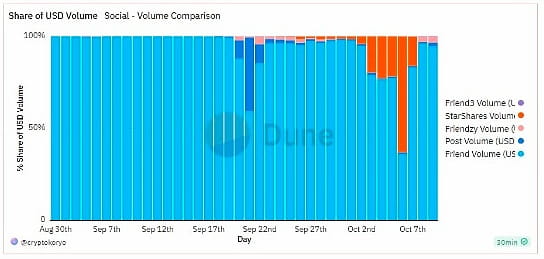
In addition, Friend.tech is still the king in terms of protocol fees and transaction volume. On October 5, 91.6% of protocol fees and 82.2% of USD transaction volume were generated by FT.
(3)Telegram Bots
I have been paying attention to the huge fees charged for Telegram Bots for a while. What are they? They are bots that allow users to trade crypto tokens in the Telegram interface. These bots can not only perform basic buy and sell transactions, but also perform advanced tasks, including:
Crypto trading.
Processing airdrops.
Portfolio management.
Strategies, technical indicators, and more.
This is a narrative with huge potential.
Poor UI/UX is one of the more serious problems facing DeFi. Operating a regular wallet and interacting with decentralized exchanges is very complicated for newcomers. Often, users have to jump between multiple websites, ensure security, approve various transactions, and so on.
TG bots eliminate this hassle. They consolidate (almost) all activities into a familiar Telegram interface. Bonus: bots can also be used on mobile phones, which is not common in standard setups.
Telegram is a massive platform with over 550 million monthly active users and over 55 million daily active users.
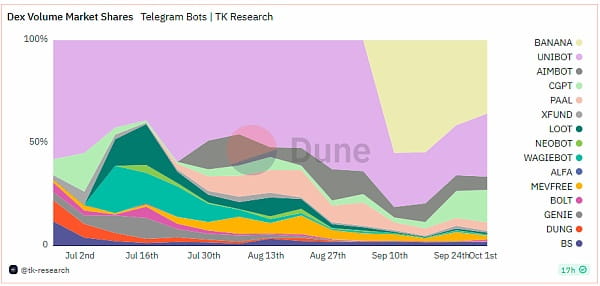
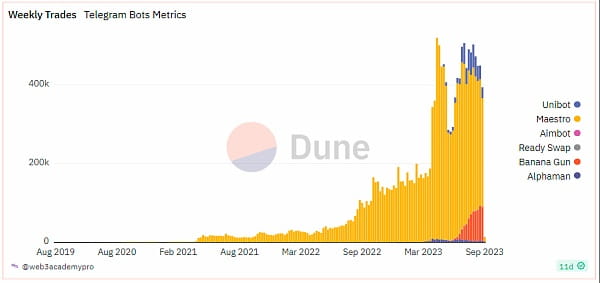
There are many competing projects in this space. The chart below tracks the DEX volume market share of different telegram bots.
Here are three projects worth tracking around this narrative.
#1 Maestro
Maestro is the OG bot, with Q3 revenue of $11.38 million. Maestro still has about 70% (September data) of its weekly volume in this category. However, they don’t have a token. If they did, it would be quite large.
#2 Unibot
Unibot is the market leader (as Maestro has no tokens). They share revenue with UNIBOT token holders. These holders have received cumulative revenues of over $1.2 million.
#3 Banana Gun
Banana Gun is a popular front-running bot. It’s a relatively new protocol. But if we exclude Maestro, they control ~35% of the DEX volume market share. That’s more than Unibot. (They also had a bad reputation due to their failed token launch.)
2. Three major projects in the third quarter
Here are the three most important projects for Q3:
(1)Base
On August 9, the Base chain was officially launched.
It is an Ethereum L2 supported by OP Stack and has been an immediate success since its launch. Here are a few reasons for its success.
Coinbase support.
L2 turntable game.
“Onchain summer” event.
Friend.tech becomes a super app.
Ecosystem funds attract projects.
Despite being launched only two months ago, it has become the Ethereum rollup with the third-largest TVL.
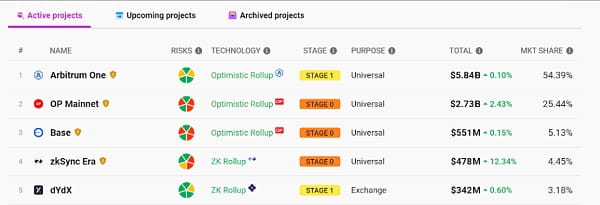 Base also has a rich protocol ecosystem, with 133 protocols. L2, Mantle, and Linea, which were launched at the same time, only have about 30 protocols. Even Optimism, one of the OG L2s, has only 190 protocols.
Base performed very well in the third quarter. All indicators were green. But for the fourth quarter, there are two major disadvantages:
Arbitrum will launch its short-term incentive plan and Base’s liquidity may be transferred to Arbitrum.
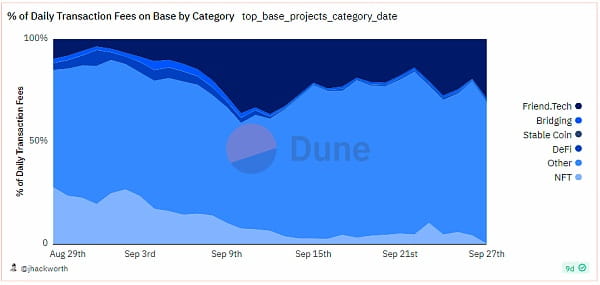
Over-reliance on Friend.tech. On September 9, 36.2% of daily transaction fees on Base came from Friend.tech. What's going on! Is this an application chain or something else?
(2)OwnLayer
EigenLayer is a re-staking protocol.
Restaking means re-staking the staked ETH to other protocols. You can re-stake your liquid staked tokens and native staked ETH.
EigenLayer is a market between protocols and restakers. Protocols require participants to provide some services. Restakers will do so in exchange for a return. If they fail to do what they promised, they will lose their restabilized ETH.
Another way to understand EigenLayer is as a "custom carrot and stick generator" for the protocol. If the user behaves in the way the protocol requires, they will get carrots, which is the income. If the user does not do so, EL will use the stick, which is to confiscate the ETH that is staked.
Their Ethereum mainnet was launched on June 14, 2023. For security reasons, they set a re-staking limit. The EigenLayer mainnet reached the re-staking limit on the day of its launch.
They raised the limit again on August 22, 2023. The cap on LST, including stETH, rETH, and cbETH, was removed. If the re-staking tokens of LST reach 100,000, then the LST will be capped.
This limit was also reached within a few hours. TVL rose from $78 million to $238 million. To put this into perspective, only 3 rollups have more TVL than this (according to DeFiLlama data).
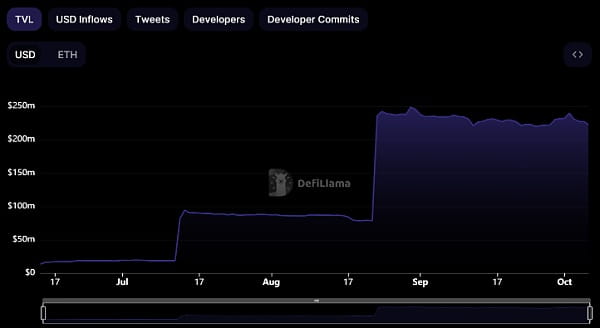
This shows the crazy demand for EigenLayer. As long as they can provide a functional product, the demand will go through the roof.
EigenLayer will enable new token economics. Projects now have a new mechanism to distribute tokens in exchange for specific services.
It will also increase the speed of real innovation. Previously, many decentralized projects were forced to create their own token networks. Projects can now outsource this to EigenLayer and focus on real innovation. 12 projects have already publicly started building on EigenLayer.
Liquid Restaked Tokens are another innovation. They are a bit like liquid staking tokens like stETH and rETH. In addition, they also earn returns from other protocols.
(3) Solana returns?
FTX collapsed and SOL fell with it.
SOL lost a lot of value when SBF was heavily promoting it and he won the title of Scammer of the Year. But the community is still moving forward. Solana seems to be making a comeback.
Solana has an active developer community. Data related to DeFi protocols is green.
It appears to have resolved the chain downtime issue, with no incidents of chain downtime in Q2 and Q3.
While the total TVL of crypto and DeFi collapsed, Solana TVL grew by 18.52% in Q3, from $770.88 million on June 30 to $913.66 million on October 1.
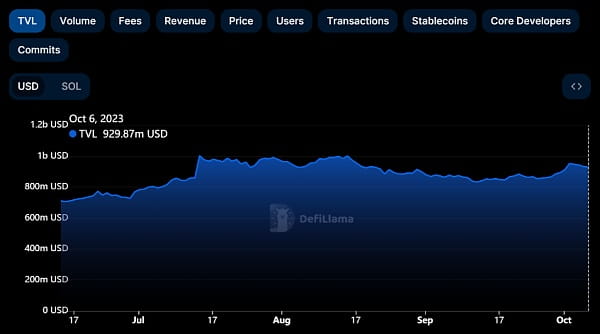
Solana also had some bullish developments in the third quarter.
Maple Finance is back on Solana.
Shopify integrates Solana into its platform.
Visa adds stablecoin settlement capabilities on Solana.
Many DeFi protocols are growing on Solana.
Membrane Finance launches Euro stablecoin on Solana.
Recognized as a high-level technology for execution engines. (MakerDAO founders hope to use Soalana’s codebase to create an L1 for Maker.)
I am not bullish on L1 right now, but Solana may be an exception.
3. Future Outlook
While looking back is helpful in learning lessons, the real opportunities lie in looking forward.
Arbitrum ecosystem. They approved a $50 million ARB incentive program. This program will last until January 31, 2024. So the yield-seeking proceeds from degen will go to Arbitrum. The DAO is voting on which projects should get funding. The optimal strategy is to focus on protocols that will be incentivized and take a position in them (but make sure they align with your investment strategy).
Canto has been on a good roll lately. It's a Cosmos chain that's introduced a lot of economic innovations, such as paying a percentage of gas fees to smart contract developers, which will incentivize developers to build on Canto; providing financial primitives like DEX, lending markets, and stablecoins as public goods at no charge; and recently, they announced that they are using Polygon CDK to move to ZK L2 on Ethereum. They've also worked with Fortunafi & Hashnote on their RWA strategy. The L2 and RWA narratives are very strong. I'll be keeping a close eye on it.
We also monitor the usual suspects: decentralized perpetual swaps, ETH L2 (Base, Mantal), LSDfi, LRT (liquidity re-collateralized derivatives), GamblFi, Cosmos, Solana, etc.
From a longer-term perspective, I am looking forward to the Ethereum Dencun upgrade. The upgrade will introduce proto-danksharding, an update that will make rollups cheaper to use Ethereum. Just like the Shapella upgrade was the catalyst for the LSDfi narrative, the Dencun upgrade can also be a catalyst for L2 projects.
On a larger scale, there is also the geopolitical backdrop of the conflict between Israel and Hamas. This article does not describe politics, but I wanted to mention it anyway because political factors can affect the market.
Overall, I think the fourth quarter ahead will be quiet.