


When it comes to the development of blockchain and cryptocurrency, Ethereum has always attracted much attention. As the largest smart contract platform, it has been driving the development of decentralized applications. However, as blockchain technology continues to evolve and user demand grows, Ethereum faces multiple challenges such as expansion. In order to solve these problems and make Ethereum more robust and sustainable, the Ethereum community is expected to carry out a major upgrade in November this year - the Ethereum Cancun upgrade.
The Ethereum Cancun upgrade is regarded as a milestone in the Ethereum upgrade path. The upgrade will form a "two-wheel drive" expansion model by introducing sharding technology and the previously used Rollup solution. The Cancun upgrade can not only solve the performance bottleneck problem currently faced by the Ethereum network, but also lay the foundation for future in-depth upgrades. This article will focus on the new technologies and protocols introduced by the Ethereum Cancun upgrade and explore the impact of this upgrade on the entire Ethereum ecosystem?
Ethereum’s road to scaling
As the amount of data on the chain increases, Ethereum, as the world's largest smart contract platform, undertakes the storage and settlement of most of the data. This places higher demands on the transaction speed and throughput of the Ethereum mainnet. Therefore, solving the Ethereum transaction speed and expansion issues has always been the focus of Ethereum developers and community staff. To this end, they have proposed different solutions.
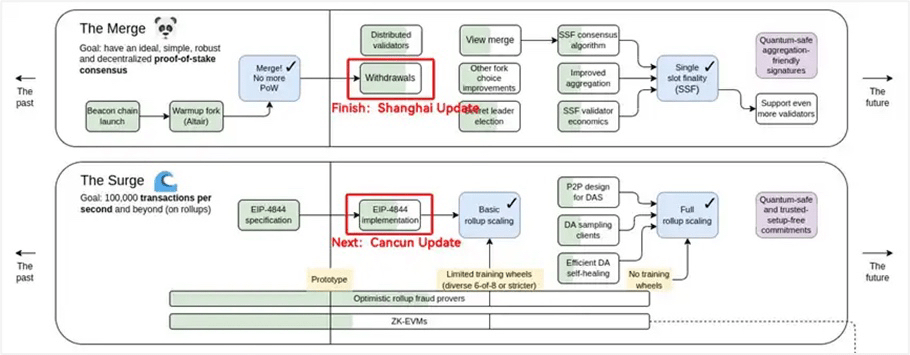
The first solution is to use Sharding (sharding technology) at the first layer (Layer 1) to achieve expansion. Sharding technology is ranked third in Ethereum's upgrade roadmap after the launch and merger of the beacon chain. It is the most critical and important part of the entire Ethereum upgrade route. The core idea of this solution is to break down the Ethereum main chain into different shards and randomly rotate validators between these shards. Each shard is essentially its own mini blockchain and runs in parallel with the beacon chain. Through sharding technology, Ethereum is able to significantly increase transaction throughput and scalability to meet the growing needs of users.
However, implementing sharding expansion is not a simple task. It involves solving a series of complex problems such as communication between shards, the design of consensus mechanisms, and the allocation of validators. It requires a lot of research and experiments, and it will take a long time to truly achieve it. In Ethereum's upgrade roadmap, the sharding solution is divided into three stages: Pro-Danksharding (EIP-4844), Proposer-Builder Separation (PBS), and Full Sharding (Danksharding). The upcoming Cancun upgrade core EIP-4844 is Ethereum's first step towards sharding expansion.
The second solution is to achieve capacity expansion at Layer 2. Among them, the mainstream Layer 2 expansion technology is Rollup. Unlike sharding technology, Rollup does not break up the main Ethereum chain into its own mini-blockchain, but instead acts as a mini-blockchain on top of the first layer of Ethereum. The way rollup works is to put a batch of packaged data into Layer 2 for execution, and then compress the execution results and transaction data and send them back to Layer 1. The advantage of Rollup is that it significantly improves transaction fees and transaction speed. Compared with the Ethereum main network, Layer 2 transaction fees can be reduced by 3 to 8 times, and transaction speeds can be increased by thousands of times.
Currently, the mainstream Rollup solutions are divided into Optimism Rollup and ZKRollup. Optimism Rollup is seen as a short-term solution, while ZKRollup is seen as a long-term solution. However, the Rollup solution has a fatal flaw, that is, the data receipt of the Rollup still needs to communicate with the first layer. Even with the use of compression algorithms, large-scale receipts will increase the storage cost of the first-layer nodes. Therefore, the upper limit of Rollup's expansion is limited by the throughput of the first layer, and it is impossible to achieve unlimited expansion.
In order to give full play to the advantages of the two technical routes, Ethereum has adopted a gradual upgrade plan. First, rapid expansion is achieved through technologies such as Rollup on the second layer to meet short-term and medium-term market demand. At the same time, Ethereum's R&D team is also advancing the research of sharding technology. The upcoming EIP-4844 is an expansion plan around Rollup, which can be seen as an accelerator for Rollup. It is also the first step for Ethereum to achieve sharding expansion, paving the way for the realization of complete sharding in the future. By combining the optimization of the second layer with the sharding technology of the first layer, Ethereum has started a "two-wheel drive" expansion mode, which not only lays the foundation for Ethereum to achieve a larger scale of application popularization, but also provides solid technical support for the growing market demand and sustainable development of the industry.
What technologies will the Cancun upgrade bring?
The Cancun Upgrade is an important upgrade of Ethereum, which will introduce a number of technologies and protocols to improve the scalability and security of the Ethereum network. The following are some of the specific technologies and protocols that the Cancun Upgrade will bring, detailed as follows:
EIP-4844:
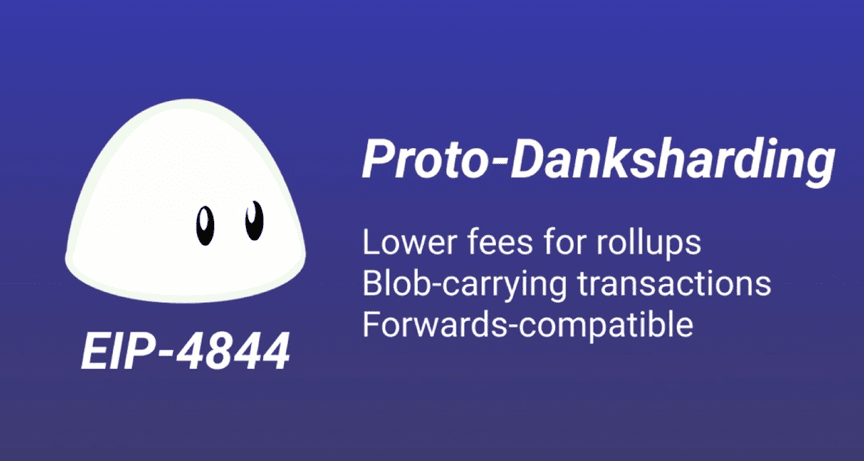
EIP-4844 is an Ethereum improvement proposal that aims to reduce transaction fees. It introduces a new type of transaction called Blob-carrying transactions. These transactions are similar to regular transactions, but contain an additional collection of data called a Blob.
The size of the blob is quite large (~125KB) and is more economical than current calldata storage methods. By temporarily storing these blobs on the Ethereum consensus layer, EIP-4844 can significantly reduce the cost of aggregating data to the Ethereum base layer, thereby reducing transaction fees. In addition to introducing blob carrying transactions, EIP-4844 will also implement other system changes such as execution layer logic, verification rules, multi-dimensional fee markets, etc. to meet the future needs of implementing complete danks sharding.
It is important to note that while EIP-4844 encompasses much of the full danks sharding logic, it does not itself implement any actual sharding. However, EIP-4844 could still bring scaling and cost-saving benefits to Ethereum, bringing it closer to the cost and throughput levels required to achieve mass adoption.
EIP-1559:
EIP-1559 is another important proposal for Ethereum that will be implemented in the Cancun upgrade. It aims to improve Ethereum's transaction fee model, improve user experience and predictability of the network. EIP-1559 introduces a dynamic fee market based on supply and demand, which includes a base fee and a variable fee. The base fee is burned, which helps reduce Ethereum's inflation. The variable fee is adjusted according to the size of the transaction to provide more reasonable transaction fees and encourage users to conduct more efficient transactions.
Shard Blob Transactions:
Under the framework of Proto-DankSharding, a new transaction type called Shard Blob transaction is introduced. This transaction type allows Rollup to submit data to Blob and attach it to the block. A Shard Blob transaction can contain up to two blobs, and each block can contain 8 to 16 blobs, each of which is about 1MB to 2MB in size. This new transaction type reduces the cost of data storage and transmission, bringing higher throughput and lower transaction costs to the Ethereum network.
KZG polynomial scheme:
During the transaction process, the KZG polynomial scheme (named by Kate, Zaverucha, and Goldberg) is introduced to verify the transaction data published in the Blob. KZG is a zero-knowledge verification system that can be verified without revealing the entire content of the Blob. This verification mechanism ensures the integrity and credibility of the transaction data.
In addition to the specific technologies and protocols mentioned above, the Cancun upgrade also includes some other important EIPs (Ethereum Improvement Proposals) to further improve the functionality and performance of Ethereum. Here are a few of the notable EIPs:
EIP-1159: This proposal aims to improve Ethereum’s transaction structure, introduce basic fees and optional extended data, and improve the efficiency and predictability of transactions.
EIP-3198: This proposal proposes a new transaction type, called "Fat" transactions, which can include multiple operations in one transaction, thereby reducing the number and cost of transactions.
EIP-3541: This proposal introduces a new contract type called "Access Lists", which reduces the cost of contract interaction by optimizing the access rights management of contracts.
EIP-3529: This proposal proposes a new contract creation and initialization mechanism called "Reduced Gas Cost for Empty Accounts", which reduces the cost of creating and initializing contracts.
EIP-2930: This proposal introduces a new transaction type called "Repricing for state access opcodes", which reduces the cost of transactions by repricing state access opcodes.
What impact will the Cancun upgrade have?
The Cancun upgrade is an important upgrade of the Ethereum network and will have a wide range of impacts. The goal of this upgrade is to prepare for a fully sharded network and expand the Rollup technology. This will have a multi-faceted impact, including on the Ethereum network and Layer 2 network.
Cancun Upgrade: Ethereum Network Performance Will Be Greatly Improved
The Ethereum network will receive several important improvements as a result of the Cancun upgrade. First, Proto-Danksharding is introduced, which will greatly improve the scalability of the Ethereum network. Currently, the Ethereum mainnet can only handle a limited number of transactions per second, leading to congestion and high gas costs. By introducing sharding technology, the Cancun upgrade will allow the Ethereum network to handle multiple shards simultaneously, significantly increasing transaction throughput. This will enable the Ethereum network to meet growing user demand and support more decentralized applications and transactions.
Secondly, the Cancun upgrade will also reduce transaction fees on the Ethereum network. In the current Ethereum network, users need to pay high gas fees to execute smart contracts and conduct transactions. This is not friendly enough for small transactions and ordinary users. However, the Cancun upgrade will reduce the gas fees of transactions by introducing data "blobs" and implementing EIP-4844. This will make the Ethereum network more affordable, attract more users to participate, and promote wider adoption.
The Cancun upgrade will also enhance the security of the Ethereum network. By taking measures such as EIP-6780, the upgrade will strengthen the network's security infrastructure. This will help protect users' funds and data and reduce the risk of potential attacks on the network. Security is one of the key elements of a blockchain network, and the security enhancements of the Cancun upgrade will set a higher standard for the reliability of the Ethereum network.
Cancun Upgrade: Layer2 Welcomes New Development Opportunities
With the upcoming Cancun upgrade of Ethereum, Layer2 will usher in new development opportunities. After the Cancun upgrade, the speed of Ethereum Layer2 will increase by 10 to 100 times, and transaction costs will also be reduced. This will enable Layer2 to better integrate into the Ethereum ecosystem and provide users with a faster and lower-cost transaction experience. Whether it is Optimistic Rollup or ZK Rollup, they will benefit from the improvements brought about by this upgrade.
First, the Cancun upgrade increases the transaction speed of the Ethereum Layer 2 network, reduces transaction costs, and brings opportunities for Layer 2 solutions such as Optimistic Rollup and ZK Rollup. For Optimistic Rollup, transaction backup will be completed faster, improving the throughput of the overall network and accelerating the development of its ecological projects. For ZK Rollup, the Cancun upgrade offers greater opportunities despite some technical challenges. ZK Rollup offers greater privacy and security, allowing users to transact with lower transaction fees without sacrificing security. With the implementation of the Cancun upgrade, the advantages of ZK Rollup will become more significant and it is expected to play a more important role in the Layer 2 network and provide users with more choices.
Secondly, the total locked value (TVL) of Layer2 has exceeded $10.79 billion from $5 billion in October last year. This shows that the market and investors are positive about the future development of Layer2. With the implementation of the Cancun upgrade, this data is expected to achieve a greater breakthrough. At the same time, some new Layer2 projects that are about to be launched on the mainnet, such as Scroll and Taiko, will also have a good development opportunity.
Third, the improvement of Layer2 network speed and cost will greatly improve the user experience, thereby attracting more users. This has a significant impact on the development of decentralized applications (DApps). For example, DeFi products based on Layer2 will be able to handle more transactions and provide a smoother experience. At the same time, industries such as games and social media also attach great importance to traffic and transaction experience, and they will also have better development opportunities.
Fourth, since Blob data can only be saved for a short time, there are problems with calling historical data. This will create a demand for decentralized storage, and the Layer 2 expansion solution also needs to use the data availability layer. Therefore, the Cancun upgrade will also have a positive impact on the L1 storage expansion network (such as Eth storage, Arweave, and Filecoin Ethereum DA layer projects), thereby further promoting the development of decentralized application projects in the Ethereum ecosystem.
In general, the Cancun upgrade is the first step in the Ethereum expansion roadmap, which will greatly promote the development of the Layer2 network through technological advancement and the effects it triggers. It can be foreseen that in the future, the Layer2 network will become the main force of the Ethereum ecosystem and provide better services to users. However, technological advancement is only a necessary condition for the success of the Layer2 network. The key lies in developing mature and high-quality applications to truly solve users' pain points. Only in this way can Layer2 maximize its value.