
BlockchainReporter
27.8k Posts

BlockchainReporter
 Square Verified+
Report
Block User
The World's Page on Emerging Tech | Cryptocurrencies | Bitcoin | Blockchain | NFT | blockchainreporter.net
2 Following
41.9K+ Followers
180.1K+ Liked
Posts
Article
Zamanat Targets GCC’s $250 Billion SME Financing Gap With Up to $100 Million Tokenized Private Cr...Dubai, UAE, September 10th, 2026, Chainwire
Zamanat Fund CEIC Limited is the company’s first live proof point for regulated fund tokenization on ZIGChain focused on GCC private credit.
Zamanat today announced its sponsorship of Zamanat Fund CEIC Limited (the “Fund”), a DIFC-domiciled tokenized private credit fund with a target size of up to USD 100 million. The Fund targets the GCC’s estimated $250 billion SME financing gap, with only 11 percent of SMEs across the region having access to credit.
Closing a $250 billion structural gap in GCC SME credit
Across the GCC, SMEs are central to economic growth yet remain significantly underserved by traditional financing. In the UAE, SMEs generate more than half of GDP and employ the majority of the private-sector workforce, yet receive less than 10 percent of total bank lending.
The Fund will invest in private credit across the region, directing capital towards strong homegrown companies whose financing needs are not fully met through traditional lending channels. The strategy supports national ambitions to expand SME participation, private-sector growth and access to alternative financing, including priorities set out under Saudi Arabia’s Vision 2030 and the UAE Centennial 2071.
“Strong businesses across the GCC still struggle to access growth capital despite sound fundamentals. Zamanat sponsored the Fund to create a credible route between those businesses and institutional capital. With a target size of up to USD 100 million and interests issued as Investment Tokens, it is our first live proof point for bringing GCC private credit into a regulated digital structure for Professional Clients,” said Umair Tariq, Founder and CEO of Zamanat.
Bringing GCC private credit into digital markets
Tokenization expands the infrastructure around traditionally hard-to-access private-market assets without changing the underlying investment or credit profile.
The Fund combines a regional private credit strategy, a DIFC fund structure, institutional administration and digital issuance on ZIGChain. It provides a first live demonstration of how regional private credit can be brought into a DFSA-regulated tokenized structure for Professional Clients.
The Fund is a DFSA-regulated closed-ended fund registered as an Exempt Fund and classified as a Credit Fund. It is managed by Truleum Venture Partners Limited and administered by Apex Group. Fund interests will be issued as ZM1 Investment Tokens on ZIGChain within a regulated, whitelisted environment.
As sponsor, Zamanat brings its regional private credit, investment structuring and institutional partnership expertise to the Fund’s development. Truleum retains responsibility for all regulated fund-management activities.
The ZM1 Investment Token structure provides a blockchain-native ownership and settlement layer within the Fund’s regulated framework. It also allows qualifying investors who meet the DFSA Professional Client criteria to participate alongside institutional investors.
Zamanat is backed by Disrupt.com, a MENA-based, operator-led AI-native venture builder and lead investor in the business.
Building the global market for Digital Shariah Assets
Global Islamic finance assets are projected to reach $9.7 trillion by 2029, yet demand for digital and Shariah-aligned assets is growing faster than the institutional infrastructure connecting them with global capital.
Zamanat continues to build the global market for Digital Shariah Assets. Its wider operating model combines investment structuring, Shariah expertise, regulated partner routes and digital distribution to bring real-world assets to market through traditional and digital channels.
The DIFC-domiciled Fund evidences the regulated fund-tokenization, digital ownership and partner-orchestration capability within that wider build. Zamanat is progressing a separate pipeline of Digital Shariah Assets across private credit, receivables, real estate and other asset classes.
Institutional partnerships
Apex Group acts as Fund Administrator, providing institutional fund administration and controls from the outset.
“Zamanat is supporting the creation of a new category in Digital Assets. Bringing institutional structure and digital distribution together within a DFSA-regulated framework sets the standard for how this market should be built, and this fund shows the model working at institutional scale. We are proud to support the infrastructure behind it, and we look forward to partnering further on the projects Zamanat already has in motion,” said Peter Hughes, Founder & CEO, Apex Group.
The global market for Digital Shariah Assets does not yet exist as an institutional category. Zamanat is building it.
Notes to Editors
Sources
LSEG and ICD, 2025 Islamic Finance Development Indicator Report, 14 October 2025 (global Islamic finance assets projected to reach $9.7 trillion by 2029); World Bank, Competition in the GCC SME Lending Markets: An Initial Assessment (estimated $250 billion GCC SME credit gap; 11 percent of SMEs with access to credit); Kearney, GCC Retail Banking Radar 2024.
Investor notice
This communication as related to Zamanat Fund CEIC Limited is approved by Truleum Venture Partners Limited in the DIFC (DFSA License Number: F008013).
This release is for information only. It is not an offer, invitation or recommendation to subscribe for interests in Zamanat Fund CEIC Limited or acquire ZM1 Investment Tokens. Any participation will be made only through the Fund Manager, final offering documents and applicable Professional Client eligibility requirements. For avoidance of doubt, this communication is intended for and directed only to investors who meet the requirements to be considered Professional Clients as specified under the Dubai Financial Services Authority Conduct of Business Rulebook, Rule 2.3.3. The Fund is an ‘Exempt Fund’. Accordingly, the ZM1 Investment Tokens are available only to Professional Clients.
This release and the information contained herein does not constitute, and is not intended to constitute, a public offer of securities in any other jurisdiction and accordingly should not be construed as such. The ZM1 Investment Tokens are only available to a limited number of investors from the DIFC. The ZM1 Investment Tokens have not been approved by or licensed or registered with any other relevant licensing authority or governmental agency. No transaction will be concluded in onshore UAE outside the DIFC.
The Fund is not an Islamic Fund and is not marketed as Shariah-compliant. References to Shariah in this release relate to Zamanat’s broader platform and market ambition and not to the Fund.
About Zamanat
Zamanat is building the global market for Digital Shariah Assets. The company connects asset originators with global capital through investment structuring, Shariah expertise, regulated partner routes, tokenization and distribution across traditional and digital channels.
Zamanat also sponsors and develops institutional investment products through appropriately licensed partners. Each product follows its own legal and regulatory framework and, where presented as Shariah-aligned, its own product-specific Shariah review and governance process. Website: www.zamanathq.com
Contact
Global Head of PR & CommunicationsKatarzyna Kosiordisrupt.cominfo@zamanathq.com
This article is not intended as financial advice. Educational purposes only.
Zamanat Targets GCC’s $250 Billion SME Financing Gap With Up to $100 Million Tokenized Private Cr...
Dubai, UAE, September 10th, 2026, Chainwire
Zamanat Fund CEIC Limited is the company’s first live proof point for regulated fund tokenization on ZIGChain focused on GCC private credit.
Zamanat today announced its sponsorship of Zamanat Fund CEIC Limited (the “Fund”), a DIFC-domiciled tokenized private credit fund with a target size of up to USD 100 million. The Fund targets the GCC’s estimated $250 billion SME financing gap, with only 11 percent of SMEs across the region having access to credit.
Closing a $250 billion structural gap in GCC SME credit
Across the GCC, SMEs are central to economic growth yet remain significantly underserved by traditional financing. In the UAE, SMEs generate more than half of GDP and employ the majority of the private-sector workforce, yet receive less than 10 percent of total bank lending.
The Fund will invest in private credit across the region, directing capital towards strong homegrown companies whose financing needs are not fully met through traditional lending channels. The strategy supports national ambitions to expand SME participation, private-sector growth and access to alternative financing, including priorities set out under Saudi Arabia’s Vision 2030 and the UAE Centennial 2071.
“Strong businesses across the GCC still struggle to access growth capital despite sound fundamentals. Zamanat sponsored the Fund to create a credible route between those businesses and institutional capital. With a target size of up to USD 100 million and interests issued as Investment Tokens, it is our first live proof point for bringing GCC private credit into a regulated digital structure for Professional Clients,” said Umair Tariq, Founder and CEO of Zamanat.
Bringing GCC private credit into digital markets
Tokenization expands the infrastructure around traditionally hard-to-access private-market assets without changing the underlying investment or credit profile.
The Fund combines a regional private credit strategy, a DIFC fund structure, institutional administration and digital issuance on ZIGChain. It provides a first live demonstration of how regional private credit can be brought into a DFSA-regulated tokenized structure for Professional Clients.
The Fund is a DFSA-regulated closed-ended fund registered as an Exempt Fund and classified as a Credit Fund. It is managed by Truleum Venture Partners Limited and administered by Apex Group. Fund interests will be issued as ZM1 Investment Tokens on ZIGChain within a regulated, whitelisted environment.
As sponsor, Zamanat brings its regional private credit, investment structuring and institutional partnership expertise to the Fund’s development. Truleum retains responsibility for all regulated fund-management activities.
The ZM1 Investment Token structure provides a blockchain-native ownership and settlement layer within the Fund’s regulated framework. It also allows qualifying investors who meet the DFSA Professional Client criteria to participate alongside institutional investors.
Zamanat is backed by Disrupt.com, a MENA-based, operator-led AI-native venture builder and lead investor in the business.
Building the global market for Digital Shariah Assets
Global Islamic finance assets are projected to reach $9.7 trillion by 2029, yet demand for digital and Shariah-aligned assets is growing faster than the institutional infrastructure connecting them with global capital.
Zamanat continues to build the global market for Digital Shariah Assets. Its wider operating model combines investment structuring, Shariah expertise, regulated partner routes and digital distribution to bring real-world assets to market through traditional and digital channels.
The DIFC-domiciled Fund evidences the regulated fund-tokenization, digital ownership and partner-orchestration capability within that wider build. Zamanat is progressing a separate pipeline of Digital Shariah Assets across private credit, receivables, real estate and other asset classes.
Institutional partnerships
Apex Group acts as Fund Administrator, providing institutional fund administration and controls from the outset.
“Zamanat is supporting the creation of a new category in Digital Assets. Bringing institutional structure and digital distribution together within a DFSA-regulated framework sets the standard for how this market should be built, and this fund shows the model working at institutional scale. We are proud to support the infrastructure behind it, and we look forward to partnering further on the projects Zamanat already has in motion,” said Peter Hughes, Founder & CEO, Apex Group.
The global market for Digital Shariah Assets does not yet exist as an institutional category. Zamanat is building it.
Notes to Editors
Sources
LSEG and ICD, 2025 Islamic Finance Development Indicator Report, 14 October 2025 (global Islamic finance assets projected to reach $9.7 trillion by 2029); World Bank, Competition in the GCC SME Lending Markets: An Initial Assessment (estimated $250 billion GCC SME credit gap; 11 percent of SMEs with access to credit); Kearney, GCC Retail Banking Radar 2024.
Investor notice
This communication as related to Zamanat Fund CEIC Limited is approved by Truleum Venture Partners Limited in the DIFC (DFSA License Number: F008013).
This release is for information only. It is not an offer, invitation or recommendation to subscribe for interests in Zamanat Fund CEIC Limited or acquire ZM1 Investment Tokens. Any participation will be made only through the Fund Manager, final offering documents and applicable Professional Client eligibility requirements. For avoidance of doubt, this communication is intended for and directed only to investors who meet the requirements to be considered Professional Clients as specified under the Dubai Financial Services Authority Conduct of Business Rulebook, Rule 2.3.3. The Fund is an ‘Exempt Fund’. Accordingly, the ZM1 Investment Tokens are available only to Professional Clients.
This release and the information contained herein does not constitute, and is not intended to constitute, a public offer of securities in any other jurisdiction and accordingly should not be construed as such. The ZM1 Investment Tokens are only available to a limited number of investors from the DIFC. The ZM1 Investment Tokens have not been approved by or licensed or registered with any other relevant licensing authority or governmental agency. No transaction will be concluded in onshore UAE outside the DIFC.
The Fund is not an Islamic Fund and is not marketed as Shariah-compliant. References to Shariah in this release relate to Zamanat’s broader platform and market ambition and not to the Fund.
About Zamanat
Zamanat is building the global market for Digital Shariah Assets. The company connects asset originators with global capital through investment structuring, Shariah expertise, regulated partner routes, tokenization and distribution across traditional and digital channels.
Zamanat also sponsors and develops institutional investment products through appropriately licensed partners. Each product follows its own legal and regulatory framework and, where presented as Shariah-aligned, its own product-specific Shariah review and governance process. Website: www.zamanathq.com
Contact
Global Head of PR & CommunicationsKatarzyna Kosiordisrupt.cominfo@zamanathq.com
This article is not intended as financial advice. Educational purposes only.
Zamanat Fund CEIC Limited is the company’s first live proof point for regulated fund tokenization on ZIGChain focused on GCC private credit.
Zamanat today announced its sponsorship of Zamanat Fund CEIC Limited (the “Fund”), a DIFC-domiciled tokenized private credit fund with a target size of up to USD 100 million. The Fund targets the GCC’s estimated $250 billion SME financing gap, with only 11 percent of SMEs across the region having access to credit.
Closing a $250 billion structural gap in GCC SME credit
Across the GCC, SMEs are central to economic growth yet remain significantly underserved by traditional financing. In the UAE, SMEs generate more than half of GDP and employ the majority of the private-sector workforce, yet receive less than 10 percent of total bank lending.
The Fund will invest in private credit across the region, directing capital towards strong homegrown companies whose financing needs are not fully met through traditional lending channels. The strategy supports national ambitions to expand SME participation, private-sector growth and access to alternative financing, including priorities set out under Saudi Arabia’s Vision 2030 and the UAE Centennial 2071.
“Strong businesses across the GCC still struggle to access growth capital despite sound fundamentals. Zamanat sponsored the Fund to create a credible route between those businesses and institutional capital. With a target size of up to USD 100 million and interests issued as Investment Tokens, it is our first live proof point for bringing GCC private credit into a regulated digital structure for Professional Clients,” said Umair Tariq, Founder and CEO of Zamanat.
Bringing GCC private credit into digital markets
Tokenization expands the infrastructure around traditionally hard-to-access private-market assets without changing the underlying investment or credit profile.
The Fund combines a regional private credit strategy, a DIFC fund structure, institutional administration and digital issuance on ZIGChain. It provides a first live demonstration of how regional private credit can be brought into a DFSA-regulated tokenized structure for Professional Clients.
The Fund is a DFSA-regulated closed-ended fund registered as an Exempt Fund and classified as a Credit Fund. It is managed by Truleum Venture Partners Limited and administered by Apex Group. Fund interests will be issued as ZM1 Investment Tokens on ZIGChain within a regulated, whitelisted environment.
As sponsor, Zamanat brings its regional private credit, investment structuring and institutional partnership expertise to the Fund’s development. Truleum retains responsibility for all regulated fund-management activities.
The ZM1 Investment Token structure provides a blockchain-native ownership and settlement layer within the Fund’s regulated framework. It also allows qualifying investors who meet the DFSA Professional Client criteria to participate alongside institutional investors.
Zamanat is backed by Disrupt.com, a MENA-based, operator-led AI-native venture builder and lead investor in the business.
Building the global market for Digital Shariah Assets
Global Islamic finance assets are projected to reach $9.7 trillion by 2029, yet demand for digital and Shariah-aligned assets is growing faster than the institutional infrastructure connecting them with global capital.
Zamanat continues to build the global market for Digital Shariah Assets. Its wider operating model combines investment structuring, Shariah expertise, regulated partner routes and digital distribution to bring real-world assets to market through traditional and digital channels.
The DIFC-domiciled Fund evidences the regulated fund-tokenization, digital ownership and partner-orchestration capability within that wider build. Zamanat is progressing a separate pipeline of Digital Shariah Assets across private credit, receivables, real estate and other asset classes.
Institutional partnerships
Apex Group acts as Fund Administrator, providing institutional fund administration and controls from the outset.
“Zamanat is supporting the creation of a new category in Digital Assets. Bringing institutional structure and digital distribution together within a DFSA-regulated framework sets the standard for how this market should be built, and this fund shows the model working at institutional scale. We are proud to support the infrastructure behind it, and we look forward to partnering further on the projects Zamanat already has in motion,” said Peter Hughes, Founder & CEO, Apex Group.
The global market for Digital Shariah Assets does not yet exist as an institutional category. Zamanat is building it.
Notes to Editors
Sources
LSEG and ICD, 2025 Islamic Finance Development Indicator Report, 14 October 2025 (global Islamic finance assets projected to reach $9.7 trillion by 2029); World Bank, Competition in the GCC SME Lending Markets: An Initial Assessment (estimated $250 billion GCC SME credit gap; 11 percent of SMEs with access to credit); Kearney, GCC Retail Banking Radar 2024.
Investor notice
This communication as related to Zamanat Fund CEIC Limited is approved by Truleum Venture Partners Limited in the DIFC (DFSA License Number: F008013).
This release is for information only. It is not an offer, invitation or recommendation to subscribe for interests in Zamanat Fund CEIC Limited or acquire ZM1 Investment Tokens. Any participation will be made only through the Fund Manager, final offering documents and applicable Professional Client eligibility requirements. For avoidance of doubt, this communication is intended for and directed only to investors who meet the requirements to be considered Professional Clients as specified under the Dubai Financial Services Authority Conduct of Business Rulebook, Rule 2.3.3. The Fund is an ‘Exempt Fund’. Accordingly, the ZM1 Investment Tokens are available only to Professional Clients.
This release and the information contained herein does not constitute, and is not intended to constitute, a public offer of securities in any other jurisdiction and accordingly should not be construed as such. The ZM1 Investment Tokens are only available to a limited number of investors from the DIFC. The ZM1 Investment Tokens have not been approved by or licensed or registered with any other relevant licensing authority or governmental agency. No transaction will be concluded in onshore UAE outside the DIFC.
The Fund is not an Islamic Fund and is not marketed as Shariah-compliant. References to Shariah in this release relate to Zamanat’s broader platform and market ambition and not to the Fund.
About Zamanat
Zamanat is building the global market for Digital Shariah Assets. The company connects asset originators with global capital through investment structuring, Shariah expertise, regulated partner routes, tokenization and distribution across traditional and digital channels.
Zamanat also sponsors and develops institutional investment products through appropriately licensed partners. Each product follows its own legal and regulatory framework and, where presented as Shariah-aligned, its own product-specific Shariah review and governance process. Website: www.zamanathq.com
Contact
Global Head of PR & CommunicationsKatarzyna Kosiordisrupt.cominfo@zamanathq.com
This article is not intended as financial advice. Educational purposes only.
66

Article
Alessio Vinassa Unveils an Emerging Technology Investment Approach Shaped By Financial ChallengesDubai, United Arab Emirates, September 10th, 2026, Chainwire
Tech entrepreneur and angel investor Alessio Vinassa today announced the expansion of his investment framework focusing on the convergence of artificial intelligence and cybersecurity, applying strategic risk-mitigation model lessons derived from managing high-pressure financial turnarounds to emerging enterprise technologies. Before he began investing across artificial intelligence, cybersecurity, Web3 and innovative finance, he faced a financial collapse that changed how he understood risk.
Alessio reached a point where approximately €180,000 was due while only about €2,200 remained in his bank account. The situation left him facing the possibility of bankruptcy and forced him to confront the consequences of growth without sufficient protection, diversification or structural discipline.
The experience became more than a difficult chapter in his entrepreneurial career. It influenced how he would later evaluate businesses, support founders and approach emerging technology.
Today, Alessio has more than fifteen years of operating and investment experience and has backed more than 40 ventures across cybersecurity, artificial intelligence, Web3 and innovative finance. His current work reflects a strategic reality that businesses can no longer afford to ignore artificial intelligence and cybersecurity are becoming increasingly intertwined.
Artificial intelligence is changing how companies interpret information, automate work and make decisions. Each capability can also introduce another form of dependence. Systems require access to data. Automated tools may influence customer interactions, financial activity and internal operations. The more authority companies give these technologies, the more important security, transparency and accountability become.
For Alessio, this is where innovation must meet discipline.
“AI should amplify executive judgment, not replace it,” he says.
Technology can increase speed and capability, but leaders remain responsible for determining how that capability should be used, which risks are acceptable and where human oversight must remain.
Cybersecurity provides part of the foundation for that trust. As artificial intelligence becomes embedded in important business processes, security extends beyond protecting networks from external threats. Companies must also understand who can access information, how automated actions are monitored and what happens when a system produces an unexpected result.
Businesses that address these questions early may be better positioned to earn the confidence of customers, investors and commercial partners. Those that treat security as an addition after adoption risk allowing operational exposure to grow alongside their success.
Alessio’s technology and investment perspective was shaped by learning what can happen when momentum is mistaken for stability. His financial collapse revealed that creating value and protecting it require different capabilities. A company may appear successful while becoming increasingly dependent on favourable conditions, concentrated decisions or systems that have not developed at the same rate as its growth.
The same lesson applies to emerging technology. A product can attract attention and investment before proving that it can operate securely, respond to failure or sustain customer trust.
Alessio evaluates opportunity through more than technical novelty. His approach considers whether a technology addresses a meaningful problem, whether customers can adopt it consistently and whether the company has the governance required to support expansion. In his published investment commentary, he has identified cybersecurity, artificial intelligence governance, identity solutions and enterprise automation as areas where technology is addressing essential infrastructure needs.
The leadership teams behind these products are equally important. Alessio has spoken about the value of founders who can identify where their businesses are exposed, explain how their systems will respond under pressure and recognise which evidence would require them to change direction.
“Good governance makes companies faster, not slower,” Alessio says.
Governance is sometimes treated as a restriction on innovation. Alessio views it as the structure that allows innovation to scale responsibly. Clear decision rights, reliable reporting and defined accountability enable companies to move without depending on one person to resolve every issue.
This perspective has particular relevance as businesses adopt artificial intelligence at increasing speed. Competitive pressure can encourage companies to introduce tools before they fully understand the information those tools access or the decisions they influence.
Alessio does not argue that innovation should slow by default. His position is that speed becomes commercially valuable only when the systems supporting it can be trusted. The objective is not to eliminate every possible risk. It is to understand exposure before customers, employees and operations become dependent on the technology.
His progression from financial collapse to investing across emerging technology also informs his broader work on leadership. The lesson was not simply that an entrepreneur can recover after losing money. Recovery became meaningful because it changed the structures and decisions that followed.
Alessio is developing these ideas further in his book, No One Is Coming: The Mental Operating System for Leaders Under Pressure. The book examines how founders, executives and operators make consequential decisions when certainty is unavailable and responsibility cannot be transferred to someone else.
As artificial intelligence and cybersecurity continue to converge, that responsibility will extend beyond technology teams. Investors will need to examine the security behind innovation. Boards will need to understand the systems on which their organisations depend. Founders will need to build trust as deliberately as they build capability.
The €180,000 turning point gave Alessio’s investment philosophy a personal foundation. It taught him that unmanaged exposure can remain hidden while confidence is high and growth is still visible. His work today applies that lesson to a new technological era: innovation creates lasting value only when the structures protecting it are built to endure.
About Alessio Vinassa
Alessio Vinassa is an entrepreneur, angel investor, technology builder and author with more than fifteen years of experience across cybersecurity, artificial intelligence, Web3, innovative finance and business leadership. He has backed more than 40 ventures and works with founders and executives on investment, strategy, organisational development and leadership under pressure. He operates between the UAE and Europe.
Contact
Alessio Vinassainfo@alessiovinassa.io
This article is not intended as financial advice. Educational purposes only.
Alessio Vinassa Unveils an Emerging Technology Investment Approach Shaped By Financial Challenges
Dubai, United Arab Emirates, September 10th, 2026, Chainwire
Tech entrepreneur and angel investor Alessio Vinassa today announced the expansion of his investment framework focusing on the convergence of artificial intelligence and cybersecurity, applying strategic risk-mitigation model lessons derived from managing high-pressure financial turnarounds to emerging enterprise technologies. Before he began investing across artificial intelligence, cybersecurity, Web3 and innovative finance, he faced a financial collapse that changed how he understood risk.
Alessio reached a point where approximately €180,000 was due while only about €2,200 remained in his bank account. The situation left him facing the possibility of bankruptcy and forced him to confront the consequences of growth without sufficient protection, diversification or structural discipline.
The experience became more than a difficult chapter in his entrepreneurial career. It influenced how he would later evaluate businesses, support founders and approach emerging technology.
Today, Alessio has more than fifteen years of operating and investment experience and has backed more than 40 ventures across cybersecurity, artificial intelligence, Web3 and innovative finance. His current work reflects a strategic reality that businesses can no longer afford to ignore artificial intelligence and cybersecurity are becoming increasingly intertwined.
Artificial intelligence is changing how companies interpret information, automate work and make decisions. Each capability can also introduce another form of dependence. Systems require access to data. Automated tools may influence customer interactions, financial activity and internal operations. The more authority companies give these technologies, the more important security, transparency and accountability become.
For Alessio, this is where innovation must meet discipline.
“AI should amplify executive judgment, not replace it,” he says.
Technology can increase speed and capability, but leaders remain responsible for determining how that capability should be used, which risks are acceptable and where human oversight must remain.
Cybersecurity provides part of the foundation for that trust. As artificial intelligence becomes embedded in important business processes, security extends beyond protecting networks from external threats. Companies must also understand who can access information, how automated actions are monitored and what happens when a system produces an unexpected result.
Businesses that address these questions early may be better positioned to earn the confidence of customers, investors and commercial partners. Those that treat security as an addition after adoption risk allowing operational exposure to grow alongside their success.
Alessio’s technology and investment perspective was shaped by learning what can happen when momentum is mistaken for stability. His financial collapse revealed that creating value and protecting it require different capabilities. A company may appear successful while becoming increasingly dependent on favourable conditions, concentrated decisions or systems that have not developed at the same rate as its growth.
The same lesson applies to emerging technology. A product can attract attention and investment before proving that it can operate securely, respond to failure or sustain customer trust.
Alessio evaluates opportunity through more than technical novelty. His approach considers whether a technology addresses a meaningful problem, whether customers can adopt it consistently and whether the company has the governance required to support expansion. In his published investment commentary, he has identified cybersecurity, artificial intelligence governance, identity solutions and enterprise automation as areas where technology is addressing essential infrastructure needs.
The leadership teams behind these products are equally important. Alessio has spoken about the value of founders who can identify where their businesses are exposed, explain how their systems will respond under pressure and recognise which evidence would require them to change direction.
“Good governance makes companies faster, not slower,” Alessio says.
Governance is sometimes treated as a restriction on innovation. Alessio views it as the structure that allows innovation to scale responsibly. Clear decision rights, reliable reporting and defined accountability enable companies to move without depending on one person to resolve every issue.
This perspective has particular relevance as businesses adopt artificial intelligence at increasing speed. Competitive pressure can encourage companies to introduce tools before they fully understand the information those tools access or the decisions they influence.
Alessio does not argue that innovation should slow by default. His position is that speed becomes commercially valuable only when the systems supporting it can be trusted. The objective is not to eliminate every possible risk. It is to understand exposure before customers, employees and operations become dependent on the technology.
His progression from financial collapse to investing across emerging technology also informs his broader work on leadership. The lesson was not simply that an entrepreneur can recover after losing money. Recovery became meaningful because it changed the structures and decisions that followed.
Alessio is developing these ideas further in his book, No One Is Coming: The Mental Operating System for Leaders Under Pressure. The book examines how founders, executives and operators make consequential decisions when certainty is unavailable and responsibility cannot be transferred to someone else.
As artificial intelligence and cybersecurity continue to converge, that responsibility will extend beyond technology teams. Investors will need to examine the security behind innovation. Boards will need to understand the systems on which their organisations depend. Founders will need to build trust as deliberately as they build capability.
The €180,000 turning point gave Alessio’s investment philosophy a personal foundation. It taught him that unmanaged exposure can remain hidden while confidence is high and growth is still visible. His work today applies that lesson to a new technological era: innovation creates lasting value only when the structures protecting it are built to endure.
About Alessio Vinassa
Alessio Vinassa is an entrepreneur, angel investor, technology builder and author with more than fifteen years of experience across cybersecurity, artificial intelligence, Web3, innovative finance and business leadership. He has backed more than 40 ventures and works with founders and executives on investment, strategy, organisational development and leadership under pressure. He operates between the UAE and Europe.
Contact
Alessio Vinassainfo@alessiovinassa.io
This article is not intended as financial advice. Educational purposes only.
Tech entrepreneur and angel investor Alessio Vinassa today announced the expansion of his investment framework focusing on the convergence of artificial intelligence and cybersecurity, applying strategic risk-mitigation model lessons derived from managing high-pressure financial turnarounds to emerging enterprise technologies. Before he began investing across artificial intelligence, cybersecurity, Web3 and innovative finance, he faced a financial collapse that changed how he understood risk.
Alessio reached a point where approximately €180,000 was due while only about €2,200 remained in his bank account. The situation left him facing the possibility of bankruptcy and forced him to confront the consequences of growth without sufficient protection, diversification or structural discipline.
The experience became more than a difficult chapter in his entrepreneurial career. It influenced how he would later evaluate businesses, support founders and approach emerging technology.
Today, Alessio has more than fifteen years of operating and investment experience and has backed more than 40 ventures across cybersecurity, artificial intelligence, Web3 and innovative finance. His current work reflects a strategic reality that businesses can no longer afford to ignore artificial intelligence and cybersecurity are becoming increasingly intertwined.
Artificial intelligence is changing how companies interpret information, automate work and make decisions. Each capability can also introduce another form of dependence. Systems require access to data. Automated tools may influence customer interactions, financial activity and internal operations. The more authority companies give these technologies, the more important security, transparency and accountability become.
For Alessio, this is where innovation must meet discipline.
“AI should amplify executive judgment, not replace it,” he says.
Technology can increase speed and capability, but leaders remain responsible for determining how that capability should be used, which risks are acceptable and where human oversight must remain.
Cybersecurity provides part of the foundation for that trust. As artificial intelligence becomes embedded in important business processes, security extends beyond protecting networks from external threats. Companies must also understand who can access information, how automated actions are monitored and what happens when a system produces an unexpected result.
Businesses that address these questions early may be better positioned to earn the confidence of customers, investors and commercial partners. Those that treat security as an addition after adoption risk allowing operational exposure to grow alongside their success.
Alessio’s technology and investment perspective was shaped by learning what can happen when momentum is mistaken for stability. His financial collapse revealed that creating value and protecting it require different capabilities. A company may appear successful while becoming increasingly dependent on favourable conditions, concentrated decisions or systems that have not developed at the same rate as its growth.
The same lesson applies to emerging technology. A product can attract attention and investment before proving that it can operate securely, respond to failure or sustain customer trust.
Alessio evaluates opportunity through more than technical novelty. His approach considers whether a technology addresses a meaningful problem, whether customers can adopt it consistently and whether the company has the governance required to support expansion. In his published investment commentary, he has identified cybersecurity, artificial intelligence governance, identity solutions and enterprise automation as areas where technology is addressing essential infrastructure needs.
The leadership teams behind these products are equally important. Alessio has spoken about the value of founders who can identify where their businesses are exposed, explain how their systems will respond under pressure and recognise which evidence would require them to change direction.
“Good governance makes companies faster, not slower,” Alessio says.
Governance is sometimes treated as a restriction on innovation. Alessio views it as the structure that allows innovation to scale responsibly. Clear decision rights, reliable reporting and defined accountability enable companies to move without depending on one person to resolve every issue.
This perspective has particular relevance as businesses adopt artificial intelligence at increasing speed. Competitive pressure can encourage companies to introduce tools before they fully understand the information those tools access or the decisions they influence.
Alessio does not argue that innovation should slow by default. His position is that speed becomes commercially valuable only when the systems supporting it can be trusted. The objective is not to eliminate every possible risk. It is to understand exposure before customers, employees and operations become dependent on the technology.
His progression from financial collapse to investing across emerging technology also informs his broader work on leadership. The lesson was not simply that an entrepreneur can recover after losing money. Recovery became meaningful because it changed the structures and decisions that followed.
Alessio is developing these ideas further in his book, No One Is Coming: The Mental Operating System for Leaders Under Pressure. The book examines how founders, executives and operators make consequential decisions when certainty is unavailable and responsibility cannot be transferred to someone else.
As artificial intelligence and cybersecurity continue to converge, that responsibility will extend beyond technology teams. Investors will need to examine the security behind innovation. Boards will need to understand the systems on which their organisations depend. Founders will need to build trust as deliberately as they build capability.
The €180,000 turning point gave Alessio’s investment philosophy a personal foundation. It taught him that unmanaged exposure can remain hidden while confidence is high and growth is still visible. His work today applies that lesson to a new technological era: innovation creates lasting value only when the structures protecting it are built to endure.
About Alessio Vinassa
Alessio Vinassa is an entrepreneur, angel investor, technology builder and author with more than fifteen years of experience across cybersecurity, artificial intelligence, Web3, innovative finance and business leadership. He has backed more than 40 ventures and works with founders and executives on investment, strategy, organisational development and leadership under pressure. He operates between the UAE and Europe.
Contact
Alessio Vinassainfo@alessiovinassa.io
This article is not intended as financial advice. Educational purposes only.
102
Verified
Article
Byrrgis Opens Community Beta for Universal Multi-Chain Trading Terminal With Real-Time Token ScoringLondon, United Kingdom, September 8th, 2026, Chainwire
Byrrgis, a non-custodial on-chain trading platform, announced that its beta is now open to its full community, bringing together real-time coin scoring, early token discovery and universal multi-chain trading in one platform.
On-chain trading has expanded across multiple networks, but the experience remains fragmented. Finding a new coin can require moving between screeners, charts and on-chain data, while trading across chains can involve bridges, network switching and separate gas balances. In fast-moving markets, those extra steps create friction when timing matters most.
Byrrgis brings that process into a single trading environment built around four core features: The Score, Byrrgis Engine, True Multi-Chain and Universal Gas, designed to help traders discover activity earlier, understand current trading conditions and execute across supported chains with fewer steps.
Every Coin. Scored. In Real Time.
Every coin available on Byrrgis carries a live Scout Score from 0 to 100. The Scout Score combines a coin’s on-chain risk, momentum and tradability into one number, updating as those underlying conditions change.
Byrrgis applies the Score across hundreds of thousands of coins, giving traders an immediate read when they open a coin rather than starting their evaluation from scratch. Users can then explore the underlying information for additional context.
Information, not a guarantee. Not financial advice.
Byrrgis Engine Finds Them Early
While the Scout Score provides context around individual coins, Byrrgis Engine (BE) focuses on discovery and timing. The dedicated coin list leverages the Scout Score together with selected filters to surface coins based on current trading conditions.
Alongside Trending, Surge, Top Gainers and New Listings, BE is designed for fast-moving markets where discovering activity early can matter. The goal is to help traders identify what’s happening sooner while leaving the decision of how to act entirely with them.
True Multi-Chain
Buy any token with any other token. Solana, Ethereum, BNB Chain. One transaction.
Byrrgis currently supports Solana, Ethereum and BNB Chain, allowing users to buy a token on one supported network using assets held on another in a single transaction. A trader holding assets on Solana, for example, can buy a token on BNB Chain without manually bridging funds, switching wallets or first acquiring the destination chain’s native gas token.
The routing happens in the background, removing much of the friction traditionally associated with cross-chain trading. Instead of moving funds to wherever an opportunity appears, traders can focus on the token they want to trade while Byrrgis handles the cross-chain complexity underneath.
Never Stuck Without Gas
Byrrgis’ Universal Gas addresses another common trading problem: having funds available but not holding the native token needed to pay gas. A trader holding USDC on Solana, for example, would normally still need SOL before they can transact.
With Byrrgis, gas can be paid using ETH, SOL, BNB, USDC, USDT or USDG, reducing the need to maintain separate native gas balances across supported networks. Combined with True Multi-Chain trading, this allows traders to move from discovery to execution with fewer steps in between.
“On-chain traders move fast, but the infrastructure around them is still fragmented,” said Siraaj Ahmed, CEO of Byrrgis. “We built Byrrgis around the moments where traders lose time. The Scout Score helps you understand what’s happening with a coin, Byrrgis Engine helps you find activity earlier, and our multi-chain and Universal Gas infrastructure lets you act without stopping to bridge funds or manage gas across different chains.”
The Byrrgis beta is now open to the project’s full community, with early users providing positive feedback on the platform and its scoring capabilities. The team will continue gathering feedback and refining the platform ahead of a broader rollout.
About Byrrgis
Byrrgis is a non-custodial on-chain trading platform built for active crypto traders. The platform combines the real-time Scout Score, Byrrgis Engine, True Multi-Chain trading and Universal Gas across Solana, Ethereum and BNB Chain, bringing coin discovery, trading information and cross-chain execution into a single terminal.
The Byrrgis platform is available at byrrgis.app
For more information, visit byrrgis.com
Contact
Robert FreemanRobert@byrrgis.app
This article is not intended as financial advice. Educational purposes only.
Byrrgis Opens Community Beta for Universal Multi-Chain Trading Terminal With Real-Time Token Scoring
London, United Kingdom, September 8th, 2026, Chainwire
Byrrgis, a non-custodial on-chain trading platform, announced that its beta is now open to its full community, bringing together real-time coin scoring, early token discovery and universal multi-chain trading in one platform.
On-chain trading has expanded across multiple networks, but the experience remains fragmented. Finding a new coin can require moving between screeners, charts and on-chain data, while trading across chains can involve bridges, network switching and separate gas balances. In fast-moving markets, those extra steps create friction when timing matters most.
Byrrgis brings that process into a single trading environment built around four core features: The Score, Byrrgis Engine, True Multi-Chain and Universal Gas, designed to help traders discover activity earlier, understand current trading conditions and execute across supported chains with fewer steps.
Every Coin. Scored. In Real Time.
Every coin available on Byrrgis carries a live Scout Score from 0 to 100. The Scout Score combines a coin’s on-chain risk, momentum and tradability into one number, updating as those underlying conditions change.
Byrrgis applies the Score across hundreds of thousands of coins, giving traders an immediate read when they open a coin rather than starting their evaluation from scratch. Users can then explore the underlying information for additional context.
Information, not a guarantee. Not financial advice.
Byrrgis Engine Finds Them Early
While the Scout Score provides context around individual coins, Byrrgis Engine (BE) focuses on discovery and timing. The dedicated coin list leverages the Scout Score together with selected filters to surface coins based on current trading conditions.
Alongside Trending, Surge, Top Gainers and New Listings, BE is designed for fast-moving markets where discovering activity early can matter. The goal is to help traders identify what’s happening sooner while leaving the decision of how to act entirely with them.
True Multi-Chain
Buy any token with any other token. Solana, Ethereum, BNB Chain. One transaction.
Byrrgis currently supports Solana, Ethereum and BNB Chain, allowing users to buy a token on one supported network using assets held on another in a single transaction. A trader holding assets on Solana, for example, can buy a token on BNB Chain without manually bridging funds, switching wallets or first acquiring the destination chain’s native gas token.
The routing happens in the background, removing much of the friction traditionally associated with cross-chain trading. Instead of moving funds to wherever an opportunity appears, traders can focus on the token they want to trade while Byrrgis handles the cross-chain complexity underneath.
Never Stuck Without Gas
Byrrgis’ Universal Gas addresses another common trading problem: having funds available but not holding the native token needed to pay gas. A trader holding USDC on Solana, for example, would normally still need SOL before they can transact.
With Byrrgis, gas can be paid using ETH, SOL, BNB, USDC, USDT or USDG, reducing the need to maintain separate native gas balances across supported networks. Combined with True Multi-Chain trading, this allows traders to move from discovery to execution with fewer steps in between.
“On-chain traders move fast, but the infrastructure around them is still fragmented,” said Siraaj Ahmed, CEO of Byrrgis. “We built Byrrgis around the moments where traders lose time. The Scout Score helps you understand what’s happening with a coin, Byrrgis Engine helps you find activity earlier, and our multi-chain and Universal Gas infrastructure lets you act without stopping to bridge funds or manage gas across different chains.”
The Byrrgis beta is now open to the project’s full community, with early users providing positive feedback on the platform and its scoring capabilities. The team will continue gathering feedback and refining the platform ahead of a broader rollout.
About Byrrgis
Byrrgis is a non-custodial on-chain trading platform built for active crypto traders. The platform combines the real-time Scout Score, Byrrgis Engine, True Multi-Chain trading and Universal Gas across Solana, Ethereum and BNB Chain, bringing coin discovery, trading information and cross-chain execution into a single terminal.
The Byrrgis platform is available at byrrgis.app
For more information, visit byrrgis.com
Contact
Robert FreemanRobert@byrrgis.app
This article is not intended as financial advice. Educational purposes only.
Byrrgis, a non-custodial on-chain trading platform, announced that its beta is now open to its full community, bringing together real-time coin scoring, early token discovery and universal multi-chain trading in one platform.
On-chain trading has expanded across multiple networks, but the experience remains fragmented. Finding a new coin can require moving between screeners, charts and on-chain data, while trading across chains can involve bridges, network switching and separate gas balances. In fast-moving markets, those extra steps create friction when timing matters most.
Byrrgis brings that process into a single trading environment built around four core features: The Score, Byrrgis Engine, True Multi-Chain and Universal Gas, designed to help traders discover activity earlier, understand current trading conditions and execute across supported chains with fewer steps.
Every Coin. Scored. In Real Time.
Every coin available on Byrrgis carries a live Scout Score from 0 to 100. The Scout Score combines a coin’s on-chain risk, momentum and tradability into one number, updating as those underlying conditions change.
Byrrgis applies the Score across hundreds of thousands of coins, giving traders an immediate read when they open a coin rather than starting their evaluation from scratch. Users can then explore the underlying information for additional context.
Information, not a guarantee. Not financial advice.
Byrrgis Engine Finds Them Early
While the Scout Score provides context around individual coins, Byrrgis Engine (BE) focuses on discovery and timing. The dedicated coin list leverages the Scout Score together with selected filters to surface coins based on current trading conditions.
Alongside Trending, Surge, Top Gainers and New Listings, BE is designed for fast-moving markets where discovering activity early can matter. The goal is to help traders identify what’s happening sooner while leaving the decision of how to act entirely with them.
True Multi-Chain
Buy any token with any other token. Solana, Ethereum, BNB Chain. One transaction.
Byrrgis currently supports Solana, Ethereum and BNB Chain, allowing users to buy a token on one supported network using assets held on another in a single transaction. A trader holding assets on Solana, for example, can buy a token on BNB Chain without manually bridging funds, switching wallets or first acquiring the destination chain’s native gas token.
The routing happens in the background, removing much of the friction traditionally associated with cross-chain trading. Instead of moving funds to wherever an opportunity appears, traders can focus on the token they want to trade while Byrrgis handles the cross-chain complexity underneath.
Never Stuck Without Gas
Byrrgis’ Universal Gas addresses another common trading problem: having funds available but not holding the native token needed to pay gas. A trader holding USDC on Solana, for example, would normally still need SOL before they can transact.
With Byrrgis, gas can be paid using ETH, SOL, BNB, USDC, USDT or USDG, reducing the need to maintain separate native gas balances across supported networks. Combined with True Multi-Chain trading, this allows traders to move from discovery to execution with fewer steps in between.
“On-chain traders move fast, but the infrastructure around them is still fragmented,” said Siraaj Ahmed, CEO of Byrrgis. “We built Byrrgis around the moments where traders lose time. The Scout Score helps you understand what’s happening with a coin, Byrrgis Engine helps you find activity earlier, and our multi-chain and Universal Gas infrastructure lets you act without stopping to bridge funds or manage gas across different chains.”
The Byrrgis beta is now open to the project’s full community, with early users providing positive feedback on the platform and its scoring capabilities. The team will continue gathering feedback and refining the platform ahead of a broader rollout.
About Byrrgis
Byrrgis is a non-custodial on-chain trading platform built for active crypto traders. The platform combines the real-time Scout Score, Byrrgis Engine, True Multi-Chain trading and Universal Gas across Solana, Ethereum and BNB Chain, bringing coin discovery, trading information and cross-chain execution into a single terminal.
The Byrrgis platform is available at byrrgis.app
For more information, visit byrrgis.com
Contact
Robert FreemanRobert@byrrgis.app
This article is not intended as financial advice. Educational purposes only.
228

Article
Why Governments and Institutions Are Putting Sovereign Debt OnchainSovereign debt markets have run on the same basic plumbing for decades: settlement windows measured in days, intermediaries stacked between issuer and buyer, and reconciliation processes that add cost without adding value. Blockchain infrastructure is starting to change that, not as a theoretical upgrade but as something governments and institutions are already using. The clearest evidence is in the numbers. According to RWA.xyz data highlighted in a Stellar Development Foundation post, Stellar now holds roughly $490 million in tokenized non-US sovereign debt, a lead it has held since February 2026. That figure is worth examining closely, because it points to a handful of specific things blockchain settlement actually changes.
Settlement that does not wait for business hours
Traditional bond settlement operates on a calendar built around market hours, time zones, and manual reconciliation between custodians. Tokenized debt settles differently. Transactions on a public blockchain can clear in seconds, at any hour, regardless of where the buyer or seller is located. For an investor in Singapore purchasing a euro denominated instrument issued in Europe, that difference is not cosmetic. It removes the multi day settlement lag that has simply been accepted as a cost of doing business in fixed income markets.
Assets that carry their own logic
A tokenized bond is not just a digital certificate. It can be programmed with rules for interest payments, redemption schedules, and compliance checks built directly into the asset itself. This is part of what has drawn institutions like Franklin Templeton and WisdomTree onto public blockchains rather than private, permissioned systems. Programmability turns a bond from a static instrument administered by intermediaries into something closer to software, capable of executing its own terms without a separate operational layer.
Stablecoins as the settlement layer
None of this works without a reliable medium of exchange sitting alongside the tokenized assets. Stablecoins have become that layer. On Stellar, stablecoin payment volume reached $5.5 billion in the first quarter of 2026, up 72 percent year over year, with transaction velocity rising 75 percent over the same period. That volume matters because it shows tokenized government debt is not sitting untouched in wallets. It is being bought, sold, and used as collateral, with stablecoins providing the liquidity that makes those transactions possible in the first place.
Costs that shrink when intermediaries do
A large share of the cost in bond markets comes from the layers between issuer and investor: custodians, clearing houses, correspondent banks, each taking a cut and adding time. Blockchain settlement collapses much of that stack. Stellar’s transaction fees run in fractions of a cent, and finality arrives in around five seconds. For smaller sovereign issuers, particularly those outside the dollar system, that cost structure opens up a distribution channel that was previously only economical at large scale.
Access that does not depend on a home market
Perhaps the most significant shift is who gets to participate. Etherfuse has brought Mexican CETES and Brazilian Tesouro bonds onchain through its Stablebonds products, giving investors outside those countries a way to hold local government debt without navigating foreign custody arrangements or currency controls. South Korean Treasury Bonds and the Marshall Islands digital sovereign bond extend that same idea further. Government debt that was once accessible mainly to domestic institutional buyers is becoming reachable by anyone with a compatible wallet.
What the Stellar case study suggests
Stellar’s position in this category was not an accident of timing. The network was built specifically for cross-border, multi currency payments, and that design is now showing up directly in where sovereign debt issuers choose to go. Combined with compliance tools like asset-level controls and an established anchor network, it has become a place where regulated institutions can bring debt onchain without building every piece of supporting infrastructure themselves.
None of this means every government bond will move onchain quickly, or that existing settlement systems will disappear. But the pattern is becoming harder to dismiss. When 24/7 settlement, programmable terms, stablecoin liquidity, lower costs, and broader access all point in the same direction, the question shifts from whether sovereign debt moves onchain to which networks are positioned to handle it well. On the current evidence, Stellar is one of the clearest answers so far.
Why Governments and Institutions Are Putting Sovereign Debt Onchain
Sovereign debt markets have run on the same basic plumbing for decades: settlement windows measured in days, intermediaries stacked between issuer and buyer, and reconciliation processes that add cost without adding value. Blockchain infrastructure is starting to change that, not as a theoretical upgrade but as something governments and institutions are already using. The clearest evidence is in the numbers. According to RWA.xyz data highlighted in a Stellar Development Foundation post, Stellar now holds roughly $490 million in tokenized non-US sovereign debt, a lead it has held since February 2026. That figure is worth examining closely, because it points to a handful of specific things blockchain settlement actually changes.
Settlement that does not wait for business hours
Traditional bond settlement operates on a calendar built around market hours, time zones, and manual reconciliation between custodians. Tokenized debt settles differently. Transactions on a public blockchain can clear in seconds, at any hour, regardless of where the buyer or seller is located. For an investor in Singapore purchasing a euro denominated instrument issued in Europe, that difference is not cosmetic. It removes the multi day settlement lag that has simply been accepted as a cost of doing business in fixed income markets.
Assets that carry their own logic
A tokenized bond is not just a digital certificate. It can be programmed with rules for interest payments, redemption schedules, and compliance checks built directly into the asset itself. This is part of what has drawn institutions like Franklin Templeton and WisdomTree onto public blockchains rather than private, permissioned systems. Programmability turns a bond from a static instrument administered by intermediaries into something closer to software, capable of executing its own terms without a separate operational layer.
Stablecoins as the settlement layer
None of this works without a reliable medium of exchange sitting alongside the tokenized assets. Stablecoins have become that layer. On Stellar, stablecoin payment volume reached $5.5 billion in the first quarter of 2026, up 72 percent year over year, with transaction velocity rising 75 percent over the same period. That volume matters because it shows tokenized government debt is not sitting untouched in wallets. It is being bought, sold, and used as collateral, with stablecoins providing the liquidity that makes those transactions possible in the first place.
Costs that shrink when intermediaries do
A large share of the cost in bond markets comes from the layers between issuer and investor: custodians, clearing houses, correspondent banks, each taking a cut and adding time. Blockchain settlement collapses much of that stack. Stellar’s transaction fees run in fractions of a cent, and finality arrives in around five seconds. For smaller sovereign issuers, particularly those outside the dollar system, that cost structure opens up a distribution channel that was previously only economical at large scale.
Access that does not depend on a home market
Perhaps the most significant shift is who gets to participate. Etherfuse has brought Mexican CETES and Brazilian Tesouro bonds onchain through its Stablebonds products, giving investors outside those countries a way to hold local government debt without navigating foreign custody arrangements or currency controls. South Korean Treasury Bonds and the Marshall Islands digital sovereign bond extend that same idea further. Government debt that was once accessible mainly to domestic institutional buyers is becoming reachable by anyone with a compatible wallet.
What the Stellar case study suggests
Stellar’s position in this category was not an accident of timing. The network was built specifically for cross-border, multi currency payments, and that design is now showing up directly in where sovereign debt issuers choose to go. Combined with compliance tools like asset-level controls and an established anchor network, it has become a place where regulated institutions can bring debt onchain without building every piece of supporting infrastructure themselves.
None of this means every government bond will move onchain quickly, or that existing settlement systems will disappear. But the pattern is becoming harder to dismiss. When 24/7 settlement, programmable terms, stablecoin liquidity, lower costs, and broader access all point in the same direction, the question shifts from whether sovereign debt moves onchain to which networks are positioned to handle it well. On the current evidence, Stellar is one of the clearest answers so far.
Settlement that does not wait for business hours
Traditional bond settlement operates on a calendar built around market hours, time zones, and manual reconciliation between custodians. Tokenized debt settles differently. Transactions on a public blockchain can clear in seconds, at any hour, regardless of where the buyer or seller is located. For an investor in Singapore purchasing a euro denominated instrument issued in Europe, that difference is not cosmetic. It removes the multi day settlement lag that has simply been accepted as a cost of doing business in fixed income markets.
Assets that carry their own logic
A tokenized bond is not just a digital certificate. It can be programmed with rules for interest payments, redemption schedules, and compliance checks built directly into the asset itself. This is part of what has drawn institutions like Franklin Templeton and WisdomTree onto public blockchains rather than private, permissioned systems. Programmability turns a bond from a static instrument administered by intermediaries into something closer to software, capable of executing its own terms without a separate operational layer.
Stablecoins as the settlement layer
None of this works without a reliable medium of exchange sitting alongside the tokenized assets. Stablecoins have become that layer. On Stellar, stablecoin payment volume reached $5.5 billion in the first quarter of 2026, up 72 percent year over year, with transaction velocity rising 75 percent over the same period. That volume matters because it shows tokenized government debt is not sitting untouched in wallets. It is being bought, sold, and used as collateral, with stablecoins providing the liquidity that makes those transactions possible in the first place.
Costs that shrink when intermediaries do
A large share of the cost in bond markets comes from the layers between issuer and investor: custodians, clearing houses, correspondent banks, each taking a cut and adding time. Blockchain settlement collapses much of that stack. Stellar’s transaction fees run in fractions of a cent, and finality arrives in around five seconds. For smaller sovereign issuers, particularly those outside the dollar system, that cost structure opens up a distribution channel that was previously only economical at large scale.
Access that does not depend on a home market
Perhaps the most significant shift is who gets to participate. Etherfuse has brought Mexican CETES and Brazilian Tesouro bonds onchain through its Stablebonds products, giving investors outside those countries a way to hold local government debt without navigating foreign custody arrangements or currency controls. South Korean Treasury Bonds and the Marshall Islands digital sovereign bond extend that same idea further. Government debt that was once accessible mainly to domestic institutional buyers is becoming reachable by anyone with a compatible wallet.
What the Stellar case study suggests
Stellar’s position in this category was not an accident of timing. The network was built specifically for cross-border, multi currency payments, and that design is now showing up directly in where sovereign debt issuers choose to go. Combined with compliance tools like asset-level controls and an established anchor network, it has become a place where regulated institutions can bring debt onchain without building every piece of supporting infrastructure themselves.
None of this means every government bond will move onchain quickly, or that existing settlement systems will disappear. But the pattern is becoming harder to dismiss. When 24/7 settlement, programmable terms, stablecoin liquidity, lower costs, and broader access all point in the same direction, the question shifts from whether sovereign debt moves onchain to which networks are positioned to handle it well. On the current evidence, Stellar is one of the clearest answers so far.
1
463

Article
Liquid Network Pauses After White-Hat Hackers Withdraw 4,000 BTC From Federation ReservesBlockstream has paused Liquid, its federated Bitcoin sidechain, after what it described as purported white-hat hackers withdrew 4,000 BTC — roughly $320 million — from the Liquid Federation wallet. The network lets a federation of exchanges and institutions custody bitcoin and issue the pegged LBTC token. The company said it is working to contact the actors on-chain with a signed message, according to a security notice posted on Blockstream’s status page.
Withdrawal Used the SideSwap Peg-out Key
Blockstream said the bitcoin was moved through the SideSwap PAK, a peg-out authorization key that lets funds leave the network, but stressed that the key itself was not compromised, nor were any others. A peg-out is the mechanism that releases bitcoin from the sidechain back to the main Bitcoin chain. The disclosure keeps the event framed as a security incident rather than a confirmed exploit, and the company has not said whether any of the withdrawn bitcoin has been recovered. Blockstream also shared a mempool.space address so the public can track the funds in real time while the investigation continues.
Bridge Nodes Disabled and LBTC Paused
Exchanges have been notified and have already paused, or will pause, LBTC deposits and withdrawals, Blockstream said. Other Liquid assets such as USDT, DePix, and real-world assets are unaffected by the incident. Bridge nodes have been temporarily disabled so no new transactions can be submitted, effectively halting the sidechain until the issue is resolved and normal network activity can be restored. While the pause is in effect, LBTC holders cannot move the pegged token on or off the sidechain through exchanges.
Federation Members Work to Restore the Network
Blockstream cautioned that Liquid wallets will be impacted and apologized for the disruption, adding that federation members are actively working to restore normal network activity. The pause again puts focus on Liquid’s federated model, in which a group of members collectively custodies pegged bitcoin — a design BlockchainReporter has examined in its coverage of a Liquid Network loophole and of Blockstream’s earlier scaling work. The company described the halt as temporary and said it would share further updates as the situation develops.
Liquid Network Pauses After White-Hat Hackers Withdraw 4,000 BTC From Federation Reserves
Blockstream has paused Liquid, its federated Bitcoin sidechain, after what it described as purported white-hat hackers withdrew 4,000 BTC — roughly $320 million — from the Liquid Federation wallet. The network lets a federation of exchanges and institutions custody bitcoin and issue the pegged LBTC token. The company said it is working to contact the actors on-chain with a signed message, according to a security notice posted on Blockstream’s status page.
Withdrawal Used the SideSwap Peg-out Key
Blockstream said the bitcoin was moved through the SideSwap PAK, a peg-out authorization key that lets funds leave the network, but stressed that the key itself was not compromised, nor were any others. A peg-out is the mechanism that releases bitcoin from the sidechain back to the main Bitcoin chain. The disclosure keeps the event framed as a security incident rather than a confirmed exploit, and the company has not said whether any of the withdrawn bitcoin has been recovered. Blockstream also shared a mempool.space address so the public can track the funds in real time while the investigation continues.
Bridge Nodes Disabled and LBTC Paused
Exchanges have been notified and have already paused, or will pause, LBTC deposits and withdrawals, Blockstream said. Other Liquid assets such as USDT, DePix, and real-world assets are unaffected by the incident. Bridge nodes have been temporarily disabled so no new transactions can be submitted, effectively halting the sidechain until the issue is resolved and normal network activity can be restored. While the pause is in effect, LBTC holders cannot move the pegged token on or off the sidechain through exchanges.
Federation Members Work to Restore the Network
Blockstream cautioned that Liquid wallets will be impacted and apologized for the disruption, adding that federation members are actively working to restore normal network activity. The pause again puts focus on Liquid’s federated model, in which a group of members collectively custodies pegged bitcoin — a design BlockchainReporter has examined in its coverage of a Liquid Network loophole and of Blockstream’s earlier scaling work. The company described the halt as temporary and said it would share further updates as the situation develops.
Withdrawal Used the SideSwap Peg-out Key
Blockstream said the bitcoin was moved through the SideSwap PAK, a peg-out authorization key that lets funds leave the network, but stressed that the key itself was not compromised, nor were any others. A peg-out is the mechanism that releases bitcoin from the sidechain back to the main Bitcoin chain. The disclosure keeps the event framed as a security incident rather than a confirmed exploit, and the company has not said whether any of the withdrawn bitcoin has been recovered. Blockstream also shared a mempool.space address so the public can track the funds in real time while the investigation continues.
Bridge Nodes Disabled and LBTC Paused
Exchanges have been notified and have already paused, or will pause, LBTC deposits and withdrawals, Blockstream said. Other Liquid assets such as USDT, DePix, and real-world assets are unaffected by the incident. Bridge nodes have been temporarily disabled so no new transactions can be submitted, effectively halting the sidechain until the issue is resolved and normal network activity can be restored. While the pause is in effect, LBTC holders cannot move the pegged token on or off the sidechain through exchanges.
Federation Members Work to Restore the Network
Blockstream cautioned that Liquid wallets will be impacted and apologized for the disruption, adding that federation members are actively working to restore normal network activity. The pause again puts focus on Liquid’s federated model, in which a group of members collectively custodies pegged bitcoin — a design BlockchainReporter has examined in its coverage of a Liquid Network loophole and of Blockstream’s earlier scaling work. The company described the halt as temporary and said it would share further updates as the situation develops.
426
Article
CoinRabbit Wins “Best Crypto Lending Platform 2026” Award From International Business MagazineToronto, Canada, September 4th, 2026, Chainwire
CoinRabbit has been named Best Crypto Lending Platform 2026 by International Business Magazine, highlighting a lending product that has issued more than $1.45 billion in loans since 2020.
About the International Business Magazine Award
The International Business Magazine Awards recognize companies and executives making a significant impact across global industries. The selection process combines public nominations with jury review, with nominees assessed on their work, progress, and contribution to their respective industries.
For CoinRabbit, the award comes at an important stage in the company’s development. It is moving beyond borrowing against crypto and building a broader ecosystem for managing digital-asset capital.
Why CoinRabbit Was Named the Best Crypto Lending Platform
The Best Crypto Lending Platform 2026 award recognizes the work CoinRabbit has put into its ecosystem. The platform provides borrowers with fast access to liquidity and confidence that their funds remain secure. CoinRabbit maintains a clear no-rehypothecation policy, giving clients greater certainty that their collateral is not being reused or lent out elsewhere.
That focus on a predictable borrowing experience has remained central as CoinRabbit has expanded the product. There is no traditional credit check because crypto collateral does the underwriting, and the lending process takes about 10 minutes whether a client is borrowing a few hundred dollars or managing a six-figure position.
The award jury also highlighted CoinRabbit’s Private Program as a high-touch approach for clients with significant balances. Designed for portfolios of $500,000 and above, it offers a more personalized way to manage assets around each client’s financial goals, liquidity needs, and timing. As part of CoinRabbit’s broader digital-asset ecosystem, the program gives clients a more private banking-style experience.
Capital Preservation at the Core
CoinRabbit is expanding into capital management, but lending remains at the core of the business. By giving clients access to liquidity without a need to sell their crypto, it helps preserve capital and keep assets invested for the long term.
Walter Barrett, Chief Strategy & Growth Officer at CoinRabbit, commented:
“We’ve spent years building and refining the product, and it’s rewarding to see that work recognized. At the same time, CoinRabbit is becoming more than just a lending platform. With the Private Program, we’re bringing a private credit approach to managing crypto. Clients can work directly with a success manager to find the right strategy for their needs, with a more tailored way to build crypto capital. We also continue to improve the core lending product, keeping it simple. For us, the goal is to make both sides of the business stronger as we grow.”
As CoinRabbit evolves, capital preservation remains a central idea behind the company’s products and services.
About CoinRabbit
CoinRabbit is a crypto asset management platform built for long-term capital preservation. It provides flexible liquidity management across multiple environments. Instant payments and lending, yield and trading products, and also the Private Program are available from a single platform. Since 2020, CoinRabbit has maintained a 100% capital reserve model, ensuring that client assets are fully reserved and never rehypothecated.
Contact
CoinRabbitmarketing@coinrabbit.io
This article is not intended as financial advice. Educational purposes only.
CoinRabbit Wins “Best Crypto Lending Platform 2026” Award From International Business Magazine
Toronto, Canada, September 4th, 2026, Chainwire
CoinRabbit has been named Best Crypto Lending Platform 2026 by International Business Magazine, highlighting a lending product that has issued more than $1.45 billion in loans since 2020.
About the International Business Magazine Award
The International Business Magazine Awards recognize companies and executives making a significant impact across global industries. The selection process combines public nominations with jury review, with nominees assessed on their work, progress, and contribution to their respective industries.
For CoinRabbit, the award comes at an important stage in the company’s development. It is moving beyond borrowing against crypto and building a broader ecosystem for managing digital-asset capital.
Why CoinRabbit Was Named the Best Crypto Lending Platform
The Best Crypto Lending Platform 2026 award recognizes the work CoinRabbit has put into its ecosystem. The platform provides borrowers with fast access to liquidity and confidence that their funds remain secure. CoinRabbit maintains a clear no-rehypothecation policy, giving clients greater certainty that their collateral is not being reused or lent out elsewhere.
That focus on a predictable borrowing experience has remained central as CoinRabbit has expanded the product. There is no traditional credit check because crypto collateral does the underwriting, and the lending process takes about 10 minutes whether a client is borrowing a few hundred dollars or managing a six-figure position.
The award jury also highlighted CoinRabbit’s Private Program as a high-touch approach for clients with significant balances. Designed for portfolios of $500,000 and above, it offers a more personalized way to manage assets around each client’s financial goals, liquidity needs, and timing. As part of CoinRabbit’s broader digital-asset ecosystem, the program gives clients a more private banking-style experience.
Capital Preservation at the Core
CoinRabbit is expanding into capital management, but lending remains at the core of the business. By giving clients access to liquidity without a need to sell their crypto, it helps preserve capital and keep assets invested for the long term.
Walter Barrett, Chief Strategy & Growth Officer at CoinRabbit, commented:
“We’ve spent years building and refining the product, and it’s rewarding to see that work recognized. At the same time, CoinRabbit is becoming more than just a lending platform. With the Private Program, we’re bringing a private credit approach to managing crypto. Clients can work directly with a success manager to find the right strategy for their needs, with a more tailored way to build crypto capital. We also continue to improve the core lending product, keeping it simple. For us, the goal is to make both sides of the business stronger as we grow.”
As CoinRabbit evolves, capital preservation remains a central idea behind the company’s products and services.
About CoinRabbit
CoinRabbit is a crypto asset management platform built for long-term capital preservation. It provides flexible liquidity management across multiple environments. Instant payments and lending, yield and trading products, and also the Private Program are available from a single platform. Since 2020, CoinRabbit has maintained a 100% capital reserve model, ensuring that client assets are fully reserved and never rehypothecated.
Contact
CoinRabbitmarketing@coinrabbit.io
This article is not intended as financial advice. Educational purposes only.
CoinRabbit has been named Best Crypto Lending Platform 2026 by International Business Magazine, highlighting a lending product that has issued more than $1.45 billion in loans since 2020.
About the International Business Magazine Award
The International Business Magazine Awards recognize companies and executives making a significant impact across global industries. The selection process combines public nominations with jury review, with nominees assessed on their work, progress, and contribution to their respective industries.
For CoinRabbit, the award comes at an important stage in the company’s development. It is moving beyond borrowing against crypto and building a broader ecosystem for managing digital-asset capital.
Why CoinRabbit Was Named the Best Crypto Lending Platform
The Best Crypto Lending Platform 2026 award recognizes the work CoinRabbit has put into its ecosystem. The platform provides borrowers with fast access to liquidity and confidence that their funds remain secure. CoinRabbit maintains a clear no-rehypothecation policy, giving clients greater certainty that their collateral is not being reused or lent out elsewhere.
That focus on a predictable borrowing experience has remained central as CoinRabbit has expanded the product. There is no traditional credit check because crypto collateral does the underwriting, and the lending process takes about 10 minutes whether a client is borrowing a few hundred dollars or managing a six-figure position.
The award jury also highlighted CoinRabbit’s Private Program as a high-touch approach for clients with significant balances. Designed for portfolios of $500,000 and above, it offers a more personalized way to manage assets around each client’s financial goals, liquidity needs, and timing. As part of CoinRabbit’s broader digital-asset ecosystem, the program gives clients a more private banking-style experience.
Capital Preservation at the Core
CoinRabbit is expanding into capital management, but lending remains at the core of the business. By giving clients access to liquidity without a need to sell their crypto, it helps preserve capital and keep assets invested for the long term.
Walter Barrett, Chief Strategy & Growth Officer at CoinRabbit, commented:
“We’ve spent years building and refining the product, and it’s rewarding to see that work recognized. At the same time, CoinRabbit is becoming more than just a lending platform. With the Private Program, we’re bringing a private credit approach to managing crypto. Clients can work directly with a success manager to find the right strategy for their needs, with a more tailored way to build crypto capital. We also continue to improve the core lending product, keeping it simple. For us, the goal is to make both sides of the business stronger as we grow.”
As CoinRabbit evolves, capital preservation remains a central idea behind the company’s products and services.
About CoinRabbit
CoinRabbit is a crypto asset management platform built for long-term capital preservation. It provides flexible liquidity management across multiple environments. Instant payments and lending, yield and trading products, and also the Private Program are available from a single platform. Since 2020, CoinRabbit has maintained a 100% capital reserve model, ensuring that client assets are fully reserved and never rehypothecated.
Contact
CoinRabbitmarketing@coinrabbit.io
This article is not intended as financial advice. Educational purposes only.
347
Article
Liquid Mercury Announces Initial Closing of ACQUA1 OfferingChicago, United States, September 4th, 2026, Chainwire
Liquid Mercury today announced that ACQUA1, LLC completed the initial closing of its MERC exchange offering on September 1, 2026.
ACQUA1 is a Liquid Mercury subsidiary that operates Liquid Mercury’s Lab Company program, licensing Liquid Mercury technology to companies primarily tokenizing real-world assets and receiving fees plus a minority equity stake in return. Liquid Mercury is the majority holder and Manager.
“Over the past 18 months, dozens of companies have approached Liquid Mercury seeking to tokenize their assets,” said Tony Saliba, CEO and founder of Liquid Mercury. “Many assumed they would need to raise capital and build this infrastructure from scratch. Licensing Mercury RWA lets them launch on systems that were already live and proven, at a fraction of the time and cost. ACQUA1 token holders now own a slice of the business that earns equity, plus fees from the companies in the Lab Company program.”
Verified accredited investors subscribed by exchanging MERC for non-voting Class B units of ACQUA1 at the initial conversion rate of 10 MERC per unit. Under its operating agreement, ACQUA1 must burn 100% of the MERC it receives at each closing within five business days and may not transfer, trade, lend, stake, pledge, or otherwise deploy it.
On September 2, all 563,230,000 MERC received at the initial closing were burned via a transfer to the dead address, as the offering documents require.
Initial Closing Highlights
Initial closing: September 1, 2026
MERC burned: 563,230,000
Transferred to the dead address September 2, 2026
Units issued: 56,323,000
Non-voting Class B units of ACQUA1, LLC under Rule 506(c) of Regulation D
10 MERC per unit
Evidenced on-chain by ACQUA1-C tokens
ACQUA1-C tokens convert one-for-one into ACQUA1 tokens upon issuance
Remaining closings: On or about October 30 and December 31, 2026
ACQUA1 may skip or terminate at its discretion
The conversion rate at subsequent closings may differ
Verification Links
Burn transaction
ACQUA1-C contract
Verified accredited investors can request full terms at acqua1.liquidmercury.com/contact.
About Liquid Mercury
Liquid Mercury powers professional crypto trading and digital asset marketplaces. The company delivers institutional-grade infrastructure, access to deep liquidity, and best-in-class trading tools and workflow automation across its Pro, OTC, and RWA platforms. Through Mercury RWA, Liquid Mercury is extending that infrastructure into tokenized real-world assets, with $MERC serving as the access and platform layer token. For more information, visit www.liquidmercury.com.
Investor Notice
This press release does not constitute an offer to sell or the solicitation of an offer to buy any securities. Class B units of ACQUA1, LLC and the ACQUA1 tokens representing them are offered and sold in reliance on the exemption from registration provided by Rule 506(c) of Regulation D under the Securities Act of 1933, solely to verified accredited investors as defined in Rule 501(a) of Regulation D, and solely pursuant to ACQUA1’s confidential private placement memorandum, as supplemented, and definitive subscription documents, which contain important information, including risk factors. ACQUA1 tokens are restricted securities, are subject to transfer restrictions under ACQUA1’s operating agreement and may remain illiquid indefinitely; investors should not assume that Rule 144 will be available. Statements regarding future revenues, valuations, portfolio performance, and subsequent closings are forward-looking and subject to risks and uncertainties; actual results may differ materially. The MERC contract has no burn function; tokens are removed from circulation by transferring to the dead address. Supply outstanding excluding the dead address is 5,436,770,000 MERC, as of the date of publication.
Contacts
DirectorKent EganLiquid Mercuryke@liquidmercury.comDirectorRyan HansenLiquid Mercuryhansenr@liquidmercury.com
This article is not intended as financial advice. Educational purposes only.
Liquid Mercury Announces Initial Closing of ACQUA1 Offering
Chicago, United States, September 4th, 2026, Chainwire
Liquid Mercury today announced that ACQUA1, LLC completed the initial closing of its MERC exchange offering on September 1, 2026.
ACQUA1 is a Liquid Mercury subsidiary that operates Liquid Mercury’s Lab Company program, licensing Liquid Mercury technology to companies primarily tokenizing real-world assets and receiving fees plus a minority equity stake in return. Liquid Mercury is the majority holder and Manager.
“Over the past 18 months, dozens of companies have approached Liquid Mercury seeking to tokenize their assets,” said Tony Saliba, CEO and founder of Liquid Mercury. “Many assumed they would need to raise capital and build this infrastructure from scratch. Licensing Mercury RWA lets them launch on systems that were already live and proven, at a fraction of the time and cost. ACQUA1 token holders now own a slice of the business that earns equity, plus fees from the companies in the Lab Company program.”
Verified accredited investors subscribed by exchanging MERC for non-voting Class B units of ACQUA1 at the initial conversion rate of 10 MERC per unit. Under its operating agreement, ACQUA1 must burn 100% of the MERC it receives at each closing within five business days and may not transfer, trade, lend, stake, pledge, or otherwise deploy it.
On September 2, all 563,230,000 MERC received at the initial closing were burned via a transfer to the dead address, as the offering documents require.
Initial Closing Highlights
Initial closing: September 1, 2026
MERC burned: 563,230,000
Transferred to the dead address September 2, 2026
Units issued: 56,323,000
Non-voting Class B units of ACQUA1, LLC under Rule 506(c) of Regulation D
10 MERC per unit
Evidenced on-chain by ACQUA1-C tokens
ACQUA1-C tokens convert one-for-one into ACQUA1 tokens upon issuance
Remaining closings: On or about October 30 and December 31, 2026
ACQUA1 may skip or terminate at its discretion
The conversion rate at subsequent closings may differ
Verification Links
Burn transaction
ACQUA1-C contract
Verified accredited investors can request full terms at acqua1.liquidmercury.com/contact.
About Liquid Mercury
Liquid Mercury powers professional crypto trading and digital asset marketplaces. The company delivers institutional-grade infrastructure, access to deep liquidity, and best-in-class trading tools and workflow automation across its Pro, OTC, and RWA platforms. Through Mercury RWA, Liquid Mercury is extending that infrastructure into tokenized real-world assets, with $MERC serving as the access and platform layer token. For more information, visit www.liquidmercury.com.
Investor Notice
This press release does not constitute an offer to sell or the solicitation of an offer to buy any securities. Class B units of ACQUA1, LLC and the ACQUA1 tokens representing them are offered and sold in reliance on the exemption from registration provided by Rule 506(c) of Regulation D under the Securities Act of 1933, solely to verified accredited investors as defined in Rule 501(a) of Regulation D, and solely pursuant to ACQUA1’s confidential private placement memorandum, as supplemented, and definitive subscription documents, which contain important information, including risk factors. ACQUA1 tokens are restricted securities, are subject to transfer restrictions under ACQUA1’s operating agreement and may remain illiquid indefinitely; investors should not assume that Rule 144 will be available. Statements regarding future revenues, valuations, portfolio performance, and subsequent closings are forward-looking and subject to risks and uncertainties; actual results may differ materially. The MERC contract has no burn function; tokens are removed from circulation by transferring to the dead address. Supply outstanding excluding the dead address is 5,436,770,000 MERC, as of the date of publication.
Contacts
DirectorKent EganLiquid Mercuryke@liquidmercury.comDirectorRyan HansenLiquid Mercuryhansenr@liquidmercury.com
This article is not intended as financial advice. Educational purposes only.
Liquid Mercury today announced that ACQUA1, LLC completed the initial closing of its MERC exchange offering on September 1, 2026.
ACQUA1 is a Liquid Mercury subsidiary that operates Liquid Mercury’s Lab Company program, licensing Liquid Mercury technology to companies primarily tokenizing real-world assets and receiving fees plus a minority equity stake in return. Liquid Mercury is the majority holder and Manager.
“Over the past 18 months, dozens of companies have approached Liquid Mercury seeking to tokenize their assets,” said Tony Saliba, CEO and founder of Liquid Mercury. “Many assumed they would need to raise capital and build this infrastructure from scratch. Licensing Mercury RWA lets them launch on systems that were already live and proven, at a fraction of the time and cost. ACQUA1 token holders now own a slice of the business that earns equity, plus fees from the companies in the Lab Company program.”
Verified accredited investors subscribed by exchanging MERC for non-voting Class B units of ACQUA1 at the initial conversion rate of 10 MERC per unit. Under its operating agreement, ACQUA1 must burn 100% of the MERC it receives at each closing within five business days and may not transfer, trade, lend, stake, pledge, or otherwise deploy it.
On September 2, all 563,230,000 MERC received at the initial closing were burned via a transfer to the dead address, as the offering documents require.
Initial Closing Highlights
Initial closing: September 1, 2026
MERC burned: 563,230,000
Transferred to the dead address September 2, 2026
Units issued: 56,323,000
Non-voting Class B units of ACQUA1, LLC under Rule 506(c) of Regulation D
10 MERC per unit
Evidenced on-chain by ACQUA1-C tokens
ACQUA1-C tokens convert one-for-one into ACQUA1 tokens upon issuance
Remaining closings: On or about October 30 and December 31, 2026
ACQUA1 may skip or terminate at its discretion
The conversion rate at subsequent closings may differ
Verification Links
Burn transaction
ACQUA1-C contract
Verified accredited investors can request full terms at acqua1.liquidmercury.com/contact.
About Liquid Mercury
Liquid Mercury powers professional crypto trading and digital asset marketplaces. The company delivers institutional-grade infrastructure, access to deep liquidity, and best-in-class trading tools and workflow automation across its Pro, OTC, and RWA platforms. Through Mercury RWA, Liquid Mercury is extending that infrastructure into tokenized real-world assets, with $MERC serving as the access and platform layer token. For more information, visit www.liquidmercury.com.
Investor Notice
This press release does not constitute an offer to sell or the solicitation of an offer to buy any securities. Class B units of ACQUA1, LLC and the ACQUA1 tokens representing them are offered and sold in reliance on the exemption from registration provided by Rule 506(c) of Regulation D under the Securities Act of 1933, solely to verified accredited investors as defined in Rule 501(a) of Regulation D, and solely pursuant to ACQUA1’s confidential private placement memorandum, as supplemented, and definitive subscription documents, which contain important information, including risk factors. ACQUA1 tokens are restricted securities, are subject to transfer restrictions under ACQUA1’s operating agreement and may remain illiquid indefinitely; investors should not assume that Rule 144 will be available. Statements regarding future revenues, valuations, portfolio performance, and subsequent closings are forward-looking and subject to risks and uncertainties; actual results may differ materially. The MERC contract has no burn function; tokens are removed from circulation by transferring to the dead address. Supply outstanding excluding the dead address is 5,436,770,000 MERC, as of the date of publication.
Contacts
DirectorKent EganLiquid Mercuryke@liquidmercury.comDirectorRyan HansenLiquid Mercuryhansenr@liquidmercury.com
This article is not intended as financial advice. Educational purposes only.
222
Article
DWF Labs Expands Global Regulatory Footprint With BVI Virtual Asset Service Provider ApprovalRoad Town, Tortola, British Virgin Islands, September 3rd, 2026, Chainwire
DWF Labs, an established, market-tested investor and market maker built to strengthen digital asset market infrastructure at scale, today announced an expansion of its global regulatory footprint with a group entity granted Virtual Asset Service Provider (VASP) regulatory approval from the British Virgin Islands Financial Services Commission (BVI FSC).
Granted under the BVI’s Virtual Assets Service Providers Act 2022, the approval authorizes DWF Labs as a registered VASP, to provide the exchange of one or more forms of virtual assets, as well as to participate in, and provide financial services related to an issuer’s offer and/or sale of a virtual asset.
The approval enables institutional clients access to DWF Labs’ integrated OTC trading and market making capabilities, including spot trading across thousands of digital assets and stablecoins, through a regulated BVI entity. It also strengthens the company’s ability to deliver investment, incubation and ecosystem development services to support token issuers and digital asset projects on a global scale.
The BVI has established itself as a leading jurisdiction for decentralized ledger deployments and structured real-world asset (RWA) tokenization. The territory now represents nearly 10% of the global tokenization US treasuries market, with $1.5 billion in distributed value. BVI-domiciled entities also facilitate more than $1.2 billion in active, circulating stablecoins – figures underpinned by more than 24,700 stablecoin asset holders and weekly transfer volumes of $694.1 million. These figures (Source: rwa.xyz treasuries and stablecoins) reflect the strength of both the regulatory and market infrastructure DWF Labs is now positioned to operate within.
Heng Lee, Managing Director and Partner at DWF Labs said, “The Virtual Asset Service Provider (VASP) approval from the British Virgin Islands Financial Services Commission (BVI FSC) is a key step in responsibly expanding and delivering DWF Labs’ regulated digital asset services to international institutional clients.”
“As the digital asset market and industry continue to mature, and adoption increases, this addition to our regulatory framework will enable us to deliver a broader range of solutions, products, and services, while reinforcing our focus upon transparency and governance.”
DWF Labs will continue to expand its regulatory footprint across key global markets, supporting its international growth strategy and commitment to operating within robust regulatory frameworks.
About DWF Labs
Established in 2022, DWF Labs is an investor and market maker, focused on giving builders the capital, liquidity, expertise, and partnerships needed to take ideas from concept to scale. DWF Labs is among the world’s largest high-frequency digital asset trading organizations, active on more than 80 centralized and decentralized exchanges. The firm supports over 20% of CoinMarketCap’s Top 100 projects and 35% of its Top 1,000, and has worked with more than 1,000 blockchain companies across Layer 1 and Layer 2 networks, DeFi, gaming, AI, payments, infrastructure, and tokenization.
The firm’s work is organized across four business lines: Liquidity (institutional market making and liquidity provision), Investment and Incubation (strategic capital and token advisory for emerging projects), Ecosystem Development (go-to-market support), and OTC and Structured Markets (tailored trading solutions for institutions, funds, and protocol treasuries). DWF Labs also founded and incubated Falcon Finance, a synthetic dollar and universal collateralization protocol.
DWF Labs operates a globally distributed team on a 24/7/365 basis.
For more information, visit www.dwf-labs.com, or follow DWF Labs on X, LinkedIn, and Telegram.
Contact
DWF Labspress@dwf-labs.com
DWF Labs Expands Global Regulatory Footprint With BVI Virtual Asset Service Provider Approval
Road Town, Tortola, British Virgin Islands, September 3rd, 2026, Chainwire
DWF Labs, an established, market-tested investor and market maker built to strengthen digital asset market infrastructure at scale, today announced an expansion of its global regulatory footprint with a group entity granted Virtual Asset Service Provider (VASP) regulatory approval from the British Virgin Islands Financial Services Commission (BVI FSC).
Granted under the BVI’s Virtual Assets Service Providers Act 2022, the approval authorizes DWF Labs as a registered VASP, to provide the exchange of one or more forms of virtual assets, as well as to participate in, and provide financial services related to an issuer’s offer and/or sale of a virtual asset.
The approval enables institutional clients access to DWF Labs’ integrated OTC trading and market making capabilities, including spot trading across thousands of digital assets and stablecoins, through a regulated BVI entity. It also strengthens the company’s ability to deliver investment, incubation and ecosystem development services to support token issuers and digital asset projects on a global scale.
The BVI has established itself as a leading jurisdiction for decentralized ledger deployments and structured real-world asset (RWA) tokenization. The territory now represents nearly 10% of the global tokenization US treasuries market, with $1.5 billion in distributed value. BVI-domiciled entities also facilitate more than $1.2 billion in active, circulating stablecoins – figures underpinned by more than 24,700 stablecoin asset holders and weekly transfer volumes of $694.1 million. These figures (Source: rwa.xyz treasuries and stablecoins) reflect the strength of both the regulatory and market infrastructure DWF Labs is now positioned to operate within.
Heng Lee, Managing Director and Partner at DWF Labs said, “The Virtual Asset Service Provider (VASP) approval from the British Virgin Islands Financial Services Commission (BVI FSC) is a key step in responsibly expanding and delivering DWF Labs’ regulated digital asset services to international institutional clients.”
“As the digital asset market and industry continue to mature, and adoption increases, this addition to our regulatory framework will enable us to deliver a broader range of solutions, products, and services, while reinforcing our focus upon transparency and governance.”
DWF Labs will continue to expand its regulatory footprint across key global markets, supporting its international growth strategy and commitment to operating within robust regulatory frameworks.
About DWF Labs
Established in 2022, DWF Labs is an investor and market maker, focused on giving builders the capital, liquidity, expertise, and partnerships needed to take ideas from concept to scale. DWF Labs is among the world’s largest high-frequency digital asset trading organizations, active on more than 80 centralized and decentralized exchanges. The firm supports over 20% of CoinMarketCap’s Top 100 projects and 35% of its Top 1,000, and has worked with more than 1,000 blockchain companies across Layer 1 and Layer 2 networks, DeFi, gaming, AI, payments, infrastructure, and tokenization.
The firm’s work is organized across four business lines: Liquidity (institutional market making and liquidity provision), Investment and Incubation (strategic capital and token advisory for emerging projects), Ecosystem Development (go-to-market support), and OTC and Structured Markets (tailored trading solutions for institutions, funds, and protocol treasuries). DWF Labs also founded and incubated Falcon Finance, a synthetic dollar and universal collateralization protocol.
DWF Labs operates a globally distributed team on a 24/7/365 basis.
For more information, visit www.dwf-labs.com, or follow DWF Labs on X, LinkedIn, and Telegram.
Contact
DWF Labspress@dwf-labs.com
DWF Labs, an established, market-tested investor and market maker built to strengthen digital asset market infrastructure at scale, today announced an expansion of its global regulatory footprint with a group entity granted Virtual Asset Service Provider (VASP) regulatory approval from the British Virgin Islands Financial Services Commission (BVI FSC).
Granted under the BVI’s Virtual Assets Service Providers Act 2022, the approval authorizes DWF Labs as a registered VASP, to provide the exchange of one or more forms of virtual assets, as well as to participate in, and provide financial services related to an issuer’s offer and/or sale of a virtual asset.
The approval enables institutional clients access to DWF Labs’ integrated OTC trading and market making capabilities, including spot trading across thousands of digital assets and stablecoins, through a regulated BVI entity. It also strengthens the company’s ability to deliver investment, incubation and ecosystem development services to support token issuers and digital asset projects on a global scale.
The BVI has established itself as a leading jurisdiction for decentralized ledger deployments and structured real-world asset (RWA) tokenization. The territory now represents nearly 10% of the global tokenization US treasuries market, with $1.5 billion in distributed value. BVI-domiciled entities also facilitate more than $1.2 billion in active, circulating stablecoins – figures underpinned by more than 24,700 stablecoin asset holders and weekly transfer volumes of $694.1 million. These figures (Source: rwa.xyz treasuries and stablecoins) reflect the strength of both the regulatory and market infrastructure DWF Labs is now positioned to operate within.
Heng Lee, Managing Director and Partner at DWF Labs said, “The Virtual Asset Service Provider (VASP) approval from the British Virgin Islands Financial Services Commission (BVI FSC) is a key step in responsibly expanding and delivering DWF Labs’ regulated digital asset services to international institutional clients.”
“As the digital asset market and industry continue to mature, and adoption increases, this addition to our regulatory framework will enable us to deliver a broader range of solutions, products, and services, while reinforcing our focus upon transparency and governance.”
DWF Labs will continue to expand its regulatory footprint across key global markets, supporting its international growth strategy and commitment to operating within robust regulatory frameworks.
About DWF Labs
Established in 2022, DWF Labs is an investor and market maker, focused on giving builders the capital, liquidity, expertise, and partnerships needed to take ideas from concept to scale. DWF Labs is among the world’s largest high-frequency digital asset trading organizations, active on more than 80 centralized and decentralized exchanges. The firm supports over 20% of CoinMarketCap’s Top 100 projects and 35% of its Top 1,000, and has worked with more than 1,000 blockchain companies across Layer 1 and Layer 2 networks, DeFi, gaming, AI, payments, infrastructure, and tokenization.
The firm’s work is organized across four business lines: Liquidity (institutional market making and liquidity provision), Investment and Incubation (strategic capital and token advisory for emerging projects), Ecosystem Development (go-to-market support), and OTC and Structured Markets (tailored trading solutions for institutions, funds, and protocol treasuries). DWF Labs also founded and incubated Falcon Finance, a synthetic dollar and universal collateralization protocol.
DWF Labs operates a globally distributed team on a 24/7/365 basis.
For more information, visit www.dwf-labs.com, or follow DWF Labs on X, LinkedIn, and Telegram.
Contact
DWF Labspress@dwf-labs.com
223

Article
Securitize and Socios.com Plan Tokenized Equity for Sports TeamsSecuritize and Socios.com announced a strategic partnership on September 2 to develop regulated tokenized equity offerings tied to minority interests in professional sports teams. The joint announcement says the proposed products will use the Socios Equity Token brand. Any offering would remain subject to securities laws, league requirements, club approval and local restrictions.
Partners Divide Sports and Securities Roles
Socios.com will manage relationships across the sports industry and build the fan-facing engagement layer. Securitize will lead securities issuance, investor onboarding, ownership-record administration, transfer controls and ongoing servicing through its regulated affiliates.
The structure combines Socios.com’s network in professional sports with Securitize’s regulated tokenization infrastructure. Securitize has also worked with asset managers on products such as a tokenized high-income fund, providing context for the administrative role it would take in the sports initiative.
Fan Tokens Remain a Separate Product
The companies stressed that existing Fan Tokens and the proposed equity tokens are different products. Fan Tokens focus on engagement and utility. Socios Equity Tokens, by contrast, would represent regulated financial interests governed by the applicable offering documents.
Socios.com says it has issued Fan Tokens with more than 70 sports organizations, including Arsenal, Manchester City, Paris Saint-Germain and FC Barcelona. That existing network does not mean those teams have agreed to an equity offering; each transaction would still require the relevant owners, clubs and leagues to approve it.
European Infrastructure Is Part of the Plan
The partners expect the initiative to become the first tokenization project launched through Securitize’s European Trading and Settlement System under the EU DLT Pilot Regime. That statement describes an expected path, not a completed launch, and the announcement does not identify a participating club or a timetable for an initial offering.
Securitize co-founder and CEO Carlos Domingo said the infrastructure could give teams and owners another way to issue and administer equity while preserving investor protections and ownership rights. The proposal extends the broader market for tokenized equity instruments into an asset class that is generally privately held.
Execution Now Depends on Approvals
The immediate development is a partnership to build and explore offerings, rather than a sale of any team’s shares. The central questions are which clubs choose to participate, which investors qualify and how league and jurisdictional rules shape each product. Until a specific offering document appears, the commercial terms, valuation, transfer venue and investor access remain undetermined.
Securitize and Socios.com Plan Tokenized Equity for Sports Teams
Securitize and Socios.com announced a strategic partnership on September 2 to develop regulated tokenized equity offerings tied to minority interests in professional sports teams. The joint announcement says the proposed products will use the Socios Equity Token brand. Any offering would remain subject to securities laws, league requirements, club approval and local restrictions.
Partners Divide Sports and Securities Roles
Socios.com will manage relationships across the sports industry and build the fan-facing engagement layer. Securitize will lead securities issuance, investor onboarding, ownership-record administration, transfer controls and ongoing servicing through its regulated affiliates.
The structure combines Socios.com’s network in professional sports with Securitize’s regulated tokenization infrastructure. Securitize has also worked with asset managers on products such as a tokenized high-income fund, providing context for the administrative role it would take in the sports initiative.
Fan Tokens Remain a Separate Product
The companies stressed that existing Fan Tokens and the proposed equity tokens are different products. Fan Tokens focus on engagement and utility. Socios Equity Tokens, by contrast, would represent regulated financial interests governed by the applicable offering documents.
Socios.com says it has issued Fan Tokens with more than 70 sports organizations, including Arsenal, Manchester City, Paris Saint-Germain and FC Barcelona. That existing network does not mean those teams have agreed to an equity offering; each transaction would still require the relevant owners, clubs and leagues to approve it.
European Infrastructure Is Part of the Plan
The partners expect the initiative to become the first tokenization project launched through Securitize’s European Trading and Settlement System under the EU DLT Pilot Regime. That statement describes an expected path, not a completed launch, and the announcement does not identify a participating club or a timetable for an initial offering.
Securitize co-founder and CEO Carlos Domingo said the infrastructure could give teams and owners another way to issue and administer equity while preserving investor protections and ownership rights. The proposal extends the broader market for tokenized equity instruments into an asset class that is generally privately held.
Execution Now Depends on Approvals
The immediate development is a partnership to build and explore offerings, rather than a sale of any team’s shares. The central questions are which clubs choose to participate, which investors qualify and how league and jurisdictional rules shape each product. Until a specific offering document appears, the commercial terms, valuation, transfer venue and investor access remain undetermined.
Partners Divide Sports and Securities Roles
Socios.com will manage relationships across the sports industry and build the fan-facing engagement layer. Securitize will lead securities issuance, investor onboarding, ownership-record administration, transfer controls and ongoing servicing through its regulated affiliates.
The structure combines Socios.com’s network in professional sports with Securitize’s regulated tokenization infrastructure. Securitize has also worked with asset managers on products such as a tokenized high-income fund, providing context for the administrative role it would take in the sports initiative.
Fan Tokens Remain a Separate Product
The companies stressed that existing Fan Tokens and the proposed equity tokens are different products. Fan Tokens focus on engagement and utility. Socios Equity Tokens, by contrast, would represent regulated financial interests governed by the applicable offering documents.
Socios.com says it has issued Fan Tokens with more than 70 sports organizations, including Arsenal, Manchester City, Paris Saint-Germain and FC Barcelona. That existing network does not mean those teams have agreed to an equity offering; each transaction would still require the relevant owners, clubs and leagues to approve it.
European Infrastructure Is Part of the Plan
The partners expect the initiative to become the first tokenization project launched through Securitize’s European Trading and Settlement System under the EU DLT Pilot Regime. That statement describes an expected path, not a completed launch, and the announcement does not identify a participating club or a timetable for an initial offering.
Securitize co-founder and CEO Carlos Domingo said the infrastructure could give teams and owners another way to issue and administer equity while preserving investor protections and ownership rights. The proposal extends the broader market for tokenized equity instruments into an asset class that is generally privately held.
Execution Now Depends on Approvals
The immediate development is a partnership to build and explore offerings, rather than a sale of any team’s shares. The central questions are which clubs choose to participate, which investors qualify and how league and jurisdictional rules shape each product. Until a specific offering document appears, the commercial terms, valuation, transfer venue and investor access remain undetermined.
1
307
Article
Liminal Launches Liminal Prime for Institutional OTC and Stablecoin LiquidityHONG KONG, HONG KONG, September 2nd, 2026, Chainwire
New suite of standalone products gives institutions principal OTC dealing and LP connectivity alongside Liminal’s existing wallet and key-management infrastructure
Today, Liminal, a provider of institutional digital asset wallet and key-management infrastructure, announced the launch of Liminal Prime, an enterprise software suite designed to provide stablecoin liquidity connectivity. It is built exclusively to enable locally licensed exchanges, financial institutions, payment providers, fintechs, market makers, corporate treasuries and OTC trading desks to access principal-to-principal OTC dealing and LP connectivity alongside Liminal’s existing wallet and key-management infrastructure. Liminal’s technology is delivered strictly as a tech infrastructure solution to authorised entities responsible for their own local regulatory compliance.
As cross-border payments, tokenized assets and enterprise blockchain applications move from pilot projects into production deployments, financial institutions increasingly need trading and liquidity infrastructure designed to integrate with the governance and compliance controls institutions have already established. Liminal Prime has been built to address that gap precisely.
For many institutions, secure wallet infrastructure is no longer the primary challenge. As digital asset operations mature, attention is shifting toward trading, liquidity access, and operational efficiency. Liminal Prime has been developed to address this next phase of institutional adoption.
This launch marks the next phase of Liminal’s evolution as an institutional partner, expanding its core wallet and key-management offering with OTC and liquidity connectivity. Each product operates as an independent module, licensed and deployed separately, giving institutions the flexibility to adopt what fits their operational and regulatory requirements, without displacing existing infrastructure
Liminal Prime is built by the team behind Liminal’s institutional wallet infrastructure and key-management infrastructure, which has processed more than US$100 billion in on-chain transactions across more than 20 blockchain networks for institutions in over 12 countries.
The products have been shaped by direct engagement with the licensed exchanges, payment companies, financial institutions and digital asset businesses that form Liminal’s client base. What those clients identified consistently was a common operational gap: institutional-grade trading and liquidity access that works within, not alongside, their existing governance and compliance frameworks.
“What we keep hearing from institutions, across markets, is that the wallet question is largely settled. The conversation has moved on. They are now asking how they actually operationalise digital assets at scale — how they trade, how they manage liquidity, and how they do all of that without introducing new counterparty risk or compliance gaps. Liminal Prime is built to close that gap. We have the relationships and the trust already in place. This is a natural next step.” Rajesh Sabari, Chief Commercial Officer, Liminal
Liminal Prime comprises three products, each addressing a distinct institutional operating requirement:
White-Glove OTC supports high-value, complex, and time-sensitive block trades through a dedicated dealing desk. A desk reaches Liminal directly, gets a price, and confirms the trade; no automated flow, a human on the other end for every transaction. Where regulatory frameworks permit, Liminal acts as principal counterparty for its own account on every trade, buying and selling digital assets. Designed for licensed institutions where transaction size, confidentiality and tailored workflow requirements are paramount.
Electronic OTC (eOTC) provides GUI and API-driven access to streaming and firm quotes for organisations managing recurring, high- frequency digital asset transaction flows at scale. A GUI and API connection enables automated, always-on pricing; a web platform provides a self-serve, screen-based experience for systematic dealing without a manual conversation for every trade. Subject to applicable local licensing, Liminal acts as principal counterparty for its own account.
Bridge is a technology platform that gives institutions a single screen or API to request quotes from, and trade directly with, liquidity providers they have separately onboarded with and been approved by. Liminal is not the counterparty to the trade, does not operate an exchange, brokerage or trading venue, and takes no custody of assets. Liminal’s role is limited to routing quote requests, displaying prices and supporting communication between the two parties; the trade and its settlement happen directly between the institution and its chosen liquidity provider, off-platform, under their own bilateral agreement.
Across all three products, Liminal Prime delivers configurable reporting, audit-ready workflows and integration with Liminal’s wallet and key-management infrastructure. The products support multiple blockchain networks and major digital asset pairs, providing the transparency, governance and operational controls that institutions require.
“The time for discussing institutional digital assets in theory is over. Institutions now need practical solutions that can be deployed against real treasury, payment and liquidity requirements. Whether you are managing stablecoin flows, entering a new market or looking for more efficient execution, bring us the challenge. Liminal Prime is ready to help you put into action.” Clarence Leong, Senior Manager – Institutional Markets, Liminal
Liminal Prime is the first step in a broader infrastructure strategy. As institutional participation in digital asset markets deepens across tokenization, cross-border payment infrastructure and enterprise treasury management, Liminal will continue building out its product offering. The company’s objective is to serve as a trusted infrastructure partner for licensed institutions at every stage of their digital asset operations, from wallet and key-management infrastructure to OTC and liquidity connectivity solutions.
Important Notice
White-Glove OTC and Electronic OTC (eOTC) are restricted and unavailable to entities operating or residing in the UAE, India, Singapore and Taiwan, as well as any jurisdiction where local laws prohibit their use. Bridge is available subject to local regulatory requirements. Note: Users are solely responsible for ensuring compliance with all local regulations before attempting to access any of our services.
Communication Notice: The following Important Notice is an integral part of this release and must be reproduced in full wherever this release, or any substantial portion of it, is published or reproduced.
About Liminal Prime
Liminal Prime is a suite of institutional OTC and liquidity connectivity products comprising three distinct offerings: White-Glove OTC, Electronic OTC and Bridge. Where regulatory frameworks permit, White-Glove OTC and eOTC are principal-to-principal dealing products in which Liminal acts as counterparty for its own account. Bridge is a technology platform through which institutions can request quotes from, and trade directly with, approved and licensed liquidity providers of their choosing; the legal trade is formed and settled bilaterally between the institution and its chosen LP under their own agreements. Each product is operated and assessed independently and is designed to complement existing institutional infrastructure. Institutions may adopt individual products independently, based on their operational and regulatory requirements.
About Liminal
Liminal is an institutional digital asset infrastructure provider offering enterprise-grade wallet infrastructure, key management and governance solutions for exchanges, financial institutions, fintech companies, digital asset businesses and enterprises. Liminal has processed over US$100 billion in on-chain transaction volume across more than 20 blockchain networks for institutions in over 12 countries.
Contact
Director-Global CommunicationARNAB DASLiminal Custodyarnabdas@lmnl.app+91-8779494868
This article is not intended as financial advice. Educational purposes only.
Liminal Launches Liminal Prime for Institutional OTC and Stablecoin Liquidity
HONG KONG, HONG KONG, September 2nd, 2026, Chainwire
New suite of standalone products gives institutions principal OTC dealing and LP connectivity alongside Liminal’s existing wallet and key-management infrastructure
Today, Liminal, a provider of institutional digital asset wallet and key-management infrastructure, announced the launch of Liminal Prime, an enterprise software suite designed to provide stablecoin liquidity connectivity. It is built exclusively to enable locally licensed exchanges, financial institutions, payment providers, fintechs, market makers, corporate treasuries and OTC trading desks to access principal-to-principal OTC dealing and LP connectivity alongside Liminal’s existing wallet and key-management infrastructure. Liminal’s technology is delivered strictly as a tech infrastructure solution to authorised entities responsible for their own local regulatory compliance.
As cross-border payments, tokenized assets and enterprise blockchain applications move from pilot projects into production deployments, financial institutions increasingly need trading and liquidity infrastructure designed to integrate with the governance and compliance controls institutions have already established. Liminal Prime has been built to address that gap precisely.
For many institutions, secure wallet infrastructure is no longer the primary challenge. As digital asset operations mature, attention is shifting toward trading, liquidity access, and operational efficiency. Liminal Prime has been developed to address this next phase of institutional adoption.
This launch marks the next phase of Liminal’s evolution as an institutional partner, expanding its core wallet and key-management offering with OTC and liquidity connectivity. Each product operates as an independent module, licensed and deployed separately, giving institutions the flexibility to adopt what fits their operational and regulatory requirements, without displacing existing infrastructure
Liminal Prime is built by the team behind Liminal’s institutional wallet infrastructure and key-management infrastructure, which has processed more than US$100 billion in on-chain transactions across more than 20 blockchain networks for institutions in over 12 countries.
The products have been shaped by direct engagement with the licensed exchanges, payment companies, financial institutions and digital asset businesses that form Liminal’s client base. What those clients identified consistently was a common operational gap: institutional-grade trading and liquidity access that works within, not alongside, their existing governance and compliance frameworks.
“What we keep hearing from institutions, across markets, is that the wallet question is largely settled. The conversation has moved on. They are now asking how they actually operationalise digital assets at scale — how they trade, how they manage liquidity, and how they do all of that without introducing new counterparty risk or compliance gaps. Liminal Prime is built to close that gap. We have the relationships and the trust already in place. This is a natural next step.” Rajesh Sabari, Chief Commercial Officer, Liminal
Liminal Prime comprises three products, each addressing a distinct institutional operating requirement:
White-Glove OTC supports high-value, complex, and time-sensitive block trades through a dedicated dealing desk. A desk reaches Liminal directly, gets a price, and confirms the trade; no automated flow, a human on the other end for every transaction. Where regulatory frameworks permit, Liminal acts as principal counterparty for its own account on every trade, buying and selling digital assets. Designed for licensed institutions where transaction size, confidentiality and tailored workflow requirements are paramount.
Electronic OTC (eOTC) provides GUI and API-driven access to streaming and firm quotes for organisations managing recurring, high- frequency digital asset transaction flows at scale. A GUI and API connection enables automated, always-on pricing; a web platform provides a self-serve, screen-based experience for systematic dealing without a manual conversation for every trade. Subject to applicable local licensing, Liminal acts as principal counterparty for its own account.
Bridge is a technology platform that gives institutions a single screen or API to request quotes from, and trade directly with, liquidity providers they have separately onboarded with and been approved by. Liminal is not the counterparty to the trade, does not operate an exchange, brokerage or trading venue, and takes no custody of assets. Liminal’s role is limited to routing quote requests, displaying prices and supporting communication between the two parties; the trade and its settlement happen directly between the institution and its chosen liquidity provider, off-platform, under their own bilateral agreement.
Across all three products, Liminal Prime delivers configurable reporting, audit-ready workflows and integration with Liminal’s wallet and key-management infrastructure. The products support multiple blockchain networks and major digital asset pairs, providing the transparency, governance and operational controls that institutions require.
“The time for discussing institutional digital assets in theory is over. Institutions now need practical solutions that can be deployed against real treasury, payment and liquidity requirements. Whether you are managing stablecoin flows, entering a new market or looking for more efficient execution, bring us the challenge. Liminal Prime is ready to help you put into action.” Clarence Leong, Senior Manager – Institutional Markets, Liminal
Liminal Prime is the first step in a broader infrastructure strategy. As institutional participation in digital asset markets deepens across tokenization, cross-border payment infrastructure and enterprise treasury management, Liminal will continue building out its product offering. The company’s objective is to serve as a trusted infrastructure partner for licensed institutions at every stage of their digital asset operations, from wallet and key-management infrastructure to OTC and liquidity connectivity solutions.
Important Notice
White-Glove OTC and Electronic OTC (eOTC) are restricted and unavailable to entities operating or residing in the UAE, India, Singapore and Taiwan, as well as any jurisdiction where local laws prohibit their use. Bridge is available subject to local regulatory requirements. Note: Users are solely responsible for ensuring compliance with all local regulations before attempting to access any of our services.
Communication Notice: The following Important Notice is an integral part of this release and must be reproduced in full wherever this release, or any substantial portion of it, is published or reproduced.
About Liminal Prime
Liminal Prime is a suite of institutional OTC and liquidity connectivity products comprising three distinct offerings: White-Glove OTC, Electronic OTC and Bridge. Where regulatory frameworks permit, White-Glove OTC and eOTC are principal-to-principal dealing products in which Liminal acts as counterparty for its own account. Bridge is a technology platform through which institutions can request quotes from, and trade directly with, approved and licensed liquidity providers of their choosing; the legal trade is formed and settled bilaterally between the institution and its chosen LP under their own agreements. Each product is operated and assessed independently and is designed to complement existing institutional infrastructure. Institutions may adopt individual products independently, based on their operational and regulatory requirements.
About Liminal
Liminal is an institutional digital asset infrastructure provider offering enterprise-grade wallet infrastructure, key management and governance solutions for exchanges, financial institutions, fintech companies, digital asset businesses and enterprises. Liminal has processed over US$100 billion in on-chain transaction volume across more than 20 blockchain networks for institutions in over 12 countries.
Contact
Director-Global CommunicationARNAB DASLiminal Custodyarnabdas@lmnl.app+91-8779494868
This article is not intended as financial advice. Educational purposes only.
New suite of standalone products gives institutions principal OTC dealing and LP connectivity alongside Liminal’s existing wallet and key-management infrastructure
Today, Liminal, a provider of institutional digital asset wallet and key-management infrastructure, announced the launch of Liminal Prime, an enterprise software suite designed to provide stablecoin liquidity connectivity. It is built exclusively to enable locally licensed exchanges, financial institutions, payment providers, fintechs, market makers, corporate treasuries and OTC trading desks to access principal-to-principal OTC dealing and LP connectivity alongside Liminal’s existing wallet and key-management infrastructure. Liminal’s technology is delivered strictly as a tech infrastructure solution to authorised entities responsible for their own local regulatory compliance.
As cross-border payments, tokenized assets and enterprise blockchain applications move from pilot projects into production deployments, financial institutions increasingly need trading and liquidity infrastructure designed to integrate with the governance and compliance controls institutions have already established. Liminal Prime has been built to address that gap precisely.
For many institutions, secure wallet infrastructure is no longer the primary challenge. As digital asset operations mature, attention is shifting toward trading, liquidity access, and operational efficiency. Liminal Prime has been developed to address this next phase of institutional adoption.
This launch marks the next phase of Liminal’s evolution as an institutional partner, expanding its core wallet and key-management offering with OTC and liquidity connectivity. Each product operates as an independent module, licensed and deployed separately, giving institutions the flexibility to adopt what fits their operational and regulatory requirements, without displacing existing infrastructure
Liminal Prime is built by the team behind Liminal’s institutional wallet infrastructure and key-management infrastructure, which has processed more than US$100 billion in on-chain transactions across more than 20 blockchain networks for institutions in over 12 countries.
The products have been shaped by direct engagement with the licensed exchanges, payment companies, financial institutions and digital asset businesses that form Liminal’s client base. What those clients identified consistently was a common operational gap: institutional-grade trading and liquidity access that works within, not alongside, their existing governance and compliance frameworks.
“What we keep hearing from institutions, across markets, is that the wallet question is largely settled. The conversation has moved on. They are now asking how they actually operationalise digital assets at scale — how they trade, how they manage liquidity, and how they do all of that without introducing new counterparty risk or compliance gaps. Liminal Prime is built to close that gap. We have the relationships and the trust already in place. This is a natural next step.” Rajesh Sabari, Chief Commercial Officer, Liminal
Liminal Prime comprises three products, each addressing a distinct institutional operating requirement:
White-Glove OTC supports high-value, complex, and time-sensitive block trades through a dedicated dealing desk. A desk reaches Liminal directly, gets a price, and confirms the trade; no automated flow, a human on the other end for every transaction. Where regulatory frameworks permit, Liminal acts as principal counterparty for its own account on every trade, buying and selling digital assets. Designed for licensed institutions where transaction size, confidentiality and tailored workflow requirements are paramount.
Electronic OTC (eOTC) provides GUI and API-driven access to streaming and firm quotes for organisations managing recurring, high- frequency digital asset transaction flows at scale. A GUI and API connection enables automated, always-on pricing; a web platform provides a self-serve, screen-based experience for systematic dealing without a manual conversation for every trade. Subject to applicable local licensing, Liminal acts as principal counterparty for its own account.
Bridge is a technology platform that gives institutions a single screen or API to request quotes from, and trade directly with, liquidity providers they have separately onboarded with and been approved by. Liminal is not the counterparty to the trade, does not operate an exchange, brokerage or trading venue, and takes no custody of assets. Liminal’s role is limited to routing quote requests, displaying prices and supporting communication between the two parties; the trade and its settlement happen directly between the institution and its chosen liquidity provider, off-platform, under their own bilateral agreement.
Across all three products, Liminal Prime delivers configurable reporting, audit-ready workflows and integration with Liminal’s wallet and key-management infrastructure. The products support multiple blockchain networks and major digital asset pairs, providing the transparency, governance and operational controls that institutions require.
“The time for discussing institutional digital assets in theory is over. Institutions now need practical solutions that can be deployed against real treasury, payment and liquidity requirements. Whether you are managing stablecoin flows, entering a new market or looking for more efficient execution, bring us the challenge. Liminal Prime is ready to help you put into action.” Clarence Leong, Senior Manager – Institutional Markets, Liminal
Liminal Prime is the first step in a broader infrastructure strategy. As institutional participation in digital asset markets deepens across tokenization, cross-border payment infrastructure and enterprise treasury management, Liminal will continue building out its product offering. The company’s objective is to serve as a trusted infrastructure partner for licensed institutions at every stage of their digital asset operations, from wallet and key-management infrastructure to OTC and liquidity connectivity solutions.
Important Notice
White-Glove OTC and Electronic OTC (eOTC) are restricted and unavailable to entities operating or residing in the UAE, India, Singapore and Taiwan, as well as any jurisdiction where local laws prohibit their use. Bridge is available subject to local regulatory requirements. Note: Users are solely responsible for ensuring compliance with all local regulations before attempting to access any of our services.
Communication Notice: The following Important Notice is an integral part of this release and must be reproduced in full wherever this release, or any substantial portion of it, is published or reproduced.
About Liminal Prime
Liminal Prime is a suite of institutional OTC and liquidity connectivity products comprising three distinct offerings: White-Glove OTC, Electronic OTC and Bridge. Where regulatory frameworks permit, White-Glove OTC and eOTC are principal-to-principal dealing products in which Liminal acts as counterparty for its own account. Bridge is a technology platform through which institutions can request quotes from, and trade directly with, approved and licensed liquidity providers of their choosing; the legal trade is formed and settled bilaterally between the institution and its chosen LP under their own agreements. Each product is operated and assessed independently and is designed to complement existing institutional infrastructure. Institutions may adopt individual products independently, based on their operational and regulatory requirements.
About Liminal
Liminal is an institutional digital asset infrastructure provider offering enterprise-grade wallet infrastructure, key management and governance solutions for exchanges, financial institutions, fintech companies, digital asset businesses and enterprises. Liminal has processed over US$100 billion in on-chain transaction volume across more than 20 blockchain networks for institutions in over 12 countries.
Contact
Director-Global CommunicationARNAB DASLiminal Custodyarnabdas@lmnl.app+91-8779494868
This article is not intended as financial advice. Educational purposes only.
187
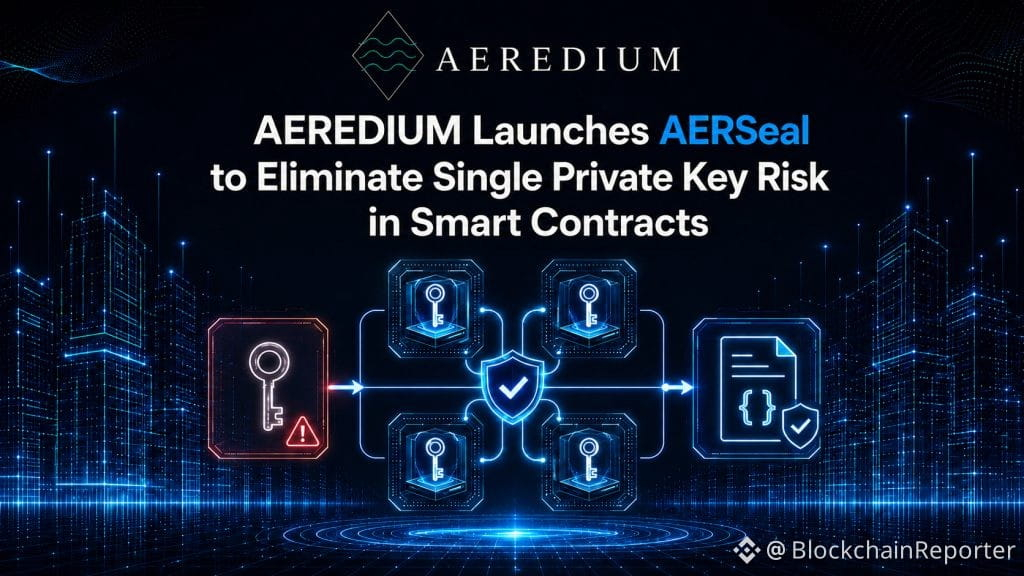
Article
AEREDIUM Launches AERSeal to Eliminate Single Private Key Risk in Smart ContractsAustin, Texas, September 2nd, 2026, Chainwire
AEREDIUM today announced AERSeal, its first end-to-end product built using AERKey, the company’s threshold key infrastructure. AERSeal is designed to remove the single private key that commonly controls privileged functions within smart contracts and replace it with threshold signing governed by multiple authorized approvers.
Smart contracts can carry powerful administrative permissions, including the ability to mint assets, upgrade contracts, or execute other privileged actions. When those permissions depend on a single private key, losing that key can mean permanently losing access, while theft or compromise can give an attacker control over the contract.
AERSeal addresses this by transferring those privileged powers to a threshold key, with key shares held separately inside hardware-attested enclaves. The shares are never reconstructed into a complete private key in one place. Instead, signatures are produced through the CGGMP24 threshold signing protocol.
The smart contract itself does not move. AERSeal currently supports smart contracts on EVM and EVM-compatible chains.
From a Single Key to Approval-Based Governance
AERSeal allows organizations to define who is authorized to approve actions and how many approvals are required through an M-of-N policy.
Once custody is active, privileged actions such as contract upgrades or minting must follow that predefined approval process. Authorized signatories approve actions using their passkeys, after which the threshold cluster produces the required signature.
This structure is designed so that no single individual, device, or complete private key is responsible for exercising the contract’s privileged powers.
Before custody is activated, AERSeal identifies the privileged powers associated with the contract and requires them to be transferred to the threshold key. The system then verifies onchain that those powers have been transferred completely.
Cryptographic Verification Without Blind Trust
AERSeal also allows customers to independently verify the threshold key assigned to them.
Using address derivation and a signed fresh challenge, customers can verify both the derivation and possession of the key themselves, including offline, rather than relying solely on AEREDIUM’s assertion that the key is valid.
The onboarding process includes KYC for individuals or KYB for organizations, contract registration, cryptographic key verification, transfer of privileged contract powers, onchain verification, and activation of the customer’s approval policy.
“AERSeal is the first complete product to put AERKey into operation from end to end,” said Albert Dadon, Founder and CEO of AEREDIUM. “The goal is to remove the idea that control over an entire smart contract should depend on one private key. With threshold signing and defined approval policies, control can be distributed and independently verified rather than concentrated in a single point.”
AERSeal is part of the AER360 family of products and is provided by Aeredium Network LLC using AERKey by AEREDIUM.
For more information about AERSeal, visit the AERSeal website.
About AEREDIUM
AEREDIUM Holdings Inc. builds The Trust Layer: blockchain infrastructure for institutional settlement in which correctness is enforced by hardware, cryptography and autonomous oversight rather than promised by intermediaries. AEREDIUM operates from Melbourne, Tel Aviv and Austin, Texas.
Contact
CEO & FounderAlbert DadonAEREDIUMadadon@aeredium.io
This article is not intended as financial advice. Educational purposes only.
AEREDIUM Launches AERSeal to Eliminate Single Private Key Risk in Smart Contracts
Austin, Texas, September 2nd, 2026, Chainwire
AEREDIUM today announced AERSeal, its first end-to-end product built using AERKey, the company’s threshold key infrastructure. AERSeal is designed to remove the single private key that commonly controls privileged functions within smart contracts and replace it with threshold signing governed by multiple authorized approvers.
Smart contracts can carry powerful administrative permissions, including the ability to mint assets, upgrade contracts, or execute other privileged actions. When those permissions depend on a single private key, losing that key can mean permanently losing access, while theft or compromise can give an attacker control over the contract.
AERSeal addresses this by transferring those privileged powers to a threshold key, with key shares held separately inside hardware-attested enclaves. The shares are never reconstructed into a complete private key in one place. Instead, signatures are produced through the CGGMP24 threshold signing protocol.
The smart contract itself does not move. AERSeal currently supports smart contracts on EVM and EVM-compatible chains.
From a Single Key to Approval-Based Governance
AERSeal allows organizations to define who is authorized to approve actions and how many approvals are required through an M-of-N policy.
Once custody is active, privileged actions such as contract upgrades or minting must follow that predefined approval process. Authorized signatories approve actions using their passkeys, after which the threshold cluster produces the required signature.
This structure is designed so that no single individual, device, or complete private key is responsible for exercising the contract’s privileged powers.
Before custody is activated, AERSeal identifies the privileged powers associated with the contract and requires them to be transferred to the threshold key. The system then verifies onchain that those powers have been transferred completely.
Cryptographic Verification Without Blind Trust
AERSeal also allows customers to independently verify the threshold key assigned to them.
Using address derivation and a signed fresh challenge, customers can verify both the derivation and possession of the key themselves, including offline, rather than relying solely on AEREDIUM’s assertion that the key is valid.
The onboarding process includes KYC for individuals or KYB for organizations, contract registration, cryptographic key verification, transfer of privileged contract powers, onchain verification, and activation of the customer’s approval policy.
“AERSeal is the first complete product to put AERKey into operation from end to end,” said Albert Dadon, Founder and CEO of AEREDIUM. “The goal is to remove the idea that control over an entire smart contract should depend on one private key. With threshold signing and defined approval policies, control can be distributed and independently verified rather than concentrated in a single point.”
AERSeal is part of the AER360 family of products and is provided by Aeredium Network LLC using AERKey by AEREDIUM.
For more information about AERSeal, visit the AERSeal website.
About AEREDIUM
AEREDIUM Holdings Inc. builds The Trust Layer: blockchain infrastructure for institutional settlement in which correctness is enforced by hardware, cryptography and autonomous oversight rather than promised by intermediaries. AEREDIUM operates from Melbourne, Tel Aviv and Austin, Texas.
Contact
CEO & FounderAlbert DadonAEREDIUMadadon@aeredium.io
This article is not intended as financial advice. Educational purposes only.
AEREDIUM today announced AERSeal, its first end-to-end product built using AERKey, the company’s threshold key infrastructure. AERSeal is designed to remove the single private key that commonly controls privileged functions within smart contracts and replace it with threshold signing governed by multiple authorized approvers.
Smart contracts can carry powerful administrative permissions, including the ability to mint assets, upgrade contracts, or execute other privileged actions. When those permissions depend on a single private key, losing that key can mean permanently losing access, while theft or compromise can give an attacker control over the contract.
AERSeal addresses this by transferring those privileged powers to a threshold key, with key shares held separately inside hardware-attested enclaves. The shares are never reconstructed into a complete private key in one place. Instead, signatures are produced through the CGGMP24 threshold signing protocol.
The smart contract itself does not move. AERSeal currently supports smart contracts on EVM and EVM-compatible chains.
From a Single Key to Approval-Based Governance
AERSeal allows organizations to define who is authorized to approve actions and how many approvals are required through an M-of-N policy.
Once custody is active, privileged actions such as contract upgrades or minting must follow that predefined approval process. Authorized signatories approve actions using their passkeys, after which the threshold cluster produces the required signature.
This structure is designed so that no single individual, device, or complete private key is responsible for exercising the contract’s privileged powers.
Before custody is activated, AERSeal identifies the privileged powers associated with the contract and requires them to be transferred to the threshold key. The system then verifies onchain that those powers have been transferred completely.
Cryptographic Verification Without Blind Trust
AERSeal also allows customers to independently verify the threshold key assigned to them.
Using address derivation and a signed fresh challenge, customers can verify both the derivation and possession of the key themselves, including offline, rather than relying solely on AEREDIUM’s assertion that the key is valid.
The onboarding process includes KYC for individuals or KYB for organizations, contract registration, cryptographic key verification, transfer of privileged contract powers, onchain verification, and activation of the customer’s approval policy.
“AERSeal is the first complete product to put AERKey into operation from end to end,” said Albert Dadon, Founder and CEO of AEREDIUM. “The goal is to remove the idea that control over an entire smart contract should depend on one private key. With threshold signing and defined approval policies, control can be distributed and independently verified rather than concentrated in a single point.”
AERSeal is part of the AER360 family of products and is provided by Aeredium Network LLC using AERKey by AEREDIUM.
For more information about AERSeal, visit the AERSeal website.
About AEREDIUM
AEREDIUM Holdings Inc. builds The Trust Layer: blockchain infrastructure for institutional settlement in which correctness is enforced by hardware, cryptography and autonomous oversight rather than promised by intermediaries. AEREDIUM operates from Melbourne, Tel Aviv and Austin, Texas.
Contact
CEO & FounderAlbert DadonAEREDIUMadadon@aeredium.io
This article is not intended as financial advice. Educational purposes only.
1
1
217
Article
Silhouette and XStocks Launch RFQ Trading for Tokenized Equities on HyperliquidZug, Switzerland, September 1st, 2026, Chainwire
Through Silhouette’s RFQ, every supported xStock gets an execution venue from day one, even those without their own order books.
Silhouette, the universal block trading layer for Hyperliquid, today announced that its RFQ system is live on mainnet, launching with tokenized equities from xStocks – Payward’s tokenized equity framework – opening new opportunities for the asset class through its demand layer.
Now, traders request a quote on any supported xStock, receive competing quotes from onboarded market makers, and settle the winning trade onchain, at any hour and at size.
“Tokenized stocks keep arriving onchain, and most of them have nowhere to trade. Silhouette’s RFQ is the demand layer: market makers compete for every trade, settlement is onchain, and the assets that prove real flow graduate to their own HyperCore markets. Launching with xStocks means starting with the issuer that brought this asset class to Hyperliquid,” said Chandler De Kock, Founder of Silhouette.
An order book is how an asset with proven demand trades. When launched before that proof exists, books sit thin and risk becoming dead markets, and the promised growth of the asset class stalls with them.
Demand for a traditional asset at a broker does not automatically carry over to its tokenized version onchain; converting it takes tooling and a cost structure trading firms recognise. Silhouette’s RFQ does that conversion cheaply, asset by asset.
The launch comes as tokenized equities accelerate across the industry, with issuers converging on the most active onchain markets. On Hyperliquid, the two layers now work as one pipeline: Silhouette discovers demand, and HyperCore’s order books host the assets that prove it.
“Access to real markets shouldn’t stop when a broker’s desk closes for the night. Every tokenized equity we’ve brought onchain has been waiting for a venue that treats it like a real asset, not an experiment. Silhouette’s RFQ is that venue, and it’s the clearest signal yet that this asset class is ready to trade the way the rest of finance already does.” said Val Gui, General Manager at xStocks.
About Silhouette
Silhouette is the universal block trading layer for Hyperliquid. It separates trader identity, size and direction from execution to ensure traders can avoid the common problems of front-running, fading or copying public transactions. By adding this layer, Silhouette enables institutions to trade without moving the book. The result is better pricing and cleaner execution for the users and teams that move markets. Backed by Polychain Capital and RockawayX. silhouette.exchange
About xStocks
xStocks is the industry benchmark for tokenized real world assets, bringing publicly listed equities and other assets onchain through fully collateralized, 1:1-backed tokens. Powered by Payward’s digital asset infrastructure, xStocks places traditional assets on blockchain rails, expanding access to global capital markets with extended availability, global reach, and digital-native settlement. Starting with tokenized US equities, xStocks now spans markets across the US, Europe and Asia.
Designed for interoperability, xStocks move seamlessly between centralized exchanges, self-custodied wallets, and onchain applications, unlocking new utility across trading, collateralization, and decentralized finance. Since launching in June 2025, xStocks has grown to power billions of dollars in transaction volume across multiple blockchain ecosystems, anchoring a rapidly expanding global network shaping the future of tokenized markets.
For more information, visit https://xstocks.fi.
Contact
Leila SteinSilhouetteleila@silhouette.exchange
This article is not intended as financial advice. Educational purposes only.
Silhouette and XStocks Launch RFQ Trading for Tokenized Equities on Hyperliquid
Zug, Switzerland, September 1st, 2026, Chainwire
Through Silhouette’s RFQ, every supported xStock gets an execution venue from day one, even those without their own order books.
Silhouette, the universal block trading layer for Hyperliquid, today announced that its RFQ system is live on mainnet, launching with tokenized equities from xStocks – Payward’s tokenized equity framework – opening new opportunities for the asset class through its demand layer.
Now, traders request a quote on any supported xStock, receive competing quotes from onboarded market makers, and settle the winning trade onchain, at any hour and at size.
“Tokenized stocks keep arriving onchain, and most of them have nowhere to trade. Silhouette’s RFQ is the demand layer: market makers compete for every trade, settlement is onchain, and the assets that prove real flow graduate to their own HyperCore markets. Launching with xStocks means starting with the issuer that brought this asset class to Hyperliquid,” said Chandler De Kock, Founder of Silhouette.
An order book is how an asset with proven demand trades. When launched before that proof exists, books sit thin and risk becoming dead markets, and the promised growth of the asset class stalls with them.
Demand for a traditional asset at a broker does not automatically carry over to its tokenized version onchain; converting it takes tooling and a cost structure trading firms recognise. Silhouette’s RFQ does that conversion cheaply, asset by asset.
The launch comes as tokenized equities accelerate across the industry, with issuers converging on the most active onchain markets. On Hyperliquid, the two layers now work as one pipeline: Silhouette discovers demand, and HyperCore’s order books host the assets that prove it.
“Access to real markets shouldn’t stop when a broker’s desk closes for the night. Every tokenized equity we’ve brought onchain has been waiting for a venue that treats it like a real asset, not an experiment. Silhouette’s RFQ is that venue, and it’s the clearest signal yet that this asset class is ready to trade the way the rest of finance already does.” said Val Gui, General Manager at xStocks.
About Silhouette
Silhouette is the universal block trading layer for Hyperliquid. It separates trader identity, size and direction from execution to ensure traders can avoid the common problems of front-running, fading or copying public transactions. By adding this layer, Silhouette enables institutions to trade without moving the book. The result is better pricing and cleaner execution for the users and teams that move markets. Backed by Polychain Capital and RockawayX. silhouette.exchange
About xStocks
xStocks is the industry benchmark for tokenized real world assets, bringing publicly listed equities and other assets onchain through fully collateralized, 1:1-backed tokens. Powered by Payward’s digital asset infrastructure, xStocks places traditional assets on blockchain rails, expanding access to global capital markets with extended availability, global reach, and digital-native settlement. Starting with tokenized US equities, xStocks now spans markets across the US, Europe and Asia.
Designed for interoperability, xStocks move seamlessly between centralized exchanges, self-custodied wallets, and onchain applications, unlocking new utility across trading, collateralization, and decentralized finance. Since launching in June 2025, xStocks has grown to power billions of dollars in transaction volume across multiple blockchain ecosystems, anchoring a rapidly expanding global network shaping the future of tokenized markets.
For more information, visit https://xstocks.fi.
Contact
Leila SteinSilhouetteleila@silhouette.exchange
This article is not intended as financial advice. Educational purposes only.
Through Silhouette’s RFQ, every supported xStock gets an execution venue from day one, even those without their own order books.
Silhouette, the universal block trading layer for Hyperliquid, today announced that its RFQ system is live on mainnet, launching with tokenized equities from xStocks – Payward’s tokenized equity framework – opening new opportunities for the asset class through its demand layer.
Now, traders request a quote on any supported xStock, receive competing quotes from onboarded market makers, and settle the winning trade onchain, at any hour and at size.
“Tokenized stocks keep arriving onchain, and most of them have nowhere to trade. Silhouette’s RFQ is the demand layer: market makers compete for every trade, settlement is onchain, and the assets that prove real flow graduate to their own HyperCore markets. Launching with xStocks means starting with the issuer that brought this asset class to Hyperliquid,” said Chandler De Kock, Founder of Silhouette.
An order book is how an asset with proven demand trades. When launched before that proof exists, books sit thin and risk becoming dead markets, and the promised growth of the asset class stalls with them.
Demand for a traditional asset at a broker does not automatically carry over to its tokenized version onchain; converting it takes tooling and a cost structure trading firms recognise. Silhouette’s RFQ does that conversion cheaply, asset by asset.
The launch comes as tokenized equities accelerate across the industry, with issuers converging on the most active onchain markets. On Hyperliquid, the two layers now work as one pipeline: Silhouette discovers demand, and HyperCore’s order books host the assets that prove it.
“Access to real markets shouldn’t stop when a broker’s desk closes for the night. Every tokenized equity we’ve brought onchain has been waiting for a venue that treats it like a real asset, not an experiment. Silhouette’s RFQ is that venue, and it’s the clearest signal yet that this asset class is ready to trade the way the rest of finance already does.” said Val Gui, General Manager at xStocks.
About Silhouette
Silhouette is the universal block trading layer for Hyperliquid. It separates trader identity, size and direction from execution to ensure traders can avoid the common problems of front-running, fading or copying public transactions. By adding this layer, Silhouette enables institutions to trade without moving the book. The result is better pricing and cleaner execution for the users and teams that move markets. Backed by Polychain Capital and RockawayX. silhouette.exchange
About xStocks
xStocks is the industry benchmark for tokenized real world assets, bringing publicly listed equities and other assets onchain through fully collateralized, 1:1-backed tokens. Powered by Payward’s digital asset infrastructure, xStocks places traditional assets on blockchain rails, expanding access to global capital markets with extended availability, global reach, and digital-native settlement. Starting with tokenized US equities, xStocks now spans markets across the US, Europe and Asia.
Designed for interoperability, xStocks move seamlessly between centralized exchanges, self-custodied wallets, and onchain applications, unlocking new utility across trading, collateralization, and decentralized finance. Since launching in June 2025, xStocks has grown to power billions of dollars in transaction volume across multiple blockchain ecosystems, anchoring a rapidly expanding global network shaping the future of tokenized markets.
For more information, visit https://xstocks.fi.
Contact
Leila SteinSilhouetteleila@silhouette.exchange
This article is not intended as financial advice. Educational purposes only.
185
Article
Aster and World Liberty Financial Launch USD1 RWA Boost: Phase 1, Offering 125M $WLFI + 6.25M USD...George Town, British Virgin Islands, September 1st, 2026, Chainwire
Aster, the privacy-first onchain trading platform backed by YZi Labs, today announced the kickoff of USD1 RWA Boost: Phase 1 with World Liberty Financial (WLFI), featuring 125,000,000 $WLFI and 6,250,000 USD1 in rewards.
The campaign builds on AOS-2, Aster’s earlier expansion of its Aster Open Standards (AOS) framework from spot markets to perpetuals.
Leonard, CEO at Aster, said: “AOS-2 is turning Aster from a decentralized perp exchange into an open infrastructure layer where anyone can launch and operate their own perpetual markets on top of Aster Chain. The first USD1 RWA perpetuals show that model is already working.”
AOS-2: A Published Standard for Perpetual Listings
AOS-2 is Aster’s standardized, onchain framework for initiating perpetual market listings, enabling projects to propose new markets through a transparent and automated process.
Applicants stake 1 million $ASTER, locked for four years with no early exit, before the proposal goes to an onchain validator vote. If approved, Aster’s risk team configures the market and the perpetual can go live as early as T+1; if rejected, the stake is returned in full.
Listing access runs on published onchain rules, while leverage and other trading parameters stay under Aster’s risk controls, letting Aster bring new markets to traders faster without giving up risk management.
USD1 RWA Boost Phase 1: 125M $WLFI + 6.25M USD1 in Rewards
The campaign runs from August 31 through December 31, 2026, covering SPCX/USD1, CL/USD1, XAU/USD1, SNDK/USD1, SKHYNIX/USD1, and MU/USD1.
Users earn Trading Points through taker volume on eligible USD1 pairs, which determine their share of the USD1 reward pool, while Open Interest (OI) Points are earned by holding eligible positions and determine their share of the $WLFI reward pool. Traders using Single Asset Mode with USD1 as collateral receive a 2x boost on OI Points. Rewards are calculated across weekly epochs and distributed the following week.
“When real-world assets trade onchain, the settlement asset matters as much as the market itself. Perpetuals on gold, energy, and equities, all denominated in USD1, give traders one dollar instrument across every one of these markets, and that is what stablecoins were built to do. We are supporting these markets because this is where onchain market structure is heading, and Phase 1 is only the start,” said Zach Witkoff, Co-Founder and CEO at World Liberty Financial.
Building the Frontier of Onchain Trading
AOS-2 gives Aster a repeatable, onchain path for bringing new markets to the platform, and the first USD1 RWA perpetual listings show that path is already at work. Paired with the ecosystem support from Aster and WLFI, the launch turns a new listing framework into real trading activity from day one.
As more real-world and crypto-native assets move onchain, Aster aims to become a leading venue for bringing new asset markets onchain. The map gets bigger from here.
About Aster
Aster is a privacy-first onchain trading platform backed by YZi Labs, with unique features like Hidden Orders to protect user trading activity. It pioneers the frontier of on-chain trading through perpetual futures, spots, and earn products for top-trending assets, including RWAs, memes, and core crypto markets. It is powered by Aster Chain, a Layer 1 blockchain built to power the future of decentralized finance.
Users can learn more about Aster on the official website or follow Aster on X.
*Disclaimer: Eligible pairs, reward parameters, and campaign rules are subject to change during the campaign. Please refer to the official campaign page for the latest eligible pair list and campaign details. Trading cryptocurrencies and leveraged products involves significant risk and may result in the loss of capital. This announcement is for informational purposes only and does not constitute investment or financial advice.
Contact
Marketing ManagerLola ChenAster DEXlola.chen@asterdex.com
Aster and World Liberty Financial Launch USD1 RWA Boost: Phase 1, Offering 125M $WLFI + 6.25M USD...
George Town, British Virgin Islands, September 1st, 2026, Chainwire
Aster, the privacy-first onchain trading platform backed by YZi Labs, today announced the kickoff of USD1 RWA Boost: Phase 1 with World Liberty Financial (WLFI), featuring 125,000,000 $WLFI and 6,250,000 USD1 in rewards.
The campaign builds on AOS-2, Aster’s earlier expansion of its Aster Open Standards (AOS) framework from spot markets to perpetuals.
Leonard, CEO at Aster, said: “AOS-2 is turning Aster from a decentralized perp exchange into an open infrastructure layer where anyone can launch and operate their own perpetual markets on top of Aster Chain. The first USD1 RWA perpetuals show that model is already working.”
AOS-2: A Published Standard for Perpetual Listings
AOS-2 is Aster’s standardized, onchain framework for initiating perpetual market listings, enabling projects to propose new markets through a transparent and automated process.
Applicants stake 1 million $ASTER, locked for four years with no early exit, before the proposal goes to an onchain validator vote. If approved, Aster’s risk team configures the market and the perpetual can go live as early as T+1; if rejected, the stake is returned in full.
Listing access runs on published onchain rules, while leverage and other trading parameters stay under Aster’s risk controls, letting Aster bring new markets to traders faster without giving up risk management.
USD1 RWA Boost Phase 1: 125M $WLFI + 6.25M USD1 in Rewards
The campaign runs from August 31 through December 31, 2026, covering SPCX/USD1, CL/USD1, XAU/USD1, SNDK/USD1, SKHYNIX/USD1, and MU/USD1.
Users earn Trading Points through taker volume on eligible USD1 pairs, which determine their share of the USD1 reward pool, while Open Interest (OI) Points are earned by holding eligible positions and determine their share of the $WLFI reward pool. Traders using Single Asset Mode with USD1 as collateral receive a 2x boost on OI Points. Rewards are calculated across weekly epochs and distributed the following week.
“When real-world assets trade onchain, the settlement asset matters as much as the market itself. Perpetuals on gold, energy, and equities, all denominated in USD1, give traders one dollar instrument across every one of these markets, and that is what stablecoins were built to do. We are supporting these markets because this is where onchain market structure is heading, and Phase 1 is only the start,” said Zach Witkoff, Co-Founder and CEO at World Liberty Financial.
Building the Frontier of Onchain Trading
AOS-2 gives Aster a repeatable, onchain path for bringing new markets to the platform, and the first USD1 RWA perpetual listings show that path is already at work. Paired with the ecosystem support from Aster and WLFI, the launch turns a new listing framework into real trading activity from day one.
As more real-world and crypto-native assets move onchain, Aster aims to become a leading venue for bringing new asset markets onchain. The map gets bigger from here.
About Aster
Aster is a privacy-first onchain trading platform backed by YZi Labs, with unique features like Hidden Orders to protect user trading activity. It pioneers the frontier of on-chain trading through perpetual futures, spots, and earn products for top-trending assets, including RWAs, memes, and core crypto markets. It is powered by Aster Chain, a Layer 1 blockchain built to power the future of decentralized finance.
Users can learn more about Aster on the official website or follow Aster on X.
*Disclaimer: Eligible pairs, reward parameters, and campaign rules are subject to change during the campaign. Please refer to the official campaign page for the latest eligible pair list and campaign details. Trading cryptocurrencies and leveraged products involves significant risk and may result in the loss of capital. This announcement is for informational purposes only and does not constitute investment or financial advice.
Contact
Marketing ManagerLola ChenAster DEXlola.chen@asterdex.com
Aster, the privacy-first onchain trading platform backed by YZi Labs, today announced the kickoff of USD1 RWA Boost: Phase 1 with World Liberty Financial (WLFI), featuring 125,000,000 $WLFI and 6,250,000 USD1 in rewards.
The campaign builds on AOS-2, Aster’s earlier expansion of its Aster Open Standards (AOS) framework from spot markets to perpetuals.
Leonard, CEO at Aster, said: “AOS-2 is turning Aster from a decentralized perp exchange into an open infrastructure layer where anyone can launch and operate their own perpetual markets on top of Aster Chain. The first USD1 RWA perpetuals show that model is already working.”
AOS-2: A Published Standard for Perpetual Listings
AOS-2 is Aster’s standardized, onchain framework for initiating perpetual market listings, enabling projects to propose new markets through a transparent and automated process.
Applicants stake 1 million $ASTER, locked for four years with no early exit, before the proposal goes to an onchain validator vote. If approved, Aster’s risk team configures the market and the perpetual can go live as early as T+1; if rejected, the stake is returned in full.
Listing access runs on published onchain rules, while leverage and other trading parameters stay under Aster’s risk controls, letting Aster bring new markets to traders faster without giving up risk management.
USD1 RWA Boost Phase 1: 125M $WLFI + 6.25M USD1 in Rewards
The campaign runs from August 31 through December 31, 2026, covering SPCX/USD1, CL/USD1, XAU/USD1, SNDK/USD1, SKHYNIX/USD1, and MU/USD1.
Users earn Trading Points through taker volume on eligible USD1 pairs, which determine their share of the USD1 reward pool, while Open Interest (OI) Points are earned by holding eligible positions and determine their share of the $WLFI reward pool. Traders using Single Asset Mode with USD1 as collateral receive a 2x boost on OI Points. Rewards are calculated across weekly epochs and distributed the following week.
“When real-world assets trade onchain, the settlement asset matters as much as the market itself. Perpetuals on gold, energy, and equities, all denominated in USD1, give traders one dollar instrument across every one of these markets, and that is what stablecoins were built to do. We are supporting these markets because this is where onchain market structure is heading, and Phase 1 is only the start,” said Zach Witkoff, Co-Founder and CEO at World Liberty Financial.
Building the Frontier of Onchain Trading
AOS-2 gives Aster a repeatable, onchain path for bringing new markets to the platform, and the first USD1 RWA perpetual listings show that path is already at work. Paired with the ecosystem support from Aster and WLFI, the launch turns a new listing framework into real trading activity from day one.
As more real-world and crypto-native assets move onchain, Aster aims to become a leading venue for bringing new asset markets onchain. The map gets bigger from here.
About Aster
Aster is a privacy-first onchain trading platform backed by YZi Labs, with unique features like Hidden Orders to protect user trading activity. It pioneers the frontier of on-chain trading through perpetual futures, spots, and earn products for top-trending assets, including RWAs, memes, and core crypto markets. It is powered by Aster Chain, a Layer 1 blockchain built to power the future of decentralized finance.
Users can learn more about Aster on the official website or follow Aster on X.
*Disclaimer: Eligible pairs, reward parameters, and campaign rules are subject to change during the campaign. Please refer to the official campaign page for the latest eligible pair list and campaign details. Trading cryptocurrencies and leveraged products involves significant risk and may result in the loss of capital. This announcement is for informational purposes only and does not constitute investment or financial advice.
Contact
Marketing ManagerLola ChenAster DEXlola.chen@asterdex.com
239

Article
Alkemya Metacore Secures $50M Via Tokenised Equity to Scale Nickel Energy and Security TechLondon, London, September 1st, 2026, Chainwire
ALKEMYA METACORE SCSp SECURES INITIAL USD 50 MILLION INVESTMENT AHEAD OF LISTING OF TOKENISED EQUITY NICKEL OFFERING
Alkemya Luxembourg S.à.r.l. (“Alkemya”), the sponsor, is pleased to announce that Alkemya Metacore SCSp has secured USD 50 million in a pre-launch capital raise for its precision industrial nickel wire business backed by Class 1 nickel wire. It is announcing the sale of additional ALKN tokens in a new tranche (the “Token”) at USD 1.0 per Token.
The offer, which is being arranged by Hanover Square Capital (UK) Ltd, will take place on Bitfinex Securities. The offer is available to institutional and professional investors and will close on 15 October 2026.
The Tokens are issued by Alkemya Metacore SCSp (“Alkemya Metacore”), a special limited partnership based in Luxembourg, which is registered as an Issuer with CNAD (National Commission of Digital Assets) in El Salvador.
Alkemya Metacore is a Luxembourg-based investment and operating platform focused on the industrial development, commercialisation, and financial structuring of high-technology metals. It owns approximately 7 million metres of 99.99% ultra-pure nickel wire with 0.025 mm diameter, which has been independently verified and valued at approximately USD 1.64 billion. The asset is held in institutional custody in Lugano, Switzerland.
Alkemya will use part of the initial capital raise and further funds raised in additional tranches to invest working capital in Alkemya Metacore to finance its commercialisation strategy of transforming its ultra-pure wire into engineered mesh products tailored to high-growth applications across seven sectors: EMI shielding, aerospace and defence, marine and desalination, power and industrials, semiconductors, green hydrogen and rare/precious metals recovery.
The successful capital raise, before secondary market listing, represents a major milestone for the offering and demonstrates confidence in the underlying exposure to high-purity nickel and the structure of the issue. The Token affords investors a combination of an asset-backed investment and a thematic play on energy transition and electronic security technologies.
The listing on Bitfinex Securities of the Token will enable Alkemya to leverage tokenisation to access a wider pool of global investors and be part of a regulated, 24/7 trading venue.
The Tokens aim to provide long-term investment value linked to real-world applications and technology.
Cash distributions will be governed by a strict waterfall that first returns investor capital in full, cumulative distributions equal to a 6% per annum compound interest calculated annually (i.e., the preferred return) on the investor capital at any time outstanding, from the date of payment of the same up to the date of final repayment of the invested capital and an additional 80/20 profit split with a carry partner in favour of Token holders from the commercial business.
Carlo Guido Della Peruta, Manager of the General Partner of Alkemya Metacore, commented: “Securing this initial investment is a significant milestone for Alkemya and validates both the quality of our asset and the strength of our commercialisation strategy. We chose to list on Bitfinex Securities because tokenisation offers us access to a genuinely global investor base within a regulated framework, and because it reflects the innovative approach we are taking across all aspects of our business. This raise will allow us to begin transforming our nickel wire asset into high-value engineered products serving some of the fastest-growing sectors in the global economy, and we look forward to welcoming further investors as the listing progresses.”
Jesse Knutson, Head of Operations at Bitfinex Securities, commented: “Bitfinex Securities exists to connect exciting investment opportunities with a broader and deeper investor base, giving more people access to investments that were previously out of reach and giving businesses access to a wider pool of capital. Alkemya Metacore will represent yet another example of how we’re using blockchain technology to bring previously inaccessible asset classes to market within stringent regulatory guardrails, and Alkemya’s initial $50 million capital raise is a sign of appetite for this exciting opportunity.”
Arvinder Sood, CEO and Director at Hanover Square Capital (UK) Ltd, said: “Hanover Square Capital is delighted to announce this transaction in collaboration with Bitfinex Securities and its successful pre-launch close of USD 50 million investment, which not only underscores the evolving direction of global capital markets but also establishes a compelling foundation for a groundbreaking transaction with the launch of ALKN tokens. This milestone reflects a broader structural shift in how financial assets are created, accessed, and exchanged, as traditional frameworks increasingly converge with digital innovation. By embracing tokenised equity, the transaction highlights a more efficient, transparent, and accessible model for capital formation, one that is better aligned with the demands of modern investors and issuers alike, with the capacity to trade on a peer-to-peer basis.
Hanover Square Capital believes that this transaction not only validates that trajectory but also signals the growing importance of blockchain-enabled solutions in redefining how assets are issued, managed, and traded on a global scale.”
Bitfinex Securities provides a regulated venue for the issuance and trading of tokenised securities, combining blockchain technology with regulated market access for issuers and eligible investors.
The offering was advised by the following law firms: CMS DeBacker in Luxembourg (as regards Luxembourg law aspects), Dentons El Salvador (as regards El Salvador law aspects), Foley and Lardner in the US (as regards US law aspects), and CNPLaw LLP in Singapore (as regards Singapore law aspects). Winston Taylor acted for Bitfinex Securities. The Edison Group advised on investor relations and issued a pre-IPO research note. The ALKN tokens will be available for trading across three regulated exchanges: Bitfinex Securities, AGX (operated by LabyrinthX Technologies Pte Ltd, a company in the Hydra X group) and Archax Ltd. HydraX Digital Assets Pte. Ltd. is the custodian and distribution partner in Asia, with Archax playing a similar role in the UK. Scytale, the technology firm, is providing onboarding technology services for compliance to Alkemya Metacore under Luxembourg and EU law.
About Hanover
Hanover Square Capital (UK) Ltd (“HSC”) is an independent, regulated advisory firm headquartered in London, comprising a small team of highly experienced finance professionals. The firm provides strategic advice across a broad range of areas, including energy transition and climate-related solutions, public and private debt and equity placements, bank financing, and both project and commodity finance, alongside advisory services on financial investments. HSC brings deep sector expertise spanning environment-related projects, infrastructure development, next-generation technologies with applications to electromagnetic shielding and efficient green energy production, with a particular emphasis on sustainability and the global energy transition.
As a member of the UK Sustainable Investment and Finance Association (UKSIF), the firm is closely aligned with leading sustainability practices. Its client base is global, encompassing large and mid-cap corporations, government and state agencies, selected institutional investors, and professional investors. HSC is further supported by its connected company, Hanover Square Investments Pte. Ltd, based in Singapore.
About Bitfinex Securities
Bitfinex Securities provides a regulated platform for the issuance, listing and trading of tokenised securities. Licensed in El Salvador and Kazakhstan, Bitfinex Securities gives issuers and eligible investors access to digital securities markets within established regulatory frameworks.
The platform supports capital raising and secondary market trading for tokenised securities, including real-world asset-linked opportunities. By combining market infrastructure, technology and regulatory oversight, Bitfinex Securities aims to make capital formation more efficient, transparent and accessible for issuers and investors.
Media Contact:
Richard Morgan Evans
rmorganevans@sapiencecomms.co.uk
Jonathan Batchelor
jbatchelor@sapiencecomms.co.uk
Sapience Communications
+44 (0) 203 841 7610
Disclaimer:
No offering is being made in the European Union or the European Economic Area, and no retail investors within the meaning of Directive 2014/65/EU (as amended, “MiFID II”) will be admitted as purchasers of the ALKN Tokens. The ALKN Tokens are also exempt from the obligation to publish a prospectus for offers to the public under Regulation (EU) 2017/1129, as amended (the “Prospectus Regulation”), as the offering will only be addressed to qualified investors in the EEA/EU. The offering is limited to institutional investors in Singapore. This news release does not constitute an offer to sell or a solicitation of an offer to buy, nor shall there be any sale of any of the ALKN Tokens in any jurisdiction in which such offer, solicitation or sale would be unlawful. These securities have not been and will not be registered under the US Securities Act of 1933, as amended (the “Securities Act”), the securities laws of any U.S. state or the securities laws of any other jurisdiction outside El Salvador, nor is such registration contemplated. The ALKN Tokens will only be offered and sold outside the United States (as defined in Regulation S under the Securities Act (“Regulation S”)) in offshore transactions pursuant to Rule 903 or Rule 904 of Regulation S and in accordance with any other applicable securities laws where such offers and sales are made. The ALKN Tokens have not been and will not be offered or sold within the United States.
Forward-Looking Statements: Information outlined in this news release may involve forward-looking statements under applicable securities laws. The forward-looking statements contained herein are expressly qualified in their entirety by this cautionary statement. The forward-looking statements included in this document are made as of the date of this document, and Alkemya Metacore and Alkemya disclaim any intention or obligation to update or revise any forward-looking statements, whether because of new information, future events or otherwise, except as expressly required by applicable securities legislation. Although management believes that the expectations represented in such forward-looking statements are reasonable, there can be no assurance that such expectations will prove to be correct.
Notice: None of Bitfinex Securities, Archax Ltd or the Hydra X group accepts responsibility for the adequacy or accuracy of this news release.
Since this offering is not targeting US investors as it is made under Regulation S and similarly it is not targeting EU retail investors under the EU Directive 2014/65/EU (as amended, “MiFID II”) or non-institutional investors in Singapore, this announcement is not intended for US investors, retail investors in the EU or non-institutional investors in Singapore. US investors, EU retail investors and non-institutional investors in Singapore are considered prohibited investors under the ALKN Token offering.
Contact
Jonathan BatchelorSapiencejbatchelor@sapiencecomms.co.uk
This article is not intended as financial advice. Educational purposes only.
Alkemya Metacore Secures $50M Via Tokenised Equity to Scale Nickel Energy and Security Tech
London, London, September 1st, 2026, Chainwire
ALKEMYA METACORE SCSp SECURES INITIAL USD 50 MILLION INVESTMENT AHEAD OF LISTING OF TOKENISED EQUITY NICKEL OFFERING
Alkemya Luxembourg S.à.r.l. (“Alkemya”), the sponsor, is pleased to announce that Alkemya Metacore SCSp has secured USD 50 million in a pre-launch capital raise for its precision industrial nickel wire business backed by Class 1 nickel wire. It is announcing the sale of additional ALKN tokens in a new tranche (the “Token”) at USD 1.0 per Token.
The offer, which is being arranged by Hanover Square Capital (UK) Ltd, will take place on Bitfinex Securities. The offer is available to institutional and professional investors and will close on 15 October 2026.
The Tokens are issued by Alkemya Metacore SCSp (“Alkemya Metacore”), a special limited partnership based in Luxembourg, which is registered as an Issuer with CNAD (National Commission of Digital Assets) in El Salvador.
Alkemya Metacore is a Luxembourg-based investment and operating platform focused on the industrial development, commercialisation, and financial structuring of high-technology metals. It owns approximately 7 million metres of 99.99% ultra-pure nickel wire with 0.025 mm diameter, which has been independently verified and valued at approximately USD 1.64 billion. The asset is held in institutional custody in Lugano, Switzerland.
Alkemya will use part of the initial capital raise and further funds raised in additional tranches to invest working capital in Alkemya Metacore to finance its commercialisation strategy of transforming its ultra-pure wire into engineered mesh products tailored to high-growth applications across seven sectors: EMI shielding, aerospace and defence, marine and desalination, power and industrials, semiconductors, green hydrogen and rare/precious metals recovery.
The successful capital raise, before secondary market listing, represents a major milestone for the offering and demonstrates confidence in the underlying exposure to high-purity nickel and the structure of the issue. The Token affords investors a combination of an asset-backed investment and a thematic play on energy transition and electronic security technologies.
The listing on Bitfinex Securities of the Token will enable Alkemya to leverage tokenisation to access a wider pool of global investors and be part of a regulated, 24/7 trading venue.
The Tokens aim to provide long-term investment value linked to real-world applications and technology.
Cash distributions will be governed by a strict waterfall that first returns investor capital in full, cumulative distributions equal to a 6% per annum compound interest calculated annually (i.e., the preferred return) on the investor capital at any time outstanding, from the date of payment of the same up to the date of final repayment of the invested capital and an additional 80/20 profit split with a carry partner in favour of Token holders from the commercial business.
Carlo Guido Della Peruta, Manager of the General Partner of Alkemya Metacore, commented: “Securing this initial investment is a significant milestone for Alkemya and validates both the quality of our asset and the strength of our commercialisation strategy. We chose to list on Bitfinex Securities because tokenisation offers us access to a genuinely global investor base within a regulated framework, and because it reflects the innovative approach we are taking across all aspects of our business. This raise will allow us to begin transforming our nickel wire asset into high-value engineered products serving some of the fastest-growing sectors in the global economy, and we look forward to welcoming further investors as the listing progresses.”
Jesse Knutson, Head of Operations at Bitfinex Securities, commented: “Bitfinex Securities exists to connect exciting investment opportunities with a broader and deeper investor base, giving more people access to investments that were previously out of reach and giving businesses access to a wider pool of capital. Alkemya Metacore will represent yet another example of how we’re using blockchain technology to bring previously inaccessible asset classes to market within stringent regulatory guardrails, and Alkemya’s initial $50 million capital raise is a sign of appetite for this exciting opportunity.”
Arvinder Sood, CEO and Director at Hanover Square Capital (UK) Ltd, said: “Hanover Square Capital is delighted to announce this transaction in collaboration with Bitfinex Securities and its successful pre-launch close of USD 50 million investment, which not only underscores the evolving direction of global capital markets but also establishes a compelling foundation for a groundbreaking transaction with the launch of ALKN tokens. This milestone reflects a broader structural shift in how financial assets are created, accessed, and exchanged, as traditional frameworks increasingly converge with digital innovation. By embracing tokenised equity, the transaction highlights a more efficient, transparent, and accessible model for capital formation, one that is better aligned with the demands of modern investors and issuers alike, with the capacity to trade on a peer-to-peer basis.
Hanover Square Capital believes that this transaction not only validates that trajectory but also signals the growing importance of blockchain-enabled solutions in redefining how assets are issued, managed, and traded on a global scale.”
Bitfinex Securities provides a regulated venue for the issuance and trading of tokenised securities, combining blockchain technology with regulated market access for issuers and eligible investors.
The offering was advised by the following law firms: CMS DeBacker in Luxembourg (as regards Luxembourg law aspects), Dentons El Salvador (as regards El Salvador law aspects), Foley and Lardner in the US (as regards US law aspects), and CNPLaw LLP in Singapore (as regards Singapore law aspects). Winston Taylor acted for Bitfinex Securities. The Edison Group advised on investor relations and issued a pre-IPO research note. The ALKN tokens will be available for trading across three regulated exchanges: Bitfinex Securities, AGX (operated by LabyrinthX Technologies Pte Ltd, a company in the Hydra X group) and Archax Ltd. HydraX Digital Assets Pte. Ltd. is the custodian and distribution partner in Asia, with Archax playing a similar role in the UK. Scytale, the technology firm, is providing onboarding technology services for compliance to Alkemya Metacore under Luxembourg and EU law.
About Hanover
Hanover Square Capital (UK) Ltd (“HSC”) is an independent, regulated advisory firm headquartered in London, comprising a small team of highly experienced finance professionals. The firm provides strategic advice across a broad range of areas, including energy transition and climate-related solutions, public and private debt and equity placements, bank financing, and both project and commodity finance, alongside advisory services on financial investments. HSC brings deep sector expertise spanning environment-related projects, infrastructure development, next-generation technologies with applications to electromagnetic shielding and efficient green energy production, with a particular emphasis on sustainability and the global energy transition.
As a member of the UK Sustainable Investment and Finance Association (UKSIF), the firm is closely aligned with leading sustainability practices. Its client base is global, encompassing large and mid-cap corporations, government and state agencies, selected institutional investors, and professional investors. HSC is further supported by its connected company, Hanover Square Investments Pte. Ltd, based in Singapore.
About Bitfinex Securities
Bitfinex Securities provides a regulated platform for the issuance, listing and trading of tokenised securities. Licensed in El Salvador and Kazakhstan, Bitfinex Securities gives issuers and eligible investors access to digital securities markets within established regulatory frameworks.
The platform supports capital raising and secondary market trading for tokenised securities, including real-world asset-linked opportunities. By combining market infrastructure, technology and regulatory oversight, Bitfinex Securities aims to make capital formation more efficient, transparent and accessible for issuers and investors.
Media Contact:
Richard Morgan Evans
rmorganevans@sapiencecomms.co.uk
Jonathan Batchelor
jbatchelor@sapiencecomms.co.uk
Sapience Communications
+44 (0) 203 841 7610
Disclaimer:
No offering is being made in the European Union or the European Economic Area, and no retail investors within the meaning of Directive 2014/65/EU (as amended, “MiFID II”) will be admitted as purchasers of the ALKN Tokens. The ALKN Tokens are also exempt from the obligation to publish a prospectus for offers to the public under Regulation (EU) 2017/1129, as amended (the “Prospectus Regulation”), as the offering will only be addressed to qualified investors in the EEA/EU. The offering is limited to institutional investors in Singapore. This news release does not constitute an offer to sell or a solicitation of an offer to buy, nor shall there be any sale of any of the ALKN Tokens in any jurisdiction in which such offer, solicitation or sale would be unlawful. These securities have not been and will not be registered under the US Securities Act of 1933, as amended (the “Securities Act”), the securities laws of any U.S. state or the securities laws of any other jurisdiction outside El Salvador, nor is such registration contemplated. The ALKN Tokens will only be offered and sold outside the United States (as defined in Regulation S under the Securities Act (“Regulation S”)) in offshore transactions pursuant to Rule 903 or Rule 904 of Regulation S and in accordance with any other applicable securities laws where such offers and sales are made. The ALKN Tokens have not been and will not be offered or sold within the United States.
Forward-Looking Statements: Information outlined in this news release may involve forward-looking statements under applicable securities laws. The forward-looking statements contained herein are expressly qualified in their entirety by this cautionary statement. The forward-looking statements included in this document are made as of the date of this document, and Alkemya Metacore and Alkemya disclaim any intention or obligation to update or revise any forward-looking statements, whether because of new information, future events or otherwise, except as expressly required by applicable securities legislation. Although management believes that the expectations represented in such forward-looking statements are reasonable, there can be no assurance that such expectations will prove to be correct.
Notice: None of Bitfinex Securities, Archax Ltd or the Hydra X group accepts responsibility for the adequacy or accuracy of this news release.
Since this offering is not targeting US investors as it is made under Regulation S and similarly it is not targeting EU retail investors under the EU Directive 2014/65/EU (as amended, “MiFID II”) or non-institutional investors in Singapore, this announcement is not intended for US investors, retail investors in the EU or non-institutional investors in Singapore. US investors, EU retail investors and non-institutional investors in Singapore are considered prohibited investors under the ALKN Token offering.
Contact
Jonathan BatchelorSapiencejbatchelor@sapiencecomms.co.uk
This article is not intended as financial advice. Educational purposes only.
ALKEMYA METACORE SCSp SECURES INITIAL USD 50 MILLION INVESTMENT AHEAD OF LISTING OF TOKENISED EQUITY NICKEL OFFERING
Alkemya Luxembourg S.à.r.l. (“Alkemya”), the sponsor, is pleased to announce that Alkemya Metacore SCSp has secured USD 50 million in a pre-launch capital raise for its precision industrial nickel wire business backed by Class 1 nickel wire. It is announcing the sale of additional ALKN tokens in a new tranche (the “Token”) at USD 1.0 per Token.
The offer, which is being arranged by Hanover Square Capital (UK) Ltd, will take place on Bitfinex Securities. The offer is available to institutional and professional investors and will close on 15 October 2026.
The Tokens are issued by Alkemya Metacore SCSp (“Alkemya Metacore”), a special limited partnership based in Luxembourg, which is registered as an Issuer with CNAD (National Commission of Digital Assets) in El Salvador.
Alkemya Metacore is a Luxembourg-based investment and operating platform focused on the industrial development, commercialisation, and financial structuring of high-technology metals. It owns approximately 7 million metres of 99.99% ultra-pure nickel wire with 0.025 mm diameter, which has been independently verified and valued at approximately USD 1.64 billion. The asset is held in institutional custody in Lugano, Switzerland.
Alkemya will use part of the initial capital raise and further funds raised in additional tranches to invest working capital in Alkemya Metacore to finance its commercialisation strategy of transforming its ultra-pure wire into engineered mesh products tailored to high-growth applications across seven sectors: EMI shielding, aerospace and defence, marine and desalination, power and industrials, semiconductors, green hydrogen and rare/precious metals recovery.
The successful capital raise, before secondary market listing, represents a major milestone for the offering and demonstrates confidence in the underlying exposure to high-purity nickel and the structure of the issue. The Token affords investors a combination of an asset-backed investment and a thematic play on energy transition and electronic security technologies.
The listing on Bitfinex Securities of the Token will enable Alkemya to leverage tokenisation to access a wider pool of global investors and be part of a regulated, 24/7 trading venue.
The Tokens aim to provide long-term investment value linked to real-world applications and technology.
Cash distributions will be governed by a strict waterfall that first returns investor capital in full, cumulative distributions equal to a 6% per annum compound interest calculated annually (i.e., the preferred return) on the investor capital at any time outstanding, from the date of payment of the same up to the date of final repayment of the invested capital and an additional 80/20 profit split with a carry partner in favour of Token holders from the commercial business.
Carlo Guido Della Peruta, Manager of the General Partner of Alkemya Metacore, commented: “Securing this initial investment is a significant milestone for Alkemya and validates both the quality of our asset and the strength of our commercialisation strategy. We chose to list on Bitfinex Securities because tokenisation offers us access to a genuinely global investor base within a regulated framework, and because it reflects the innovative approach we are taking across all aspects of our business. This raise will allow us to begin transforming our nickel wire asset into high-value engineered products serving some of the fastest-growing sectors in the global economy, and we look forward to welcoming further investors as the listing progresses.”
Jesse Knutson, Head of Operations at Bitfinex Securities, commented: “Bitfinex Securities exists to connect exciting investment opportunities with a broader and deeper investor base, giving more people access to investments that were previously out of reach and giving businesses access to a wider pool of capital. Alkemya Metacore will represent yet another example of how we’re using blockchain technology to bring previously inaccessible asset classes to market within stringent regulatory guardrails, and Alkemya’s initial $50 million capital raise is a sign of appetite for this exciting opportunity.”
Arvinder Sood, CEO and Director at Hanover Square Capital (UK) Ltd, said: “Hanover Square Capital is delighted to announce this transaction in collaboration with Bitfinex Securities and its successful pre-launch close of USD 50 million investment, which not only underscores the evolving direction of global capital markets but also establishes a compelling foundation for a groundbreaking transaction with the launch of ALKN tokens. This milestone reflects a broader structural shift in how financial assets are created, accessed, and exchanged, as traditional frameworks increasingly converge with digital innovation. By embracing tokenised equity, the transaction highlights a more efficient, transparent, and accessible model for capital formation, one that is better aligned with the demands of modern investors and issuers alike, with the capacity to trade on a peer-to-peer basis.
Hanover Square Capital believes that this transaction not only validates that trajectory but also signals the growing importance of blockchain-enabled solutions in redefining how assets are issued, managed, and traded on a global scale.”
Bitfinex Securities provides a regulated venue for the issuance and trading of tokenised securities, combining blockchain technology with regulated market access for issuers and eligible investors.
The offering was advised by the following law firms: CMS DeBacker in Luxembourg (as regards Luxembourg law aspects), Dentons El Salvador (as regards El Salvador law aspects), Foley and Lardner in the US (as regards US law aspects), and CNPLaw LLP in Singapore (as regards Singapore law aspects). Winston Taylor acted for Bitfinex Securities. The Edison Group advised on investor relations and issued a pre-IPO research note. The ALKN tokens will be available for trading across three regulated exchanges: Bitfinex Securities, AGX (operated by LabyrinthX Technologies Pte Ltd, a company in the Hydra X group) and Archax Ltd. HydraX Digital Assets Pte. Ltd. is the custodian and distribution partner in Asia, with Archax playing a similar role in the UK. Scytale, the technology firm, is providing onboarding technology services for compliance to Alkemya Metacore under Luxembourg and EU law.
About Hanover
Hanover Square Capital (UK) Ltd (“HSC”) is an independent, regulated advisory firm headquartered in London, comprising a small team of highly experienced finance professionals. The firm provides strategic advice across a broad range of areas, including energy transition and climate-related solutions, public and private debt and equity placements, bank financing, and both project and commodity finance, alongside advisory services on financial investments. HSC brings deep sector expertise spanning environment-related projects, infrastructure development, next-generation technologies with applications to electromagnetic shielding and efficient green energy production, with a particular emphasis on sustainability and the global energy transition.
As a member of the UK Sustainable Investment and Finance Association (UKSIF), the firm is closely aligned with leading sustainability practices. Its client base is global, encompassing large and mid-cap corporations, government and state agencies, selected institutional investors, and professional investors. HSC is further supported by its connected company, Hanover Square Investments Pte. Ltd, based in Singapore.
About Bitfinex Securities
Bitfinex Securities provides a regulated platform for the issuance, listing and trading of tokenised securities. Licensed in El Salvador and Kazakhstan, Bitfinex Securities gives issuers and eligible investors access to digital securities markets within established regulatory frameworks.
The platform supports capital raising and secondary market trading for tokenised securities, including real-world asset-linked opportunities. By combining market infrastructure, technology and regulatory oversight, Bitfinex Securities aims to make capital formation more efficient, transparent and accessible for issuers and investors.
Media Contact:
Richard Morgan Evans
rmorganevans@sapiencecomms.co.uk
Jonathan Batchelor
jbatchelor@sapiencecomms.co.uk
Sapience Communications
+44 (0) 203 841 7610
Disclaimer:
No offering is being made in the European Union or the European Economic Area, and no retail investors within the meaning of Directive 2014/65/EU (as amended, “MiFID II”) will be admitted as purchasers of the ALKN Tokens. The ALKN Tokens are also exempt from the obligation to publish a prospectus for offers to the public under Regulation (EU) 2017/1129, as amended (the “Prospectus Regulation”), as the offering will only be addressed to qualified investors in the EEA/EU. The offering is limited to institutional investors in Singapore. This news release does not constitute an offer to sell or a solicitation of an offer to buy, nor shall there be any sale of any of the ALKN Tokens in any jurisdiction in which such offer, solicitation or sale would be unlawful. These securities have not been and will not be registered under the US Securities Act of 1933, as amended (the “Securities Act”), the securities laws of any U.S. state or the securities laws of any other jurisdiction outside El Salvador, nor is such registration contemplated. The ALKN Tokens will only be offered and sold outside the United States (as defined in Regulation S under the Securities Act (“Regulation S”)) in offshore transactions pursuant to Rule 903 or Rule 904 of Regulation S and in accordance with any other applicable securities laws where such offers and sales are made. The ALKN Tokens have not been and will not be offered or sold within the United States.
Forward-Looking Statements: Information outlined in this news release may involve forward-looking statements under applicable securities laws. The forward-looking statements contained herein are expressly qualified in their entirety by this cautionary statement. The forward-looking statements included in this document are made as of the date of this document, and Alkemya Metacore and Alkemya disclaim any intention or obligation to update or revise any forward-looking statements, whether because of new information, future events or otherwise, except as expressly required by applicable securities legislation. Although management believes that the expectations represented in such forward-looking statements are reasonable, there can be no assurance that such expectations will prove to be correct.
Notice: None of Bitfinex Securities, Archax Ltd or the Hydra X group accepts responsibility for the adequacy or accuracy of this news release.
Since this offering is not targeting US investors as it is made under Regulation S and similarly it is not targeting EU retail investors under the EU Directive 2014/65/EU (as amended, “MiFID II”) or non-institutional investors in Singapore, this announcement is not intended for US investors, retail investors in the EU or non-institutional investors in Singapore. US investors, EU retail investors and non-institutional investors in Singapore are considered prohibited investors under the ALKN Token offering.
Contact
Jonathan BatchelorSapiencejbatchelor@sapiencecomms.co.uk
This article is not intended as financial advice. Educational purposes only.
106

Article
The Next Trillion-Dollar Currency May Not Be a StablecoinA new CoinDesk analysis examines why the next trillion-dollar currency may emerge outside today’s stablecoin model and may not have a name yet. CoinDesk reported.
What the Report Says
The development is notable because it changes the factual picture around next trillion-dollar currency. The available reporting identifies a specific development, but it does not justify treating the event as proof of a completed industry-wide shift. The figures and descriptions remain tied to the source and its stated scope.
Why It Matters for Digital Assets
Crypto infrastructure increasingly connects payments, markets and software systems. That creates new opportunities for adoption, but it also leaves participants facing questions about security, regulation, liquidity and operational reliability. Those questions will determine whether the reported development expands beyond an initial test, study or proposal.
What Comes Next
The next milestones are additional disclosures, implementation details and evidence that users or institutions are adopting the relevant system. Until those details appear, the event should be read as a dated development rather than a prediction about market prices or guaranteed future adoption. BlockchainReporter has previously covered related digital-asset infrastructure in earlier coverage.
The Next Trillion-Dollar Currency May Not Be a Stablecoin
A new CoinDesk analysis examines why the next trillion-dollar currency may emerge outside today’s stablecoin model and may not have a name yet. CoinDesk reported.
What the Report Says
The development is notable because it changes the factual picture around next trillion-dollar currency. The available reporting identifies a specific development, but it does not justify treating the event as proof of a completed industry-wide shift. The figures and descriptions remain tied to the source and its stated scope.
Why It Matters for Digital Assets
Crypto infrastructure increasingly connects payments, markets and software systems. That creates new opportunities for adoption, but it also leaves participants facing questions about security, regulation, liquidity and operational reliability. Those questions will determine whether the reported development expands beyond an initial test, study or proposal.
What Comes Next
The next milestones are additional disclosures, implementation details and evidence that users or institutions are adopting the relevant system. Until those details appear, the event should be read as a dated development rather than a prediction about market prices or guaranteed future adoption. BlockchainReporter has previously covered related digital-asset infrastructure in earlier coverage.
What the Report Says
The development is notable because it changes the factual picture around next trillion-dollar currency. The available reporting identifies a specific development, but it does not justify treating the event as proof of a completed industry-wide shift. The figures and descriptions remain tied to the source and its stated scope.
Why It Matters for Digital Assets
Crypto infrastructure increasingly connects payments, markets and software systems. That creates new opportunities for adoption, but it also leaves participants facing questions about security, regulation, liquidity and operational reliability. Those questions will determine whether the reported development expands beyond an initial test, study or proposal.
What Comes Next
The next milestones are additional disclosures, implementation details and evidence that users or institutions are adopting the relevant system. Until those details appear, the event should be read as a dated development rather than a prediction about market prices or guaranteed future adoption. BlockchainReporter has previously covered related digital-asset infrastructure in earlier coverage.
437
Verified

Article
BTC News Today: Bitcoin Holds Near $80K As IceBull Offers Stage 1 Access Before the Next Presale ...BTC news today has Bitcoin holding near $80K, a level that keeps market sentiment focused on whether risk appetite can extend beyond the largest asset. A firm Bitcoin backdrop does not decide the future of smaller tokens, but it can set the tone for interest in altcoins and fresh launches. IceBull offers a separate timing story within that environment: its presale is live at Stage 1, before the next planned increase in its 16-stage price sequence.
Bitcoin Near $80K Sets the News Tone
Bitcoin remains the reference point for crypto sentiment because it is the asset many readers use to gauge appetite for the sector. Holding near $80K can keep discussion constructive, yet a single price area never removes volatility or determines where capital goes next. BTC news today is best read as context. It describes the market’s largest benchmark, while each altcoin and presale needs its own facts, risks, and acquisition mechanics.
That distinction matters when a headline shifts from Bitcoin to a new project. A move in BTC can encourage attention toward new themes, but it cannot validate a promotional upside claim. IceBull is not presented as a copy of Bitcoin. It is a bull-themed Ethereum ERC-20 token with a presale structure designed around fixed stages. The connection is market mood, not a promise that one asset’s stability will translate into another asset’s future performance.
Risk Appetite Can Open a New Search
When Bitcoin is steady, some readers broaden their research from major coins to projects with an earlier entry point. That is why the best crypto to buy now search often combines large-cap news with presale discovery. IceBull gives that search a visible condition: Stage 1 is active. The sale has 16 stages, and every later stage is designed with a higher official price. Fifteen planned price increases remain while the first stage is live.
Waiting can therefore change the official token allocation available for a given payment amount. That is a presale pricing fact, not a statement about eventual resale value. The timing element has no fixed deadline in this article. It is tied to a stage transition, whenever the sale advances. For the best crypto to buy now search, readers can inspect the displayed stage and allocation before payment rather than rely on a broad claim that the next market move is known.
IceBull Adds Disclosed Mechanics
The IceBull setup includes facts that can be reviewed alongside its meme-style energy. The token is an Ethereum ERC-20 with a fixed 120 billion supply. SolidProof has audited the contract, liquidity is planned to be locked at listing, and team tokens vest. These controls do not guarantee demand, a listing result, or a future price. They do provide clear subjects for due diligence before someone decides whether a presale belongs in their research.
The project also cites 1250X potential connected with a planned $0.025 listing price. Potential is the important qualifier. It is not financial advice, a fixed projection, or a completed gain. Approximately $5K raised is likewise an early, time-sensitive project snapshot rather than proof of traction. The stronger present-tense case is simply that Stage 1 is live, the price sequence is defined, and the published token mechanics can be checked.
How to Buy IceBull
Visit the official IceBull Buy Now page and confirm that Stage 1 is displayed.
Choose a cryptocurrency payment route or credit or debit card.
Connect a compatible Web3 wallet for a cryptocurrency purchase.
Select ETH, BNB, USDT, or choose the card checkout option.
Review the on-screen $ICEBULL allocation and payment total before confirming.
Claim tokens through the official procedure after the presale has ended.
The Payment Route Does Not Change the Stage
Crypto and card checkout solve different practical needs. A crypto purchase requires a compatible Web3 wallet and uses ETH, BNB, or USDT. Credit and debit card payment follows the available card route. Neither method creates a different presale stage. The displayed Stage 1 terms govern the allocation while that stage remains active. Checking the amount before confirmation makes the process easier to understand and prevents payment convenience from being confused with price certainty.
The later claim step is equally important. A completed payment records a presale allocation, while token claiming follows after the presale through the official process. This timeline differs from buying Bitcoin on an exchange, where the asset may be available immediately under that venue’s rules. Knowing the difference lets readers assess an early project on its own terms rather than assuming every crypto purchase has the same delivery model.
A Live Stage Inside a Wider Market Story
BTC news today supplies the big-market backdrop, but IceBull‘s immediate story is more specific: Stage 1 is open before the next presale price increase. The sale’s 16-stage design, 15 future higher prices, planned listing reference, and stated claim process are the points that can be verified now. Readers using the best crypto to buy now search can inspect IceBull’s live terms and decide based on their own research, keeping the 1250X potential clearly separate from any guaranteed outcome.
BTC News Today and IceBull FAQs What does Bitcoin near $80K mean for IceBull?
It is market context only. Bitcoin’s position does not guarantee a result for an early-stage presale.
Why does Stage 1 matter in the best crypto to buy now search?
It is the opening stage of a 16-stage sale, with 15 planned higher prices remaining after it.
Can I use a credit or debit card for IceBull?
Yes. The official flow supports credit and debit cards as well as ETH, BNB, and USDT.
When are IceBull tokens claimed?
Purchased tokens are claimed through the official process after the presale.
This article is not intended as financial advice. Educational purposes only.
BTC News Today: Bitcoin Holds Near $80K As IceBull Offers Stage 1 Access Before the Next Presale ...
BTC news today has Bitcoin holding near $80K, a level that keeps market sentiment focused on whether risk appetite can extend beyond the largest asset. A firm Bitcoin backdrop does not decide the future of smaller tokens, but it can set the tone for interest in altcoins and fresh launches. IceBull offers a separate timing story within that environment: its presale is live at Stage 1, before the next planned increase in its 16-stage price sequence.
Bitcoin Near $80K Sets the News Tone
Bitcoin remains the reference point for crypto sentiment because it is the asset many readers use to gauge appetite for the sector. Holding near $80K can keep discussion constructive, yet a single price area never removes volatility or determines where capital goes next. BTC news today is best read as context. It describes the market’s largest benchmark, while each altcoin and presale needs its own facts, risks, and acquisition mechanics.
That distinction matters when a headline shifts from Bitcoin to a new project. A move in BTC can encourage attention toward new themes, but it cannot validate a promotional upside claim. IceBull is not presented as a copy of Bitcoin. It is a bull-themed Ethereum ERC-20 token with a presale structure designed around fixed stages. The connection is market mood, not a promise that one asset’s stability will translate into another asset’s future performance.
Risk Appetite Can Open a New Search
When Bitcoin is steady, some readers broaden their research from major coins to projects with an earlier entry point. That is why the best crypto to buy now search often combines large-cap news with presale discovery. IceBull gives that search a visible condition: Stage 1 is active. The sale has 16 stages, and every later stage is designed with a higher official price. Fifteen planned price increases remain while the first stage is live.
Waiting can therefore change the official token allocation available for a given payment amount. That is a presale pricing fact, not a statement about eventual resale value. The timing element has no fixed deadline in this article. It is tied to a stage transition, whenever the sale advances. For the best crypto to buy now search, readers can inspect the displayed stage and allocation before payment rather than rely on a broad claim that the next market move is known.
IceBull Adds Disclosed Mechanics
The IceBull setup includes facts that can be reviewed alongside its meme-style energy. The token is an Ethereum ERC-20 with a fixed 120 billion supply. SolidProof has audited the contract, liquidity is planned to be locked at listing, and team tokens vest. These controls do not guarantee demand, a listing result, or a future price. They do provide clear subjects for due diligence before someone decides whether a presale belongs in their research.
The project also cites 1250X potential connected with a planned $0.025 listing price. Potential is the important qualifier. It is not financial advice, a fixed projection, or a completed gain. Approximately $5K raised is likewise an early, time-sensitive project snapshot rather than proof of traction. The stronger present-tense case is simply that Stage 1 is live, the price sequence is defined, and the published token mechanics can be checked.
How to Buy IceBull
Visit the official IceBull Buy Now page and confirm that Stage 1 is displayed.
Choose a cryptocurrency payment route or credit or debit card.
Connect a compatible Web3 wallet for a cryptocurrency purchase.
Select ETH, BNB, USDT, or choose the card checkout option.
Review the on-screen $ICEBULL allocation and payment total before confirming.
Claim tokens through the official procedure after the presale has ended.
The Payment Route Does Not Change the Stage
Crypto and card checkout solve different practical needs. A crypto purchase requires a compatible Web3 wallet and uses ETH, BNB, or USDT. Credit and debit card payment follows the available card route. Neither method creates a different presale stage. The displayed Stage 1 terms govern the allocation while that stage remains active. Checking the amount before confirmation makes the process easier to understand and prevents payment convenience from being confused with price certainty.
The later claim step is equally important. A completed payment records a presale allocation, while token claiming follows after the presale through the official process. This timeline differs from buying Bitcoin on an exchange, where the asset may be available immediately under that venue’s rules. Knowing the difference lets readers assess an early project on its own terms rather than assuming every crypto purchase has the same delivery model.
A Live Stage Inside a Wider Market Story
BTC news today supplies the big-market backdrop, but IceBull‘s immediate story is more specific: Stage 1 is open before the next presale price increase. The sale’s 16-stage design, 15 future higher prices, planned listing reference, and stated claim process are the points that can be verified now. Readers using the best crypto to buy now search can inspect IceBull’s live terms and decide based on their own research, keeping the 1250X potential clearly separate from any guaranteed outcome.
BTC News Today and IceBull FAQs What does Bitcoin near $80K mean for IceBull?
It is market context only. Bitcoin’s position does not guarantee a result for an early-stage presale.
Why does Stage 1 matter in the best crypto to buy now search?
It is the opening stage of a 16-stage sale, with 15 planned higher prices remaining after it.
Can I use a credit or debit card for IceBull?
Yes. The official flow supports credit and debit cards as well as ETH, BNB, and USDT.
When are IceBull tokens claimed?
Purchased tokens are claimed through the official process after the presale.
This article is not intended as financial advice. Educational purposes only.
Bitcoin Near $80K Sets the News Tone
Bitcoin remains the reference point for crypto sentiment because it is the asset many readers use to gauge appetite for the sector. Holding near $80K can keep discussion constructive, yet a single price area never removes volatility or determines where capital goes next. BTC news today is best read as context. It describes the market’s largest benchmark, while each altcoin and presale needs its own facts, risks, and acquisition mechanics.
That distinction matters when a headline shifts from Bitcoin to a new project. A move in BTC can encourage attention toward new themes, but it cannot validate a promotional upside claim. IceBull is not presented as a copy of Bitcoin. It is a bull-themed Ethereum ERC-20 token with a presale structure designed around fixed stages. The connection is market mood, not a promise that one asset’s stability will translate into another asset’s future performance.
Risk Appetite Can Open a New Search
When Bitcoin is steady, some readers broaden their research from major coins to projects with an earlier entry point. That is why the best crypto to buy now search often combines large-cap news with presale discovery. IceBull gives that search a visible condition: Stage 1 is active. The sale has 16 stages, and every later stage is designed with a higher official price. Fifteen planned price increases remain while the first stage is live.
Waiting can therefore change the official token allocation available for a given payment amount. That is a presale pricing fact, not a statement about eventual resale value. The timing element has no fixed deadline in this article. It is tied to a stage transition, whenever the sale advances. For the best crypto to buy now search, readers can inspect the displayed stage and allocation before payment rather than rely on a broad claim that the next market move is known.
IceBull Adds Disclosed Mechanics
The IceBull setup includes facts that can be reviewed alongside its meme-style energy. The token is an Ethereum ERC-20 with a fixed 120 billion supply. SolidProof has audited the contract, liquidity is planned to be locked at listing, and team tokens vest. These controls do not guarantee demand, a listing result, or a future price. They do provide clear subjects for due diligence before someone decides whether a presale belongs in their research.
The project also cites 1250X potential connected with a planned $0.025 listing price. Potential is the important qualifier. It is not financial advice, a fixed projection, or a completed gain. Approximately $5K raised is likewise an early, time-sensitive project snapshot rather than proof of traction. The stronger present-tense case is simply that Stage 1 is live, the price sequence is defined, and the published token mechanics can be checked.
How to Buy IceBull
Visit the official IceBull Buy Now page and confirm that Stage 1 is displayed.
Choose a cryptocurrency payment route or credit or debit card.
Connect a compatible Web3 wallet for a cryptocurrency purchase.
Select ETH, BNB, USDT, or choose the card checkout option.
Review the on-screen $ICEBULL allocation and payment total before confirming.
Claim tokens through the official procedure after the presale has ended.
The Payment Route Does Not Change the Stage
Crypto and card checkout solve different practical needs. A crypto purchase requires a compatible Web3 wallet and uses ETH, BNB, or USDT. Credit and debit card payment follows the available card route. Neither method creates a different presale stage. The displayed Stage 1 terms govern the allocation while that stage remains active. Checking the amount before confirmation makes the process easier to understand and prevents payment convenience from being confused with price certainty.
The later claim step is equally important. A completed payment records a presale allocation, while token claiming follows after the presale through the official process. This timeline differs from buying Bitcoin on an exchange, where the asset may be available immediately under that venue’s rules. Knowing the difference lets readers assess an early project on its own terms rather than assuming every crypto purchase has the same delivery model.
A Live Stage Inside a Wider Market Story
BTC news today supplies the big-market backdrop, but IceBull‘s immediate story is more specific: Stage 1 is open before the next presale price increase. The sale’s 16-stage design, 15 future higher prices, planned listing reference, and stated claim process are the points that can be verified now. Readers using the best crypto to buy now search can inspect IceBull’s live terms and decide based on their own research, keeping the 1250X potential clearly separate from any guaranteed outcome.
BTC News Today and IceBull FAQs What does Bitcoin near $80K mean for IceBull?
It is market context only. Bitcoin’s position does not guarantee a result for an early-stage presale.
Why does Stage 1 matter in the best crypto to buy now search?
It is the opening stage of a 16-stage sale, with 15 planned higher prices remaining after it.
Can I use a credit or debit card for IceBull?
Yes. The official flow supports credit and debit cards as well as ETH, BNB, and USDT.
When are IceBull tokens claimed?
Purchased tokens are claimed through the official process after the presale.
This article is not intended as financial advice. Educational purposes only.
564
Article
Same Election Question, Two Different Odds: Predictions.io Launches Free Cross-Venue Comparison T...Washington, United States, August 28th, 2026, Chainwire
As prediction-market volume hits record highs and regulators circle, identically worded midterm questions are trading several points apart depending on the venue. Predictions.io now tracks 9,700+ markets across Kalshi, Polymarket and Manifold in one place – with free fee and odds calculators so traders can see what a price actually costs them.
Prediction markets have never been bigger, or more contested. Kalshi, Polymarket and Polymarket US together posted a record $50.59 billion in combined volume in July, with Kalshi accounting for roughly 74.5% of the total. In the same month, New York City opened a probe into both leading venues, a Washington judge ordered Kalshi to halt most wagers in the state, and the CFTC began an internal review of so-called “mention markets.”
Amid that scrutiny, a simpler question has gone largely unexamined: when two venues list the same question, do they agree on the answer?
Often, they do not. On identically worded midterm markets tracked by Predictions.io, “Blue tsunami in 2026?” was priced at 44.5% on Polymarket and 36.0% on Kalshi. “Blue wave in 2026?” showed 82.5% against 74.0%. Both gaps are 8.5 percentage points — on questions whose wording is identical on the two venues. Across a sample of directly comparable binary markets live on more than one venue, the median gap was more than four points, and nearly half of the pairs differed by five points or more. (Prices as of 05:08 UTC on 28 August 2026; both venues’ live prices are shown side by side on Predictions.io.)
Those gaps matter to anyone quoting a single number. A market priced at 44.5% on one venue and 36.0% on another does not have one “market-implied probability” – it has two, and which one gets cited is arbitrary unless the reader is told both.
“A single venue’s price is a data point. The spread between venues is the information. When the two biggest markets in the world disagree by seven points on the same sentence, that disagreement is the story – and nobody who runs one of those markets is in a position to report it.” said spokesperson of Predictions.io
Predictions.io aggregates markets from Kalshi, Polymarket and Manifold, matching equivalent questions across venues so the same event can be compared directly. The platform currently tracks more than 9,700 event pages across 23 categories including US politics, economics, crypto, sport and geopolitics.
Alongside the comparison pages, Predictions.io publishes two free tools:
● Fee Calculator — enter any trade and see the fee, total outlay and effective all-in price on each venue, including Kalshi’s 0.07 × P × (1−P) taker formula and maker discount against Polymarket’s zero-fee standard markets.
https://predictions.io/tools/fee-calculator
● Odds Converter — convert American, decimal and fractional odds into implied probability and prediction-market prices, and see the vig-free line.
https://predictions.io/tools/odds-converter
A direct venue comparison is available at https://predictions.io/compare/polymarket-vs-kalshi, and live midterms markets at https://predictions.io/lobby/us-politics.
Predictions.io operates no market and takes no position in any contract. It is a data and comparison service, not an exchange, broker or investment adviser.
About Predictions.io
Predictions.io is an independent aggregator of prediction markets, bringing prices from Kalshi, Polymarket and Manifold into a single view so the same question can be compared across venues. It publishes free tools for traders and journalists, including a cross-venue fee calculator and odds converter.
Users can learn more about Predictions.io here: https://predictions.io/
Predictions.io socials: https://bio.site/predictions.io
Contact
SpokespersonPredictions.iosupport@predictions.io
This article is not intended as financial advice. Educational purposes only.
Same Election Question, Two Different Odds: Predictions.io Launches Free Cross-Venue Comparison T...
Washington, United States, August 28th, 2026, Chainwire
As prediction-market volume hits record highs and regulators circle, identically worded midterm questions are trading several points apart depending on the venue. Predictions.io now tracks 9,700+ markets across Kalshi, Polymarket and Manifold in one place – with free fee and odds calculators so traders can see what a price actually costs them.
Prediction markets have never been bigger, or more contested. Kalshi, Polymarket and Polymarket US together posted a record $50.59 billion in combined volume in July, with Kalshi accounting for roughly 74.5% of the total. In the same month, New York City opened a probe into both leading venues, a Washington judge ordered Kalshi to halt most wagers in the state, and the CFTC began an internal review of so-called “mention markets.”
Amid that scrutiny, a simpler question has gone largely unexamined: when two venues list the same question, do they agree on the answer?
Often, they do not. On identically worded midterm markets tracked by Predictions.io, “Blue tsunami in 2026?” was priced at 44.5% on Polymarket and 36.0% on Kalshi. “Blue wave in 2026?” showed 82.5% against 74.0%. Both gaps are 8.5 percentage points — on questions whose wording is identical on the two venues. Across a sample of directly comparable binary markets live on more than one venue, the median gap was more than four points, and nearly half of the pairs differed by five points or more. (Prices as of 05:08 UTC on 28 August 2026; both venues’ live prices are shown side by side on Predictions.io.)
Those gaps matter to anyone quoting a single number. A market priced at 44.5% on one venue and 36.0% on another does not have one “market-implied probability” – it has two, and which one gets cited is arbitrary unless the reader is told both.
“A single venue’s price is a data point. The spread between venues is the information. When the two biggest markets in the world disagree by seven points on the same sentence, that disagreement is the story – and nobody who runs one of those markets is in a position to report it.” said spokesperson of Predictions.io
Predictions.io aggregates markets from Kalshi, Polymarket and Manifold, matching equivalent questions across venues so the same event can be compared directly. The platform currently tracks more than 9,700 event pages across 23 categories including US politics, economics, crypto, sport and geopolitics.
Alongside the comparison pages, Predictions.io publishes two free tools:
● Fee Calculator — enter any trade and see the fee, total outlay and effective all-in price on each venue, including Kalshi’s 0.07 × P × (1−P) taker formula and maker discount against Polymarket’s zero-fee standard markets.
https://predictions.io/tools/fee-calculator
● Odds Converter — convert American, decimal and fractional odds into implied probability and prediction-market prices, and see the vig-free line.
https://predictions.io/tools/odds-converter
A direct venue comparison is available at https://predictions.io/compare/polymarket-vs-kalshi, and live midterms markets at https://predictions.io/lobby/us-politics.
Predictions.io operates no market and takes no position in any contract. It is a data and comparison service, not an exchange, broker or investment adviser.
About Predictions.io
Predictions.io is an independent aggregator of prediction markets, bringing prices from Kalshi, Polymarket and Manifold into a single view so the same question can be compared across venues. It publishes free tools for traders and journalists, including a cross-venue fee calculator and odds converter.
Users can learn more about Predictions.io here: https://predictions.io/
Predictions.io socials: https://bio.site/predictions.io
Contact
SpokespersonPredictions.iosupport@predictions.io
This article is not intended as financial advice. Educational purposes only.
As prediction-market volume hits record highs and regulators circle, identically worded midterm questions are trading several points apart depending on the venue. Predictions.io now tracks 9,700+ markets across Kalshi, Polymarket and Manifold in one place – with free fee and odds calculators so traders can see what a price actually costs them.
Prediction markets have never been bigger, or more contested. Kalshi, Polymarket and Polymarket US together posted a record $50.59 billion in combined volume in July, with Kalshi accounting for roughly 74.5% of the total. In the same month, New York City opened a probe into both leading venues, a Washington judge ordered Kalshi to halt most wagers in the state, and the CFTC began an internal review of so-called “mention markets.”
Amid that scrutiny, a simpler question has gone largely unexamined: when two venues list the same question, do they agree on the answer?
Often, they do not. On identically worded midterm markets tracked by Predictions.io, “Blue tsunami in 2026?” was priced at 44.5% on Polymarket and 36.0% on Kalshi. “Blue wave in 2026?” showed 82.5% against 74.0%. Both gaps are 8.5 percentage points — on questions whose wording is identical on the two venues. Across a sample of directly comparable binary markets live on more than one venue, the median gap was more than four points, and nearly half of the pairs differed by five points or more. (Prices as of 05:08 UTC on 28 August 2026; both venues’ live prices are shown side by side on Predictions.io.)
Those gaps matter to anyone quoting a single number. A market priced at 44.5% on one venue and 36.0% on another does not have one “market-implied probability” – it has two, and which one gets cited is arbitrary unless the reader is told both.
“A single venue’s price is a data point. The spread between venues is the information. When the two biggest markets in the world disagree by seven points on the same sentence, that disagreement is the story – and nobody who runs one of those markets is in a position to report it.” said spokesperson of Predictions.io
Predictions.io aggregates markets from Kalshi, Polymarket and Manifold, matching equivalent questions across venues so the same event can be compared directly. The platform currently tracks more than 9,700 event pages across 23 categories including US politics, economics, crypto, sport and geopolitics.
Alongside the comparison pages, Predictions.io publishes two free tools:
● Fee Calculator — enter any trade and see the fee, total outlay and effective all-in price on each venue, including Kalshi’s 0.07 × P × (1−P) taker formula and maker discount against Polymarket’s zero-fee standard markets.
https://predictions.io/tools/fee-calculator
● Odds Converter — convert American, decimal and fractional odds into implied probability and prediction-market prices, and see the vig-free line.
https://predictions.io/tools/odds-converter
A direct venue comparison is available at https://predictions.io/compare/polymarket-vs-kalshi, and live midterms markets at https://predictions.io/lobby/us-politics.
Predictions.io operates no market and takes no position in any contract. It is a data and comparison service, not an exchange, broker or investment adviser.
About Predictions.io
Predictions.io is an independent aggregator of prediction markets, bringing prices from Kalshi, Polymarket and Manifold into a single view so the same question can be compared across venues. It publishes free tools for traders and journalists, including a cross-venue fee calculator and odds converter.
Users can learn more about Predictions.io here: https://predictions.io/
Predictions.io socials: https://bio.site/predictions.io
Contact
SpokespersonPredictions.iosupport@predictions.io
This article is not intended as financial advice. Educational purposes only.
366
Article
Margex Launches Competitions Mode Featuring Weekly Fantasy Leagues and 10,000 USDT RewardsVictoria, Seychelles, August 28th, 2026, Chainwire
Margex, a specialized digital asset trading platform powered by proprietary MP Shield technology, has launched Competitions Mode, introducing free weekly trading contests with real USDT rewards. The new feature kicks off today with the Fantasy League, offering a 10,000 USDT weekly prize pool and top individual payouts of up to 3,000 USDT.
The competition focuses on price accuracy rather than account size. Participants select five crypto pairs from their previous trading activity and predict whether their prices will move up or down. Points are awarded for accurate calls, with rankings determined by weekly leaderboard performance and cash payouts available to eligible participants.
How the Fantasy League Works
Five-Pair Selection: Selecting five crypto assets from recent trading history.
Price Direction: Participants indicate whether each asset’s price will move up or down over the course of the week.
Points Program: Accumulating leaderboard points when directional calls align with market movements.
Prize Pool: Up to 3,000 USDT: Participants who finish near the top of the weekly standings can claim a share of the 10,000 USDT prize pool.
Every weekly competition is completely free to enter for registered users. Points and leaderboard standings update in real time.
Participants can enter this week’s active Fantasy League directly through the new platform. Competitions tab on the Margex dashboard.
About Margex
Established in 2019, Margex is a specialized digital asset trading platform known for its institutional-grade security and professional-tier infrastructure. Engineered with proprietary MP Shield technology to protect users against price manipulation, the platform provides a secure environment for high-leverage trading across a diverse range of assets, including tokenized gold and privacy-centric collateral.
Margex is also home to a high-performance copy trading ecosystem, allowing users of all experience levels to align their portfolios with professional strategies. With a focus on transparency, accessibility, and merit-based rewards, Margex continues to bridge the gap between traditional safe-haven assets and the agility of global digital markets.
Users can follow Margex on X, Facebook, Telegram, and YouTube, or visit the official website to connect directly with the Margex team.
Contact
Margex Press TeamMargex Trading Solutions Ltdpr@margex.com
This article is not intended as financial advice. Educational purposes only.
Margex Launches Competitions Mode Featuring Weekly Fantasy Leagues and 10,000 USDT Rewards
Victoria, Seychelles, August 28th, 2026, Chainwire
Margex, a specialized digital asset trading platform powered by proprietary MP Shield technology, has launched Competitions Mode, introducing free weekly trading contests with real USDT rewards. The new feature kicks off today with the Fantasy League, offering a 10,000 USDT weekly prize pool and top individual payouts of up to 3,000 USDT.
The competition focuses on price accuracy rather than account size. Participants select five crypto pairs from their previous trading activity and predict whether their prices will move up or down. Points are awarded for accurate calls, with rankings determined by weekly leaderboard performance and cash payouts available to eligible participants.
How the Fantasy League Works
Five-Pair Selection: Selecting five crypto assets from recent trading history.
Price Direction: Participants indicate whether each asset’s price will move up or down over the course of the week.
Points Program: Accumulating leaderboard points when directional calls align with market movements.
Prize Pool: Up to 3,000 USDT: Participants who finish near the top of the weekly standings can claim a share of the 10,000 USDT prize pool.
Every weekly competition is completely free to enter for registered users. Points and leaderboard standings update in real time.
Participants can enter this week’s active Fantasy League directly through the new platform. Competitions tab on the Margex dashboard.
About Margex
Established in 2019, Margex is a specialized digital asset trading platform known for its institutional-grade security and professional-tier infrastructure. Engineered with proprietary MP Shield technology to protect users against price manipulation, the platform provides a secure environment for high-leverage trading across a diverse range of assets, including tokenized gold and privacy-centric collateral.
Margex is also home to a high-performance copy trading ecosystem, allowing users of all experience levels to align their portfolios with professional strategies. With a focus on transparency, accessibility, and merit-based rewards, Margex continues to bridge the gap between traditional safe-haven assets and the agility of global digital markets.
Users can follow Margex on X, Facebook, Telegram, and YouTube, or visit the official website to connect directly with the Margex team.
Contact
Margex Press TeamMargex Trading Solutions Ltdpr@margex.com
This article is not intended as financial advice. Educational purposes only.
Margex, a specialized digital asset trading platform powered by proprietary MP Shield technology, has launched Competitions Mode, introducing free weekly trading contests with real USDT rewards. The new feature kicks off today with the Fantasy League, offering a 10,000 USDT weekly prize pool and top individual payouts of up to 3,000 USDT.
The competition focuses on price accuracy rather than account size. Participants select five crypto pairs from their previous trading activity and predict whether their prices will move up or down. Points are awarded for accurate calls, with rankings determined by weekly leaderboard performance and cash payouts available to eligible participants.
How the Fantasy League Works
Five-Pair Selection: Selecting five crypto assets from recent trading history.
Price Direction: Participants indicate whether each asset’s price will move up or down over the course of the week.
Points Program: Accumulating leaderboard points when directional calls align with market movements.
Prize Pool: Up to 3,000 USDT: Participants who finish near the top of the weekly standings can claim a share of the 10,000 USDT prize pool.
Every weekly competition is completely free to enter for registered users. Points and leaderboard standings update in real time.
Participants can enter this week’s active Fantasy League directly through the new platform. Competitions tab on the Margex dashboard.
About Margex
Established in 2019, Margex is a specialized digital asset trading platform known for its institutional-grade security and professional-tier infrastructure. Engineered with proprietary MP Shield technology to protect users against price manipulation, the platform provides a secure environment for high-leverage trading across a diverse range of assets, including tokenized gold and privacy-centric collateral.
Margex is also home to a high-performance copy trading ecosystem, allowing users of all experience levels to align their portfolios with professional strategies. With a focus on transparency, accessibility, and merit-based rewards, Margex continues to bridge the gap between traditional safe-haven assets and the agility of global digital markets.
Users can follow Margex on X, Facebook, Telegram, and YouTube, or visit the official website to connect directly with the Margex team.
Contact
Margex Press TeamMargex Trading Solutions Ltdpr@margex.com
This article is not intended as financial advice. Educational purposes only.
307
Article
YZi Labs Backs TermMax to Advance On-Chain Bond Market InfrastructureSingapore, Singapore, August 27th, 2026, Chainwire
TermMax, a fixed-rate lending protocol built by Term Structure Labs, announced on August 26 that it has received a strategic investment from YZi Labs. Terms were not disclosed.
TermMax was selected for YZi Labs’ EASY Residency Season 3 and has raised more than $8 million to date. Its earlier backers include Cumberland DRW — which led the 2023 seed round — HashKey Capital, Decima Fund, Longling Capital and MZ Web3 Fund.
The protocol has been live on mainnet since April 2025 and now runs across 10 EVM-compatible chains, with 60 fixed-rate markets, 40 strategy vaults, tens of millions of dollars in total value locked and more than 1.5 million registered wallets. Keyrock, Hardcore Labs, Edge Capital and Origami serve as Curators, managing strategy vaults on the protocol. The $TMX token completed its TGE on August 25.
The investor’s own public position points to the gap this investment is meant to fill. In an August 14 post describing what it wants to see built, YZi Labs wrote that tokenized blue-chip equities have reached meaningful volume, but that the financial application layer around them — credit, collateral management, risk transfer and structured products — remains underdeveloped, and that options and other risk-transfer products in particular remain conspicuously absent.
YZi Labs placed this investment precisely where that gap sits.
“When I left banking, there were a few hundred billion dollars of assets sitting on-chain without a single directly observable interest rate curve between them. In traditional markets, that would be unheard of. That is what made me decide to build this infrastructure on-chain.” – Jerry Li, Co-founder and CEO, TermMax.
Tokenized equities are the fastest-growing asset class on-chain, now at $2.48 billion, with holder count up 165% in 30 days.
TermMax integrated Ondo Global Markets in January 2026 to launch the first fixed-rate borrowing market to accept tokenized U.S. equities as collateral, then added Binance’s bStock. In August it went live on Robinhood Chain, where QQQ, SPY and NVDA can be posted against USDG.
But financing is only half of what tokenized equities need. Nearly all of this year’s tokenized-equity infrastructure has gone into perpetual futures, and almost none into options.
TermMax Alpha is where that changes: physical delivery options, with no liquidation before expiry. The conversion price is fixed when the position is opened, and the position is settled by physical delivery at expiry. A directionally correct position therefore cannot be knocked out by a few minutes of volatile trading in thin liquidity — the failure mode that makes perpetuals unsuitable at the illiquid end of tokenized equities.
This no-liquidation design rests on a choice running through the whole protocol: when liquidation does happen, it settles by physical delivery, with collateral delivered directly to the lender rather than sold into the market. The usual assumption — that collateral can be sold at fair value on demand — holds for ETH and fails for a tokenized equity with a few million dollars of depth.
On the institutional side, TermPrime completed its first live trade on Canton Network at the end of June and has since grown its counterparty network to nine institutions.
TermMax runs an early validator node on Canton, and TermPrime is ready to support lending business for institutions there through open markets.
TermMax holds a DeFiSafety Process Quality Review score of 93%, matching Aave V3.
“What we set out to do is not to teach traditional institutions DeFi. It is to let DeFi grow into something professional enough to genuinely serve finance.” – Jerry Li, Co-founder and CEO, TermMax.
What TermMax wants to be is not another lending protocol, but the on-chain interest rate curve itself.
About TermMax
TermMax is a fixed-rate, fixed-term borrowing and lending marketplace built by Term Structure Labs, live on mainnet since April 2025 and deployed across 10 EVM-compatible chains, where it runs 60 fixed-rate markets and 40 strategy vaults. The protocol splits debt into three tradable tokens: FT (principal), XT (interest and option value) and GT (an ERC-721 receipt for leveraged positions). Professional Curators set target APR ranges across isolated markets and manage strategy vaults, and liquidations settle by physical delivery of collateral. Co-founder and CEO Jerry Li has 25 years in global financial markets and served as Managing Director at Deutsche Bank, running fixed income and FX for Greater China.
Website: https://ts.finance/
About YZi Labs
YZi Labs manages over $10 billion in assets globally. Our investment philosophy emphasizes impact first — we believe that meaningful returns will naturally follow. We invest in ventures at every stage, prioritizing those with solid fundamentals in Web3, AI, and biotech. YZi Labs’ portfolio covers over 300 projects from over 25 countries across six continents. Some notable portfolios include Trust Wallet, CoinMarketCap, Polygon, Injective, Ethena, SafePal Wallet, Better Payment Network, Aster, XAI, and more. More than 65 of YZi Labs’ portfolio companies have gone through our incubation program, EASY Residency. For more information, follow YZi Labs on X (@yzilabs).
Contact
TermMax Marketing Teamhello@cipherdance.com
This article is not intended as financial advice. Educational purposes only.
YZi Labs Backs TermMax to Advance On-Chain Bond Market Infrastructure
Singapore, Singapore, August 27th, 2026, Chainwire
TermMax, a fixed-rate lending protocol built by Term Structure Labs, announced on August 26 that it has received a strategic investment from YZi Labs. Terms were not disclosed.
TermMax was selected for YZi Labs’ EASY Residency Season 3 and has raised more than $8 million to date. Its earlier backers include Cumberland DRW — which led the 2023 seed round — HashKey Capital, Decima Fund, Longling Capital and MZ Web3 Fund.
The protocol has been live on mainnet since April 2025 and now runs across 10 EVM-compatible chains, with 60 fixed-rate markets, 40 strategy vaults, tens of millions of dollars in total value locked and more than 1.5 million registered wallets. Keyrock, Hardcore Labs, Edge Capital and Origami serve as Curators, managing strategy vaults on the protocol. The $TMX token completed its TGE on August 25.
The investor’s own public position points to the gap this investment is meant to fill. In an August 14 post describing what it wants to see built, YZi Labs wrote that tokenized blue-chip equities have reached meaningful volume, but that the financial application layer around them — credit, collateral management, risk transfer and structured products — remains underdeveloped, and that options and other risk-transfer products in particular remain conspicuously absent.
YZi Labs placed this investment precisely where that gap sits.
“When I left banking, there were a few hundred billion dollars of assets sitting on-chain without a single directly observable interest rate curve between them. In traditional markets, that would be unheard of. That is what made me decide to build this infrastructure on-chain.” – Jerry Li, Co-founder and CEO, TermMax.
Tokenized equities are the fastest-growing asset class on-chain, now at $2.48 billion, with holder count up 165% in 30 days.
TermMax integrated Ondo Global Markets in January 2026 to launch the first fixed-rate borrowing market to accept tokenized U.S. equities as collateral, then added Binance’s bStock. In August it went live on Robinhood Chain, where QQQ, SPY and NVDA can be posted against USDG.
But financing is only half of what tokenized equities need. Nearly all of this year’s tokenized-equity infrastructure has gone into perpetual futures, and almost none into options.
TermMax Alpha is where that changes: physical delivery options, with no liquidation before expiry. The conversion price is fixed when the position is opened, and the position is settled by physical delivery at expiry. A directionally correct position therefore cannot be knocked out by a few minutes of volatile trading in thin liquidity — the failure mode that makes perpetuals unsuitable at the illiquid end of tokenized equities.
This no-liquidation design rests on a choice running through the whole protocol: when liquidation does happen, it settles by physical delivery, with collateral delivered directly to the lender rather than sold into the market. The usual assumption — that collateral can be sold at fair value on demand — holds for ETH and fails for a tokenized equity with a few million dollars of depth.
On the institutional side, TermPrime completed its first live trade on Canton Network at the end of June and has since grown its counterparty network to nine institutions.
TermMax runs an early validator node on Canton, and TermPrime is ready to support lending business for institutions there through open markets.
TermMax holds a DeFiSafety Process Quality Review score of 93%, matching Aave V3.
“What we set out to do is not to teach traditional institutions DeFi. It is to let DeFi grow into something professional enough to genuinely serve finance.” – Jerry Li, Co-founder and CEO, TermMax.
What TermMax wants to be is not another lending protocol, but the on-chain interest rate curve itself.
About TermMax
TermMax is a fixed-rate, fixed-term borrowing and lending marketplace built by Term Structure Labs, live on mainnet since April 2025 and deployed across 10 EVM-compatible chains, where it runs 60 fixed-rate markets and 40 strategy vaults. The protocol splits debt into three tradable tokens: FT (principal), XT (interest and option value) and GT (an ERC-721 receipt for leveraged positions). Professional Curators set target APR ranges across isolated markets and manage strategy vaults, and liquidations settle by physical delivery of collateral. Co-founder and CEO Jerry Li has 25 years in global financial markets and served as Managing Director at Deutsche Bank, running fixed income and FX for Greater China.
Website: https://ts.finance/
About YZi Labs
YZi Labs manages over $10 billion in assets globally. Our investment philosophy emphasizes impact first — we believe that meaningful returns will naturally follow. We invest in ventures at every stage, prioritizing those with solid fundamentals in Web3, AI, and biotech. YZi Labs’ portfolio covers over 300 projects from over 25 countries across six continents. Some notable portfolios include Trust Wallet, CoinMarketCap, Polygon, Injective, Ethena, SafePal Wallet, Better Payment Network, Aster, XAI, and more. More than 65 of YZi Labs’ portfolio companies have gone through our incubation program, EASY Residency. For more information, follow YZi Labs on X (@yzilabs).
Contact
TermMax Marketing Teamhello@cipherdance.com
This article is not intended as financial advice. Educational purposes only.
TermMax, a fixed-rate lending protocol built by Term Structure Labs, announced on August 26 that it has received a strategic investment from YZi Labs. Terms were not disclosed.
TermMax was selected for YZi Labs’ EASY Residency Season 3 and has raised more than $8 million to date. Its earlier backers include Cumberland DRW — which led the 2023 seed round — HashKey Capital, Decima Fund, Longling Capital and MZ Web3 Fund.
The protocol has been live on mainnet since April 2025 and now runs across 10 EVM-compatible chains, with 60 fixed-rate markets, 40 strategy vaults, tens of millions of dollars in total value locked and more than 1.5 million registered wallets. Keyrock, Hardcore Labs, Edge Capital and Origami serve as Curators, managing strategy vaults on the protocol. The $TMX token completed its TGE on August 25.
The investor’s own public position points to the gap this investment is meant to fill. In an August 14 post describing what it wants to see built, YZi Labs wrote that tokenized blue-chip equities have reached meaningful volume, but that the financial application layer around them — credit, collateral management, risk transfer and structured products — remains underdeveloped, and that options and other risk-transfer products in particular remain conspicuously absent.
YZi Labs placed this investment precisely where that gap sits.
“When I left banking, there were a few hundred billion dollars of assets sitting on-chain without a single directly observable interest rate curve between them. In traditional markets, that would be unheard of. That is what made me decide to build this infrastructure on-chain.” – Jerry Li, Co-founder and CEO, TermMax.
Tokenized equities are the fastest-growing asset class on-chain, now at $2.48 billion, with holder count up 165% in 30 days.
TermMax integrated Ondo Global Markets in January 2026 to launch the first fixed-rate borrowing market to accept tokenized U.S. equities as collateral, then added Binance’s bStock. In August it went live on Robinhood Chain, where QQQ, SPY and NVDA can be posted against USDG.
But financing is only half of what tokenized equities need. Nearly all of this year’s tokenized-equity infrastructure has gone into perpetual futures, and almost none into options.
TermMax Alpha is where that changes: physical delivery options, with no liquidation before expiry. The conversion price is fixed when the position is opened, and the position is settled by physical delivery at expiry. A directionally correct position therefore cannot be knocked out by a few minutes of volatile trading in thin liquidity — the failure mode that makes perpetuals unsuitable at the illiquid end of tokenized equities.
This no-liquidation design rests on a choice running through the whole protocol: when liquidation does happen, it settles by physical delivery, with collateral delivered directly to the lender rather than sold into the market. The usual assumption — that collateral can be sold at fair value on demand — holds for ETH and fails for a tokenized equity with a few million dollars of depth.
On the institutional side, TermPrime completed its first live trade on Canton Network at the end of June and has since grown its counterparty network to nine institutions.
TermMax runs an early validator node on Canton, and TermPrime is ready to support lending business for institutions there through open markets.
TermMax holds a DeFiSafety Process Quality Review score of 93%, matching Aave V3.
“What we set out to do is not to teach traditional institutions DeFi. It is to let DeFi grow into something professional enough to genuinely serve finance.” – Jerry Li, Co-founder and CEO, TermMax.
What TermMax wants to be is not another lending protocol, but the on-chain interest rate curve itself.
About TermMax
TermMax is a fixed-rate, fixed-term borrowing and lending marketplace built by Term Structure Labs, live on mainnet since April 2025 and deployed across 10 EVM-compatible chains, where it runs 60 fixed-rate markets and 40 strategy vaults. The protocol splits debt into three tradable tokens: FT (principal), XT (interest and option value) and GT (an ERC-721 receipt for leveraged positions). Professional Curators set target APR ranges across isolated markets and manage strategy vaults, and liquidations settle by physical delivery of collateral. Co-founder and CEO Jerry Li has 25 years in global financial markets and served as Managing Director at Deutsche Bank, running fixed income and FX for Greater China.
Website: https://ts.finance/
About YZi Labs
YZi Labs manages over $10 billion in assets globally. Our investment philosophy emphasizes impact first — we believe that meaningful returns will naturally follow. We invest in ventures at every stage, prioritizing those with solid fundamentals in Web3, AI, and biotech. YZi Labs’ portfolio covers over 300 projects from over 25 countries across six continents. Some notable portfolios include Trust Wallet, CoinMarketCap, Polygon, Injective, Ethena, SafePal Wallet, Better Payment Network, Aster, XAI, and more. More than 65 of YZi Labs’ portfolio companies have gone through our incubation program, EASY Residency. For more information, follow YZi Labs on X (@yzilabs).
Contact
TermMax Marketing Teamhello@cipherdance.com
This article is not intended as financial advice. Educational purposes only.
184
Article
The Agentic Economy Takes Center Stage At Sui Basecamp 2026 in SingaporeSingapore, Singapore, August 27th, 2026, Chainwire
Two days at Marina Bay Sands in Singapore, on October 7-8, alongside TOKEN2049, with product reveals, leading voices in AI, and a live attempt at a sustained TPS record.
The Sui community worldwide is invited to Sui Basecamp 2026, held October 7-8 at Marina Bay Sands in Singapore alongside TOKEN2049. This year’s program centers on the agentic economy: instant settlement, autonomous payments, private transactions, stable digital dollars, and post-quantum security.
Sui Basecamp is the Sui ecosystem’s flagship annual gathering, bringing together the people building, investing in, and shaping what comes next on Sui. Over two days, founders, builders, developers, investors, traders, and industry leaders come together for product reveals, technical deep dives, hands-on demos, and direct conversations with the people pushing the technology forward. Top-tier speakers from inside and outside the Sui ecosystem will provide a peek into what’s coming next and offer a direct look at the infrastructure carrying finance onchain.
This year, one conversation will loom especially large: the rise of the agentic economy. The next $5 trillion in transactions won’t be human. Agentic finance needs rails that settle instantly, prove ownership and authorization, and keep transaction details private by default.
Hear From the Builders of the Agentic Future
What happens when you put a macro legend, the architects of Sui, an AI pioneer, a gaming visionary, and builders of the autonomous economy on the same stage? That’s just the beginning of the Sui Basecamp lineup:
Raoul Pal, Co-Founder and CEO of Real Vision, has spent his career mapping where capital moves next, and was early to the shift from traditional macro into digital assets.
Adeniyi Abiodun, Co-Founder and Chief Product Officer of Mysten Labs, is part of the team that came out of Meta’s Diem project that went on to build Sui and the infrastructure for the autonomous economy.
Kostas Chalkias, Co-Founder and Chief Cryptographer at Mysten Labs, works on the cryptographic foundations autonomous systems depend on, including Sui’s push toward post-quantum security. He also will lead the Main Stage speed test.
Hilmar Veigar Petursson, CEO of Fenris Creations and formerly CEO of CCP Games, spent more than two decades running one of software’s longest-lived player-driven economies. He is bringing that experience onchain through EVE Frontier.
Alex Mourfarek, Director of Inception at Google DeepMind, works at the intersection of frontier AI research and entrepreneurship, helping turn breakthrough ideas into ambitious new AI ventures.
Jen Zhu Scott, Co-Founder and CEO of Power Dynamics, is building the cooling and energy storage infrastructure that AI relies on to scale.
Brian Quintenez, Director of Sui Holdings Group and a former commissioner of the U.S. Commodity Futures Trading Commission, is an expert on public policy and regulatory frameworks in crypto.
Richard Socher, Co-Founder and CEO of Recursive and You.com, builds at the front edge of AI research and the evolution of intelligent software.
Explore the full Sui Basecamp 2026 speaker roster here, with more names to be added over the coming weeks.
A Live Record Attempt on the Main Stage
On October 7, live on the Main Stage, Mysten Labs Co-Founder and Chief Cryptographer Kostas Chalkias will push Sui to its absolute limit in a public, real-time speed test. The target is to break Sui’s standing record of 6,086,766 transactions per second (TPS), recorded earlier this year on July 4th.
Participate live from Marina Bay Sands or anywhere in the world: submit your TPS prediction to compete for first (10,000 SUI), second (5,000 SUI), and third-place (1,000 SUI) rewards. Details will be announced by @SuiNetwork on X.
High throughput shows how much room the network has under real load, which is exactly what an economy of agents will demand. The test is built to mirror those conditions. AI agents and users will transact across games, payments, and chat using programmable tunnels, producing the velocity expected when software transacts continuously and at machine speed.
To ensure total transparency, web3 security leader CertiK will serve as the independent auditor for the attempt. Every transaction will be logged in a cryptographic transcript for post-test verification and formal reconfirmation, providing proof that can be mathematically audited rather than simply observed.
Following the attempt, attendees are invited to join a celebration on-site.
Get Hands-On at Sui Basecamp
Sui Basecamp isn’t just about what happens on stage. In the AI Builder Lab, get hands-on with the latest AI tools, join sessions led by teams building at the intersection of AI and Sui, and learn how to build AI-powered applications and agents yourself. Then head to the Trading Arena to watch your favorite traders go head-to-head live on Hudi where you can watch their moves in real time. Whether you’re here to build,or try something new, Sui Basecamp is designed for active participation.
Sui Basecamp Brings Builders and Capital Together
Sui Basecamp is designed around what happens when the people building on Sui occupy the same space. This year, the people building the agentic financial stack across protocols, wallets, payments, data infrastructure, AI systems, institutions, and applications are converging on the same set of problems. Sui Basecamp puts them in one room for two days.
If you’re building at the intersection of technology and finance, investing in the machine to machine future, or trying to understand where the next generation of economic activity is headed, this is the room to be in.
“Economic activity is shifting from people clicking checkout buttons to agents transacting on their behalf, continuously and at machine speed,” said Adeniyi Abiodun, Co-Founder and Chief Product Officer of Mysten Labs, the original contributor to Sui. “That only works when intent, authorization, and settlement can each be proven onchain. Sui Basecamp is the one place where every layer of that stack is in the same room, so you leave understanding the whole picture instead of one piece of it.”
Sui Basecamp 2026 is sponsored by AlphaFi, EVE Frontier, and Walrus at the Diamond level, ONE Championship at Platinum, Slush at Gold, RedotPay at Silver, and Scallop, Anyflo, Merkle Science, and Sentio at Bronze.
How to Register
A standard pass covers both days, including all presentations, programming, workshops, expo areas, and official opening and evening events.
Lock in the discounted rate at luma.com/SuiBasecamp2026 and join us in Singapore on October 7-8. Build with us.
About Sui
Sui, where money moves as freely as messages, is a next-generation Layer 1 blockchain built for scalable finance and global payments. Founded by the core team behind Meta’s stablecoin initiative and powered by an object-centric model, Sui makes assets, permissions, and user data programmable and ownable. Sui’s primitives offer builders everything they need to create high-performance payments and financial applications, including instant agentic payments. Learn more at sui.io. Learn more about Sui Basecamp at sui.io/basecamp.
Contact
Sui Foundationmedia@sui.io
This article is not intended as financial advice. Educational purposes only.
The Agentic Economy Takes Center Stage At Sui Basecamp 2026 in Singapore
Singapore, Singapore, August 27th, 2026, Chainwire
Two days at Marina Bay Sands in Singapore, on October 7-8, alongside TOKEN2049, with product reveals, leading voices in AI, and a live attempt at a sustained TPS record.
The Sui community worldwide is invited to Sui Basecamp 2026, held October 7-8 at Marina Bay Sands in Singapore alongside TOKEN2049. This year’s program centers on the agentic economy: instant settlement, autonomous payments, private transactions, stable digital dollars, and post-quantum security.
Sui Basecamp is the Sui ecosystem’s flagship annual gathering, bringing together the people building, investing in, and shaping what comes next on Sui. Over two days, founders, builders, developers, investors, traders, and industry leaders come together for product reveals, technical deep dives, hands-on demos, and direct conversations with the people pushing the technology forward. Top-tier speakers from inside and outside the Sui ecosystem will provide a peek into what’s coming next and offer a direct look at the infrastructure carrying finance onchain.
This year, one conversation will loom especially large: the rise of the agentic economy. The next $5 trillion in transactions won’t be human. Agentic finance needs rails that settle instantly, prove ownership and authorization, and keep transaction details private by default.
Hear From the Builders of the Agentic Future
What happens when you put a macro legend, the architects of Sui, an AI pioneer, a gaming visionary, and builders of the autonomous economy on the same stage? That’s just the beginning of the Sui Basecamp lineup:
Raoul Pal, Co-Founder and CEO of Real Vision, has spent his career mapping where capital moves next, and was early to the shift from traditional macro into digital assets.
Adeniyi Abiodun, Co-Founder and Chief Product Officer of Mysten Labs, is part of the team that came out of Meta’s Diem project that went on to build Sui and the infrastructure for the autonomous economy.
Kostas Chalkias, Co-Founder and Chief Cryptographer at Mysten Labs, works on the cryptographic foundations autonomous systems depend on, including Sui’s push toward post-quantum security. He also will lead the Main Stage speed test.
Hilmar Veigar Petursson, CEO of Fenris Creations and formerly CEO of CCP Games, spent more than two decades running one of software’s longest-lived player-driven economies. He is bringing that experience onchain through EVE Frontier.
Alex Mourfarek, Director of Inception at Google DeepMind, works at the intersection of frontier AI research and entrepreneurship, helping turn breakthrough ideas into ambitious new AI ventures.
Jen Zhu Scott, Co-Founder and CEO of Power Dynamics, is building the cooling and energy storage infrastructure that AI relies on to scale.
Brian Quintenez, Director of Sui Holdings Group and a former commissioner of the U.S. Commodity Futures Trading Commission, is an expert on public policy and regulatory frameworks in crypto.
Richard Socher, Co-Founder and CEO of Recursive and You.com, builds at the front edge of AI research and the evolution of intelligent software.
Explore the full Sui Basecamp 2026 speaker roster here, with more names to be added over the coming weeks.
A Live Record Attempt on the Main Stage
On October 7, live on the Main Stage, Mysten Labs Co-Founder and Chief Cryptographer Kostas Chalkias will push Sui to its absolute limit in a public, real-time speed test. The target is to break Sui’s standing record of 6,086,766 transactions per second (TPS), recorded earlier this year on July 4th.
Participate live from Marina Bay Sands or anywhere in the world: submit your TPS prediction to compete for first (10,000 SUI), second (5,000 SUI), and third-place (1,000 SUI) rewards. Details will be announced by @SuiNetwork on X.
High throughput shows how much room the network has under real load, which is exactly what an economy of agents will demand. The test is built to mirror those conditions. AI agents and users will transact across games, payments, and chat using programmable tunnels, producing the velocity expected when software transacts continuously and at machine speed.
To ensure total transparency, web3 security leader CertiK will serve as the independent auditor for the attempt. Every transaction will be logged in a cryptographic transcript for post-test verification and formal reconfirmation, providing proof that can be mathematically audited rather than simply observed.
Following the attempt, attendees are invited to join a celebration on-site.
Get Hands-On at Sui Basecamp
Sui Basecamp isn’t just about what happens on stage. In the AI Builder Lab, get hands-on with the latest AI tools, join sessions led by teams building at the intersection of AI and Sui, and learn how to build AI-powered applications and agents yourself. Then head to the Trading Arena to watch your favorite traders go head-to-head live on Hudi where you can watch their moves in real time. Whether you’re here to build,or try something new, Sui Basecamp is designed for active participation.
Sui Basecamp Brings Builders and Capital Together
Sui Basecamp is designed around what happens when the people building on Sui occupy the same space. This year, the people building the agentic financial stack across protocols, wallets, payments, data infrastructure, AI systems, institutions, and applications are converging on the same set of problems. Sui Basecamp puts them in one room for two days.
If you’re building at the intersection of technology and finance, investing in the machine to machine future, or trying to understand where the next generation of economic activity is headed, this is the room to be in.
“Economic activity is shifting from people clicking checkout buttons to agents transacting on their behalf, continuously and at machine speed,” said Adeniyi Abiodun, Co-Founder and Chief Product Officer of Mysten Labs, the original contributor to Sui. “That only works when intent, authorization, and settlement can each be proven onchain. Sui Basecamp is the one place where every layer of that stack is in the same room, so you leave understanding the whole picture instead of one piece of it.”
Sui Basecamp 2026 is sponsored by AlphaFi, EVE Frontier, and Walrus at the Diamond level, ONE Championship at Platinum, Slush at Gold, RedotPay at Silver, and Scallop, Anyflo, Merkle Science, and Sentio at Bronze.
How to Register
A standard pass covers both days, including all presentations, programming, workshops, expo areas, and official opening and evening events.
Lock in the discounted rate at luma.com/SuiBasecamp2026 and join us in Singapore on October 7-8. Build with us.
About Sui
Sui, where money moves as freely as messages, is a next-generation Layer 1 blockchain built for scalable finance and global payments. Founded by the core team behind Meta’s stablecoin initiative and powered by an object-centric model, Sui makes assets, permissions, and user data programmable and ownable. Sui’s primitives offer builders everything they need to create high-performance payments and financial applications, including instant agentic payments. Learn more at sui.io. Learn more about Sui Basecamp at sui.io/basecamp.
Contact
Sui Foundationmedia@sui.io
This article is not intended as financial advice. Educational purposes only.
Two days at Marina Bay Sands in Singapore, on October 7-8, alongside TOKEN2049, with product reveals, leading voices in AI, and a live attempt at a sustained TPS record.
The Sui community worldwide is invited to Sui Basecamp 2026, held October 7-8 at Marina Bay Sands in Singapore alongside TOKEN2049. This year’s program centers on the agentic economy: instant settlement, autonomous payments, private transactions, stable digital dollars, and post-quantum security.
Sui Basecamp is the Sui ecosystem’s flagship annual gathering, bringing together the people building, investing in, and shaping what comes next on Sui. Over two days, founders, builders, developers, investors, traders, and industry leaders come together for product reveals, technical deep dives, hands-on demos, and direct conversations with the people pushing the technology forward. Top-tier speakers from inside and outside the Sui ecosystem will provide a peek into what’s coming next and offer a direct look at the infrastructure carrying finance onchain.
This year, one conversation will loom especially large: the rise of the agentic economy. The next $5 trillion in transactions won’t be human. Agentic finance needs rails that settle instantly, prove ownership and authorization, and keep transaction details private by default.
Hear From the Builders of the Agentic Future
What happens when you put a macro legend, the architects of Sui, an AI pioneer, a gaming visionary, and builders of the autonomous economy on the same stage? That’s just the beginning of the Sui Basecamp lineup:
Raoul Pal, Co-Founder and CEO of Real Vision, has spent his career mapping where capital moves next, and was early to the shift from traditional macro into digital assets.
Adeniyi Abiodun, Co-Founder and Chief Product Officer of Mysten Labs, is part of the team that came out of Meta’s Diem project that went on to build Sui and the infrastructure for the autonomous economy.
Kostas Chalkias, Co-Founder and Chief Cryptographer at Mysten Labs, works on the cryptographic foundations autonomous systems depend on, including Sui’s push toward post-quantum security. He also will lead the Main Stage speed test.
Hilmar Veigar Petursson, CEO of Fenris Creations and formerly CEO of CCP Games, spent more than two decades running one of software’s longest-lived player-driven economies. He is bringing that experience onchain through EVE Frontier.
Alex Mourfarek, Director of Inception at Google DeepMind, works at the intersection of frontier AI research and entrepreneurship, helping turn breakthrough ideas into ambitious new AI ventures.
Jen Zhu Scott, Co-Founder and CEO of Power Dynamics, is building the cooling and energy storage infrastructure that AI relies on to scale.
Brian Quintenez, Director of Sui Holdings Group and a former commissioner of the U.S. Commodity Futures Trading Commission, is an expert on public policy and regulatory frameworks in crypto.
Richard Socher, Co-Founder and CEO of Recursive and You.com, builds at the front edge of AI research and the evolution of intelligent software.
Explore the full Sui Basecamp 2026 speaker roster here, with more names to be added over the coming weeks.
A Live Record Attempt on the Main Stage
On October 7, live on the Main Stage, Mysten Labs Co-Founder and Chief Cryptographer Kostas Chalkias will push Sui to its absolute limit in a public, real-time speed test. The target is to break Sui’s standing record of 6,086,766 transactions per second (TPS), recorded earlier this year on July 4th.
Participate live from Marina Bay Sands or anywhere in the world: submit your TPS prediction to compete for first (10,000 SUI), second (5,000 SUI), and third-place (1,000 SUI) rewards. Details will be announced by @SuiNetwork on X.
High throughput shows how much room the network has under real load, which is exactly what an economy of agents will demand. The test is built to mirror those conditions. AI agents and users will transact across games, payments, and chat using programmable tunnels, producing the velocity expected when software transacts continuously and at machine speed.
To ensure total transparency, web3 security leader CertiK will serve as the independent auditor for the attempt. Every transaction will be logged in a cryptographic transcript for post-test verification and formal reconfirmation, providing proof that can be mathematically audited rather than simply observed.
Following the attempt, attendees are invited to join a celebration on-site.
Get Hands-On at Sui Basecamp
Sui Basecamp isn’t just about what happens on stage. In the AI Builder Lab, get hands-on with the latest AI tools, join sessions led by teams building at the intersection of AI and Sui, and learn how to build AI-powered applications and agents yourself. Then head to the Trading Arena to watch your favorite traders go head-to-head live on Hudi where you can watch their moves in real time. Whether you’re here to build,or try something new, Sui Basecamp is designed for active participation.
Sui Basecamp Brings Builders and Capital Together
Sui Basecamp is designed around what happens when the people building on Sui occupy the same space. This year, the people building the agentic financial stack across protocols, wallets, payments, data infrastructure, AI systems, institutions, and applications are converging on the same set of problems. Sui Basecamp puts them in one room for two days.
If you’re building at the intersection of technology and finance, investing in the machine to machine future, or trying to understand where the next generation of economic activity is headed, this is the room to be in.
“Economic activity is shifting from people clicking checkout buttons to agents transacting on their behalf, continuously and at machine speed,” said Adeniyi Abiodun, Co-Founder and Chief Product Officer of Mysten Labs, the original contributor to Sui. “That only works when intent, authorization, and settlement can each be proven onchain. Sui Basecamp is the one place where every layer of that stack is in the same room, so you leave understanding the whole picture instead of one piece of it.”
Sui Basecamp 2026 is sponsored by AlphaFi, EVE Frontier, and Walrus at the Diamond level, ONE Championship at Platinum, Slush at Gold, RedotPay at Silver, and Scallop, Anyflo, Merkle Science, and Sentio at Bronze.
How to Register
A standard pass covers both days, including all presentations, programming, workshops, expo areas, and official opening and evening events.
Lock in the discounted rate at luma.com/SuiBasecamp2026 and join us in Singapore on October 7-8. Build with us.
About Sui
Sui, where money moves as freely as messages, is a next-generation Layer 1 blockchain built for scalable finance and global payments. Founded by the core team behind Meta’s stablecoin initiative and powered by an object-centric model, Sui makes assets, permissions, and user data programmable and ownable. Sui’s primitives offer builders everything they need to create high-performance payments and financial applications, including instant agentic payments. Learn more at sui.io. Learn more about Sui Basecamp at sui.io/basecamp.
Contact
Sui Foundationmedia@sui.io
This article is not intended as financial advice. Educational purposes only.
487
Log in to explore more content
Join global crypto users on Binance Square
⚡️ Get latest and useful information about crypto.
💬 Trusted by the world’s largest crypto exchange.
👍 Discover real insights from verified creators.
Email / Phone number
Trending Topics
AppleDebutsFoldablePhone
37,043 views
777 Discussing
Apple just dropped the foldable iPhone — and the market is paying attention. This isn't just another product cycle; it's a new product category, a new CEO on stage, and a $1,999 price tag that pushes $AAPL further into ultra-premium territory. Foldables are the narrative, and Apple is now the headline.
#appledebutsfoldablephone #EUExtendsCentralContactPointToCASPs #US10YTreasuryYieldHitsHighestSinceNov2023 #BrentCrudeTops$100 #USTreasuryToBuyBackUpTo$6BLongDatedDebt
KimHotbae
·2 Likes
·2.9k views
TSMCAugustRevenueUp53.3%YoY
6,235 views
224 Discussing
IranSaysReadyToEscalateWarWithUS
9,727 views
239 Discussing