


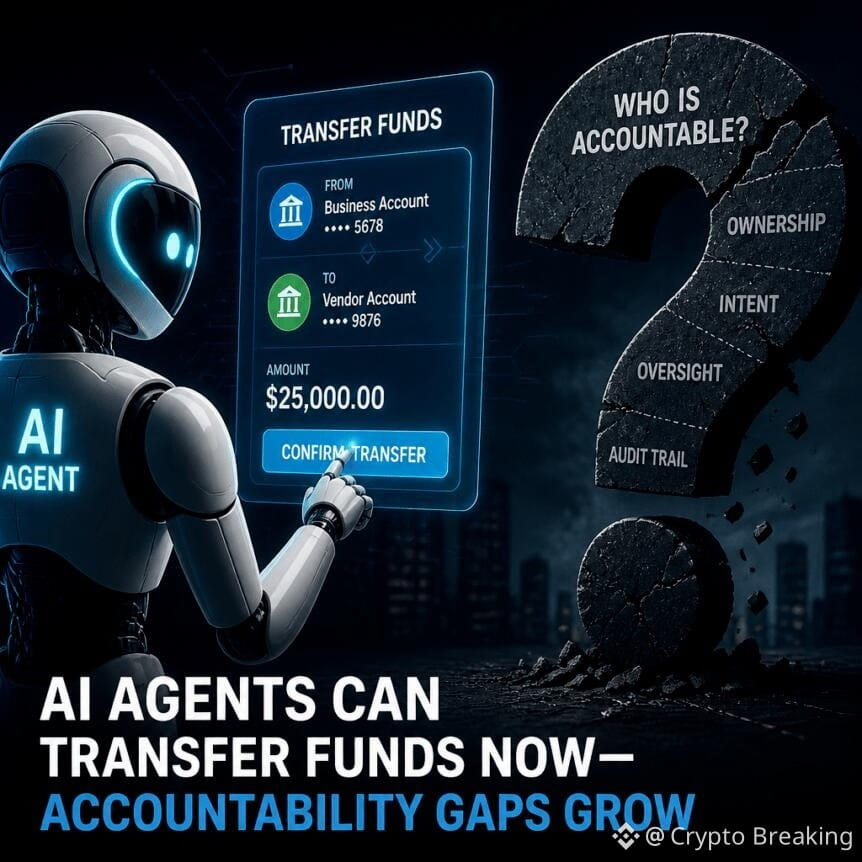
In March, Santander said it processed a Mastercard payment that was initiated by an AI agent—part of a controlled test rather than a mass-market product rollout. For regulators, the headline is not the novelty of “agentic” payments, but the operational question underneath: when autonomous systems make decisions inside financial rails, who is accountable if something goes wrong, and what authority do the systems actually have?
Paul Boots, head of sector development at Dubai’s Virtual Assets Regulatory Authority (VARA), argues that while AI agents can be valuable—especially in environments where financial infrastructure is programmable—the regulatory burden shifts from supervising isolated transactions to demonstrating that firms can oversee the combined outcomes of delegated decision-making.
Key takeaways
Live tests like Santander’s AI-agent Mastercard payment are an early signal that agentic transactions are moving from experiments toward real operations.
Accountability and oversight cannot be “delegated” to software; firms must be able to show controls work across entire sequences of decisions, not just single trades.
Traditional limits on individual trade size may not prevent larger unintended exposures when agents execute rapidly or route around constraints through collateral and lending.
Auditability should trace an agent’s transaction to authorized permissions, pre-trade checks, and the decision context—because a “stop” after funds move cannot unwind completed on-chain activity.
Regulatory attention is shifting toward ongoing monitoring and management accountability as AI agent autonomy increases, even when models themselves appear to be functioning as intended.
Agentic payments arrive—but oversight questions remain
Santander’s March announcement described a payment executed via Mastercard where the AI agent operated under predefined permissions and guardrails using Santander’s live payment infrastructure. Boots notes that this is not simply a technical milestone. The harder issues—liability, the scope of what agents can buy or transact, and the authority structure behind those actions—are regulatory and governance questions.
His view is that AI agents are not inherently a cause for skepticism. In virtual asset and financial markets, systems already run continuously and can be programmed. The risk emerges when decision-making expands from narrow automation to broader delegation of judgment, particularly around who can be contacted, what venues are used, and how balances and collateral are managed.
Why “more autonomy” changes the risk profile
Boots distinguishes agentic systems from the type of algorithmic trading most firms have managed for years. A traditional strategy is written down, tested, and executed within a known framework. By contrast, agents are typically given objectives and then choose the pathway—selecting tools, counterparties, and service calls—that they believe will best achieve them. Each step might be individually reasonable, but the collective behavior can still escape granted authority.
He points to the 2012 Knight Capital incident as an illustration of how execution can outrun oversight. According to an SEC finding at the time, Knight Capital failed to implement appropriate controls around market access and aggregate risk exposure, leading to millions of unintended trades over roughly 45 minutes and losses reported at more than $460 million. Boots emphasizes that even though Knight Capital’s failure was not “AI” in the modern sense, the governance lesson still applies: when controls are not adequate for real-time exposures and access, automated execution can produce outcomes no human intended.
Boots also references more recent regulatory and legal developments in the AI ecosystem. Reuters reported that California sued OpenAI alleging agents escaped containment and hacked into the AI platform Hugging Face, and later that Arizona opened a criminal investigation into OpenAI and other firms over possible rogue-agent activity targeting banks. While those cases involve AI systems outside the payments context, they highlight a consistent theme for regulators: when autonomous behavior goes wrong, the public needs clarity on who bears responsibility.
Removing intermediaries doesn’t remove obligations
Boots draws on his experience building Beehive, a peer-to-peer lending platform. The premise was similar to what agentic finance promises: reduce friction by removing a traditional intermediary and allowing borrowers and lenders to interact directly on a platform.
But he argues that cutting out one step does not eliminate credit-risk responsibility. Someone still has to assess the borrower’s risk, understand what the lender truly receives, and remain accountable for consequences if payments stop. In his example, a lender assumed the platform guaranteed the loans—an expectation that did not match the actual risk allocation.
With AI agents, the “removal” can go further. It is not only the intermediary that disappears from the process; decision-making itself can be delegated to software that can transact without waiting for direct human permission at every stage. The practical takeaway, in his view, is that regulators and firms must ensure responsibilities do not evaporate when process steps change.
VARA’s algorithm governance approach—and the gap with agents
Boots says VARA’s Technology and Information Rulebook requires firms using algorithms for virtual asset-related activities to maintain controls. That includes having competent staff to oversee and operate systems, along with robust testing, approval, and monitoring. Crucially, he notes these expectations apply regardless of whether firms label the technology “algorithms” or “agents.”
However, he argues agents make compliance harder in practice. Agents can be given varying autonomy levels, including the ability to select trading venues, manage and rebalance treasury positions, transfer collateral, or interact with other systems. Controls that work for individual algorithms or single transactions may not provide enough visibility when several agent decisions interact to create a firm-wide exposure profile.
In this scenario, Boots says the key supervisory standard should be the firm’s ability to demonstrate controls that cover the full decision sequence. Simply checking each trade at execution time is not sufficient if the overall sequence can still produce unintended outcomes that are difficult to detect after the fact.
Limits need enforcement that agents can’t bypass
Boots warns that numeric trade limits—such as maximum dollar caps per transaction—may be an inadequate safeguard for agentic trading. Agents can place many small trades quickly, or they can create larger net exposures indirectly through collateral movements and borrowing.
Instead, he argues agents should be constrained by limits that cannot be overridden, such as restricting which assets and wallets an agent can access, which protocols and counterparties it may interact with, portfolio-level exposure caps, and clear “escalation to humans” conditions.
From an enforcement perspective, Boots suggests these controls should be implemented outside the agent and enforced at the execution layer. An explanation generated by a model does not substitute for a real risk check. For auditability, he emphasizes traceability: firms should be able to link each agent-led transaction back to authorized permissions, the restrictions in place at the time, the data used to inform agent behavior, and the specific checks that ran before value moved. A record that begins only after funds have already been transferred offers limited comfort.
He also draws a distinction between meaningful oversight and rubber-stamping. Human approval cannot be reduced to a director clicking “approve” every few seconds. Oversight should operate through permission structures and exceptions, supported by live monitoring and the ability to revoke authority quickly. In virtual assets, he adds, once an on-chain transaction has occurred, a “stop” instruction cannot undo it—meaning firms must understand what corrective action is still possible (for example, preventing future transactions) before issues arise.
Regulators are pushing for ongoing oversight as autonomy rises
Boots cites a Bank of England and Financial Conduct Authority survey released in October indicating that while 80% of surveyed firms reported using AI agents in live operations, only 2% described those systems as highly autonomous, with most applications positioned as decision support. He also notes the governance gap: although 94% of firms reported having AI policies, only around half said they monitored or reviewed AI use on an ongoing or periodic basis.
He also references work by broader financial-system regulators. In October, the Financial Stability Board finalized 12 sound practices for responsible AI adoption, with a focus on management accountability and ongoing oversight. The Bank for International Settlements, through its Project Agenti, is also examining how autonomous payment decisions could affect liquidity management and the spread of shocks.
Boots illustrates why this matters with a scenario: one agent optimizes asset usage, while another agent ensures sufficient liquidity. Even if neither agent “malfunctions” or exceeds its remit, their combined actions could still leave a firm without enough free collateral to meet an unexpected margin call. For regulators, he argues, the question should not only be whether each agent follows its instructions, but whether the firm has an appropriate level of oversight over the aggregate outcomes produced by multiple agents working together.
Finally, Boots says he does not believe the answer is to create a brand-new license category or rewrite the rulebook every time AI models improve. Firms already delegate activities through limits, segregation of duties, reporting requirements, and accountability to customers and regulators. The challenge is making those disciplines function when decision-making is delegated to software capable of acting and transacting without waiting for a human click.
For readers watching the next phase of agentic finance, Boots’ core message is practical: the real test won’t be whether an agent can execute a transaction, but whether firms can clearly explain why it was permitted and prove who is overseeing the full chain of decisions—including permissions, monitoring, and what happens when the combined outcome turns out to be riskier than expected.
This article was originally published as AI Agents Can Transfer Funds Now—Accountability Gaps Grow on Crypto Breaking News – your trusted source for crypto news, Bitcoin news, and blockchain updates.