
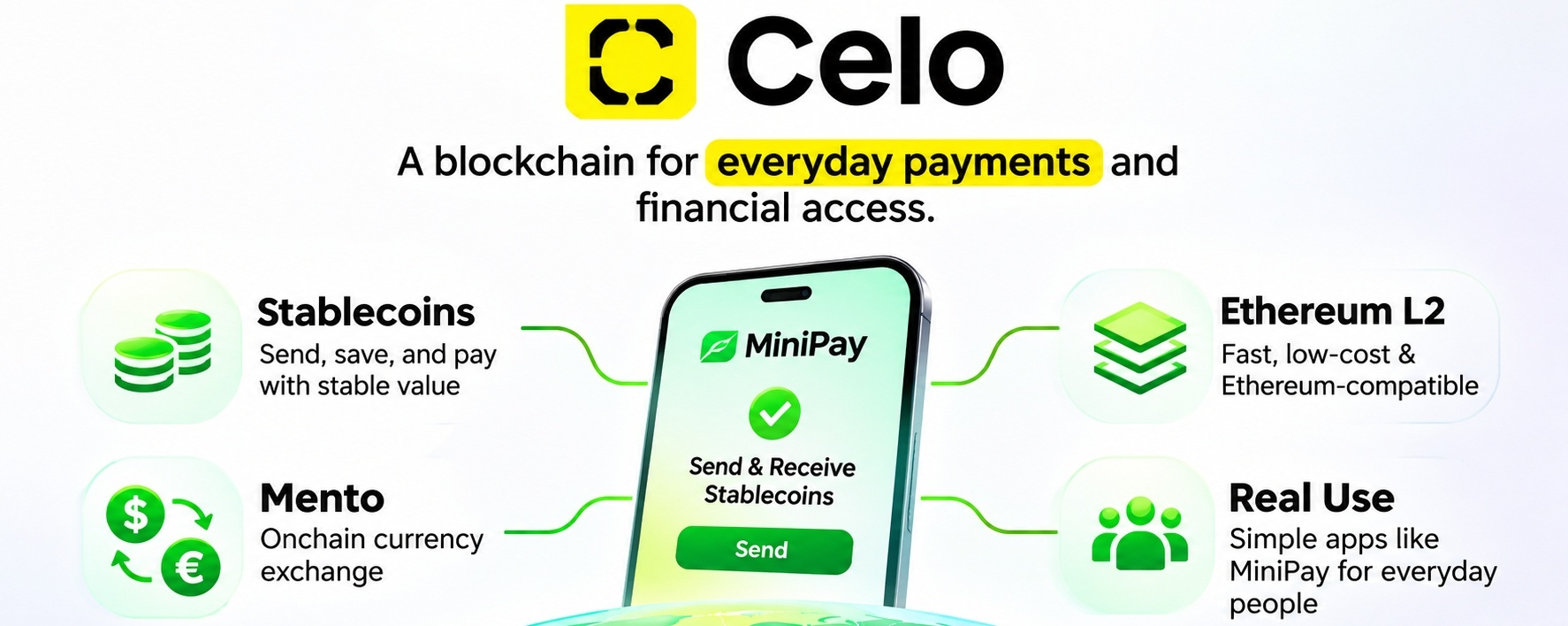


The cryptocurrency world is full of projects promising to change the future, but what really matters is whether that technology can make people's lives easier. Celo is one project trying to turn that idea into reality by focusing on something everyone understands: money.
Sending money, receiving payments, and accessing financial services should not be difficult. Yet, for millions of people, traditional financial systems still come with high fees, limited access, and unnecessary complications.
Celo wants to help change that.
Its vision is to make financial services more accessible through blockchain technology, mobile applications, and stablecoins. Instead of building technology that only experienced crypto users can understand, Celo is working toward an ecosystem that ordinary people can use in their everyday lives.
How Celo Started and Where It Is Going
Celo launched in 2020 with a simple but meaningful goal: making financial tools available to more people, regardless of where they live or how much money they have.
From the beginning, the project focused on mobile accessibility. The team understood that smartphones were becoming one of the easiest ways for people to access digital services, especially in regions where traditional banking was not always convenient.
As blockchain technology developed, Celo also evolved.
One of its biggest milestones came in March 2025, when it moved from an independent Layer 1 blockchain to an Ethereum Layer 2 network.
This transition connected Celo more closely with Ethereum while giving developers an opportunity to build affordable and accessible applications.
It was an important step because the project could continue working toward its original mission while benefiting from a much larger blockchain ecosystem.
Why Celo Is Paying So Much Attention to Stablecoins
Stablecoins are a major part of Celo's ecosystem, and there is a good reason for that.
People do not always need another volatile cryptocurrency. Sometimes they simply need a convenient way to send money, receive payments, or hold digital value without dealing with constant price movements.
That is where stablecoins become useful.
Celo supports stablecoin activity through assets such as USDC and USDT, along with other digital currencies connected to different markets.
What makes this approach interesting is its attention to local currencies.
Financial needs are different around the world. Someone in Brazil, Nigeria, Kenya, or the Philippines may have very different requirements when sending or receiving money.
Celo wants to support a financial environment where people can interact with digital currencies that are relevant to their local economies.
This could make blockchain payments more practical for individuals, freelancers, families, and businesses.
Mento: Making Currency Exchange More Accessible
Another important part of the Celo ecosystem is Mento.
Mento focuses on decentralized stablecoins and onchain foreign exchange. Its goal is to make supported digital currencies and currency markets easier to access through blockchain infrastructure.
Think about a freelancer working with international clients. Receiving money from another country can sometimes involve multiple services, conversion fees, and delays.
Or consider a small business that needs to pay suppliers in another currency.
These are everyday financial situations, but traditional systems do not always make them simple.
Mento is exploring how blockchain-based currency markets can provide another option.
Its role is important because Celo is not only interested in digital dollar payments. It also wants to help connect different currencies through a more accessible financial infrastructure.
MiniPay: Bringing Crypto Closer to Ordinary People
One of the most interesting developments in Celo's ecosystem is MiniPay.
Developed by Opera in collaboration with the Celo ecosystem, MiniPay is a mobile wallet designed to make stablecoin payments easier.
For someone who has never used cryptocurrency, traditional wallets can feel confusing. There are unfamiliar networks, transaction fees, recovery phrases, and technical details that can discourage beginners.
MiniPay takes a more straightforward approach.
Its purpose is to make sending and receiving digital money feel simple through a mobile-friendly experience.
This is important because blockchain adoption cannot grow only by attracting people who already understand cryptocurrency.
It also needs products that make sense to someone using digital money for the first time.
MiniPay gives Celo an opportunity to reach a much wider audience through everyday smartphone use.
Its growing presence also shows why partnerships and distribution matter just as much as blockchain technology itself.
Why the Ethereum Layer 2 Transition Matters
Moving to Ethereum Layer 2 was a major decision for Celo.
Ethereum has a large developer community and an established ecosystem of decentralized applications. By adopting the OP Stack, Celo gained a foundation that connects it more closely with this environment.
But there is another important reason behind the transition: affordability.
Imagine making several small payments throughout the day. If every transaction comes with a high fee, using blockchain for everyday purchases becomes inconvenient.
Celo is designed to make these interactions more affordable.
The network also supports fee abstraction, which allows users to pay transaction fees with supported tokens instead of always needing CELO.
Small improvements like this can make a big difference for people who are new to blockchain technology.
Understanding the CELO Token
CELO is the native token of the Celo network.
It is connected to several important parts of the ecosystem, including staking, governance, and transaction fees.
The token also plays a role in the network's economic structure and community decision-making.
One thing worth understanding is that a growing blockchain ecosystem does not automatically mean its native token will increase in value.
Real adoption, network revenue, token demand, governance decisions, and the broader cryptocurrency market all matter.
Celo's long-term development will therefore depend on more than attracting users. It will also need a sustainable economic model that connects network activity with the value and utility of its ecosystem.
More Than Payments: Celo's DeFi Ecosystem
Celo is also developing opportunities in decentralized finance.
DeFi gives users access to financial services through blockchain-based applications. These services can include lending, borrowing, trading, and providing liquidity.
This creates additional possibilities for people who hold stablecoins or other digital assets.
Ethereum compatibility also gives Celo opportunities to connect with established applications and attract developers who are already familiar with Ethereum technology.
The bigger picture is that Celo wants to build an ecosystem where people can do more than simply transfer money.
They should also have access to different financial services through the same broader blockchain environment.
Of course, decentralized finance comes with risks, including smart-contract vulnerabilities, liquidity issues, and market volatility.
The Growing Interest in Onchain Foreign Exchange
Celo's recent FX Alliance initiative adds another interesting direction to its development.
The initiative brings together participants from different areas of the stablecoin and payments industries to support onchain foreign-exchange markets.
Why does this matter?
Because moving money between currencies is still a challenge for many individuals and businesses.
A company receiving payments in one currency may need to pay expenses in another. A person working internationally may need access to a convenient way to convert digital money.
Onchain foreign exchange could help make these processes more accessible.
The FX Alliance reflects Celo's ambition to connect different currency markets rather than focusing only on one type of digital asset.
Its success will depend on whether these markets attract enough liquidity, reliable partners, and real users.
What Makes Celo Different?
There are many blockchain networks competing for attention, but Celo has developed a relatively clear identity.
It is focused on practical financial use cases.
Its technology, partnerships, and applications are connected to one broader idea: making digital money easier to access and use.
MiniPay focuses on the user experience. Mento works on currency infrastructure. Stablecoins provide a practical way to move digital value. DeFi applications introduce additional financial services, while the Ethereum Layer 2 architecture provides the foundation connecting these pieces.
This combination gives Celo an interesting position in the blockchain industry.
However, the competition is strong. Other networks are also improving their payment systems, transaction costs, and developer tools.
Celo will need to keep building useful products and attracting people who genuinely want to use them.
What Could the Future Hold?
There are several areas worth watching as Celo continues to develop.
Stablecoin adoption could create more opportunities for everyday digital payments.
MiniPay could bring blockchain-based financial services to more smartphone users.
Mento could help expand access to local-currency markets.
The FX Alliance could support deeper connections between different digital currencies.
Meanwhile, improvements in DeFi and payment infrastructure could make the ecosystem more useful for developers, businesses, and individuals.
These are opportunities rather than guaranteed outcomes. Long-term success will depend on execution, security, regulation, liquidity, and actual demand.
Final Thoughts
What makes Celo interesting is that its story is not just about another blockchain competing for attention.
It is about a practical problem that exists around the world: accessing and moving money should be easier.
The project has spent years developing infrastructure, partnerships, and applications around this idea. Its transition to Ethereum Layer 2, its focus on stablecoins, and the growth of MiniPay show how its vision continues to evolve.
There is still a lot of work ahead. Building a reliable global financial ecosystem takes time, and competition will continue to challenge the project.
But Celo is working toward something worth paying attention to.
A future where sending money does not feel complicated, where digital payments are accessible through a smartphone, and where financial services are not restricted by geographical boundaries.
That is the bigger idea behind Celo, and its progress over the coming years will show how far this vision can go.