Washington moved the bitcoin reserve debate from executive order to statute this week — and the market barely noticed.
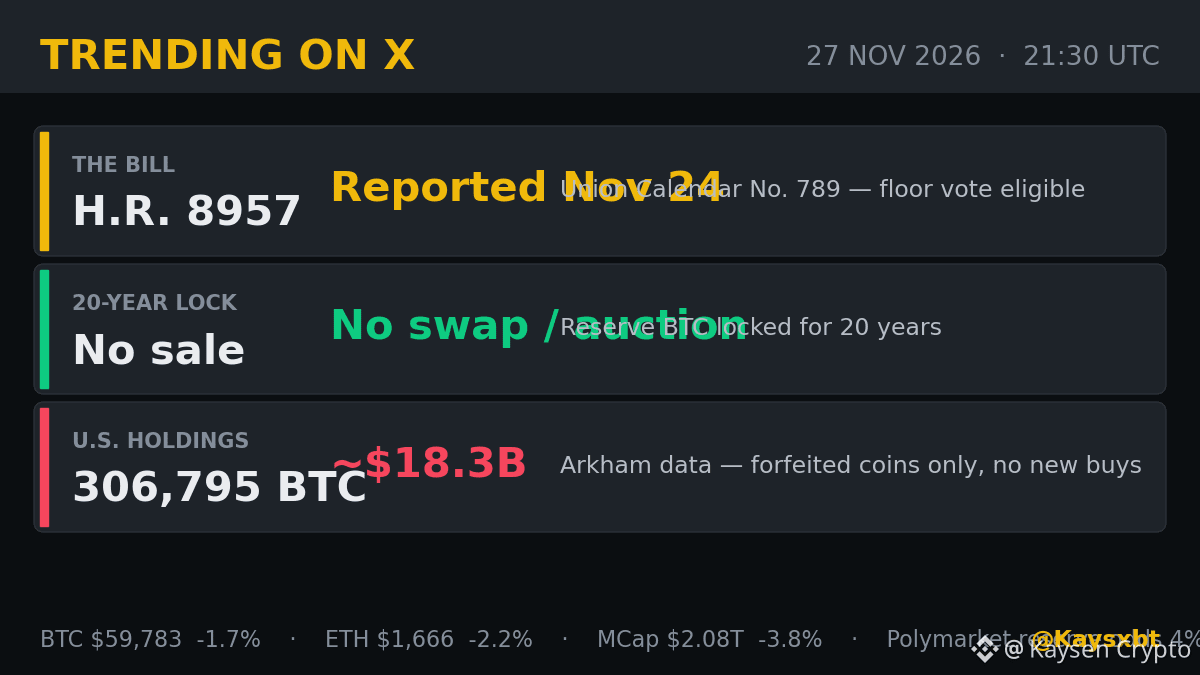
On Nov 24, the House Financial Services Committee formally reported H.R. 8957, the American Reserve Modernization Act of 2026, placing it on the Union Calendar (No. 789) and making it eligible for a floor vote. Treasury would have 180 days to set up the reserve and a separate Digital Asset Stockpile.
The headline provision is a 20-year lock-up: reserve bitcoin could not be sold, swapped, auctioned or encumbered for two decades. After that, Treasury could recommend selling up to 10% in any two-year period.
The reported text authorises no new purchases — no borrowing, no collateralised buying, no deficit spending. The reserve would be built from bitcoin the government already holds: about 306,795 BTC, worth ~$18.3 billion at current prices (Arkham). The earlier idea of budget-neutral purchases using Federal Reserve resources was stripped out.
That explains the muted response. $BTC traded at $59,783 at publication, down 1.7% in 24 hours; total market capitalisation was $2.08 trillion, down 3.8%. Traders are pricing a bill that changes the legal status of existing holdings, not one that adds a buyer. Polymarket puts the odds of a national reserve by year-end at 4%, down from 60% a year ago.
The clock is also tight: the current Congress ends Jan 3, leaving just over five weeks for a House vote, Senate action and a signature.
What to watch: whether House leadership schedules a floor vote before adjournment. A vote would turn a symbolic reserve into codified law a future administration could not unwind by executive order alone.
Does a 20-year federal lock-up change how you value bitcoin's supply overhang, or is this a non-event until the government actually buys?
Sources: CoinDesk, Bitcoin Magazine, The Block via TradingView, Arkham (via CoinDesk), CoinGecko (prices, 21:30 UTC 27 Nov 2026).
#Bitcoin #BTC #CryptoPolicy #Macro