


Bangkok Is Rewriting Finance's Rulebook While the Ink Is Still Wet || #EvolveAtBinanceBlockchainWeek
Executive Summary
Binance Blockchain Week Bangkok 2026 is built around one theme, Evolve, and one central argument: traditional finance and blockchain are converging, markets that once ran on business hours are becoming global and always-on, and AI is changing how people move, manage and grow their money.
I've spent several days reading the agenda session by session, along with the regulatory developments unfolding in Thailand at the same time. In this article I'll cover what the event is, which sessions matter most, where I think the real substance sits, and where I'd stay cautious. I'll also translate the key themes for newcomers, since making this space accessible is the reason I write.
Event Overview
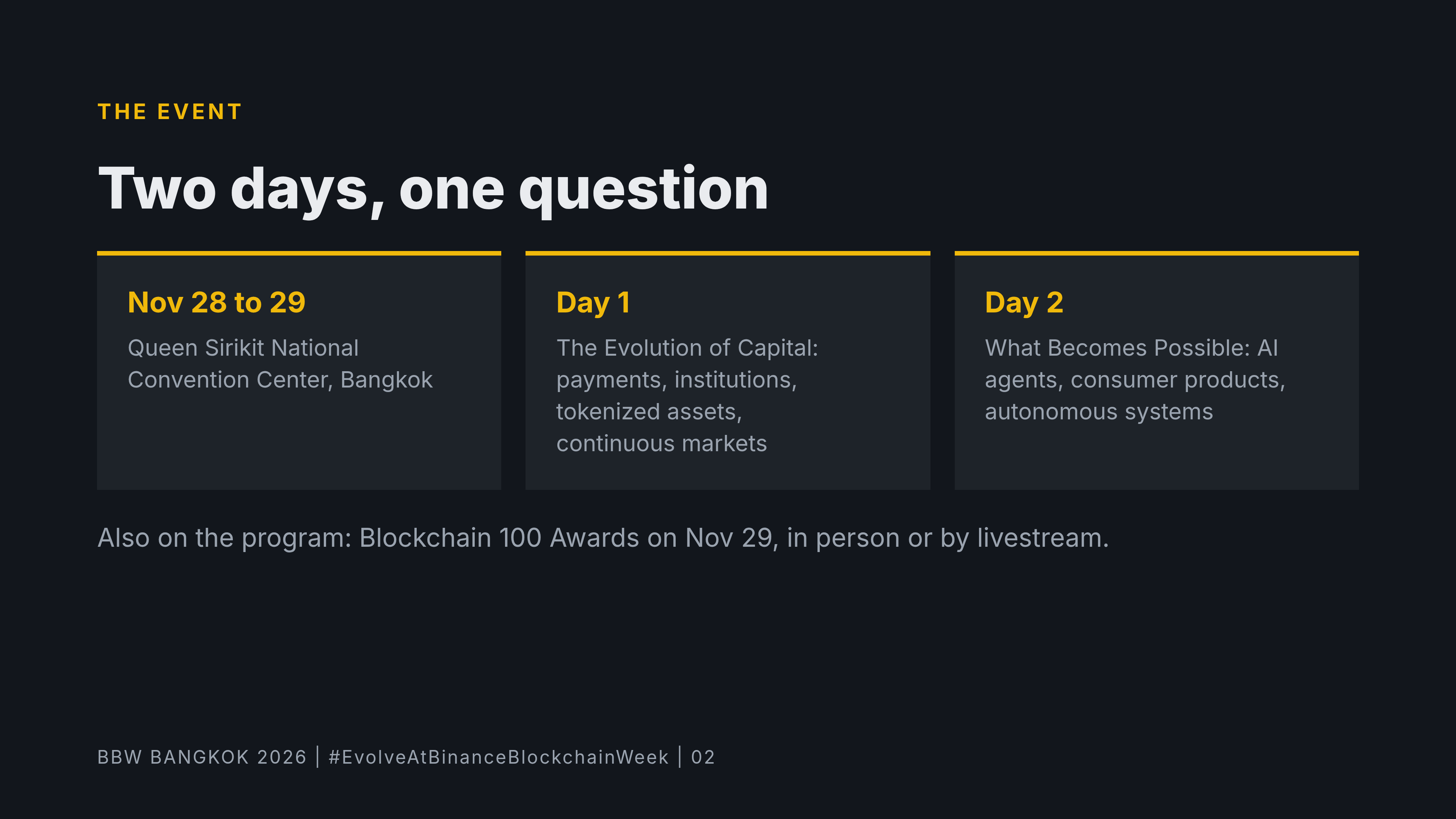
-Dates:November 28 and 29, 2026
-Venue:Queen Sirikit National Convention Center, Bangkok
-Local partner:Binance TH
-Theme:EVOLVE
-Day 1:"The Evolution of Capital," covering payments, institutional adoption, tokenized assets and continuous markets
-Day 2:"What Becomes Possible," covering AI agents, consumer products and autonomous systems
- Also on the program:the Blockchain 100 Awards on November 29, with participation available in person or by livestream
Why Asia Is the Real Story
 Binance describes this as the first time its flagship Blockchain Week is held in Asia, although other coverage refers to an earlier Singapore edition, so I'd treat that "first" with some caution. Previous editions have taken place in Singapore, Istanbul, Paris and Dubai. The same coverage describes Blockchain Week as the flagship among roughly 1,500 events Binance runs worldwide.
Richard Teng presents Asia as the epicenter where the next wave of convergence between traditional finance and digital assets is being built and deployed at scale. He also argues that regulatory innovation is no longer confined to traditional financial centres, and that emerging jurisdictions are increasingly shaping the future of digital finance.
I think that observation holds up, and the reasons are practical:
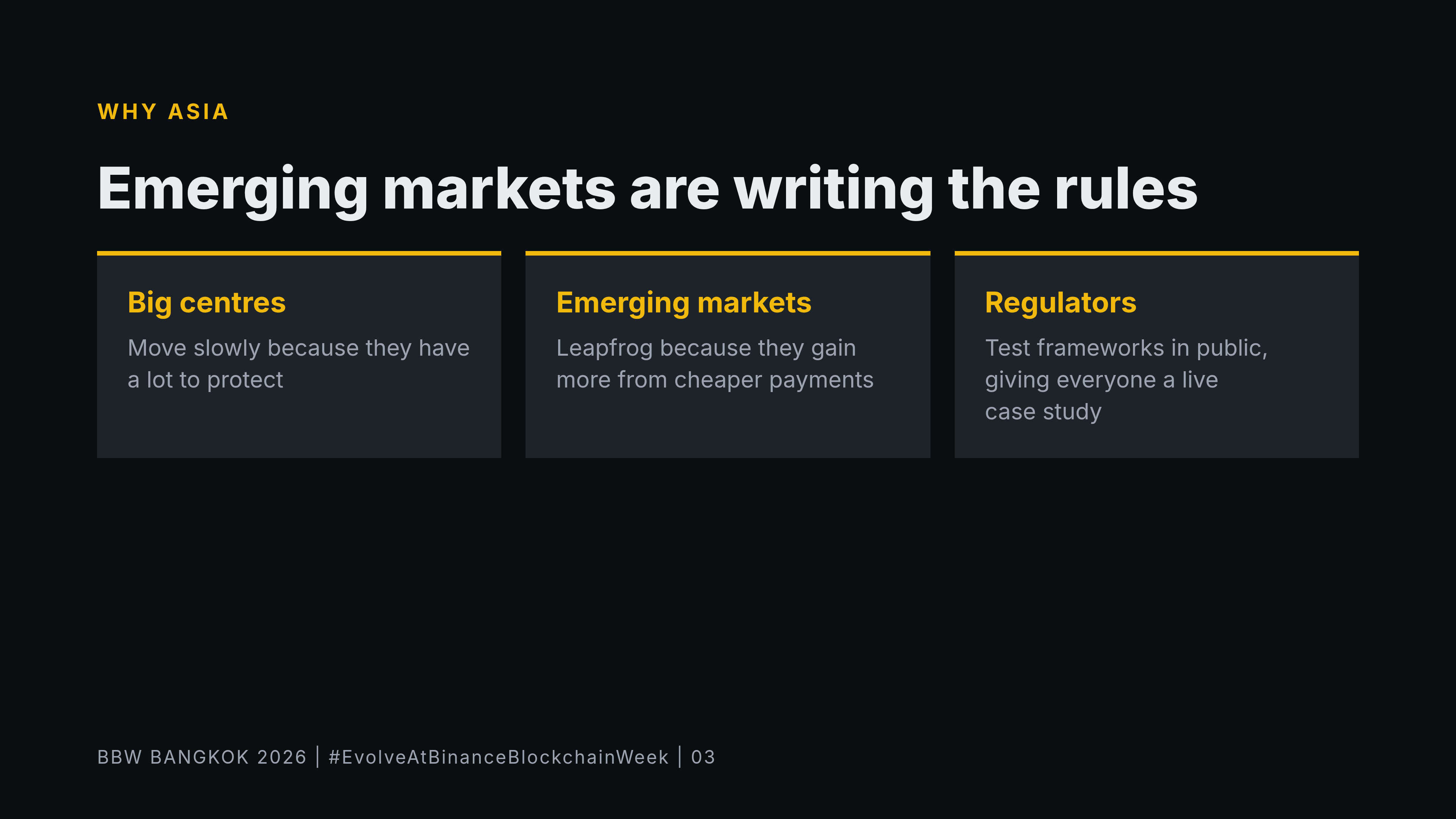
- Established financial centres tend to move slowly because they have a great deal to protect
- Emerging markets often leapfrog legacy systems because they have more to gain from cheaper payments and wider access
- Regulators in these jurisdictions are testing frameworks in public, which gives the rest of the industry a live case study of what works and what doesn't
Bangkok is therefore more than a backdrop. It's a market in the middle of writing its own digital asset rules while the world's largest exchange hosts its flagship conference there.
Regulatory Context: Thailand's Stablecoin Framework Is Still in Draft
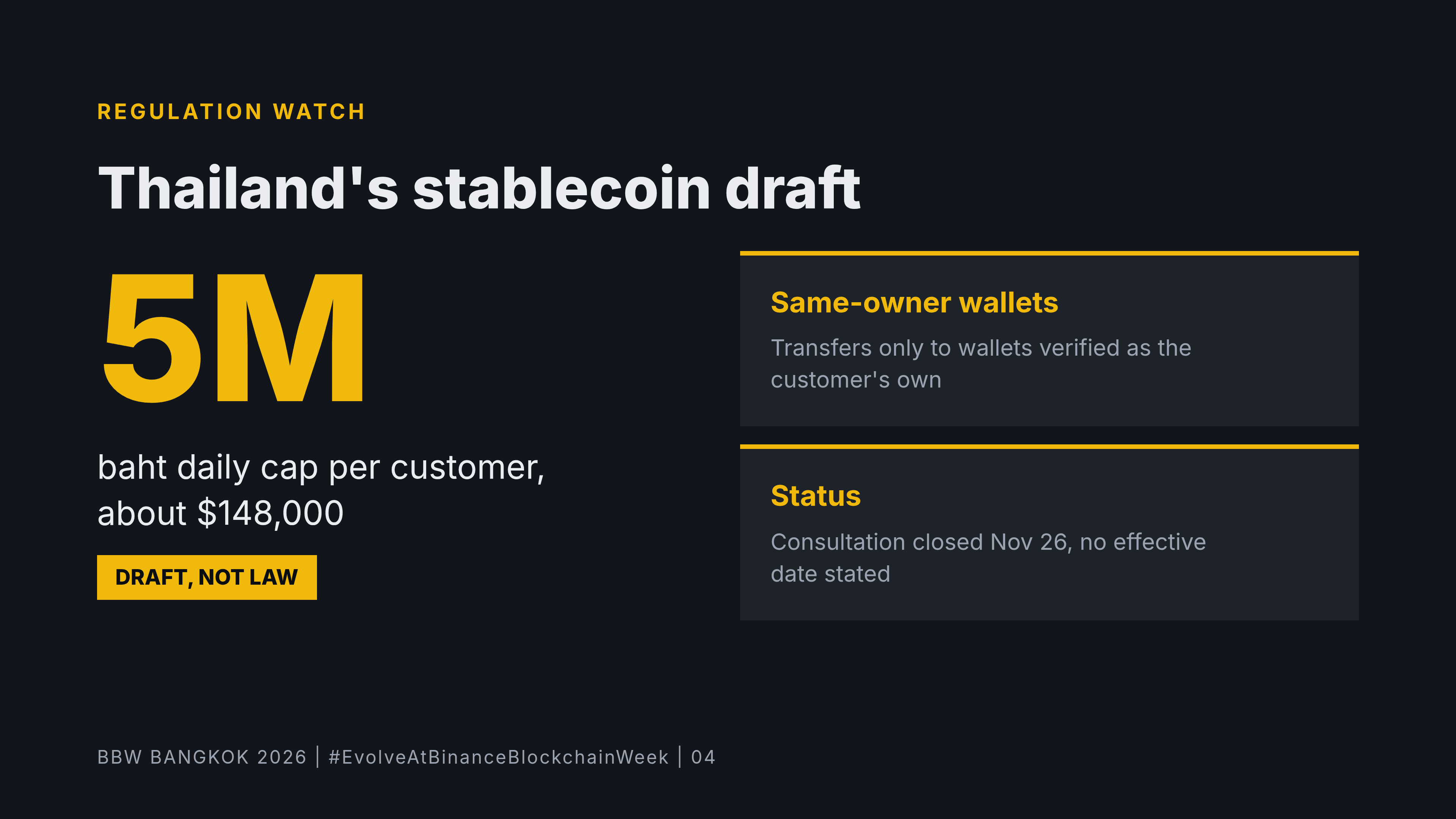 Two weeks before the conference, Thailand's SEC published draft rules for stablecoin activity. In my view this is the most important context for the entire event, and it receives far less attention than the speaker lineup. The proposal includes:
A daily cap of 5 million baht, roughly $148,000, per customer
Transfers permitted only between licensed platforms and wallets verified as the customer's own, which would block transfers to or from third-party accounts
A 3-million-baht minimum for off-platform transactions, together with public price disclosure requirements
A stated purpose of preventing stablecoins from being used for money laundering, cybercrime and circumvention of international money transfer rules
The draft sits within a broader sequence. It follows a September public hearing and builds on Travel Rule wallet-verification requirements adopted that same month, reportedly taking effect in February 2027. The consultation closed on 26 November 2026, and no effective date has been stated. For that reason I'd describe these measures as proposals rather than settled law. The central bank is also running a parallel track, having proposed a licensing framework for baht-denominated stablecoins.
The main stage reflects this directly. One session asks whether stablecoins are the future of payments or simply the rails, and it features a Thai Member of Parliament and Deputy Leader for Economic Affairs of the Democrat Party, alongside Tether, Visa, Celo and United Stables. An issuer, a card network, a payments chain and a policymaker in one room, while the host country's rulebook is still unfinished, makes for unusually well-timed programming.
My Assessment of the Proposed Caps
The proposal has genuine strengths and genuine weaknesses, and I think both deserve to be stated plainly.
- Strength: Same-owner wallet verification makes it harder for scam networks to cash out through licensed exchanges
- Concern: Hard caps and strict wallet rules add friction for legitimate users, including freelancers and small businesses who rely on stablecoins because traditional banking is slow or costly
- Open question: The rules would not apply when people send crypto directly to one another without a licensed platform, so determined bad actors may route around them while ordinary users absorb the inconvenience
This is the classic regulatory trade-off between protection and usability. I'll be watching whether speakers address it directly instead of simply endorsing "clear standards."
Capital Markets: Wall Street Joins the Conversation on 24/7 Trading
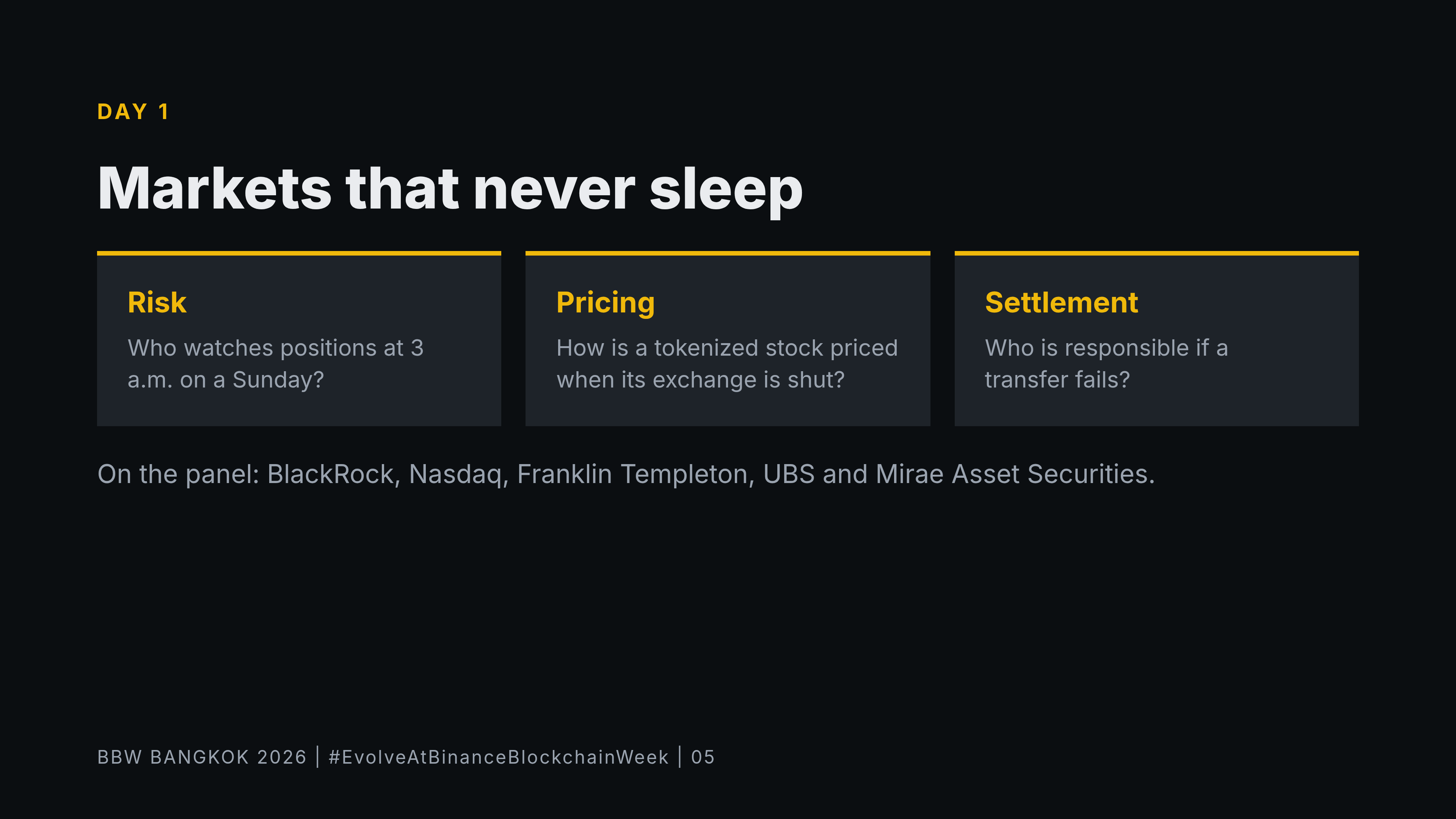
For years, a common observation in crypto was that Bitcoin trades on Sunday while equity markets do not. The agenda now includes executives from BlackRock, Nasdaq, Franklin Templeton, UBS and Mirae Asset Securities discussing infrastructure and business models for capital markets operating outside traditional hours.
That changes the nature of the debate. The question is no longer whether traditional finance will take crypto seriously. It's how to staff, price and settle a market that never closes. Each of those carries real operational weight:
Risk oversight:Who monitors positions and liquidity during weekends and overnight hours
Price discovery:How a tokenized equity should be priced when its underlying exchange is closed
Settlement:How quickly value actually moves, and who is responsible if a transaction fails
Closely related is the tokenization session, which brings together FTSE Russell, CSOP Hong Kong, DBS Bank, KGI Financial and Ondo Finance to discuss moving real-world asset tokenization from pilot programs to liquid, institutional-scale markets. The emphasis on pilots is telling. The industry has produced many of them, and liquidity remains the unresolved challenge. A tokenized asset that can't be traded efficiently offers limited practical value. Background coverage of the event also notes that the legal structure and holder rights of tokenized stocks can differ sharply by jurisdiction, and I'd encourage every retail participant to read the terms carefully before buying anything labelled tokenized.
Emerging Markets: Where Crypto Is Actually Used
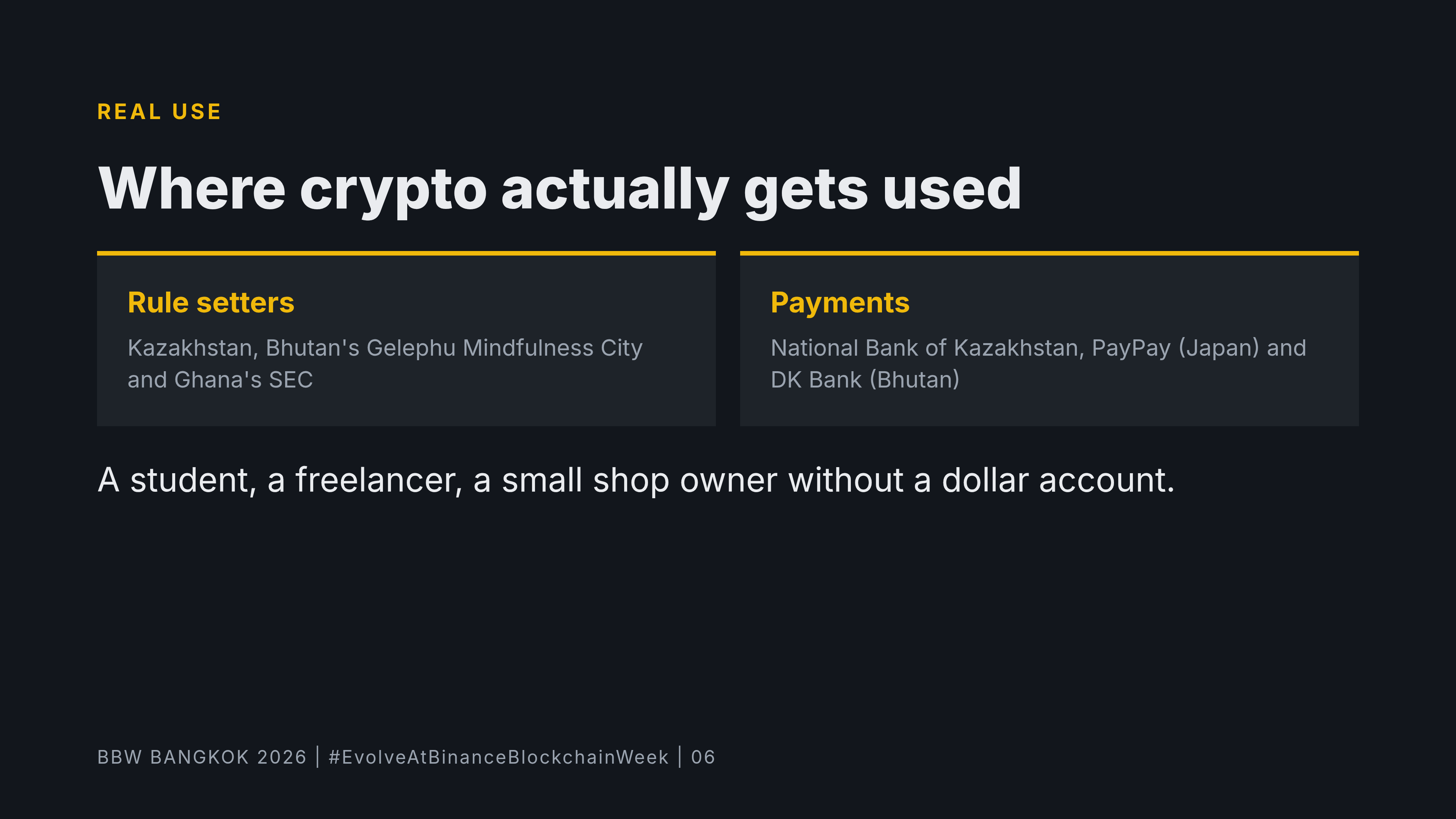 One feature of this lineup I particularly value is the strong presence of government and payments voices from outside the traditional financial centres:
-Who sets the rules for new financial capitals: Kazakhstan's Vice Minister of AI and Digital Development, a growth lead from Gelephu Mindfulness City in Bhutan, and the Deputy Director General of Ghana's SEC
-Where crypto delivers in real payments:the Deputy Governor of the National Bank of Kazakhstan, alongside payment providers from Japan (PayPay) and Bhutan (DK Bank)
I'm based in Pakistan, so this part resonates with me directly. Adoption is often pictured through the lens of institutional funds and ETF flows, but the people with the most immediate need for cheaper cross-border payments are in places like Ghana, Kazakhstan and South Asia. A student receiving support from abroad, a freelancer paid by an overseas client, a small business owner who can't easily open a dollar account: these are the real use cases. This agenda reflects that map more accurately than most conference programs I've reviewed.
Security and Compliance
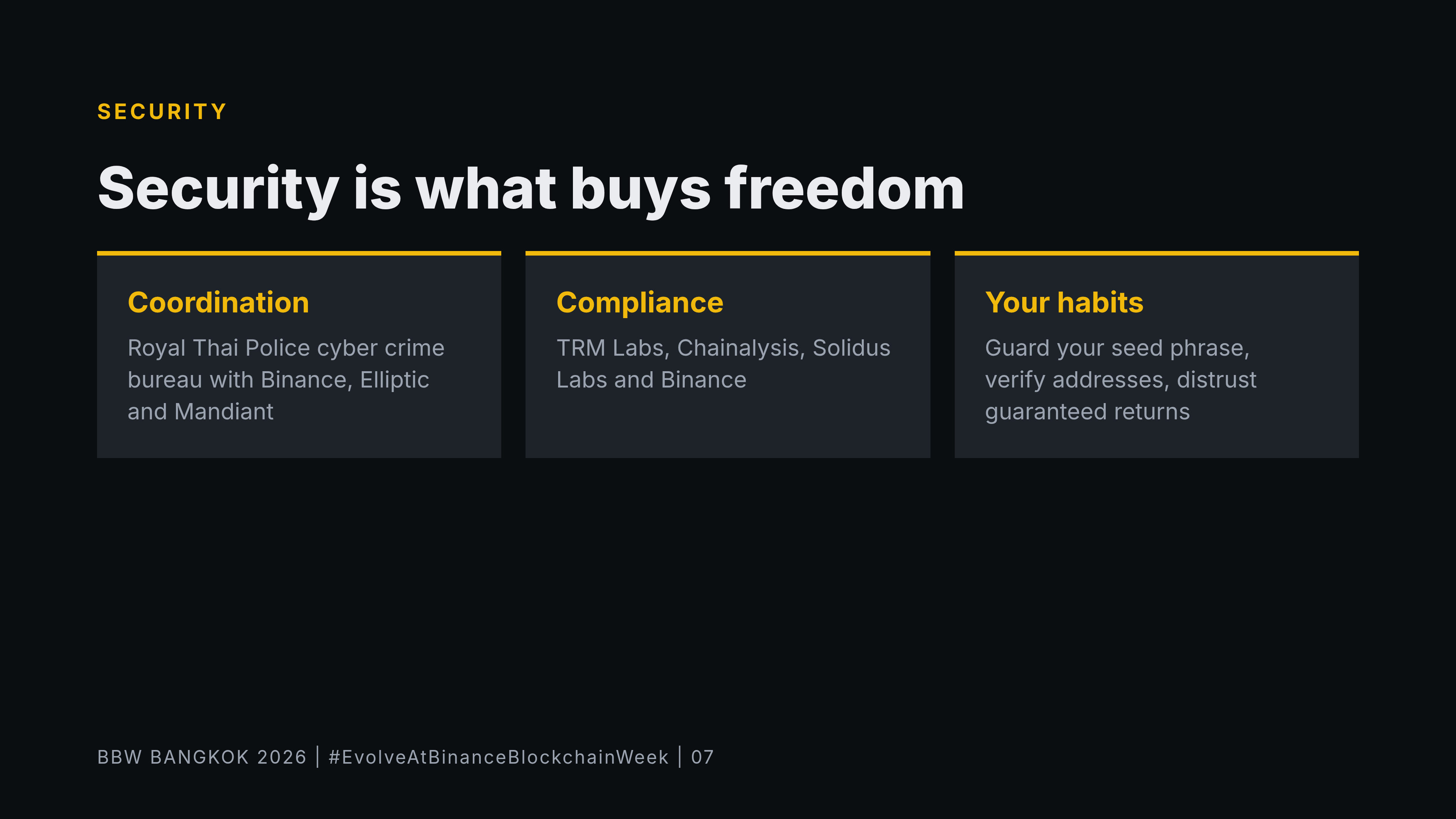
Two sessions stood out in this area:
- A security panel pairing an officer from the Royal Thai Police Cyber Crime Investigation Bureau with Binance, Elliptic and Mandiant on cross-industry cybersecurity coordination
- A compliance session featuring TRM Labs, Chainalysis, Solidus Labs and Binance on how financial crime prevention can evolve for borderless transactions
I used to view compliance discussions as a secondary topic. I no longer do. Nearly every rule being drafted worldwide, Thailand's included, is a response to scams and money laundering. If investigators, analytics providers and exchanges can demonstrate genuine coordination, regulators have less justification for blunt instruments such as hard transfer caps. In that sense, strong security isn't the opposite of financial freedom. It's the foundation that makes it sustainable.
For individual users, the practical lesson is straightforward. The most common way people lose money in this industry is still fraud, not market volatility. Safeguard your recovery phrase, verify every wallet address before sending, and treat any promise of guaranteed returns as a warning sign regardless of how professional it appears.
Day Two: AI, Agents and the Limits of Automation
Yi He opens Day 2 by outlining Binance's evolution toward a comprehensive financial platform, which analysts interpret as a move toward a "financial super app" bridging traditional finance and digital assets. Binance describes serving more than 300 million users across 100+ countries, so the scale of that ambition is considerable.
The sessions I'd prioritize include:
Agentic AI in finance: Prof. Hongxia Yang of PolyU and Jeff Li of Binance on automating workflows and unlocking new efficiencies
AI and macro conditions:Arthur Hayes on how AI compute demand and macro conditions are creating dynamics that current valuations may not reflect
Pre-IPO perpetuals:analysts from Kaiko, DeFi Llama, CoinDesk and CoinMarketCap on an emerging product category
DeFi infrastructure: BNB Chain, Pyth Network, RedStone and Babylon on price feeds, verifiable data and Bitcoin staking
Ecosystem direction: Justin Sun in a fireside conversation with Felix Fan, CEO of Trust Wallet
Humanitarian applications: UNICEF, Prosper Global and Fortune Credit on tracking and distributing aid
Education and adoption: Guy Turner of Coin Bureau, Lea Thompson of Girl Gone Crypto and Dr. Udomsak Rakwongwan on what is and isn't working
Where I Remain Cautious
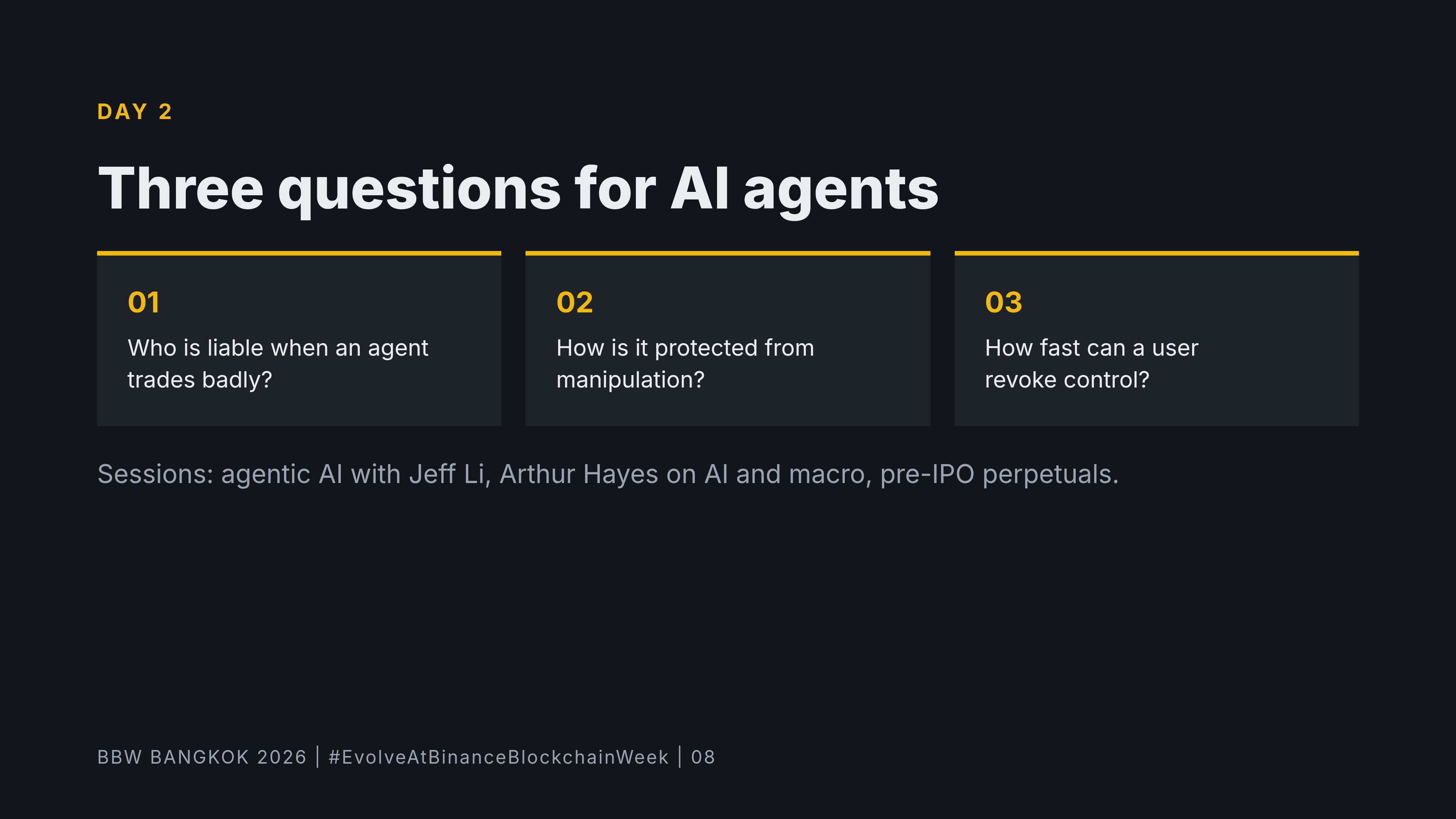
The idea that AI agents will manage personal finances is easy to present and difficult to implement safely. Before I'd endorse it, I'd want clear answers to a few questions:
- Who bears responsibility when an agent executes a poor trade on a user's behalf
- How agents are protected against manipulation through malicious prompts or fraudulent website
- How much authority a user should delegate, and how quickly they can revoke it
I don't expect one panel to resolve these, but I'd value seeing them addressed honestly. The humanitarian session interests me for a different reason. Tracking where donated funds actually go is a problem blockchains may be genuinely well suited to, and it asks the technology to prove its worth beyond speculation.
What This Means for Newcomers
 My goal as a creator is to make this industry reachable for people starting with little capital or technical background, particularly women who've often been told the space is too complex or too risky. Here is my practical translation of the week's themes:
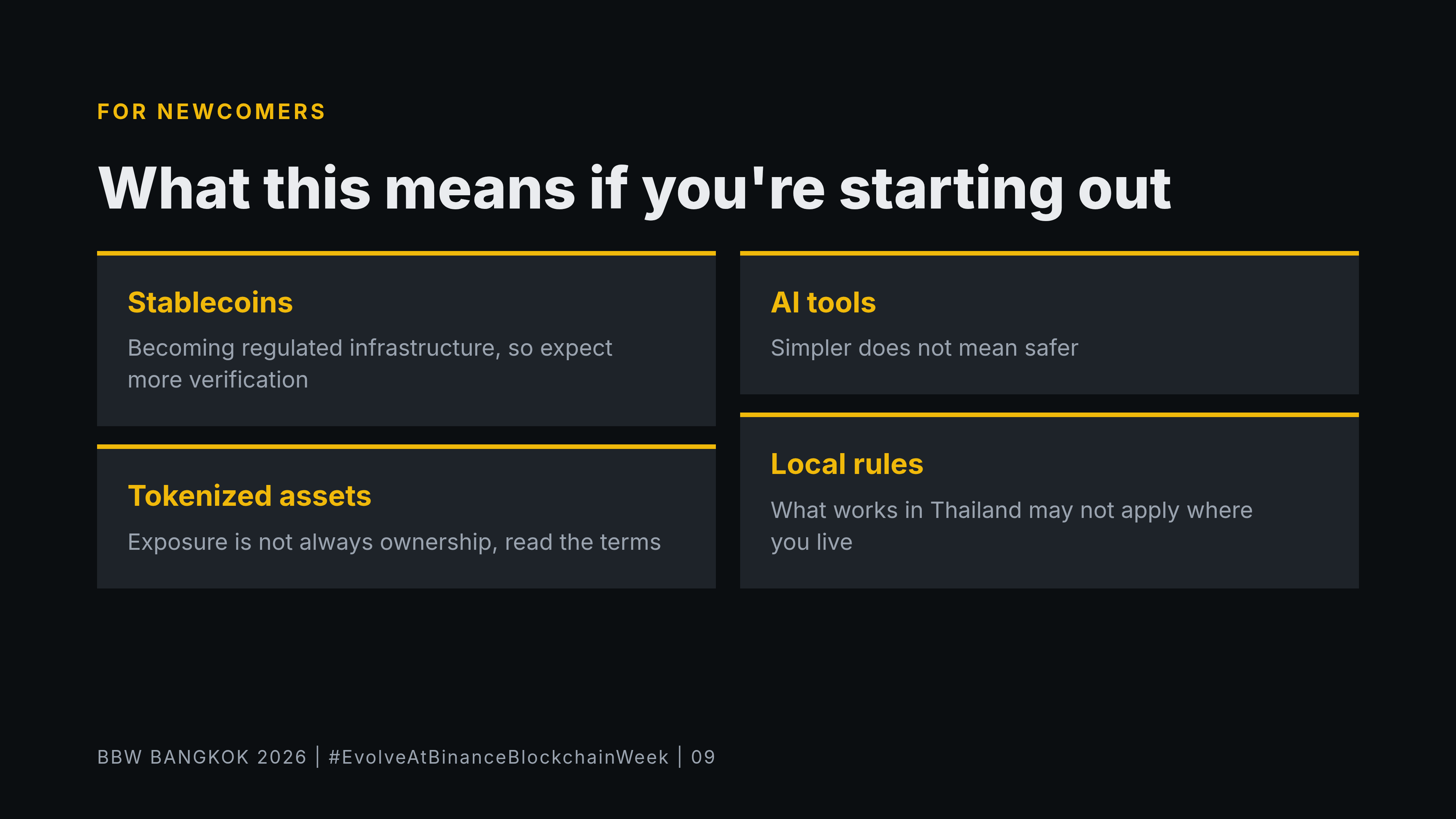
Stablecoins are becoming regulated infrastructure: Expect more verification, limits and documentation on licensed platforms. That adds friction, but it also reduces the room scammers have to operate
Tokenized assets are advancing, but terms matter: Exposure to a stock isn't always equivalent to owning it
AI will make financial tools feel simpler:Simpler doesn't mean safer, so continue building your fundamentals
Security is a skill, not an afterthought: A strong portfolio means little if the account is compromised
Local rules apply to you: Regulations vary widely, and what is permitted in Thailand may not be permitted where you live
Evaluation Framework for the Weekend
I'll be assessing the event against a short set of criteria:
- Whether the 24/7 market discussion includes concrete settlement and risk detail
- Whether the Thailand stablecoin debate acknowledges the trade-off between safety and usability
- Whether claims about AI agents come with clear answers on accountability
- Whether tokenization panels address liquidity and investor rights, not only product launches
- Whether regulators on stage are meaningfully questioned, not simply thanked
Beneath the branding, BBW Bangkok is asking one question from many angles: what happens when finance stops closing, stops being local, and begins to be run partly by software? The answers will come from regulators and payment providers as much as from exchanges, which is why I consider Evolve a stronger theme than it first appears.
A conference is a showcase, however, and a confident panel isn't a shipped product. Event momentum can influence short-term sentiment, but it shouldn't be treated as a trading signal. What I'll actually track in the coming months is whether this week's announcements turn into live products, licences and finalized rules.
I'll be following the sessions closely. Tell me which one you're watching and what question you'd want put to the speakers. Share it in the comments.
@Binance Blockchain Week Hope you will gonna Love the BBW research for this article.
#EvolveAtBinanceBlockchainWeek @CZ @Richard Teng @Yi He @Binance Angels @Binance Square Official
"Disclaimer: This article is for educational purposes only and does not constitute financial advice. Digital assets are volatile, and regulations differ by jurisdiction. Please conduct your own research before making any decisions."