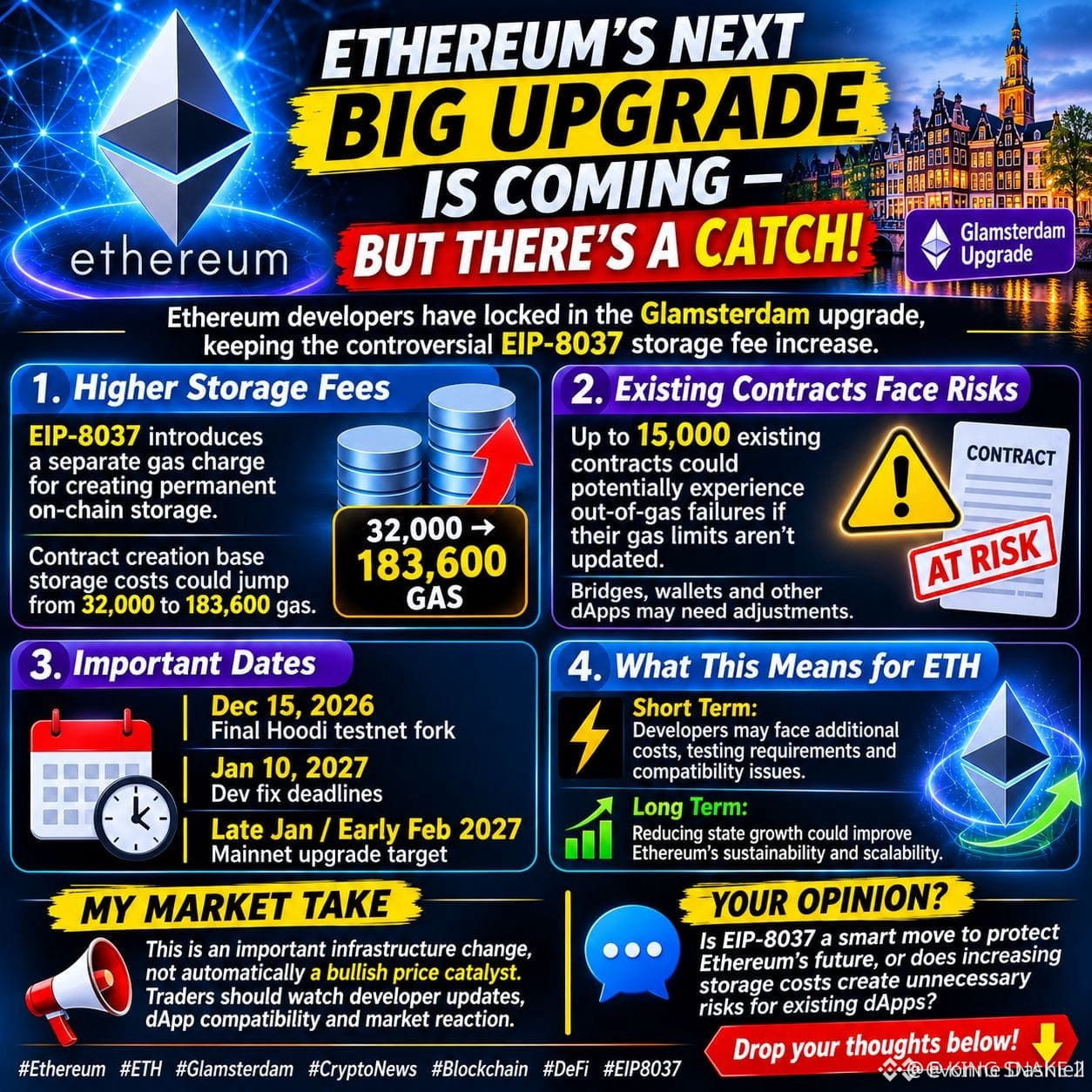
If you're still ignoring technical roadmap debates because market sentiment is at rock bottom, stop now.
Most investors lose money not from bad timing, but from getting completely blindsided when foundational network mechanics shift under their feet while they were busy doomscrolling. We watched that exact mistake play out before EIP-1559, where half the market dismissed fee restructuring as abstract developer gossip until the burn dynamic permanently altered the asset supply.
The decision to retain storage fee changes in Ethereum's upcoming Glamsterdam scope is quietly setting up the next major architectural split. For years, $ETH let state growth compound while rivals like $SOL leaned into aggressive storage rent models to prevent ledger bloat. Glamsterdam is essentially confirming that the era of permanent, essentially free on-chain storage is drawing to a close, forcing developers to rethink how state expiry and data retention will actually cost users over multi-year horizons.
Unlike $BTC, which avoids the issue entirely by strictly limiting script complexity and letting raw blockspace fees do the filtering, Ethereum is choosing active economic management. It makes the network vastly more sustainable for decentralized node operators down the road, but it also creates real friction for legacy contracts and shifts the margin profile for rollups that rely on cheap data settlement.
Do you think forcing ongoing costs on contract storage makes the ecosystem healthier, or does it just push more developers toward alternative chains?
#EthereumGlamsterdamKeepsStorageFeeChange #CanMarketsReboundAfterThanksgiving