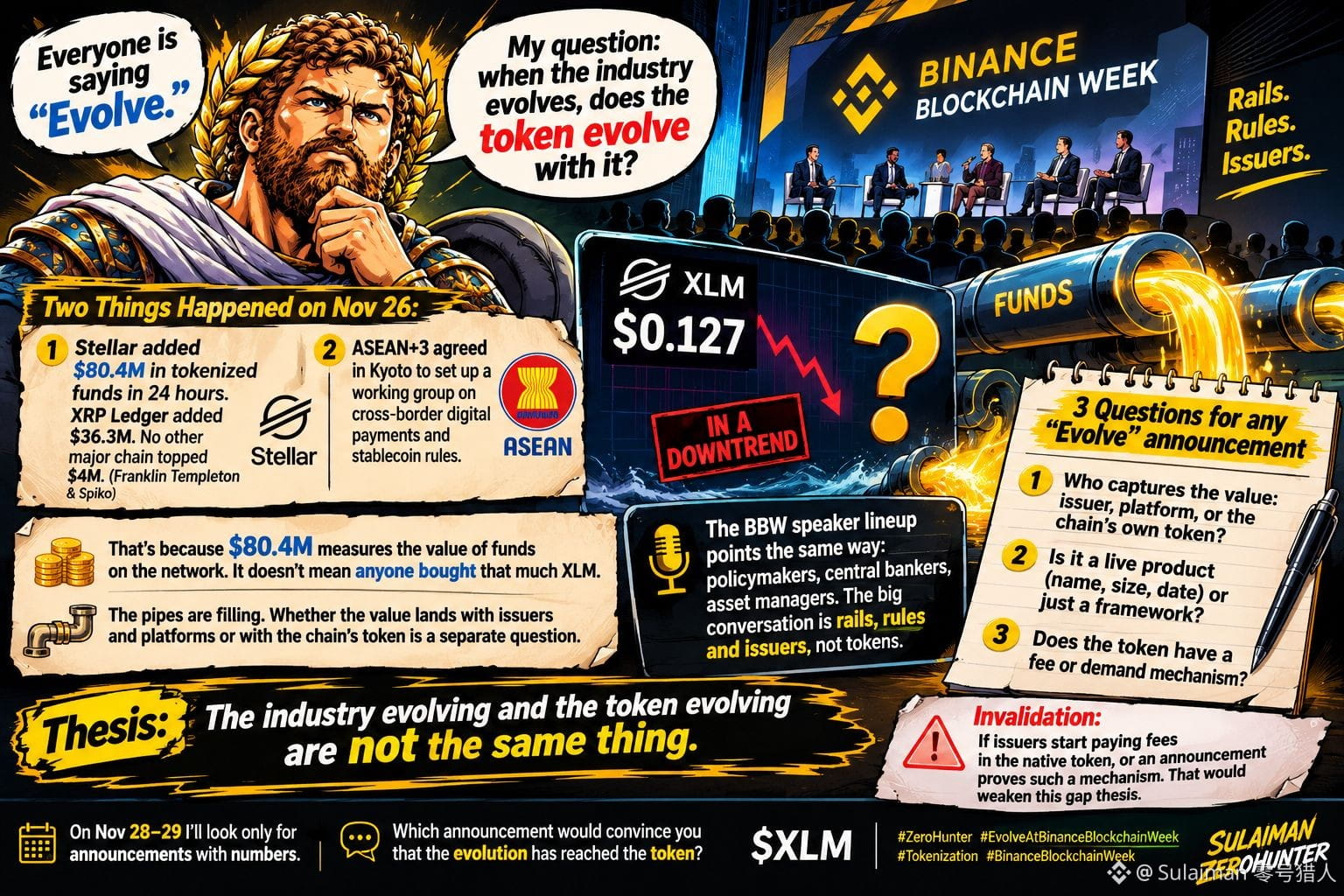
Everyone is saying "Evolve." My question: when the industry evolves, does the token evolve with it?
Two things happened on Nov 26:
Stellar added about $80.4M in tokenized funds in 24 hours. The XRP Ledger added $36.3M. No other major chain topped $4M. One report credits Franklin Templeton and Spiko.
ASEAN+3 (11 ASEAN states, China, Japan, South Korea) agreed in Kyoto to set up a working group on cross-border digital payments and stablecoin rules.
Now look at the gap. In the same window, XLM sits near $0.127, in a downtrend.
That's because $80.4M measures the value of funds on the network. It doesn't mean anyone bought that much XLM.
The pipes are filling. Whether the value lands with issuers and platforms or with the chain's token is a separate question.
The BBW speaker lineup points the same way: policymakers, central bankers, asset managers. The big conversation is rails, rules and issuers, not tokens.
📌 Save this: 3 questions for any "Evolve" announcement
Who captures the value: issuer, platform, or the chain's own token?
Is it a live product (name, size, date) or just a framework?
Does the token have a fee or demand mechanism?
Thesis: the industry evolving and the token evolving are not the same thing.
Invalidation: issuers start paying fees in the native token, or an announcement proves such a mechanism. That would weaken this gap thesis.
On Nov 28–29 I'll look only for announcements with numbers.
Which announcement would convince you that the evolution has reached the token?
Not financial advice. DYOR.
$XLM
$INIT
$MMT
#ZeroHunter #Tokenization #BinanceBlockchainWeek
#evolveatbinanceblockchainweek