Your private keys never left your phone — and $1.6M still vanished.
That's the brutal lesson from Fluidkey's November 19 hack. In just 36 minutes, an attacker drained ~$1.6M from 52 accounts across six chains — Ethereum, Base, BNB Chain, Polygon, Optimism and Arbitrum. The largest single hit: $415,783 in USDT from two Ethereum accounts.
The attacker never touched a private key. Instead, they exploited two known flaws in Fluidkey's self-hosted SigNoz logging server (v0.121.1) — flaws already patched upstream — and read users' session tokens straight out of the logs. With those tokens, they queued transfers that users' own apps then signed. About 887 ETH ended up in a mixer.
The damage goes beyond money: 70 accounts had personal data exposed — 38 emails, 37 names, 17 bank account numbers (IBANs) and 24 postal addresses — plus the viewing keys of 54 newly registered accounts. Fluidkey took services offline within 37 minutes, restored them on November 20, and reported the case to the FBI and Swiss cyber authorities. No reimbursement has been announced.
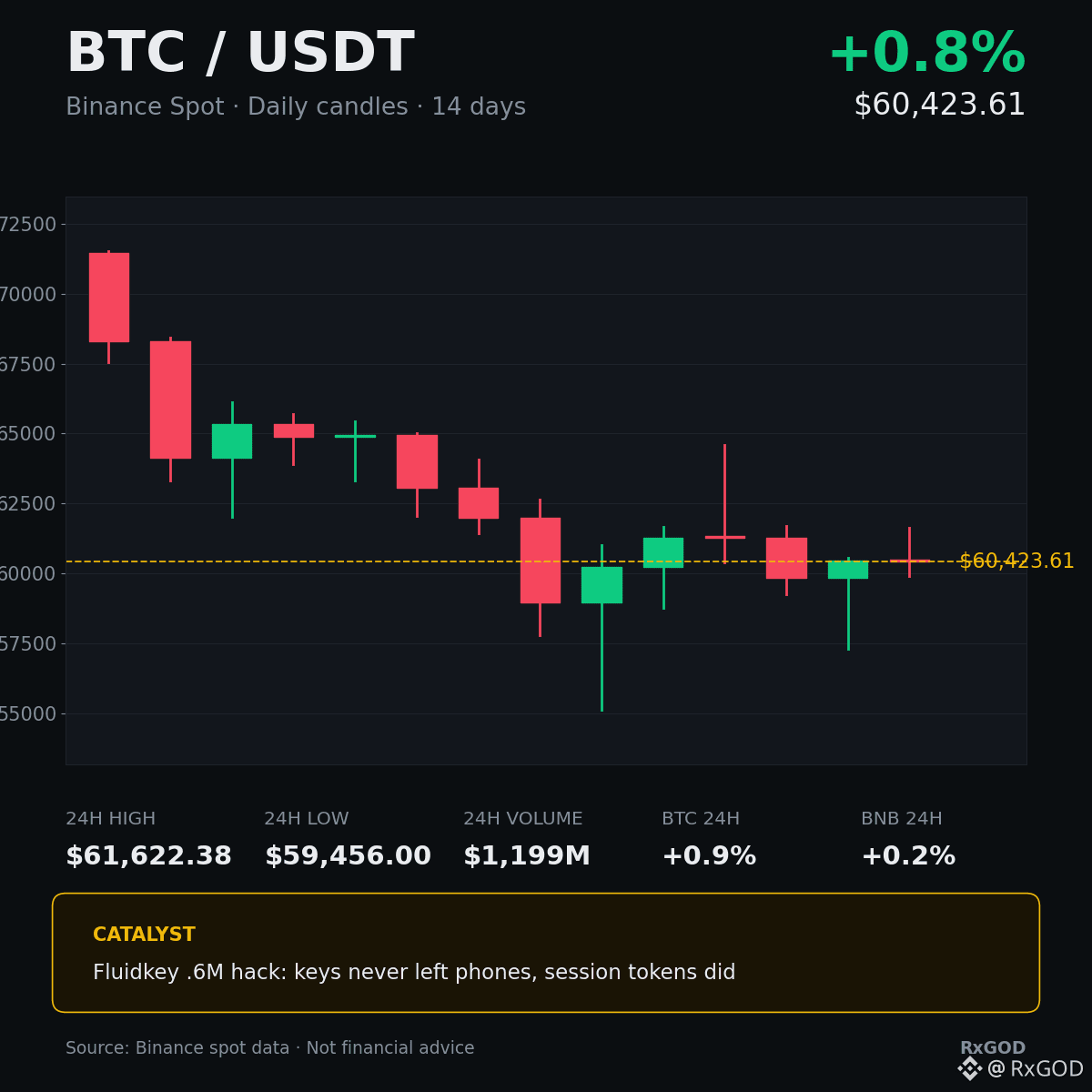
Meanwhile $BTC holds $60,424 (+0.8% 24h) in its Thanksgiving bounce, still -11.5% over 14 days, with the Fear & Greed Index at 9 — Extreme Fear.
The uncomfortable question: if "self-custodial" can still be drained through a logging server, what does self-custody actually guarantee? Do you check what your wallet apps log — or do you just trust the label?
Not financial advice — DYOR.
#CryptoNews #CryptoSecurity #SelfCustody #Fluidkey