South Korea just proposed the strictest transparency rule crypto has seen — and it comes with a freeze button.
The Financial Services Commission's draft Digital Asset Industry Innovation and User Protection Act, reported November 26, would force issuers and listing exchanges to publicly disclose anything that materially affects a token's circulating supply: large issuer transactions, airdrops, token burns, hacks, system failures and core technology changes. Miss a disclosure — or file a false one — and the fine runs up to 100 million won (about $72,000).
The sharper edge: the FSC could request payment suspensions of up to one year — six months, extendable once — on exchange and bank accounts suspected of insider trading, market manipulation or fraud.
Korea is one of the world's largest crypto markets, so this is not a footnote. Disclosure of issuer dumps and burns is genuinely pro-investor — no more silent supply shocks. But a regulator freezing accounts for a year on "reasonable grounds" is a big power, and the line between protecting users and overreach is thin.
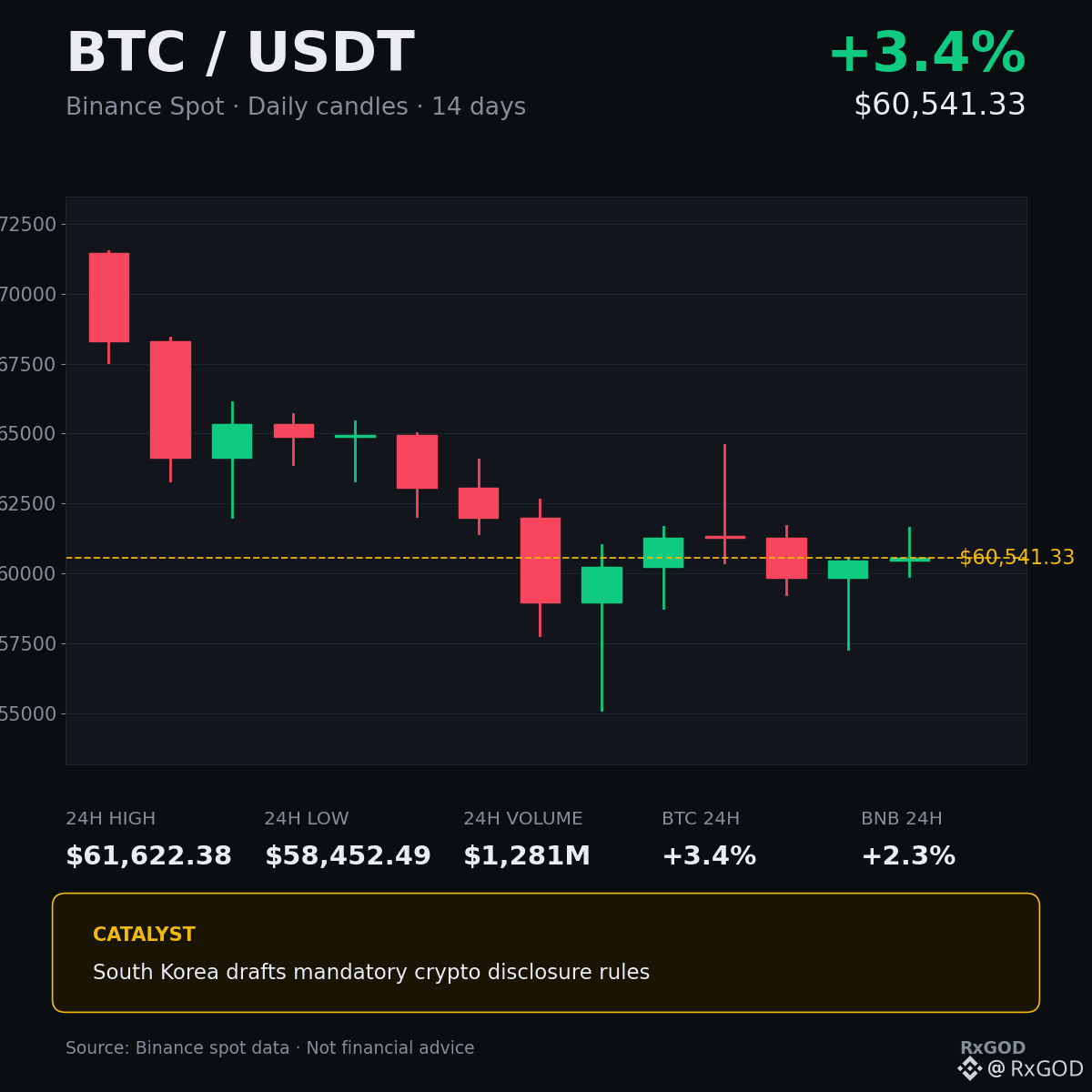
Bitcoin ($BTC ), meanwhile, holds its Thanksgiving rebound at $60,541 (+3.4% in 24 hours), still in the lower third of its 14-day range ($55,130–$71,514) and down 11.4% over two weeks, with fear stuck at Extreme Fear 10 and $7 billion of options expiring tomorrow.
Would mandatory disclosure of issuer dumps and burns make you trust a token more — or is this regulators overreaching? And should other countries copy Korea's one-year freeze power?
Not financial advice — DYOR.
#SouthKoreaProposesMandatoryDigitalAssetTransactionDisclosure #CryptoNews #ExtremeFear